Significant outcomes
• The study support previous findings of increased complement activity in patients with schizophrenia.
• There was indication of aetiological heterogeneity among the patients.
• The results emphasise that multilocus genotypes should be used when examining for genotypic effects on MBL serum concentration.
Limitations
Single-gene genetic effects in complex mental disorders are likely to be relatively small. Low power to detect real associations may therefore be the most severe limitation. The large variations of serum concentrations may be another power issue but differences may also be much more pronounced from such quantitative traits. Finally, the lack of ancestry restrictions to the sample of controls is considered a minor limitation. Information regarding demographics, on the other hand, would have been ideal in order to include possible environmental confounders or effect-modifiers.
Introduction
Causative relations between infections and psychosis, especially schizophrenia, have been speculated for more than a century (Reference Yolken and Torrey1). Schizophrenia has been associated with a number of autoimmune diseases and a 45% increase in risk for schizophrenia has been found for subjects with a history of autoimmune disease (Reference Eaton, Byrne and Ewald2). Moreover, maternal infections during the embryonic stage or infections in early childhood are possible risk factors for psychosis (Reference Buka, Tsuang, Torrey, Klebanoff, Bernstein and Yolken3–Reference Xiao, Buka and Cannon5). In a recent paper Hävik et al. (Reference Hävik, Hellard and Rietschel6) observe an association with schizophrenia for single nucleotide polymorphisms (SNPs) in genes encoding CSMD1 and CSMD2. These genes encode proteins with a domain structure which is seen in some control proteins of the complement cascade, but also in a number of other proteins outside this system. Although not explored extensively it could be that the encoded proteins are influencing the activity of the complement system, e.g. a soluble form of the corresponding rat protein was tested positive for such activity (Reference Kraus, Elliott and Chute7). Furthermore they found associations with genes from the major histocompatibility complex (MHC) region on chromosome 6. This study and other recent results from large and combined studies showing association with genetic markers in the MHC region (Reference Stefansson, Ophoff and Steinberg8–Reference Shi, Levinson and Duan10) are also consistent with a possible (auto)immune system connection. Hence a hypothesis of an association between schizophrenia and hereditary immune defects is suggested.
Mannan-binding lectin (MBL) is a pattern- recognition molecule of the innate immune defence. MBL deficiency is, with a prevalence of 10%, the most common hereditary defect in the human immune system and may predispose to infection and autoimmunity (Reference Thiel, Frederiksen and Jensenius11). As reviewed by Mayilyan et al. (Reference Mayilyan, Weinberger and Sim12) studies have shown increased activity of the lectin pathway of complement activation in patients with schizophrenia, mainly in complexes with mannan-binding lectin serine proteases (MASPs). Two key components in this activation process are MBL and MASP-2 with the latter as main initiator of the lectin complement pathway (Reference Garred, Honore, Ma, Munthe-Fog and Hummelshøj13). The genes encoding these proteins are MBL2 located at 10q21.1 and MASP2 located at 1p36.22 (UCSC Genome Browser hg18, March 2006, http://genome.ucsc.edu).
The molecular basis for MBL deficiency is reviewed in Garred et al. (Reference Garred, Larsen, Seyfarth, Fujita and Madsen14). Substantially de- creased level of MBL is known to be associated with the presence of three non-synonymous mutations in exon 1 of MBL2 while three polymorphisms from the promoter region explain much of the remaining variation in the serum concentration of MBL. Seven haplotypes formed by these six variants are common and correlate with different levels of MBL. Differences in haplotype frequencies may explain some of the variation in serum concentration seen between humans of different ancestral origin (Reference Garred, Larsen, Seyfarth, Fujita and Madsen14).
Aim of the study
The main objective of this study was to investigate in a Danish case–control sample if schizophrenia is associated with concentrations of MBL and MASP-2 in serum or with genetic variants of MBL2 and MASP2. Subsequently we explored for a possible disease association with the protein levels after adjustment for the known effect of the polymorphisms.
Material and methods
Samples
From previous genetic studies a sample of 100 patients with schizophrenia was obtained. The patients were diagnosed with SCAN interviews (Reference Wing, Sartorius and Üstün15) fulfilling a life-time, best estimate diagnosis of schizophrenia according to the ICD-10-DCR (16) and the DSM-IV (17). To minimise the effect of population stratification, recruitment was restricted to individuals of Danish ancestry for three generations. A sample of 350 healthy, psychiatrically unscreened Danish volunteer blood donors (controls) was obtained. In Denmark a health questionnaire must be completed and approved before blood donation. This ensures that none of the donors suffers from a current infectious disease. Due to restrictions defined by the ethical committees, ethnic origin is unknown for the controls but they are expected to be mainly Western European descent. For the same reason no information on demographics is available. The studies were approved by the Danish Data Protection Agency and by the Danish Ethical Committees and the work has been carried out in accordance with the Helsinki Declaration.
DNA extraction and genotyping
Genomic DNA was extracted from whole blood using the Maxwell 16 System Blood DNA Purification Kit (Promega, Madison, WI, USA). Genotyping was performed using real-time polymerase chain reaction (rt-PCR) with TaqMan SNP Genotyping Assays (Applied Biosystems, Foster City, CA, USA).
MBL2–D (codon 52, rs5030737), MBL2–B (codon 54, rs1800450), MBL2–C (codon 57, rs18004 51), MBL2–H/L (−550, rs11003125), MBL2–X/Y (−221, rs7096206) and MBL2–P/Q (+4, rs127801 12) were genotyped using previously described assays (Reference Henckaerts, Nielsen and Steffensen18–Reference Van, Houtmeyers and Massonet20). Genotyping for the MASP2 mutation D120G [nucleotide 359 A to G (359 A/G)] was carried out in a similar way (Reference Mølle, Steffensen, Thiel and Peterslund19). The positions of the markers in MBL2 are shown in Fig. 1.
Positions and frequencies of genetic markers in MBL2. Reference names and positions for the genetic markers in MBL2 located at 10q21.1. The positions are relative to the untranslated (UTR) start position of exon 1. Allele frequencies of the rare alleles are given for controls and patients with schizophrenia.

For all TaqMan assays, DNA amplification was carried out in 384-well plates with 5 μl PCR containing 20 ng DNA, 0.9 μM primers and 0.2 μM probes (final concentrations). Reactions were performed with the following protocol on a GeneAmp PCR 9700: 95°C for 10 min, followed by 40 cycles of 95°C for 15 s and 60°C for 1 min. To determine genotypes, endpoint fluorescence was read on the 7900 HT Sequence Detection Systems using SDS software version 2.3.
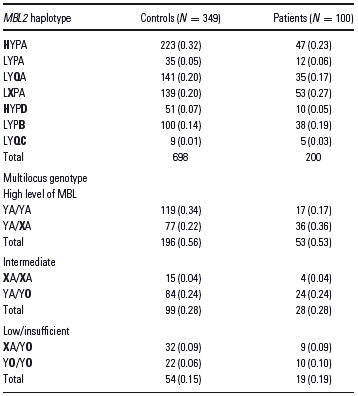
Haplotypes of the MBL2 gene were identified (Table 1). Due to linkage disequilibrium, only seven haplotypes (HYPA, LYQA, LYPA, LXPA, LYPB, LYQC and HYPD) are commonly found, with HYPA being the most frequent in samples of European ancestry. In controls, nevertheless, an additional haplotype LYPD was found in a single individual. This sample was re-genotyped to exclude genotyping errors. LYPD has also been found in a few other studies (Reference Boldt and Petzl-Erler21–Reference Skalnikova, Freiberger, Chumchalova, Grombirikova and Sediva23). Recently Boldt et al. (Reference Boldt, Messias-Reason and Meyer24) explored the evolution of MBL2 haplotypes and proposed a phylogenetic nomenclature to standardise studies related to MBL2. They suggest that LYPD probably is the product of a recent intragenic recombination event between HYPD and LYPA or LYPB. However, we excluded this individual rather than dealing with this extra haplotype. Two-marker haplotypes with mutant alleles (YB, YC and YD) were combined and collectively represented as YO, the other haplotypes being YA and XA. Genotypes based on these haplotypes were classified according to their known association with high (YA/YA, YA/XA), intermediate (XA/XA, YA/YO) or low/insufficient (XA/YO, YO/YO) MBL concentrations (Reference Olesen, Jensenius, Steffensen, Thiel and Schiøtz25).
MBL2 haplotype and multilocus genotype frequencies: counts (proportions)
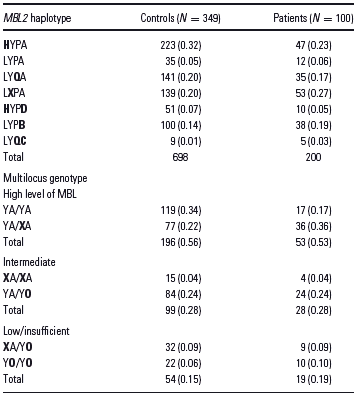
The rare alleles are marked with bold type and the O-allele is any of the D, B and C variants of exon 1. Multilocus genotypes are grouped with respect to their known association with high, intermediate or low/insufficient level of MBL in serum.
Concentration of MBL and MASP-2 in serum
Concentrations of MBL and MASP-2 in serum were determined as previously described (Reference Thiel, Møller-Kristensen, Jensen and Jensenius26). In brief, the method used was time resolved immunofluorometric assay (TRIFMA). For MBL assessment, serum samples, diluted 100-fold, were applied onto microtitre wells pre-coated with the polysaccharide, mannan, from baker's yeast. MBL binds through its carbohydrate-recognition domains and the bound MBL is detected with biotin-labelled monoclonal anti-MBL antibody, followed by europium-labelled streptavidin and time resolved fluorometry. MBL concentration was determined with a detection limit of 10 ng MBL/ml serum. Serum was missing for two of the patients.
MASP-2 concentration was also measured by TRIFMA (Reference Møller-Kristensen, Jensenius and Jensen27). In brief, microtitre wells were coated with monoclonal anti-MASP-2 (MAb 8B5 against the C-terminal domains of MASP-2). Serum samples, diluted 40-fold, were applied, and bound MASP-2 was detected with biotin-labelled anti-MASP-2 (MAb 6G12 against the N-terminal domain of MASP-2), followed by europium-labelled streptavidin.
MBL deficiency classification is still an open question (Reference Dommett, Klein and Turner28) and various serum levels have been suggested: <10, <50, <100 and <500 ng/ml. Often the detection limit of the specific assay has been used but no clinical data supports such a definition (Reference Petersen, Thiel and Jensenius29), and the clinical relevance may depend on the disease investigated (Reference Thiel, Frederiksen and Jensenius11). Only a minor part of deficient individuals become affected clinically. The following MBL levels will be referred to as: very low/ deficient: <100, low: 100–400, normal: >400 ng/ml (http://www.ssi.dk).
Statistical analysis
Single-marker genotypic associations were assessed using logistic regression assuming an additive model on the log scale. The resulting odds ratio (OR) indicates the effect of each extra copy of the rare allele. Hence, the OR between the two homozygote variants is the square of the reported OR. Similarly, the additive effects of having 0, 1 or 2 copies for each of the seven haplotypes were considered. Linkage phase of haplotypes was assumed known although validity of the identified haplotypes was also checked by inferring phased haplotypes from genotypes with BEAGLE 2.1.3 (Reference Browning and Browning30). We ran BEAGLE 1000 times using a different seed (random starting point) for each run and observed that the multilocus genotypes matched perfectly in all runs (results not shown). Additive effects for each of m multiple SNPs were tested by an m df X 2-test that has a corresponding score test which is a generalisation of the Armitage test (Reference Balding31).
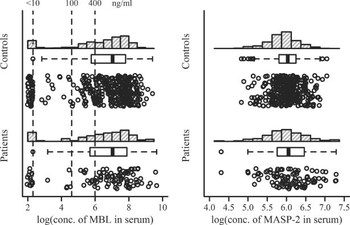
The distributions of MBL and MASP-2 serum concentration were markedly skewed and clearly violate any assumption of a symmetric distribution (e.g. a normal distribution). Concentration of MBL and MASP-2 in serum were therefore analysed on log-transformed data. Standard analysis of variance (linear regression) was used for the analysis of MASP-2 concentration while Tobit regression analysis (Reference Amemiya32) was applied to handle the bulk of observations below the MBL 10 ng/ml detection limit (Fig. 2) by censoring techniques. A categorisation as indicated in the preceding subsection would also solve this problem but at the expense of continuity (information loss). Estimated median serum concentrations are presented after back-transformation with the exponential function.
Distribution of MBL and MASP-2 serum concentration. Concentration of MBL and MASP-2 in serum for controls and patients with schizophrenia. Before logarithmic transformation, concentrations were measured in ng protein/ml serum. The vertical lines in the left panel indicate: below MBL detection limit (<10 ng/ml), very low/insufficient MBL level (<100 ng/ml), low MBL level (100–400 ng/ml) and normal MBL level (>400 ng/ml). Histogram, box-plot and scatter plot of the observed concentrations are given for each protein and separately for patients and controls.

Logistic regression was used for analyses of dichotomous traits of MBL deficiency status (</≤100 ng/ml) and MBL serum detection status (</≤10 ng/ml).
Statistical analyses were carried out using the software package R (http://www.r-project.org) and with a 5% level of significance. To account simultaneously for the nine different SNP and haplotype association tests permutation adjusted p-values were calculated using a step-down maximum-statistics approach corresponding to the algorithm from Box 2 in Dudoit et al.'s study (Reference Dudoit, Shaffer and Boldrick33). For serum concentration analyses solely nominal p-values were reported but these can be interpreted using the following Bonferroni thresholds: 0.01 for tests concerning MBL serum concentration and 0.0125 for tests concerning serum concentration of MASP-2. The following tests were primarily included to ease comparison with earlier studies and should be considered exploratory only in the context of multiple testing: two-marker haplotypes (YA/XA/YO), the A/O pseudo-marker and the tests of multiple SNPs.
Results
Haplotypes and multilocus genotypes
Allele frequencies of the genetic markers in MBL2 are shown in Fig. 1. The most common mutation allele in exon 1 is B, while the D allele is common and the C allele is rare. With seven haplotypes there are 28 possible multilocus genotypes but 2 of these (LYPA/LYQC and LYQC/LYQC) were not observed.
Frequencies of haplotypes in the MBL2 region are shown in Table 1. With 26 categories on only 100 and 350 individuals many of these will turn out having low expected counts and analyses using this 26 level variable would therefore be problematic. Grouping multilocus genotypes by X/Y and A/O has previously been used (Reference Steffensen, Hoffmann and Varming34). Frequencies of the resulting six genotype groups are shown in Table 1. None were homozygous for the MASP2 mutation allele 359 G/G. However, this is within expectations under Hardy–Weinberg proportions. The proportions of 359 A/G heterozygote individuals were 12% in patients and 9% in controls.
Association analysis
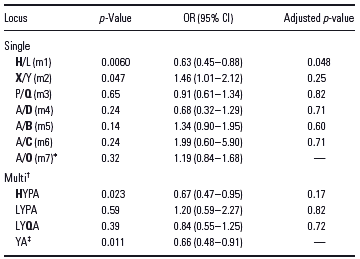
Results from the trend test of disease association with single- and multilocus genetic markers in MBL2 are shown in Table 2. Significant association was found for the H/L marker and nominally for the X/Y marker. None of the SNPs in MBL2 exon 1 were significantly associated with schizophrenia, possibly due to lack of power.
Trend tests (1 df χ 2) for association of schizophrenia with MBL2 single-locus and multilocus genetic markers by use of logistic regressions with an additive effect on a log scale of the rare allele (marked with bold type)
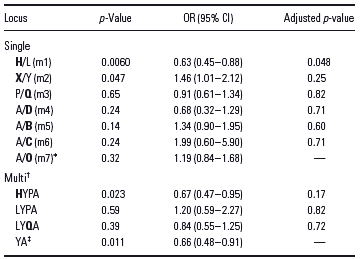
* OR measure the effect of each extra copy of the rare allele and OR between the two homozygote variants is therefore this value squared. Permutation adjusted p-values from a step-down max-statistics procedure accounts simultaneously for the corresponding nine null hypotheses.
* The O-allele of the A/O marker is any of the D, B and C variants of MBL2 exon 1.
† LXPA, HYPD, LYPB and LYQC are identifiable with m2, m4, m5 and m6, respectively.
‡ XA and YO are identifiable with m2 and m7, respectively.
An exploratory analysis of multiple SNPs also showed nominal significant disease association with the three promoter region markers (p = 0.016) and for the X/Y marker combined with A/O (p = 0.030). It turns out that under the present conditions, the model for multiple SNPs with a trend parameter for each of the six single markers is simply another parameterisation of the model containing a trend parameter for each of the seven haplotypes (see Appendix S1, Supporting Information). The HYPA and YA haplotypes showed nominal significant protective effects against schizophrenia.
For MASP2 no significant disease association was found although the proportion of 359 A/G heterozygotes was higher in patients.
Concentration of MBL and MASP-2 in serum
The median (and range) of the observed MBL concentration in serum for the three groups (high, intermediate and low/insufficient) determined by X/Y and A/O were: 2319.5 (202–12216), 446 (<10–1818) and <10 (<10–190) in patients; 2639 (557–15615), 538.5 (93–2558) and <10 (<10–444) in controls. The distribution of (log-transformed) MBL and MASP-2 serum concentrations are shown in Fig. 2.
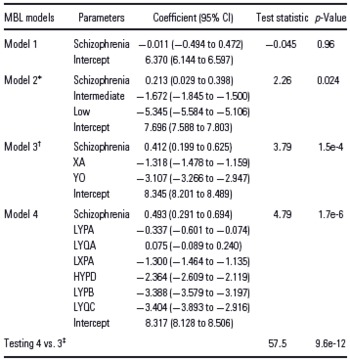
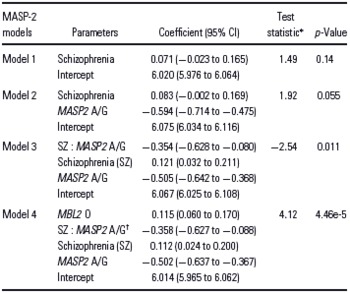
Table 3 shows the results from Tobit regression analysis of MBL concentration in serum. As anticipated, significant single-marker and haplotype associations with MBL concentration were found with effects in the expected direction (results not shown). MBL concentrations in serum were not significantly different between patients and controls per se (model 1) with estimates of the median at 584 ng/ml [confidence interval (CI): 443–717] and 578 ng/ml (CI: 296–831), respectively (Table S1, Supporting Information). However, when adjusted for the additive effect of MBL2 haplotypes the patient/control effect on MBL serum concentrations turned out being highly significant (model 4: p = 1.7e-6) with a higher concentration in patients. Estimated median MBL concentrations in serum for each of the 26 observed multilocus genotypes are shown in Table S1. To ease comparison to other studies, we also show results obtained by use of the coarser X/Y-A/O groups.
Association of MBL serum concentration with schizophrenia after adjustment for MBL2 genetic variants (models 2, 3 and 4) as well as unadjusted (model 1)

* The additive effects of having 0, 1 or 2 copies for each of the specific haplotypes enter in the model 3 and 4.
* High level multilocus genotypes: YA/YA and YA/XA; intermediate: XA/XA and YA/YO; low: XA/YO and YO/YO.
† The O-allele of the A/O marker is any of the D, B and C variants of MBL2 exon 1.
‡ Deviance test (chi-square on 4 df) of the reduction from model 4 to model 3.
The median (and range) of MASP-2 observed in patients and controls were 425 ng/ml (74–1467) and 417 ng/ml (125–1152), respectively. As expected, MASP-2 concentrations depended significantly on the MASP2 genotypes (Table 4 model 2) and, surprisingly and interestingly, on MBL2 genotypes (Table 4 model 4). Using a backward elimination procedure we found the effect of MBL2 genotypes to be well captured by an additive effect of the O variant, i.e. number of alleles (0, 1 or 2) of any of the three mutations in MBL2 exon 1 (results not shown).
Regression analysis of (log-transformed) MASP-2 concentration in serum against the following independent variables: patients with schizophrenia versus controls, carrier of the rare MASP2 G-allele (A/A and A/G) and number of MBL2 exon 1 O-alleles (A/A: 0, A/O: 1 and O/O: 2) where the O-allele is any of the D, B and C variants of MBL2 exon 1

* Wald tests evaluated in a t-distribution with df equal to the difference between the number of subjects (349 + 98 = 447) and number of parameters in the model (e.g. 444 df in model 2).
† Here ‘V1: V2' represents the interaction effect between V1 and V2.
MASP-2 concentrations in serum for patients and controls were not significantly different (Table 4). However, we found a significant interaction (p = 0.011) between MASP2 genotype and patient/ control status (Table 4 model 3). Applying a forward inclusion procedure, the final model contained this interaction effect and also the additive effect of the MBL2 variant (Table 4 model 4). Table S2 contains estimates of median MASP-2 serum concentrations from this final model and also results from the model without MBL2 adjustment (Table 4 model 3) and with patient/control status only (Table 4 model 1). The 359 A/G variant was associated with lower MASP-2 concentrations in serum whereas mutations in MBL2 exon 1 were associated with a higher level of MASP-2. The effect of the D120G mutation was stronger in patients than in controls (the interaction effect) and actually the difference between patients and controls within MASP2 genotype changes direction. Specifically MASP2 A/A patients have higher median MASP-2 concentration than the controls whereas this median is lower than controls for patients carrying the 359 A/G variant (Table S2).
MBL deficiency
Inherited MBL deficiency defined as homozygosity for either of the mutations in MBL2 exon 1 (YO/YO in Table 1) was observed in a relatively high proportion (10%) of the patients although not significantly higher than in controls (6%). The proportion in controls is in line with the 5% detected from another Danish sample (Reference Dahl, Tybjærg-Hansen, Schnohr and Nordestgaard35).
Distribution of MBL concentrations on the categories very low (<100), low (100–400) and normal (>400 ng/ml) is indicated in Fig. 2. With a 100 ng/ml cut-off (very low) 18% of the patients were deficient. Yet, this is not a significantly higher fraction than the 15% seen in controls.
Fifty-three individuals (12%) had MBL concentrations below the 10 ng/ml detection limit. This is usually seen in 10–15% of investigated individuals and is not a problem specific to this study. The proportion was not significantly different in patients (13%) and controls (11%). All O/O homozygous subjects except one belonged to this group. Amongst the 22 other of these 53 individuals, 21 (95%) carried the XA/YO genotype. All subjects with YA/YA had concentrations above the detection limit.
Discussion
Changes in inflammatory-related pathways have long been suggested to have a role in the pathophysiology of schizophrenia but there is no clear understanding as to which specific inflammatory-related pathways are involved or how they can precipitate the onset of the disorder. Activation of the peripheral innate immune cytokine pathways whether as a result of an immune challenge or stress leads to increased proinflammatory cytokine production and decreased neurotrophic support and neurogenesis in brain areas important to behaviour and cognition (Reference Capuron and Miller36). In this study we attempt to link parameters of inflammation in the innate immune pathway with schizophrenia.
Constitutional, MBL levels of individuals with identical MBL2 genotypes may vary 10-fold pointing to limitations in studies relying on genotyping only. Indeed, the lectin pathway of complement activation comprises several factors other than MBL. The associated serine proteases (MASP-1, MASP-2 and MASP-3) are thus required for the downstream transmission of the activation signal. Besides MBL, further three other recognition proteins, H-, L- and M-ficolins, may also initiate the lectin pathway. Apart from MBL our study included estimation of the main serine protease, MASP-2. It would have been satisfactory to include also MASP-1 in this study but to our knowledge nobody has yet been able to produce specific anti-MASP-1 antibodies. Thus, unfortunately, it is not possible to analyse for this component and as there is no assay, there is no literature on this. The involvement of the lectin pathway of the complement system was suggested by Mayilyan et al. (Reference Mayilyan, Arnold, Presanis, Soghoyan and Sim37). They found that the overall activity of the classical pathway as well as the C4 cleaving activity of MBL-MASP-2 complexes caught on a surface of mannan was elevated in patients with schizophrenia. Ideally, the remaining proteins in the pathway ought to be investigated and functional assessment would be relevant too (Reference Dommett, Klein and Turner28). With regards to a more general measurement of complement factors in schizophrenia only very few studies have been performed and all with small sample sizes of less than 100 individuals (Reference Mayilyan, Weinberger and Sim12).
The concentration of MBL was higher in patients when accounting for genetic variants of MBL2 but the proportion of subjects in the MBL low-producing multilocus genotype groups was higher too, i.e. pointing toward increased risk of MBL deficiency indicating aetiological heterogeneity among patients. The genetic disease association was only significant for MBL2 promoter region SNPs but the absence of association with the functional variants in exon 1 may be a power issue more than lacking true association. The frequency of the common HYPA haplotype was notable lower in patients (23%) as compared to controls (32%), in parallel with an increased frequency of especially LXPA and LYPB. The lower frequency of patients in the high level producing YA/YA group is largely compensated although by a higher frequency in the other high level producing group YA/XA. Therefore multilocus genotypes have to be considered when analysing for effects on MBL level. We investigated if the simplification by considering only X/Y and A/O markers was statistically justified by backward elimination from the saturated model but found this reduction to be significantly too coarse (results not shown). Thus, the detailed genotype grouping was preferred and in view of the estimates (Table S1) we recommend using the finer grid in future studies. Also, the recent work by Boldt et al. (Reference Boldt, Messias-Reason and Meyer24) should be taken into consideration.
A very clear effect of higher MBL serum concentration in patients with schizophrenia was seen when adjusting for the variation in MBL ascribed to MBL2 variants. This may indicate that more insight into the aetiology of schizophrenia can be found by analysing the complement pathway of activation in greater detail. As schizophrenia is a polygenic disease (Reference Wray and Stone9) it is possible that there are variants in the genes coding for other complement components that are both associated with the disease and with elevated levels of MBL.
MASP-2 serum concentration was lower in patients than in controls for subjects carrying the D120G mutation but higher for wild-type carriers. This interaction was significant. In a sample of 492 Danes the allele frequency of the mutation was 3.6% but none were homozygous for the mutation and the clinical relevance of MASP-2 deficiency is uncertain (Reference Sørensen and Thiel38). Interestingly, MASP-2 levels also depended significantly on variants in MBL2 exon 1. This has not been reported before and we do not at present have a plausible explanation for this. It will be exciting to follow if other research groups find similar effects.
The findings from this study indicate an association between schizophrenia and components of the complement system, and future studies should explore the interplay between immunity-related genes in the human leukocyte antigen (HLA) region and key components in the lectin pathway. This would be of interest as the various individual MHC molecules encoded by the HLA region present a key factor of the adaptive immune system whereas the lectin pathway represents the innate immune system. The recent study by Hävik et al. (Reference Hävik, Hellard and Rietschel6) seconds this with findings of significant association between schizophrenia and immunity-related genes both within and outside the HLA region.
In conclusion this study supports previous studies showing increased complement activity in patients with schizophrenia, it indicates aetiological heterogeneity among patients and underline that multilocus genotypes have to be considered when the effect on MBL level is investigated. It is apparent that inclusion of additional components from the complement system will be vital to investigate further the association between schizophrenia and the activation pathway.
Acknowledgements
We thank Annette G. Hansen and Lisbeth Jensen for technical assistance, Jakob Grove for a critical evaluation of the manuscript and Raben Rosenberg for valuable discussions and comments. Funding for this study was provided by the Danish Medical Research Foundation (DMRF) and The Stanley Medical Research Institute. The authors declare no conflicts of interests.