Introduction
During the course of their disease, more than 90% of people with dementia show behavior that health professionals and relatives experience as challenging (such as apathetic behavior) (Wetzels et al., Reference Wetzels, Zuidema, Jansen, Verhey and Koopmans2010). This challenging behavior is often referred to as neuropsychiatric symptoms (NPSs) or behavioral and psychological symptoms of dementia (BPSDs). The worsening of these challenging behaviors is the main reason for nursing home admission (Gaugler et al., Reference Gaugler, Yu, Krichbaum and Wyman2009). In nursing homes, the prevalence of challenging behavior in people with dementia varies between 11% and 90% depending on the instruments and observation period used in the study (Wetzels et al., Reference Wetzels, Zuidema, Jansen, Verhey and Koopmans2010). NPSs also influence the quality of life of people with dementia and are associated with staff distress and burden (Schmidt et al., Reference Schmidt, Dichter, Palm and Hasselhorn2012). Therefore, the reduction of challenging behavior is frequently used and recommended as an outcome for the evaluation of interventions to improve the quality of care (Moniz-Cook et al., Reference Moniz-Cook, Vernooij-Dassen, Woods and Orrell2011).
The NPI developed by Cummings et al. (Reference Cummings, Mega, Gray, Rosenberg-Thompson, Carusi and Gornbein1994) is one of the most frequently used instruments in clinical trials and epidemiological studies (Lai, Reference Lai2014). This inventory is applied to quantify behaviors and their severity or to detect changes in response to interventions among individuals with dementia (Aalten et al., Reference Aalten2003). The NPI-NH assesses twelve different NPSs. In general, when testing the psychometric properties of an instrument, it is essential to evaluate the structural validity as part of the construct validity. The construct validity describes the “degree to which the scores of an instrument are an adequate reflection of the dimensionality of the construct to be measured” (Mokkink et al., Reference Mokkink2010). The construct validity has already been tested for several translations of the NPI-NH (Canevelli et al., Reference Canevelli2013; Lai, Reference Lai2014). The number of identified factors varies among the translations of the NPI-NH. Five factors (agitation, mood, psychosis, sleep/motor activity, and elation behavior) were identified in a Canadian nursing home population (Lange et al., Reference Lange, Hopp and Kang2004), four to five factors (agitation/aggression, depression, psychosis, psychomotor agitation, and apathy) were demonstrated depending on dementia severity for the Dutch NPI-NH version (Zuidema et al., Reference Zuidema, de Jonghe, Verhey and Koopmans2007b), and three to four factors (agitation, psychosis, apathy, and affective behavior) were identified for the Norwegian version (Lange et al., Reference Lange, Hopp and Kang2004).
However, until now, no study has examined structure validity as part of the construct validity of the NPI-NH version in German (Canevelli et al., Reference Canevelli2013; Lai, Reference Lai2014). The evaluation of the psychometric quality of NPI-NH versions for different countries is very important; because the culture-specific characteristics of different settings and populations can have a significant influence, instruments are only partly generalizable to new study populations. Consequently, an instrument that was developed and optimized in a given country (e.g. the Netherlands) or care setting (e.g. hospitals) may perform less well when it is used in a different context. Therefore, the aim of this article is to evaluate the structure validity and the internal consistency of the identified factors of the NPI-NH in a large German nursing home population. Furthermore, the robustness of the identified factors will be examined in terms of their dependence on dementia severity (mild/severe vs. very severe dementia).
Method
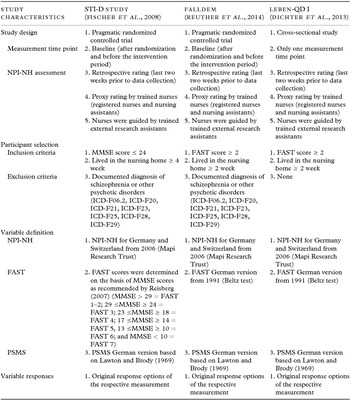
We performed a secondary data analysis of three German primary studies in nursing homes. The data were collected at baseline from two pragmatic cluster-randomized controlled trials, the STI-D (Serial Trial Intervention-Germany) (Fischer et al., Reference Fischer, Kuhlmey, Sibbel and Nordheim2008) and FallDem (case conferences for people with dementia) (Reuther et al., Reference Reuther2014), and a cross-sectional study, Leben-QD I, Strengthening Quality of Life for people with dementia (Dichter et al., Reference Dichter, Bartholomeyczik, Nordheim, Achterberg and Halek2013). As van der Steen et al. (Reference van der Steen2008) proposed, we evaluated the comparability of the three primary studies by carefully reconciling study designs, participant selection criteria, variable definitions, and variable responses. The data from the primary studies were pooled based on a high level of equal or comparable study characteristics (Table 1). The variable distribution was not compared because one of our particular study objectives was to evaluate the robustness of the identified NPI-NH factor structure (structural validity).
Results for the comparability of the three primary studies

ICD = International Classification of Diseases, NPI-NH = Neuropsychiatric Inventory – Nursing Home, MMSE = Mini-Mental Status Examination, FAST = functional assessment staging, PSMS = Physical Self-Maintenance Scale.
Moreover, two of the three studies had already been pooled as part of a previous secondary data analysis aimed at evaluating a quality of life measurement (Dichter et al., Reference Dichter, Bartholomeyczik, Nordheim, Achterberg and Halek2011).
The good practices guidelines for secondary data analysis (GPS) were applied for quality assurance (Swart et al., Reference Swart2015). Prior to data pooling, all three primary data sets were tested with respect to structure, completeness, and plausibility. We determined that the differences among the three datasets were not likely to be relevant to our analysis.
The ethics committee of the German Society of Nursing Science approved the FallDem and Leben-QD I studies. Ethical approval for the STI-D studies was received from the ethics committee of the Charité-Universitaetsmedizin Berlin.
Setting and population
Data collection took place between January and March 2009 for the STI-D study, between September and November 2010 for the Leben-QD I study and between October 2013 and March 2015 for the FallDem study. The total sample comprised 784 residents with dementia from 40 nursing homes located in North Rhine-Westphalia (FallDem study = 12, Leben-QD I study = 9) and in and around Frankfurt/Main (STI-D study, n = 19). The inclusion criteria for nursing home residents were as follows: Mini-Mental State Examination (MMSE) (Folstein et al., Reference Folstein, Folstein and McHugh1975) score ≤ 24 (STI-D) or a Functional Assessment Staging (FAST) (Reisberg, Reference Reisberg2007) score ≥ 2 (FallDem, Leben-QD I) and having lived in the nursing home for at least two weeks (Leben-QD I and FallDem) or four weeks (STI-D). The exclusion criterion was a documented diagnosis of schizophrenia or other psychotic disorders (FallDem and STI-D; Table 1). Participants with missing values (n = 58) were excluded from the secondary data analysis.
Procedures
In all three studies, registered nurses or nursing assistants who were highly involved in caring for the people with dementia (the inclusion criterion; involvement was determined by the head nurse of the nursing ward) completed the questionnaires based on their observations over the previous two weeks. To ensure standardization and to improve the quality of data (i.e. a low rate of missing values), data collection was initiated and guided by trained external research assistants (registered nurses and students in health care study programs, Table 1).
Measurements
The NPI-NH is a proxy-based instrument consisting of 12 items that cover the following behaviors: delusions, hallucinations, agitation, depression, anxiety, apathy, irritability, euphoria, disinhibition, aberrant motor behavior, night-time behavior disturbances, and appetite and eating abnormalities. For each of the 12 items, the presence, frequency and severity can be assessed. The severity and frequency of each symptom are scored on the basis of the caregivers responses to structured questions. The score for each symptom is obtained by multiplying the severity (1–3) by the frequency (1–4). The summed symptom scores give the total NPI score, which ranges from 0 to 144. In our study, we used the German language version of the NPI-NH for Germany and Switzerland from 2006, provided by the Mapi Research Trust (Mapi Research Trust, 2006).
The FAST (Reisberg, Reference Reisberg1988) was used to detect the severity of dementia. The FAST scale includes seven stages (1 = normal adult, 2 = normal older adult, 3 = early dementia, 4 = mild dementia, 5 = moderate dementia, 6 = moderately severe dementia, and 7 = severe dementia).
The Physical Self Maintenance Scale (PSMS) was used to assess activities of daily living (Lawton and Brody, Reference Lawton and Brody1969) based on the items for toileting, feeding, dressing, grooming, physical ambulation, and bathing. The response options ranged from 1 = no impairment to 5 = severe impairment, resulting in a total range of 6 to 30 points.
To describe the residents’ care dependency, levels defined by the German statutory Long-Term Care Insurance were used (ranging from 1 = low to 3+ = very high). The sample's age and gender characteristics were assessed with single items.
Statistical analysis
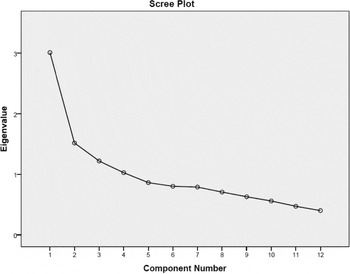
The statistical analysis was performed in the following steps. First, a descriptive analysis of important characteristics of the study subsample and total sample, such as demographic data and the prevalence of individual behaviors on the NPI-NH, was performed. Second, the factor structure was explored. To investigate the robustness of the identified factor structure, an analysis was performed for each primary study, two different stages of dementia severity and the total sample. The two subgroups of dementia included mild to severe dementia (FAST score = 2–6) and very severe dementia (FAST score = 7). The factor analysis was based on a PCA using an orthogonal rotational procedure (varimax). The factor extraction followed these criteria: (1) eigenvalues > 1 for a factor (Kaiser–Guttman criterion), (2) scree plot (Figure 1), (3) a higher eigenvalue of the determined factors than the average eigenvalue of the single items, and (4) content homogeneity of the yielded factors (Amaratunga et al., Reference Amaratunga, Cabrera and Shkedy2014; Polit, Reference Polit2014).
Scree plot.

Similar to the procedure described in Zuidema et al. (Reference Zuidema, de Jonghe, Verhey and Koopmans2007b), only factor loadings ≥ 0.4 were considered. In cases in which an item demonstrated factor loadings ≥ 0.4 for two factors, the item was assigned based on the factor content to generate a homogeneous factor content. The criterion for adequate adaptation of the PCA was a significant finding via Bartlett's test of sphericity and the Kaiser-Meyer-Olkin (KMO) measure for adequate sample size > 0.7.
Third, the internal consistency of the identified factors was evaluated by calculating Cronbach's α coefficients. The statistical analysis was performed with the statistical program SPSS (IBM SPSS Version 21.0).
Results
Study population
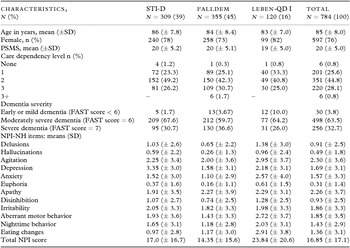
A total sample of 784 residents with dementia (STI-D: n = 309, Leben-QD I: n = 120, FallDem: n = 355) was included in the data analysis. The main study characteristics and the demographic data of the participants are described in Table 2. In summary, the three studies showed similar values in terms of the sample characteristics. The total NPI-NH score was higher in the Leben-QD I study population compared with the other two samples.
Characteristics of the people with dementia and distribution of neuropsychiatric symptoms for the primary studies and the total sample

SD = standard deviation; NPI-NH means = frequency x severity.
Construct validity – factor structure
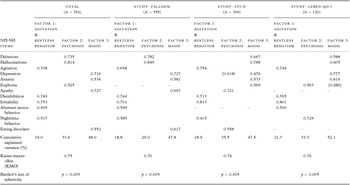
The results of the analysis for the total sample and the ‘mild to moderate’ and ‘very severe’ dementia subsamples of the three primary studies are presented in Tables 3 and 4. The PCA identified three factors that explained 48% of the variance (Figure 1) for the total sample. The items agitation, disinhibition, irritability, and aberrant motor behavior showed high factor loadings for the first factor, agitation, & restless behavior. The second factor, psychosis, represents the items delusions, hallucinations, and euphoria, and the third factor, mood, refers to the items depression, anxiety, and apathy. Factor one and Factor two were robust over all three primary studies with the exception of the item aberrant motor behavior, which had no factor loading ≥ 0.4 in one of the three studies. The factor psychosis was not robust for the three subsamples. Here, the items delusions and hallucinations in the three primary studies switched between the factors mood and psychosis. However, the items anxiety and depression were robust stable for the factor mood across all three primary studies, while the item eating disorders was not robust stable for the three subsamples (Table 3).
Results of the NPI-NH factor analysis based on the total sample and the three primary studies

Only factor loadings > 0.40 are presented; factor loadings in parentheses imply that a specific item loads to more than one factor and that the factor loading to the other factor is higher.
Factor analysis and internal consistency results for the NPI-NH based on the total sample and the subsamples of mild to severe and very severe dementia

Only factor loadings > 0.40 are presented. Factor loadings in parentheses imply that a specific item loads to more than one factor and that the factor loading to the other factor is higher.
In the subsamples of people with mild to severe and very severe dementia, the factors under agitation & restless behavior were robust, with the exception of the item nighttime behavior (Table 4). For the factor mood, the items depression, anxiety, and apathy demonstrated robust factor loadings. The factor psychosis was not robust between the two stages of dementia severity. Psychosis in the very severe dementia subsample differed from the total sample and from the mild to severe subsample.
Internal consistency
The reliability analysis using Cronbach's coefficient yielded a moderate internal consistency of between 0.6 and 0.7 for the total sample. This value was comparable with the results for the factor analysis, which indicated that the factor agitation & restless behavior had a moderate to good internal consistency for both of the dementia severity subsamples (α: 0.5–0.7). The results of the internal consistency analysis for the factor mood were moderate (α: 0.5–0.6) for both subsamples. For the factor psychosis, the internal consistency was moderate for people with mild to severe dementia (α: 0.6) and weak for people with very severe dementia (α: 0.4; Table 4).
Prevalence and distribution of the various items of the NPI-NH
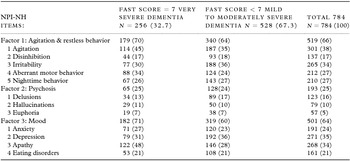
The prevalence of the various items of the NPI-NH differed between the dementia severity subgroups (Table 5). For example, the behaviors depression and irritability were more common in the subgroup with mild to severe dementia. In contrast, apathy and aberrant motor behavior were more common in people with very severe dementia. Agitation is independent of the stage of dementia and is one of the most common neuropsychiatric behaviors. Additionally, assigning the NPI-NH items to the identified factors mood and agitation & restless behavior produced the highest prevalence rates (greater than 60%). In contrast, the prevalence rate of the factor psychosis was lower (25%; Table 4).
Prevalence in n (%) for the NPI-NH items for people with mild to severe or very severe dementia and for each of the three factors

Discussion
The results of this study show that the factor structure of the NPI-NH in German nursing homes is relatively robust and internally consistent. We identified three factors for the NPI-NH: agitation & restless behavior (items: agitation, disinhibition, irritability, aberrant motor behavior, and nighttime behavior), psychosis (items: delusions, hallucinations, and euphoria) and mood (items: anxiety, depression, and apathy). The factor agitation & restless behavior was robust for all three primary studies. In contrast, the item sets for the factors psychosis and mood were not robust for the three primary studies, and only the factor loadings of the items depression and anxiety were robust for mood.
These results are largely comparable with the results of a recent review that showed that most of the 31 analyzed studies that used the NPI-NH clustered the items into four groups: (1) affective behaviors (dysphoria and anxiety), (2) psychosis (delusions and hallucinations), (3) hyperactivity (irritability and agitation), and (4) euphoria (van der Linde et al., Reference van der Linde, Dening, Matthews and Brayne2014). For the studies included in this review, the items apathy, eating disturbances, night-time behavior, disinhibition, and aberrant motor behavior did not show consistent results (van der Linde et al., Reference van der Linde, Dening, Matthews and Brayne2014).
Our findings may have some important implications for other researchers or clinicians using the instrument.
The principal component analysis confirmed a set of NPI-NH items that was robust for people with mild to severe dementia (FAST scores = 5–6) and very severe dementia (FAST scores = 7). The item set agitation, disinhibition, and irritability showed especially high factor loadings (≥ 0.6) for the first factor. These results applied in the same manner to the item set depression, anxiety, and apathy. It seems that these item sets can be used in populations as an outcome measurement in studies regardless of whether people with mild to severe dementia or very severe dementia are included.
In contrast, the NPI-NH items delusions and hallucinations were not robust in populations with very severe dementia, and the instrument might not be useful within this population.
This can be explained by the fact that people with very severe dementia have poor verbal communication skills, which inhibits their ability to discuss hallucinations and delusions and therefore the ability of proxy raters to assess these concerns. Accordingly, the prevalence rates of these items were much lower in our data.
Few other studies have evaluated the robustness of the factor structure of the NPI-NH with regard to different stages of dementia (van der Linde et al., Reference van der Linde, Dening, Matthews and Brayne2014). Similar to our results, a previous study identified one factor representing the behavioral items agitation, disinhibition, and irritability that was robust for different stages of dementia severity, whereas all other items showed different factor loadings depending on the severity of dementia (Zuidema et al., Reference Zuidema, de Jonghe, Verhey and Koopmans2007b).
In general, however, the pathogenesis of the behavior can be perceived as a complex interplay of psychological, social, and biological factors that changes over time and may directly influence the presence and absence of various types of behavior (Robert et al., Reference Robert2005). Therefore, a detailed knowledge about the intervention and its interaction mechanism (the expected effect and type of behavior affected) is necessary when using the NPI as an outcome instrument. Here, the results support the assertion that the NPI-NH can be subdivided into multiple domains. The validity of the NPSs measured with the NPI-NH can be increased by using specific factors, such as agitation & restless behavior, as outcomes instead of applying the entire instrument. This method might be more sensitive to changes following interventions that focus on behavioral modifications and thus may facilitate the detection of the changes (e.g. in mood) that an intervention induces. This sensitivity could be especially important when using challenging behavior as an outcome measurement. Researchers are often confronted with challenge arising from the co-occurrence of various behaviors or the remission of one behavior (potentially because of an intervention) accompanied by the initiation of another (Lyketsos et al., Reference Lyketsos2011; Selbaek and Engedal, Reference Selbaek and Engedal2012). Therefore, it may be useful to identify clusters of similar items (Selbaek and Engedal, Reference Selbaek and Engedal2012) that react to the same intervention or that are based on the same neurobiological pathogenesis (Aalten et al., Reference Aalten2003).
However, this approach has limitations; some authors argue that an understanding of the reasons for a behavior must be the starting point for defining the right intervention. Different behaviors could have similar triggers or causes or the same behavior could have different causes because challenging behavior can be understood as arising from the unmet needs of the people with dementia and their inability to solve them (Whall and Kolanowski, Reference Whall and Kolanowski2004).
In summary, more studies are necessary to evaluate the robustness of the NPI-NH in various populations (Selbaek and Engedal, Reference Selbaek and Engedal2012), cultures, and languages because several factors (such as the degree of dementia) could influence the grouping of different behaviors (Selbaek and Engedal, Reference Selbaek and Engedal2012).
Study limitations
There are some limitations to this study. First, given the available data, we were not able to test the robustness of the factors over time. Selbaek and Engedal (Reference Selbaek and Engedal2012) tested the stability of the factor structure of the NPI items over 12 months (n = 592) and 31 months. In that study, agitation, psychosis, affective behaviors, apathy, and eating disorders were the most robust factors (Selbaek and Engedal, Reference Selbaek and Engedal2012); however, these results should be validated in different countries and with various populations and settings (van der Linde et al., Reference van der Linde, Dening, Matthews and Brayne2014).
Second, we tested the stability of the factors only for the subgroups with (1) mild to severe and (2) very severe dementia. Other subgroups, such as dementia type (e.g. vascular dementia), or people with early dementia may be important for future research. Third, we were unable to confirm our results via a confirmatory factor analysis (CFA) of another sample (that was not based on the same sample as the PCA). However, we decided to use the greatest possible sample size for factor extraction. Therefore, further studies would be of interest to confirm these results in a German population using a CFA.
Fourth, we operationalized the challenging behavior only with the comprehensive NPI-NH because this instrument measures a broad range of behavior and because most of the behaviors do not generally appear in isolation (Petrovic et al., Reference Petrovic2007). Furthermore, the NPI-NH is a very commonly used instrument, and we sought to compare our results with similar studies and populations from different countries (van der Linde et al., Reference van der Linde, Dening, Matthews and Brayne2014). However, in general, the content of the different assessment instruments reflects differing assumptions about behavior in dementia and other instruments. For example, the Cohen-Mansfield Agitation Inventory (CMAI) may be more suitable when testing interventions developed for specific behaviors (like agitation) in people with dementia (Zuidema et al., Reference Zuidema2011). The CMAI is an example of a scale used to assess behavioral changes that are common in dementia but rare in other settings; it was specifically constructed to measure agitation or aggressive behavior (Zuidema et al., Reference Zuidema, de Jonghe, Verhey and Koopmans2007a). Fifth, until now, no information has been available regarding the inter-rater reliability of the German version of the NPI-NH. Because our study was a secondary data analysis, we were not able to compensate for this lack of knowledge. However, the data collection of all three of the included primary studies was standardized and guided by trained research assistants, which indicates a high-quality approach.
Conflict of interest
None.
Description of authors’ roles
Study design: SR, MND, SB, MH. Data handling: SR, MND. Data analysis: SR, MND. Manuscript preparation: SR, MND, SB, MH.