INTRODUCTION
During November and December 2012 and later in October and December 2013, five specimens of an Aglajidae species were found in the localities Punta Saline (Olbia), Lido del Sole (Olbia) and Porto San Paolo (Loiri-Porto San Paolo), in north-eastern Sardinia. They match very well, both in external feature and in appearance of the internal shell, with the description of Spinoaglaja wildpretii (Ortea et al., Reference Ortea Rato, Bacallado Aránega and Moro Abad2003), a species described from the Canary Islands; especially the shell is characteristic, being provided with two long apical spines. Spinoaglaja wildpretii was previously reported from the Mediterranean only once, in the locality Epanomi, Aegean Sea (Manousis et al., Reference Manousis, Mpardakis, Zamora Silva, Paraskevopoulos, Manios and Galinou-Mitsoudi2012) where, however, only two shells were found, but not living specimens. This is therefore the first record from the Italian coasts and the first report of living specimens from the entire Mediterranean.
MATERIALS AND METHODS
The specimens were found during SCUBA diving as follows:
-
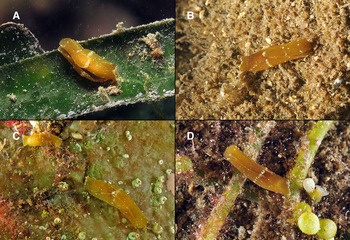
1. On 27 November 2012 and on 12 December 2012, two specimens (one for day) were found on the northern side of Punta Saline (Olbia, 40°54′54.85″N 9°34′34.37″E) on a Posidonia matte with scattered living plants at a depth of 3 m (Figure 1A, B).
-
2. On 28 October 2013 two specimens were found on a sedimentary bottom at a depth of 5 m, in Lido del Sole Bay (Olbia, 40°54′51.82″N 9°34′2.86″E) (Figure 1C).
-
3. On 7 December 2013 another specimen was found in Porto San Paolo Bay (Loiri Porto San Paolo, 40°52′57.01″N 9°38′17.37″E), at a depth of 5 m, on a sedimentary bottom (Figure 1D).
Spinoaglaja wildpretii: (A) 27 November 2012, Punta Saline (Olbia); (B) 12 December 2012, Punta Saline (Olbia); (C) 28 October 2013, Lido del Sole Bay (Olbia); (D) 7 December 2013, Porto San Paolo Bay (Loiri Porto San Paolo).

The length of the specimens ranged from 7.5 to 14 mm. One of the specimens, 8 mm in length, was dissected for examination of the shell. The shell, 1.20 mm long, showed the two apical spines that are a typical character of the species. Unfortunately due to reckless manipulation during an attempt to photograph it, the shell, extremely minute, fragile and very difficult to handle, was destroyed.
RESULTS
SYSTEMATICS
Order CEPHALASPIDEA Fischer, P., 1883
Superfamily PHILINOIDEA Gray, 1850
Family AGLAJIDAE Pilsbry, 1895
Genus Spinoaglaja Ortea, Moro & Espinosa, Reference Ortea, Moro and Espinosa2007
Spinoaglaja wildpretii (Ortea & Espinosa, Reference Espinosa and Ortea2001) [Philinopsis]
SYNONYMS
Melanochlamys wildpretii Ortea, Bacallado & Moro, Reference Ortea Rato, Bacallado Aránega and Moro Abad2003.
DESCRIPTION
Body smooth and cylindrical–elongate, head rounded at the front edge, cephalic shield extended for about three-fifths of the total length of the body; colour orange-brown with a particular shade of green, dotted with white pigment most densely concentrated on the head, on the posterior end of the cephalic shield, on the edge of the foot, of the parapodia and of the posterior margin, and on the half of the body where larger white spots are arranged to form a transverse band. Elsewhere on the body the white pigment is composed of very thin and short longitudinal lines. The shell is calcified but very thin and fragile, quadrangular in shape, with marked growth lines, and with two long thorny processes in the protoconch, as illustrated in Ortea et al. (Reference Ortea Rato, Bacallado Aránega and Moro Abad2003), at page 306 (figures H–G), and in Ortea et al. (Reference Ortea, Bacallado and Moro2013) at page 82 (figure B).
HABITAT
The Sardinian specimens were found crawling on a Posidonia oceanica leaf and on a P. oceanica matte with scattered living plants at a depth of 3 m; on a valve of a dead Pinna nobilis in sedimentary bottom within a Cymodocea nodosa meadow with sparse Pinna nobilis, both living and dead; and between stolons of Caulerpa racemosa var. cylindracea on a sedimentary bottom, with scattered Caulerpa prolifera and Cymodocea nodosa, at a depth of 5 m. According to Ortea et al. (Reference Ortea Rato, Bacallado Aránega and Moro Abad2003) the specimens from the Canary Islands were discovered buried in a muddy sediment covering stones, at 4–15 m depth while the Greek shells were found in a shallow Zostera meadow at 0.2 m depth (Manousis et al., Reference Manousis, Mpardakis, Zamora Silva, Paraskevopoulos, Manios and Galinou-Mitsoudi2012).
DISCUSSION
Spinoaglaja wildpretii was initially described from Sardina del Norte, Canary Islands (Ortea et al., Reference Ortea Rato, Bacallado Aránega and Moro Abad2003), as Melanochlamys wildpretii. The finding of two shells, without soft parts, of this species was reported from Epanomi, Aegean Sea (Manousis et al., Reference Manousis, Mpardakis, Zamora Silva, Paraskevopoulos, Manios and Galinou-Mitsoudi2012). In addition to the external morphology, the internal shell with two long spines on the apex is another distinctive character of this species. Two other Aglajidae species with two apical spines on the shell have been described: Chelidonura petra Ev. Marcus, Reference Marcus1976 from Pernambuco, Brazil and Philinopsis aeci Ortea & Espinosa, Reference Espinosa and Ortea2001, from the Atlantic coast of Costa Rica (Espinosa & Ortea, Reference Espinosa and Ortea2001) later also found in Cuba and the Bahamas (Ortea et al., Reference Ortea, Moro and Espinosa2007); in these two species shape, arrangement and orientation of the spines are different compared to S. wildpretii (Ortea et al., Reference Ortea, Espinosa, Moro, Caballer and Bacallado2012, Reference Ortea, Bacallado and Moro2013). A further species, Philinopsis anneae Ornelas-Gatdula & Valdés, Reference Ornelas-Gatdula and Valdés2012 from the Bahamas, has a single apical spine.
A new genus, Spinoaglaja, has been proposed for all these Atlantic Aglajidae characterized by a non-reversible buccal bulb, lack of sensory structures on the head and apical conical spines on the shell (Ortea, et al., Reference Ortea, Moro and Espinosa2007, Reference Ortea, Espinosa, Moro, Caballer and Bacallado2012, Reference Ortea, Bacallado and Moro2013). Despite a preliminary molecular phylogeny of the Aglajidae (Ornelas-Gatdula & Valdés, Reference Ornelas-Gatdula and Valdés2012) Spinoaglaja nested within Philinopsis and made one suspect that the first, devoid of evidence of monophyly, could be considered a synonym of the latter. Ortea et al. (Reference Ortea, Espinosa, Moro, Caballer and Bacallado2012) pointed out that the choice of the Philinopsis species tested by Ornelas-Gadula & Valdés (Reference Ornelas-Gatdula and Valdés2012) was not correct, having used specimens of uncertain generic attribution, so they preferred to separate the two genera on the basis of morphological differences.
This is the first report of living specimens of Spinoaglaja wildpretii in the Mediterranean, since the only other report refers the discovery of shells only. Though initially described from the Atlantic the fact that also the reports from the Canary Islands are scarce and very recent, shows that, probably due to its burrowing habits, it is a rare and inconspicuous species that remained unnoticed for a long time. Therefore, it could also be a native species in the Mediterranean, never found up to now, and not necessarily an immigrant species from the Atlantic. Only prospective evidence on the distribution of populations and their relative abundance will clarify this point.
It is interesting to note that all findings have been made in autumn months, although we have been frequenting these localities much more intensively in the spring and summer months. This could be an indication of a seasonality of the species, as already described for other opisthobranch species (Kuzirian, Reference Kuzirian1979; Todd, Reference Todd and Russell-Hunter1983; Poizat, Reference Poizat1984; Bouchet et al., Reference Bouchet, Lozouet, Maestrati and Heros2002).
ACKNOWLEDGEMENTS
The authors thank Miho Tsuruoka for the finding of one specimen at Punta Saline, Maria Agostini for the finding of two specimens at Lido del Sole, and Mario Munaretto and Lulù for their support in diving activities.