NICU babies are at high risk for morbidity and mortality due to their birthweight, gestational age, care needs, and extended length of stay. Notably, babies are the only inpatients whose whole bodies are in frequent close contact with HCP face and neck. Because the nose is the main reservoir of S. aureus, this activity may explain why S. aureus NICU outbreaks are common. Reference Lake, Weiner, Milstone, Saiman, Magill and See1 Whole-genome sequencing (WGS) in conjunction with epidemiologic investigation can clarify the scope, duration, and potential source of an outbreak to tailor an effective response.
An “outbreak” is an “unusual occurrence,” generally described as a rapid rise in cases. 2,Reference Wenzel, Reagan, Bertino, Baron and Arias3 Our hospital has traditionally used temporal and spatial clustering (eg, 3 hospital-onset cases within 2 weeks in a unit) as a routine method of outbreak detection. Reference Mellman, Friedrich and Rosenkotter4–Reference Baker, Huang and Letourneau6 Recently, WGS has been used to aid investigation, to confirm the scope of clonal transmission, and occasionally, to find a common source. Reference Köser, Holden and Ellington7 We report here the integration of genomics and epidemiology to address a slow and prolonged MRSA outbreak.
Methods
NICU setting and baseline processes
University of California Irvine (UCI) Health is a 422-bed, tertiary-care, academic medical center with a 45-bed, level IV NICU. All NICU babies and mothers of inborn patients undergo admission bilateral nares screening for MRSA. Isolates are considered “community onset” (CO) within the 2 days of admission, and “hospital onset” (HO) thereafter. All NICU MRSA isolates are routinely banked.
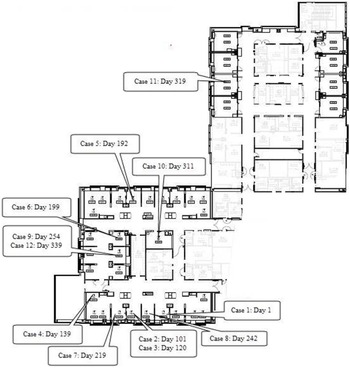
The NICU includes 2 units with 4 triple, 11 double, and 9 single rooms (Fig. 1). Nursing assignments are maintained for most long-term babies, with support for nearby babies when additional assistance or nursing breaks are needed.
Unit map and case location with timing.

Laboratory testing
Screening swabs of nares and skin (axilla and groin) from babies and HCP were cultured for methicillin-susceptible S. aureus (MSSA) using sheep blood agar and for MRSA using chromogenic agar (Spectra MRSA, ThermoFisher Scientific, Waltham, MA). Standardized susceptibilities and mupirocin E-test were performed. Banked samples were sent to the local public health department for pulsed-field gel electrophoresis (PFGE). After the outbreak concluded, samples were sent for WGS at the Broad Institute using an innovative microfluidic sample preparation methodology. Reference Kanjilal, Sater and Thayer8
WGS and transmission analysis
MRSA DNA was sequenced using Illumina Hiseq2500 after constructing sequencing libraries with Nextera protocol Reference Kanjilal, Sater and Thayer8 (SRA-data no. PRJNA787392). Single-nucleotide polymorphism (SNP) calling was performed using a reference mapping approach (Supplementary Material online). SCOTTI Reference Maio, Wu and Wilson9 was used to reconstruct 2 putative transmission networks combining epidemiologic and genomic data examining differences in SNPs. In our first reconstruction of the transmission network (T-1), we assumed baby acquisition risk to be constant throughout hospitalization and HCP exposure to be constant throughout the outbreak. T-1 ignored screens that were negative because most were obtained immediately after decolonization. In the second transmission network (T-2), negative screens were assumed to indicate successful decolonization for 2 weeks.
Results
There were 15 NICU HO-MRSA cases; 12 cases occurred slowly over a 1-year period followed by a resurgence of 3 additional cases 7 months later. MRSA was not associated with any deaths.
Initial 12-case MRSA outbreak epidemiology and response
In total, 12 HO-MRSA cases occurred from April 2016 to March 2017. The sequence of events and infection prevention responses are detailed in Table 1. For the 2 years prior to the cluster, 1 case of HO-MRSA and 6 cases of CO-MRSA occurred in the NICU. Also, the CLABSI rate was 0.63 per 1,000 central-line days (standardized infection ratio [SIR], 0.43), and hand hygiene compliance was independently validated to be >93% consistently.
Neonatal Intensive Care Unit (NICU) Methicillin-Resistant Staphylococcus aureus (MRSA) Outbreak Response Actions

Note. PFGE, pulsed-field gel electrophoresis; HCP, healthcare personnel; EVS, environmental services; UV ultraviolet; CHG, chlorhexidine gluconate; RN, registered nurse.
a Once initiated, continues with each case until end of outbreak.
b Once initiated, continues until end of outbreak.
In April 2016, a case of HO-MRSA pneumonia was identified, with contact precautions and nasal mupirocin decolonization implemented (standard for all MRSA-positive babies) (Table 1). When a second case appeared several months later in July 2016 (bacteremia), isolates were sent for PFGE and were reported as nonidentical with only a single-band difference.
A third case (conjunctivitis) was identified 3 weeks later in a baby who occupied the room that the second case had vacated. Additional infection prevention interventions included increased environmental cleaning and hand hygiene surveillance. Epidemiologic evaluations of staffing, procedures, and equipment were unrevealing. After the third case, 0–2 additional cases per month were identified for the next 7 months (Fig. 2a).
A–C. Outbreak cases and epidemiology curves. Data follow retrospective whole-genome sequencing. “HO Clonal” indicates baby cases that were identified on hospital inpatient day 3 or greater and are the outbreak clonal strain. “HO Non-Clonal” indicates baby cases that were identified on hospital inpatient day 3 or greater and NOT the outbreak strain. “Community Onset” indicates baby cases that were identified on hospital day 1 or 2 and NOT the outbreak strain. “Staff Clonal” indicates point prevalence staff cases staff that are the outbreak clonal strain. “Staff Non-Clonal” indicates point prevalence staff cases that are NOT the outbreak strain. *June 2016, incidental finding, PFGE results available January 2017. **January 2017, April 2017, November 2017, point-prevalence staff screening. ***Nonclonal staff from June 2016 converted to clonal in January 2017.

Across the entire outbreak, cases accrued at a mean of 30.7 days apart (SD, 28.2 days). Of 12 babies, isolates from 9 babies had identical PFGE patterns; isolates from 3 other babies (cases 1, 2, and 6) had single-band difference from these 9 babies. Variable susceptibility to mupirocin, erythromycin, and tetracycline was observed (Supplementary Table 1 online).
In response to accruing cases and findings of clonality, a multidisciplinary team involving infection prevention, NICU medical and nursing leadership, respiratory therapy, occupational health, hospital leadership, and communications collaborated to implement intensified interventions, in communication with the county department of public health (Table 1). Many interventions were implemented over the course of the outbreak. (1) Hand hygiene and cleaning reminders were given to respiratory therapy and nursing staff. (2) Active surveillance of babies was performed, initially with unit-wide bilateral nares screenings after each case of MRSA, then progressing to weekly, unit-wide, 3-body-site screening (ie, bilateral nares, axilla, groin). (3) MRSA-positive babies were decolonized as they were identified, and all NICU babies were universally decolonized periodically. (4) Decolonization kits were offered to immediate family members of MRSA-positive babies. (5) Nurses were placed in care cohorts for MRSA-positive babies. (6) The entire unit received terminal cleaning, with updated competencies for cleaning staff, blacklight monitoring for cleaning effectiveness, and 1-time unit disinfection with hydrogen peroxide vapor. (7) The unit was closed to new admissions. (8) Visitors restrictions were implemented. (9) Units were monitored for universal antiseptic hand washing and universal nasal decolonization for staff and visitors upon unit entry. (10) Universal pre-emptive contact precautions were implemented for all babies. And (11) periodic HCP nasal and axillary and groin screening plus targeted decolonization was performed. Throughout the outbreak, hand hygiene compliance by unit staff and undisclosed monitors was >95%. Specifics related to HCP decolonization are discussed below.
Epidemiologic assessment did not identify a single persistent source, although periodic compelling links were found between hospital-onset cases and shared baby rooms, proximity of baby care areas, and baby assignments to HCP, including those who were MRSA positive on screening. The directionality of linkages between HCP and babies was complicated by the extensive length of stay. Among the first 9 cases, 52 (35.1%) of 148 nurses had cared for at least 4 MRSA-positive babies. Also, 6 HCP cared for at least 5 MRSA-positive babies, but none were MRSA positive on screening.
The lack of a clear source for the slow but persistent 12-month initial outbreak led to committees that created (1) assigned cleaning responsibilities for all in-room items; (2) cleaning validation UV marker protocols for bassinets and other NICU-specific items; (3) protocols to decolonize MRSA carriers (babies and staff); (4) protocols to reduce skin-to-skin contact between infants and HCP, and (5) guidance for staff to mask when face-to-face (nose-to-nose) activity was anticipated for ≥15 minutes, such as respiratory care (Supplementary Materials online).
The initial 12-case MRSA outbreak was deemed concluded by state and county public health officials after 8 weekly point-prevalence screenings occurred without further cases. Subsequently, weekly point-prevalence screens were continued as routine care. A postoutbreak expert panel of NICU infection prevention experts did not recommend further action.
Brief return of the outbreak strain
A baby developed HO-MRSA bacteremia 7 months later. Unit screening identified 2 more cases of HO-MRSA colonization. All were identical to the outbreak strain by PFGE. One-time universal decolonization of all NICU babies was pursued, along with universal HCP screening. 1 HCP who was MRSA positive during the initial outbreak cared for all 3 newly positive babies. Despite being negative for MRSA on the most recent HCP screening, that HCP was removed from direct care until decolonization was completed and 3 negative 3-site screens were confirmed. No further cases were identified.
Decolonization of patients and HCP
MRSA-positive babies were given 5 days of twice-daily nasal mupirocin. In addition, 2% leave-on chlorhexidine gluconate (CHG) baths were given for 5 days based upon a gestational and age-based protocol (Supplementary Protocol 2 online). In January 2017, nasal mupirocin of babies was changed to retapamulin due to evidence of high-level mupirocin resistance in some strains from 5 of 12 babies and 2 of 6 HCP.
Overall, 3 HCP screenings were performed (January and April 2017 during the outbreak, and November 2017 after the strain returned). Of 319 staff, 11 (3%) were MRSA positive. Of these 11 staff, 6 were carriers of the outbreak strain by PFGE. For HCP decolonization, a 5-day regimen of 4% rinse-off CHG body wash and 2% nasal mupirocin was used (later changed to 10% iodophor when the first mupirocin-resistant strain was found).
MRSA-positive HCP were removed from clinical duty until 3 sets of negative cultures from 3 body sites on separate days were obtained (Supplementary Protocol 3 online). Of 6 HCP with the clonal strain, 4 demonstrated clearance after a single decolonization attempt. The remaining 2 HCP had mild-to-moderate intermittent skin issues that required further medical assessment. One had an isolate banked from an unrelated HCP screening in mid-2016 that matched the outbreak strain.
These 2 HCP and 1 of the HCP who had demonstrated initial clearance were found to have both epidemiologic (staffing assignment) and genomic (outbreak strain) links to HO-MRSA cases. All 3 HCP were placed on a twice-monthly 5-day nasal decolonization protocol (ie, iodophor, mupirocin, or retapamulin) and CHG decolonization protocol. In addition, decolonization kits were offered to their household members, and home instructions for cleaning and laundry to prevent MRSA transmission were provided. The HCP protocol included twice-monthly, 3-site screening checks to verify clearance. After 6 months, the protocol allowed gradual de-escalation of the frequency of decolonization and screening if surveillance cultures remained negative. Any positive surveillance cultures or open skin lesion resulted in removal from clinical duty until healing and repeated clearance was demonstrated. Notably, skin conditions showed clinical improvement with repeat decolonization treatments. All 3 HCP demonstrated successful long-term clearance on this regimen and returned to work.
Genomic assessment of the outbreak
In total, 44 MRSA isolates from 15 babies (12 initial outbreak cases plus 3 from the brief return of the outbreak) and 11 HCP collected between April 2016 and January 2018 were sequenced. Of these, 11 isolates (25%) were unrelated, either belonging to a different sequence type or having >120 SNP differences (>5 times the maximum SNP distance observed between outbreak isolates) within the same sequence type as the outbreak strain. All 15 babies (23 isolates) and 6 of 11 HCP (10 isolates) were confirmed to have the outbreak strain by WGS (Fig. 3). Of 33 outbreak isolates, 12 had the mupA gene and were mupirocin resistant by phenotype.
Outbreak timeline showing screening dates and swab results. First letter of the Y-axis labels indicate source, “H” indicates HCP, and “B” for babies. White circles represent negative screens; black circles represent positive screens with outbreak strain; and black triangles indicate positive screen with other strains. Admission and discharge dates of babies are represented by grey segment length. All HCP continued to work throughout the outbreak timeline except for one denoted by an asterisk (*).

The earliest instances of the outbreak strain were identified in April 2016 in baby 01B-A followed by HCP 02H-A, who had 5 isolates spanning June 2016 to July 2017 with <22 SNPs in pairwise distance (Fig. 3 and Supplementary Fig. 4 online). For HCP 02H-A, the initial MRSA was identified during HCP screening performed for a potential MSSA cluster (ultimately determined to not be a cluster), and 3 subsequent isolates were collected during postdecolonization monitoring in 2017. An additional isolate from HCP 02H-A was identified during long-term monitoring of chronic decolonization therapy. PFGE had identified the first HCP 02H-A isolate as related, but not identical, to the first 2 baby isolates identified between April and August; however, WGS confirmed clonality of these isolates (Supplementary Fig. 1 online).
In addition, real-time PFGE also indicated related, but nonidentical, patterns among isolates from first 3 babies (April–September 2016), and WGS confirmed them as identical (<10 SNP differences) (Fig. 3 and Supplementary Figs. 1 and 4 online).
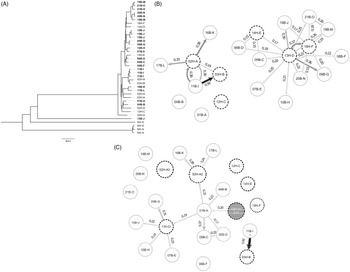
The T-1 (constant infectivity) transmission network and phylogenetic tree (Fig. 4A) identified 2 transmission nodes centered on HCP 02H-A and HCP 13H-D (Fig. 4B). This network reconstruction suggested that HCP 02H-A had >30% probability of direct transmission to 2 babies (16B-K and 17B-L) and a reciprocal 31% transmission probability with baby 11B-I, who, in turn, had a 56% direct transmission probability to HCP 03H-B. In the second node, HCP 13H-D, 14H-E, and 18H-F were implicated in transmission but with lower overall direct transmission probabilities. The indirect transmission network reconstruction (no overlap in time) was very similar to the direct transmission network reconstruction with slightly higher probabilities (Supplementary Fig. 2 online).
Proposed phylogenetic tree and transmission network inferred using SCOTTI Reference Maio, Wu and Wilson9 with the first baby case from April 2016. (A) Phylogenetic tree for all ST-8 isolates, grey highlight indicates closely related outbreak strain <26 SNPs. Inferred direct transmission network (B) ignoring negative screens (methods T-1) and (C) factoring in negative screens (methods T-2), dotted rings correspond to HCP; arrows represent predicted transmission direction and corresponding probability (P > .15); arrow thickness is proportional to probability. Grey circle indicates index case. An alternative proposed transmission network is provided in the Supplementary Material (online) and assumes that the first HCP carrier may have preceded the first baby case.

The T-2 transmission network analysis identified the first isolate of HCP 02H-A as the index case with only 1% probability (Fig. 4C). The direct transmission network also showed HCP 02H-A and 13H-D to be central nodes but with lower probabilities of direct transmission compared to criteria T-1. This analysis implicated baby 01B-A as another transmission node to babies and HCP (Fig. 4C). Baby 11B-I had a 74% probability of transmission to HCP 03H-B. The indirect transmission network (Supplementary Fig. 3 online) indicated that HCP 02H-A and 13H-D, as well as baby 01B-A, were central nodes with the highest number and probability of transmissions.
Discussion
We report a NICU MRSA outbreak involving 15 babies and 6 HCP over a 19-month period. Although the initial source is unclear, epidemiologic and genomic assessments found multiple links, with evidence of transmission from nurse to baby, baby to nurse, nurse to nurse, and baby to baby (presumably via HCP). This finding raised several key issues in the context of a prolonged and slow outbreak involving ∼1 new transmission per month.
Although outbreaks are generally identified by a larger-than-expected number of cases over a short period, outbreaks can also begin slowly and persist for prolonged periods. Reference Köser, Holden and Ellington7,Reference Harris, Cartwright and Török10 The limit of detection for these types of outbreaks may depend on our personal suspicions and inclination for reaction. In this case, it was only our practice of routinely banking all MRSA strains isolated from the NICU that enabled us to identify additional clonal cases several months prior to detecting the unusual clustering of cases over several contiguous months.
We identified 3 possible contributors to the slow progression of the MRSA outbreak. First, we identified NICU-specific practices that required new protocols to prevent transmission. The NICU is a unique setting in that infants are periodically held or placed near HCP noses. This “face-to-face” proximity could be conducive to the bidirectional spread of S. aureus. We ultimately instituted guidance for staff to wear a mask when face-to-face proximity was <1 foot for at least 15 minutes. We also ensured use of physical barriers (blanket) for cradling babies close to the neck.
Furthermore, special protocols were needed to ensure the quality of cleaning processes (ie, frequency and technique and thoroughness) not performed by environmental services. For example, incubators and bassinets were cleaned by technicians, but milk bottles, bedside monitors, and shared equipment (eg, diaper scale, mobile computers) were cleaned by nurses. In addition, a “Code Clean” protocol of twice-daily synchronized cleaning of high-touch surfaces was initiated.
Second, it is possible, perhaps likely, that slower outbreaks occur when some infection prevention practices are robustly in place. Prior to, and during, the outbreak, hand hygiene compliance was observed to be >95% by designated and secret-shopper staff. These measures likely provided some protection leading to temporal delays before sufficient breaches of cleaning, contact, and hand hygiene aligned to produce a transmission event.
Third, like many MRSA outbreaks, Reference Köser, Holden and Ellington7,Reference Harris, Cartwright and Török10–Reference Berthelot, Grattard and Fascia19 we identified 6 HCP colonized with the outbreak strain. These were not newly employed HCP, which raised questions about how and when these longstanding HCP became colonized. In 2 HCP, colonization risk was exacerbated by longstanding intermittent skin conditions, which can enhance MRSA acquisition from hospital or community settings and increase the risk of persistent or recurrent carriage. Reference Harris, Cartwright and Török10,Reference Duckworth17–Reference Berthelot, Grattard and Fascia19 One HCP with skin issues was known to harbor the outbreak strain near the beginning of the outbreak and, according to WGS and epidemiologic indicators, was central to a major nidus of outbreak transmission.
Furthermore, 3 HCP with skin conditions or continued epidemiologic linkages to HO-MRSA cases underwent repeated decolonization that ultimately enabled these HCP to work safely. In published studies of outbreaks, Reference Blok, Troelstra and Kamp-Hopmans11,Reference Berthelot, Grattard and Fascia19,Reference Bertin, Vinski and Schmitt20 hospitals have opted to reassign or terminate HCP who were persistent MRSA carriers associated with an outbreak. Use of repeated nasal and skin decolonization with close follow-up with occupational health for skin checks and nasal, axilla, and groin screening provided an effective strategy to keep babies safe from MRSA and highly skilled HCP employed in the NICU even when known to harbor an outbreak strain of S. aureus.
Overall, better detection tools are needed to identify slow and persistent outbreaks that may occur with over a month’s time between new cases. The common rubric of using 3 nosocomial cases within 2 weeks in a single unit would have missed all of our cases. In hindsight, retrospective application of WHONET-SaTScan space–time permutation software 21 for outbreak detection would have identified a statistical anomaly for the first 2 cases 3 months earlier. This publicly available software is designed to detect hospital outbreaks by using a retrospective 1- or 2-year moving baseline to detect statistically unusual clusters using pathogen, susceptibility profile, and unit location. This software has since been integrated into our hospital’s outbreak surveillance.
Finally, we identified a clonal outbreak strain with variable antimicrobial susceptibility to erythromycin, tetracycline, and mupirocin. Variable susceptibility often leads to false assumptions that strains are unlikely to be clonal. WGS was valuable to confirm clonality beyond PFGE (86% match to WGS-based clonality identification) and antibiotic sensitivity patterns.
WGS was superior to either PFGE or antimicrobial susceptibility alone for determining clonality. Nevertheless, the earliest detection of the outbreak strain was in a baby and, shortly thereafter an HCP. Pinpointing an originating source and overall transmission network topology was affected by the limited number of staff screening events and the infrequent screening of babies until weekly screening was made routine (see Supplementary Material online). Although transmission reconstruction can provide useful information about outbreak dynamics, several factors may influence its accuracy. These factors include sampling biases, uncertainty in timing or onset of colonization, screening sensitivity, within host genetic diversity, transmission bottlenecks, and sequencing and bioinformatics artifacts. Therefore, caution is warranted in interpreting these results.
We describe a slow and prolonged NICU MRSA outbreak involving multiple babies and HCP. The outbreak persisted with both HCP and babies serving as niduses for transmission, as inferred from epidemiologic and genomic links. Cessation of the outbreak occurred after implementing chronic decolonization protocols for HCP who were persistent carriers. Additional success was attributed to protocols to decolonize MRSA-positive babies and to have HCP mask for prolonged face-to-face contact with babies. These interventions resolved the outbreak and enabled HCP carriers of the outbreak strain to remain employed while assuring safe care of NICU babies.
Supplementary material
To view supplementary material for this article, please visit https://doi.org/10.1017/ice.2022.133
Acknowledgments
Financial support
This project was funded by UCI Health and the CDC (grant no. 200-2016-91779S) and by the National Institutes of Health/National Institute of Allergy and Infectious Diseases (grant no. AI121932). P.C.B. was supported by a Burroughs Wellcome Fund Career Award at the Scientific Interface. Y.H.G. was supported by Doris Duke Clinical Scientist Development Award (grant no. 2016092).
Conflicts of interest
S.S.H. reports conducting studies in which participating hospitals and nursing homes receive contributed antiseptic (Medline, Xttrium, Molnlycke, Stryker) or cleaning products (Medline). M.R.A.S. is an employ at Day Zero Diagnostics. P.C.B. consults for or holds equity in 10X Genomics, GALT, Celsius Tx, Next Generation Diagnostics, Cache DNA, and Concerto Biosciences and receives research funding from industry for unrelated work. All other authors report no conflicts of interest relevant to this article.