1 Introduction
In this article we will be concerned with the processes by which adjectives can come to function as secondary deictics (Halliday Reference Halliday1994: 185) or postdeterminers (Sinclair et al. Reference Sinclair1990: 70), which are functionally related to the primary determiner in the NP, as illustrated by the combination of a and different in (1), which together specify that reference is made to (repeatedly) new instances of the type ‘girl’.
(1) I thought about how corrupt I was, always wanting to be drunk or stoned, always with a different girl. (CB)Footnote 2
By contrast, used as descriptive modifier different expresses a gradable relation of comparison as in (2), in which it attributes very different personality traits to Gemma than to Nicola.
(2) As is usually the case, Gemma is turning out to be a very different girl than Nicola. (www.igs.net/~jonesb/xmas04letter.htm)
As a starting point for the conceptual analysis of postdeterminer adjectives and the deictification process, we will take the functional parallelism between secondary auxiliaries and postdeterminers. Just as in the VP secondary auxiliaries are deictically bound by the finite element (Halliday Reference Halliday1994: 183), postdeterminers in the NP are deictically bound by the element functioning as primary determiner. In this article we will explore whether this parallelism extends to the finer deictic mechanisms pointed out by Langacker (Reference Langacker2002a: 23) for secondary auxiliaries.
The structure of this article is as follows. In section 2 we will indicate what we take as preliminaries in the literature to the investigation of postdeterminer adjectives: their main functional–structural features as observed in synchronic approaches (section 2.1); their common diachronic emergence as the result of grammaticalization (section 2.2); and a general characterization of deictic relations and the speech event (section 2.3). In section 3, we will set out the data, methodology and precise research questions. We will study the development of postdeterminer uses of five adjectives representing the deictic notions of space, quantity, time and modality in diachronic and synchronic data, viz. opposite, complete, old, regular and necessary. In section 4, we will present the findings of our case studies of these adjectives. In section 5, we will formulate our conclusions about what constitutes the deictification of adjectives.
2 Postdeterminer uses of adjectives and grammaticalization
2.1 Postdeterminer adjectives in the literature
Even though the postdeterminer use of adjectives has received surprisingly little attention so far, a number of observations by functionally oriented authors can be put together into a rough grammatico-semantic sketch. Semantically, postdeterminer adjectivesFootnote 3 do not describe the referent of the NP, but have a reference-oriented function (Bolinger Reference Bolinger1967). According to Halliday (Reference Halliday1994: 183), they add further to the identifying function and in Bache's (Reference Bache2000: 235) view they ‘help single out or quantify the referent of the construction in relation to some context’.
In terms of formal properties, Bache (Reference Bache2000: 235) notes that the postdeterminer use of adjectives is a ‘peripheral’ one in comparison with their ‘central’ use as descriptive modifiers. When adjectives describe properties of the nominal referent, they are typically gradable and alternate systematically with predicative use, as illustrated by (2) above, Gemma is a very different girl than Nicola, in which different designates a gradable relation of unlikeness and can be used predicatively with the same sense: Gemma is very different from Nicola. In their postdeterminer use, by contrast, adjectives are not gradable and cannot be used predicatively (Bache Reference Bache2000: 235), as is the case with different in (1) always with a different girl, which indicates the nonidentity of the girls referred to; always with a girl that was very different only conveys the descriptive qualitative meaning. The third main function adjectives can fulfil in the NP, viz. sub-classification of the general class designated by the head noun (Halliday Reference Halliday1994: 184), is also peripheral: classifying adjectives are nongradable and cannot occur in predicative position either: *a very electric train – *that train is electric. Postdeterminer and classifier uses of adjectives are both noncentral ones, but they are part of two distinct functional zones in the NP. Classifiers modify the head noun, while postdeterminers are a kind of modifier of the determiner (Bolinger Reference Bolinger1967: 19). This is reflected in their position in NP-structure: classifiers are always placed immediately in front of the head noun, while postdeterminers typically occur after the determiner and in front of descriptive attributes (Bache Reference Bache2000: 239), as in Roche yesterday sat calmly in the same seat he used to watch his former famous charge, Ivan Lendl, destroy many an opponent on Flinders Park centre court (CB). With secondary deictics, this positional principle is what Huddleston & Pullum (Reference Huddleston and Pullum2002: 452) call a ‘labile ordering constraint’: it gives the preferred order in the default case, but may be departed from for reasons of scope or information distribution. For instance, in how many of our stalwart former lawmakersavail themselves of the inequitous [sic] perquisite (CB), the placing of stalwart before former gives it a special emphasis contributing to the ironic tone (CB).Footnote 4
It is symptomatic of the neglect of the postdeterminer function that there is no agreement about the number and type of adjectives that can express it (for partial lists see Halliday Reference Halliday1994: 183; Sinclair et al. Reference Sinclair1990: 70; Bache Reference Bache2000: 241). More fundamentally, faced with actual examples of adjectives generally thought to have postdeterminer as well as descriptive uses (such as old, famous, complete, different, etc.), the analyst will quickly find that the available semantic glosses do not suffice to distinguish postdeterminer uses, which add ‘further to the identification of the subset in question’ (Halliday Reference Halliday1994: 183), from, for instance, defining attributes, as in I saw the oldpart of Govan, which also help identify the referent. This shows the need to provide a more precise semantic characterization of their ‘secondary identifying’ semantics.
2.2 Postdeterminer uses of adjectives and grammaticalization
Recent approaches to postdeterminer adjectives within a grammaticalization framework (Breban Reference Breban2002; Adamson & González-Díaz Reference Adamson and González-Díaz2004; Denison Reference Denison, vanKemenade and Los2006) are beginning to shed new light on them by interpreting their properties in terms of generally recognized semantic and formal tendencies of grammaticalized items. Denison (Reference Denison, vanKemenade and Los2006: 298) describes the historical process by which the determiner-like use of several, meaning ‘individually separate, different’, developed from its original descriptive use, in which it meant ‘existing apart, separate’. He also points out the development of a postdeterminer use of certain following the indefinite article (Reference Denison, vanKemenade and Los2006: 298). Such processes of change, he proposes, suggest that categories are gradient entities, which can stepwise acquire some properties of a new category, rather than necessarily manifesting a wholesale change into that new category: ‘various and certain, while still adjectives, have moved a small way towards acquiring properties more typical of determiners’ (Denison Reference Denison, vanKemenade and Los2006: 300). Adamson & González-Díaz (Reference Adamson and González-Díaz2004) discuss the increased subjectification, coupled to leftward movement in NP-structure, of very. Starting from its original descriptive use, in which it meant ‘true’, very acquired intensifier meanings as in a very gentleman, as well as postdeterminer uses, as in the very man we are looking for.
In her investigation of adjectives of comparison, Breban (Reference Breban2002, Reference Breban, Facchinetti and Rissanen2006a, Reference Breban, Athanasiadou, Canakis and Cornillie2006b, Reference Breban2006c) puts forward the hypothesis that the postdeterminer uses of adjectives such as other, different, similar, comparable developed through grammaticalization and subjectification of their fully lexical descriptive uses. She proposed to interpret the polysemy illustrated by examples (1)–(2) above for different as the result of a semantic shift from ‘meanings situated in the described external or internal (evaluative/perceptual/cognitive) situation’ to ‘meanings situated in the textual situation’ (Traugott Reference Traugott1989: 31, italics ours). This type of semantic change was hypothesized by Traugott (ibid.) to typically form the first stage towards the subjectification of an item. Breban (Reference Breban2002) also argued that the shift from descriptive attribute to postdeterminer is a case of grammaticalization, featuring at least three central characteristics of this process. Firstly, in their postdeterminer use the adjectives develop from autosemantic to synsemantic signs (Lehmann Reference Lehmann1985: 308). Whereas descriptive adjectives function as an independent modifier in NP-structure (Dixon Reference Dixon1982: 25), postdeterminers form a unit with the determiner, with the latter determining the general definite or indefinite value of the determiner complex. In some of the most prototypical cases, this functional coalescence is reflected orthographically, as in English another and Dutch dezelfde, hetzelfde (‘the same’). In other cases, we find such strong collocational patterns of co-occurrence that they can be viewed as another form of coalescence, e.g. the same, which the Oxford English Dictionary (OED) (vol. 9: 74) describes as functionally one word. Secondly, the postdeterminer uses also instantiate paradigmaticization (Lehmann Reference Lehmann1985), as the adjectives come to figure in a more restricted and more homogeneous paradigm than the very extensive and varied set of descriptively used adjectives. Finally, the adjectives lose the gradability and potential for predicative alternation associated with their lexical use, i.e. they manifest decategorialization (Hopper & Traugott Reference Hopper and Traugott2003) or what Denison (Reference Denison, vanKemenade and Los2006) more positively characterizes as ‘gradient category shift’.
Breban (Reference Breban, Facchinetti and Rissanen2006a) adduced two types of empirical evidence for this hypothesis. In the first place, synchronic and diachronic data contain a number of bridging contexts (Evans & Wilkins Reference Evans and Wilkins2000), in which both a descriptive and a postdeterminer reading is plausible. For instance, contextual elements in (3) support both a reading in which different standards describes standards characterized by different properties, and one in which it simply refers to two different sets of standards.
(3) One of the saddest elements of the crisis was that there were voices in the Arab world trying to justify the premise that Arabs lived by different standards from the rest of the international community. (CB)
Such bridging contexts indicate ongoing semantic change, which paves the way towards polysemy (Evans & Wilkins Reference Evans and Wilkins2000).
Secondly, Breban (Reference Breban, Facchinetti and Rissanen2006a) argued that quantified historical data analysis of other, different, similar and comparable bears out her grammaticalization hypothesis, as the postdeterminer uses are either predated by fully lexical uses, or have increased over time at the expense of the descriptive uses. For instance, the prototypical postdeterminer of difference, other, was commonly used as a postdeterminer in Old English already. Its infrequent descriptive (attributive and predicative) uses waned throughout Middle English and Modern English, leaving other in Present-day English an adjective with grammaticalized meaning only. Postdeterminer uses of similar emerged as a small fraction (averaging less than 10 per cent vis-à-vis lexically full uses) in Late Modern English, but have increased in Present-day English to 30 per cent of all uses.
Breban (Reference Breban, Facchinetti and Rissanen2006a) found that not all English postdeterminer adjectives grammaticalized in the language itself. For instance, same and identical, whose typical function was to emphasize the coreferentiality with a referent already present in the discourse, came into English as grammaticalized adjectives, but they were loans of adjectives that had lexical uses in other languages. Same, which derives from an Indo-Germanic word meaning ‘level, equal, same’, has been used from Middle English on as postdeterminer of definite determiners, as in (4).
(4) For Salomon seith that ‘ydelnesse techeth a man to do manye yveles’. And the same Salomon seith that ‘he that ttravailleth and bisieth hym to tilien his land shal eten breed, . . .’ (Helsinki 1350–1420)
The Romance word identical was borrowed into English in the seventeenth century, with the emphasis of identity of reference in definite NPs as primary function, as in (5).
(5) One Man's fatal fall came at the identical fence which caused the retirement of another great grey, Desert Orchid. (CB)
According to Breban (Reference Breban2006c: 186), the emphatic nature of postdeterminers of identity, which may be further strengthened by ‘a synonymous adjective: †that ilk (thilk) same, †the same self, †the same very, the very same’ (OED vol. 9: 75), explains why they relatively quickly lose their strengthening effect and are subject to frequent ‘renewal’ (Hopper & Traugott Reference Hopper and Traugott2003: 122–4) also by the borrowing of new expressions.
2.3 Deixis and the speech event
With Langacker (Reference Langacker2002a: 7), we view deictic elements as linguistic elements whose meaning refers to an aspect of the ‘ground’, i.e. the speech event, the speaker or hearer, the time and place of utterance, or the speech act itself. Some deictic elements explicitly designate, or in Langacker's (Reference Langacker1991: 551) terminology ‘profile’, aspects of the speech event, for instance I, you, here and now and explicit performatives like I order you to desist (Langacker Reference Langacker2002a: 9). Other deictic elements merely invoke the ground implicitly ‘as an “offstage” reference point’ (Langacker Reference Langacker2002a: 9), such as yesterday, which requires a ‘today/now’ for its interpretation, or demonstrative this, which is typically interpreted as in some sense near the speaker.
Within the ground, the speaker is the deictically primary speech participant. Thus the ultimate, nonrepresented, temporal reference point – the temporal zero-point (t0) as Declerck (Reference Declerck2006: 97) calls it – typically coincides with the time at which the speaker makes the utterance. Likewise, the primary spatial reference point is typically formed by the speaker's vantage point (Langacker Reference Langacker2002a: 19). The speaker is also the only speech participant who can be ‘performatively’ active (Benveniste Reference Benveniste1966: chapters 10–12), as is the case in speaker-oriented modality (Verstraete Reference Verstraete2001: 1524): the speaker may here and now order or permit an action (subjective deontic modality), or come to a conclusion about the likelihood of an event (subjective epistemic modality). By contrast, the hearer role is assigned by the speaker (Benveniste Reference Benveniste1966: chapters 10–12), and even when the hearer is part of the deixis as with certain demonstratives, or of the grounding of the utterance as with hearer-oriented modals in questions, this is as the result of speaker construal (Verstraete Reference Verstraete2007: chapter 2). The third person is not part of the ground, but is defined with reference to the ground, viz. as a ‘definite . . . specific entity distinct from the speech-act participants’ (Langacker Reference Langacker1991: 148).
Grounding elements are the primary deictics in a full NP and in a finite clause, which specify the relation of the designated entity or situation to the speech event (Langacker Reference Langacker2002a: 7; Halliday Reference Halliday1994: 72, 181). The clause is ‘grounded’ by the finite element of the VP, expressed in English by morphological tense marking or by primary auxiliaries. The finite locates the situation vis-à-vis the ground in terms of meanings such as ‘simultaneous with’ or ‘temporally removed from’ t0 (tense), or ‘uncertain, but likely according to speaker’ and ‘not yet realized, but obligatory according to speaker’ (modality). In other words, the deictic notions associated with the states of affairs referred to by clauses are tense and modality.
The NP is grounded by the primary determiner (Halliday Reference Halliday1994: 181; Langacker Reference Langacker2002b: 33), which indicates whether the hearer should be able to identify and make mental contact with the specific instance the speaker has in mind (definite determination), or whether the hearer should mentally conjure up a new instance of the indicated type (indefinite determination). Langacker (Reference Langacker1991: 91) describes the cognitive instructions given by definite NPs as follows: ‘the speaker (S) and hearer (H) who jointly form the ground (G), face the task of coordinating their mental reference to some instance ti of type T drawn from the reference mass RT . . . . When both S and H make mental contact with ti, full coordination of reference is achieved.’ In this definition Langacker builds in the fact that contexts may contain several instances of the type talked about. His concept of the reference mass refers to all the instances of the relevant type present in the context. With NPs containing definite determiners such as demonstratives, e.g. These cats are friendlier than those cats (Langacker Reference Langacker1991: 102), the speaker directs the hearer's attention to particular instances of a type ‘out of all the possible candidates’ (Langacker Reference Langacker2002b: 33). Definite determiners are ‘verbal acts of pointing’ (ibid.), instructing the hearer ‘to “seek out” the intended referent’ (ibid.). However, as argued by Davidse (Reference Davidse, Achard and Kemmer2004: 515), directing the hearer to the intended instances involves not only the ‘pointing’ generally associated with definite determiners, but also a form of quantitative delineation. Definite reference always involves in one way or other delineation of the singled-out subset vis-à-vis the reference mass of all the instances present in the context. This has been recognized, amongst others, in the formulation of the implicature of ‘inclusive’ reference to all contextually available instances typically associated with the definite article (Hawkins Reference Hawkins1978).
The grounding elements, as in you must desist and this dog, are the most grammatical and abstract ones in clause and NP (Langacker Reference Langacker2002a: 9–13). Speaker and hearer and the relation to the speech event are part of their meaning in a wholly implicit way. To explicitly describe the relations to the speech event, one has to use expressions such as I order you to desist, the dog near me/known to us.
Clause and NP may also contain secondary deictics. In the VP, these are secondary auxiliaries expressing either secondary tense (Halliday Reference Halliday1994: 204), e.g. be going to, or non-speaker/hearer-oriented modality, e.g. have to (Palmer Reference Palmer1990: 131). In finite VPs, the notions expressed by secondary auxiliaries are deictically boundFootnote 5 by the finite element, which has a direct relation to the speech event (Halliday Reference Halliday1994: 204). Secondary auxiliaries have often developed via grammaticalization from full lexical verbs,Footnote 6 such as the modal semi-auxiliary have to from lexical have (‘possess’) (Hopper & Traugott Reference Hopper and Traugott2003: 111). Likewise, be going to developed via grammaticalization from the lexical verb go expressing intentional motion in space towards a goal (Hopper & Traugott Reference Hopper and Traugott2003: 3). As pointed out by Langacker (Reference Langacker2002a: 23), a grammaticalized secondary auxiliary such as be going to still has more general lexical meaning than the finite element of the VP. This general lexical meaning concerns the relation to the ground, e.g. the relation of posteriority expressed by be going to, which is more explicitly profiled than the relation of anteriority to the t0 marked by morphological tense in He was going to close the door. The reference point of the relation designated by the secondary auxiliary need not coincide with the ground, as illustrated by the same example, in which the posteriority relation is bound by the past time of orientation (Declerck Reference Declerck2006: 16) indicated by the past tense was. Unlike the finite, secondary auxiliaries are not intrinsically bound to the speaker-now.
In the NP, the secondary deictics are, of course, the postdeterminers that we are concerned with in this article. In complex determiner units, the primary determiner establishes the basic deictic values such as definite–indefinite, that is, it deictically binds the more specific relation or notion expressed by the postdeterminer. As we saw, a different girl in (1) refers to repeatedly new instances (indefinite reference) while the identical fence in (3) emphasizes that the same fence was involved (definite reference). Adjectives currently functioning as postdeterminers have often come to do so as the result of grammaticalization.Footnote 7 In the remainder of this article, we will investigate the shift from lexical to postdeterminer uses in more detail and we will examine whether postdeterminer adjectives have specific deictic characteristics similar to those of secondary auxiliaries, such as the possibility of invoking a secondary reference point.
3 Data, methodology and research questions
The aim of this study is to arrive, by generalization from case studies, at a better conceptual and historical understanding of the deictification of adjectives within an integrated theory of deixis. To this end, we investigated two adjectives which have postdeterminer uses relating to the nominal deictic notions of space and quantityFootnote 8 (Langacker Reference Langacker2002b), opposite and complete. As noted by Bolinger (Reference Bolinger1967), nouns incorporating a temporal dimension may take postdeterminers that temporally or modally qualify the implied state or event, as in the future king, a sure win (Bolinger Reference Bolinger1967: 20). Therefore, we selected three more adjectives with postdeterminer uses invoking time and modality, viz. old, regular and necessary.
To focus the investigation, we restricted the structural contexts studied to NPs with the + adjective, which embody identifiability of the referent as a presupposition. Such NPs can only be used if their referent is already available in one way or other in the discourse context as a singled-out entity, onto which speaker and hearer can coordinate their mental reference (Langacker Reference Langacker2002b: 33). For this reason we expected this environment to strongly foreground the semantic shifts affecting adjectives in their development of identification-supporting meanings.
Because of the nature of our research questions, we analysed diachronic as well as synchronic datasets. For opposite, complete, regular and necessary, which, as Romance loanwords, came into English at a relatively late stage, we worked with samples of up to 100 instances of each adjective for the historical periods 1150–1500 and 1500–1710 from the Helsinki corpus and for the stages 1710–80, 1780–1850 and 1850–1920 from De Smet's (Reference De Smet2005) Corpus of Late Modern English Texts (CLMET)Footnote 9 and samples of 200 contemporary instances from the COBUILD corpus.Footnote 10 Because old, unlike the other adjectives, is an old adjective of Anglo-Saxon origin, its uses in earlier stages of English were examined, as attested in the York–Toronto–Helsinki Parsed Corpus of Old English Prose (YCOE) (750–1150), the Penn–Helsinki Parsed Corpus of Middle English, second edition (PPCME) (1150–1500), and the Penn–Helsinki Parsed Corpus of Early Modern English (PPCEME) (1500–1710).Footnote 11 For the periods 1710–80, 1780–1850, 1850–1920 of Late Modern English samples of up to 100 examples (CLMET) were studied as well as a sample of 200 for the period after 1990 (COBUILD).
For each adjective, we analysed in each historical stage all the various prenominal uses as either descriptive attribute, classifier or postdeterminer. In each case study, we will first summarize the postdeterminer uses which the adjective has in Present-day English. We will then describe the first postdeterminer uses observed in our historical data in relation to the lexical uses from which they derived, that is, we will reconstruct the specific form deictification took in all cases. We will focus on the questions of what type of deictic relation the adjective came to express, what reference points this deictic relation could have, and whether this shift was prepared or accompanied by other lexicosemantic shifts such as metaphor and metonymy. Finally a general idea will be given of how the proportion of postdeterminer uses developed over time relative to other prenominal uses following the definite article.
4 Corpus study of five adjectives yielding postdeterminer uses
4.1 Opposite
In Present-day English, opposite used as a postdeterminer locates the entity referred to on the other side of some reference point, either in the concrete spatio-temporal world (6) or in some metaphorical sense (7).
(6) . . . the need for a solid barrier between both sides of a super highway would impede access for emergency vehicles coming from the opposite direction. (CB)
(7) . . . the ALP has clung to its clearly fake commitment to increase female representation of 35 percent, while the Bob Gibbs – Wayne Goss boys club has moved in the opposite direction, campaigning against female candidates at all levels in the party. (CB)
The diachronic data reveal when and how this postdeterminer use developed from a prior fully lexical use, and what this process of deictification entailed for opposite. As indicated by the OED and as emerges from our Middle English data, the adjective opposite was first used to locate things, such as stars in the sky or points on the earth, relative to geometric constructs such as degrees, meridians and latitudes, as in (8).
(8) The nader of the sonne is thilke degre that is opposyt to the degre of the sonne, in the 7 signe as thus: . . . (Helsinki 1350–1420)
In these early predicative uses opposite was always followed by a prepositional phrase introduced by to or from, which explicitly describes the entity taken as reference point of the opposite-relation.
In the period 1570–1640 of Early Modern English we find the first attested postdeterminer use in our data, in which opposite has shifted to a use with deictic function bound by the definite article:
(9) This circle deuideth the East part of the world from the West and also it sheweth both the North and South, for by turning your face towardes the East, you shall finde the Sunne being in that line at noonetide to bee on your right hand right South, the opposit part of which circle sheweth on your left hand the North. (Helsinki 1570–1640)
The opposite in (9) identifies a specific part of the meridian on which the imagined you evoked by the writer is positioned. The opposite-relation is no longer part of an objective configuration being described out there, but is crucially tied to the vantage point of a conceptualizer (Langacker Reference Langacker2002a: 15–16), in this case speech participant you. The exact reference point of the opposite-relation is specified in the preceding discourse as the right-hand side of the imagined you on the meridian. For its interpretation, opposite in (9) thus invokes both a conceptualizer within the ground (you), and a reference point distinct from but related to you. This sort of more complex deictic relation with a reference point that does not coincide with the ground cannot be expressed by a primary determiner like the or that. In this respect, the first postdeterminer use of opposite attested in our data immediately bears out the expected analogy with the deictic complexity observed by Langacker (Reference Langacker2002a) for secondary auxiliary be going to.
The deictification of opposite is also a clear case of subjectification. In the shift from designating a relation with objective reference point to one with subjective reference point, the speaker becomes an intrinsic part of the meaning of determiner + opposite, which incorporates the speaker's point of view, as is characteristic of deictic meanings (Traugott & Dasher Reference Traugott and Dasher2002: 22). Moreover, even though the deictic use of opposite depicts a relation to speaker and hearer, the speech participants are not explicitly expressed in the NP. Thus there is also subjectification as defined by Langacker (Reference Langacker2002a: 15): speaker and hearer are part of the meaning but not of the scope of linguistic predication: they have moved ‘off-stage’ in the linguistic expression.
When we look at the next time slice in our data, Late Modern English, we see that, from the period 1710–80 on, the conceptualizer invoked by opposite extends from speech participants such as the narrating I in (10) to third persons like the Alemanni in (11).
(10) Mr Banks, Dr. Solender, and myself only landed at first, and went to the side of the river, the natives being got together on the opposite side. (CLMET~1\cook-c~1.txt 42)
The opposite in (11) invokes ‘the conception entertained’ (Langacker Reference Langacker2002a: 20) by the described individuals, but, as noted by Langacker (Reference Langacker2002a: 20), that ‘conception is also entertained by the speaker’, in this case, the narrative voice in the text. In principle, the relation between the primary conceptualizer, the narrator, and the secondary conceptualizer, the described character, can be of two types. The vantage point of the primary and secondary conceptualizer may coincide as a result of what is called ‘character-focalization’ in literary theory, i.e. evoking the world through the eyes of a specific character. However, it is also possible for the vantage point of the narrator to be distinct from and to transcend the vantage point of the character, as in (11), in which the opposite bank evokes a narrator who as primary conceptualizer transcends the restricted vantage point of the secondary conceptualizer, the Alemanni.
(11) and the Alemanni, laden with the spoils of Italy, arrived at the Danube, without suspecting, that on the opposite bank, and in an advantageous post, a Roman army lay concealed and prepared to intercept their return. (CLMET~1\gibbon~1.txt 48)
In addition, it has to be observed that opposite with third-person conceptualizer may have a reference point different from that of the conceptualizer – as was the case with conceptualizer you in (9) – so that opposite does not mean ‘what the conceptualizer sees in front of him or her’, but ‘opposite a more specific reference point associated with the secondary conceptualizer’. In (12) either the female main character or the young man who accompanies her and whom she ignores may be taken as reference point of the opposite-relation.
(12) She saw and inwardly rejoiced at the humility of his looks; but far from rewarding it with one approving glance, she industriously avoided this ocular intercourse, and rather coquetted with a young gentleman that ogled her from the opposite box. (CLMET~1\smolle~1.txt 34)
Throughout the three stages of Late Modern English the relative frequency of postdeterminer opposite in NPs with the increased from 51 to 67 to 88 per cent. This happened at the expense of the qualitative uses that had developed from the mathematical notion ‘opposite’, as in very opposite views, reasons, intentions, etc. In Present-day English, the relative proportion of opposite's postdeterminer use has fallen back to 56 per cent, but this is due uniquely to the explosion in frequency of the expression the opposite sex, in which the classifying adjective + noun form a lexicalized unit.
4.2 OldFootnote 12
In Present-day English, old has two basic postdeterminer meanings, roughly equivalent to ‘past’ and ‘former’. It may locate the event or state described by the NP in the past, as in
(13) Women are entering into competition with men more and more and their old subordination to and dependence on men is fast disappearing. (CB)Footnote 13
or it may indicate that the status or function described by the head noun which applied to the referent in the past has been superseded, but can still be used to bring about mental contact with that referent, as in
(14) Anders completed the distance in 20 minutes seven-point-five-two-seconds, taking nearly nine-and-a-half seconds off the old record, set by Australia's Kerry Saxby in January. (CB)
For the reconstruction of how these postdeterminer uses developed we turn to the diachronic data. In the first stage of the Old English data, 750–850, old is used only as a qualitative adjective, which ascribes such gradable features to animates and things as ‘having lived or existed long’, ‘having the characteristics. . . of age’ (OED 7: 97). Already from the second stage, 850–950, on, it is also used as a classifying adjective with a nongradable meaning, as in (15), in which ealdan (‘old’) collocates with æ (‘law’).
(15) Ond suæ suæ ðara monna honda and fet wæren aðwægene on ðære ealdan æ on ðæm ceake beforan ðæm temple
‘And like in the old law the hands and feet of the men were washed in the basin before the temple, . . .’ (YCOE 850–950)
This combination, which refers to the Decalogue of the Old Testament, is very frequent throughout the Old English period, accounting for 43.15 per cent of all the + old sequences. Apart from æ, other nouns are attested, such as gecyðnys and gesetnys (‘law’). Another, less frequent, classifying use is found in examples such as (16), which refers to peoples of a past era.
(16) Her Ald Seaxe & Francan gefuhtun.
‘Here have fought the Old Saxons and Franks.’ (YCOE 850–950)
In these uses, old adds the subcategorization ‘associated with an earlier time or period’ to the meaning of the head noun. The adjective has clearly undergone semantic generalization and shift of perspective from ‘being old and having the characteristics of it’ to ‘lying in the past’. In its classifying use, old also intrinsically invokes a reference point with regard to which it lies in the past. These reference points are fixed, objective ones (p.c. Jean-Christophe Verstraete) such as specific time periods or other historical landmarks. In (15), Mosaic law is categorized as ‘past’ in comparison with the ‘new’ law given by Christ, while in (16), the description Ald Seaxe (‘Old Saxons’) applies to that people during a specific past time period.
In addition to the first classifying uses, the 850–950 period also witnesses the first secondary deictic uses of old. Whereas the former categorize entities as ‘past’ relative to fixed historical reference points, the postdeterminer uses locate referents relative to the time of utterance or the time focused on in the discourse. As the earliest attestations of both uses date from the same period, we cannot posit a diachronic process of subjectification between them. Rather, the main semantic shift was from the gradable qualitative meaning of old to uses involving a relation with a temporal reference point, which is objective in the case of classifying old and subjective in the case of postdeterminer old.
The first postdeterminer uses of old locate states of affairs (SoAs) depicted by deverbal nouns in an ‘anterior time’, as in (17)–(18) (cf. Brinton Reference Brinton, Fanego, Pérez-Guerra and López-Couso2002: 79–84 on the comparable use of temporal adverbs in NPs, as in all his hitherto offences, the then fermentation).
(17) ond æfter cwom god gear and wæstmbeorende. Ond swa awurpon þa aldan dysignesse and deofolgild onscunedon
‘And afterwards came a good and fertile year. And they thus rejected the old folly/blasphemy, and shunned devil worship.’ (YCOE 850–950)
(18) Se Themestocles gemyndgade Ionas þære ealdan fæhþe þe Xersis him to geworht hæfde, hu he hie mid forhergiunge and mid heora mæga slihtum on his geweald geniedde.
‘Themistocles reminded the Ionians [an ancient Hellenic people] of the old hostility that Xerxes had done to them, how he in his command oppressed them with devastation and with murders of their kinsmen.’ (YCOE 850–950)
In (17), the NP þa aldan dysignesse designates ‘the folly’ that lies in the past of those persons who rejected it, which refers to the local religion prior to Christianity. In other words, rather than expressing the meaning ‘past relative to an objective reference point’, old expresses an anteriority relation relative to represented SoAs, which in their turn are past to the temporal zero-point (t0). The meaning of these SoAs, viz. aweorpan (‘throw away’, ‘reject’) and onscunian (‘shun’, ‘avoid’), implies that the folly is no longer adhered to at the time of the narrative (i.e. the past time of awurpon and onscunedon).
The same analysis applies to (18), in which Xerxes' hostility to the Ionians is temporally located before the past SoA gemyndgade. In particular, the past perfect form geworht hæfde makes clear that the acts of hostility, specified in the hu-clause, are anterior to the past time of gemyndgade. However, besides the ‘act of hostility’, the noun fæhþe may also designate the – lingering – feeling of hostility or opposition. On this reading, ealdan can be interpreted as a subjective qualitative attribute, meaning ‘long-standing’ and reflecting the negative connotations of the noun hostility which it modifies. In the Old English data we found quite a few similar cases with nouns that could refer either to (past) acts or to the (continuing) emotions caused by them, which suggests that this ambiguity between a subjective attribute and a postdeterminer reading may form one of the semantic paths to the postdeterminer meaning of ‘past’.
The anteriority relation established by postdeterminer old can be associated with third persons, as in (17) and (18) above, but also with the speaker, as in (19).
(19) Se, Lord, þou kneu all þe last þynges and þe old
‘See, Lord, you know all the last things, and the old [things]’ (PPCME 1250–1350)
This example is a translation of verse 5 from the well-known Psalm 139, in which the psalmist says that the Lord knows him through and through. The NP þe old, with head noun þynges elided, designates ‘the things (his thoughts, acts, etc.) that lie in the past of the speaker’. Thus, old in (19) expresses an anteriority relation directly related to the speaker-now (t0).
The ‘former’ postdeterminer use of old emerges later in 1350–1420, with nouns designating roles and functions, as in þe olde (as opposed to þe newe) kyng in (20) (cf. Brinton Reference Brinton, Fanego, Pérez-Guerra and López-Couso2002, which deals extensively with the ‘former’ meaning that time adverbs in NPs came to express from Early Modern English on). Even though at first sight roles of people such as king, dean, bishop and functions of inanimates such as abbey, nunnery, coins refer to entities rather than SoAs, they do invoke a processual, temporal substrate. Roles are enacted in appropriate actions and entities may be the official loci or instruments of specific actions. All are bound in time.
(20) Meny [{Iewes{] come to þis solempnite leste þe welþe þat þei hadde under þe olde kyng schulde be wiþdrawe in þe newe kynges tyme.
‘Many Jews came to this solemnity lest the wealth that they had under the old king should be withdrawn in the new king's time.’ (PPCME 1350–1420)
In (20) þe olde kyng refers to the person who formerly held the title ‘king’ and who presumably is no longer alive at the past time of the narrative. The temporal reference point marking that person as the former ‘king’ is thus a past time, distinct from the time of speaking. As an example such as (21) illustrates, the previous title holder may also still be alive at the time of the discourse. Likewise with inanimates, we find NPs referring to entities in terms of their previous role that are no longer around (22) or to entities that have been stripped of their value but still exist (23).
(21) The xxix day of May was depreved of ys byshopepryke of London doctur Boner, and in ys plasse master Gryndall; and [{Nowell{] electyd dene of Powless, and the old dene depreved, . . .
‘On the 29th day of May doctor Bonner was deprived of his bishopric of London, and master Gryndall was put in his place; and Nowell was elected dean of [St] Paul's, and the old dean was put out of office.’ (PPCEME 1500–70)
(22) And the same yere the Crosse in Chepe was take a dovvne and a newe sette uppe there þat the olde Crosse stode
‘And the same year, the cross in Chepe was taken down and a new one set up again there where the old cross stood.’ (PPCME 1420–1500)
(23) And the same yere the kyng let make to be smetyn newe nowblys but they were of lasse wyght thenne {of} was the olde nobylle by the paysse of an halpeny wyght, soo that a nobylle shuld wey but iiij d. and halfe a peny
‘And the same year, the king had new nobles forged, but they were of less weight than the old noble was by the weight of a halfpenny weight, so that a noble should weigh but four d. [i.e. pence] and half a penny.’ (PPCME 1420–1500)
The reference point determining the nonapplication of the role or function mostly lies before the time focused on in the discourse, as in the above examples, but occasionally it can also lie in the near future, as in (24), in which the administrative methods in question still exist at the time of speaking but will soon be done away with.
(24) The loud rejection of the article made us see more clearly that we must move ahead faster. Similarly, we are now rejecting all attempts to conserve the old administrative methods. (CB)
We can conclude that both postdeterminer uses expressed by old invoke the temporal dimension associated with SoAs, which are described by the nouns collocating with old in its ‘past’ meaning and implied by those co-occurring with old in its ‘former’ meaning. With both there is the possibility of having a reference point distinct from the ground.
From the fifteenth century on, we find the two postdeterminer uses of old co-occurring with collocational sets with the same selection restrictions as in Present-day English. In its ‘former’ meaning, old collocates with institutional roles as well as with sociocultural products such as official buildings, charters, money, taxes, etc. In its ‘past’ meaning, old collocates with deverbal nouns, nominalizations and other nouns implying states and events. In Present-day English, postdeterminer old simply extends to more collocates within these sets. In terms of relative frequency of postdeterminer uses versus other prenominal uses in NPs with definite article, there is a slight rise throughout the various historical stages: from 4.6 per cent in Old English, to 9.4 per cent in Middle English, to 12.8 per cent in Early Modern English, to 13 per cent in the first stage of Late Modern English, and to 18 per cent in Present-day English.
4.3 Complete
The current postdeterminer use of complete can be summarized as indicating that reference is made to the whole entity, as in
(25) To care for your Retractable Brushes, follow washing instructions (see Before you Begin) taking care not to immerse the complete unit in the water. (CB)
(26) And, in contrast to the accepted practices of the time, he had memorised the complete score. (CB)
More specifically, complete expresses a type of relative quantification (Langacker Reference Langacker1991: 107ff.): in these examples there is an inherent notion of the ‘whole’ thing, and complete, like a universal quantifier such as all, quantifies over this whole thing.
This postdeterminer use appears to have derived from one of the earliest adjectival uses, still close to the perfect participle of the verb complete, which was predicated of periods such as a month or a year that ‘has run its full course’ (OED 2: 725), as in (27). The state of completeness in these examples has an objective reference point, viz. the end of the month.
(27) Whan that the Monthe that highte March Was compleet. (Chaucer 1386, I Nun's Pr. T. 369) (OED)
It is this ‘perfective’ sense that relates most closely to the postdeterminer uses, which begin to be attested in the data from the period 1640–1710 on, such as (28).
(28) the late difference arisen in the Corporae-on of Our City of Dublin in that Our Kingdome, about the Election of Common Councell men out of the severall Companies, . . . Wee have thought fit in pursuance thereof to signify to you Our Pleasure that the last choice made by the Lord Mayor of that Our Citty of the compleate number of Common Counsell men all at once, leaving out the ten or eleven Roman Catholiques that were chosen at the first choice, shall stand and be confirmed, . . . (Helsinki 1640–1710)
In this example, the NP with the complete refers to all the newly chosen council men for Dublin, leaving out the Catholics that had been chosen earlier. This shift from predicative to postdeterminer use of complete was accompanied by two lexicosemantic changes. Firstly, the earlier perfective meaning of complete illustrated in (27) generalized beyond the description of time periods, so that it could also apply, for instance, to abstract numbers, as in (28). Secondly, complete underwent a shift of perspective from focusing on the final stage to profiling the whole. That as a postdeterminer complete applies to the whole, not just to the final stage, is also in evidence in (29), in which it delineates the whole reign of ‘popery’.
(29) Section II. . . . State of the popular mind in Christendom during the complete reign of Popery. (CLMET~2\foster~1. txt 4)
Still, in some examples, the NP containing postdeterminer complete contributes, in interaction with the VP, to the expression of the telicity of the action, representing it as ‘tending towards a natural (inherent) point of completion’ (Declerck Reference Declerck2006: 60). This may reactivate an element of the original ‘final stage’ semantics of complete, as in (26) above. If we take these shifts into account, the deictification of complete can be viewed as another instance in which a relation with objective reference point is transformed into one with subjective reference point, viz. the contextually given instance it quantifies over.
What deictic meaning does complete add to the primary determiner? The definite article refers by implication to the whole contextual instantiation of the type designated by the NP: NPs with the have an implicature of inclusive reference (see section 2.3). Hence, adding a postdeterminer like complete to the determining meanings of the NP might at first sight appear to be redundant, but it is used in contexts in which there is in some sense doubt, or a counterexpectation, as to whether the whole potential instance is being talked about, or is in fact involved in the act described by the VP.
In that complete merely makes explicit an element that is normally part of definite identification, complete is not a postdeterminer which, like opposite and old, creates a more specific determining meaning. Nor can it take a reference point distinct from the ground: its reference point is always the full contextual instantiation that speaker and hearer are aware of. For these reasons, complete can be viewed as an emphasizing postdeterminer, like same and identical. Just as the latter typically emphasize the coreferentiality with a referent given elsewhere in the discourse, postdeterminer complete stresses the inclusive reference, as in State of the popular mind in Christendom during the completereign of Popery (29), which touts the comprehensiveness of coverage of the book section.
The general semantics and pragmatics of the postdeterminer use of complete are very stable from the early periods of its emergence to its current uses. The relative proportion of postdeterminer uses in NPs with the definite article has increased from 9 per cent in 1640–1710 through 17 per cent in 1850–1920 to 35 per cent in Present-day English. This means that complete has spread to many more nouns. Collocationally, complete seemed to be more restricted to nouns with an obvious measurable element in their semantics in Late Modern English, such as number, reign, range, circumference, whereas in Present-day English it is also used with nouns such as unit, score, show, etc.
4.4 Regular
Regular has developed two related postdeterminer uses, an aspectual one indicating that the event or action described by the deverbal head noun successively re-occurs, e.g. (30):
(30) . . . the regular loss of wickets meant they were doomed once skipper Mohammad Azharuddin departed . . . (CB)
and a modal one, assessing ‘a potential or inevitability inherent in the situation’ (Nuyts Reference Nuyts, Klinge and Høeg-Müller2005: 8), e.g. (31):
(31) Snow fell in Tenterfield as well as west of Sydney and on the regular snow fields yesterday as a cold front gripped the entire coast of Australia. (CB)
Most modal uses do not involve reference to whole events by deverbal nouns, but to typical participants in these events such as the areas in Australia in which, unlike Tenterfield and the area west of Sydney, snow in winter is more or less inevitable and which can therefore be identified as the regular snow fields.
These two uses of regular derive from the gradable qualitative meaning ‘with a symmetrical pattern’, which is attested first in our 1500–1710 data. In the period 1710–80, regular manifested a semantic shift that paved the way for deictification, viz. a metaphorical transfer from space to time. In the specific environment of binominal NPs, regular extended from assessing spatial patterns, as in the regular cast of her features, the regular and uniform elevation of the land, to assessing abstract temporal ones, as in the regular progress of cultivated life, the regular succession of civil and military honours, and example (32).
(32) . . . since nothing is ever really present to the mind, besides its own perceptions, it is not only impossible, that any habit should ever be acquired otherwise than by the regular succession of those perceptions, but also that any habit should ever exceed that degree of regularity. (CLMET~1\hume~1.txt 83)
Particularly in examples such as (32), in which the second noun refers to events, the semantic extension from ‘regular’ (temporal pattern) to ‘recurrent’ (event) seems to be prepared.
It is in the same period, the beginning of Late Modern English, that we find the first postdeterminer uses such as (33), in which regular is followed by a singular deverbal noun describing a SoA and in which its meaning has shifted to expressing regular recurrence of that type of event.
(33) Nor is the act of settlement only preserved unviolated by the reasons of the present alliance, but by the regular concurrence of the senate which his majesty has desired, . . . (CLMET~1\johnso~1.txt 94)
In the process, the meaning of regular has become more general and more grammatical, indicating iterative aspect (Declerck Reference Declerck2006: 35), and has subjectified in that the norm implied by descriptive regular has been transformed into speaker assessment of frequency.
What sort of deictic relation is expressed by the regular and how does it relate to the ground? Just like the ‘past’ postdeterminer use of old, NPs with iterative regular refer to actions and events, and invoke verbal deictic semantics. The iterativity is always assessed within a specific portion of the time axis. Which time span is determined by the tense of the VP in the clause of which the NP is part, as in example (30), in which meant is in the past, situating the losses of wickets in a time span anterior to the temporal zero-point. In (33), the perfect has desired locates the concurrences of the senate in a period starting in the past and leading up to the present. In sum, iterative postdeterminer regular always has a temporal reference point, which may (partly) coincide with the ground or which may be distinct from it.
In the last period of Late Modern English, 1850–1920, we can observe the second step in the deictification process, in which the reoccurrence notion gives rise to the dynamic modal notion of necessity, that is, of characteristics inherent in a situation necessarily leading to the indicated results (Palmer Reference Palmer1990: 130, Nuyts Reference Nuyts, Klinge and Høeg-Müller2005: 8). The height and location of areas such as the Snowy Mountains in (31) inevitably lead to them being snow-covered in winter, and in (34) the social mores were such that a birthday speech by the chief was inevitable.
(34) We, in the servants' hall, began this happy anniversary, as usual, by offering our little presents to Miss Rachel, with the regular speech delivered annually by me as the chief. (CLMET~3\collin~1.txt 24)
In other words, the modal meaning at stake is not the performative epistemic one of the speaker drawing a conclusion here and now (Palmer Reference Palmer1990: 130; Verstraete Reference Verstraete2001: 1524) but that of indicating the necessary results of inherent characteristics of the situation. Because of this ‘characterizing’ meaning, the modal uses of regular may have not only the temporal zero-point as reference point, but also past times of orientation. For instance, in an example about the ice age, a use of the regular snow fields is imaginable whose reference point is past with regard to the time of utterance.
In conclusion, the two postdeterminer meanings of regular, the aspectual and the modal one, are both used in NPs referring to or implying SoAs. Both invoke a temporal reference point that may coincide with or be distinct from the ground. Because of the verbal semantics of the deictic meanings of regular, its most noticeable co-selection tendency is with deverbal and nominalized head nouns, particularly in the iterative use. Quantification of the postdeterminer uses in our sample reveals steady and increasing deictification of regular: from forming smaller proportions of all the prenominal uses in NPs with definite article in the first two stages of Late Modern English, the postdeterminer uses of regular go up to 15 per cent in the third stage of Late Modern English, and to 30 per cent in Present-day English.
4.5 Necessary
Throughout its history necessary developed two dynamic modal postdeterminer meanings: a very common one indicating that the entities referred to are needed in view of some aim (35), and a much more marginal one indicating that some SoA is the logically inevitable corollary of another SoA (36).
(35) It seems obvious federal governments have failed to take the necessary action to deal with the problem. (CB)
(36) A second and very rare condition of an elective government is a CALM national mind – a tone of mind sufficiently stable to bear the necessary excitement of conspicuous revolutions. (CLMET~1\cook-c-~1.txt 100)
Necessary was at first, in Middle English, used only predicatively in the sense of (religiously, morally or physically) ‘essential’, ‘needed’, as in (37).
(37) And therfore seith Seint Austyn that ‘ther been two thinges that arn necessarie and nedefulle, and that is good consience and good loos;. . .’ (Helsinki 1350–1420)
After 1640 it also came to be used prenominally in front of nouns with which it shared the semantic feature ‘required’, e.g. the necessary Charges, those necessary Duties of Religion, the necessary ceremonials, the necessary Dutys of the Ship. According to Sinclair (Reference Sinclair1991), adjectives restating features inherent in the head noun end up delexicalizing in these collocations, which may have paved the way for the deictification of necessary.
It is precisely in these combinations that the earliest postdeterminer uses can be observed in the period 1640–1710, such as (38) in which necessary is bound by all rather than the.
(38) Wee doe hereby require and direct you to doe all things, and give all necessary orders for the speedy settling of this affaire accordingly. (Helsinki 1640–1710)
The determiner complex all necessary, whose primary determining meaning is quantificational, has to be contextually related to ‘for the speedy settling of this affair’, as reinforced by accordingly. All necessary gives an instruction for cataphoric retrieval of its contextual specification and in this way identifies the orders in question as ‘all those required for speedy settling’.
The emergence of the second postdeterminer use appears to be the result of an analogous process. Starting in the 1640–1710 period, the very common fixed expression a necessarie conclusioun establishes the sharing of the semantic feature ‘logically necessary’ between adjective and noun, which extends at the beginning of the eighteenth century to other combinations such as the necessary consequence/connection/effect. It is again in one of those combinations that the postdeterminer use expressing the logically necessary relation between two SoAs emerges:
(39) To complain of the age we live in, to murmur at the present possessors of power, to lament the past, to conceive extravagant hopes of the future, are the common dispositions of the greater part of mankind – indeed, the necessary effects of the ignorance and levity of the vulgar. (CLMET~1\burke-~2.txt 2)
In this example, the SoAs making the effects referred to inevitable have to be retrieved cataphorically as being ‘the ignorance and levity of the vulgar’. After the emergence of these first cataphoric uses, the two postdeterminer meanings of necessary develop anaphoric uses, illustrated in (40) and (41) respectively.
(40) But it is known, sir, that in king William's reign, very few estimates were honestly computed; it is known that the rotation of parties, and fluctuation of measures, reduced the ministry to subsist upon artifices, to amuse the senate with exorbitant demands, only that they might obtain the necessary grants, . . . (CLMET~1\smith-~1.txt 22)
(41) She got into the victoria and placed herself with her back to the horse. The necessary roar ensued, . . . (CLMET~3\forste-~1.txt 88)
The unit the necessary has a complex deictic meaning incorporating a modal, a phoric and a quantificational element. The modal notion found in examples such as (35), (38) and (40) is not performative and does not invoke on-the-spot authority of the speaker (Verstraete Reference Verstraete2001: 1524f). Rather, it refers to what is ‘required’ for specific goals, i.e. circumstantially determined necessity (Nuyts Reference Nuyts, Klinge and Høeg-Müller2005: 8). The primary link to the speech event is hence formed by the temporal location of the goals or circumstances. In a present-tense clause like (38), necessary has the temporal zero-point as reference point. In (35), the NP the necessary action is part of a clause with an indefinite present perfect, and its temporal reference point lies in the pre-present time-span considered in that clause. Similarly, the concept expressed by necessary in examples such as (39) and (41) is not hic et nunc deduction by the speaker, but the indication of an ‘inevitable’ relation between two SoAs, whose location, simultaneous with the temporal zero-point in example (39) and anterior to it in (41), provides the link with the ground. We thus see that the reference point of postdeterminer necessary, in its two dynamic modal senses, may either coincide with the ground or be distinct from it.
Secondly, the deictic unit the necessary expresses ‘phoric’, i.e. cataphoric, anaphoric or even exophoric, relations. It gives instructions for retrieval from the text or situational context of the determinants of the modal relations expressed by necessary. With the ‘required’ uses, these are the specific needs and goals determining what the NPs refer to, and with the ‘inevitable’ uses, the situations causing the SoAs referred to. In other words, the phoric nature of postdeterminer necessary is motivated by its dynamic modal semantics, for which external determinants have to be indicated.
Thirdly, the ‘required’ use of the necessary has developed a typical pragmatic inference of quantity, by which it conveys something like ‘the right amount of’. This quantitative inference can be observed from the beginning of Late Modern English on with two specific sets of gradable nouns (Paradis Reference Paradis, Bermúdez-Otero, Denison, Hogg and McCully2000: 243), viz. nouns denoting emotion and exertion, such as the necessary tenderness, degree of buoyancy, effort, care and pains, etc. (42), and measure nouns, such as the necessary sum, standards, grants, amount, expense, quantity, etc. (43).
(42) Solidity and delicacy of thought must be given to us: it cannot be acquired, though it may be improved; but elegance and delicacy of expression may be acquired by whoever will take the necessary care and pains. (CLMET~1\cheste-~1.txt 33)
(43) Put what Sugar you think proper into each Dumpling, when you take it up, and the necessary quantity of Butter. (CLMET~1\bradle-~1.txt 95)
Towards the end of Late Modern English and in Present-day English, quantitative implications are also increasingly activated by the core uses of the necessary, which pertain to actions or instruments required for the achievement of goals in specific situations. Particularly in the Present-day data, the collocating head nouns found in this type of use, such as the necessary action, support, supplies, resources, criteria, standard, infrastructure, time, vitamins, etc., seem to invoke both qualitative and quantitative norms which have to be met in order to realize the aims inherent in those contexts. The exact nature and size of these norms often remain oblique to the reader who is not ‘in’ on these situations. In this way, the necessary may function as a summation of specifics which the speaker, for some reason, does not go into, as in (43) above.
This characterization of the dynamic modal meaning of the necessary also gives an idea of how the objective norms of what is (religiously, morally or physically) ‘essential/needed’ in the descriptive use were transformed into a subjectively construed relation of ‘necessity’. In this context it can also be noted that, even though necessary continues to be used predicatively in other senses up till the present day, no idiomatic predicative alternates tend to be available for its very specific, pragmatically enriched, secondary deictic senses: for instance, the roar is necessary is not semantically equivalent to the necessary roar in (41) and neither is the care and pains are necessary semantically equivalent to the necessary care and pains in (42).
As to their quantitative occurrence, the ‘required’ and ‘inevitable’ postdeterminer uses develop along paths which are rather different. In terms of relative frequency, the ‘required’ uses steadily increase from 30 per cent in 1710–80, through 46 per cent in 1780–1850 and 55 per cent in 1850–1920, up to 80 per cent of all prenominal uses in NPs with the in Present-day English. The ‘inevitable’ use shows a small momentary rise to 8 per cent in the third stage of Late Modern English, but most of the uses attested in that period, illustrated by (39) and (41), are not possible any more and the ‘inevitable’ sense of necessary has now all but disappeared.
5 Generalizing from the case studies
What do the case studies in section 4 teach us about the meaning and development of postdeterminers? By having investigated postdeterminer uses of adjectives other than those of comparison, we can, building on Breban's (Reference Breban2002, Reference Breban2006c) findings about the grammaticalization and semantic shift of the latter, work towards a more comprehensive and precise understanding of the deictification of adjectives. For all the adjectives investigated, the postdeterminer uses are preceded by fully lexical uses, which usually first appear in predicative position. In general the postdeterminer uses also increase in frequency through time at the expense of the descriptive prenominal uses. This shows that the diachronic grammaticalization hypothesis investigated by Breban (Reference Breban, Facchinetti and Rissanen2006a, Reference Breban2006c, forthcoming) for the adjectives of comparison applies more generally.Footnote 14 On the basis of the five case studies, we can also analytically go beyond the traditional semantic glosses of the postdeterminer function such as ‘helping identification’.
For adjectives to be able to develop postdeterminer uses in the first place, they have to express a relation which can come to be used to locate the nominal referent in the universe of the discourse. Some of the adjectives studied in this article expressed such a relation from the start, like opposite, whose original meaning was ‘spatial position over and against something’. Opposite did not undergo any noticeable semantic generalization or any other of the traditional lexicosemantic shifts before or during the deictification process. Other adjectives in our case studies underwent a semantic change towards expressing such a general relation prior to deictification, like regular, which had already undergone metaphorical transfer from the spatial to the temporal before its deictification. Still others underwent one of the traditional lexicosemantic changes in the deictification process, such as complete, which generalized semantically as part of the deictification process. Hence we conclude that deictification cannot simply be equated with semantic generalization or one of the other meaning shifts traditionally associated with grammaticalization (e.g. Bybee Reference Bybee, Joseph and Janda2003).
Deictification, then, is a semantic process which has to be described more specifically with concepts from a theory of deixis. We propose that the deictification of adjectives is a meaning shift which gives the general relation profiled by the adjective a reference point that is directly or indirectly related to the speech event. Like secondary auxiliaries, postdeterminers semantically profile these relations to the speech event. The opposite and the old, for instance, explicitly designate spatial and temporal relations, whereas primary determiners such as this and that do not. Postdeterminer uses of adjectives often involve semantic generalization from their original lexical uses, but they are semantically still less abstract than primary determiners. With regard to all the adjectives studied we have noted that deictification involved a shift from the expression of a relation with an objective reference point to one with a subjective reference point. Deictification is a subjectification process in the sense of Traugott (Reference Traugott1989: 31), in that relations originally describing situations out there shift to relations located in the textual situation and to meanings involving the speaker's perspective (Traugott & Dasher Reference Traugott and Dasher2002: 22). The secondary deictic relations that thus evolve are subjective constructs associated with a specific speaker–hearer exchange, which can only be processed relative to that exchange. For instance, the old record will refer to different sports milestones in a text of 1910 than in one of 1990. It is in this respect that secondary deictics differ from, for instance, defining attributes. Any precise semantic gloss of postdeterminer meanings requires reference to the speech event and ultimately to the speech participants. Deictification is also a case of subjectification according to Langacker's (Reference Langacker2002a: 15) definition, in that speaker and hearer are intrinsically part of the meaning of the determiner and postdeterminer unit, but do not – and cannot – receive explicit linguistic coding: corresponding to the old record in (14) one cannot get *the old to now record, nor to the regular speech in (34) *the regular to me speech.
To get a better grasp of the secondary deictic meanings of adjectives, we investigated, inspired by their analogy with secondary auxiliaries, whether they may also take reference points that differ from the ground. Postdeterminers to do with (non)identifiability and relative quantification cannot have reference points distinct from the speech event. With postdeterminers marking identifiability (e.g. same, identical) the reference point is formed by entities which for some reason are already known to speaker and hearer, while with postdeterminers of relative quantity (e.g. complete) the reference point is the full contextual instantiation of a thing or mass which speaker and hearer are aware of. We venture that this is so because the identification and quantitative delineation of the instances referred to are the most fundamental cognitive operations involved in definite reference (Langacker Reference Langacker1991; Davidse Reference Davidse, Achard and Kemmer2004). As noted in the discussion of same, identical and complete, these postdeterminers tend to merely emphasize the coreferentiality and inclusive reference conveyed by the primary determiners.
The other postdeterminer uses studied involved either a spatial (opposite) or a temporal relation to the ground (old, regular, necessary). All of these can have a reference point coinciding with the speaker's spatial or temporal vantage point or one different from but related to the speech event. These postdeterminer meanings are not redundant with the primary determiners, but contribute additional information situating the referent. The situating postdeterminers confront us with the puzzle that theyFootnote 15 accommodate not only notions traditionally associated with nominal deixis (space) but also typically verbal and clausal notions (tense, modality).
Langacker (Reference Langacker2002b: 32–3) has cognitively motivated the traditional dichotomy between nominal and clausal deixis by positing a fundamental asymmetry between the construal of things and processes. In his view, the referents of NPs are prototypically objects in the spatial world, whose existence is taken for granted, but for which the key issue is identification. ‘Because objects endure, at a given moment C [the conceptualizer] is surrounded by many objects, including multiple instances of the same object type’ (Langacker Reference Langacker2002b: 32). The simultaneous focusing by speaker and hearer on the intended instantiation is typically brought about by deictic specifications in terms of location and quantification of the entity-instance. The referents of clauses, by contrast, are actions, events and states with a temporal dimension, for which the main issue is whether they exist, i.e. whether they are real or potential, and whether they are grounded either temporally or modally.
While it is true that the primary determiners of NPs are to do with identifiability, quantity and space (concrete and metaphorical), and the finite element of the VP is either a tense or (performative) modal marker, secondary deictics challenge this strongly asymmetrical picture. The set of postdeterminer adjectives studied in this article reveals that, subordinated to these direct relations to the ground, situating relations can be expressed in which notions assumed to be either typically nominal or verbal are inextricably intertwined. Or, put differently, nominal referents may invoke a processual dimension, or a SoA-substrate, in more ways than traditional thinking has it, according to which only nominalizations allow for temporal and modal qualifications. To identify these other ways, we will look at which of Nuyts' (Reference Nuyts, Klinge and Høeg-Müller2005) qualifications of SoAs are expressed by the adjectives studied here, which were intuitively selected to be representative of the various speech-event-related notions that can be expressed by secondary deictics.
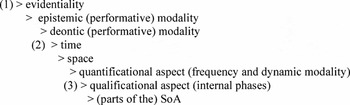
Nuyts (Reference Nuyts, Klinge and Høeg-Müller2005) proposes the functional hierarchy of SoA-qualifications shown in figure 1, in which those placed higher tend to take the lower ones in their scope and in which three groupings can be distinguished: (1) those involving hic et nunc commitment of the speaking subject; (2) those situating the SoA; (3) those that are part of the predicated SoA.
Hierarchy of qualifications of SoAs (Nuyts Reference Nuyts, Klinge and Høeg-Müller2005: 20)

All the postdeterminer uses of opposite, old, regular and necessary fall under Nuyts' subgroup of qualifications situating the SoA. Old and opposite involve time and space, while the secondary deictic senses of regular and necessary are subsumed under quantificational aspect, which is defined by Nuyts as including not only iterativity but also dynamic modality.
Unlike Langacker (Reference Langacker2002b), who strongly contrasts spatial nominal deixis with temporal clausal deixis, Nuyts (Reference Nuyts, Klinge and Høeg-Müller2005: 19, 22) stresses that SoAs are situated both in time and space, with time having scope over space. Assessing the temporal and spatial situation of a SoA requires relating it to a set of complex and abstract parameters for which the speaker has to transcend the immediate perception of the SoA, which is all that is needed for the predicate-internal qualifications (Nuyts Reference Nuyts, Klinge and Høeg-Müller2005: 22). The temporal and spatial locations of SoAs can also be or not be relative to another SoA. As this study is concerned with the referents of NPs rather than of clauses, it raises the question of how nominal referents invoke SoAs. The combination of old with a deverbal noun is easily explained: it expresses the temporal relation to the ground of the event or state referred to by the NP, as in their old subordination to men (13). As for the ‘former’ postdeterminer use of old, as in the old king (20), the old cross (22), we pointed out that the roles of people and the functions of things intrinsically evoke associated actions, which are bound in time. Likewise, the complex spatial perspectives construed by the opposite are inextricably linked to the actions of the participants being described.
In Nuyts' (Reference Nuyts, Klinge and Høeg-Müller2005: 20) understanding of quantificational aspect, notions such as ‘inevitability’ and ‘need’ (dynamic modality) are semantically akin to notions such as ‘iterativity’ in that they are all concerned with the ‘appearance’ of SoAs in the world. The dynamic modal notions and iterativity relate to situations that are ascribed a property with a ‘law-like’ character. Interestingly, all the postdeterminer uses of regular and necessary fall under this characterization. As stressed in sections 4.4 and 4.5, the modal notions expressed are of this ‘situating’ nature, not of the performative nature associated with deontic and epistemic modality as they figure in the highest grouping of Nuyts' qualifications. Further research will have to establish whether it is a general tendency of modal postdeterminers to be situating rather than performative.
With regard to the aspectual and modal postdeterminer uses of necessary and regular, it has to be remarked again that they are not restricted to deverbal nouns, e.g. the necessary action (35), but are also found with NPs that clearly refer to things, e.g. the regular snow fields (31), the necessary quantity of Butter (43). The relations of requirement and inevitability pertain here to the way in which the entities referred to participate in larger scenarios invoked by the whole context. Sanford & Garrod (Reference Sanford and Garrod1998) have proposed that nominal referents may be made identifiable by being mapped onto certain roles they fulfil in contextually derivable scenarios. These are schematic of situations constructed by the hearer on the basis of text clues. In examples such as those with postdeterminers regular and necessary just quoted such scenarios motivate the location of entity referents in dynamic modal domains. All the mechanisms discussed above show, in our view, that nominal deixis is less diametrically opposed to verbal deixis than is often assumed. It is not always the case that nominal referents exist autonomously, ready to be referred to, and that only the referents of verbs can exist in potential domains. The theory of nominal deixis has to recognize that the determination of things may be intertwined with the SoAs referred to and the larger scenarios implied by the discourse.
In the above discussion it has become clear that, to characterize the specific function of postdeterminer adjectives, one has to take into account the difference between postdeterminers which basically relate to the ground, like primary determiners, and postdeterminers whose reference points can be distinct from the ground. The reference points in the ground of postdeterminers marking identity (e.g. same, identical) and relative quantity (complete) are integral to the identifying operations performed by speaker and hearer. By contrast, the postdeterminers which situate the nominal referents in terms of time (old), space (opposite), quantitative aspect (regular) and dynamic modality (regular, necessary) do so by construing direct and indirect relations to the speech event. These postdeterminers add secondary deictic qualifications that are more semantically diverse and more complex than the primary determiners they are bound by.
6 Conclusion
We hope to have shown in this article that deictification is an important type of semantic shift that deserves to be investigated further along the various axes of grammaticalization research, such as synchronic, diachronic and comparative investigation. Descriptively, we should strive towards full inventories of adjectives fulfilling postdeterminer functions in the languages studied. It will also have to be examined whether the deictic notions put forward in this article exhaust the conceptual semantics of postdeterminers. Diachronically, more case studies are needed of the actual emergence of secondary deictic adjective uses as well as of their possible decline. Comparative case studies involving more than one language, finally, can also shed light on and provide extra arguments for hypotheses about the development of postdeterminer meanings (see e.g. Breban Reference Breban2002/2003). It is to be expected that some of the findings from such studies will have to be fed back into the general formation of the theories of grammaticalization and semantic shift.