INTRODUCTION
Ticks are obligate ectoparasites that feed on blood of a variety of host species, including birds, reptiles, amphibians and mammals (Klompen et al. Reference Klompen, Black, Keirans and Oliver1996). They are vectors of many important pathogens, including protozoan, rickettsial, viral, bacterial and fungal organisms (Oliver, Reference Oliver1989; Sonenshine, Reference Sonenshine and Sonenshine1991). Approximately 10% of the 867 currently recognized tick species are known to transmit infectious microorganisms (Jongejan and Uilenberg, Reference Jongejan and Uilenberg2004) that threaten not only livestock and wildlife, but also human health, causing diseases such as heartwater, Lyme disease and babesiosis (Karesh et al. Reference Karesh, Cook, Bennett and Newcomb2005). Ticks may also cause severe damage to their hosts, including injuries to skin and hides, wounds, abscesses and bleeding (Muchenje et al. Reference Muchenje, Dzama, Chimonyo, Raats and Strydom2008; Moyo and Masika, Reference Moyo and Masika2009); and they secrete substances that can generate toxicosis and host paralysis (Stone et al. Reference Stone, Binnington, Gauci and Aylward1989).
Tick host preferences are an important component of their ecology (Hoogstraal and Aeschlimann, Reference Hoogstraal and Aeschlimann1982; Uilenberg, Reference Uilenberg1995; Cumming, Reference Cumming1998; Jongejan and Uilenberg, Reference Jongejan and Uilenberg2004). A parasite's host specificity is closely related to its ability to persist in a given environment and its potential to expand its range or colonize new areas (Poulin and Mouillot, Reference Poulin and Mouillot2003; Koh et al. Reference Koh, Dunn, Sodhi, Colwell, Proctor and Smith2004). A deep understanding of tick–host relationships is needed not only for comprehending the evolution and basic ecology of ticks, but also for the management and control of ticks and tick-borne pathogens, prediction of future changes in the epidemiology of tick-borne diseases and proactive responses to relevant environmental drivers such as deforestation and climate change (Cumming and Van Vuuren, Reference Cumming and Van Vuuren2006).
Ticks were historically considered to be specialist parasites, exhibiting morphological adaptations to feed on particular hosts (Hoogstraal and Aeschlimann, Reference Hoogstraal and Aeschlimann1982; Hoogstraal and Kim, Reference Hoogstraal, Kim and Kim1985). For example, the soft tick Argas (Microargas) transversus feeds exclusively on the Galapagos giant tortoise (Geochelone elephantopus) (Hoogstraal et al. Reference Hoogstraal, Clifford and Keirans1973). However, most ticks are able to feed on a greater variety of host species (Oliver, Reference Oliver1989; Cumming, Reference Cumming1998). Experimental studies have revealed that they can feed and reproduce successfully using a wide diversity of hosts (James and Oliver, Reference James and Oliver1990; Belan and Bull, Reference Belan and Bull1995; Marques Lisbôa Lopes et al. Reference Marques Lisbôa Lopes, Cerequeira Leite, Bahia Labruna, de Oliveira, Miranda Ferreira Borges, Batista Rodrigues, Avila de Carvalho, Vianna de Freitas and Vieira Junior1998). In the wild, ticks are often collected from a limited number of species and may appear to be host specialists (Hoogstraal and Aeschlimann, Reference Hoogstraal and Aeschlimann1982). Tick–host interactions are, however, influenced not only by the physiological and morphological characteristics of ticks and hosts (Sonenshine, Reference Sonenshine and Sonenshine1993), but also by their habitat preferences (Klompen et al. Reference Klompen, Black, Keirans and Oliver1996; Nava and Guglielmone, Reference Nava and Guglielmone2013). Ticks exhibiting preferences for certain micro- and macro-habitats, such as Ixodes species commonly found on bats (Chiroptera), may preferentially parasitize hosts living in similar habitats (Sonenshine, Reference Sonenshine and Sonenshine1993; Klompen et al. Reference Klompen, Black, Keirans and Oliver1996). Similarly, the nature of animal movements is such that ticks that are underdispersed (clumped) in the environment will be more likely to be perceived as specialists, regardless of their true host preferences (Cumming, Reference Cumming2004).
For many tick–host combinations, there is still considerable uncertainty as to whether an absence of an observed tick–host interaction indicates that the interaction cannot occur or is simply a matter of it not having been observed (Klompen et al. Reference Klompen, Black, Keirans and Oliver1996; Cumming, Reference Cumming1998, Reference Cumming2004; Petney et al. Reference Petney, Kolonin and Robbins2007). In addition, the most comprehensive previous analysis of tick–host specificity for African species (Cumming, Reference Cumming1998) did not distinguish between larval and adult ticks or consider phylogenetic differences between host species. Thus, a re-evaluation of the classification of ticks as more generalist or more specialist parasites in light of evolutionary and life-stage differences is necessary. If ticks are more generalist than previously indicated, then they may have an increased chance of transmitting the pathogens they carry to a wider diversity of host species, altering animal populations on a larger scale (Power and Mitchell, Reference Power and Mitchell2004), and threatening the survival of small host populations (Altizer et al. Reference Altizer, Harvell and Friedle2003). Also, since the transmission of some pathogenic agents can be associated with a particular tick life stage (e.g. tick-borne encephalitis virus, Babesia spp. and the Lyme disease agent Borrelia burgdorferi are preferentially transmitted by juvenile ticks) (Sonenshine, Reference Sonenshine and Sonenshine1993; Ostfeld et al. Reference Ostfeld, Cepeda, Hazler and Miller1995; Randolph and Storey, Reference Randolph and Storey1999), it is important to differentiate the host specificity of juvenile and adult ticks.
Host specificity was classically determined as the number of host species a parasite uses (Lymbery, Reference Lymbery1989; Poulin and Mouillot, Reference Poulin and Mouillot2003; Poulin and Keeney, Reference Poulin and Keeney2007). More recent host-specificity indices, however, include ecological characteristics (e.g. prevalence or intensity of parasite infestation; Rohde, Reference Rohde1980, Reference Rohde1993, Reference Rohde2002); evolutionary history, (i.e. host taxonomic or phylogenetic distances; Caira et al. Reference Caira, Jensen, Holsinger, Combes and Jourdane2003; Poulin and Mouillot, Reference Poulin and Mouillot2003); or both (Poulin and Mouillot, Reference Poulin and Mouillot2005). These indices offer deeper insights into differences in host specificity and help to reduce the biases associated with inadequate sampling.
We used a large, newly assembled dataset of unusually high quality to re-evaluate the specificity of South African ticks for mammalian hosts. We used this opportunity to both reassess existing knowledge of tick–host specificity in southern Africa and explore the utility of two state-of-the-art host-specificity indices. Specifically, we asked (1) whether ticks are dominantly host specialists or host generalists; (2) whether differences in host specificity between juvenile and adult ticks occur; and (3) whether the two host-specificity indices, which accounted for (i) host phylogeny and (ii) host phylogeny and tick infestation intensity, respectively, would provide the same or different insights and conclusions about the nature of tick–host relationships.
MATERIALS AND METHODS
Data
The data were collected by Prof. Ivan Horak (IH) over a 36-year period. Each tick sampled was either pulled off from a dead (natural death, roadkill, hunted) or a living host (domestic species). The animals were not captured or restricted under any circumstances. Data were captured digitally from hand-written notebooks over a 2-year period, under the direct supervision of IH; each row of data was individually re-checked post capture for errors. All ticks in the dataset were individually identified by IH and post-identification taxonomic revisions and reclassifications were included in the database, ensuring that both nomenclature and identification were contemporary and consistent throughout the dataset. Using ‘collection’ to refer to samples of one or more ticks of a given species taken from a single host, the final dataset used in this analysis consisted of 35 604 collections of 61 tick species (from nine genera of the family Ixodidae) obtained from 95 mammal host species (85 wild mammals and ten domestic mammals) (Supplementary Material A) collected from 1976 to 2012 in all nine provinces of South Africa.
For each collection, the tick species, life stage (larva, nymph or adult), the number of individual ticks collected, the host species, the host health condition, the geographic location of the sample and the date of collection were recorded. In some cases, the host species was not known but its genus or family was indicated. All of the hosts considered in this analysis were mammalian. They belonged to 11 orders of mammals: Carnivora (29 spp.), Cetartiodactyla (32 spp.), Rodentia (14 spp.), Primates (3 spp.), Perissodactyla (6 spp.), Macroscelidea (4 spp.), Lagomorpha (3 spp.), Proboscidea (1 sp.), Hyracoidean (1 spp.), Eulipotyphla (1 spp.) and Soricomorpha (1 family, Soricidae).
Host-specificity indices
We calculated two different state-of-the-art indices for the dataset. The first of these, S TD (Poulin and Mouillot, Reference Poulin and Mouillot2003), quantifies the specificity of each tick species that parasitized two or more mammal hosts. Low values indicate tick species that primarily infested closely related hosts, while high values reflect tick species that were found across divergent host species. A higher S TD index indicates a more generalist parasite.
The S TD index accounts for the number of host species used by the tick species, S, and for the divergence time between each pair of host species i and j, ω ij , expressed in millions of years:
 $${S_{{\rm TD}}} = 2\displaystyle{{\sum {\sum_{i\lt j} {\omega _{ij}} }} \over {S\left( {S - 1} \right)}}$$
The variance of the index S TD (VarS TD) was calculated for tick species feeding on a minimum of three host species (it is always zero with two species; Poulin and Mouillot Reference Poulin and Mouillot2003). The VarS TD index provides information about the distribution of hosts across the phylogenetic tree. The higher the VarS TD, the more hosts are evenly distributed across the phylogenetic tree. The variance of the S TD index was computed as follows:
 $${Var{S_{{\rm TD}}}} = \displaystyle{{\sum {\sum_{i \ne j} {({\omega _{ij}} - {\bar \omega} )}^2 }} \over {S(S - 1)}}$$
where
 $\bar \omega $
was the average phylogenetic distance over all pairs of parasitized hosts.
The second index, S TD* (Poulin and Mouillot, Reference Poulin and Mouillot2005), differs from the first index by its inclusion of abundance data (i.e. the number of ticks of each species collected from each infested host and not just the presence or absence of each tick species such as in Supplementary Material B). Low values indicate that the tick species achieve a high intensity of infestation on a few closely related hosts, while high values reflect tick species that reach their highest intensity of infestation in distantly-related host species. The higher the S TD* index, the more generalist is the parasite. The S TD* index weights the sum of the phylogenetic distance, ω ij , by the intensity of infestation in host i (I i ) and host j (I j ):
 $${S_{{\rm TD}}{\ast}} = \displaystyle{{\sum {\sum_{i \lt j} {{\omega _{ij}}{I_i}{I_j}} }} \over {\sum {\sum_{i \lt j} {{I_i}{I_j}} }}}$$
where I i and I j were calculated as the average number of individual ticks of a given species found on the infested individuals of the host species i and j, respectively (Margolis et al. Reference Margolis, Esch, Holmes, Kuris and Schad1982).
The variance of the index S TD* (VarS TD*) was calculated for tick species feeding on a minimum of three host species. The VarS TD* provides information about the distribution of hosts across the phylogenetic tree and the distribution of infestation intensities. The higher the VarS TD*, the more hosts are evenly distributed across the phylogenetic tree and across the distribution of infestation intensity. The variance of S TD* was computed as follows:
 $${Var{S_{{\rm TD}}}{\ast}} = \displaystyle{{\sum {\sum_{i \ne j} {{\left[ {({\omega _{ij}}{I_i}{I_j}) - (\overline {{\omega _{ij}}{I_i}{I_j}} )} \right]}^2} }} \over {\sum {\sum {I_i} {I_j}}}}$$
where
 $\overline {{\omega _{ij}}{I_i}{I_j}} $
was the average of the ω
ij
x I
i
Ij
product.
Phylogenetic data
The majority of the divergence times between mammal species were obtained from the phylogenetic tree published by Bininda-Emonds et al. (Reference Bininda-Emonds, Cardillo, Jones, MacPhee, Beck, Grenyer, Price, Vos, Gittleman and Purvis2007). The species of interest were selected and separated from the rest of the tree using the package ‘ape 3·1-1’ (Paradis et al. Reference Paradis, Claude and Strimmer2004) in the R software 3·1·2. (R Core Team, 2014), and the divergence times were visualized with the program FigTree v1·4·2 (Supplementary Material C). Phylogenetic information for two domestic mammal species (Felis silvestris catus and Bos indicus) was derived from other sources (Driscoll et al. Reference Driscoll, Menotti-Raymond, Roca, Hupe, Johnson, Geffen, Harley, Delibes, Pontier, Kitchener, Yamaguchi, O'Brien and Macdonald2007; Hiendleder et al. Reference Hiendleder, Lewalski and Janke2008).
Analyses of indices
The indices and their variances were computed for three categories of ticks: all ticks (whatever their life stage), juveniles (larva and nymph) and adults. The values of the indices and their variances were tested for normality using Shapiro–Wilks tests and for skewness using D'Agostino skewness tests in the R package ‘moments 0·14’. We tested for differences between juvenile and adult indices using a Wilcoxon signed rank test (Siegel and Castellan, Reference Siegel, Castellan, Siegel and Castellan1998). All calculations and statistical tests were conducted in R 3·1·2. (R Core Team, 2014).
RESULTS
Collections vs host species
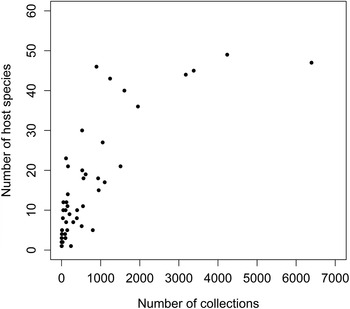
The most-collected ticks came from 50 different host species (Fig. 1). Although the number of host species increased initially with sampling effort, the number of mammal species recorded for each individual tick species reached a plateau beyond about a thousand collections (Fig. 1).
Number of mammalian host species (total n = 95 species) as a function of the number of collections (total n = 35 604 collections) for the 61 recorded tick species. Collections refer to samples of one or more ticks taken from a single host.

Host-specificity indices
The S TD and S TD* indices were calculated for 54 of the 61 recorded tick species (7 species fed on <2 mammal host species and were not included) (Supplementary Material D).
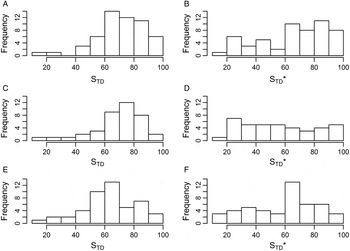
The S TD index had a mean value of 70·65 and a median of 71·85 for ticks of all life stages; a mean of 68·72 and a median of 71·41 for juvenile ticks; and a mean of 62·88 and a median of 63·40 for adult ticks. The lowest S TD index values (most specialized ticks) for pooled life stages and juvenile ticks was found for Amblyomma nuttalli Dönitz, 1909 (S TD = 16·80 in both cases), a tick species that commonly parasitizes reptiles. It was collected from two carnivores, Acinonyx jubatus and Panthera leo. The lowest index value for adult ticks was found for Dermacentor rhinocerinus (Denny, 1843) (S TD = 14·70), which was collected from two rhinoceroces, Ceratotherium simum and Diceros bicornis. The highest S TD index value (most generalist tick) for pooled life stages and juvenile ticks was found for Amblyomma tholloni Neumann, 1899 (all life stages: S TD = 97·70; juvenile ticks: S TD = 96·10). This tick species was found on three very different hosts when looking at all life stages: Lepus saxatilis, Loxodonta africana and P. leo, and on two of these host species (P. leo and L. saxatilis) when considering juvenile ticks. For adult ticks, the S TD index was highest for Ixodes bakeri Arthur and Clifford, 1961 (S TD = 98·50), which was found on two small mammals: Elephantulus myurus and Otomys sp. The distribution of the S TD index was significantly negatively skewed globally (z = −2·54, P = 0·01; Fig. 2A) and for juvenile ticks (z = −2·52, P = 0·01; Fig. 2C), indicating that according to this index, the majority of these tick species behaved as generalists. For adult ticks, however, the distribution of the S TD index was not significantly skewed (z = −0·9, P = 0·36; Fig. 2E), suggesting that they do not behave more as generalists than as specialists.
Distribution of the host-specificity indices S TD and S TD* obtained for all ticks of all life stages (A, B), for juvenile ticks only (C, D) and for adult ticks only (E, F).

The S TD* index had a mean value of 65·54 and a median of 70·61 for ticks of all life stages, a mean of 55·24 and a median of 51·99 for juvenile ticks, and a mean of 58·78 and a median of 63·40 for adult ticks. The lowest S TD* index value (most specialist tick) was again found for A. nuttalli Dönitz, 1909 (S TD* = 16·8) for pooled life stages and juvenile ticks. The lowest index values for adult ticks were again found for D. rhinocerinus (Denny, 1843) (S TD = 14·70). The highest S TD* index value (most generalist tick) for all life stages was found for A. tholloni Neumann, 1899 (S TD* = 97·99), which was collected from L. saxatilis, L. africana and P. leo. For juvenile ticks, the S TD* index was highest for Rhipicephalus distinctus Bedford, 1932 (S TD* = 97·06), which was found on ten host species (Caracal caracal, Elephantulus edwardii, E. myurus, Galerella pulverulenta, L. saxatilis, Pedetes capensis, Procavia capensis, Pronolagus rupestris, Rhabdomys pumilio and Saccostomus campestris). For adult ticks, the S TD* index was highest for I. bakeri Arthur and Clifford, 1961 (S TD = 98·74), which was found on E. myurus and Otomys sp. The distribution of the S TD* index was not significantly skewed (all: z = −1·46, P = 0·14; juveniles: z = 0·78, P = 0·43; adults: z = −0·76, P = 0·44; Fig. 2B, D, F), indicating that according to this index and across all life stages, ticks do not behave more as specialists than as generalists, and that all degrees of host specificity are observed (Fig. 2).
Variance of host-specificity indices
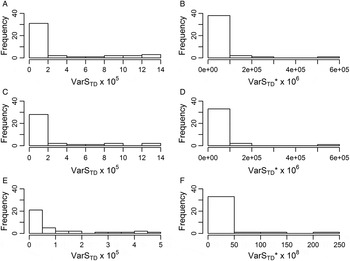
The variances of each index were calculated for 42 tick species (all life stages), 36 species in their juvenile stage and 36 species in their adult stage. The VarS TD and VarS TD* values exhibited a high frequency of small values, whether for all ticks, juveniles only or adults only (Fig. 3). There was thus little taxonomic heterogeneity among groups of host species and little heterogeneity in the intensity of infestation among hosts (Fig. 3).
Distribution of VarS TD and VarS TD* obtained for all ticks of all life stages (A, B), for juvenile ticks only (C, D) and for adult ticks (E, F).

Comparison of host-specificity indices for juvenile and adult ticks
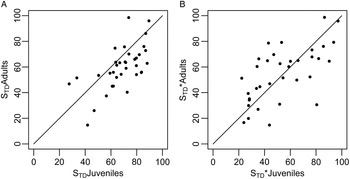
S TD and S TD* values for adult ticks followed a normal distribution, but those for juvenile ticks did not. A non-parametric Wilcoxon signed rank test was thus used to compare the values of the two life stages. Significant differences were found between them for S TD (V = 486, P = 0·001), with juvenile ticks having higher S TD values than adults (Fig. 4A). Conversely, the S TD* values of adult and juvenile ticks were not significantly different (V = 294, P = 0·74) (Fig. 4B).
Relationship between the host specificity of juvenile and adult ticks, using the S TD index (A) and the S TD* index (B). The solid line represents the expected relationship if juveniles’ and adults’ values are similar.

DISCUSSION
Accounting for host phylogeny using the S TD index (Poulin and Mouillot, Reference Poulin and Mouillot2003), we found that across all life stages, most ticks behaved as generalists; and that juvenile ticks tended to be more generalist than their adults. By contrast, when the intensity of tick infestation was accounted for using the S TD* index (Poulin and Mouillot, Reference Poulin and Mouillot2005), tick species were not found to be more generalist than specialist and both adults and juveniles exhibited a wide range of specificity for mammal species.
The results of our analysis are broadly in support of the results obtained by Cumming (Reference Cumming1998) for his pan-African analysis across all host taxonomic groups. Cumming (Reference Cumming1998) included a number of more specialized species on reptiles and birds that were not included in this analysis; incorporation of these data into a comparable analysis would probably reduce the degree of host generalism that we found in our analysis, although the potential for some species to be found across classes (e.g. on both birds and reptiles) might have the converse effect.
Our finding that juvenile ticks tend to be more generalist than their adults is novel. This is also the first time that the evolutionary host–parasite relationship (Poulin and Mouillot, Reference Poulin and Mouillot2003) has been considered in assessing tick–host specificity in Africa. According to the S TD index, ticks in South Africa can infest a variety of hosts with distant divergence times (i.e. high S TD index values). This suggests that some tick species have made relatively long jumps across their hosts’ phylogenetic tree (Cumming, Reference Cumming2000). However, the low VarS TD values also showed that the host distribution was homogeneous in the phylogenetic tree for most ticks, implying that the majority of tick species at any life stage tended to infest host species with similar divergence time distributions across the phylogenetic tree.
The S TD index shows that juvenile ticks behave more as generalists than adult ticks. In general, juvenile ticks appear to be able to infest host species from different phylogenetic groups, becoming more host-specific as adults. Some tick species (e.g. Rhipicephalus exophthalmos Keirans and Walker, 1993; Rhipicephalus capensis Koch, 1844; Hyalomma glabrum Delpy, 1949; and D. rhinocerinus Denny, 1843) exhibited a large decrease in S TD values from juvenile to adult stages, denoting an important change of strategy from generalist to specialist during their lifetime. This shift may be mediated by mouthpart morphology; juvenile ticks are unable to pierce the hide of most large mammals and must feed on thinner-skinned organisms. The need to find a mate may also impose greater specificity on adults. Experimental studies also suggest that juvenile ticks have low levels of specificity (Oliver, Reference Oliver1989; James and Oliver, Reference James and Oliver1990; Belan and Bull, Reference Belan and Bull1995; Marques Lisbôa Lopes et al. Reference Marques Lisbôa Lopes, Cerequeira Leite, Bahia Labruna, de Oliveira, Miranda Ferreira Borges, Batista Rodrigues, Avila de Carvalho, Vianna de Freitas and Vieira Junior1998) and the juveniles of many species can be reared successfully on domestic rabbits. In South Africa, the larvae and nymph of ixodid tick species are typically found on small mammals, but these juvenile ticks have also been found on a large variety of domestic and wild animal species (Horak et al. Reference Horak, Braack, Fourie and Walker2000). These findings stress the need to consider the different life stages of the vectors in the study of tick-borne diseases. Considering only adult ticks may lead to an important underestimation of pathogen transmission rates and/or of the range of hosts at risk. For example, Rickettsia africae, the causal agent of African tick bite fever, is transmitted by Amblyomma larvae and nymphs that infest a broader host range (including domestic and wild mammals, humans, as well as reptiles and birds) than Amblyomma adults (Cumming, Reference Cumming1998; Jensenius et al. Reference Jensenius, Fournier, Kelly, Myrvang and Raoult2003).
Using the S TD* index (Poulin and Mouillot, Reference Poulin and Mouillot2005), different results were obtained for tick–host specificity in South Africa. Adding infestation intensity to host phylogenetic distinctness lowered the values of the specificity index and led to a non-skewed distribution of specificity degrees. Contrary to what was found using the S TD index, this index indicates that ticks were neither more generalists nor more specialists. This result differs from that of Nava and Guglielmone (Reference Nava and Guglielmone2013) for neotropical ixodid ticks of wild and domestic hosts (mammals, birds, amphibians and reptiles), who found that juvenile ticks fed on a broader taxonomic range of hosts and exhibited higher S TD* values than adults. The difference between their study and ours may be attributable to differences in host species diversity and/or phenology and in the measure of host exploitation by the ticks (prevalence, i.e. presence–absence, vs infestation intensity).
As with the first index, VarS TD* values were low at any life stage, suggesting that the majority of tick species infested more intensively host species with similar phylogenetic distances. Poulin and Mouillot (Reference Poulin and Mouillot2004) similarly found a negative correlation between parasites’ average infection success and the taxonomic or phylogenetic distances among their hosts. These authors argued that a parasite may reach a higher abundance in congeneric hosts because of shared host features (e.g. immune system, behaviour, anatomy and biochemistry) to which it is pre-adapted, whilst colonizing distantly related hosts requires parasite physiological and morphological adaptations that may affect its ability to achieve a high abundance.
Together, our results suggest that ticks are generalist, but do not infest with the same intensity hosts that are phylogenetically too distant (as revealed by the S TD and the S TD* indices, respectively). Although host phylogenetic distinctness denotes host switching over evolutionary time scales (Poulin and Mouillot, Reference Poulin and Mouillot2003, Reference Poulin and Mouillot2004), considering infestation intensity emphasizes host use more strongly (Poulin and Mouillot, Reference Poulin and Mouillot2005).
Despite the more sophisticated conclusions about tick-feeding preferences offered by the inclusion of both phylogeny and infestation intensity, incorporating these elements in the analyses requires data of good quality. It is difficult to accurately estimate the number of ticks on a host. For example, when studying heavily infested animals, special attention is given to a fixed area (i.e. ears, neck and head) (Sonenshine, Reference Sonenshine and Sonenshine1993); orifices, such as the rectum and ear cavities, are hard to search effectively on a live animal. Ticks may also attach to their hosts only at particular times during their life cycle (Jongejan and Uilenberg, Reference Jongejan and Uilenberg2004); and microclimatic conditions may influence when either a juvenile or adult tick may be found on a particular host (Randolph and Storey, Reference Randolph and Storey1999).
We conclude that although ticks as a group appeared to follow a range of strategies from specialist to generalist, a majority of tick species behaved as generalist when feeding on mammals in South Africa and that for many tick species, generalism was higher during the juvenile stage. The separation of different life history stages and the inclusion of evolutionary and ecological data using two state-of-the-art indices provided new insights into tick–mammal interactions. Our results also demonstrate the value of comparing different host-specificity indices, while indicating that further research is needed to determine their sensitivity to data type and quantity.
SUPPLEMENTARY MATERIAL
To view supplementary material for this article, please visit http://dx.doi.org/10.1017/S0031182015001730.
ACKNOWLEDGEMENTS
We thank Rina Serfontein and her many assistants for their role in data capture, and Lisa Nupen for assisting with the processing of phylogenetic information.
FINANCIAL SUPPORT
This research was supported by a grant from the South African National Biodiversity Institute's South African Biodiversity Information Facility (SABIF) to IH and GC and the DST/NRF Centre of Excellence at the Percy FitzPatrick Institute.