Introduction
Psychosis, especially schizophrenia, may be a disabling condition and classically is associated with poor clinical outcome. Nonetheless, recent findings confirm that prognosis is not universally poor and that the course need not be one of inexorable decline (Hopper et al., Reference Hopper, Harrison, Janca and Sartorius2007; Morgan et al., Reference Morgan, Lappin, Heslin, Donoghue, Lomas, Reininghaus, Onyejiaka, Croudace, Jones, Murray, Fearon, Doody and Dazzan2014; Revier et al., Reference Revier, Reininghaus, Dutta, Fearon, Murray, Doody, Croudace, Dazzan, Heslin, Onyejiaka, Kravariti, Lappin, Lomas, Kirkbride, Donoghue, Morgan and Jones2015). Interest has therefore shifted towards identifying predictors of outcome for treatment planning in order to ameliorate the adverse impact of the illness (White et al., Reference White, Stirling, Hopkins, Morris, Montague, Tantam and Lewis2009; Juola et al., Reference Juola, Miettunen, Veijola, Isohanni and Jääskeläinen2013; Friis et al., Reference Friis, Melle, Johannessen, Røssberg, Barder, Evensen, Haahr, Ten Velden Hegelstad, Joa, Langeveld, Larsen, Opjordsmoen, Rund, Simonsen, Vaglum and McGlashan2016).
Neurocognitive deficits and negative symptoms are important drivers of disability in psychosis (Breier et al., Reference Breier, Schreiber, Dyer and Pickar1991; Wieselgren et al., Reference Wieselgren, Lindström and Lindström1996; Ho et al., Reference Ho, Nopoulos, Flaum, Arndt and Andreasen1998; Green et al., Reference Green, Kern, Braff and Mintz2000; Lipkovich et al., Reference Lipkovich, Deberdt, Csernansky, Sabbe, Keefe and Kollack-Walker2009; Faber et al., Reference Faber, Smid, Van Gool, Wunderink, Wiersma and van den Bosch2011), as is social cognition (Couture et al., Reference Couture, Penn and Roberts2006; Fett et al., Reference Fett, Viechtbauer, Dominguez, Penn, van Os and Krabbendam2011; Pinkham, Reference Pinkham2014). However, which aspects of cognition are most predictive of prognosis remains elusive.
One area to attract attention in this regard is reasoning and cognitive biases (van Hooren et al., Reference van Hooren, Versmissen, Janssen, Myin-Germeys, à Campo, Mengelers, van Os and Krabbendam2008). Jumping to conclusions (JTC) defines a tendency to form beliefs and to make a decision about an event without having enough information about it, sometimes referred to as data-gathering bias (Freeman et al., Reference Freeman, Pugh and Garety2008). JTC plays a central role in psychological and neuropsychological theories of delusions as it is considered to lead to the rapid acceptance of implausible ideas and to prevent consideration of more realistic alternative explanations of events (Freeman and Garety, Reference Freeman and Garety2014). A recent meta-analysis (Dudley et al., Reference Dudley, Taylor, Wickham and Hutton2016) summarized evidence that people with psychosis make decisions on the basis of little evidence, have a more extreme reasoning style than people with other mental health conditions or healthy controls and that JTC is linked with a higher probability of having delusions. Moreover, there is evidence that such hasty reasoning is predictive of less improvement over time in delusions (So et al., Reference So, Peters, Swendsen, Garety and Kapur2014).
In her theoretical model of psychosis, Garety et al. (Reference Garety, Kuipers, Fowler, Freeman and Bebbington2001) proposed JTC as one of the biased conscious appraisal processes which are crucial in contributing to the perception of anomalous experiences as personally significant and externally caused when the subject is in search for an explanation (Garety et al., Reference Garety, Kuipers, Fowler, Freeman and Bebbington2001). Garety and Freeman (Reference Garety and Freeman1999) found empirical support for JTC, externalizing attributional biases and deficits in understanding social situations and the intentions of others, to be specific biases in these processes (Garety and Freeman, Reference Garety and Freeman1999). Interestingly, these biases and deficits, which are considered to be part of social cognition, are also included in similar constructs as metacognition (Lysaker et al., Reference Lysaker, Carcione, Dimaggio, Johannesen, Nicolo, Procacci and Semerari2005, Reference Lysaker, Gumley, Luedtke, Buck, Ringer, Olesek, Kukla, Leonhardt, Popolo and Dimaggio2013), which has led to the development of specific intervention programmes, as the Metacognition Training designed by Moritz and Woodward, which has specific modules dedicated to the bias (Moritz and Woodward, Reference Moritz and Woodward2007). This latter intervention has been reported to improve positive symptoms (Aghotor et al., Reference Aghotor, Pfueller, Moritz, Weisbrod and Roesch-Ely2010; Moritz et al., Reference Moritz, Kerstan, Veckenstedt, Randjbar, Vitzthum, Schmidt, Heise and Woodward2011, Reference Moritz, Veckenstedt, Bohn, Hottenrott, Scheu, Randjbar, Aghotor, Köther, Woodward, Treszl, Andreou, Pfueller and Roesch-Ely2013; Favrod et al., Reference Favrod, Rexhaj, Bardy, Ferrari, Hayoz, Moritz, Conus and Bonsack2014) in patients with schizophrenia, which renders the JTC bias as especially interesting for research into the outcome of the disorder.
There is also evidence of a link between JTC and the more classic construct of neurocognition. JTC has been shown to be negatively associated with neuropsychological performance in FEP samples (Falcone et al., Reference Falcone, Murray, O'Connor, Hockey, Gardner-Sood, Di Forti, Freeman and Jolley2015Reference Falcone, Murray, O'Connor, Hockey, Gardner-Sood, Di Forti, Freeman and Jolleya; González et al., Reference González, López-Carrilero, Barrigón, Grasa, Barajas, Pousa, González-Higueras, Ruiz-Delgado, Cid, Lorente-Rovira, Pélaez, Ochoa and Ochoa2017), but also with lower IQ scores among healthy relatives of patients with schizophrenia (Van Dael et al., Reference Van Dael, Versmissen, Janssen, Myin-Germeys, van Os and Krabbendam2006) and controls with high levels of psychotic experiences (Mortimer et al., Reference Mortimer, McKay, Quemada, Clare, Eastwood and McKenna1996; Van Dael et al., Reference Van Dael, Versmissen, Janssen, Myin-Germeys, van Os and Krabbendam2006). Nonetheless, whether the relationship between neurocognition and JTC moderate the link with positive symptoms remains elusive (Andreou et al., Reference Andreou, Schneider, Balzan, Luedecke, Roesch-Ely and Moritz2015).
To the best of our knowledge, only one study has examined whether JTC moderates outcome of the disorder by measuring its impact on functional outcome (Andreou et al., Reference Andreou, Treszl, Roesch-Ely, Köther, Veckenstedt and Moritz2014). The results did not support a predictor role of the bias, although this may have been because of the length of follow-up was only 6 months and the sample was small. We decided to examine reasoning bias as a possible predictor of the course and clinical outcome in the medium to long term, using data from a well-characterized sample of patients presenting to psychiatric services for the first time with psychosis. The aim of our study was to examine independent associations between JTC and clinical outcome at 4 years after the first contact with mental health services. For this purpose, we selected remission and several clinical outcomes of service use such as days of admissions, use of the Mental Health Act (MHA) for involuntary treatment and instances of police involvement during an admission to a psychiatric unit.
As JTC has been related in several studies to the presence of delusions (Falcone et al., Reference Falcone, Murray, O'Connor, Hockey, Gardner-Sood, Di Forti, Freeman and Jolley2015Reference Falcone, Murray, O'Connor, Hockey, Gardner-Sood, Di Forti, Freeman and Jolleya; McLean et al., Reference McLean, Mattiske and Balzan2016), and to a lesser extent to persistence of delusion severity (Falcone et al., Reference Falcone, Murray, Wiffen, O'Connor, Russo, Kolliakou, Stilo, Taylor, Gardner-Sood, Paparelli, Jichi, Di Forti, David, Freeman and Jolley2015b), we hypothesized that those patients who presented more severe reasoning bias at baseline would have worse clinical prognosis.
Methodology
Participants
Participants for this study were recruited as part of the National Institute of Health Research Biomedical Research Centre Genetics and Psychosis (GAP) study conducted in South London, UK. Further details of the study are available in Di Forti et al. (Reference Di Forti, Marconi, Carra, Fraietta, Trotta, Bonomo, Bianconi, Gardner-Sood, O'Connor, Russo, Stilo, Marques, Mondelli, Dazzan, Pariante, David, Gaughran, Atakan, Iyegbe, Powell, Morgan, Lynskey and Murray2015). Briefly, the GAP study comprised individuals aged 18–65 years who presented to the psychiatric services of the South London and Maudsley (SLaM) National Health Service (NHS) Foundation Mental Health Trust between December 2005 and October 2010 with a first-episode of psychosis (FEP) [International Classification of Diseases (ICD)-10; F20-F29 and F30-F33; and Diagnostic and Statistical Manual of Mental Disorders (DSM)–IV; 295.1–298.9] (WHO, 1992; American Psychiatric Association, 2000). Diagnosis at the moment of recruitment was determined by administration of the Schedules for Clinical Assessment in Neuropsychiatry (SCAN) (WHO, 1994) and was later validated by using the computerized Operational Criteria system (version 2004) (McGuffin et al., Reference McGuffin, Farmer and Harvey1991). Cases were excluded if there was evidence of: (1) psychotic symptoms precipitated by an organic cause; (2) transient psychotic symptoms resulting from an acute intoxication as defined by ICD-10; (3) head injury causing clinically significant loss of consciousness; and (4) learning disability (IQ < 70) as assessed by the Wechsler Adult Intelligence Scale – Third Edition (WAIS-III) (Wechsler, Reference Wechsler1997). The original GAP sample comprised N = 431 FEP cases; of these, information on JTC at baseline was available for 123 cases [28% of the original GAP sample (Falcone et al., Reference Falcone, Murray, O'Connor, Hockey, Gardner-Sood, Di Forti, Freeman and Jolley2015Reference Falcone, Murray, O'Connor, Hockey, Gardner-Sood, Di Forti, Freeman and Jolleya)]. This subsample with information on JTC did not differ significantly from the full GAP sample in terms of gender, age, education level, diagnosis or ethnicity (online Supplementary Table S1). Further, 83% (N = 102) of the subsample (N = 123) was successfully traced 4 years after first contact with mental health services. Therefore, data presented here are based on these 102 cases. Ethical permission was obtained from the SLaM and the Institute of Psychiatry Research Ethics Committee. All patients gave informed written consent after reading a detailed information sheet.
Measures at baseline
Socio-demographic characteristics
Demographic data were collected using the Medical Research Council (MRC) Socio-demographic Schedule modified version (Mallett et al., Reference Mallett, Leff, Bhugra, Pang and Zhao2002) and supplemented by clinical records. For educational level, we divided the sample into three categories: no qualification, school education (GCSE, ‘O’ levels and ‘A’ levels) and tertiary education (vocational, college, university or professional qualification). We dichotomized the domains of employment (employed v. unemployed), marital (in a stable relationship v. no relationship) and living arrangements status (independent living v. no independent living). For lifetime use of alcohol and illegal drugs, we collected data from the GAP baseline measures, and split both into ever used (1) v. never used (0). Lifetime use of cannabis was assessed with the Cannabis Experience Questionnaire modified version (Di Forti et al., Reference Di Forti, Morgan, Dazzan, Pariante, Mondelli, Marques, Handley, Luzi, Russo, Paparelli, Butt, Stilo, Wiffen, Powell and Murray2009), dividing patients into those who reported ever having used cannabis (1) and those who reported never having used it (0). Ethnicity was self-ascribed using categories employed by the 2001 UK Census (http://www.ons.gov.uk/ons/guide-method/census/census-2001/index.html). Due to small numbers in some ethnic categories, we combined them into three broad ethnic groups: white (all white groups), black (all black groups) and other (encompassing Asian, mixed ethnicity and other ethnicities).
Clinical assessments at baseline
Duration of untreated psychosis (DUP) was defined as the difference between the date of the appearance of the first positive psychotic symptom and the date of initiation of treatment with antipsychotics, in weeks (Norman and Malla, Reference Norman and Malla2001).
The baseline diagnoses were made from interviews and mental health records utilizing the Operational Criteria Checklist (McGuffin et al., Reference McGuffin, Farmer and Harvey1991) and were grouped using ICD-10 into: affective psychosis group (patients diagnosed with codes F30–33) or schizophrenia-spectrum disorders group (ICD-10 codes F20–29) (Trotta et al., Reference Trotta, Iyegbe, Di Forti, Sham, Campbell, Cherny, Mondelli, Aitchison, Murray, Vassos and Fisher2016). For those who did not meet the criteria based on ICD-10, we extracted the diagnosis from the same OPCRIT assessment based on DSM-IV, grouping them into: affective psychosis (patients diagnosed with bipolar disorder, manic episode with psychosis or major depression with psychotic features – codes 296–296.9-) or schizophrenia-spectrum disorder (for schizophrenia, schizoaffective disorder, delusional disorder and psychotic disorder NOS – codes 295.1–295.9 and 297.1–298.9-).
Symptomatology at baseline was rated on the Positive and Negative Syndrome Scale (PANSS) (Kay et al., Reference Kay, Fiszbein and Opler1987), from face-to-face interviews in the week preceding the assessment. The 30 items that comprise the scale are divided into positive, negative and general psychopathology scales. A confirmatory factor analysis (CFA) was conducted of the Wallwork/Fortgang five-factor model (Wallwork et al., Reference Wallwork, Fortgang, Hashimoto, Weinberger and Dickinson2012). This Wallwork/Fortgang five-factor model has been shown to be the most robust PANSS factorial solution for exploring symptom profiles in FEP patients (Langeveld et al., Reference Langeveld, Andreassen, Auestad, Faerden, Hauge, Joa, Johannessen, Melle, Rund, Røssberg, Simonsen, Vaglum and Larsen2013) and has previously used in this sample (Ajnakina et al., Reference Ajnakina, Trotta, Oakley-Hannibal, Di Forti, Stilo, Kolliakou, Gardner-Sood, Gaughran, David, Dazzan, Pariante, Mondelli, Morgan, Vassos, Murray and Fisher2016, Reference Ajnakina, Lally, Di Forti, Kolliakou, Gardner-Sood, Lopez-Morinigo, Dazzan, Pariante, Mondelli, MacCabe, David, Gaughran, Murray and Vassos2017). Global Assessment of Functioning (GAF) was used to measure both overall symptoms severity and disability associated with the illness at the study entry (Endicott et al., Reference Endicott, Spitzer, Fleiss and Cohen1976). We complimented the GAF with the Clinical General Impression scale (CGI) (Guy, Reference Guy1976).
Baseline general intelligence was assessed using a brief version of the WAIS-III (Wechsler, Reference Wechsler1997) which includes a standardized set of five tasks (Information, Block Design, Matrix Reasoning, Digit Symbol Coding and Digit Span) to give a prorated intelligence quotient (IQ).
Jumping to conclusions
For the measurement of the JTC bias, participants had to complete both versions of the probabilistic reasoning ‘Beads’ Task (Garety et al., Reference Garety, Freeman, Jolley, Dunn, Bebbington, Fowler, Kuipers and Dudley2005), with beads in 85:15 and 60:40 ratios. Participants are shown two jars containing coloured beads in opposite ratios (e.g. in one of them, the proportion was 85 black v. 15 orange, and in the other, the ratio was reversed). Beads are then drawn from one of the two jars (randomly chosen by the computer), one at a time. After each draw, the participants can either make a guess about which jar the beads come from or request a new bead. Participants will only have a single trial in which they can ask as many beads as they need to make their final decision. The two main variables classically extracted from the ‘Beads Task’ are: a continuous variable defined as the numbers of draws before making a decision, so-called ‘draws to decision’ (DTD); and a dichotomous variable (JTC/no JTC), in which JTC bias has been operationally defined as reaching a decision after fewer than three beads (Garety et al., Reference Garety, Freeman, Jolley, Dunn, Bebbington, Fowler, Kuipers and Dudley2005).
In this study, dichotomous rating was preferred since the distribution of the DTD variable is not normal, the colour of each drawn and the sequence could influence the next decision; and there is a better fit with clinical validity of the dichotomous approach, as we are mainly interested in identifying the extreme responders from the rest. Moreover, the use of dichotomous scoring seems to be superior in predicting change in delusion conviction (So et al., Reference So, Freeman, Dunn, Kapur, Kuipers, Bebbington, Fowler and Garety2012). Consequently, and based on previously published papers using different types of Beads Tasks, we considered a hasty decision on any of the two versions of the task, to be evidence of the tendency to JTC (Garety et al., Reference Garety, Freeman, Jolley, Dunn, Bebbington, Fowler, Kuipers and Dudley2005; Ross et al., Reference Ross, Freeman, Dunn and Garety2011; Jolley et al., Reference Jolley, Thompson, Hurley, Medin, Butler, Bebbington, Dunn, Freeman, Fowler, Kuipers and Garety2014; So et al., Reference So, Peters, Swendsen, Garety and Kapur2014; So and Kwok, Reference So and Kwok2015).
Tracing patients at follow-up
Approximately 4 years (mean = 4.0, s.d. = 0.13) after first contact with psychiatric services for psychosis, we sought to trace all FEP cases included in the original GAP study with JTC scores available at baseline and who had given consent for their clinical records to be accessed at follow-up. A thorough database search was carried out using the electronic psychiatric records that are the primary clinical record keeping system within the SLaM Trust [Electronic Patient Journey System (ePJS)]. To trace those patients who dropped out from the services, we contacted their last known general practitioners via mail seeking further information about the patient's whereabouts and health; then patients themselves were contacted wherever possible. All deaths and emigrations up to and including those that occurred during the final year of follow-up were identified by a case-tracing procedure with the Office for National Statistics for England and Wales and the General Register Office for Scotland. Further details are available in Ajnakina et al. (Reference Ajnakina, Lally, Di Forti, Kolliakou, Gardner-Sood, Lopez-Morinigo, Dazzan, Pariante, Mondelli, MacCabe, David, Gaughran, Murray and Vassos2017).
Data at follow-up
At follow-up, extensive information was extracted across clinical and social domains, and patterns of care, from electronic psychiatric clinical records using the WHO Life Chart Schedule (LCS) extended version (Sartorius et al., Reference Sartorius, Gulbinat, Harrison, Laska and Siegel1996).
Clinical outcomes
Remission was defined as an absence of overt psychotic symptoms for ⩾6 months similar to earlier work conducted in the same geographical region (Morgan et al., Reference Morgan, Lappin, Heslin, Donoghue, Lomas, Reininghaus, Onyejiaka, Croudace, Jones, Murray, Fearon, Doody and Dazzan2014; Revier et al., Reference Revier, Reininghaus, Dutta, Fearon, Murray, Doody, Croudace, Dazzan, Heslin, Onyejiaka, Kravariti, Lappin, Lomas, Kirkbride, Donoghue, Morgan and Jones2015) and in line with Operational Criteria (Andreasen et al., Reference Andreasen, Carpenter, Kane, Lasser, Marder and Weinberger2005) using information extracted from clinical records. This measure of remission was neither dependent on absence of non-psychotic symptoms (e.g. depressed mood, neurotic manifestations), nor on whether patients were receiving treatment with antipsychotic medications during remission.
Service use
Utilising the LCS extended version (Sartorius et al., Reference Sartorius, Gulbinat, Harrison, Laska and Siegel1996) and excluding hospital admission on first contact with mental health services for psychosis, we extracted detailed information on circumstances of each re-admission including all compulsory admissions (i.e. admissions exercised under MHA legislation) and instances when police was involved at the time of, or shortly before, hospital admissions throughout the 4-year follow-up period. Compulsory admission under the MHA has been previously used for analysing pathways of care in similar samples of the area of South London (Davies et al., Reference Davies, Thornicroft, Leese, Higgingbotham and Phelan1996; Morgan et al., Reference Morgan, Mallett, Hutchinson, Bagalkote, Morgan, Fearon, Dazzan, Boydell, McKenzie, Harrison, Murray, Jones, Craig and Leff2005b); and more recently instances of police involvement has been also applied to measure pattern of care in this same sample (Ajnakina et al., Reference Ajnakina, Lally, Di Forti, Kolliakou, Gardner-Sood, Lopez-Morinigo, Dazzan, Pariante, Mondelli, MacCabe, David, Gaughran, Murray and Vassos2017). Using the admission and discharge dates for each re-admission, we calculated the total length of inpatient stays in psychiatric wards during the entire follow-up period.
Analyses
All analyses were conducted in STATA release 14 (STATACorp, 2015).
Descriptive statistics
The basic characteristics of the sample including socio-demographics (gender, age, ethnicity and educational level) and clinical information (DUP, diagnosis and length of follow-up) were described using frequencies, percentages, mean and standard deviations (s.d.), median and interquartile ranges (IQRs). The comparisons between FEP groups based on the presence or not of the bias were made using χ2, Student's t test or Wilcoxon–Mann–Whitney tests when appropriate. Normality of all variables was assessed computing Shapiro–Wilk normality test. For the investigation of cross-sectional relationships at follow-up between JTC and clinical outcome, we ran Wilcoxon–Mann–Whitney tests for ‘days of hospitalization’ as it is not normally distributed, and χ2 for the three dichotomous categorical variables: MHA intervention, police intervention and remission (yes/no). Effect sizes were calculated for all the statistical tests using Cohen's d for t test and Cramer's v. (Φc) for χ2. When Mann–Whitney test is used, effect sizes from z values were calculated.
Confirmatory factor analysis
The detailed description of methods employed to conduct CFA using this sample is available in Ajnakina et al. (Reference Ajnakina, Trotta, Oakley-Hannibal, Di Forti, Stilo, Kolliakou, Gardner-Sood, Gaughran, David, Dazzan, Pariante, Mondelli, Morgan, Vassos, Murray and Fisher2016). Briefly, CFA was conducted to evaluate the statistical fit (Stefanovics et al., Reference Stefanovics, Elkis, Zhening, Zhang and Rosenheck2014) of the Wallwork/Fortgang five-factor model of psychosis (Wallwork et al., Reference Wallwork, Fortgang, Hashimoto, Weinberger and Dickinson2012) in this sample. This model includes positive (P1, P3, P5, G9), negative (N1, N2, N3, N4, N6 and G7), excited (P4, P7, G8 and G14), disorganized/concrete (P2, N5, G11) and depressed (G2, G3, G6) factors; which were used as confounders for regression analyses.
Association analysis
The main hypothesis was tested by four regressions with the dichotomous rating of JTC as the dependant variable (JTC = 1; no JTC = 0): A negative binomial regression for the not normally distributed count-dependent variable ‘days of hospitalization’ as it was over dispersed; and logistic regression analyses for the binary variables (clinical remission, MHA intervention and police intervention). These regressions were calculated both unadjusted and adjusted for age, gender, ethnicity, IQ, symptom dimensions and functional level measured by GAF. In the regression model for predicting days of admission, we performed further adjustment of the model including the dichotomy variables of MHA and police intervention, as they both could be confounders for longer admission.
Results
Follow-up was successfully completed for 82.9% (n = 102) of baseline patients, with a total of 17.1% lost (n = 21). Of those 21, two (1.6%) had died, six (4.9%) had emigrated, four (3.3%) were excluded as we did not have available information on follow-up and in nine (7.3%) the attempt at contact was unsuccessful. When comparing baseline sociodemographic characteristics of those subjects lost at follow-up with those included, we did not find any significant difference in age, gender, educational level, ethnicity nor diagnosis (please refer to the online Supplementary Table S2). Nonetheless, we found significant differences in baseline symptomatology, with more severe symptoms in the lost subjects compared with those who completed follow-up [positive subscale of PANSS 16.6 v. 13.52, respectively; t (113) = 0.21, p = 0.03; GAF symptom subscale 42.22 v. 52.8, respectively, t (105) = 2.11, p = 0.04]. Hence, it is not possible to reject the possibility of attrition bias.
Patient characteristics at baseline
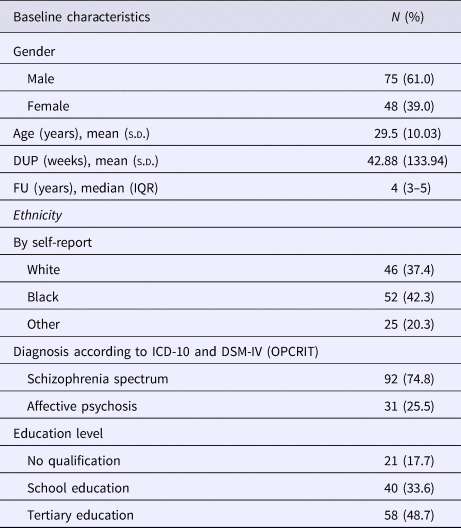
Sociodemographic and clinical information of the baseline sample is shown in Table 1. The mean age at first contact was 29.4 years (s.d. = 10.03); n = 75 (61%) of the sample were men, 38% were of white ethnicity and n = 58 (49%) had tertiary education. Of the total 123 patients, n = 63 (51.2%) had shown JTC and n = 92 (74.8%) had received a diagnosis of a schizophrenia-spectrum disorder.
Sociodemographic and clinical characteristics of the entire sample (n = 123)

s.d., standard deviation; IQR, interquartile range; DUP, duration of untreated psychosis; FU, follow-up.
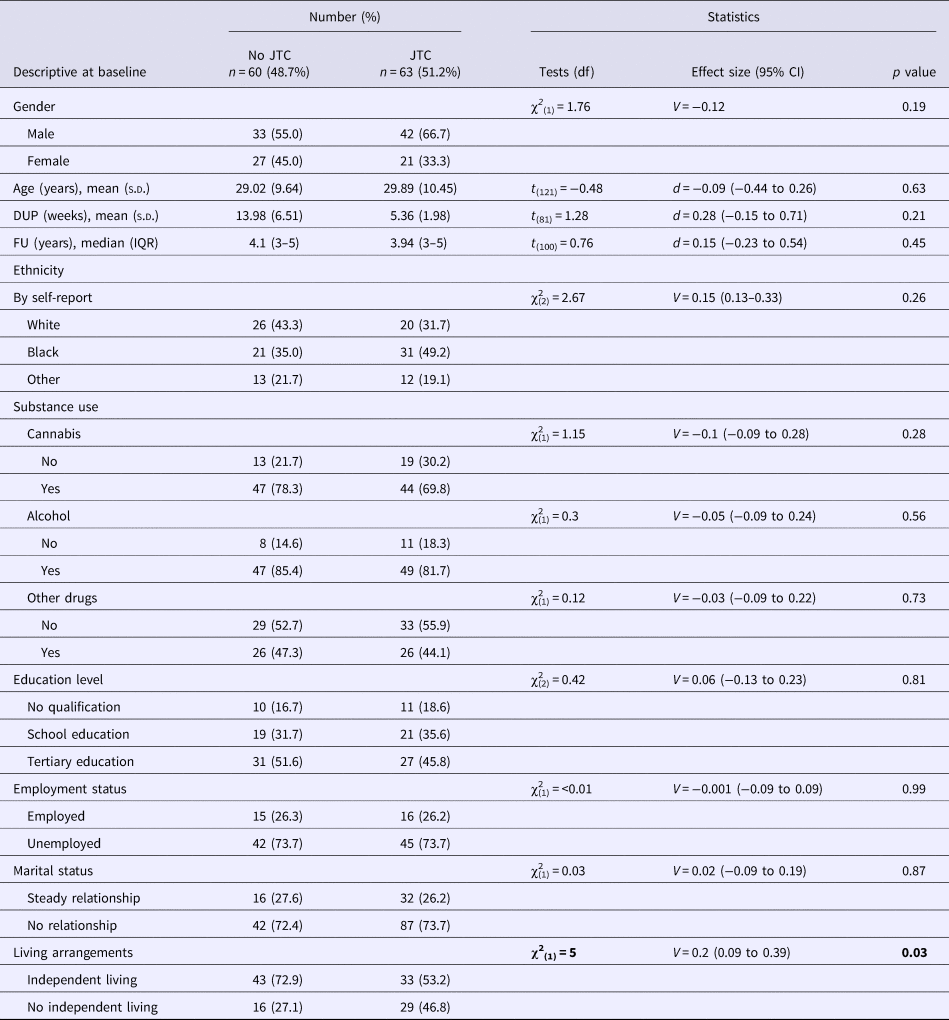
Table 2 shows the comparison of baseline sociodemographic and clinical characteristics between patients with and without JTC bias (JTC/no JTC groups). We found no statistically significant differences in age, gender, DUP, follow-up time, ethnicity or educational level. In terms of lifetime substance use, there were no statistically significant differences regarding consumption of cannabis by JTC. As far as social functioning is concerned, no difference was found in employment or marital status according to JTC, but there was a significant difference in living arrangements, with a higher proportion of non-independent living in those presenting the bias [46.8% v. 27.1%; χ2(1) = 5, p = 0.03].
Description and comparison of sociodemographic at baseline of patients with and without JTC bias

JTC, jumping to conclusions; s.d., standard deviation; IQR, interquartile range; df, degrees of freedom; FU, follow-up. Bold highlights statistically significant values at p < 0.05.
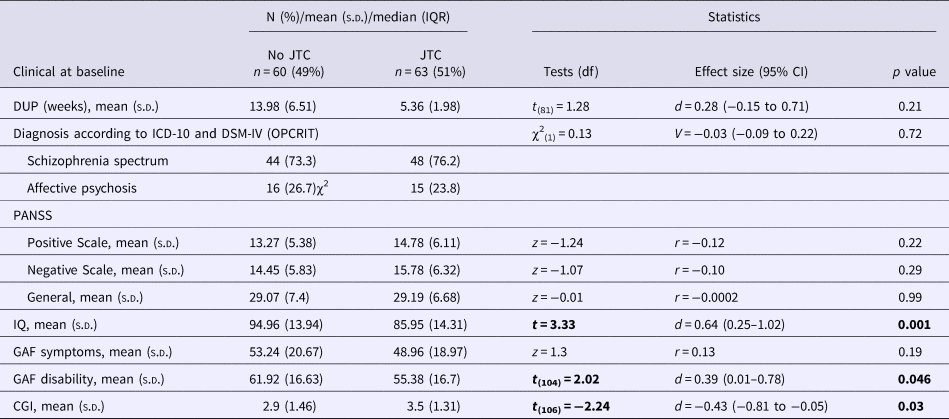
The baseline clinical status characteristics are presented in Table 3. There was no statistically significant difference in diagnosis between JTC groups (p = 0.72). To our surprise, we did not find significant differences in scores on the Positive Symptoms subscale of the PANSS (14.78 ± 6.11 v. 13.27 ± 5.38; p = 0.22). We found significant differences in IQ (mean of 85.95 ± 14.31 for those presenting JTC and 94.96 ± 13.94 for those without the bias; d = 0.64 p = 0.001). Functionality measured by the GAF scale was worse in patients with JTC (mean of 55.38 ± 16.7) than the patients without it (mean of 61.92 ± 16.63; t = 2.02; d = 0.39; p = 0.05).
Description and comparison of clinical and functional state at baseline of patients with and without JTC bias

JTC, jumping to conclusions; s.d., standard deviation; IQR, interquartile range; df, degrees of freedom; DUP, duration of untreated psychosis; PANSS, Positive and Negative Symptoms Scale; GAF, Global Assessment of Functioning; CGI, clinical global impressions. Bold highlights statistically significant values at p < 0.05.
Clinical presentation over the follow-up period
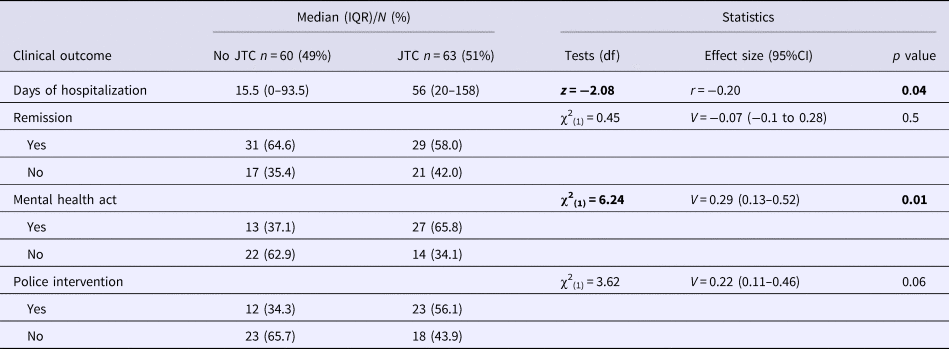
The comparison of clinical outcome domains during follow-up is presented in Table 4. Fifty-eight per cent (n = 29 of 50) of the individuals with the bias and 64% (n = 31 of 48) of those without JTC achieved remission criteria in the long term; this difference was not statistically significant (χ2 = 0.45, df = 1, p = 0.5).
Comparison of clinical outcome during follow-up of patients with and without JTC

JTC, jumping to conclusions; IQR, interquartile range; df, degrees of freedom. Bold highlights statistically significant values at p < 0.05.
Service use over the follow-up period
The comparison of service use variables during follow-up are also presented in Table 4.
In the follow-up period, on average, patients presenting JTC had more inpatient days (median = 56, IQR = 20–158), than those without the bias (median = 15.5, IQR = 0–93.5; U = −2.08, p = 0.04). A higher proportion of patients with the JTC bias (N = 27, 65.8%) were detained under the MHA than those without JTC [N = 13, 37.1%; χ2(1) = 6.24; p = 0.01]. The percentage subject to police involvement in compulsory admission during follow-up shows a tendency to be higher in the patients with JTC [N = 23 (56.1%) out of 41] than in those without the bias [12 (34.3%) out of 35], but this did not reach significance [χ2(1) = 3.62; p = 0.06].
Predicting effects of JTC on long-term clinical outcome
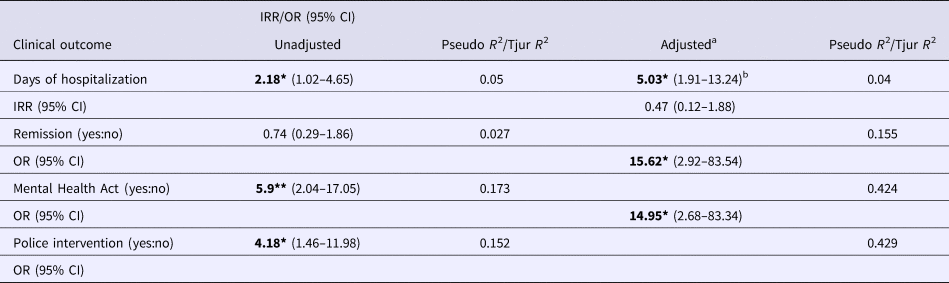
Predictor effects of JTC on long-term clinical outcome are presented in Table 5.
Predicting effects of JTC on long-term clinical outcome

JTC, jumping to conclusions; IRR, incident rate ratio; OR, odds ratio; CI, confident interval. Bold highlights statistically significant values
*p < 0.05 **p < 0.001.
a Adjusted for age, gender, ethnicity, IQ, symptom dimensions and GAF disability.
b Mental health act and police intervention was also added as confounders for days of admission.
Regression analyses showed that the presence of JTC predicted more inpatient days [IRR = 2.18, 95% confidence interval (CI) 1.01–4.72, p = 0.05] and more proneness to intervention under the mental health act (OR 5.9, 95% CI 2.04–17.05, p = 0.001) and by the police (OR 4.18, 95% CI 1.46–11.98, p = 0.008) in the moment of admission. After adjusting for age, gender, ethnicity, IQ and symptoms and disability measured by GAF, the effect remained significant for days of hospitalization (adjusted IRR = 5.03, 95% CI 1.91–13.24, p = 0.001), use of the MHA (adjusted OR 15.62, 95% CI 2.92–83.54, p = 0.001) and police involvement (adjusted OR 14.95, 95% CI 2.68–83.34, p = 0.002). There was no predictive effect on remission.
Additionally, all the OR with 95% CIs and p values for all covariates of four full regression models are presented in the online Supplementary Table S3.
Discussion
The presence of JTC at baseline was associated with subsequent greater risk of compulsory admissions under the MHA and higher risk of police intervention at follow-up, confirming our preliminary hypothesis. Why that should be is as yet unclear. One possible explanation is that JTC is related to behaviours such as impulsivity, beyond general cognitive and executive impairments, although evidence for this association has not been demonstrated conclusively (Moritz and Woodward, Reference Moritz and Woodward2005; Rubio et al., Reference Rubio, Ruiz-Veguilla, Hernández, Barrigón, Salcedo, Moreno, Gómez, Moritz and Ferrín2011; Lunt et al., Reference Lunt, Bramham, Morris, Bullock, Selway, Xenitidis and David2012); however, the studies claiming to look at this association have not employed a specific measure of impulsivity.
Another possible explanation for our findings could be a relationship between data-gathering bias and risk of aggressive behaviour or violence. The link between schizophrenia and violence has been previously studied (Fazel et al., Reference Fazel, Gulati, Linsell, Geddes and Grann2009), but it has been challenging to identify the processes underlying this association. Despite discrepancies in the literature, neurocognition seems to be one of the core risk factors for violence, mediated by several proximal and more direct risk factors (O'Reilly et al., Reference O'Reilly, Donohoe, Coyle, O'Sullivan, Rowe, Losty, McDonagh, McGuinness, Ennis, Watts, Brennan, Owens, Davoren, Mullaney, Abidin and Kennedy2015). In addition, it has been shown that positive psychotic symptoms, including persecutory ideation, increase the risk of minor and serious violence (Swanson et al., Reference Swanson, Swartz, Van Dorn, Elbogen, Wagner, Rosenheck, Stroup, McEvoy and Lieberman2006). Given the relationship between JTC and the proneness and maintenance of delusion ideation, this could also explain part of the association of JTC and the higher need for police and MHA interventions in the moment of admission.
One mediating factor may be insight. Preliminary work on this cohort showed that JTC bias and cognition were each associated with poorer recognition of illness (Wiffen et al., Reference Wiffen, Falcone, O'Connor, Russo, Murray and David2010). Furthermore, the relationship between JTC and insight has been explored in schizophrenia patients in forensic settings and it was found a direct correlation between the information patients consider in making decisions and their clinical insight (Kuokkanen et al., Reference Kuokkanen, Lappalainen, Repo-Tiihonen, Tiihonen and Aho-Mustonen2016). Given that poor clinical insight was found to be a risk factor for violence, and following the same rationale (Alia-Klein et al., Reference Alia-Klein, O'Rourke, Goldstein and Malaspina2007), lack of insight could be a possible additional explanation for the need of police intervention in those presenting hasty-decision style; and indeed poor insight is strongly associated with involuntary treatment in hospital (David et al., Reference David, Buchanan, Reed and Almeida1992). Thus, insight could have had an impact in the association between JTC and the intervention of police and MHA, so further studies focusing on the relationship between JTC and insight should be encouraged. Nonetheless, the interpretation of the need for police intervention as a proxy for social or behavioural disruption should be cautious. Previous work from the same area found that the higher police involvement at the time of admission in the African Caribbean group was explained by the greater likelihood of such families to seek help from police themselves in these situations than white British families (Morgan et al., Reference Morgan, Mallett, Hutchinson, Bagalkote, Morgan, Fearon, Dazzan, Boydell, McKenzie, Harrison, Murray, Jones, Craig and Leff2005b).
The other effect predicted by JTC was number of days of hospitalization. This outcome is one of the most employed markers of service use in order to study the clinical course of psychosis (Johnstone et al., Reference Johnstone, Macmillan, Frith, Benn and Crow1990; Geddes et al., Reference Geddes, Mercer, Frith, MacMillan, Owens and Johnstone1994; Takei et al., Reference Takei, Persaud, Woodruff, Brockington and Murray1998; Lehtinen et al., Reference Lehtinen, Aaltonen, Koffert, Räkköläinen and Syvälahti2000; Cahn et al., Reference Cahn, Hulshoff Pol, Lems, van Haren, Schnack, van der Linden, Schothorst, van Engeland and Kahn2002; Möller et al., Reference Möller, Bottlender, Gross, Hoff, Wittmann, Wegner and Strauss2002; Thara, Reference Thara2004; Nordentoft et al., Reference Nordentoft, Øhlenschlæger, Thorup, Petersen, Jeppesen and Bertelsen2010; Heslin et al., Reference Heslin, Lappin, Donoghue, Lomas, Reininghaus, Onyejiaka, Croudace, Jones, Murray, Fearon, Doody, Dazzan, Craig and Morgan2016). As JTC is thought to be critical in delusion formation by contributing to erroneous interferences (Garety et al., Reference Garety, Hemsley and Wessely1991), it is reasonable to expect an effect on inpatient length of stay.
Contrary to our hypothesis, an association between JTC and remission rates at follow-up was not significant. As noted above, JTC is linked to with the persistence of delusion ideation (Falcone et al., Reference Falcone, Murray, Wiffen, O'Connor, Russo, Kolliakou, Stilo, Taylor, Gardner-Sood, Paparelli, Jichi, Di Forti, David, Freeman and Jolley2015b) and hence less improvement in delusions over time (So et al., Reference So, Peters, Swendsen, Garety and Kapur2014). As our remission outcome was based on Remission in Schizophrenia Working Group (RSWG) (Andreasen et al., Reference Andreasen, Carpenter, Kane, Lasser, Marder and Weinberger2005) which includes delusions, we expected that the presence of reasoning bias at baseline would have been inversely related to the achievement of remission at follow-up. One of the reasons for the lack of effect could have been a ceiling effect for our sample, as reported rates of RSWG remission range between 48% and 61% for first-episode patients (Lambert et al., Reference Lambert, Karow, Leucht, Schimmelmann and Naber2010); and in our patients, the percentages of remission were above that range.
The relationship between the presence of JTC and cognitive impairments has been widely studied in both schizophrenia patients and healthy participants, especially with working memory (Garety et al., Reference Garety, Gittins, Jolley, Bebbington, Dunn, Kuipers, Fowler and Freeman2013), executive functions (Woodward et al., Reference Woodward, Mizrahi, Menon and Christensen2009; Rubio et al., Reference Rubio, Ruiz-Veguilla, Hernández, Barrigón, Salcedo, Moreno, Gómez, Moritz and Ferrín2011), verbal memory (Keefe et al., Reference Keefe, Eesley and Poe2005; Lee and Park, Reference Lee and Park2005; Forbes et al., Reference Forbes, Carrick, McIntosh and Lawrie2009; Fatouros-Bergman et al., Reference Fatouros-Bergman, Cervenka, Flyckt, Edman and Farde2014) and cognitive processing speed (Ochoa et al., Reference Ochoa, Haro, Huerta-Ramos, Cuevas-Esteban, Stephan-Otto, Usall, Nieto and Brebion2014). The potential effect of neurocognition on clinical outcome is well known (Lam et al., Reference Lam, Raine and Lee2014). In our study, we found a negative association between IQ and JTC, but the associations in the regression models remain statistically significant when IQ was added as a confounder in the adjusted model. Nonetheless, the evidence supporting the association between some neurocognitive domains and JTC talks in favour of encouraging new studies with bigger samples to include not only IQ but also other cognitive measures as confounder factors in the association of JTC and clinical outcome.
Our evidence that the presence of JTC appears to be linked to poor outcome variables makes it a potential target for therapies aiming to improve the prognosis of the illness. There is a body of literature showing that changes in JTC are directly linked with changes in symptomatology (Dudley et al., Reference Dudley, Daley, Nicholson, Shaftoe, Spencer, Cavanagh and Freeston2013; Sanford et al., Reference Sanford, Lecomte, Leclerc, Wykes and Woodward2013; Garety et al., Reference Garety, Waller, Emsley, Jolley, Kuipers, Bebbington, Dunn, Fowler, Hardy and Freeman2015). Furthermore, psychotherapeutic interventions have been developed for overcoming biases in metacognition, including JTC, which have been proven to be effective in reducing the tendency to make hasty decisions and in improving outcome for people with psychosis, such as the Maudsley Review Training Programme (Waller et al., Reference Waller, Freeman, Jolley, Dunn and Garety2011), Metacognitive Training (MCT) (Moritz et al., Reference Moritz, Andreou, Schneider, Wittekind, Menon, Balzan and Woodward2014a, Reference Moritz, Veckenstedt, Andreou, Bohn, Hottenrott, Leighton, Köther, Woodward, Treszl, Menon, Schneider, Pfueller and Roesch-Ely2014b) and Social Cognition and Interaction Training (SCIT) (Roberts et al., Reference Roberts, Combs, Willoughby, Mintz, Gibson, Rupp and Penn2014). Our study raises the question of whether the implementation of these specific interventions to reduce JTC may be a useful addition in early psychosis intervention programmes.
Limitations and strengths
Among the main limitations in our study are the lack of inclusion of more neurocognitive measures and the small sample size, which limited the inclusion of more confounders in the regression models. Nonetheless, a general IQ measure was used as confounder. Another limitation is the lack of information regarding co-morbid diagnosis at baseline and follow-up that may have had an impact in clinical outcome. A potential methodological limitation is the information bias arising from loss and missing data at follow-up. Although we completed follow-up for 82.9% of patients, we found statistically significant differences in symptomatology between those who completed the follow-up and those who were lost. Specifically, those lost participants had higher scores in the subscale of positive symptoms of PANSS. Our findings may therefore not be generalizable to the more severely affected patients. Lastly, it should be noted that by only performing one trial per version, as widely used in JTC Beads Tasks, may allow results to be affected by miscomprehension (Balzan et al., Reference Balzan, Delfabbro, Galletly and Woodward2012), with a tendency to overestimate the presence of JTC.
On the other hand, one of the strengths of our study is the inclusion in the regression analyses of ethnicity and other important socio-demographic confounders. It has been shown in previous works with a sample from the same area that there exists a higher risk of compulsory admission and longer admission among African–Caribbean and black African patients (Morgan et al., Reference Morgan, Mallett, Hutchinson, Bagalkote, Morgan, Fearon, Dazzan, Boydell, McKenzie, Harrison, Murray, Jones, Craig and Leff2005a; Ajnakina et al., Reference Ajnakina, Lally, Di Forti, Kolliakou, Gardner-Sood, Lopez-Morinigo, Dazzan, Pariante, Mondelli, MacCabe, David, Gaughran, Murray and Vassos2017), but a strong association between JTC and compulsory admission remained in our study after adjusting by ethnicity.
Conclusions
JTC is a data-gathering bias that has been consistently proved to be associated with psychotic patients. Our study found that its presence at FEP is associated with worse clinical outcome, reflected by more days of admissions, greater need for compulsory hospitalization and police intervention. This raises the question of whether more efforts should be devoted to developing and applying therapies focusing on JTC as possible target.
Supplementary material
The supplementary material for this article can be found at https://doi.org/10.1017/S0033291718003197.
Acknowledgements
This study represents independent research funded by the National Institute for Health Research (NIHR) Biomedical Research Centre (BRC) at South London and Maudsley NHS Foundation Trust and King's College London.