Introduction
The industrialized nations are experiencing a rapid shift in the number of older adults, particularly among the “oldest-old.” For instance, within the U.S. alone there are approximately 40 million individuals over the age of 65 (Administration on Aging (AOA), 2011) and nearly half of these individuals are over the age of 75 (Howden and Meyer, Reference Howden and Meyer2011). While aging has traditionally been viewed as a period of decline in physical, cognitive, and psychosocial health, recent literature has shown that many elderly individuals consider themselves to be aging successfully (Montross et al., Reference Montross2006; Jeste et al., Reference Jeste2013) and report increased subjective well-being (SWB) with age (Gana et al., Reference Gana, Bailly, Saada, Joulain and Alaphilippe2013) even in spite of age related declines. Self-rated successful aging may be a powerful indicator of well-being (Strawbridge et al., Reference Strawbridge, Wallhagen and Cohen2002; Li et al., Reference Li2006; Jeste et al., Reference Jeste2013). Thus, clarification of factors underlying the perceptions of those who see themselves as aging successfully could inform intervention strategies to improve well-being among the remainder of the aging population (cf. Ní Mhaoláin et al., Reference Ní Mhaoláin2012).
Although not framed explicitly in reference to “successful aging,” Ferraro (Reference Ferraro1980) found that individuals aged 75 years and above, in spite of more health-related problems, rated their health more positively than those aged 65–74 years. This is important as subjective self-reports of health or well-being predicts subsequent mortality even after accounting for variance in objective health indices (DeSalvo et al., Reference DeSalvo, Bloser, Reynolds, He and Muntner2006; Diener and Chan, Reference Diener and Chan2011). This calls us to consider the factors that are associated with the subjective experience of aging in old-old (O-O) compared to young-old (Y-O) adults. We found three empirical studies that compared successful aging between different age categories of older adults (Garfein and Herzog, Reference Garfein and Herzog1995; Chou and Chi, Reference Chou and Chi2002; Cherry et al., Reference Cherry2013b). These studies found significant differences between categories of younger- and older- old age groups on a variety of factors that are commonly included in objective successful aging. In particular, the oldest groups tended to have worse status in terms of physical health (Cherry et al., Reference Cherry2013b), everyday functioning, cognitive functioning, and productive involvement (Garfein and Herzog, Reference Garfein and Herzog1995; Chou and Chi, Reference Chou and Chi2002). It is important to note that while all of the above studies used multidimensional models of successful aging, they used objective or researcher defined criteria for successful aging (i.e. physical health, mental health, cognitive health) and none of them examined successful aging from the perspective of the individual “ager” (i.e. self-perceived successful aging (SPSA)). In addition, there are a number of studies that focus on successful aging in either Y-O or O-O adults, but do not compare these groups in terms of SPSA.
In a prior report, we found that aging was associated with a progressive increase in medical comorbidity, yet self-rated successful aging progressively increased with age and appeared closely related to greater levels of resilience and lower levels of depression (Jeste et al., Reference Jeste2013). In contrast to the present report, our previous report was focused on older adults collectively (50–99 years old) and, thus, examined age as a continuous variable. Based on the understanding that older adults are not a homogeneous group, the present report aims to augment our prior work by examining the differences between Y-O and O-O in terms of SPSA. To our knowledge, there are no other published reports that explored differences in SPSA in more than one age cohort of older adults.
In the present report, we compared SPSA (a composite of self-rated successful aging, self-ratings of aging well and satisfaction with life) among Y-O versus O-O adults in a community-based cohort. We also examined and compared the two age groups in terms of the association of SPSA with other preselected measures commonly associated to successful aging—physical and mental functioning, objective and subjective cognitive functioning, emotional health, and positive psychological constructs. We hypothesized that, relative to Y-O adults, among O-O adults SPSA would be higher, and less powerfully associated with physical functioning. Assuming O-O adults must compensate for increased physical problems in order to maintain or increase SPSA, we also hypothesized that the strength of association between SPSA and positive psychological traits (i.e. resilience, optimism) would be greater among the O-O compared to the Y-O. These hypotheses would also be consistent with the “construal model of happiness” (Lyubomirsky and Dickerhoorf, Reference Lyubomirsky, Dickerhoorf, Maddux and Tangney2010) which posits that the effects of adverse objective circumstances are modulated by the way an individual construes those circumstances; therefore, positive psychological traits such as optimism and resilience become important predictors of SWB among people experiencing adverse circumstances (such as the increased physical comorbidity that is typically associated with increased age). Consequently, the way one construes adverse circumstances, and the degree to which constructs like resilience favor a positive construal, would, therefore, lead one to expect such positive construal promoting factors might be more operative, on average, among O-O compared to Y-O adults.
Methods
Participants
Participants were 1,006 English speaking adults, aged 50–99 years, recruited as part of a structured multi-cohort study of successful aging among community-dwelling adults conducted through the University of California, San Diego (UCSD) Stein Institute for Research on Aging (see Jeste et al., Reference Jeste2013). All participants were capable of providing informed consent and physically and mentally able to participate in survey measurements. Participants were excluded if they had a diagnosis of dementia, resided in a nursing home, required daily skilled nursing care, had a terminal diagnosis or were currently receiving hospice care. This was a community representative sample of older adults and, consequently participants noted a number of health conditions.
The sample used in the Successful AGing Evaluation (SAGE) study was recruited using list assisted random digit dialing of older adults living in San Diego County, CA. Those willing to participate were subsequently mailed the SAGE survey (see below). In the entire sample we had a return rate of 77.4% (Y-O = 74.0% and O-O = 80%). Based on a priori estimates, the recruitment for the SAGE sample was stratified and weighted (to account for anticipated differential attrition) by age group; enrollment targets were 200 for ages 50–59, 200 for ages 60–69, 250 for ages 70–79, 325 for ages 80–89, and 325 for ages 90 and above, with approximately equal number of men and women (for additional recruitment information see Jeste et al., Reference Jeste2013). This report uses cross-sectional data from the baseline year of this study.
Given the absence of any consensus definition, or empirical basis for determining the best O-O cut-point, we selected the mid-point of our sample age range (Y-O = 50–74; O-O = 75–99). There is some precedent for this cut-off in defining the age ranges of Y-O and O-O adults (e.g. Neugarten, Reference Neugarten1974).
Measures were collected through in-home, self-report surveys, as part of the SAGE study. The baseline mail-in survey included 47 pages of questions related to general medical conditions, health behaviors, social, physical and mental activities, and general outlook on life. A detailed description of the full SAGE survey is available in Jeste et al. (Reference Jeste2013). Except where otherwise indicated, all measures were collected as part of the mail-in survey. The only exception (Telephone Interview for Cognitive Status – Revised (TICS-M)) was collected as part of initial telephone screening. Key measures for the present report are described below.
SELF-PERCEIVED SUCCESSFUL AGING
SPSA was measured as a composite of the following components scores:
Self-rated successful aging
Using a previously established method (Montross et al., Reference Montross2006) participants were asked to rate to what extent they thought they had aged successfully, on a 10-point Likert-type scale, ranging from 1 (least successful) to 10 (most successful). Subjects were instructed to use their own conceptualization of successful aging rather than any a priori investigator-defined construct.
Aging well
Participants were asked to rate to what extent they thought they were aging well, on a 4-point Likert scale, ranging from 1 (definitely true) to 4 (definitely false).
Satisfaction with life:
was measured with the Satisfaction with Life Scale (SWLS; Diener et al., Reference Diener, Emmons, Larsen and Griffin1985) a 5-item, 7-point Likert scale, ranging from 1 (not at all true) to 7 (absolutely true).
SPSA composite score was computed as the standardized mean of z-scores of self-rated successful aging, aging well, and satisfaction with life. Higher SPSA composite scores correspond to a higher quality of successful aging.
HEALTH RELATED QUALITY OF LIFE AND FUNCTIONING
Health-related quality of life and functioning was measured with the mental and physical health composite scores from the medical outcomes study 36-item short form (Sf-36; Ware and Sherbourne, Reference Ware and Sherbourne1992).
Cognitive functioning
Objective cognitive impairment was measured with the total score from a modified version of the Telephone Interview for Cognitive Status (TIC-M; de Jager et al., Reference de Jager, Budge and Clarke2003) which was the only measure collected via telephone interview at the time of enrollment in the SAGE study. Subjective cognitive concerns were measured with the Cognitive Failures Questionnaire (CFQ; Broadbent et al., Reference Broadbent, Cooper, FitzGerald and Parkes1982).
Positive psychological constructs
We used several published rating scales for assessing positive psychological characteristics. These included the 10-item version of the Connor-Davidson Resilience Scale (CD-RISC; Connor and Davidson, Reference Connor and Davidson2003; Campbell-Sills and Stein, Reference Campbell-Sills and Stein2007), and Life Orientation Test for optimism (LOT-R; Scheier et al., Reference Scheier, Carver and Bridges1994).
Emotional health
Perceived Stress Scale (PSS; Cohen et al., Reference Cohen, Kamarck and Mermelstein1983); and Patient Health Questionnaire – 9-Item Version (PHQ-9; Kroenke and Spitzer, Reference Kroenke and Spitzer2002).
In addition, sociodemographic information – age, education, gender, ethnicity, and marital status was collected via self-report. We also recorded employment status (gainfully employed, not employed) and household income as ordinal variables.
Statistical analyses
Data were evaluated prior to analyses to detect any univariate or multivariate limitations (Tabachnick and Fidell, Reference Tabachnick and Fidell2007) including assumptions of independence, normality as well as linearity. The data were also evaluated for missing data patterns and missing data were evaluated for missing at random and missing systematically (Cohen et al., Reference Cohen, Cohen, West and Aiken2013). Two hundred ninety eight individuals (30%) were missing data on at least one of the variables included in the regression model. To screen for appropriateness for regression analyses, we examined correlations among potential predictors to test for multicollinearity using the variance inflation factor (VIF); variables demonstrated low multicollinearity (VIF = 1.60–2.83). We used Akaike information criterion (AIC) to select the best array of parameters used in the full linear model (with interactions; AIC = 2088.37).
Sociodemographic differences between age-groups (Y-O/O-O) were examined with independent t-tests for continuous interval data variables, Mann-Whitney U for ordinal variables, and X 2 for categorical variables. Based on the structure of our data (i.e. unequal sizes, non-homogeneous variance) we used the Welch-Satterthwaite equation to calculate the effective degrees of freedom for t-tests and X 2 analyses. Bivariate correlations for select sociodemographic characteristics with SPSA were examined with Pearson's r or Spearman's rs as appropriate.
We employed multiple regression of SPSA on pre-selected measures potentially related to SPSA as independent variables. The multiple regression model explored the effects of these pre-selected covariates by age group on SPSA. We created interaction terms between age-group (Y-O/O-O) and continuous predictor variables (e.g. physical functioning, depression) to determine if these variables more strongly predicted SPSA in the two age cohorts. We ran one regression model, which included all subjects with an interaction term that crossed a dichotomous age variable with all of the included parameters. Coefficient estimates for the non-interaction terms and their respective t-statistics, and p-values from this model represent the Y-O group. The coefficients for the O-O group could be found by adding the coefficients for the differences to the coefficients for the Y-O group. The interaction terms’ coefficients estimates, t-statistics, and p-values represent the differences between Y-O and O-O groups. Missing data were imputed before running multiple regressions, employing the method of chained equations (Van Buuren, Reference Van Buuren2007). Age group (Y-O/O-O) was coded as minus ½ and plus ½. Continuous age was also included as an interaction with grouped age (as were all other covariates) in order to determine the association of continuously aging, by age group, and SPSA. Continuous age and grouped age measure different aspects of growing older and we included both to capture the effect of each. Marital status was coded as an indicator variable – one indicating presently married or in a married like relationship and zero indicating not married. Gender was also coded as an indicator variable with one indicating male and zero indicating female. All other independent variables were continuous, and were standardized to have a mean of 0 and variance of 1. To reduce the risk of type I errors, two-sided alpha level for significant effects was set at 0.01.
Results
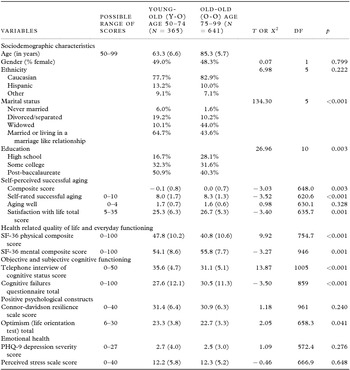
As shown in Table 1, there were significant differences between Y-O and O-O age groups on marital status and education. The Y-O group was more likely to be married or divorced, and participants in the O-O group were more likely to report being widowed. In addition, Y-O adults were significantly more likely to be gainfully employed than were O-O adults (43.6% vs. 5.6%, respectively; X2 = 204.4, p < 0.001), as well as having higher household income (z = 7.59, p < 0.001), and higher education (z = 3.95, p < 0.001). Household income and education were each modestly correlated with SPSA (rs = .171 and .103, respectively, both p values <0.005). However, there was no significant correlation between gainful employment status and SPSA (r = 0.005, p = 0.886).
Sociodemographics of the young-old and old-old SAGE participants

Note: Values represent means (and SDs) or proportions as appropriate.
PHQ 9 = Patient Health Questionnaire – 9-item Version.
SF-36 = 36-item Short-Form Health Survey.
Also relative to the O-O group, the Y-O group had lower SPSA, lower self-rated successful aging, lower satisfaction with life, higher physical functioning, lower mental functioning, less objective cognitive impairment, and fewer subjective cognitive concerns. There were no significant differences between groups on gender, ethnicity, aging well, resilience, optimism, depression or perceived stress.
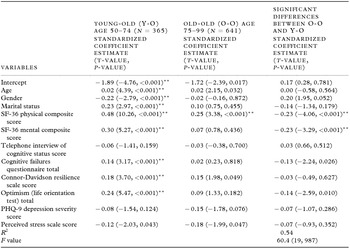
Strength of associations of SPSA with explanatory variables from the multiple regression are displayed in Table 2, as well as the degree to which these associations differed in the Y-O versus O-O group. The difference in intercepts (−1.89 vs. −1.72) reflects the expected differences in SPSA with higher levels in the O-O group versus Y-O group. In the Y-O group, higher levels of SPSA were significantly associated with age, female gender, married marital status, higher physical functioning and mental functioning, lower levels of subjective cognitive concerns, and higher resilience and optimism. Within the O-O group higher SPSA was significantly associated only with higher physical functioning. Comparing the magnitude of associations between Y-O and O-O, physical functioning and mental functioning had significantly stronger associations with SPSA in the Y-O versus O-O group. With the exception of depression and perceived stress, the overall pattern of results when comparing the interaction of age group with various associations of SPSA was for smaller regression coefficients in the O-O group, indicating that the majority of the explanatory variables were more weakly associated with SPSA in the O-O group than in the Y-O group.
Associations of self-perceived successful aging in young-old and old-old adults

Note: *p < 0.01. **p < 0.001.
PHQ 9 = Patient Health Questionnaire – 9-item Version.
SF-36 = 36-item Short-Form Health Survey.
Discussion
To our knowledge, this is the first study to compare respondents’ self-perceptions of successful aging among O-O relative to Y-O adults. Consistent with our hypothesis, physical functioning was less associated with SPSA in the O-O relative to Y-O adults. However, contrary to our hypothesis, the association of positive psychological traits with SPSA was not greater in the O-O versus Y-O group. Within these analyses we found several significant associations to SPSA in Y-O individuals suggesting the importance of physical and mental health, subjective cognitive status, and positive psychological traits on SPSA within this group. Yet, only physical functioning appeared to be associated with SPSA in O-O individuals and that association was weaker than it was among the Y-O individuals. Mental functioning was also found to be less associated with SPSA among the O-O relative to Y-O. Together with earlier findings that self-rated successful aging increased with age (Jeste et al., Reference Jeste2013), this raises an interesting paradox of aging; SPSA continues to increase with age while physical comorbidity also typically increases with age. It remains unclear what factors explain the age-related increase in SPSA as it does not appear to be the influence of positive psychological traits. It may be that SPSA as a construct changes with age, or additional, presently unidentified variables are responsible for the association of increased SPSA with aging.
While physical functioning was not the only determinant of SPSA, it appeared to have a significant effect on SPSA in both Y-O and O-O adults. We found a significant difference of physical functioning effect between the Y-O and O-O adults, suggesting a decreasing influence of physical functioning on overall SPSA among the O-O. Physical health still remains the most commonly used measure of successful aging in studies focused on Y-O and O-O adults (Garfein and Herzog, Reference Garfein and Herzog1995; Cherry et al., Reference Cherry2013b). In a qualitative study, Cherry et al. (Reference Cherry, Marks, Benedetto, Sullivan and Barker2013a) found that those adults between ages 60–89 highlighted physical, mental and relational aspects of successful aging, whereas those age 90 or above were focused on peace of mind and the absence of anger. In addition, people between the ages 60–74 suggested the need for health promotion such as diet and exercise. In another qualitative study of adults age 85 years and older, participants reported that successful aging was about adaptation; they valued their social functioning and well-being above cognitive and physical functioning (von Faber et al., Reference von Faber2001). The findings of the present report suggest that, compared to Y-O, O-O adults place less emphasis on physical health status as important to their SPSA. This is consistent with previous studies that suggest that O-O adults, have more positive views of their own health despite increased illnesses and disability (Ferraro, Reference Ferraro1980).
There were several limitations in this investigation that should be acknowledged. With the exception of one measure of objective cognitive functioning, the data were based on self-report. Thus, our results speak to the associations among self-perceptions of various constructs. It is possible that a different pattern of association would be obtained with objective measures of physical health in relation to SPSA. An additional limitation of the present study is that the comparisons are cross-sectional. Consequently, we cannot rule out cohort effects (variations based on birth years) or survivor bias (survivor of the fittest into older age); these can only be addressed via long-term longitudinal follow up of Y-O adults as they transition to O-O status. One interpretive limitation of the present study is the possibility that group differences in household income and education may partially affect the associations with SPSA. On the other hand, while statistically significant in the context of the large sample size the magnitude of correlation between these variables and SPSA was in the small range, so any such effects are likely modest.
The above limitations noted, the results point to an interesting paradox of aging that – despite increased physical disability, O-O adults have higher SPSA than their Y-O counterparts. One such possible explanation to the paradox of aging can be explained by the Socioemotional Selectivity Theory (SST), which argues that as people age and their time horizons decrease there is a natural shift in motivation that emphasizes emotion and meaning (Charles and Carstensen, Reference Charles and Carstensen2010). According to SST, as individuals age there is increased focus on meaningful social ties and a decrease in expanding horizons (i.e. making new social contacts, acquiring knowledge). Goals become focused on the quality of social relationships, emotional meaning, and enhanced appreciation of life (Carstensen and Löckenhoff, Reference Carstensen and Löckenhoff2006). Consequently, older adults prioritize general well-being as people realize they are gradually approaching the end of life (Samanez-Larkin et al., Reference Samanez-Larkin, Robertson, Mikels, Carstensen and Gotlib2009). In addition, SST suggests that because of the shift towards emotional goals older adults have a predisposition for the “positivity effect” in which they selectively attend to positive information over negative information and are increasingly likely to remember positive memories, in contrast to negative ones (Samanez-Larkin et al., Reference Samanez-Larkin, Robertson, Mikels, Carstensen and Gotlib2009).
A similar paradox of aging has been noted in the SWB literature, in that in the face of physical and cognitive declines, SWB remains constant or increases with age (Gana et al., Reference Gana, Bailly, Saada, Joulain and Alaphilippe2013). One potential explanation for this paradox is the role of goal discrepancy or the discrepancy between one's current status and their expectation in a specific domain (Cheng, Reference Cheng2004). Ryff (Reference Ryff1991) found that when young-, middle-, and old-adults were asked about their expectations for their future functioning on six dimensions of psychological well-being, the oldest group anticipated declines across domains. Consequently, older adults appeared to have a more realistic and closer fit between their actual and their ideal self-perceptions. The dual-process model of self-regulation (Brandtstädter and Renner, Reference Brandtstädter and Renner1990), similar to the theory of goal discrepancy, is an adaptive coping process commonly noted in the aging literature that may also partially explain the paradox of aging. Based on this model, there are two complementary approaches (assimilative and accommodative) activated when coping with anticipated or perceived discrepancies between actual and desired outcomes. An assimilative approach occurs when one modifies a situation to be in line with personal goals, while the accommodative approach refers to the modification of personal preferences based on the constraints of the situation. Because aging is frequently indicative of functional declines and losses, accommodative and assimilative processes are both positively related to subjective and affective well-being in older-adults (Heyl et al., Reference Heyl, Wahl and Mollenkopf2007).
Lastly, a corresponding model is the Life-Span Theory of Control (Heckhausen and Schulz, Reference Heckhausen and Schulz1995). Similar to assimilative coping, the concept of primary control involves attempts to change the external environment based on the needs and wants of the individual. While secondary control parallels the accommodative approach and assists in coping with failure and fostering primary control by redirecting motivational resources toward alternate goals. Secondary control strategies are frequently used in older adults as a way of coping with decline, thus adjusting aspirations and goals appropriately, minimizing goal discrepancy.
With a rapidly growing population of older adults, it is increasingly important to understand what factors contribute to higher levels of SPSA in O-O versus Y-O adults. In addition to being, what to our knowledge is the first published study of SPSA comparing O-O and Y-O adults, it should also be noted that our sample of 641 O-O participants included 352 people age 80–89 years, and 183 age 90–99. These are substantially larger than the sample sizes of people 80 years or older than in any previously published study comparing successful aging in O-O vs. Y-O adults (cf. Garfein and Herzog, Reference Garfein and Herzog1995; Chou and Chi, Reference Chou and Chi2002; Cherry et al., Reference Cherry2013b). Covariates of aging such as physical functioning and mental functioning appear to become less associated with SPSA in the O-O population. It is apparent that SPSA is a multidimensional construct that cannot be defined by physical functioning alone. Clarifying the nature of such underlying factors may inform tailored interventions to promote successful aging targeted at the diverse experiences of Y-O and O-O adults.
Conflict of interest
None
Author contributions
Averria Sirkin Martin: report conception and design, interpretation of data, preparation of manuscript, final approval. Barton W. Palmer: report conception and design, interpretation of data, preparation of manuscript, final approval. David Rock: analysis and interpretation of data, final approval. Camille V. Gelston: analysis and interpretation of data, final approval. Dilip V. Jeste: study and report conception and design, interpretation of data, preparation of manuscript, final approval.
Acknowledgments
This work was supported, in part, by National Institutes of Health grants T32 MH019934, P30MH066248 and NCRS UL1RR031980, by the John A. Hartford Foundation, and by the Sam and Rose Stein Institute for Research on Aging.