Introduction
With the speed of population aging hastening across most high-income countries, the care needs of the growing number of older citizens has been an important priority for policy-makers. Consistent with the preferences of older persons, successive Australian governments have sought to assist older people to receive care in their own homes, rather than institutions since the 1980s (Dow et al., Reference Dow, Sparrow, Moore, Gaffy and Yates2013). One of the factors key to the success of this strategy is the large pool of informal carers in Australia, providing unpaid caring activities, estimated to account for 80% of the care of older people in Australia (Productivity Commission, 2011). In 2015, 2.7 million people provided informal care with an estimated economic value of $60 billion (Deloitte Access Economics, 2015; Australian Bureau of Statistics [ABS], 2016b). The United Kingdom and USA also rely significantly on informal carers to care for older persons. Six and a half million people in the United Kingdom are carers, with 44% caring for a parent or grandparent (Carers UK, 2015) and 34.2 million Americans provide unpaid care to a person aged over 50 years (National Alliance for Caregiving, 2015).
Although informal caring is mostly unpaid, a number of government programs and payments are in place to assist Australian carers. Carers can access respite care and several types of carer payment, including an income support payment for those who are unable to work in paid employment due to their caring role through the government's Carer Gateway (Australian Government, 2017). There are carer advocacy and support services in every state and territory through which carers can gain access to services such as counselling and support groups (Carers Australia, 2017). Carers in Australia also have the right to request flexible working arrangements enshrined in legislation and this request cannot be reasonably refused by employers (Victorian Equal Opportunity and Human Rights Commission, 2012). There are similar arrangements in place for carers in the United Kingdom, but in the USA there is no income support payment for carers (Agingcare, 2017).
Despite these government programs, research has shown that many carers have unmet needs for further support. Some carers require support and education on practical skills to assist with their caregiving role and access to support services is oftentimes limited due to complex eligibility criteria (Essue et al., Reference Essue2010). This is complicated further by the low levels of assistance to primary caregivers and awareness of many existing community services for carers and their recipients (Lucke et al., Reference Lucke2008; Vecchio, Reference Vecchio2008b). Users of different support services may also have differing levels of unmet support needs. In an examination of respite service use in 2003, respite care users had considerable unmet demands for financial assistance, whereas non-respite care users had unmet needs to improve their own well-being (Vecchio, Reference Vecchio2008a). More generally, stressors associated with caregiving may impact upon the carer, requiring additional needs, including health and emotional support (O'Connell et al., Reference O'Connell, Bailey and Walker2003; Horner and Boldy, Reference Horner and Boldy2008). This issue of unmet emotional support is important, as there is considerable evidence that carers are at increased risk of adverse mental health, including depression (Gaugler et al., Reference Gaugler, Anderson, Leach, Smith, Schmitt and Mendiondo2004; Cummins et al., Reference Cummins, Hughes, Tomyn, Gibson, Woerner and Luffana2007; Dahlberg et al., Reference Dahlberg, Demack and Bambra2007; Neri et al., Reference Neri, Yassuda, Fortes-Burgos and Guariento2012).
Despite the considerable contribution of the above studies to our understanding of carer needs, there remains a gap in studies of the types of needs of carers, specifically among those who care for older Australians and those who have multiple unmet support needs. With the availability of new nationally representative data, we seek to answer two questions: (1) What is the prevalence and type of unmet support needs of those who care for older Australians? (2) Is there an association between the carers' unmet support needs and mental health?
Methods
Data
Data for this study are from the 2015 Survey of Disability, Ageing and Carers (SDAC) conducted between July and December 2015. Three populations were sampled using multi-stage sampling techniques. These consisted of persons living in private dwellings, in self-care retirement villages, and in cared accommodation. The module on carers' unmet needs was administered to primary carers living in households. Primary carers were identified through a series of screening questions. As defined by the ABS, primary carers “provide(s) the most informal assistance, in terms of help or supervision, to a person with one or more disabilities, with one or more of the core activities of mobility, self-care or communication” (ABS, 2016a). The ABS has the authority to collect these data under the Census and Statistics Act 1905, and has collected eight cross sections since 1981. Respondents were neither paid for participation nor were any other inducements offered.
Of 31,957 households originally contacted, 25,555 fully responded, yielding a response rate of 80%. Of these persons living in households, 2,421 were primary carers who filled out the unmet needs questionnaire. Of this group, we omit 340 participants where the primary carer did not answer questions pertaining to unmet needs. This left a final sample size of 2,081 primary carers. Within this group approximately 18% care for children (n = 382), 20% care for person in the primary working ages (n = 420), and 61% care for older Australians aged 55 years and over (n = 1,274). This later group of carers are the focus of this study, representing over 60% of primary carers. We used the cut-off age of 55 years because from age 55, persons born before 1960 can access private superannuation and retire in Australia. The average age of primary carers (of recipients of any age) in Australia is 55 years, with two-thirds being female and the majority caring for a family member (ABS, 2016b).
Measures
In the self-completed carer questionnaire, primary carers were asked “Do you feel you need more support or an improvement in your situation to aid in your role as a carer?” A follow up question was then asked “Which of the following would assist you in your role as a carer?” A list of possible responses was then provided, including the following:
1. more respite care,
2. more financial assistance,
3. more physical assistance,
4. more emotional support,
5. an improvement in my own health,
6. more aids/equipment to help me assist in my role as a carer,
7. more courses available on how to care for persons with particular disabilities,
8. more training in correct use of equipment,
9. more training in correct methods of lifting to prevent injury to myself, and
10. none of the above.
For those who answered multiple needs, they were asked to nominate which would “most assist you in your role as carer?” Herein, this later measure is referred to as the single item measure.
For the first time in 2015, the SDAC collected measures of psychological distress. The specific measure of psychological distress used was Kessler's K10. The K10, although not a diagnostic tool, is a widely used screening instrument for psychological distress based on the respondent's emotional state in the four weeks prior to the interview (Anderson et al., Reference Anderson, Sunderland, Andrews, Titov, Dear and Sachdev2013; ABS, 2016a). This enables an analysis of whether psychological distress is associated with unmet carer support needs. Following other examples in the literature, we indicate a “high” or “very high” score on Kessler's measure as indicating psychological distress (Anderson et al., Reference Anderson, Sunderland, Andrews, Titov, Dear and Sachdev2013).
Statistical model and estimation of variance
To examine differences in the prevalence of unmet carer needs and psychological distress we present weighted tests of proportions, with a 95% critical value. To examine the association between unmet carer needs and psychological distress we fitted logistic regression models. Using the raw logit coefficients, we calculated odds ratios (OR), which measure the change in the odds of experiencing psychological distress given a change in unmet carer needs, once all other factors in the model are controlled for.
Variables were entered into the regression and improvement to model fit assessed using the Bayesian Information Criteria following the Raftery (Reference Raftery1995) procedure. With all models specified, we checked the conditioning of the matrix of independent variables to investigate any collinearity influence (Belsley et al., Reference Belsley, Kuh and Welsch1980). The condition numbers and variance inflation factors were small to provide support for the model specification. Final goodness-of-fit for the logistic regression models was confirmed using the Hosmer and Lemeshow test (Hosmer et al., Reference Hosmer, Hosmer, Le Cessie and Lemeshow1997).
Due to the complex survey design, adjustments are necessary to generate correct variance estimates. The SDAC includes 60 replicate weights on the data file to adjust for sample design and non-response. Utilizing an algorithm developed by Winter (Reference Winter2008), we employed the unstratified delete-one jackknife method to make the necessary replicate adjustments (Wolfer, Reference Wolfer1985). All analyses were conducted using Stata 15 (Stata Corporation, 2017).
Results
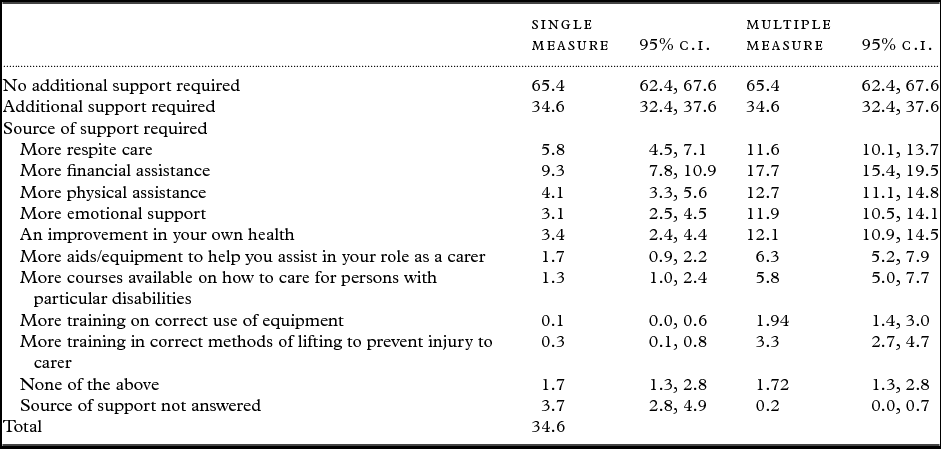
Table 1 displays the differences in prevalence of carer unmet support needs using the single item (most assist you) and multiple item measure (any need for assistance). Regardless of the measure used, about one-third of the primary carers of older persons have unmet demands for support (34.6%). There is considerable variation in the prevalence of additional support requested by carers according to the measure used (Table 1). Relying only on the single item measure significantly underrepresents the full demand for a number of sources of support. For example, using the single item measure, about 9% of carers report “more financial assistance” compared with almost one in five carers responding to the multiple item measure (17.7%). Similarly, only 3% report a need for emotional support on the single item measure, but about 12% of carers indicate this unmet need on the multiple item measure (11.9%).
Prevalence of carer unmet support needs, by type, single and multiple measures, 2015

Notes: 95% CI: 95% confidence interval for logit proportions. All percentages are weighted to account for survey design. Unweighted confidence intervals reported for transparency.
Focusing on the multiple item measure, financial assistance is the most heavily cited among carers as an unmet need (17.7%). Half of all carers with unmet needs cited this unmet support need (49.7%). In addition, over 10% of carers report additional physical assistance (12.7%), support with improving their own health (12.1%), more emotional support (11.9%), and respite care (11.6%) as key support needs to improve their caring role. Around 6% of carers report a need for additional aids or equipment (6.3%) or courses on caring for persons with particular disabilities (5.8%).
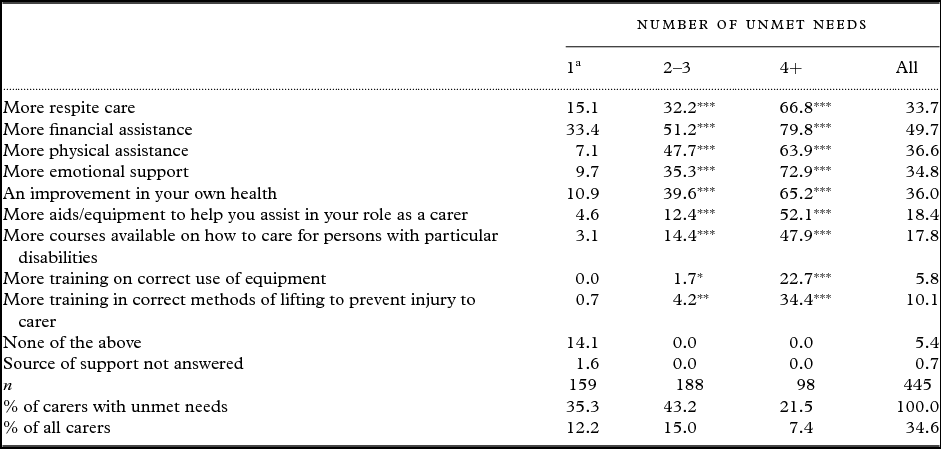
Using the multiple item measure, we generate a variable measuring the number of types of unmet needs of carers. In Table 2, we tabulate the types of unmet needs by number of types of unmet needs. This table includes the population of those who report any unmet need (n = 445). Of those with unmet needs, 35% of carers have one unmet need only, 43% have two or three unmet needs and about one in five have four or more unmet needs (21.5%). In total, almost two-thirds of carers with unmet needs have multiple unmet needs (64.7%), representing 22% of all primary carers of older Australians.
Prevalence of carer unmet support needs, by type and number of unmet needs, 2015

Notes: All: All persons with unmet support needs; percentages weighted. Tests of percentages unweighted.
aComparison category for test of percentages is 1 unmet need.
***p < 0.001.
**p < 0.01.
*p < 0.05.
As expected, the proportions reporting across all unmet support need types increase with total unmet needs. For example, 7% of those with one unmet need require physical assistance, compared with half of those with two or three unmet needs (47.7%) and almost two-thirds of those with four or more unmet needs (63.9%). Of those with multiple needs, considerable proportions of these groups cite financial, physical, and emotional support. However, those with four or more needs also have considerably high demand for training and courses compared with those who have fewer unmet needs. Half of those with four or more unmet needs have unmet demand for “more aids/equipment” (52.1%) or “courses available on how to care for persons with particular disabilities” compared with under 5% of those with one unmet need and under 15% of those with two or three unmet needs.
The results above indicate a considerable proportion of carers report unmet and multiple unmet support needs, and that those with higher numbers of needs report demand for support across a range of need types. An important question, therefore, is can unmet needs place additional stressors upon carers influencing their mental health? As these data are cross sectional, we cannot infer causation, but we can investigate whether there are differences and an association between increasing likelihood of unmet needs with increased likelihood of psychological distress.
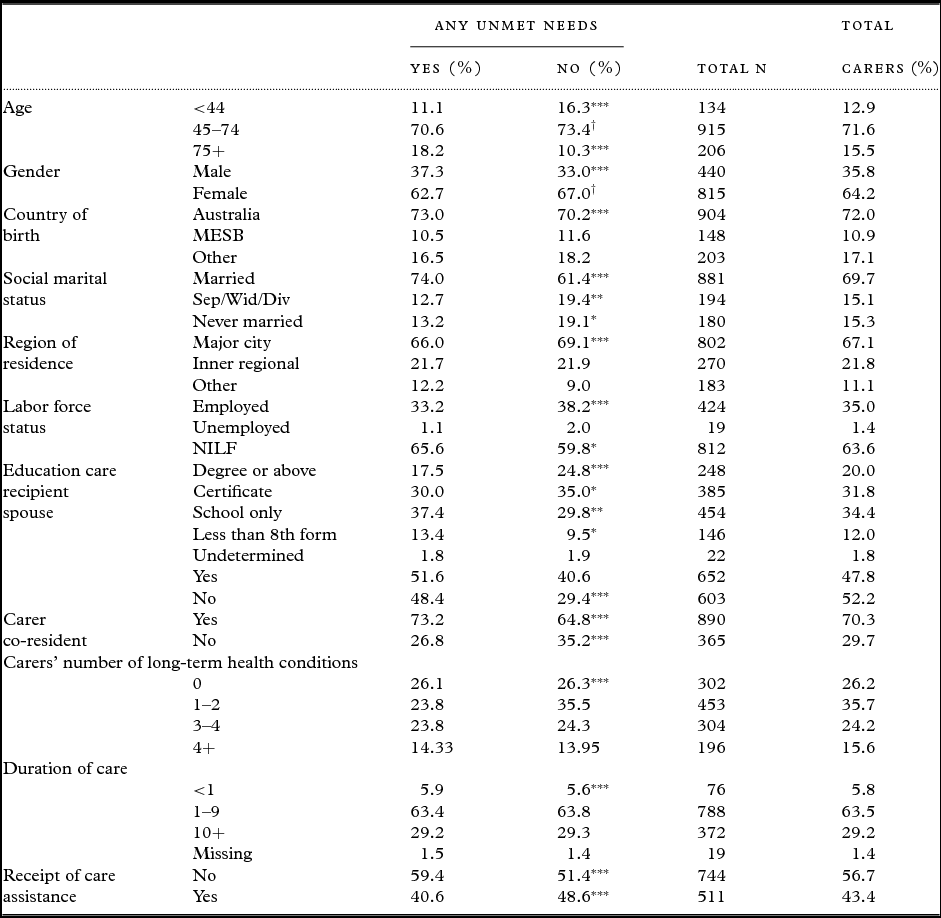
Before turning to the multivariate analyses, results in Table 3 illustrates the differences in demographic characteristics and care details of carers tabulated by whether they have unmet support needs. Consistent with evidence on carers of persons of any age reported by the ABS, about two-thirds of carers of older Australians are female (64%) (ABS, 2016b). About 70% of this group were born in Australia (72%), are married (69.7%), living in a major city (67.1%), co-resident with the recipient of care (70.3%), and aged between 45 and 74 years (71.6%).
Characteristics of primary carers of older Australians and unmet support needs, 2015

Notes: MESB: main English-speaking countries; NILF: not in the labor force; %Carers: the percentage of carers in each demographic group.
***p < 0.001.
**p < 0.01.
*p < 0.05.
†p < 0.1.
Comparing across unmet support need status, those with unmet needs tend to be slightly older, married and not in the labor force and with lower levels of education compared to those with no unmet support needs. It is not surprising then that about 52% of those with unmet support needs are caring for a spouse, compared with 40% of those with no unmet needs. Those with no unmet support needs are also slightly more likely (48.6%) to have used support services compared to those with no unmet needs (40.6%). There are no meaningful differences between the groups by duration of care or the carers' number of long-term conditions.
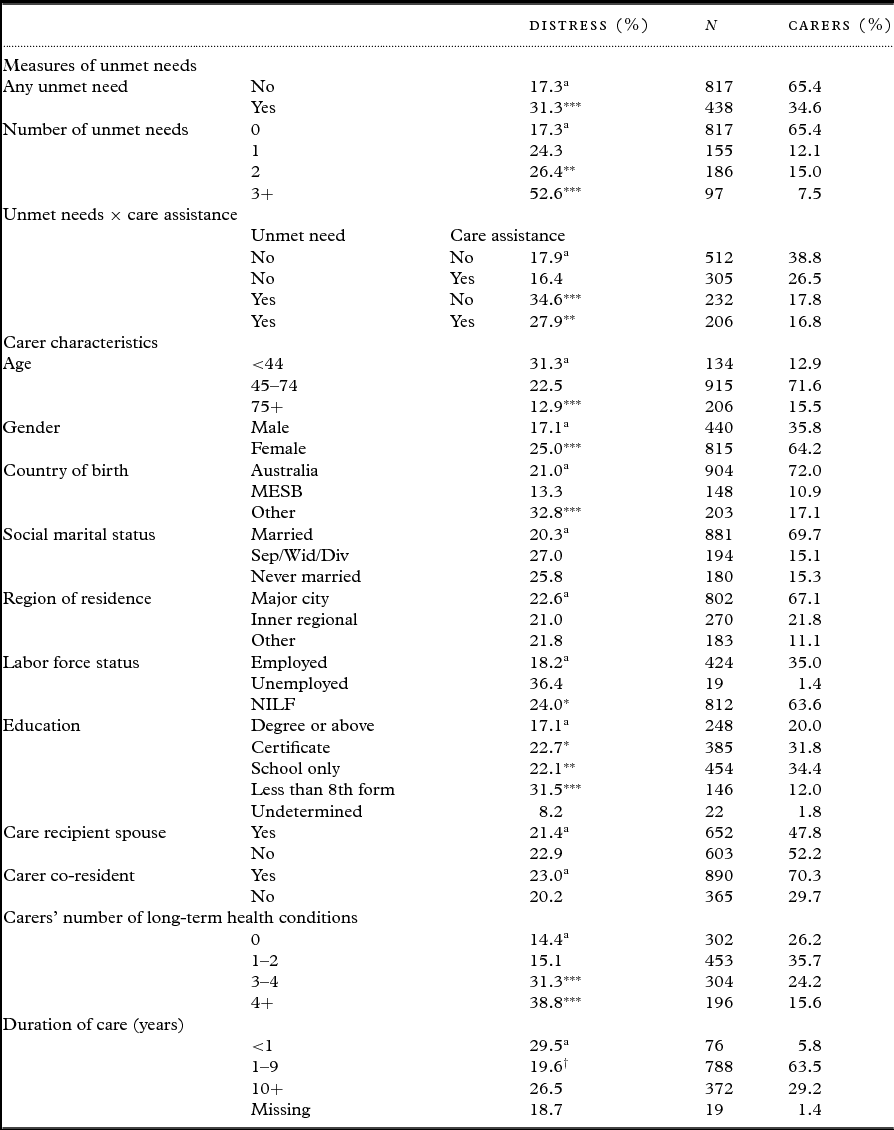
Results in Table 4 illustrate the differences in the prevalence of psychological distress in this group of careers of older Australians (60% of all primary carers) by the demographic and care characteristics provided above. Among this group of carers, approximately one-third of those with any unmet support needs were in psychological distress (31.3%), compared with 17% of those with no unmet needs. We also observe considerable differences in the prevalence of psychological distress by the number of unmet support needs. Compared to the 17% of those with no unmet needs in distress, about 26% of those with two or more needs and over half of those with three or more needs (52.6%) report psychological distress.
Characteristics of primary carers of older Australians and psychological distress, 2015

Notes: MESB: main English-speaking countries; NILF: not in the labor force; %Carers: the percentage of carers in each demographic group.
aComparison category for test of proportions.
***p < 0.001.
**p < 0.01.
*p < 0.05.
†p < 0.1.
To examine the association between unmet needs and psychological distress, it is important to control for demographic groups with differing prevalence rates. For example, variations in psychological distress in these data appear by age, gender, country of birth, education level, and the number of health conditions that the carer reports (Table 4).
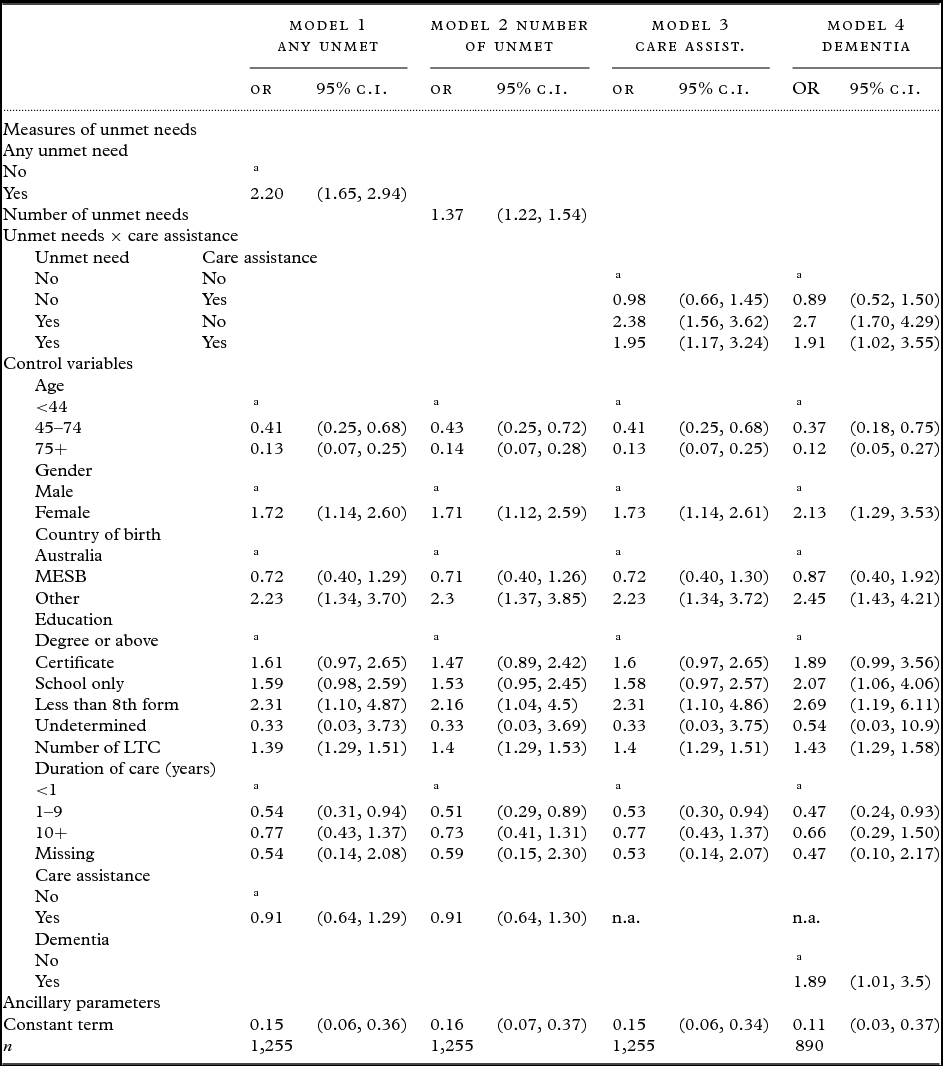
With extensive demographic controls, the multivariate evidence strongly supports the proposition that unmet support needs of carers is associated with carers’ mental health (Table 5). With control variables included, having any unmet need for support increases the odds of psychological distress twofold (Model 1: OR = 2.20, p < 0.001). Including a continuous measure of unmet support needs, we find that with each additional unmet support need, the odds of carer psychological distress increases 1.37 times (Model 2: OR = 1.36, p < 0.001). Further support is provided in Model 3, which includes a categorical variable measuring combinations of receipt of whether the carer received any assistance to care and unmet need. Not surprisingly, there is no difference in distress between those who do not have unmet support needs classified by care assistance usage (OR = 0.98, p < 0.10). However, those who have received care assistance and have continuing unmet needs are about 1.95 times more likely to be in distress relative to those with no unmet needs (OR = 1.95, 95% CI = 1.17, 3.24). Those who have unmet needs and have not received care assistance are at almost 2.4 times the risk of distress (OR = 2.38, 95% CI = 1.56, 3.62).
Odds ratios from models of psychological distress, 2015

Notes: 95% CI: 95% confidence intervals; MESB: main English-speaking countries; OR: odds ratio; NILF: not in the labor force; Care assist.: care assistance.
aComparison category.
Previous studies highlight the impact of dementia on carers' levels of stress and well-being (Gaugler et al., Reference Gaugler, Anderson, Leach, Smith, Schmitt and Mendiondo2004; Bertrand et al., 2006; Stirling et al., Reference Stirling, Andrews, Croft, Vickers, Turner and Robinson2010). In the confidentialized data we utilize, the care recipient's conditions are only available for co-resident carers. That is, for primary carers living in households who have non-usual resident care recipients, the condition data is unfortunately unavailable. Restricting our sample to 890 co-resident carers, we re-estimated all models measuring a care recipient with dementia (Model 4). Unsurprisingly, carers with a care recipient who has dementia are at an almost twofold risk of distress compared to those caring for a person without dementia (OR = 1.89, 95% CI = 1.01, 3.5). Importantly, even with the additional controls for dementia and the restricted sample size, the coefficients measuring unmet needs and receipt of care assistance are highly comparable to the full sample models. That it, those who have received care assistance and have unmet needs are significantly more likely to be in distress (OR = 1.91, 95% CI = 1.02, 3.55) as are those who have unmet needs but no care service use (OR = 2.7, 95% CI = 1.70, 4.29).
Although not the purpose of the analyses, the control variables are also of substantive interest themselves. Among this group of carers of older Australians, psychological distress is highest among females (vs. males), those from a non-English speaking background (vs. Australian born), younger carers and those with low levels of education (vs. university educated). The number of health conditions of the carer is also strongly associated with the odds of psychological distress (OR = 1.39, p < 0.001). A range of other characteristics, including marital status, geography, income, carer relationship, and co-residence status, were tested and found not to be significant predictors of psychological distress in this sample. Polynomial terms for the number of health conditions and unmet needs, as well as various interaction terms were also not significant. Both models show absence of multicollinearity (Mean VIF = 1.46) or omitted variable bias and the final specification is confirmed with the Hosmer–Lemeshow test (Model 1: χ2 = 9.4, p < 0.1; Model 2: χ2 = 4.1, p < 0.1). All models controlled for duration of care and prior use of care services.
Discussion
Like most high-income nations such as the USA and United Kingdom, Australia's population is projected to age considerably out to and beyond 2050 (ABS, 2013). The Australian government, along with older persons themselves, prioritize care in the community, rather than institutional settings. This places not only considerable faith, but also pressure upon the informal care workforce in Australia, numbering in excess of 2.7 million people. Supporting the needs of carers is therefore crucial. In this study, we sought to (1) examine what are the unmet care needs of the primary carers of older Australians and (2) to investigate whether there is an association between these needs being unmet and the carers' mental health.
Types of unmet support needs
In 2015, 35% of carers of older Australians cited at least one unmet need for support. Among this group, almost two-thirds cited multiple unmet support needs (64.7%). The most prevalent types of unmet needs included financial (18%), physical (13%), emotional support (12%), as well as additional respite care (12%). These findings are consistent with earlier surveys of carers in Australia (Schofield et al., Reference Schofield, Bloch, Herrman, Murphy and Nankervis1998; Cummins et al., Reference Cummins, Hughes, Tomyn, Gibson, Woerner and Luffana2007). The study by Cummins et al. (Reference Cummins, Hughes, Tomyn, Gibson, Woerner and Luffana2007) found that, “satisfaction with ability to pay for household essentials, to afford the things you would like to have, to save money, to have financial security, and to not worry about income covering expenses, are all severely comprised for carers compared with a general population sample (p. vii).” They also found that carers were much less likely to be in paid employment compared with the general population with 20.6% of their sample classifying themselves as unemployed (Cummins et al., Reference Cummins, Hughes, Tomyn, Gibson, Woerner and Luffana2007).
Our findings show that carers still have significant unmet financial needs. This could be related to the well-documented difficulties that carers have in combining paid work with caring, especially primary carers. It could also mean current carer payments are not adequate to meet the financial needs of those who rely on these payments. Future research could include a review of the effectiveness of current workplace arrangements that seek to enable carers to combine paid work with a caring role and/or a review of the adequacy of carer payments from government.
Other unmet needs we identify (physical and emotional support and additional respite care) are potentially due to a lack of services and/or poor tailoring of these services for the diversity of carer needs. Despite carers often identifying respite care as a need, they rarely take up the current respite offerings, as they are either inconvenient or difficult to access for the carer or do not provide suitable activities or care for the care recipient (Phillipson, Reference Phillipson2016). Respite services should be better tailored to meet carers’ and carer recipients’ specific needs, including offering culturally specific programs to carers from culturally and linguistically diverse background (Kosloski et al., Reference Kosloski, Schaefer, Allwardt, Montgomery and Karner2002).
It is interesting to note that those with multiple support needs were significantly more likely to signal needs for training and aids to assist in their caring role. There are existing free on-line training programs for carers of people with specific conditions usually associated with older age, such as dementia, in Australia. This study suggests that these could be better targeted to those carers who report a number of unmet needs.
Results here also underscore the importance of measurement in the unmet needs of carers. Focusing only on a single item measure of the “most assist you” significantly under represents the prevalence of a range of unmet needs of carers, which is important as two-thirds of those with unmet needs have multiple unmet support needs. As such, usage of the single item measure significantly distorts the types of overall needs of carers with multiple unmet needs, particularly as it pertains to needs for training and aids to assist in their caring role. This may have implications for health and age care professionals working to support carers. Careful wording of questions aimed to assess carers’ unmet needs is required. Rather than asking a single question of carers as to what they think would be of most assistance, our findings suggest that a checklist with a range of options would enable carers to better identify their unmet needs.
Association between unmet needs and mental health
This measurement issue is noteworthy, as results of this study point to an important association between increasing unmet needs of carers and a higher likelihood of psychological distress. Accounting for complex survey design and incorporating extensive control variables, we find that having any unmet need for support increases the odds of psychological distress twofold and that each additional unmet need increased the likelihood of psychological distress by 36%. Given that two-thirds of carers in this sample have multiple unmet support needs, this result is concerning.
Carer depression has been found to be a risk factor for placement of the older care recipient in residential aged care (Gaugler et al., Reference Gaugler, Yu, Krichbaum and Wyman2009) and abuse of the care recipient (Cooper et al., Reference Cooper, Selwood, Blanchard, Walker, Blizard and Livingston2010), so it is a key risk factor for adverse outcomes in the care relationship. However, it is also important for the health and well-being of the carer themselves, as increased depression is associated with reduced quality of life (Bruvika et al., Reference Bruvika, Ulsteina, Ranhoff and Engedala2012) and increased suicidal ideation in carers (O'Dwyer et al., Reference O'Dwyer, Moyle, Zimmer-Gembeck and De Leo2013). Most of the research on caregiving has focused on characteristics of the carer, care recipient and the relationship between them rather than broader social and policy issues (Dow and McDonald, Reference Dow and McDonald2003). While a previous research has identified important directions for mental health clinicians (for example, Loi et al., Reference Loi2016), this study points to the need to consider broader policy issues, such as income support, as many carers clearly have unmet financial needs that may impact their mental health.
The availability of government programs, however, does not necessarily mean that carers take them up and/or that they reduce burden or mental distress. In Australia, less than 30% of carers use respite services (AIHW, 2007). There has been considerable investigation of why carers do not use respite services and the evidence is mixed. For example, some studies show spousal carers are less likely to use respite than non-spousal carers (Robinson et al., 2005). Other studies have not found any relationship between carer relationship and use of respite services (Douglass and Visconti, 1998; Douglass and Fox, 1999; Montoro-Rodriguez et al., 2003). Indeed, some studies show carer or caregiver characteristics are only weakly associated with non-use of services (Phillipson et al., Reference Phillipson, Jones and Magee2014). It may simply be that these services are difficult to access or do not meet carers’ or care recipients’ needs (Phillipson, Reference Phillipson2016). For example, people from a culturally and linguistically diverse background are more likely to use services that are specifically tailored to their culture (Kosloski et al., Reference Kosloski, Schaefer, Allwardt, Montgomery and Karner2002).
Apart from barriers and usage to respite care, there have been very few studies in Australia on barriers and applications for financial support, for example, through the Carers Payment or Carers Allowance. This is a considerable research gap and further analysis is warranted here.
Limitations and extensions
In interpreting these results, it is important to recognize the studies limitations. First, the data are cross sectional. We cannot and do not draw causal inferences about carers' unmet needs and psychological distress. Unfortunately, there is a dearth of nationally representative longitudinal data with measures of carers' needs and psychological well-being in Australia, in which this linkage could be explored further.
An additional limitation of this study is that the SDAC measures focus only on primary carers. However, this group represents a substantial proportion of the total informal care workforce in Australia. Of the 2.7 million Australians providing informal care in 2015, approximately 856,000, or about one-third, were deemed to be primary carers by the ABS (ABS, 2016b). Our study represents a sub sample of about 60% of this group who specifically care for older Australians. By definition, however, primary carers provide the most informal care to the recipient, and therefore most likely to have unmet needs to assist in their care provision. However, these data do raise the question of how other carers’ unmet needs for support are distributed throughout the population and whether the associations with mental health are as strong as we observe in this study? For example, do carers of younger care recipients have differing unmet needs and does this association with psychological distress persist to the same degree observed here?
Analysis of longitudinal data to assess the relevant pathway from unmet support needs to psychological distress is a priority. Further studies may also wish to examine the relationship between unmet support needs and mental health in other countries with different funding and support mechanisms for carers and care recipients. Moreover, there is a need for further Australian studies on barriers to accessing means or alleviating financial stress – mainly through the Carers Allowance and Carers Payment. There is also considerable scope to examine the intersection of unmet needs, the care recipients' health conditions and carers' psychological well-being.
Summary
Notwithstanding these limitations, using newly released nationally representative data on Australian carers, we show the prevalence of unmet support needs to be considerable (34.6%) that two-thirds of this group have multiple unmet support needs and that unmet financial, emotional, physical, and support to improve carers' health are among the most commonly specified. Moreover, we show a clear association between unmet needs and psychological distress, independent of comprehensive control variables and accounting for complex survey design. We further show that even accounting for unmet needs, specific health conditions of the care recipient, such as dementia can heighten carers' likelihood of psychological distress.
Conflict of interest
None.
Description of authors’ roles
J. B. Temple and B. Dow jointly designed the study and authored the manuscript. J. B. Temple performed the data analysis.
Acknowledgments
Data for this study were made available to the authors by the Australian Bureau of Statistics (ABS). J. B. Temple is funded by the Australian Research Council's Centre of Excellence in Population Ageing Research (CE1101029). The opinions expressed herein are those of the authors alone.