Implication
This experiment illustrated that the addition of alfalfa hay influences intake and growth of young Holstein dairy calves. Alfalfa hay can be included in starter diets when calves are ~2 weeks of age. Under our experimental condition, the inclusion of 15% chopped alfalfa hay in the starter diet, when calves were 2 weeks old, resulted in greater weight gain and feed intake throughout the study period.
Introduction
Attention to nutritional management of young calves is one of the most important steps in successful heifer raising operations. Rumen development is always a critical time in calf’s life because the rumen and reticulum are under-developed at birth. Though little rumen development occurs during the liquid feeding phase (Tamate et al., Reference Tamate, McGilliard, Jacobson and Getty1962; Van Soest, Reference Van Soest, Robertson and Lewis1994), it is important to offer the solid feed to begin encouraging rumen development. Roughage may be used in calf starters to help promote rumen development (Tamate et al., Reference Tamate, McGilliard, Jacobson and Getty1962; Hamada et al., Reference Hamada, Maeda and Kameoka1976), stimulates rumination (Hodgson, Reference Hodgson1971; Phillips, Reference Phillips2004) and reduces some issues associated with eating behavior (Phillips, Reference Phillips2004; Castells et al., Reference Castells, Bach, Araujo, Montoro and Terre2012). With inadequate dietary roughage, rumen papillae can remain small and rumen volume is depressed (Nocek et al., Reference Nocek, Herbein and Polan1980). Several investigators noted that inclusion of forage in calf diets increased starter intake (Kincaid, Reference Kincaid1980; Thomas and Hinks, Reference Thomas and Hinks1982) and average daily gain (ADG; Anderson et al., Reference Anderson, Khoyloo and Walters1982), as well as improved feed efficiency (Hibbs et al., Reference Hibbs, Conrad, Pounden and Frank1956; Kincaid, Reference Kincaid1980; Coverdale et al., Reference Coverdale, Tyler, Quigley and Brumm2004), although in some of the studies improved performance may have been confounded by the lack of measurement on gut fill. Furthermore, Khan et al., Reference Khan, Weary and von Keyserlingk2012 reported that adding alfalfa in textural starter diets pre-weaning did not reduce growth but did affect how calves grew. Authors believed that greater rate of forage intake after weaning of calves fed hay early in life may have been related to an improved rumen capacity to accommodate and degrade forage, as a result of greater saliva flow to the rumen and increased ruminal pH, although saliva flow was not measured (Khan et al., Reference Khan, Weary and von Keyserlingk2012). Khan et al. (Reference Khan, Weary, Varia and von Keyserlingk2011) reported that intake of hay (with mean particle size 1.2) rapidly increased after 35 days of age when milk supplied was decreased from 8 to 4 l/day; the hay intake was further increased post-weaning. Therefore, some producers offer free choice hay pre-weaning. Others have observed, however, a negative impact on the consumption of starter diets upon inclusion of forage (e.g. Hibbs et al., Reference Hibbs, Conrad, Pounden and Frank1956). Furthermore, forage quality could affect calf’s performance and adding straw decreased starter intake and ADG (Morrill and Dayton, Reference Morrill and Dayton1981). Diets that are chopped or finely ground decrease rumen pH and cellulolytic bacterial populations (Beharka et al., Reference Beharka, Nagaraja, Morrill, Kennedy and Klemm1998). Overall, little information is available as to what is the appropriate age of calves when adding alfalfa (or similar feed items) in order to obtain the best results for calf growth, rumen development and feeding behavior. The objective of this study was to determine the optimum age of calves for inclusion of alfalfa hay (AH) in starter diet on animal performance, apparent digestibility and indirect measures of rumen development.
Material and methods
Animals, management and treatments
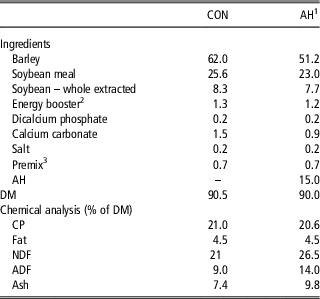
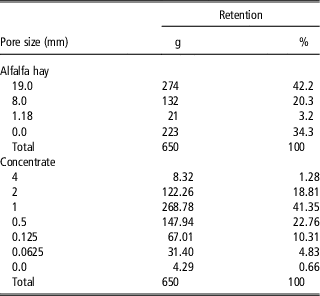
A total of 40 Holstein calves (20 female and 20 male) were separated from their dams shortly after birth, all obtained from one single farm (Ghiam Farm, Isfahan, Iran), weighed, and moved to individual pens (1.1×1.80 m), bedded with sand and fed 4 l of colostrum within 12 h of birth, followed by four feedings of colostrum at the research facility of the Isfahan University of Technology Animal Science Department (Isfahan, Iran). Experiment started early November and ended 29 January with minimum temperature of −7°C and maximum temperature of 23°C. Milk was provided in two equal feedings at 10% of birth weight provided at 0800 and 1600 h every day until weaning. The first two feeding used the colostrum, the others were transitional milk. After this step, whole milk from the bulk tank was fed for the entire trial. Calves within a pair (a male calf and a female calf) were randomly assigned according to BW at birth (40.5±4 kg) to one of four groups including control (CON) fed a starter feed (in meal form) without any forage supplementation. Calves in the other three treatments were fed the same starter feed as those in CON treatment plus 15% chopped AH (3 mm average particle size; Penn State Particle Separator, University Park, PA, USA) that was mixed with the starter meal creating a total mixed feed at the 2nd (AH2), 4th (AH4) and 6th (AH6) weeks of age. Starter was offered from the 4th day after birth and fresh starter was offered once a day at ~0800 h with refusals measured on a daily basis as well. Feed items were well mixed to reach a total mixed ration (Table 1). Particle size distribution of AH and starter is shown in Table 2. Fresh bedding was added to each pen every other day. Water and calf starter was available freely and provided twice daily in equal portions. Over a gradual process and a week before weaning, calves received half of the milk they were receiving (2 l/day) and once a day at 1600 h. Calves were 57 days old when they were weaned and the study concluded when the calves were 73 days old. Calves were observed daily for any signs of illness (e.g. pneumonia and diarrhea). To further monitor calf health, fecal scoring was used on a weekly basis. Scoring was as follows: 1=hard, 2=normal, 3=soft to loose and watery, 4=watery, mucous, 5=watery mucous and bloody.
Ingredients (%, dry matter (DM) basis) and chemical composition of experimental starter diets

CON=control; AH=alfalfa hay.
1 In AH treatments, 15% chopped alfalfa was blended into the starter diet at the time of feeding by hand and fed to three different groups of calves at the 2nd, 4th and 6th weeks of age.
2 Energizer RP10: 99% fat, 95% free fatty acid, minimum 85% palmitic acid, maximum 2% stearic acid, predicted net energy for lactation of 5.7 Mcal/kg (IFFCO International, Sharjah, UAE).
3 Contained 1500 kIU vitamin A/kg, 600 kIU vitamin D/kg, 12 kIU vitamin E/kg, 1.81 g niacin/kg, 0.02 g folic acid/kg, 8.3 g Cu/kg, 0.02 g Co/kg, 0.05 g I/kg, 5.7 g Mn/kg, 0.10 g Se/kg and 6.4 g Zn/kg.
Particle size distribution of alfalfa hay and concentrate used in calves’ starter

Measurements and sample collection
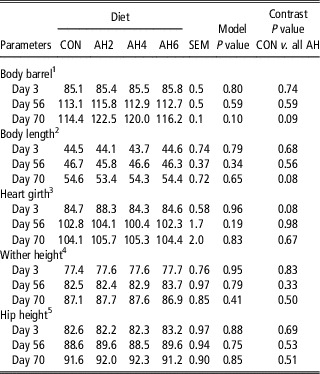
Calf starter intake was measured daily and calves were weighed weekly. The orts for each calf was measured daily so the feed intakes of each calve could be determined. Samples from orts were obtained and composited, and at the end of the week a subsample was obtained from the composited pool for analysis. At 4, 6, 8, 10 weeks of age, total fecal collection was performed on six calves per treatment (three female and three male per treatment) to determine apparent dry matter (DM), organic matter (OM) and CP digestibility of the diet. During 2 consecutive days all fecal matters were collected (on sampling day, fecal samples were taken from the bottom of the mesh floor) and weighed from six calves per treatment for four periods (days 30 to 31, 44 to 45, 58 to 59 and 72 to 73). Fecal matters were dried at 60°C for 72 h. Samples were then ground to pass through a 1 mm screen and analyzed for DM, OM and CP. The DM, ash and CP were analyzed according to the procedure of the Association of Official Analytical Chemists (1990). DM content was obtained by oven until a constant weight, ash by ignition to 600°C and CP by Kjeldahl (N×6.25). NDF and ADF were analyzed according to the procedures of Van Soest et al. (Reference Van Soest1991). Ruminal fluid samples were collected via a stomach tube at ~3 to 4 h post-feeding from six calves (three female plus three male animals per treatment) at 4, 6, 8 and 10 weeks of age and strained through two layers of cheese cloth and 25% meta-phosphoric acid at a ratio of four parts rumen fluid to one part acid was added. Sample’s pH was determined immediately by digital pH meter (model 8314; Hanna, Milan, Italy). Fluid was immediately frozen and stored (−20°C) and samples were then centrifuged at 3500×g for 10 min, and using a modified phenol–hypochlorite reaction adapted from Broderick and Kang (Reference Broderick and Kang1980), NH3 concentration was determined. Body length (distance between the points of the shoulder and rump), heart girth (HG; circumference of the chest), withers height (distance from base of the front feet to the withers), hip height (distance from the base of the rear feet to the hip bone), body barrel (BB; circumference of the belly before feeding) and hip width (distance between the left and right trochanter major) measurements of calves were recorded at birth for pre-weaning (d 1 to 52) and for post-weaning (d 52 to 70) stages on d 10 and every 10 days thereafter (Table 3).
Effect of inclusion of alfalfa hay (AH) at different ages of calves on hip height, body length, body barrel, heart girth and wither height (in cm) of Holstein dairy calves

CON=control; AH2=15% of alfalfa hay at week 2; AH4=15% of alfalfa hay at week 4; AH6=15% of alfalfa hay at week 6.
1 Circumference of the belly before feeding.
2 Distance from hip to withers.
3 Circumference of the chest.
4 Distance from base of the front feet to the withers.
5 Distance from base of the rear feet to hook bones.
Animal behavior
Behavior was monitored by direct observations for all calves, 2 weeks pre- and 2 weeks post-weaning, that is, all calves continuously for 2 weeks before and after weaning for 2 h right before the morning milk feeding. Animals were observed for 1 h immediately following the morning milk feeding and one additional hour after starter feed during the second pre-weaning week. Post-weaning, calves were observed for 2 h after being offered the starter feed. Therefore, total observation time per animal was 8 h for the entire monitoring period. The observer recorded behaviors including laying down (no chewing activity), standing (no chewing activity), eating starter feed, ruminating (either lying down or standing) and non-nutritive oral behaviors (when the animal licked any surface).
Statistical analysis
Intake of starter and total DM (hay plus starter), BW, pH and NH3 data were analyzed in repeated measures of the mixed model (PROC MIXED, version 9.2; SAS Institute, Inc., Cary, NC, USA) including initial BW as a covariate (covariate structure: compound symmetry) with treatment, week and their interaction as fixed components and animal as random effect. Structural growth (HG, BB, wither height and hip height) data were evaluated by GLM. Behavior data were tested for normality by the normal score of the statistical Minitab (1995) and were transformed by taking logarithm. These data were individually put aside to each behavior monitored before and after weaning as the total time (minutes). Gender was considered a block but was not significant in any of the statistical analyses. A mixed-effects regression analysis, which included calf and period as random effects and treatment and time relative to weaning (before or after) as fixed effects, was then performed. Health-related data were analyzed as previously described (Mirzaei et al., Reference Mirzaei, Khorvash, Ghorbani, Kazemi-Bonchenari, Riasi, Nabipour and van den Borne2015). Briefly, fecal score was square root transformed for analysis to improve homogeneity. For specific pre-planned comparisons, orthogonal contrasts in GLM were made (CON v. all AH) for detecting significant differences among treatments to specifically determine the effect of forage inclusion (without regard to any specific age). Significance was declared at P⩽0.05 and a trend toward significance was declared when 0.05<P<0.1.
Results and discussion
Intake
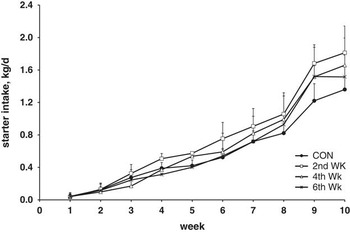
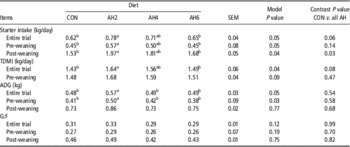
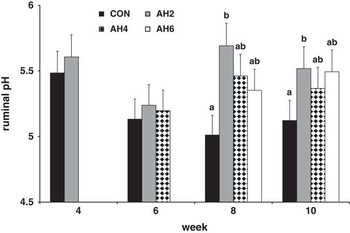
Intake of starter and total DM (starter plus hay) are presented in Table 4. The intake of starter and total DM increased with age (P<0.05). Starter feed intake in AH treatments rapidly increased when alfalfa was offered at the 2nd, 4th or 6th week (Figure 1). Post-weaning starter intake was 1.81 and 1.53 kg/day (18% numerical difference) for CON and AH4, respectively. Within the same time period, ADG were not significantly different for these two treatments (0.73 kg/day). Although there was a large numerical difference in starter intake, ADG did not reach significance, which may have been related to small n per treatment and large variations observed. Starter consumption was greater in pre-weaning period and post-weaning and the entire trial for AH calves compared with those offered CON. Calves in AH2 had greater starter consumption than those in AH6 (P<0.05). No detectable treatment effect on feed intake, however, was observed between AH2 and AH4. A larger intake for AH calves was expected because voluntary intake of legumes is consistently reported to be greater because of more palatability (Phillips, 2004), which supports findings of the present study during pre-weaning but not the entire trial period. The post-weaning starter intake was relatively low. At 10 weeks of age, intakes should have been closer to 3% of BW. The starter was a fine meal, which may have been poorly consumed compared with coarse textured feeds. The starch came mostly from barley, which is a rapidly fermentable source (Rooney and Pflugfelder, Reference Rooney and Pflugfelder1986; Franklin et al., Reference Franklin, Amaral-Phillips, Jackson and Campbell2003). Consumption of hay may have therefore helped reducing possibility of acidosis in calves receiving AH as calves on CON diet (no dietary AH included) showed reduced rumen pH on weeks 8 and 10 (pH ~5 to 5.2 when compared with pH of 5.5 or greater in weeks 4 and 6). Another study from Khan et al. (Reference Khan, Weary, Varia and von Keyserlingk2011) reported no major alteration from feeding hay except improving marginal rumen acidosis (pH of 5.06 v. 5.49 for starter v. starter+hay, respectively, when starter diets were texturized). Overall, the results from present study are in agreement with reports from researchers who noted an increased total intake with provision of forages into the ration (pelleted starter; Kincaid, Reference Kincaid1980; Thomas and Hinks, Reference Thomas and Hinks1982). However, there are also negative responses reported when adding forages to the ration (e.g. Beharka et al., Reference Beharka, Nagaraja, Morrill, Kennedy and Klemm1998 (unground diet); Leibholz, Reference Leibholz1975 (pelleted starter)). The decrease of starter intake reported by Beharka et al. (Reference Beharka, Nagaraja, Morrill, Kennedy and Klemm1998) or others might have been related to larger particle size of forages used or greater percentage of hay included in their diets. For the present study, these levels of forage and particle size were selected based on our previous work (Mirzaei et al., Reference Mirzaei, Khorvash, Ghorbani, Kazemi-Bonchenari, Riasi, Nabipour and van den Borne2015) in which it was noted that high level of alfalfa with medium particle size (16%, 2.9 mm) improved performance and decreased rumen parakeratosis. We showed that one could achieve an accepted level of performance with regards to intake and ADG with 8% alfalfa but larger particle size (e.g. 5 mm; Mirzaei et al., Reference Mirzaei, Khorvash, Ghorbani, Kazemi-Bonchenari, Riasi, Nabipour and van den Borne2015).
Mean weekly starter intake for Holstein calves fed starter diets without (control (CON); closed circle) or with alfalfa hay (AH) at a 15% rate at the 2nd (AH2; open squares), 4th (AH4; open triangles) or 6th week (AH6; star) of age over the study period. Model P value=0.05.

Effect of inclusion of alfalfa hay (AH) at different ages of calves on calves’ starter intake, total dry matter intake (TDMI), average daily gain (ADG) and gain to feed ratio (G:F)

CON=control (starter feed with no additional alfalfa); AH2=15% of alfalfa hay at week 2; AH4=15% of alfalfa at week 4; AH6=15% of alfalfa hay at week 6.
a,bDifferent superscripts within a row indicate significance among treatments (P⩽0.05).
When intake data were analyzed further, no significant interaction (treatment×time) were detected for any of the measurement reported (P>0.27 for all).
BW gain and feed efficiency
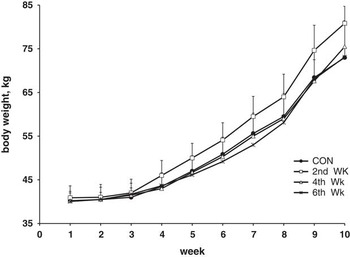
Throughout the course of the experiment, there were significant differences by both treatment and age in BW gain (Table 4). Calves were not (P>0.1) different in BW at birth (x̅=40.5±4 kg); however, calves fed AH2 were heavier than those fed CON, AH4 or AH6 later on (Figure 2). BW was not affected (P>0.1) by dietary treatments post-weaning. Over the entire experiment period of 10 weeks, ADG was greater for calves fed AH2 compared with CON calves (P<0.05). These results are in agreement with some but not all other reports. For instance, Klein et al. (Reference Klein, Kincaid, Hodgson, Harrison, Hillers and Cronrath1987) reported meal alfalfa provided in pelleted pre-starter ration increased intake and BW throughout the experiment, similar to the present study. Present results are not, however, in agreement with report by Hibbs et al. (Reference Hibbs, Conrad, Pounden and Frank1956) who noted that by adding chopped forage to diet, ADG declined. Over three consecutive reports, Hill et al. (Reference Hill, Bateman, Aldrich and Schlotterbeck2008, Reference Hill, Bateman, Aldrich and Schlotterbeck2009 and Reference Hill, Bateman, Aldrich and Schlotterbeck2010) noted that calves, fed by increasing percentages of hay in the starter (texturized), linearly reduced feed intake of starter, ADG and feed efficiency. It should be noted that when forage consumption is at 15% of solid feed intake (Mirzaei et al., Reference Mirzaei, Khorvash, Ghorbani, Kazemi-Bonchenari, Riasi, Nabipour and van den Borne2015), gut fill will increase and may artificially improve BW and improve feed efficiency, which is supported by lack of treatment effect in skeletal growth measures reported in the present study. It should also be noted that texturized starter diets have greater intake than meal starters, possibly because of more rumination and greater ruminal pH (Porter et al., Reference Porter, Warner and Kertz2007; Khan et al., Reference Khan, Weary, Varia and von Keyserlingk2011). Despite the changes that were observed in starter intake and BW gain with the addition of AH in the present study, no significant differences were observed among AH treatments and CON regarding feed efficiency (P>0.11). When ADG and feed efficiency data were analyzed further, no significant interaction (treatment×time) were detected for any of the measurements reported (P>0.28 for all).
Mean BW for Holstein calves fed starter diets without (control (CON); closed circle) or with alfalfa hay (AH) at a 15% rate at the 2nd (AH2; open squares), 4th (AH4; open triangles) or 6th week (AH6; star) of age over the study period. Model P value<0.05.

Calf health
Fecal scores and days with diarrhea did not differ by treatments. Fecal scores were not different throughout the experiment, pre-weaning or post-weaning. Average fecal score were 2.94, 2.75, 2.75 and 2.83 (±0.10) for CON and AH2, AH4 and AH6, respectively. Mean days of diarrhea were 1.6, 1.1, 1.6 and 1.00 (±0.05) for calves CON and AH2, AH4 and AH6, respectively. These results agree with observations made by Coverdale et al. (Reference Coverdale, Tyler, Quigley and Brumm2004) who reported no detectable effects on fecal scores as a result of feeding forage. Antibiotic treatments were numerically greater for CON calves compared with calves fed AH for pneumonia remedy. Average time on antibiotic therapy did not differ by treatments (data not shown).
Ruminal pH
Ruminal pH was influenced in a quadratic fashion by the age of the calf (P<0.05; Figure 3), which agrees with results of Anderson et al. (Reference Anderson, Nagaraj and Morrill1987) who reported a quadratic change in the relationship between pH and age of the calf. Beharka et al. (Reference Beharka, Nagaraja, Morrill, Kennedy and Klemm1998) who fed 25% AH with different particle sizes reported a decrease in ruminal pH with age of calf, regardless of the fiber level in the diet. Diets without roughages caused a decrease in rumen pH, which is caused by a lack of rumination and saliva flow into the rumen (Hibbs et al., Reference Hibbs, Conrad, Pounden and Frank1956; Kellaway et al., Reference Kellaway, Thomson, Beever and Osbourn1977; van Ackeren et al., Reference van Ackeren, Steingasa, Hartungb, Funkc and Drochnera2009). There were no significant differences between AH groups and CON calves at weeks 4 and 6 that may indicate that buffering of the rumen by AH may have become apparent after week 6; however, with increasing age, mean ruminal pH was greater at weeks 8 and 10 (P<0.05 for both) for the calves fed AH diets than the calves fed CON diet. The observation of a greater ruminal pH by AH calves compared with CON calves is in agreement with the findings of other studies (Khan et al., Reference Khan, Weary, Varia and von Keyserlingk2011 (textured starter); Suarez et al., Reference Suarez, Van Reenen, Beldman, van Delen, Dijkstra and Gerrits2006 (pelleted diet); Zitnan et al., Reference Zitnan, Voigt, Schonhusen, Wegner, Kokardova, Hagemeister, Levkut, Kuhla and Sommer1998 (with hay particle size of 2 to 4 cm)) showing an increase in ruminal pH when forage was added to the diet.
Ruminal pH in calves fed without (control (CON); closed bar) or with alfalfa hay (AH) at a 15% rate at the 2nd (AH2; gray bar), 4th (AH4; checkered bar) or 6th week (AH6; open bar) of age. Pooled SEM=0.14. Different letters within a time point indicate significant difference among treatments (P⩽0.05).

Ruminal ammonia
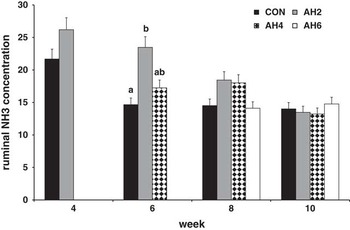
A treatment effect on NH3 concentrations was observed, and NH3 concentrations decreased over time (P<0.05; Figure 4). It has been shown that rumen pH can alter the NH3 concentrations as it affects ruminal NH3 absorption (Bartlet et al., Reference Bartley, Davidovich, Barr, Griffel, Dayton, Deyoe and Bechtle1976; Kertz et al., Reference Kertz, Davidson, Cords and Puch1983). These results reported here agree with those of Anderson et al. (Reference Anderson, Nagaraj and Morrill1987) who reported ruminal NH3 concentrations decreased as the calves became older. This is likely related to the increase of the NH3 utilization by the rumen microbes as well as the absorption of NH3 across the rumen wall. As ammonia is a major metabolite found in the rumen, it can be used as a marker for rumen function. In the present study, there were no treatment effect for concentration of NH3 at weeks 4, 8 and 10. Calves fed alfalfa at week 2 had greater concentration of NH3 at week 6 than calves fed CON treatment (P<0.05), but there were no significant difference between calves in AH2 and AH4. Results are also in agreement with those of Beharka et al. (Reference Beharka, Nagaraja, Morrill, Kennedy and Klemm1998) who noted that when calves were fed an ungrounded diet, there were higher NH3 concentrations at week 6 when compared with the calves that had consumed ground diet when 25% AH was added in a calf starter.
Ruminal ammonia concentrations in calves fed without (control (CON); closed bar) or with alfalfa hay (AH) at a 15% rate at the 2nd (AH2; gray bar), 4th (AH4; checkered bar) or 6th week (AH6; open bar) of age. Pooled SEM=2.51. Different letters within a time point indicate significant difference among treatments (P⩽0.05).

Skeletal growth measures
Body measurements (body length, BB, HG, withers height and hip height) were performed (Table 3). On d 3, 56 and 70, no treatment differences for hip height, wither height and HG were observed; however, calves on AH treatments tended to be greater (P<0.1) than those fed CON diet for BB and body length on d 70. Possibility exists that these trends may have reached significance had there been a larger n per treatment. Lack of significant difference in other skeletal growth measures might have resulted from large calf-to-calf variation and small number of animals per treatment. Alternatively, this lack of significant difference may have been resulted from gut fill. Calves fed alfalfa at week 2, numerically had more BB than those fed other times. However, no treatment effect for BB was observed on d 3 and 56.
Apparent nutrient digestibility
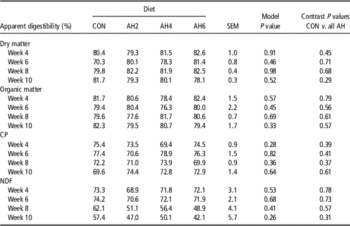
Apparent digestibility from the male and female calves during weeks 4, 6, 8 and 10 were not significantly different for DM, OM, NDF and CP when comparing AH calves v. CON (Table 5). Apparent nutrient digestibilities observed in this study are within the ranges that have previously been reported in weaned calves (Hill et al. Reference Hill, Bateman, Aldrich and Schlotterbeck2010; Castells et al. Reference Castells, Bach, Araujo, Montoro and Terre2012). In the present study, digestibility of NDF declined with age. One could expect that with CON, digestibility would increase with age because the NDF should have a high potential digestibility coming from all starters (concentrates). As the rumen enlarges and microbial populations increase, rumen retention time and NDF digestion would potentially increase. In other words, NDF digestion would have been reduced at 6 weeks of age because the rumen was small and the microbial population was immature. The differences in NDF digestibilities were not significant but higher feed intake along with higher rate of passage could be a reason that these were not significantly different. Apparent digestibility of NDF was numerically grater in CON compared with AH treatments. The increase of NDF digestibility in CON may explain different source of NDF between concentrate and hay. Furthermore, NDF digestibility decreased over time, which may have been associated with pH. By increasing the starter intake and consequently dropping pH, out flow rate would potentially be increased and retention time decreased (Hoover, Reference Hoover1986; Porter et al., Reference Porter, Warner and Kertz2007; Laarman and Oba, Reference Laarman and Oba2011). The findings of the present study are supported by those of Castells et al. (Reference Castells, Bach, Araujo, Montoro and Terre2012) who noted that total tract apparent DM, OM and NDF digestibilities did not differ between treatments that contain forage, but CP digestibility of free choice forage treatments were greater or similar to, but never lower than, calves fed starter without forages. The results observed may explain the lack of significant difference in feed efficiency across treatments (Table 4).
Nutrient apparent digestibility of calves (n=24; six calves per treatment) fed without (CON) or with alfalfa hay at the 2nd, 4th and 6th weeks of age

CON=control (starter feed with no additional alfalfa); AH2=15% of alfalfa hay at week 2; AH4=15% of alfalfa hay at week 4; AH6=15% of alfalfa hay at week 6.
Animal behavior
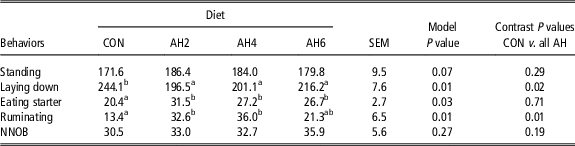
Time spent for each behavior that took place during 8 h of observation conducted over 2 weeks before and 2 weeks after weaning are shown in Table 6. Overall, calves spent ~15% of the observational period time laying down, which seems low. Calves fed AH2 and AH4 treatments spent more time for rumination (P<0.05) than CON. In addition, calves in AH2 spent less time laying down compared with CON (P<0.05). Calves in AH2 treatment devoted more time to eating (P<0.05). The differences in laying down between AH and CON treatments could be explained, at least in part, by the fact that AH calves spent more time eating and ruminating, which did not occur in CON calves. In contrast, there were no differences in non-nutritive oral behaviors (e.g. licking any surfaces or other animals) across treatments. These observations may lend support to the notion that calves in CON may have experienced a mild acidosis (lower intake, less rumination time, less eating time), which may relate to feeding alfalfa (with potentially some buffering effect on rumen pH) after certain age. Furthermore, no differences for standing, laying down, eating and non-nutritive oral behavior were observed in calves offered AH2, AH4 and AH6. These results are in accordance with some of the other reports in which ruminating was reduced when forage was not offered (Hodgson, Reference Hodgson1971; Phillips, Reference Phillips2004; Castells et al., Reference Castells, Bach, Araujo, Montoro and Terre2012). The non-nutritive oral behavior data conflict with those of Castells et al. (Reference Castells, Bach, Araujo, Montoro and Terre2012) who reported calves fed alfalfa devoted less time to non-nutritive oral behaviors (e.g. licking other animals) than calves fed only starter without alfalfa. The decrease in non-nutritive behavior reported by Castells et al. (Reference Castells, Bach, Araujo, Montoro and Terre2012) might be related to using wood shavings in calves’ bedding as compared with current study in which sand was used as bedding material. It should be noted that the measurements reported here (Table 6) were performed over a short period (8 h) for a certain, small number of days, and with a small number of animals per treatment; therefore, findings should be treated with caution.
Total time (minutes) devoted to different behaviors during 8 h observations of calves fed without (CON) or with alfalfa hay at the 2nd, 4th and 6th weeks of age

CON=control (starter feed with no additional alfalfa); AH2=15% of alfalfa hay at week 2; AH4=15% of alfalfa hay at week 4; AH6=15% of alfalfa hay at week 6; NNOB=non-nutritive oral behaviors (e.g. licking other animals).
a,bDifferent superscripts within a row indicate significance among treatments (P⩽0.05).
The inclusion of chopped AH at the rate of 15% to the starter diet when calves were 2 weeks old (receiving AH when calves were at 2 weeks of age), as compared with CON (no added alfalfa), resulted in producing heavier calves with greater starter intake and better ADG through pre-weaning and post-weaning periods without detectable negative impact on apparent nutrient digestibility. Among AH treatments, calves in AH2 had better performance than AH6 in several cases including starter intake, ADG. Furthermore, under our experimental condition feeding alfalfa in early age (week 2) did not negatively affect fecal scores or the incidence of pneumonia and diarrhea; however, it did stimulate time spent on ruminating. Collectively, addition of AH may be economically desirable because it could potentially lower the costs associated with production. Results reported should be viewed cautiously, however, as the number of animals allocated to each treatment was small and calf-to-calf variation may have affected the results.
Acknowledgements
Authors acknowledge assistance of Ghiam Farm (Isfahan, Iran) and Animal Science support staff at Isfahan University of Technology.