Implications
A suboptimal prenatal environment has been shown to influence intrauterine development in multiple species. The objective of the present study was to detect maternal and environmental factors associated with placental development in cattle. Results indicate that both lactation in adult cows and growth in adolescent heifers, as well as higher environmental temperatures, may alter placental development. Although the placenta seems to compensate for a nutritional challenge by adapting cotyledonary characteristics, it is suggested that placental efficiency remains lower in these pregnancies, with potential consequences for the developing fetus.
Introduction
In adult pregnancy, the gravid uterus receives a very large proportion of total cardiac output, enabling the pregnant mother to favor partitioning of nutrients toward the developing embryo/fetus, sometimes even at her own expense (Redmer et al., Reference Redmer, Wallace and Reynolds2004). Despite this high priority status of the conceptus, the prenatal growth trajectory remains extremely sensitive to environmental and maternal challenges. Thermal stress is known to compromise fetal development, caused by both decreased uterine blood flow (Reynolds et al., Reference Reynolds, Caton, Redmer, Grazul-Bilska, Vonnahme, Borowicz, Luther, Wallace, Wu and Spencer2006) and placental function (Early et al., Reference Early, McBride, Vatnick and Bell1991). Heat stressed cows also have a reduced dry matter intake (Tao et al., Reference Tao, Bubolz, Do Amaral, Thompson, Hayen, Johnson and Dahl2011), which at least partly contributes to intrauterine growth retardation of the fetus. Suboptimal maternal dietary intake during all stages of pregnancy and even during the peri-conception period has been shown to influence fetal growth and/or development in multiple species (Funston et al., Reference Funston, Larson and Vonnahme2010; Fleming et al., Reference Fleming, Velazquez, Eckert, Lucas and Watkins2012). In addition to the level of maternal nutrition, the age and growth status of the dam at the time of pregnancy are of major importance. Since in adolescent pregnancy nutrient partitioning toward maternal tissue growth and fat deposition is absolutely prioritized, suboptimal dietary intake has an even more detrimental effect on fetal development than seen in adults (Redmer et al., Reference Redmer, Wallace and Reynolds2004). The latter has been repeatedly demonstrated in the pregnant adolescent sheep model by Wallace and co-workers (Wallace et al., Reference Wallace, Bourke and Aitken1998), who showed that overnourishing adolescent ewes promotes rapid maternal tissue growth but leads to a concomitant reduction in lamb birth weight. In these ewes, the decrease in lamb birth weight was accompanied by a reduction in placental mass, stressing the strong correlation between placental and fetal size. Furthermore, various experiments in sheep conducted to directly impair placental development, have provided definite evidence that placental development is a major determinant of the fetal growth trajectory (Fowden et al., Reference Fowden, Ward, Wooding and Forhead2011).
In cattle, first parity heifers are expected to calve at 24 months of age and are therefore bred at an age of ~15 months and only 55% of their mature size (NRC, 2001). This results in a large part of their body growth taking place during their first gestation. Furthermore, dairy cows are inseminated early in lactation and produce large amounts of milk whilst being pregnant. Since both growth and milk production are highly demanding in terms of nutrient needs, it is reasonable to believe that these processes expose the pregnant uterus to a competition for nutrients with potential consequences for the developing placenta and fetus. In contrast to Holstein Friesian (HF) dairy cattle, the double-muscled Belgian Blue (BB) breed is reared explicitly for beef production and has lost the potential for (high) milk yield. Furthermore, due to very high growth rates during the first 2 years of life, only a limited weight gain is seen in this breed after second parturition (Fiems and Ampe, Reference Fiems and Ampe2015). As a consequence, the pregnant uterus does not have to compete with other processes and an excellent nutrient supply to the conceptus is assumed, which is underlined by very high birth weights in this breed (Kolkman et al., Reference Kolkman, Opsomer, Aerts, Hoflack, Laevens and Lips2010).
The objective of the present study was to determine the effect of environmental factors, like season of calving, and maternal factors on placental development. We hypothesize that growth in pregnant heifers and lactation in pregnant multiparous cows are comparable to adolescent pregnancy in human and sheep in terms of priority status for, respectively, maternal tissue growth and milk production. Fetal membranes of growing BB heifers were compared with those of fully grown BB cows to determine the effect of dam growth on placental development. Furthermore, the impact of dam lactation on placental development and its analogy with dam body growth was explored by comparing placentas of growing HF heifers to placentas of lactating HF cows.
Material and methods
All experimental procedures were approved by the Ethical Committee of the Faculty of Veterinary Medicine (2011/166-Ghent University, Belgium).
Animals
The study took place between November 2011 and June 2013 and involved 76 purebred HF and 43 purebred double-muscled BB animals, belonging to the herd of ILVO (Melle, Belgium). HF dams were pregnant by artificial insemination and BB dams were mated to a BB breeding bull. From November till April, BB cows were tethered, whereas HF cows were loose housed. Animals were fed according to their requirements for maintenance, growth and production. From May till October, all cows had access to pasture. HF cows were grazing during the day and were housed after evening milking, where they were fed a balanced ration based on grass silage and maize. Multiparous BB dams stayed on pasture permanently without supplement, whereas BB heifers were supplemented with 4 kg/day maize silage.
When the cows approached parturition, they were separated in a maternity pen and closely monitored by the herd employees. After calving, all calves were immediately removed into individual calf pens with straw bedding. Cows were moved back into the group after the placenta was shed.
Measurements and data collection
Purebred HF and BB calves were enrolled at birth. Crossbred, twin and stillborn calves, as well as calves born following an abnormally short (<265 days) or long (>295 days) gestation were excluded from further analyses. All BB calves were born by elective cesarean section. The gender and birth date of the calves were collected, as well as the birth date of the dam. The season of calving was grouped as follows: winter (21 December to 20 March), spring (21 March to 20 June), summer (21 June to 20 September) and fall (21 September to 20 December).
Placental measurements
Fetal membranes were collected and immediately checked for completeness after spontaneous expulsion. Fetal membranes were stored in the fridge (4°C) and measurements were done within 24 h after expulsion. Fetal membranes expelled after 12 h, were classified as retained and excluded from further analysis, as were damaged or incomplete fetal membranes. Accessory cotyledons (<10 mm in diameter) were not included in cotyledon number and surface calculations.
The entire fetal membranes (amnion and chorioallantois) were weighed using a digital scale with an accuracy of 0.1 kg. Cotyledons were one by one separated from the chorioallantoic by pulling by hand, after which the remaining membranes and the cotyledons were weighed separately. Each cotyledon was laid flat and the major and minor diameters were measured with an accuracy of 1 mm using calipers.
The individual cotyledonary surface area was calculated using the formula to calculate the area of an ellipse: Area (ellipse)=πab; with a=half of the major diameter and b=half of the minor diameter. Total cotyledonary surface area was calculated as the sum of all individual cotyledonary surface areas. The calf weight/total cotyledonary surface ratio was used as a measure of placental efficiency (Wooding and Burton, Reference Wooding and Burton2008).
Body measurements
Body measurements of both calf and dam were performed on day 3 postpartum. Calf BW was measured in kilogram (kg) on a digital scale while heart girth (HG), wither height (WH) and diagonal length (DL) of both dams and calves were measured on a centimeter (cm) scale. The HG was measured with a plastic-coated fiber tape (Animeter, Agro2000, Izegem, Belgium) as the minimal circumference around the body immediately behind the elbows. The WH and DL were measured with specially designed metal calipers (Bromet GmbH, Günzburg, Germany) on the left side while animals were in a standing position. The WH was defined as the distance from the floor to the top of the withers directly above the center of the shoulder and was measured with the animal standing squarely on a flat surface, head facing stretched out forward. The DL was defined as the distance from the leading edge of the tuberculum majus humeri to the medial border of the tuber ischiadicum.
Statistical analyses
All statistical analyses were performed using SAS version 9.4 (SAS Institute Inc., Cary, NC, USA). Normality of the data and error terms of the models were checked using the Kolmogorov–Smirnov test (P<0.01). PROC ANOVA was used to assess differences in body measurements between breeds and Pearson correlation coefficients were calculated to demonstrate the relationship between HG of the dam and BW of the calf using PROC CORR. To identify the variables associated with placental characteristics, generalized linear mixed models were build using PROC MIXED. As placental efficiency and individual cotyledonary surface were LOG-normally distributed, PROC GLIMMIX was used for these models. For individual cotyledonary surface, repeated measurements within a cow were stated in the random effect. Categorical predictors of breed (HF and BB), parity (primiparous and multiparous) and their interaction were forced into the models as fixed effects. Significance and tendency were declared at P<0.05 and 0.05<P<0.1, respectively.
Calving season was initially included as an independent variable in all models but was only significant in the model for individual cotyledonary surface.
Results of the models are presented as least squares means using the LSMEANS option.
Results
Dam and calf characteristics
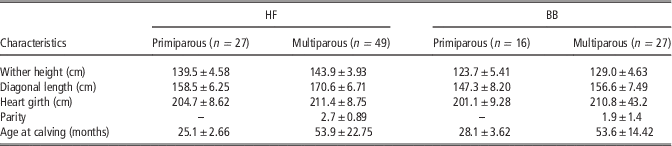
Dam body measurements, parity and age at calving are shown in Table 1. HF heifers (n=27) were 25.1±2.66 months at first calving, which is 3 months younger than BB heifers (n=16, 28.1±3.62 months, P=0.003). Multiparous HF cows (n=49) calved at an average age of 53.9±22.75 months, with parities ranging from 2 to 8. Parity in BB (n=27) cows ranged from 2 to 5, with an average calving age of 53.6±14.42 months. In both parity groups, HF dams had a significantly (P<0.001) larger WH and DL than BB dams, but HG was comparable between the breeds, with an average of 203.4±8.94 cm for primiparous (n=43) and 213.8±10.38 cm for multiparous (n=76) dams.
Descriptive statistics (mean±SD) of the dam characteristics by breed and parity

Calf morphological parameters are shown in Table 2. Breed had a significant (P<0.001) effect on all parameters, with BB calves having a higher BW (50.8±8.22 v. 41.4±5.32 kg) and HG (84.3±5.19 v. 80.4±3.62 cm) but a smaller WH (73.8±3.41 v. 76.6±3.07 kg) and DL (68.0±3.53 v. 71.0±3.14 kg) than HF calves. Within each breed, female calves had a lower weight and a smaller HG and WH than male calves (P<0.05).
Descriptive statistics (mean±SD) of the calf characteristics by breed and gender

A strong linear relationship between the HG of the multiparous BB dams and the weight of their newborn calves (r=0.68, P<0.001) was noticed. In multiparous HF dams on the other hand, no such relationship was detected (r=0.11, P=0.47). In primiparous BB and HF dams, a tendency toward a linear relationship between dam HG and calf BW was seen (r=0.46, P=0.05 and r=0.33, P=0.09, respectively).
Placental characteristics
Most cows calved during spring (n=43), winter (n=33) and fall (n=34), with only nine placentas collected in summer. Fetal membranes were expelled between 2.5 and 12 h after parturition, with an average of 6.8 h. The incidence of retained fetal membranes was 8.8%. In placentas of winter calvings, an average of 120±34.6 cotyledons was counted, compared with 106±25.1, 107±26.3 and 103±29.4 in spring, summer and fall calvings, respectively (P=0.09).
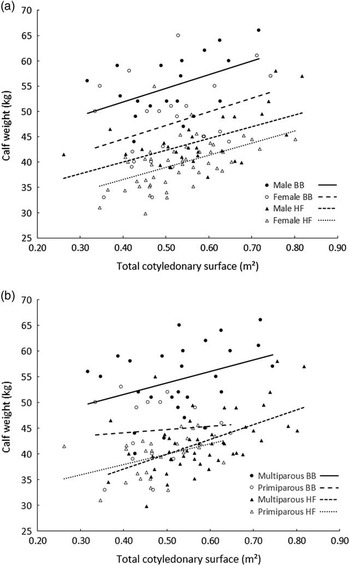
Linear relationships between calf weight and total cotyledonary surface of the placenta are shown in Figure 1a and b. Overall, a significantly positive correlation was found between calf weight and total cotyledonary surface (r=0.27, P=0.003). This relationship was strengthened when breed and gender of the calf were taken into account (Figure 1a). The strongest linear relationship between calf weight and total cotyledonary surface was seen in multiparous HF dams (r=0.53, P<0.001) (Figure 1b). In primiparous HF dams, a less strong linear relationship was seen between total cotyledonary surface and calf weight (r=0.41, P=0.03), but in primiparous BB dams, no significant correlation was found. In multiparous BB dams, placentas of heavier calves tended to have a larger total cotyledonary surface (r=0.35, P=0.07).
Linear relationship between the total cotyledonary surface (m2) and the calf weight (kg) (a) by calf breed and gender, and (b) by dam breed and parity.

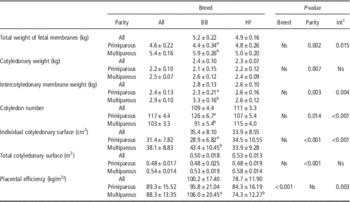
Results of the multivariable regression models searching for factors that are significantly associated with gross placental morphology, are shown in Table 3.
Results of the analysis of risk factors for placental characteristics in all dams from the multivariable regression model (LSM±SE)

1 Int=Interaction term between breed and parity. Different superscript indicate significant differences within breed or parity (P<0.05).
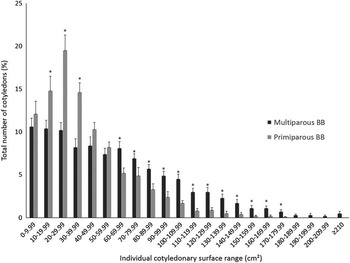
In HF dams, total weight of fetal membranes was 4.9±0.16 kg and was not affected by parity of the dam. On the other hand, fetal membranes of multiparous BB dams were significantly heavier than those of primiparous BB dams (5.9±0.26 v. 4.4±0.34 kg, P=0.004), caused by a 1.0 kg (P=0.001) larger weight of the intercotyledonary membranes. Parity affected cotyledon weight in both breeds, with heifers having a 0.3 kg lower cotyledonary weight compared with multiparous dams (P=0.007). A parity effect was also seen on cotyledon number and individual cotyledonary surface in the BB breed. Multiparous BB dams had 91±5.4 cotyledons with an individual surface of 43.4±10.45 cm2, while placentas of primiparous BB dams had a higher cotyledon number (126±6.7, P<0.001), but were found to have a greater proportion of smaller (<40 cm2) cotyledons (Figure 2). Within the HF breed, parity had no effect on cotyledon number and individual cotyledonary surface. The total cotyledonary surface of heifers was significantly smaller than that of cows in both breeds (0.48±0.017 v. 0.54±0.014, respectively, P<0.001). Placental efficiency was similar in HF and BB heifers but in multiparous animals, BB dams had a significantly higher placental efficiency compared with HF dams (106.0±20.45 v. 74.3±12.27 kg/m2, respectively, P<0.001).
Distribution of surface area (cm2) of individual cotyledons from primiparous and multiparous BB dams. Values are means±SEM and significant differences between groups are indicated as * (P<0.05).

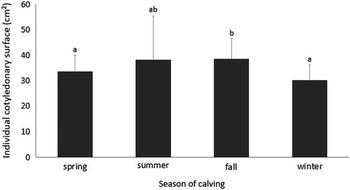
Finally, the model for individual cotyledonary surface showed, besides the breed×parity effect, a significant effect of calving season (P<0.001), with cotyledons from winter and spring placentas being smaller than those from placentas expelled in fall (Figure 3).
The effect of calving season on the individual cotyledonary surface (cm2). Values are LSM±SE, different superscripts indicate significant differences (P<0.05).

Discussion
In the present study we tested the hypothesis that placental development in cattle is associated with body growth and lactation of the dam and environmental factors like season of calving. To do so, expelled fetal membranes were collected and gross macroscopic characteristics of the fetal component of the placenta were measured and analyzed.
Dam and calf size
The hypermuscularity in the BB breed originates from an increase in skeletal muscle fibers, caused by a mutation and associated inactivation of the myostatin (mh) gene (Grobet et al., Reference Grobet, Martin, Poncelet, Pirottin, Brouwers, Riquet, Schoeberlein, Dunner, Menissier, Massabanda, Fries, Hanset and Georges1997). As the inactivation of the mh-gene is already present during intrauterine development, BB calves are extremely muscled at birth, giving rise to high birth weights as recorded in the present and previous studies (Kolkman et al., Reference Kolkman, Opsomer, Aerts, Hoflack, Laevens and Lips2010). Due to the pleiotropic effect of the mh-gene, the hypermuscularity is accompanied by a shortening of the skeletal bones (Shahin et al., Reference Shahin, Berg and Price1991), explaining the smaller WH and DL of BB calves and dams compared with HF animals of similar ages.
In multiparous BB cows, weight of the calf shows a strong relationship with the HG of the dam. Since in the BB breed, as well as in other cattle breeds, HG is known to be highly correlated with BW (Coopman et al., Reference Coopman, Van Zeveren, Verhoeven and De Smet2007), a strong linear relationship between dam BW and weight of the newborn calf was illustrated in multiparous BB cows. In both beef and dairy cattle, BW is a determining factor for dry matter intake (NRC, 2000 and 2001), so a better nutrient supply of the dam and thus the pregnant uterus might be expected in heavier dams. In addition, crossbreeding experiments in horses have shown that the size of the uterus is of major importance for intra-uterine development (Allen et al., Reference Allen, Wilsher, Turnbull, Stewart, Ousey, Rossdale and Fowden2002; Peugnet et al., Reference Peugnet, Wimel, Duchamp, Sandersen, Camous, Guillaume, Dahirel, Dubois, Jouneau and Reigner2014) which, combined with the higher feed intake, could explain the heavier offspring born out of dams with a larger HG. On the other hand, in multiparous HF cows and in heifers of both breeds, body size parameters of the dam showed no significant correlation with the weight of the offspring, suggesting other factors to be involved in determining the body size of their neonates. These results correspond with the research of Kamal et al. (Reference Kamal, Van Eetvelde, Depreester, Hostens, Vandaele and Opsomer2014), who found age at first calving in HF heifers and milk yield in HF cows to be better predictors of calf size than body measurements. The latter implies that, although larger dams are believed to have a larger uterus (Allen et al., Reference Allen, Wilsher, Turnbull, Stewart, Ousey, Rossdale and Fowden2002) and a higher feed intake, the fetus is not directly benefitting from this advantage, which suggests other maternal tissues to have a higher priority in terms of nutrient partitioning. These results resemble the situation in the ovine adolescent pregnancy model, as a higher nutrient intake in these ewes resulted in a concomitantly elevated maternal growth but had an adverse effect on lamb birth weight (Wallace et al., Reference Wallace, Bourke and Aitken1998). Hence, it is reasonable to believe that the results of studies in pregnant adolescent sheep could be extrapolated to pregnancy in growing adolescent heifers and lactating cows. On the contrary, in non-growing and non-lactating BB dams, the strong linear relationship between dam and calf size suggests a high priority and an unconditional nutrient supply toward the pregnant uterus. As BB animals have an extreme growth performance during the first 2 to 3 years of life, only limited weight gain is seen after second parturition (Fiems and Ampe, Reference Fiems and Ampe2015). Furthermore, research on growth rates in female beef cattle has shown that pelvic height begins to plateau between 24 and 27 months of age (Neville et al., Reference Neville, Mullinix, Smith and McCormick1978), indicating multiparous BB dams to have a close to mature frame and only limited nutrient requirements for maintenance and growth. In these dams, we can conclude that a larger body size results in the birth of larger calves. Whether this is purely mediated by a larger intra-uterine space and a higher feed intake, or by a more efficient placental nutrient supply in this breed, is not yet elucidated.
Maternal factors associated with gross placental morphology
Weight of total fetal membranes, cotyledons and intercotyledonary membranes
In HF dams, parity did not affect the total weight of the fetal membranes and the intercotyledonary membrane weight. In BB animals on the other hand, a parity effect on weight of fetal membranes was seen, mainly caused by a higher intercotyledonary membrane weight in multiparous compared with primiparous BB dams. As transport of nutrients and waste takes place at the functional sites of the placentomes, the membranes do not have an active role in supplying nutrients toward the calf. Thus, the higher intercotyledonary membrane weight in multiparous BB cows is suggested to be merely due to a spatial effect, caused by the fast growth and high birth weight of the calves of these dams.
In both breeds, the total cotyledonary weight was lower in growing heifers compared with cows. Research in rapidly growing adolescent ewes (Wallace et al., Reference Wallace, Bourke and Aitken1998) shows a similar restriction in cotyledon mass, reinforcing our hypothesis that pregnancy in growing heifers could be compared with adolescent pregnancy in sheep.
Cotyledon number
In the present study, the number of cotyledons per placenta varied between 51 and 211, with only seven cows expelling fetal membranes having more than 150 cotyledons. These results are comparable to those of Bertolini et al. (Reference Bertolini, Mason, Beam, Carneiro, Sween, Kominek, Moyer, Famula, Sainz and Anderson2002), who mentioned a range of 52 to 153 cotyledons counted on expelled fetal membranes of Angus and Angus×Hereford pregnancies. Within the BB breed, cows had 35 cotyledons less than heifers but the individual surface of their cotyledons was 4.5 cm2 larger. These results support the hypothesis that a minimal placentome development is necessary to sustain gestation, but that this can be achieved either by multiple smaller or a few larger placentomes (Adeyinka, Reference Adeyinka2012). Furthermore, a larger proportion of small cotyledons (with an individual surface area of<40 cm2) was found in BB heifers compared with BB cows. A similar outcome was reported by Clarke et al. (Reference Clarke, Heasman, Juniper and Symonds1998), who described a larger placentome number but a greater proportion of small placentomes in nutrient-restricted ewes. In addition, Miglino et al. (Reference Miglino, Pereira, Visintin, Garcia, Meirelles, Rumpf, Ambrósio, Papa, Santos and Carvalho2007) reported a large number of small placentomes in pregnancies from nuclear somatic transfer. Hence, it is suggested that the formation of more placentomes could be a form of adaptation to suboptimal circumstances, allowing such pregnancies to survive and continue to term. However, the precise mechanism by which the number of cotyledons is increased, remains unclear.
In female calves, caruncular buttons are already present in the uterus at birth (Schlafer et al., Reference Schlafer, Fisher and Davies2000), but it is not clear yet whether there is a large variation between animals in terms of the number of these caruncular buttons, and which factors affect this variation. Since during pregnancy, all uteri have spare caruncles not covered or attached to a cotyledon (Laven and Peters, Reference Laven and Peters2001), it seems that the number of the buttons that will be used during pregnancy to contribute in the nutrition of the fetus and hence develop toward active placentomes, may be regulated by several factors. Furthermore, in cattle, placentome number is known to be established early in gestation (Neto et al., Reference Neto, Morceli, da Fonseca, Ambrosio, Pereira and Miglino2009), and to not change throughout pregnancy (Laven and Peters, Reference Laven and Peters2001). The latter suggests that, during later pregnancy, the bovine fetus cannot respond to greater nutritional demands by forming more cotyledons. Consequently, the maternal and environmental factors during early gestation are believed to be decisive in determining the number of placentomes. Because of the fast growth in adolescent BB heifers, their nutritional demand (in terms of energy and protein requirements) is at least 1.5 higher than that of adult BB cows in early pregnancy (Fiems and Ampe, Reference Fiems and Ampe2015) and a high priority status of maternal tissue growth is expected. As a consequence, maternal growth in primiparous BB dams might impair the availability of nutrients for the conceptus. Since nutrient requirements of the early pregnant uterus are rather low, pregnancy should be able to continue under these circumstances. However, to increase the fetus’ chance of survival in longer term, when higher nutrient supply is required, it is suggested that the pregnant uterus can anticipate by forming more cotyledons over the available caruncles.
In contrast with the BB breed, no difference in cotyledon number or distribution of individual cotyledonary surfaces was detected between primiparous and multiparous HF dams. In accordance to our hypothesis, this might indicate that body growth in HF heifers and lactation in multiparous HF dams lead to a comparable decrease in nutrient availability for the developing placenta and fetus. As a consequence, it is suggested that in both primiparous and multiparous HF dams, the placenta compensates by a similar increase in cotyledon number.
Cotyledonary surface
A second mechanism of the placenta to assure a sufficient nutrient supply for the fetus, might be by expanding the cotyledonary surface. In contrast with sheep placentomes, placentome growth in cattle can continue throughout gestation (Reynolds et al., Reference Reynolds, Millaway, Kirsch, Infeld and Redmer1990), which may allow the bovine placentome to adapt to changing requirements and/or supply by compensatory growth, rather than by changing structure.
The total cotyledonary surface was lower in heifers compared with cows in both breeds.
The large total cotyledonary surface in multiparous BB dams, despite their low cotyledonary number, reinforces our hypothesis of a high nutrient supply for the uterus in these non-growing, non-lactating dams.
In HF dams on the other hand, heifers had a similar cotyledon number but smaller total cotyledonary surface compared with cows, suggesting that there might be an expanding mechanism of the cotyledonary surface in multiparous HF dams which is absent in primiparous animals. Since we only observed placentas after calving, we do not know at what time during gestation the increase in cotyledonary surface took place. In the third trimester of pregnancy, a rapid increase in nutritional demands by the fetus is seen. At the same time, dairy cows are usually dried off and a sudden decrease in nutrient supply toward the udder with a restoration of nutrient supply to the placenta and fetus is suggested. Therefore, we hypothesize that at the end of pregnancy, when the cow is dried of, the placenta can meet the high fetal nutrient demand by expanding its cotyledonary surface (Reynolds and Redmer, Reference Reynolds and Redmer1995). The latter needs confirmation by a follow up study in lactating animals researching the effect of milk yield and duration of lactation on placental phenotype.
In contrast with multiparous cows, the reduced nutrient availability for the conceptus is expected to be present during the entire gestation in pregnant heifers. As there is no restoration of nutrient supply (comparable to drying off in lactating cows), an expansion of the cotyledons might not be able to occur, leading to smaller total cotyledonary surfaces as noticed in the HF heifers from the present study. To further underpin the latter reasoning, placental development should be monitored progressively throughout the whole gestation.
Overall, a significant positive correlation was seen between total cotyledonary surface and calf size. This correlation was strengthened when breed was taken into account, with BB calves having a higher birth weight than HF calves at a given placental surface. As male calves grow faster than female calves from early gestation on, male calves were heavier than female calves at any placental weight, as seen in humans (Barker et al., Reference Barker, Thornburg, Osmond, Kajantie and Eriksson2010). These findings illustrate that the intra-uterine development is more complex than placental cause and fetal effect and rather a result of a strictly regulated co-ordination between placental and fetal development. The placental phenotype is clearly regulated by the fetal genetic drive for growth, although the nature of fetal nutrient demand signals that regulate placental growth and concomitant nutrient transfer capacity, remains unknown (Constância et al., Reference Constância, Angiolini, Sandovici, Smith, Smith, Kelsey, Dean, Ferguson-Smith, Sibley and Reik2005). Remarkably, despite the absence of a correlation between dam and calf size in multiparous HF cows, a strong linear relationship between placental characteristics and calf weight was seen in this group of dams. The latter might be an indication that in HF cows the prenatal environment is a more important regulator of fetal development than the maternal genome, as demonstrated by the early cross-breeding experiments of Walton and Hammond (Reference Walton and Hammond1938). Furthermore, it reinforces our hypothesis that, at the end of pregnancy, the expansion of the cotyledons enables a sufficient nutrient supply to the fetus, assuring a good correlation between cotyledonary surface and calf size.
Placental efficiency
The calf weight/total cotyledonary surface ratio, used as a measure of placental efficiency (Wooding and Burton, Reference Wooding and Burton2008), was significantly higher in multiparous BB than in multiparous HF dams. On the one hand, this can be explained by the higher prenatal growth rate and birth weights in BB calves at a certain cotyledonary surface, as shown in Figure 1a. On the other hand, the low placental efficiency in multiparous HF dams is mainly caused by the very large cotyledonary surface. This may be a reflection of the nutrient constraint caused by lactation during the majority of the gestation in these dams, despite the attempts for compensation during the dry period. Heasman et al. (Reference Heasman, Clarke, Stephenson and Symonds1999) found similar results in nutrient restricted sheep. The nutritional challenge was followed by an enhancement of the fetal component of the placenta when nutritional level was restored, leading to a disproportionally larger placental to fetal weight ratio and thus a reduced placental efficiency.
As no difference was seen in the placental efficiency between BB and HF heifers, this suggests that the effect of body growth on placental efficiency is similar in both breeds.
Environmental effects on placental characteristics
Calving season had an effect on the size of the individual cotyledons, with winter and spring placentas having the smallest individual cotyledonary surfaces. As suggested previously, the increase in cotyledonary surface might be a reaction to the increasing fetal demand combined with the restoration of nutrient supply after drying off. As cows calving in winter and spring are dried off during the coldest months of the year, a very good blood supply to the uterus could be expected during the final months of gestation. In consequence, nutrient provision to the calf is expected to be sufficient even when fetal demand is higher, and it is suggested that compensation by expanding the cotyledonary surface is not necessary. On the other hand, when cows are dried off during hotter months a suboptimal nutrient supply of the calf is expected, which the placenta might compensate for by an expansion of the cotyledonary surface.
Conclusions
The main findings of this study are that maternal growth and lactation during gestation might impede placental development, most likely caused by a shift in hierarchy for nutrient partitioning toward maternal tissue growth respectively milk yield. The results suggest two potential compensation mechanisms by the placenta. In early pregnancy, the placenta might cope by developing more cotyledons over the available caruncles, enabling pregnancy to survive. On the other hand, at the end of pregnancy an expansion of the cotyledonary surface is suggested to meet the increasing nutrient demand of the fetus. The contribution of maternal tissue in this compensation mechanism and the microscopic characteristics of the feto–maternal interface should be more closely investigated. Moreover, to further elucidate the mechanisms underlying placental compensation, more research on factors influencing placental development, with a special interest on milk production level and moment of drying off, is warranted.
Acknowledgments
The authors want to thank the farm staff of ILVO (Melle, Belgium) for their contribution to this study.