Introduction
Early activation or use of Emergency Medical Services (EMS) are associated with improved outcomes in patients with EMS priority conditions.Reference El Sayed, Tamim, Al-Hajj Chehadeh and Kazzi 1 , Reference Sozener and Barsan 2 The EMS outcome project, a cooperative project funded by the US National Highway Traffic Safety Administration (Washington, DC USA), defined these conditions as important in EMS research because of either their relatively high frequencies or because of the impact of early treatment provided by EMS.Reference Tan, Wong and Poh 3 For adult patients, the top quartile EMS conditions accounted for 65.5% of all emergency transports in a US study population and included minor trauma, respiratory distress, chest pain, major trauma, cardiac arrest, airway obstruction, and respiratory arrest.Reference Tan, Wong and Poh 3 Outcomes evaluated consisted of satisfaction, cost effectiveness, alleviating discomfort, limiting disability, impaired physiology, and survival.Reference Tan, Wong and Poh 3 More specifically, activation or use of EMS in time-sensitive conditions such as cardiac arrest, stroke, or myocardial infarction are associated with earlier triage, faster access to treatment, and improved patient outcome.Reference El Sayed, Tamim, Al-Hajj Chehadeh and Kazzi 1 , Reference Sozener and Barsan 2 , Reference Maio, Garrison and Spaite 4 - Reference Loh, Satler and Pendyala 6 The evidence for the clinical effectiveness of prehospital treatment associated with EMS utilization also exists in the form of number needed to treat for various conditions.Reference Kuster, Bueno Alves, Cendoroglo Neto and Silva 7
Lebanon has a relatively under-developed EMS system that is fragmented with multiple volunteer agencies operating at the Basic Life Support level. National EMS curriculum and scope of practice for prehospital providers are lacking with absence of a governmental regulatory or legislative authority responsible for the EMS system;Reference Myers, Slovis and Eckstein 8 EMS agencies are mostly volunteer-based with the exception of one government agency that provides less than one-third of transports.Reference Myers, Slovis and Eckstein 8 Previous studies examining out-of-hospital cardiac arrest (OHCA) and acute stroke in Beirut revealed that 71.5% of OHCA victims and only 14.9% of acute stroke patients used EMS transport.Reference El Sayed and Bayram 9 , Reference El Sayed, Tamim, Nasreddine, Dishjekenian and Kazzi 10 A similar underutilization of EMS was reported in the Arab Gulf States with fewer than one out of five patients with acute coronary syndromes being transported by EMS.Reference El Sayed, El Zahran and Tamim 11 This is worse than the reported relative underutilization of EMS in the US where only 49.8% of patients with acute myocardial infarction and 50.3% of those with acute stroke presented by EMS.Reference Fares, Zubaid and Al-Mahmeed 12
Several demographic, clinical, situational, and belief factors have been described as affecting EMS use in other settingsReference Tataris, Kivlehan and Govindarajan 13 - Reference Shah, Glushak and Karrison 16 but have not been examined in Lebanon. Identifying these factors is needed to create strategies to address underutilization and to ensure that the need of emergency care translates into reliance, use, as well as early activation of EMS, and eventually improved patient outcomes.
This study describes patterns of EMS use and identifies predictors of EMS utilization in EMS priority conditions in Lebanon.
Methods
Study Design
This was a cross-sectional study of patients presenting to the emergency department (ED) at the American University of Beirut Medical Center (AUBMC; Beirut, Lebanon) - the busiest ED in Lebanon with more than 50,000 patient visits yearly. The study consisted of a chart review followed by patient (or proxy) survey. The Institutional Review Board office at AUBMC approved this study.
Inclusion/Exclusion Criteria
A random sample of adult patients (age 18 and above) presenting to the ED with respiratory distress, chest pain, major trauma, cardiac arrest, airway obstruction, and respiratory arrest presenting to AUBMC were enrolled during the study period (October 2013-September 2015).
Patients with Emergency Severity Index (ESI) greater than three were excluded (ESI is a validated acuity scoring system used at ED triage).Reference Razzak, Cone and Rehmani 17 Those who were unable to fill the survey part of the study, those who were too ill to complete the survey with the absence of a proxy, and those refusing to fill the survey were excluded from the study.
Sampling
In order to include a representative sample of patients admitted to the ED at AUBMC, a two-level sampling was carried out. The first was to select the ED shifts (day, evening, or night) randomly, through a stratified random selection, taking into consideration the distribution of ED visits by shift and by obtaining computer-generated random numbers. As a second level of sampling, consecutive patients presenting to the ED and meeting inclusion criteria were invited to participate. A total of 481 patients were recruited during the study period.
Data Collection
After consenting patients, trained research assistants collected data using an initial chart review for the following elements: age, gender, marital status, insurance status, education level, time of ED admission, chief complaint, triage clinical severity (ESI score from one to five with one for highest severity and five for lowest severity), pain score (a verbal numeric descriptor scale from one to five with five being the highest score for pain), and mode of transport to the ED (self, ambulance, or other).
A survey was developed for this study using review of literature and relevant clinical background (Appendix 1; available online only). The survey was then translated and back-translated into Arabic language by two independent translators, and any discrepancy was resolved through consensus. Once the survey was finalized, it was pilot tested among 10 patients where minor revisions were incorporated into the final version that was used in the study.
The research assistants administered the questionnaire to enrolled patients. The survey addressed different factors affecting EMS use, including but not limited to EMS access, clinical, illness, and health belief. For patients who were unable to respond due to their clinical status, a proxy (family member or friend accompanying the patient) was interviewed. The responses to the survey questions were “disagree,” “neutral,” or “agree” and were coded as one, two, or three (three having higher likelihood of using EMS). A total scale score ranging from 20 to 60 was created and transformed from 0% to 100%.
Statistical Analyses
Statistical analysis was performed using the SAS 9.1 statistical package (SAS Institute; Cary, North Carolina USA). Numbers/percent were used for categorical variables and medians/interquartile ranges for continuous variables. Comparison between the two groups (based on EMS use) was carried out by the student’s t-test for continuous variables or the chi-square test for the categorical ones. This was followed by multivariable logistic regression analyses to identify predictors of EMS use. Predictors were summarized by the odds ratios (OR) with 95% confidence intervals (CI). Statistical significance was considered at the .05 level.
Results
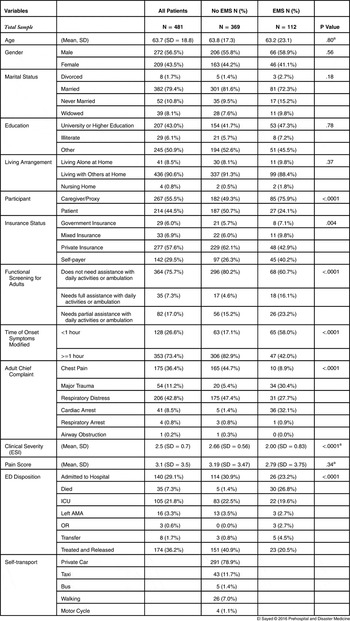
During the study period, 481 random patients were enrolled among those who presented to the ED with the selected EMS priority conditions (Table 1). Only 112 (23.3%) patients used EMS.
Description of Study Population and Association between Variables and the Use of EMS

Abbreviations: AMA, against medical advice; ED, emergency department; EMS, Emergency Medical Services; ESI, Emergency Severity Index; ICU, intensive care unit.
a P value calculated by student’s t-test. All other P values were calculated by Chi square test.
The study population had a mean age of 63.7 years (SD=18.8 years) with 56.5% males. Mean clinical severity score (ESI) was 2.5 (SD=0.7) and mean pain score was 3.1 (SD=3.5) at ED presentation. Most patients were living with others at home (90.6%). Over one-half were privately insured (57.6%). Almost one-half of the patients (49.7%) presented within six hours of onset of symptoms with 26.6 % presenting within one hour. Over one-half (58.8%) needed admission to hospital with 21.8% to an intensive care unit care level. The mortality rate among the study population was 7.3%.
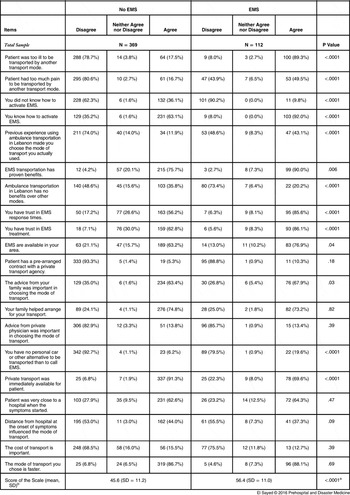
Significant associations were found between EMS use and the following variables: severity of illness, degree of pain, familiarity with EMS activation, previous EMS use, perceived EMS benefit, availability of EMS services, trust in EMS response times and treatment, advice from family, and immediate availability of another mode of transport (P≤.05; Table 2). Those who used EMS, when compared with those who did not, were more likely to agree that the clinical condition was severe, the pain severity was high, that they knew how to activate EMS, that EMS transportation had proven benefit, that previous experience with EMS use was important, that they trusted EMS response times and treatment, that EMS services were available in their areas, and that family advice was important. Patients who had private transport immediately available were less likely to use EMS (Table 2).
Association between the Scale’s Items and Score, and the Use and Non-use of EMS

Abbreviation: EMS, Emergency Medical Services.
a P value calculated by student’s t-test. All other P values were calculated by Chi square test.
b Scale scores ranging from 0 to 100.
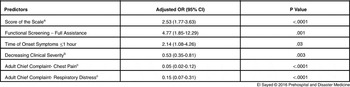
Results of the multivariate logistic regression (Table 3) showed that patients with lower clinical severity measured by ESI score (OR=0.53; 95% CI, 0.35-0.81) and patients with chest pain (OR=0.05; 95% CI, 0.02-0.12) or respiratory distress (OR=0.15; 95% CI, 0.07-0.31) were less likely to use EMS (cardiac arrest chief complaint used as the reference). Patients with EMS priority conditions were more likely to use EMS if they required full assistance with their daily activities or ambulation (OR=4.77; 95% CI, 1.85-12.29), if they had acute symptoms onset of less than one hour (OR=2.14; 95% CI, 1.08-4.26), or if they had higher scale scores (OR=2.99; 95% CI, 2.20-4.07) on the survey.
Multivariate Analysis for the Predictors of EMS Use

Note: Hierarchical regression imposing the 10% score of the scale.
Abbreviation: EMS, Emergency Medical Services.
a Scale scores ranging from 0 to 100.
b Clinical severity as ESI from 1 to 5 (1 for highest severity and 5 for lowest severity; ESI >3 were excluded).
c Adult chief complaint - cardiac arrest as a reference.
Discussion
Examining patterns and identifying predictors of EMS use are very important to understand the different aspects of an EMS system and to meet demand when resources are limited. The main finding of this study is that EMS use among ED patients with EMS priority conditions in Lebanon is low (23.3%). This study also identified predictors of EMS use and patterns of utilization of EMS in Lebanon by examining a select group of patients with EMS priority conditions who are known to benefit from EMS care in a developed EMS system, such as that of the USA. Despite the variations in structural components, overall organization of, and available resources in different EMS systems, the end goal of any EMS system is to reduce unnecessary death and disability, mainly for patients with time-sensitive conditions such as cardiac arrest, ST-elevation myocardial infarction/STEMI, or respiratory distress.
Several variables were identified to be significantly associated with EMS use or non-use. First, health belief factors such as the perceived severity of the illness, the perceived EMS benefit, and the trust in EMS response times and treatment were found to be significantly different between the EMS and no EMS groups. Second, access-related factors such as familiarity with EMS activation, availability of EMS services, or immediate availability of private transport were also found to be important. Third, other illness-related factors (such as perceived pain and onset of symptoms) and cultural factors (such as advice from family in addition to previous experience with EMS) were significant when deciding on EMS use. All of these factors are important to consider when assessing the perspective of the patient who is the end-user of the EMS system and what needs to be addressed to improve access to the overall system, when needed. Some of these factors were identified previously in a study done in Karachi, Pakistan evaluating the prehospital system.Reference Shah, Glushak and Karrison 16 These included perception of severity of illness, ambulance response times, and difficulty finding an ambulance or knowing how to activate the EMS system.Reference Shah, Glushak and Karrison 16
This study also described significant predictors of EMS use. These include functional status, clinical severity, onset of symptoms (≤ one hour), and specific chief complaints such as chest pain and respiratory distress (when compared to cardiac arrest). Some of these predictors, mainly functional status, have been shown to be important predictors of EMS use in other settings.Reference Young, Torner, Sihler, Hansen, Peek-Asa and Zwerling 15 Patients tend to use EMS or request ambulance transport when they have limited mobility or poor physical function.Reference Young, Torner, Sihler, Hansen, Peek-Asa and Zwerling 15 Similarly, acute symptom onset (less than four hours) has been described to be an important predictor of EMS.Reference Young, Torner, Sihler, Hansen, Peek-Asa and Zwerling 15 In the study analysis, the one-hour limit was used instead of four hours since this was considered more than enough time for patients to decide on whether or not to activate EMS and to decide on the mode of transport. A higher scale score also was an important predictor in the study setting for EMS use. The scale score represented the summary measure of the responses to the survey questions with higher scores reflecting the need to activate EMS rather than present by private transport. This scale is not unique to the Lebanese system and can be applied to any survey assessing potential users of the EMS system.
In contrast to other studies in the US and China, older age was not a strong predictor of EMS use in Lebanon. Elders usually are considered to be frequent users of EMS with age ≥ 85 years previously identified as a strong predictor of EMS use.Reference Young, Torner, Sihler, Hansen, Peek-Asa and Zwerling 15 This was not the case in this study setting, potentially because the Lebanese strong, close-nit family ties would prompt children, siblings, and neighbors to step-in immediately and move the ill elder to the hospital, especially if and when the patient is still ambulating. This also could be because the mean age in this study population was 63.7 years compared to 76 years in the study by Shah et al. Financial coverage was also not an important predictor of EMS use in this study, similar to previous studies.Reference Young, Torner, Sihler, Hansen, Peek-Asa and Zwerling 15 In Lebanon, most EMS agencies are volunteer-based with free care and transports for patients.
Patients with specific chief complaints, such as chest pain and respiratory distress, were less likely to use EMS when cardiac arrest was used as a reference in the analysis. This was expected since EMS should be activated for all patients with OHCA for on-scene care and transport, though this is not always the case in Lebanon. Presence of chest pain also was described previously as a predictor of non-EMS use in a study assessing EMS utilization by patients with acute coronary symptoms in the Arab Gulf countries.Reference El Sayed, El Zahran and Tamim 11 This deviation from Western EMS utilization profiles also could be attributed to socio-cultural factors such as the strong, close-nit family structure in the Middle East region.
Appropriateness of EMS use was not assessed directly in this study; however, the EMS conditions that were selected for enrolling patients are conditions that would benefit from EMS care and transport, as described earlier. The clinical severity measured by ESI score on arrival to ED correlated well with the perceived illness severity described by patients or proxies in their responses and with the rate of admission (58.8%), including the rate of mortality of 7.3%. There is room for an intervention at the public education level since 78.7% of those who did not use EMS did not perceive the patient to be too sick for transport by another mode such as ambulance.
Prior to devising such initiatives, it would be prudent to consider facts about the existing EMS system and whether the type of care provided in the prehospital setting would be beneficial. A previous study assessing OHCA survival in Beirut, Lebanon showed non-consistent EMS clinical care including low EMS-initiated cardiopulmonary resuscitation (51.9%), low prehospital automated external defibrillator use (0.9%), and extensive delays in EMS response times (median 15 minutes; IQR 10.0-27.5).Reference El Sayed and Bayram 9 Ensuring timely EMS responses and appropriate care according to evidence-based protocols are some of the issues to be addressed by EMS agencies as prerequisites for public education and encouraging patients to use EMS.
Limitations
Some limitations of this study can be noted. Selection bias can be an issue with observational studies, especially that the study enrolled patients from only one center. Patients enrollment was done in a random manner according to predefined criteria using presenting condition as the main criterion and ensuring that the sample was representative of the distribution of patients by ED shifts (morning, evening, or night). The findings of this study reflect the EMS system or the urban setting in which it took place and might be different for patients presenting to other facilities in Lebanon, especially in rural or remote areas. Interviewer bias is unlikely since the data were collected from the chart and trained interviewers administered the survey using standardized protocols for data collection. The benefit of EMS transport in Lebanon is not well documented and the interviewers did not have preconceived notions about benefits of EMS use prior to the study.
The study findings are important, however, since they assess the EMS system from the end user perspective. The study also provides a model for EMS administrators to use when examining their systems, regardless of the type of EMS system they are managing. Initiatives to address access barriers, public education, or performance improvement should follow the analysis of results from studies when using such an assessment.
Conclusion
Emergency Medical Services utilization in EMS priority conditions in Lebanon is low. Several EMS initiatives are needed to address this underutilization to improve prehospital care and patient outcomes. Documenting benefits of EMS care in these conditions is a prerequisite to encouraging patients to use EMS in any setting. This assessment model can help EMS administrators evaluate their system and its end users’ perspectives and devise improvement initiatives accordingly.
Supplementary Material
To view supplementary material for this article, please visit http://dx.doi.org/10.1017/S1049023X16000972