Implications
Although it is generally assumed that high-forage diets used in organic farming supply limited energy to dairy cows, few studies have analyzed this problem. This study reports on the nutritional status of dairy cattle on organic farms in northern Spain, focusing on the energy–protein balance of the diets. The conditions on the organic farms under study are representative of the usual field conditions in the organic dairy sector in temperate regions. The study findings can be used to improve the diet formulation with the aim of increasing the profit of organic farming and reducing the environmental emissions associated with the inefficient use of dietary protein.
Introduction
Adequate provision of suitable feed is one of the primary objectives of farmers to ensure the health and performance of their livestock (Manteca et al., Reference Manteca, Villalba, Atwood, Dziba and Provenza2008). This is particularly important in dairy production as dairy cows require high-quality diets to ensure a balance between optimal milk production and the maintenance of both good health and reproductive efficiency (Weller and Bowling, Reference Weller and Bowling2007). In conventional dairy farming, high-yielding cows are commonly fed in excess of requirements using diets supplemented with high amounts of energy and protein concentrates. However, in organic dairy farming the aim is to optimize available resources rather than maximize production, so that in most cases systems are based on the maximum use of forage (Sorge et al., Reference Sorge, Moon, Wolff, Michels, Schroth, Kelton and Heins2016). European Union regulations in organic farming state that forage, either grazed or conserved, should represent at least 60% of the total diet of organically farmed animals (Commission Regulation, 2008), thus limiting the use of concentrates. Diets based on grazing and forage are cheaper and improve the use of available resources compared with high-concentrate diets but may be limited in the provision of energy to the cow (Weller and Bowling, Reference Weller and Bowling2007; Blair, Reference Blair2011).
The energy requirements of high-yield dairy cows at early lactation are usually higher than the amount of energy consumed leading to a negative energy balance, especially when feed intake is restricted (Hammon et al., Reference Hammon, Stürmer, Schneider, Tuchscherer, Blum, Engelhard, Genzel, Staufenbiel and Kanitz2009). Conventional farms use high-energy concentrates to alleviate this deficit, but the energy shortage at early lactation may be more critical in grazing-based organic systems. In fact, an increased lipomobilization after calving has been observed in organically compared with conventionally reared, and the proportion of cows with subclinical ketosis is greater in organic than in conventional farms (Abuelo et al., Reference Abuelo, Hernández, Benedito and Castillo2014). The nitrogen (N) supply, another key factor in organic dairy production, can vary widely, ranging from low levels in rations based on conserved forage, to a surplus of protein in grazing cows, especially in pasture with herbage mixtures including clover, leading to increased loss of N to the environment (Weller and Bowling, Reference Weller and Bowling2007). The challenges in organic dairy farming are therefore to produce sufficient forage of quality (to minimize the concentrate use) to meet the energy and protein requirements of the dairy cows. This is a difficult task since the conditions of each farm are distinctive and largely variable within a region (Weller and Bowling, Reference Weller and Bowling2007; Hardie et al., Reference Hardie, Wattiaux, Dutreuil, Gildersleeve, Keuler and Cabrera2014). Moreover, there are no specific studies about the general nutritional status of organic dairy cattle.
The overall aim of the present study was to analyze the composition of the diets and the nutritional status (focusing on the energy–protein balance of the diets) of organic dairy farms in northern Spain, which are similar and representative of the variability of organic pasture-based dairy systems. Our hypothesis is that organic diets for dairy cows could be unbalanced, so the results could help to identify the main limitations of the diets to offer proposals aiming to improve their formulation in order to ensure optimum animal performance and farm returns, and to reduce the environmental impact of N losses.
Material and methods
Sample collection and processing
The data used in this study were obtained as part of a research project (Spanish Government Ref. AGL 2010–21026) carried out to analyze the nutritional and sanitary status of the organic dairy herd in North Spain comparing with the conventional sector. All organic (ORG) dairy farms enrolled in Dairy Control Record and with willingness to participate in the study (n=22) were selected, representing the 40% of the total ORG dairy farms in the region. Samples in five conventional grazing (GRZ) and five conventional no-grazing (CNG) representative dairy farms were collected for comparison. The project was designed to get data from a larger number of ORG farms since they are much more unknown and include a wider range of management practices, compared with the conventional farms that are more uniform and show smaller variability.
Data were collected from each farm at three different times of year (summer/winter/spring), between July 2011 and June 2012, to obtain exhaustive information on feeding and performance in each farm. In addition, feed samples were collected and information about the types and quantities of the different feedstuffs consumed was obtained from each farm in each season. Feed samples (duplicate samples of each type of feed, including lucerne hay (n=24), pasture (n=75), hay (n=36), concentrate feed (n=95), grass silage (n=71), maize silage (n=40), straw (n=4) and vetch (n=1)) from ORG (n=244), GRZ (n=52) and CNG farms (n=50) were analyzed. The feed samples were oven-dried (60°C, 24 h), grounded and sieved (0.5 mm diameter) before analysis.
The following productive parameters were obtained from dairy control records on each farm: milk production, % milk fat, % milk protein, % dry extract, bacterial count (BC), somatic cell count (SCC) and milk urea nitrogen (MUN).
Analytical methods
Different analytical parameters in each feed material were determined using near IR spectroscopy. Organic matter (OM), CP, ADF, NDF, water soluble carbohydrates and digestibility of OM were determined for lucerne, hay, vetch hay, pasture and straw. Analyses were conducted to determine OM, CP, ADF, NDF, starch and OM digestibility in maize silage; OM, CP, ADF, NDF, OM digestibility, pH, lactate, butyrate in grass silage; and OM, CP, crude fibre, crude fat and starch in concentrate feeds. Sample spectra were recorded in a Foss NIR Systems 6500 monochromator (spectophotometric NIRSystems 6500; FOSS NIRSystems, Inc., Silver Spring, WA, USA). Two aliquots of each sample were scanned in a spinning circular cup with a quartz window of 37.5 mm diameter, at 2 nm intervals (1050 data points) in the wavelength range 400 to 2500 nm. The spectrum obtained for each sample was the average computed from the two sub-samples. Data were processed using WinISI II software, version 1.5 (Infrasoft International, Port Matilda, PA, USA, 2000).
Data on each feed material (including the chemical composition analyzed and the quantities of each feedstuff given to the animals in each farm) were used as inputs in the INRATION® software (INRA, 2008). This application was used to calculate the composition of the ration (with the contribution of each feedstuff) and to estimate the pasture intake and the energy–protein balance expected, considering the mean daily milk production and the average cow weight for each farm. The module PrevAlim of the INRATION® software was used to calculate the nutritive value of each feedstuff using the available chemical analyses, and thus to predict the energy concentration and the protein value of the feedstuffs. The ration formulation and prediction of nutritive value of feeds by the INRATION® software are based on the principles for ruminant feeding and equations derived and developed by INRA (1989). Feed energy value was expressed in UFL (forage unit for lactation, ‘Unité Fourragère Lait’) per kilogram feed, the unit of the INRA system corresponding to the net energy in 1 kg of air-dried barley (1.70 Mcal net energy for milk production). Protein value of feeds was assessed in terms of PDIN (protein digested in the small intestine supplied by rumen-undegraded dietary protein and by microbial protein when rumen-degraded dietary N is limiting) and PDIE (protein digested in the small intestine supplied by rumen-undegraded dietary protein and by microbial protein when rumen-fermentable energy is limiting).
Statistical analysis
For each variable, univariate ANOVA was performed using the PROC MIXED procedure of SAS. The statistical model included the type of farm (CNG, GRZ or ORG), season (summer, winter or spring) and their interaction as fixed effects, with farm as a random effect. The Tukey–Kramer adjustment was used for multiple comparisons of least square-mean differences. Orthogonal contrasts were used to test for (i) differences between ORG and non-organic (CNG and GRZ) farms, and (ii) differences between grazing (GRZ and ORG) farms and no grazing (CNG) farms.
Multivariate analysis was used for comprehensive assessment of the differences between the types of farm based on the data set including all cases (94 records from 32 farms in three seasons, two missing data-points) and variables considered in the study. The variables used in the multivariate analyses were those related with dry matter intake (DMI) and estimated amount of pasture grazed; proportion of each type of feed in the daily ration (concentrate, total forage, hay, lucerne, maize or grass silage); milk production (kg/day) and composition (fat, protein, total solids, BC, SCC and MUN); chemical composition (OM, ADF), energy concentration (UFL) and protein value (CP, PDIN and PDIE) of the total daily ration and of total forage and concentrate in the ration and feed efficiency indices (milk yield per unit of dry matter (DM), concentrate, energy or protein intake). First, all variables were feature-scaled to test three variable transformations: standardization or z-scores, rescaling of range from 0 to 1 and Box–Cox transformation. The min–max normalization (rescaling of range from 0 to 1) was the most appropriate method for our data set. Multivariate analysis of variance and non-parametric or permutational multivariate ANOVA (PERMANOVA) were applied to the transformed data to compare the types of farm (CNG, GRZ or ORG), considering all variables together in the data set. Post hoc tests were used for pairwise comparisons of the three types of dairy farms. The variables primarily responsible for an observed difference between types of farms were identified by the similarity percentage method. The Bray–Curtis similarity measure was used for PERMANOVA and similarity percentage analyses. Multivariate analysis of variance, ANOVA, PERMANOVA and similarity percentage analysis were performed with the Paleontological Statistics software package, version 3.16 (Hammer et al., Reference Hammer, Harper and Ryan2001).
Linear discriminant analysis (LDA) was used to plot the cases along the two canonical axes, resulting in maximal separation between the three types of dairy farms. In order to facilitate the visualization, each farm type (CNG, GRZ or ORG) was labelled differently, showing the separation between the three groups and how each case was ascribed to each type of farm. Linear discriminant analysis also provided information on the loadings (relative influence) of each variable on the group discrimination, thus contributing to identifying the most important features for characterizing each type of farm.
Finally, all the available observations were partitioned into well-differentiated clusters by the non-hierarchical K-means clustering method. The optimal number of clusters for classifying the cases in the data set was established by an ‘elbow’ procedure (Chiang and Mirkin, Reference Chiang and Mirkin2010) based on the explained variance as a function of the number of clusters. Using the outcome of the elbow method, the non-supervised K-means clustering was implemented with a machine learning algorithm, classifying each case into one of the groups derived. Linear discriminant analysis was then applied to the output of the cluster analysis to plot all the cases on a 2-D plane in which the farms were separated according to the non-supervised (blind) classification. Python programming language (Python Software Foundation, https://www.python.org/) and its machine learning toolbox ‘sklearn’ were used for the elbow, K-means clustering and LDA procedures.
Results
Overall, no between-season differences (summer, winter and spring) were detected in the data, and therefore only type of farm effects will be reported, showing the differences among CNG, GRZ and ORG farms.
Farm characteristics
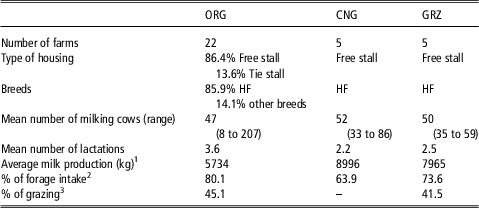
Characteristics of the groups of farms included in the study are shown in Table 1. The predominant type of housing was free stalls and the size of farms was similar in the three groups studied. Holstein Friesian was the predominant breed and only a small proportion of cows from ORG farms (14.1%) were other breeds (Brown Swiss, Swedish Red and Fleckvieh-Simmental) and Holstein Friesian crosses. The mean number of lactations was higher and the average milk production was lower in cows on ORG farms than in cows on conventional farms.
Farm characteristics of the three management systems studied: organic (ORG), conventional no grazing (CNG) and conventional grazing (GRZ) dairy cow farms

HF=Holstein Friesian.
1 305-day normalized lactation.
2 Relative to the total dry matter intake.
3 Relative to the total forage intake.
Dry matter intake and dietary ingredients
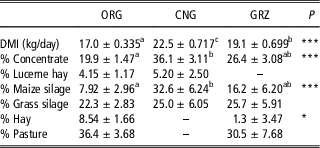
The DMI and the ingredients used in the diets in the three systems studied are presented in Table 2. Dry matter intake was significantly higher (F 2,93=25.4; P<0.001) on CNG farms (22.5 kg DMI/day) than on GRZ (19.1 kg DMI/day) and ORG farms (17.0 kg DMI/day). Organic farms used less concentrate feed (19.9% of the total DMI) than CNG farms (36.1%), and GRZ farms used intermediate amounts (26.4%) (F 2,93=11.7; P<0.001). Daily rations contained more maize silage on CNG farms (32.6%) than on ORG farms (7.92%) and hay was only used on ORG and GRZ farms (8.54% and 1.27% of the daily ration, respectively). A similar proportion of pasture was ingested on ORG and GRZ farms (36.4% v. 30.5% of the daily ration, respectively). Vetch hay and straw were used only on some organic and conventional farms, but generally represented <1% of the DMI. None of the other ingredients included in the rations (lucerne, grass silage, straw and vetch) differed significantly between the types of farms.
Description of dry matter intake (DMI) and ingredient composition of the diets (presented as percentage of total dry matter intake) of the three dairy cow farm systems studied: organic (ORG), conventional no-grazing (CNG) and conventional grazing (GRZ)

a,bDifferent superscript letter in the same row indicate differences statistically significant between groups (a<b).
*P<0.05; **P<0.01; ***P<0.001.
Characteristics of the diets
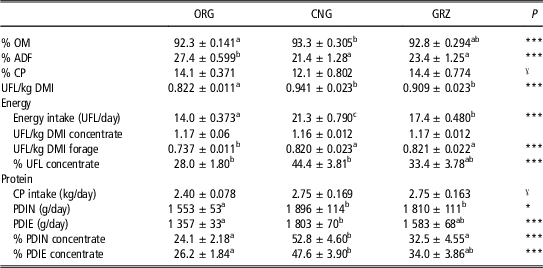
The percentage of OM in the ration was statistically significantly lower for the ORG farms than for CNG farms, with intermediate values for GRZ farms. Diets used in ORG farms contained a higher percentage of ADF than the diets of both types of conventional farms. The energy content of the rations supplied to the cows was significantly lower on ORG farms (0.822 UFL/kg DM) than on GRZ (0.909 UFL/kg DM) and CNG farms (0.941 UFL/kg DM) (F 2,93=14.12; P<0.001) (Table 3). Taking into consideration the DMI in each type of farm, ORG cows ingested the smallest amount of energy (14.0 UFL/day) followed by GRZ (17.4 UFL/day) and CNG cows (21.3 UFL/day). The energy content of concentrates was similar in the three groups, whereas the energy content of the forage (0.737 UFL/kg DM) supplied on ORG farms was significantly lower than that of the forage used in the conventional farms (GRZ: 0.821 UFL/kg DM and CNG: 0.820 UFL/kg DM). Analysis of the amount of energy provided by each type of feed material revealed that forage represented 72.0% of the total energy ingested on ORG farms, whereas only 55.6% of the energy was provided by the forage on CNG farms, and concentrate feed was the most important energy source. Regarding the protein level of the diet, cows on conventional farms tended to receive more protein than those on ORG farms (2.75 v. 2.40 kg/day) (P=0.06). However, the rations used on grazing farms (both ORG and GRZ) tended to contain more protein (140 and 144 g/kg of DM, respectively) than those used on CNG farms (121 g/kg of DM). The ration supplied on GRZ and ORG farms had higher levels of PDIN than PDIE (GRZ: 1810 v. 1583 and ORG: 1553 v. 1357, respectively), whereas on CNG farms, the diets were more balanced, with more similar levels of PDIN and PDIE (1896 v. 1803, respectively).
Characteristics and composition of the diets administered in the three dairy cow farm systems studied: organic (ORG), conventional no-grazing (CNG) and conventional grazing (GRZ)

OM=organic matter; UFL=unité fourragère lait (1 UFL=1.7 Mcal); DMI=dry matter intake; PDIN=protein digested in the small intestine supplied by rumen-undegraded dietary protein and by microbial protein from rumen-degraded dietary N; PDIE=protein digested in the small intestine supplied by rumen-undegraded dietary protein and by microbial protein from rumen-fermented OM (INRA, 1989).
a,bDifferent superscript letter in the same row indicate differences statistically significant between groups (a<b).
*P<0.05; **P<0.01; ***P<0.001; ˠP<0.1(tendency).
Feed efficiency
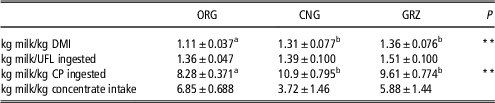
In order to evaluate the efficiency of the different diets in the three systems, different ratios were calculated (Table 4). Milk production per kilogram of DMI was lower on ORG farms (1.11) than on GRZ (1.36) and CNG farms (1.31) (F2,93=66.07; P=0.006). However, milk production per UFL and also milk production per kilogram of concentrate feed was not different between groups (P>0.05). Regarding protein, ORG farms yielded less milk per kilogram of CP intake (8.28) than CNG farms (10.9), with intermediate values for GRZ (9.61) (F 2,93=4.94; P=0.01).
Efficiency of the diets administered in the three dairy cow farming systems: organic (ORG), conventional no-grazing (CNG) and conventional grazing (GRZ)

Milk=milk production; DMI=dry matter intake (kg); UFL=unité fourragère lait; 1 UFL=1.7 Mcal; Concentrate: concentrate intake (kg).
a,bDifferent superscript letter in the same row indicate differences statistically significant between groups (a<b).
*P<0.05; **P<0.01; ***P<0.001.
Productive parameters
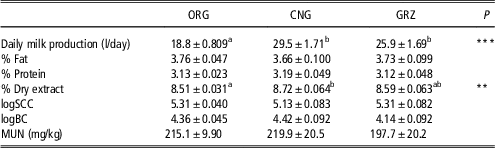
Data on productive parameters from the three systems studied are summarized in Table 5. Overall, daily milk production (18.8 L) was lower on ORG farms than in both GRZ (25.9 L) and CNG farms (29.5 L) (F 2,93=19.8; P<0.001). No differences between groups were detected in the percentage of fat and protein in milk. However, the proportion of dry extract was higher in milk from CNG farms than in milk from ORG farms and was intermediate in milk from GRZ farms (F 2,93=4.46; P=0.02). Both logSCC and logBC were similar in all types of farms (P>0.05). Although the MUN content was numerically lower for GRZ farms than for the other types of farm, the differences were not statistically significant (P<0.05).
Description of the milk yield and milk composition of the three dairy cow systems studied: organic (ORG), conventional no-grazing (CNG) and conventional grazing (GRZ)

SCC=somatic cell count; BC=bacterial count; MUN=milk urea nitrogen.
a,bDifferent superscript letter in the same row indicate differences statistically significant between groups (a<b).
*P<0.05; **P<0.01; ***P<0.001.
Multivariate analysis
Multivariate analysis of variance revealed significant (P<0.001) differences between the three types of farms; however, pairwise comparison between CNG and GRZ farms was not possible because the number of cases was less than the number of variables. Thus, a PERMANOVA was more appropriate for the data set. Use of the Bray-Curtis similarity index and the conservative Bonferroni correction for the post hoc pairwise comparisons revealed significant differences (P<0.001) between the different types of dairy farms. SIMPER analysis showed that CNG and GRZ farms mainly differed in relation to the amount of maize silage supplied (greater in CNG), grazing (no grazing in CNG) and the forage to concentrate ratio (greater in GRZ farms). The same variables defined the distance between CNG and ORG farms, along with the differences in milk yield and DMI (both greater in CNG than in ORG farms). Finally, the main variables responsible for the divergence between GRZ and ORG farms were the amounts of silage and concentrate supplied and the milk production (all greater in GRZ than in ORG farms), whereas pasture grazed and total amount of forage supplied were greater on ORG than on GRZ farms.
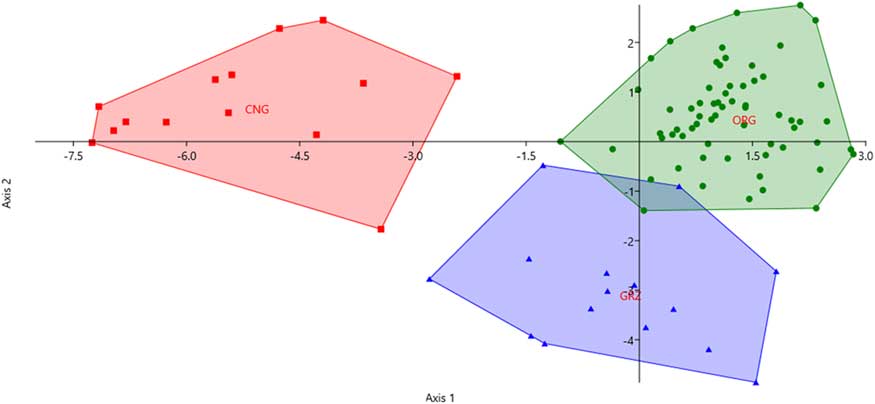
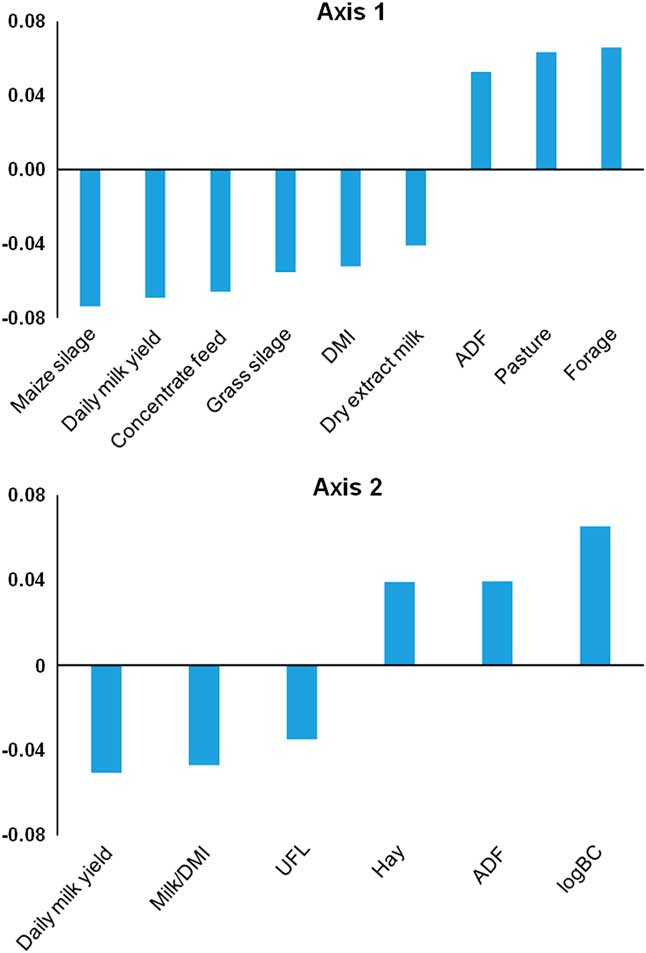
The LDA output is shown in Figure 1 (2D plot of all the cases). This is a supervised procedure as all the observations were initially assigned to the type of farm (dependent variable). The plot shows a clear separation of the three types of farm, with a small overlap between areas for the GRZ and ORG farms, so that up to 98% of the cases were correctly classified. Axis 1 explained 75% of the discrimination between groups, whereas axis 2 explained the remaining 25%. The loadings of the most discriminant variables are shown in Figure 2. Separation along Axis 1 is defined by higher total DMI, maize silage and concentrate intake and daily milk production in CNG farms, whereas hay, pasture and fibre intake were greater on GRZ and ORG farms. The discriminating variables in axis 2 are more closely related to the divergence between GRZ and ORG farms.
Linear discriminant analysis two-dimensional plot of all observations according to the types of dairy cow farm: organic (ORG), conventional no-grazing (CNG) and grazing (GRZ).

Loadings of the most discriminant variables to Axis 1 and Axis 2 in the linear discriminant analysis (LDA). DMI=dry matter intake; UFL=Unité Fourragère Lait; BC=bacterial count.

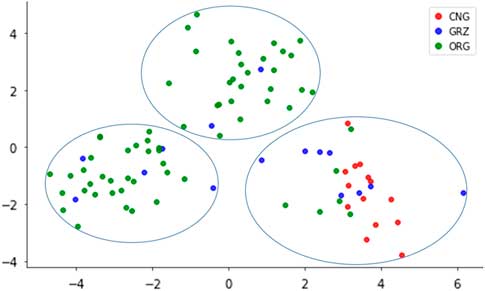
The elbow algorithm indicated that the optimum number of clusters for a classification analyses was three. The K-means procedure was used to classify all the cases in the data set into three clusters, and the LDA was used to plot the data on a 2D graph to show the separation between the three clusters and the relationship between the (non-supervised) clusters and the type of farm (Figure 3). The three clusters were clearly separated, with the cluster in the right lower quadrant of the plot including all the CNG cases and only six out of 65 ORG observations. Most ORG farms were distributed in the other two clusters, whereas GRZ farms were mainly located in the two clusters located in the lower part of the chart. The multivariate clustering procedure clearly separated the CNG and ORG farms, whereas discrimination of GRZ was not as evident. Assessment of the loadings of the most influential variables on each axis shows that the cluster including all the CNG farms represents cases with higher silage intake (mainly maize silage) and milk production in which there is no grazing or only a small amount of pasture is grazed. The cluster located in the left lower quadrant represents the farms in which grazed pasture contributes greatly to the cows’ diets, characterized by higher CP and PDIN contents. Finally, the upper intermediate cluster includes cases in which the rations contain more fibre and less UFL, characterized by higher proportions of hay and total forage.
Representation of the clusters obtained after non-hierarchical K-means clustering method and the LDA 2D plot showing the separation of the three clusters and the relationship between the (non-supervised) clusters and the types of dairy cow farm: organic (ORG), conventional no-grazing (CNG) and conventional grazing (GRZ).

Discussion
Organic farming aims to optimize available resources rather than maximize production (Shennan et al., Reference Shennan, Krupnik, Baird, Cohen, Forbush, Lovell and Olimpi2017; van Wagenberg et al., Reference Van Wagenberg, de Haas, Hogeveen, van Krimpen, Meuwissen, van Middelaar and Rodenburg2017), which leads to the lower milk yields that have been described in organic dairy systems based on the maximum utilization of forages (Erlt et al., Reference Erlt, Knaus and Steinwidder2014; Leiber et al., Reference Leiber, Schenk, Maeschli, Ivemeyer, Zeitz, Moakes, Klocke, Staehli, Notz and Walkenhorst2017; Rodríguez-Bermúdez et al., Reference Rodríguez-Bermúdez, Miranda, Orjales, Rey-Crespo, Muñoz and López-Alonso2017). The results of the present study are consistent with these earlier findings, as daily milk production was 35% lower on ORG farms than on CNG farms. This can be explained by the fact that less concentrate feed is included in the diets fed on ORG farms (Erlt et al., Reference Erlt, Knaus and Steinwidder2014) as supported by our findings (16.2% lower than CNG farms) and by previous reports of the benefits of concentrate supplementation in increasing milk production (Blair, Reference Blair2011; Heublein et al., Reference Heublein, Dohme-Meier, Sudekum, Bruckmaier, Thanner and Schori2017; Leiber et al., Reference Leiber, Schenk, Maeschli, Ivemeyer, Zeitz, Moakes, Klocke, Staehli, Notz and Walkenhorst2017). Dry matter intake in lactating dairy cows largely depends on the type of feeds supplied, level of feeding, ration formulation and quality of feed (Mazumder and Kumagai, Reference Mazumder and Kumagai2006). Our results indicated that DMI was almost 25% lower in organically managed cows, in which less concentrate feed was supplied in the diet. Even though a recent study performed in Switzerland found that DMI, energy and protein intakes were not significantly affected when the level of dietary concentrates was reduced by increasing the intake of good quality roughage (Leiber et al., Reference Leiber, Dorn, Probst, Isensee, Ackermann, Kuhn and Neff2015), it does not seem to be the case of our study. Feedstuffs used in ORG farms contained more fibre (NDF or ADF) than in both conventional groups, so that diets would be less digestible in ORG farms. In addition to a higher proportion of forage (more than 80% of the diet), ORG farms use different types of forage with less maize silage and more hay in the diets. Similar results were observed in a study comparing the management of organic and conventional farms in the United States, where conventional farms used greater amounts of maize and maize silage than ORG farms (Sorge et al., Reference Sorge, Moon, Wolff, Michels, Schroth, Kelton and Heins2016). This explains why the dietary ingredients were also the main factors differentiating the three systems in the multivariate analysis.
As for total DMI, the energy intake and energy concentration of the diets were lower in the organic farming systems. Similar results have been found in pasture-based herds and intensively-managed herds (Hofstetter et al., Reference Hofstetter, Frey, Gazzarin, Wyss and Kunz2014). This is mainly due to the reduced amount of concentrates and maize silage (the main energy sources for cattle) used in the diets provided in ORG farms. Energy is usually the limiting factor in grazing dairy systems. Therefore, producing forage of sufficient quality to meet the energy requirements of lactating cows is the main target of grazing systems, particularly in organic systems where forage accounts for the main part of the diet. In fact, forage represented 72% of total energy of the diet in ORG farms, whereas this percentage was only 55.6% and 66.6% in the CNG and grazing systems, respectively. Although the energy content of pasture was similar on organic and conventional farms, the lower amount of maize silage used on ORG farms led to a lower energy content of the total forage used. Introducing high energy crops in the diets (including forage maize or fodder beet) will provide energy-rich forage feed and improve the quality of the diets given to dairy cows (Hoffstetter et al., Reference Hofstetter, Frey, Gazzarin, Wyss and Kunz2014). Moreover, the quality of forage depends on the type of forage, herbage species, the plant stage of development and the soil and climatic conditions (Blair, Reference Blair2011). Although forage age may be the most important factor (because the fibre becomes increasingly lignified, thus reducing the digestibility of the plant material), the methods used for forage preservation also add a new source of variation to the feed quality (Randby et al., Reference Randby, Weisbjerg, Noggard and Heringstad2012). These factors could be even more important in ORG farms, because forage represents the main ingredient of diets and should be of enough quality to provide an adequate energy to the diet.
In addition to the energy content of the diets, the other key factors in the balance of dairy cattle diets are the protein content and protein use efficiency. The CP intake was similar in the three systems studied, although the protein concentration of the diets tended to be higher in grazing systems. Pasture usually contains more CP than other forages (Hofstetter et al., Reference Hofstetter, Frey, Gazzarin, Wyss and Kunz2014), although the content depends on the N supplied through fertilizers, use of which is restricted in organic farming, and also on the species cultivated. For example, pasture containing clover is rich in N whereas the CP concentration of perennial ryegrass (Lolium perenne) is lower than that of the leguminous species (Van Vuuren and Van Den Pol-Van Dasselaar, Reference Van Vuuren and Van Den Pol-Van Dasselaar2006). Plant growth stage and leaf to stem ratio are important factors affecting the protein content of pasture. The PDI system enables standardization of the supply of rumen-degradable N and detection of diets with excess of degradable N. The diets provided on CNG farms were more balanced in terms of PDIN-PDIE, whereas the diets provided in both GRZ and organic systems contained higher levels of PDIN than of PDIE. In the grazing systems studied (both organic and conventional grazing), the degradable N was excessive or the energy supply was limiting for the synthesis of microbial protein, and therefore the dietary protein is not efficiently used. Another parameter that has been suggested as a good indicator for diagnosing the on-farm efficiency of N utilization is MUN (Jonker et al., Reference Jonker, Khon and High2002). Steinshamn and Thuen (Reference Steinshamn and Thuen2008) observed that MUN was decreased when high protein grass–clover silage was supplemented with a cereal-based concentrate. Although this parameter has been correlated with the dietary CP concentrations and with the ratio of dietary CP to energy (Kirchgessner et al., Reference Kirchgessner, Kreuzer and Roth-Maier1986) is not always sensitive enough to detect an unbalanced dietary protein to energy ratio. In fact, whereas the analysis of PDIN-PDIE clearly shows differences between systems and disorders in the protein–energy balance of grazing farms, MUN was not different among the systems and was in between the adequate levels (González-Rodríguez and Vázquez-Yañez, Reference González-Rodríguez and Vázque-Yáñez2006; 150–350) in all groups studied. However, the large deviation between PDIN and PDIE clearly suggests that in the grazing systems (both organic and conventional grazing), the degradable N is in excess or the energy supply is limiting for the synthesis of microbial protein, and therefore the dietary protein is not efficiently used. When energy from fermentable OM is limited to ruminal microorganisms, not all N derived from degradable dietary protein can be used for the synthesis of microbial protein. The N in excess is excreted mainly as urinary urea, and thus with these unbalanced diets it is expected an increased excretion of N per unit of dietary protein consumed by the animal. In circular dairy systems (de Wit et al., Reference de Wit, Bardout, Ramkumar and Kubbinga2016), N in excreta is recycled when manure is used as fertilizer reducing the environmental impact at the farm level (Koesling et al., Reference Koesling, Hansen and Bleken2017). However, at the animal level, the use of unbalanced diets results in less dietary N converted into milk protein (lower milk to feed protein ratio) and more N disposed of to the environment. Balancing protein to energy in feed rations is considered one of the most effective dietary interventions to reduce N emissions by ruminants (Eckard et al., Reference Eckard, Grainger and de Klein2010).
The maximum utilization of forage in the diets used in ORG farms may determine a relative shortage in the energy supply to the dairy cows. This feature is characteristic of pasture-based organic dairy systems as confirmed in other studies (Weller and Bowling, Reference Weller and Bowling2007; Steinshamn and Thuen, Reference Steinshamn and Thuen2008; Blair, Reference Blair2011), and may constrain the productive performance of the cows in terms of kg milk per kilogram of DM feed (Beever and Doyle, Reference Beever and Doyle2007). Feed efficiency may be an important determinant of the sustainability of organic dairy farms, and thus it is important to make compatible the optimum utilization of forage resources with an adequate energy allowance for the lactating cow. A number of strategies have been proposed to ensure satisfactory dietary energy supply for the high-yielding dairy cow, founded upon the supplementation of high-forage diets with cereal-based concentrates (Heublein et al., Reference Heublein, Dohme-Meier, Sudekum, Bruckmaier, Thanner and Schori2017; Leiber et al., Reference Leiber, Schenk, Maeschli, Ivemeyer, Zeitz, Moakes, Klocke, Staehli, Notz and Walkenhorst2017), energy rich by-products (Ertl et al., Reference Erlt, Zebeli, Zollitsch and Knaus2017) or high energy forages such as maize silage (Velik et al., Reference Velik, Baumung and Knaus2008; Baldinger et al., Reference Baldinger, Zollitsch and Knaus2011).
Finally, the results of the multivariate analysis enabled identification of nutritional patterns for the ORG, CNG and GRZ farms as well as the most influential variables in the classification. This is very important for the ORG farms, as unlike the CNG and, to a lesser extent, the GRZ farms, the ORG farms constitute a very heterogeneous production system with very different feed management systems. The LDA and the blind K-means procedures both clearly distinguished the ORG and the CNG farms, although the discrimination was not as clear for the GRZ farms (particularly for the K-means procedure). The CNG farms were characterized by a higher total DMI (with a high proportion of concentrate feed, maize silage and forage silage) and higher daily milk production. By contrast, in the ORG and GRZ systems, the forage, pasture and fibre intake were the most important variables. Similar findings (no clear separation between ORG and GRZ farms) were obtained in a previous study analyzing the trace element concentrations in blood of cattle raised on organic and conventional farms (Orjales et al., Reference Orjales, Herrero-Latorre, Miranda, Rey-Crespo, Rodríguez-Bermúdez and Lopez-Alonso2018). The main source of essential trace elements in the more intensive, CNG farms was the concentrate feed, whereas ingestion of soil during grazing was the main source of these elements in the pasture-based conventional (GRZ) and organic farming systems.
Conclusions
The study findings indicate that the diets supplied to dairy cattle reared in organic farming systems in northern Spain (representative other organic systems in temperate regions) are very different from those used on both types of conventional farms considered, although the difference was not as evident for farms in which the cattle are grazed. The multivariate analysis enabled identification of characteristic feeding systems and strategies for the three types of farms considered. Thus, the conventional farms were characterized by a higher total DMI with a high proportion of concentrate feed, maize silage and forage silage. By contrast, in the organic system and GRZ system, the forage, pasture and fibre intake were the most important variables. The differences in dietary patterns explain the limited energy intake in cows reared on ORG farms, which is associated with lower protein use efficiency. In order to match more precisely the requirements for milk production and to improve the protein use efficiency reducing consequently the loss of N to the environment, organic farming should aim to increase the energy content of cattle diets by improving forage quality and formulating rations with more balanced combinations of forage and grain.
Acknowledgments
This study was supported by the Spanish Government (project code AGL2010-21026) and Centro Tecnológico Agroalimentario de Lugo (CETAL). I. Orjales is in receipt of a FPU fellowship (Ref. FPU14/01473) from the Spanish Ministry of Education, Culture and Sports. The authors thank all farmers who participated in the study and the staff at CIAM (Centro de Investigacións Agrarias de Mabegondo) for analyzing the samples.
Declaration of interest
The authors declare no conflict of interest.
Ethics statement
All experiments performed followed Spanish standards for the protection of animals used for scientific purposes. The procedures applied were supervised and approved by the Bioethics Committee of the University of Santiago de Compostela (Spain).
Software and data repository resources
None of the data were deposited in an official repository.