It is currently projected that by 2060, 94.7 million people in the United States will be 65 or older, translating to about 23% of the population (Vespa et al., Reference Vespa, Armstrong and Medina2018). Current estimates indicate that about 14 million of these older adults will be diagnosed with some form of cognitive disorder or dementia (Matthews et al., Reference Matthews2019). Increasingly, attention has been paid to persons with mild psychiatric and behavioral symptoms. These neuropsychiatric symptoms (NPS) have been found to be commonly represented in the general population (Geda et al., Reference Geda2014; Okura et al., Reference Okura, Plassman, Steffens, Llewellyn, Potter and Langa2010). Recent research has supported this discovery with findings that regardless of cognitive status, older adults with these NPS are at greater risk for dementia and will see a faster transition into a dementia diagnosis (Mortby et al., Reference Mortby, Burns, Eramudugolla, Ismail and Anstey2017; Taragano et al., Reference Taragano, Allegri and Lyketsos2008).
Mild behavioral impairment (MBI) is a late-life transitional state between normal aging and dementia in which individuals present with NPS that are atypical of their past history. Specifically, MBI describes individuals who have persistent behavioral changes and/or mild psychiatric symptoms, but do not have serious cognitive complaints, meet criteria for dementia, or have difficulties in performing activities of daily living (Taragano et al., Reference Taragano, Allegri and Lyketsos2008; Ismail et al., Reference Ismail2016). Recent developments in the diagnostic criteria for MBI have been expanded in order to allow for the concurrent presence of mild cognitive impairment (MCI). This alteration in criteria was done in an attempt to further elucidate the relationship between the two entities, specifically in regard to their influence as prodromal stages of dementia (Ismail et al., Reference Ismail2016).
The development of MBI criteria has mainly been supported through research focusing on the presence of these noncognitive NPS in prodromal dementia (Burhanullah et al., Reference Burhanullah2020; Lo et al., Reference Lo2019; Matsuoka et al., Reference Matsuoka, Ismail and Narumoto2019; Peters et al., Reference Peters2013; Rosenberg et al., Reference Rosenberg, Mielke, Appleby, Oh, Geda and Lyketsos2013; Taragano et al., Reference Taragano, Allegri and Lyketsos2008; Taragano et al., Reference Taragano2018; Wise et al., Reference Wise, Rosenberg, Lyketsos and Leoutsakos2019). For example, a study by Taragano and colleagues (Reference Taragano2018) provided initial support for MBI criteria through an analysis of it in comparison to typical, and atypical, cognitive and psychiatric changes. They reported that individuals with MBI were more likely to convert to dementia, and within a faster time period, than those without MBI, regardless of the presence of a MCI diagnosis. In their 5-year study, 71.5% of those with MBI only converted to dementia, compared to 59.6% of those with MBI and MCI, 37.8% of those with MCI only, and 13.9% of those with a psychiatric illness per DSM-IV criteria. Persons with MCI were more likely to be diagnosed with Alzheimer’s disease (AD), whereas those with MBI were more likely to be diagnosed with dementia with Lewy bodies or frontotemporal dementia (Taragano et al., Reference Taragano2018). This research further emphasizes the significant role that MBI plays in older adults, especially in the absence of objective cognitive impairment.
Persons with MBI are at greater risk of dementia, but it unclear whether cognitive and noncognitive factors act synergistically to increase the risk of cognitive decrements in the absence of dementia. Among studies investigating cognitive outcomes in older adults with NPS, the only consistent finding has been a relationship between the presence of these symptoms and impaired executive function (Brodaty et al., Reference Brodaty2012; Rosenberg et al., Reference Rosenberg, Mielke, Appleby, Oh, Leoutsakos and Lyketsos2011; Taragano et al., Reference Taragano2018). More recent studies, including MBI criteria, by Taragano et al. (Reference Taragano2018) and Creese et al. (Reference Creese2019) have reported that persons with MBI performed worse on cognitive tasks, especially on tasks of executive function and attention, when compared to those without MBI, regardless of a MCI diagnosis. These studies have also shown that impairment in domains of cognition such as executive function and attention, which are associated with MBI, is likely to be an early marker of neurodegenerative and vascular disease.
The objective of this research is to investigate how MBI might influence the cognitive abilities of older adults with and without MCI. We sought to determine whether there is an overall effect of MBI on the executive function, attention, short-term memory, and episodic memory domains of cognition. Additionally, we sought to evaluate whether MBI differentially influences each of these cognitive domains depending upon whether or not a person is diagnosed with MCI. We hypothesized that (1) those with MBI will perform worse on tests of executive function and attention, and (2) when a diagnosis of MBI is superimposed on MCI, participants will perform worse on tasks across all domains of cognition.
Methods
Participants
Archival data for this study came from the Florida Alzheimer’s Disease Research Center (FL-ADRC; Duara et al., Reference Duara2008; Schinka et al., Reference Schinka2010). The FL-ADRC included comprehensive physical, neurological, and neuropsychological evaluations of older adults who were cognitively healthy or had evidence of cognitive impairment. Use of the dataset was approved by the University of South Florida’s institutional review board. Participants were included in our data analysis if they had the following at baseline: (1) complete information about their cognitive status, (2) all 12 questions of the Neuropsychiatric Inventory Questionnaire (NPI-Q; Cummings, Reference Cummings1997) assessment completed, and (3) most of the neuropsychological assessments completed. Participants were excluded if they: (1) did not have a consensus conference diagnosis, (2) had subjective cognitive complaints, (3) had been diagnosed with dementia, or (4) did not have complete information surrounding key demographic variables. These demographic variables were identified as age, gender, race, and education. Of the original 940 participants, there were 497 participants at baseline who met the above criteria and their data was subsequently used for this analysis.
Cognitive status assessment
Information about cognitive status was collected by the standards established by the FL-ADRC (Duara et al., Reference Duara2010). Cognitive diagnoses followed the National Alzheimer’s Coordinating Center D1 classification protocol, which includes cognitively normal, amnestic and non-amnestic MCI, and dementia (Beekly et al., Reference Beekly2007). To be included in this study, participants had to be diagnosed as cognitively normal (but without subjective complaints), or to have amnestic or non-amnestic MCI (Petersen et al., Reference Petersen, Smith, Waring, Ivnik, Tangalos and Kokmen1999), i.e. they had cognitive impairment but did not meet criteria for dementia.
Neuropsychological assessment
Several measures were used to assess executive functioning, including Trail Making B (Ivnik et al., Reference Ivnik, Malec, Smith, Tangalos and Petersen1996; Reitan, Reference Reitan1958), category fluency (Lucas et al., Reference Lucas, Ivnik, Bohac, Tangalos, Graff-Radford and Petersen1998), and verbal fluency (Benton, Reference Benton1967; Tombaugh et al., Reference Tombaugh, Kozak and Reese1999). Category fluency required participants to respond to the categories of animals, fruits, and vegetables. Verbal fluency queried about words that start with the letters a, s, and f. On account of lower scores indicating better performance on Trail Making B, an inverse of the score was calculated in order to have higher scores indicative of better performance. All three scores were then standardized into z-scores. Following this, the standardized values were averaged together to create a composite score for the domain of executive function.
Three measures were used to evaluate attention, including Trail Making A (Ivnik et al., Reference Ivnik, Malec, Smith, Tangalos and Petersen1996; Reitan, Reference Reitan1958), the Digit Symbol subtest of the Wechsler Adult Intelligence Scale III (Wechsler, Reference Wechsler1997), and the Stroop Task of word identification, color identification, and color-word discrimination abilities (Ivnik et al., Reference Ivnik, Malec, Smith, Tangalos and Petersen1996; Stroop, Reference Stroop1935). As mentioned above, an inverse of the score was calculated for Trail Making A, in order to have higher scores indicative of better performance. All five scores were then standardized into z-scores, allowing the scores to be averaged together to create one composite score for the domain of attention.
Short-term memory was evaluated using the Digit Span Task, where forwards and backwards scores were collected and used for analysis (Wechsler, Reference Wechsler1997). On the Digit Span Task, higher scores indicate better performance and therefore both of these scores were standardized as z-scores and subsequently averaged together to create a composite score for the cognitive domain of short-term memory.
The Logical Memory subtest of the Wechsler Memory Scale (Wechsler, Reference Wechsler1997) and the Hopkin’s Verbal Learning Test (HVLT; Brandt and Benedict, Reference Brandt and Benedict1991) were used to analyze episodic memory. Immediate and delayed recall scores were collected for both assessments. For the HVLT, a discrimination score from the recognition trial was also obtained. For all of the episodic memory tasks, higher scores are indicative of better performance, therefore all five tasks were standardized into z-scores and averaged together in order to create a composite score for this domain.
NPS assessment
The NPI-Q was used to assess psychopathology found in patients via 12 sections that query on each individual NPS (Cummings, Reference Cummings1997). The symptoms questioned are delusions, hallucinations, agitation/aggression, depression/dysphoria, anxiety, elation/euphoria, apathy/indifference, disinhibition, irritability/lability, aberrant motor behaviors, sleep and nighttime behavior disorders, and appetite/eating changes. During this assessment, the informant is asked a question about the presence or absence of each of these specific symptoms (Cummings, Reference Cummings1997; Morris et al., Reference Morris2006). Of the 12 NPS, only the first 10 were grouped together into 5 categories, based on MBI criteria developed by the International Society to Advance Alzheimer’s Research and Treatment, subgroup Alzheimer’s Association (ISTAART-AA). According to ISTAART-AA criteria, MBI symptoms should be present for at least 6 months and to have onset in late-life (Ismail et al., Reference Ismail2017). For this study, a modified reference range that has been used in previous research (Mortby et al., Reference Mortby, Ismail and Anstey2018; Sheikh et al., Reference Sheikh2017) was used to characterize MBI, as the NPI-Q has a reference range of 1 month. The five cardinal features of MBI are decreased motivation (i.e. apathy), affective dysregulation (i.e. depression, anxiety, elation), impulse dyscontrol (i.e. agitation, irritability, aberrant motor behaviors), social inappropriateness (i.e. disinhibition), and abnormal perception or thought content (i.e. delusions and hallucinations; Ismail et al., Reference Ismail2017). According to the ISTAART-AA criteria, individuals can be said to have MBI if they demonstrate one or more of the MBI features. Accordingly, individuals were assigned a dichotomous value indicating the presence (MBI+) or absence (MBI-) of a MBI diagnosis. In addition, a dichotomous value was assigned, indicating whether or not each of the cardinal features of MBI was present.
Statistical analyses
Descriptive statistics for demographic characteristics and diagnoses of MBI and MCI were calculated. Group differences were examined using univariate analyses of variance (ANOVA) for age and education and chi square tests for gender and race.
The primary analyses evaluated between group differences using a 2 (MCI: presence or absence) x 2 (MBI: presence or absence) multivariate analysis of co-variance. This was done in order to assess the interaction between cognitive status and MBI, as well as the differences in the composite scores for the cognitive domains of attention, executive function, short-term memory, and episodic memory. Multiple imputation (Enders, Reference Enders2010) was then completed in order to estimate missing test-level scores for some of the neuropsychological assessments. This was done prior to standardizing the scores and creating the composite cognitive variables. Age, gender, and education were entered as covariates. Following results of a statistically significant interaction effect between these groups, a one-way ANOVA was completed in order to further elucidate the differences within the MCI and MBI groups. If a significant interaction, or overall effect, was identified for any cognitive domain, secondary analyses were conducted, including one-way ANOVAs to identify differences in performance in persons with and without MBI for each individual cognitive task. These secondary analyses were completed in order to investigate if the significant differences were isolated to one task, or if it was consistent across all tasks. Finally, statistically significant effects were scaled as partial eta-squared and categorized based on their size as small (i.e. η 2 = .01), medium (i.e. η 2 = .06), or large (i.e. η 2 = .14; Cohen, Reference Cohen1973). All analyses were conducted with IBM SPSS Statistics 25.
Results
Group demographics
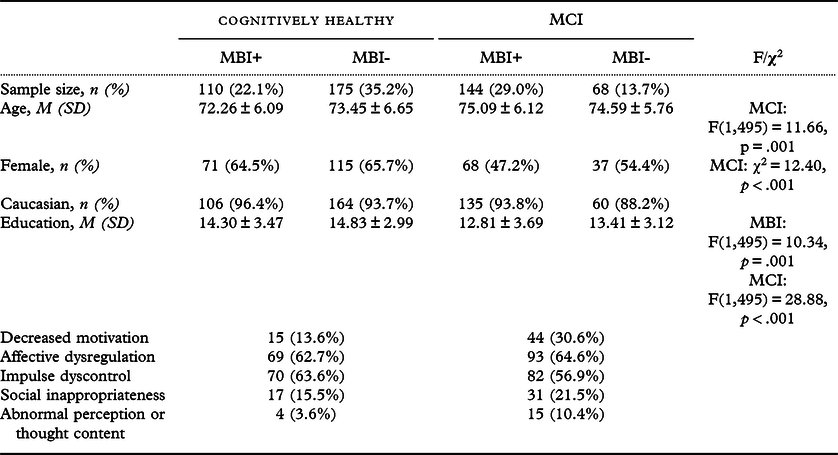
Of the 497 participants, 285 were cognitively healthy, 212 had MCI, and 254 met diagnostic criteria for MBI. In the cognitively healthy group, 38.6% had MBI, whereas in the MCI group 67.9% met criteria for MBI. Persons with MCI were significantly more likely to have MBI than those who were cognitively healthy (χ2 = 41.85, p < .001). The most common MBI domain within the cognitively healthy and MCI groups were impulse dyscontrol and affective dysregulation, respectively (see Table 1). Significant differences were found between those who were cognitively healthy and those with MCI for age, education, and gender, but not for race. Persons with MCI were older, had fewer years of education, and were more likely to be male. Additionally, there were significant differences found between those with and without MBI for education, but not for age, gender, and race. Persons with MBI had fewer years of education. There was no significant interaction found between MCI, MBI, and age or education. The sample demographics for the individuals in this study, along with the between group differences, are summarized in Table 1.
Participant’s demographic characteristics

MBI = mild behavioral impairment; MCI = mild cognitive impairment
Neuropsychological performance of individuals with MBI
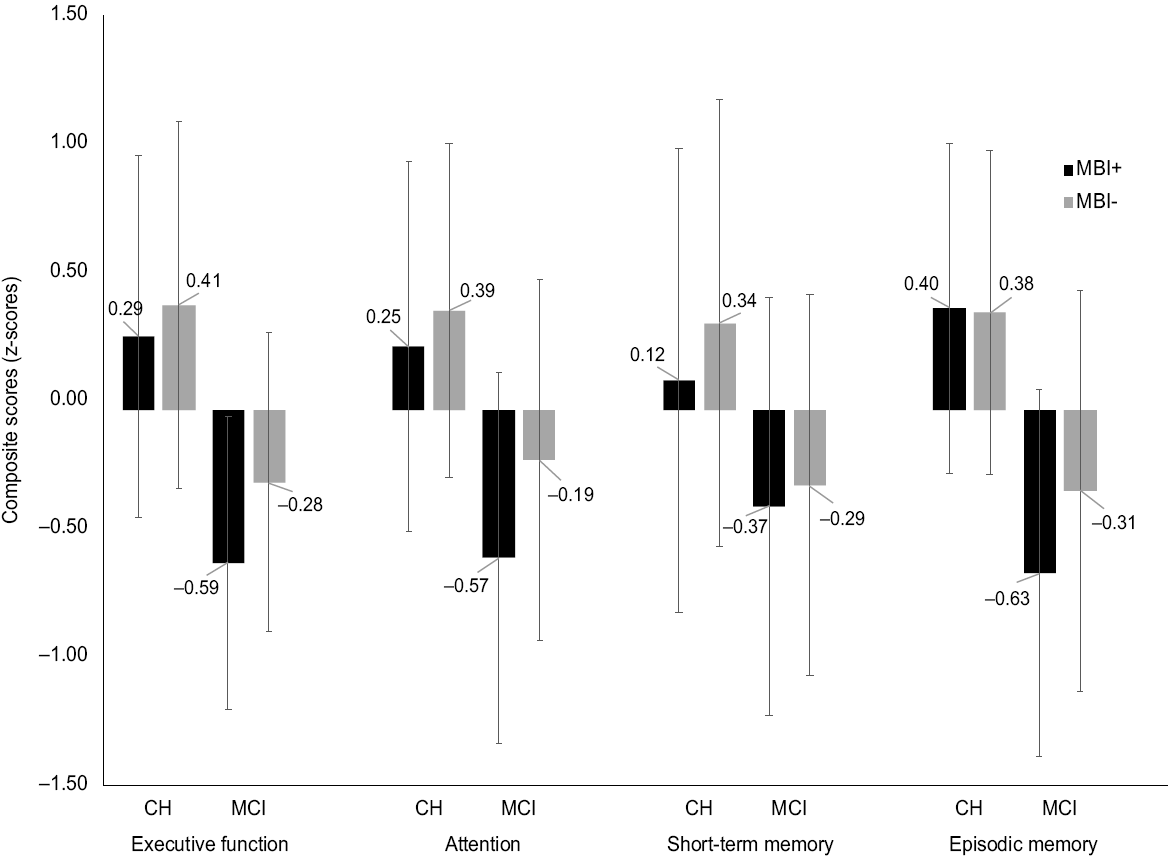
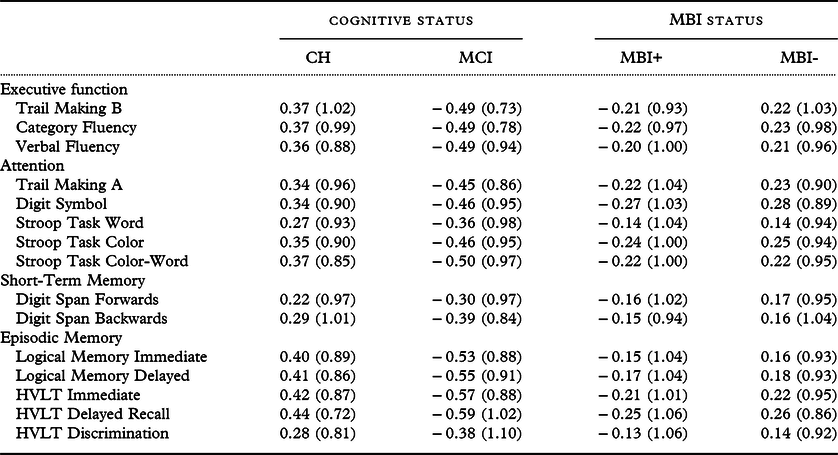
The mean scores and standard deviations for the MBI and MCI groups, on each of the four cognitive domains are reported in Figure 1. The mean scores and standard deviations for the secondary analyses for each neuropsychological test are reported in Table 2.
Average composite scores by cognitive status, and presence or absence of MBI. CH = cognitively healthy; MBI = mild behavioral impairment; MCI = mild cognitive impairment.

Group means (and standard deviations) on individual neuropsychological assessments for executive function, attention, and memory

CH = cognitively healthy; MCI = mild cognitive impairment; MBI = mild behavioral impairment; HVLT = Hopkin’s Verbal Learning Test
Executive function tasks
A statistically significant main effect was found for MBI on executive function domain scores (F(1,490) = 10.08, p = .002, η 2 = .020; MBI+=-0.21 ± 0.76, MBI- = 0.22 ± 0.74). At the test level, significant differences were found on Trail Making B (F(1,495) = 23.05, p < .001, η 2 = .044), category fluency (F(1,495) = 26.98, p < .001, η 2 = .052), and verbal fluency (F(1,495) = 21.94, p < .001, η 2 = .042). Overall, individuals with MBI performed worse than those without MBI. No significant interaction was found between MBI and MCI for executive function tasks (p > .05).
As expected, cognitive status was significant for executive function domain scores (F(1,490) = 118.62, p < .001, η 2 = .195; cognitively healthy = 0.37 ± 0.70; MCI = -0.49 ± 0.59), as well as each of the individual tasks, including Trail Making B (F(1,495) = 110.28, p < .001, η 2 = .182), category fluency (F(1,495) = 110.47, p < .001, η 2 = .182), and verbal fluency (F(1,495) = 105.90, p < .001, η 2 = .176). Persons who were cognitively healthy performed better than those with MCI.
Attention tasks
Analyses indicated a statistically significant main effect for MBI on attention domain scores (F(1,490) = 14.07, p < .001, η 2 = .028; MBI+=−0.22 ± 0.83; MBI- = 0.23 ± 0.71). Significant differences in favor of the MBI group were found on Trail Making A (F(1,495) = 26.36, p < .001, η 2 = .051), Digit Symbol (F(1,495) = 41.26, p < .001, η 2 = .077), Stroop Task Word (F(1,495) = 9.74, p = .002, η 2 = .019), Stroop Task Color (F(1,495) = 32.28, p < .001, η 2 = .061), and Stroop Task Color-Word (F(1,495) = 25.48, p < .001, η 2 = .049). There was no significant interaction found between MBI and MCI on any of the attention tasks (p > .05).
Analyses revealed a significant effect of cognitive status on attention domain scores (F(1,490) = 73.94, p < .001, η 2 = .131; cognitively healthy = 0.33 ± 0.68; MCI = -0.45 ± 0.73). Significant differences in performance were found on Trail Making A (F(1,495) = 90.02, p < .001, η 2 = .154), Digit Symbol (F(1,495) = 93.95, p < .001, η 2 = .160), Stroop Task Word (F(1,495) = 53.67, p < .001, η 2 = .098), Stroop Task Color (F(1,495) = 94.74, p < .001, η 2 = .161), and Stroop Task Color-Word (F(1,495) = 113.25, p < .001, η 2 = .186). Overall, those who were cognitively healthy performed better than those with MCI.
Short-term memory tasks
There was no significant main effect found for MBI, nor for the interaction between MBI and MCI, for the short-term memory domain score (all ps > .05). Analyses indicated statistically significant effects of cognitive status on short-term memory domain scores (F(1,490) = 32.39, p < .001, η 2 = .062; cognitively healthy = 0.25 ± 0.89; MCI = -0.34 ± 0.78). Upon further analysis, significant main effects were found on Digit Span Forward (F(1,495) = 34.60, p < .001, η 2 = .065) and Digit Span Backward (F(1,495) = 62.24, p < .001, η 2 = .112). For each of these assessments, individuals who were cognitively healthy performed better than those with MCI.
Episodic memory tasks
Analyses indicated a statistically significant main effect of MBI on episodic memory domain scores (F(1,490) = 3.97, p = .047, η 2 = .008; MBI+=−0.18 ± 0.85; MBI- = 0.19 ± 0.74). Persons with MBI performed significantly worse on Logical Memory Immediate (F(1,495) = 12.05, p = .001, η 2 = .024), Logical Memory Delayed (F(1,495) = 16.32, p < .001, η 2 = .032), HVLT Immediate (F(1,495) = 23.85, p < 001, η 2 = .046), HVLT Delayed (F(1,495) = 33.51, p < .001, η 2 = .063), and HVLT Discrimination (F(1,495) = 8.91 p = .003, η 2 = .108).
A statistically significant interaction between MBI and MCI was observed on episodic memory domain scores (F(1,490) = 5.87, p = .016, η 2 = .012). The corresponding mean scores for each of the four groups can be seen in Figure 1. Persons with MCI and MBI performed worse than those with MCI alone on episodic memory tasks (F(1,210) = 8.82, p = .003, η 2 = .040). None of the other between group comparisons were statistically significant (p > .05). Upon further analysis, statistically significant interactions were found for Logical Memory Immediate (F(1,490) = 6.46, p = .011, η 2 = .013), Logical Memory Delayed (F(1,490) = 4.06, p = .045, η 2 = .008), and HVLT Discrimination (F(1,490) = 4.54, p = .034, η 2 = .009). There were no significant interactions found on HVLT Immediate or HVLT Delayed (all ps > .05). Persons with MCI and MBI performed worse on Logical Memory Immediate (F(1,210) = 5.72, p = .018, η 2 = .026), Logical Memory Delayed (F(1,210) = 4.86, p = .029, η 2 = .023), and HVLT Discrimination (F(1,210) = 4.20, p = .042, η 2 = .020). There was no significant difference between cognitively healthy groups for all three assessments as a function of MBI status (all ps > .05).
Additional analyses indicated a significant effect of cognitive status (F(1,490) = 134.37, p < .001, η 2 = .215; cognitively healthy = 0.39 ± 0.63, MCI = −0.52 ± 0.75) on episodic memory domain scores. Further analyses found a statistically significant effect of cognitive status on Logical Memory Immediate (F(1,495) = 131.82, p < .001, η 2 = .210), Logical Memory Delayed (F(1,495) = 144.53, p < .001, η 2 = .226), HVLT Immediate (F(1,495) = 156.54, p < 001, η 2 = .240), HVLT Delayed (F(1,495) = 176.06, p < .001, η 2 = .262), and HVLT Discrimination (F(1,495) = 59.64, p < .001, η 2 = .108). Cognitively healthy individuals performed better than those with MCI on all tasks.
Discussion
The goals of this study were to evaluate whether MBI was associated with poorer cognitive performance and if this effect was exacerbated by the cognitive status of the individual (MCI or cognitively healthy). The first major finding is that persons with MBI, regardless of cognitive status, performed worse on tests of executive function, attention, and episodic memory than those without MBI. The second finding is that individuals with MBI, who also had MCI, performed significantly worse on tasks associated with episodic memory, compared to those with MCI only.
This study contributes to existing knowledge regarding the impact of MBI with cognitive status, as well as the information about the cognitive phenotype that accompanies MBI. Creese and colleagues (Reference Creese2019) reported that MBI was associated with cross-sectional decrements on measures of attention and working memory, as well as a larger longitudinal decline at a 1-year follow-up. However, their diagnosis of cognitive status was based on participant’s online reports of subjective cognitive status, whereas the participants in the current study underwent formal neuropsychological evaluation in order to establish the diagnosis of cognitively healthy or MCI. Our results agree with and extend the findings reported by Creese et al. (Reference Creese2019) by virtue of including a group with MCI and by incorporating a battery of neuropsychological tasks that included tasks for executive function and other aspects of memory. With the more formal diagnostic criteria associated with our study, we are able to provide results that are more supportive of the cognitive phenotype associated with MBI that was established by Creese and colleagues (Reference Creese2019). Our findings also align with those of Taragano et al. (Reference Taragano2018) thereby leading to a growing consensus that cognitive performance is worse among those with MBI. Taragano and colleagues (Reference Taragano2018) also found that even though about quarter of their MBI participants had memory deficits, those with MBI were more likely than MCI participants to have impairments in non-memory domains of cognition, such as language, attention, and executive function. In our study, we found a relationship between episodic memory but not short-term memory and MBI, highlighting the need to assess multiple dimensions of memory in order to identify the specificity of the effects.
ISTAART-AA formed the criteria for MBI to allow for more consistent research into a population of older adults who may be at an increased risk of cognitive decline or dementia (Ismail et al., Reference Ismail2017). Several studies have examined the prevalence, and importance, of the corresponding NPS of MBI in prodromal dementia states since. Wise and colleagues (2019) recently reported that 59% of older adults will develop NPS before the diagnosis of any cognitive disorder, suggesting that the presence of these symptoms is not uncommon. Additional evidence highlighted the risk of conversion to dementia due to the presence of these symptoms. When MBI is juxtaposed on a diagnosis of MCI, the risk for progression into dementia is greater than if one were to only have MCI (Lo et al., Reference Lo2019; Taragano et al., Reference Taragano2018). More interestingly, meeting criteria for MBI alone has been found to be a greater risk factor for dementia than the presence of any cognitive disorder (Matsuoka et al., Reference Matsuoka, Ismail and Narumoto2019; Taragano et al., Reference Taragano2018). Furthermore, the cognitive phenotype that corresponds to MBI is found to be extremely useful in understanding these trajectories. In these cognitively healthy older adults presenting with symptoms of MBI, performance on cognitive tasks were found to decline significantly and more rapidly when compared to those without any symptoms of MBI (Burhanullah et al., Reference Burhanullah2020). Additionally, the deficits in cognitive abilities are consistently found to be non-memory domains (Taragano et al., Reference Taragano2018), potentially implying a transition into a non-AD dementia disorder (Goldman et al., Reference Goldman, Williams-Gray, Barker, Duda and Galvin2014; Johns et al., Reference Johns2009; Taragano et al., Reference Taragano2018; Wittenberg et al., Reference Wittenberg, Possin, Rascovksy, Rankin, Miller and Kramer2008). This information stresses the importance of assessing for these noncognitive symptoms, because in addition to being a risk factor for dementia, MBI is also found to be a risk factor for cognitive impairment.
The main limitations of the current research are that the original study was not designed to investigate MBI, and therefore the newly validated MBI Checklist (Ismail et al., Reference Ismail2017) was not implemented. There was also differential representation of NPS across domains of MBI, which did not allow us to analyze the influence of individual MBI domains on cognition. Another limitation is that the frequency and severity of NPS were not collected, so it was not possible to determine whether there was a dose effect of MBI features on cognition. It would be hypothesized that individuals who have more frequent and severe NPS would see greater deficits in cognition. Finally, we excluded 43 people with subjective cognitive complaints from the analyses. At the time of data collection, information regarding formalized criteria for subjective cognitive decline (Jessen et al., Reference Jessen2014) was not articulated, therefore we could not classify persons into this group. Although Creese and colleagues (Reference Creese2019) were able to examine the relationship between subjective cognitive decline and MBI, we were unable to conduct such analyses here.
In conclusion, this study was able to operationalize the new ISTAART-AA criteria for MBI in order to examine the impact of MBI and MCI on a diverse set of cognitive abilities in older adults. We found that persons with MBI exhibited poorer performance on tests of executive function, attention, and episodic memory. In addition, we found a significant interaction between the presence of MBI and MCI on tasks associated with only episodic memory, where those meeting both of these diagnoses performed worse than those with only MCI. It is essential that future research takes into consideration the presence of these symptoms in order to obtain accurate results, and that further research is conducted to truly understand the effect that MBI has on older adults with, and without, MCI.
Conflicts of interest
None.
Source of funding
This work was supported by the National Institute of Aging (grant number 1P50AG025711-01).
Description of authors’ roles
H. Rouse: (1) developed study objectives; (2) responsible for statistical design and analyses; (3) drafted the manuscript
B. Small: (1) advised on the methodology for data analysis; (2) provided feedback on draft manuscript
J. Schinka: (1) designed research study and supervised data collection; (2) provided feedback on draft manuscript
D. Loewenstein: (1) designed research study and supervised data collection
R. Duara: (1) designed research study and supervised data collection; (2) provided feedback on draft manuscript
H. Potter: (1) designed research study and supervised data collection; (2) provided feedback on draft manuscript