Implications
Data on feeding behaviour of dairy cows can provide useful information for herd management. Adequate sensor techniques for data collection in practical farming are not available. When feeding behaviour, and herein especially feed intake, cannot be monitored directly, indicators might allow to estimate the desired data. For this purpose, the ability to estimate feed intake of dairy cows from records on feeding and chewing was evaluated. Furthermore, the accordance between both sensor systems used for data collection was analysed. The availability of cow’s individual feed intake for practical farming is supposed to improve animal health and economic profitability.
Introduction
Monitoring of individual feeding behaviour, namely feeding time, feed intake and feeding rate can provide useful information for dairy herd management. Next to promising attempts for statistical prediction of feed intake (Halachmi et al., Reference Halachmi, Edan, Moallem and Maltz2004), devices for direct monitoring of feeding behaviour have been used and developed. Traditional methods, such as visual observation or video recording (Krawczel et al., Reference Krawczel, Klaiber, Thibeau and Dann2012), caused high demands for time and work input. In recent years, disadvantages of former systems have been overcome by development of automatic systems based on radio frequency (DeVries et al., Reference DeVries, von Keyserlingk, Weary and Beauchemin2003) or weighing (Chapinal et al., Reference Chapinal, Veira, Weary and von Keyserlingk2007). Those monitoring systems enable to collect the individual feeding behaviour of dairy cows in loose housing systems continuously. Validations of these systems with regard to presence at feeding device confirmed high values for both sensitivity (DeVries et al., Reference DeVries, von Keyserlingk, Weary and Beauchemin2003: 87.4%; Chapinal et al., Reference Chapinal, Veira, Weary and von Keyserlingk2007: 100%) and specificity (DeVries et al., Reference DeVries, von Keyserlingk, Weary and Beauchemin2003: 99.2%; Chapinal et al., Reference Chapinal, Veira, Weary and von Keyserlingk2007: 100%) when compared with direct observation.
The implementation of feeding behaviour in dairy management is encouraged to enhance animal welfare by early detection of upcoming health disorders (González et al., Reference González, Tolkamp, Coffey, Ferret and Kyriazakis2008). Changes in feeding behaviour of dairy cows have been identified as serious indicators for health disorders (Bareille et al., Reference Bareille, Beaudeau, Billon, Robert and Faverdin2003). Reduced dry matter intake often heralds upcoming health disorders in the days before they become acute and thereby facilitates early detection. Changes in feeding behaviour during health disorders were not limited to feed intake and accounted for feeding time and feeding rate as well (González et al., Reference González, Tolkamp, Coffey, Ferret and Kyriazakis2008). Different health disorders caused specific effects, but especially in case of ketosis, a decrease in feeding time, feed intake and feeding rate appeared several days before detection by the farm staff (González et al., Reference González, Tolkamp, Coffey, Ferret and Kyriazakis2008).
Feed intake is of particular importance for calculation of need-based feed composition. The traditional way of calculating feed intake of cows by reweighing of residuals is imprecise as only mean intake can be estimated. Despite the proven suitability of weighing troughs and electronic identification systems for monitoring of feeding behaviour, the former are hardly applicable for commercial farms and are used mainly in dairy research. Automated systems like weighing troughs have higher space requirements than conventional feeding systems and are quite expensive. In consequence, benefits such as need-based feed composition or early detection of health disorders are missing transfer into practical dairy management and there is a need for methods which are easier to implement. Therefore, the objective of the present study was to analyse whether feed intake could be estimated with adequate accuracy from feeding time or chewing time. Furthermore, the improvement of accuracy for estimation of feed intake from a combination of the two variables was analysed. In the same context, the temporal accordance between feeding time and chewing time, measured by two different sensor types, was evaluated.
Material and methods
The study was conducted at the federal state research farm LVZ Futterkamp (Schleswig-Holstein Chamber of Agriculture, Germany). The farm milked around 190 German Holstein cows with an average herd yield of 10 700 kg milk/305 days (3.9% milk fat and 3.2% milk protein) during the trial period. Seven cows were included in the trial and between five and eight measurement days per cow were included in the analysis. Data recording was scheduled in August and September 2011.
Animals, housing and feeding
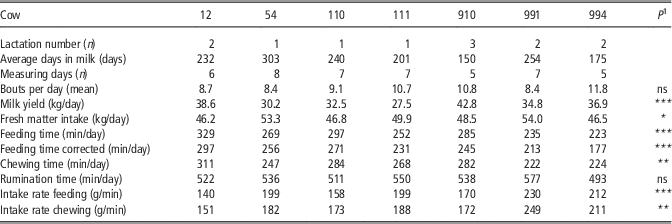
Primiparous (first lactation; n=3) and multiparous (⩾second lactation; n=4) cows were included in the trial and cows had been on average 150 to 303 days in milk (DIM) during trial (Table 1). The cows in the study were kept in one of the two separate compartments, each with 36 cow places, 18 feed weighing troughs (Insentec, Marknesse, The Netherlands) and two water troughs (Insentec). The two compartments were part of a cubicle housing system with a solid concrete floor, which were cleaned by folding slides. Cows were fed total mixed rations (TMR) containing 51% to 57% corn silage, 22% to 32% grass silage, 9% to 21% concentrate, 1% straw and additives, whereby TMR were calculated to achieve a daily milk yield of 33 kg. Dry matter content was 44%, energy content was 6.9 to 7.1 MJ NEL/kg DM and crude fibre content amounted to 16% of DM. The basic components varied because of changes in management of the research farm. Both TMR and water were provided ad libitum. Fresh TMR was fed twice per day at 0600 and 1600 h. Cows were milked in a milking parlour between 0500 and 0700 h in the morning and between 1500 and 1700 h in the afternoon. Milk yield per cow per milking time was recorded by infrared milk meters (MM25; DeLaval Int., Tumba, Sweden).
Number of measuring days, stage of lactation, milk yield and feeding behaviour of experimental cows

1 Effect of cow: ns=not significant; *P<0.05; **P<0.01; ***P<0.001 (Kruskal–Wallis test).
Data recording
Feeding behaviour was monitored with two different systems: weighing troughs for recording feeding time and feed intake, and pressure sensors (ART-MSR; Agroscope Reckenholz-Tänikon ART, Ettenhausen, Switzerland) for recording chewing and rumination time. The weighing troughs were locked when in a passive state, opened after identifying the entering cow by means of a transponder, and closed after the cow had left. The system recorded time of day, visit duration and weight loss for each feed trough visit and stored the data together with the number of the trough and the number of the visiting cow. Presence at the trough was classified as feeding time if the visit duration was longer than 20 s within 1 min.
Raw data for chewing and rumination were recorded with ART-MSR sensors. Experimental cows were equipped with one of four ART-MSR pressure sensors. The sensors consisted of a noseband sensor, fixed to the cow’s head by a halter, and a modular signal recorder MSR 145 logger (Nydegger et al., Reference Nydegger, Gygax and Egli2010). The measuring principle of the sensors is based on pressure shifts in the noseband sensor, which are caused by jaw movements. Pressure values are registered with a frequency of 10 Hz and stored by the logger. The raw data were evaluated using R-based software (R, Boston, MA, USA). Characteristic sequences (about 5 to 10 min per 24 h) for the activities ‘rumination’ and ‘chewing’ were defined as learning data files, and these were then utilised for classification of pressure raw data (Nydegger et al., Reference Nydegger, Gygax and Egli2010). The aggregation of ART-MSR sensor data was done by RumiWatch Converter (ART, Ettenhausen and ITIN+HOCH, Liestal, Switzerland). The activity within 1 min (1 min time slot) was summarised and classified according to the prevailing activity (0=other, 1=ruminating, 2=chewing). The following variables were included in the evaluation:
-
∙ Feeding time (minute; weighing trough): duration of presence at trough, including presence at trough without measurable feed intake.
-
∙ Feeding time corrected (minute; weighing trough): duration of presence at trough with measurable feed intake (weight loss>100 g/visit).
-
∙ Trough visit (weighing trough): number of weighing trough visits.
-
∙ Feed intake (kg; weighing trough): weight loss (>100 g/visit) of trough content during presence at trough.
-
∙ Intake rate feeding (kg/min; weighing trough): feed intake per minute of feeding time corrected.
-
∙ Chewing time (minute; pressure sensor): minutes classified as chewing activity.
-
∙ Intake rate chewing (kg/min; weighing trough and pressure sensor): feed intake per minute of chewing time
-
∙ Rumination time (minute, pressure sensor): minutes classified as rumination activity.
Data analysis
Feeding, chewing and rumination activity were grouped into bouts whereby feed trough visits were used as determining variable for definition of bout length. Feed trough visits and the time intervals between feed trough visits were aggregated to one bout if time intervals between single visits were not longer than 5 min. Each bout started 3 min after the last feed trough visit of the preceding bout and lasted until 3 min after the last feed trough visit of the current bout. Feed intake, feeding time, chewing time and rumination time were aggregated per bout. Presence at weighing troughs occasionally contained feeding time during which no feed intake was measured. The variable ‘feeding time corrected’ excluded such times without measureable feed intake, and hence increased the accuracy of measured feeding time.
The programme used for statistical analysis was PASW 18.0 (IBM, Armonk, NY, USA). Differences between groups of primiparous and multiparous cows were analysed using the Mann–Whitney test. For differences between individual cows, Kruskal–Wallis test was used. Correlation coefficients between variables were tested by Pearson correlation test (P<0.01). Coefficients of determination were calculated with a linear regression model. Feed intake served as dependent variable and cow, feeding and chewing time as independent variables.
Results
The average milk yield varied between 27.5 and 42.8 kg/day per cow, and the average fresh matter intake (FMI) between 46.2 and 54.0 kg (Table 1). Cows spent on average 270±39 min/day at the feeding troughs (feeding time) within those they fed 243±43 min (feeding time corrected). The average chewing and rumination time per day per cow was 262±48 min and 534±58 min, respectively. Feeding, chewing and rumination time per day did not differ between primiparous and multiparous cows. The average intake rate per day was 211 g/min for feeding and 190 g/min for chewing. The daily intake rate varied between 120 g/min (0400 to 0500 h) and 299 g/min (1500 to 1600 h) for feeding and between 88 g/min (0100 to 0200 h) and 238 g/min (1600 to 1700 h) for chewing.
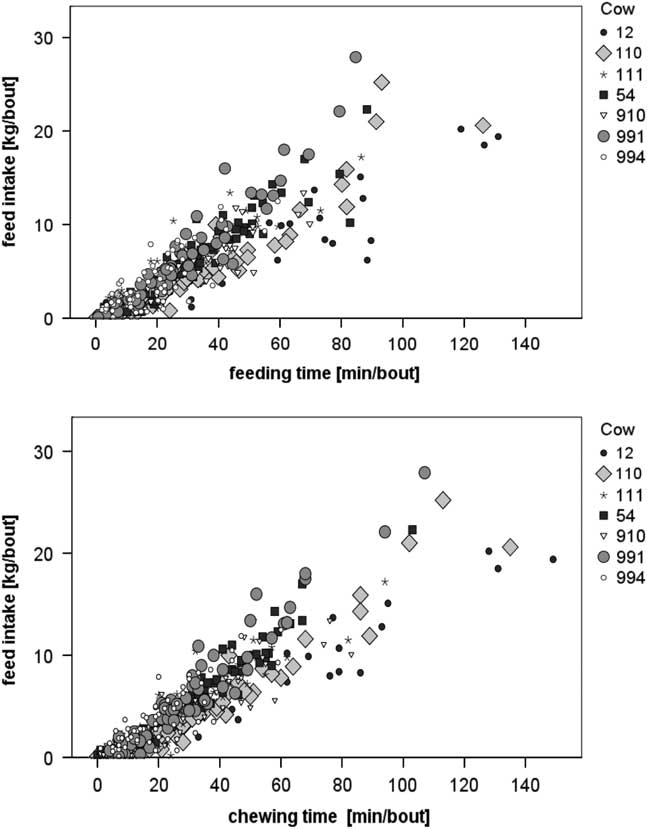
The number of bouts per cow per day ranged between 8.4 and 11.8 and averaged 9.7. Most feeding bouts started between 0600 and 0700 h (12%) and between 1700 and 1800 h (8%). The fewest bouts were initiated between 0200 and 0600 h (together 2.5%). Feeding and chewing time per bout varied depending on the length of the bout (Figure 1). The average feeding time per bout was 27.8±21.7 min with a maximum of 131 min, while average chewing time per bout was 27.0±23.1 min with 149 min in maximum (Figure 1). Cows consumed 5.2±4.5 kg fresh matter (FM) per bout on average and 28 kg FM per bout in maximum (Figure 1). Primiparous and multiparous cows did not differ in respect of feeding time per bout, chewing time per bout or feed intake per bout. Feeding time corrected per bout and chewing rate per bout were higher in primiparous cows than in multiparous cows; for feeding rate the opposite was true (P<0.05).
Feed intake in relation to feeding and chewing time per cow per bout.

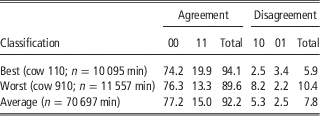
The temporal accordance between the feeding trough and the ART-MSR sensor for classification of feeding time corrected and chewing time per minute (1 min time slot) is exemplified in Table 2 for the cow with the highest and the lowest accordance. The highest accordance between both systems was achieved in cow 110 as 94.1% of the recorded 1 min time slots were classified identically as feeding/chewing (11) or no feeding/no chewing (00; Table 2). The lowest accordance was obtained for cow 910 with 89.6% of time slots classified identically. In six of the seven cows both systems classified >90% of the time slots in the same way. On average, more time slots were designated as chewing by ART-MSR sensor and as not feeding by feed troughs (10) than vice versa (01). The absolute number of classifications as chewing exceeded those as feeding in five of seven cows.
Accordance (%) between weighing trough and ART-MSR sensor for classification of cow activity as feeding time corrected and chewing time

00=no chewing/no feeding; 11=feeding/chewing; 10=chewing/no feeding; 01=no chewing/feeding.
Correlations for feed intake with feeding time per bout (r=0.891) and feed intake with chewing time per bout (r=0.907) were highly significant (P<0.01) for each cow (Table 3). Correlations between feed intake and feeding time per bout were similar to correlations between feed intake and chewing time per bout, except for cow 54. This resulted in a lower correlation between feed intake and chewing time per bout for the complete group of cows. The exclusion of time spent at feeding troughs without feed intake (feeding time corrected) improved the correlation coefficients per bout for individual cows and for the group. Feed intake and rumination time per bout were correlated significantly (P<0.05) but correlation was only of medium strength (r=0.337, cow 991; r=0.362, cow 994).
Correlation (r) and R 2 for relationship between feed intake per bout (dependent variable) and feeding and chewing time per bout (independent variables; solely and combined)

1–6Values in the table represent evaluation of chewing time with standard classification; values for low amplitude classification in cow 54 were: 1 r=0.958**; 2 r=0.907**; 3 R 2=0.928; 4 R 2=0.825; 5 R 2=0.929; 6 R 2=0.844.
**Correlation on significant level (P<0.01).
The ability to estimate feed intake was tested with a linear regression model using cow, feeding and chewing time as input variables. The individual cow had a significant effect on the relationship between feed intake and feeding or chewing time (P<0.001). The R 2 per cow ranged between 0.699 and 0.940 when feeding time included time slots without measurable feed intake and between 0.874 and 0.950 for feeding time corrected (Table 3). In general, the contribution of chewing time to feed intake estimation was equal or slightly higher than that of feeding time, indicated by higher correlation coefficients. However, chewing time was more susceptible to individual cows, as exemplified in cow 54. For this cow a high correlation between feed intake and chewing time was achieved if low amplitude classification was chosen but not for the common classification. The additional consideration of rumination time led to a slight increase in the coefficient of determination (R 2=0.743, cow 994; R 2=0.950, cow 991).
Discussion
The results confirmed that records of the duration cows are present at the feed trough or chew are valuable variables for estimation of feed intake. Intake rates feeding differed between individual cows but the within-cow variability was very low and hardly affected by day time or bout length. The consideration of feeding bouts rather than daily values ensured a sufficient variation of the data to allow statistical analysis. Splitting of daily feeding activity into bouts for calculation of feeding and chewing variables was done already in the study of Dado and Allen (Reference Dado and Allen1994). When splitting feeding behaviour into bouts, the competitive feeding situation of cows has to be considered. The amount of trough changes, especially short-termed trough changes caused by expulsion through dominant cows, probably has been enforced by competition between cows for a limited number of troughs (Albright, Reference Albright1993). In the current study, sequences of feed trough visits interrupted by breaks below 5 min were aggregated to one bout. Feed intake was continued in most cases within a smaller time frame. Minimum interbout intervals (MIBI) between feeding bouts were set to 2 min (Harb and Campling, Reference Harb and Campling1985) and 7.5 min (Dado and Allen, Reference Dado and Allen1994) in former studies. Although the MIBI in the current study was shorter than in Dado and Allen (Reference Dado and Allen1994), the number of bouts per day was lower in the present study (9.7 bouts/day) compared with Dado and Allen (Reference Dado and Allen1994) (11.0 bouts/day).
The correlations between feed intake and feeding or chewing time per bout were very similar to findings in Dado and Allen (Reference Dado and Allen1994) for multiparous cows (r=0.89). In contrast, results for primiparous cows differed between Dado and Allen (Reference Dado and Allen1994) (r=0.40) and the current study (r>0.9). Cows in Dado and Allen (Reference Dado and Allen1994) were housed in a tie-stall barn, resulting in non-competitive feeding conditions. Possibly, the permanent availability without competition led to straightening of the feeding behaviour.
The prediction of feed intake in dairy cows is influenced by manifold factors: diet, management, housing, environment and animal (Ingvartsen and Andersen, Reference Ingvartsen and Andersen2000). Cows in the current study were kept under constant environmental conditions, but showed variation in actual milk yield and stage of lactation. Furthermore, cows were neither suffering from apparent health disorders nor affected by management activities like, for example, hoof trimming during trial. Consequently, feeding and chewing time of cows were monitored on days without obvious behaviour abnormalities. As the present study represents a random sampling of five to eight observation days per cow, effects like, for example, season or health disorders were not included. For example, lameness is known to impair feeding behaviour (González et al., Reference González, Tolkamp, Coffey, Ferret and Kyriazakis2008; Norring et al., Reference Norring, Häggmann, Simojoki, Tamminen, Winckler and Pastell2014) and probably would cause an influence on the relation between feed intake and feeding or chewing time. Hence, the estimated relation is supposed to be treated with caution unless not confirmed by a broader data base which would enable to include unconsidered effects.
In general, stationary electronic feed monitoring systems are validated by comparison to records from direct visual observation (DeVries et al., Reference DeVries, von Keyserlingk, Weary and Beauchemin2003; Bach et al., Reference Bach, Iglesias and Busto2004; Chapinal et al., Reference Chapinal, Veira, Weary and von Keyserlingk2007). The current study differs from the cited works as a stationary weighing trough system was compared with a mobile pressure sensor. The occurrence of feeding activity was limited to troughs, while chewing activity could take place in the complete stable compartment. The amount of non-uniform classified measuring data per cow ranged between 5.9% and 10.4% (Table 2) for which several scenarios deliver possible explanations. Thrown-off feed became unreachable for cows, but might have been monitored as feed intake. The incidence of such misclassifications was reduced by the high side panels of the feeding troughs. Moreover, cows could have been logged in to feed troughs while just idling or browsing the ration and thereby monitored as feeding. In the present analysis, such misclassifications were avoided by imposing measurable weight loss of trough contents (>100 g) as condition for feeding classification. As the system of weighing troughs was not able to monitor weight loss below 100 g, presence of cows at troughs with very low feed intake might have been classified as non-feeding but chewing. The classification of data as chewing by ART-MSR sensors and non-feeding by weighing troughs seemed much more likely than vice versa (Table 2). Cows could have shown chewing activity beside troughs because they simply continued chewing after having left the feeding troughs. Furthermore, continuous (>10 s) grooming or licking of other cows might have caused pressure shifts which led to classification as feeding. Altogether, the accordance between the two monitoring systems was high (>92%), which implied already that the added benefit of a combination of the two sensor systems for estimation of feed intake was low (0.2% to 3.1%). This was particularly true in cases in which both systems recorded data with a high accuracy, for example, by using feeding time corrected. In five of seven cows, the latter delivered better accuracies for estimation of feed intake than chewing time (Table 3). However, when compared with non-corrected feeding time, chewing time contributed to a higher accuracy in six cows. Particularly one cow (cow 994) displayed by far the highest percentage of feeding time without feed intake (20.3%). The similar ability of the two systems for estimation of feed intake indicated that implementation of one sensor is in general sufficient for the named purpose. However, the less accurate the data records represent the time the cow is truly feeding, the more important a combination of sensors gets.
Conclusions
In the current study, feeding time, feed intake and feeding rate measured by weighing troughs and chewing time measured by ART-MSR sensors were evaluated for seven cows each. The results showed a high accordance between time of feed trough visit and time of chewing activity. Feeding time and chewing time per bout were strongly correlated with feed intake per bout and explained a great amount of variation in feed intake data. The combination of feeding and chewing time improved prediction accuracy only to a low extent. Both variables separately showed potential for estimation of feed intake but were also susceptible to individual cows. Future studies will need to broaden the data base in order to obtain more information on variations due to, for example, feed ration, lactation, health status, season or management, and to include and cope with cow individuals.
Acknowledgement
The authors gratefully acknowledge the H. Wilhelm Schaumann Stiftung for financial support.