1. INTRODUCTION
The Interrogation of Mihail of Manastır
Q: What are your and your father's name? And where are you from? And what is your profession?
A: Mihail from Manastır, son of Hristo. I do carpentry.
Q: How many years ago did you leave Manastır?
A: Six years ago.
Q: Where did you go first?
A: Five years ago I worked in carpentry in the [Imperial] Shipyards in Istanbul. Afterwards, I went off to Sire. There, I resided for three and a half years. From Sire I went to Kuşadası by sea. In Kuşadası I stayed with several master masons, we were from the same division, and I went to the village of Maaşlar with my friends to work at the mansion of one Kümes Ağasıoğlu […] İbrahim Ağa did not let me go, so I stayed there. Later, one master named Yanni Kalanarko from Aydın came, and took me to Tire to work in construction. We went to Tire without an official document. We hired a room in an inn. Three-four days after we settled, one Saturday, while sitting in a coffee shop, police sergeant Şişlioğlu Hüseyin came with five to ten policemen and asked the coffee shop owner about me. ‘He is a newcomer, I don't know him,’ he said. Then the coffee shop owner called me. ‘Are you from Tire’, he [the sergeant] said [i.e. asked]. ‘I'm a foreigner’, I said. [He] asked me about my craft, and when did I come, and where did I come from, and I gave answers. ‘Grab him and take him’, he said. They caught me, and the irregular policemen (zeybeks) took [me] away […].Footnote 1
I came across Mihail's case by chance, while reading a long protocol of an inquiry committee set up by the Ottoman imperial government to establish whether a certain detainee in the prison in Izmir, in western Anatolia, had died as a result of torture. The file included many interrogations of people related to the case. Among them was one not directly related at all, that concerning Mihail. Yet his testimony, which was recorded during his interrogation, provides us with a rare opportunity to recover the voice of one working immigrant at first hand.
Drawing on this evidence, the aim of this article is twofold. The first objective is to show how a socio-legal reading of migration is useful in reconstructing the history of immigrants, especially in the nineteenth century, when migration became a legal issue. The second is to demonstrate the potential of diaspora theory for analysing and explaining the experience of working immigrants from the Balkans and the Aegean Islands during the nineteenth century, among them the protagonist of this article.
Court records of trials that were held in Anatolia in the mid-nineteenth century suggest that working immigrants – young, single men, or men without their families, in search of work – found themselves to be ‘the usual suspects’ in felony cases.Footnote 2 The Tanzimat era (1830s–1880s) was a time of vast and sweeping reforms in the Ottoman state during which Ottoman institutions were refashioned, becoming more activist and more centralised in nature. To meet the key rationale of state centralisation, the legal system and provincial administration were remodelled. Criminal law and law enforcement featured prominently within the legal and administrative reforms.
Simultaneously, this period witnessed massive migration both into and within the Ottoman Empire, in general, and Anatolia in particular. This influx of immigrants from elsewhere was counterproductive to the centralisation efforts introduced by the imperial government and, among other things, made it necessary to monitor the movements of newcomers.Footnote 3
However, it took considerable time for the Ottomans to develop efficient, modern tools for monitoring the movement of populations within their borders. Practices such as census-taking, issuing identity documents and establishing institutions like the police force were all in their infancy well into the 1880s.Footnote 4 In trying to deal with the immediate demands of the situation on the ground without modern tools that had yet to be fully developed, the imperial government continued to use centuries-old practices when dealing with immigrants, while exploring new methods at the same time.
Over the last three decades, there has been a growing body of work on migration.Footnote 5 Attempts to uncover the voices of individual migrants have been a major objective of such studies since the 1990s.Footnote 6 However, there is almost no socio-legal study of immigration in Middle Eastern contexts.Footnote 7 This absence with respect to the relatively well-studied nineteenth century is quite surprising, since migration in the modern era is a legal experience by definition. People who wished to be on the move, whether across borders, across regions or more locally, inevitably encountered law enforcement agencies.
Generally speaking, works on nineteenth-century Ottoman reforms tend to focus on institutional history. This is also true of studies of law and order, criminal history and legal history, which have expanded considerably since the 1990s.Footnote 8 Therefore, a socio-legal study of migration is well timed, since it provides an appropriate perspective for contextualising and analysing the personal experiences of immigrants, mainly by making use of new documentation practices. Rather than fixating on the perspective of the state, the socio-legal approach draws attention to ordinary men and women, policemen and officers, low-level judges and heads of communities.
Mihail's story enables us to reconstruct the legal experience of a working immigrant and understand how different players took part in interpreting new laws and norms that reshaped Ottoman life. The records left behind in this case provide us with a rare opportunity to capture something of the experience emanating from the implementation of the reforms in the countryside. The case exposes tensions between old and new norms, between doctrine and practice, and between the different interest groups, namely the imperial administration, local administration, policemen, Christian notables, the local population and working immigrants.
Our protagonist, Mihail, is ‘representative’ in a microhistorical sense. The episodic or cultural microhistorical approach explores individual persons, extraordinary cases, or unusual events, and is based on meticulous reconstruction of daily existence, often employing a ‘thick description’ mode of representation.Footnote 9 Such reconstruction is an effective means of contextualising the historical phenomenon under study. Through this contextualisation, we learn about the ‘normalcy’ of individuals’ experiences, and of the role played by large-scale structures in shaping their lives.Footnote 10
I start by unfolding Mihail's case, layer by layer, exploring the facts of the case along with Mihail's biography. Next I discuss his experiences at the police barracks, thereby gaining an insight into the establishment of the Ottoman police in the 1840s. Subsequently we enter the courtroom and follow its proceedings. Last, the working of the investigation commission whose records provide the backbone for this article will be examined. The analysis will be informed by socio-legal studies and diaspora theories, and places emphasis on the link between migration and law, which provides the larger context for Mihail's experiences.
2. UNFOLDING THE CASE OF MANASTIRLI MİHAİL
2.1 The events
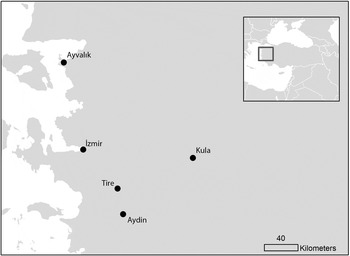
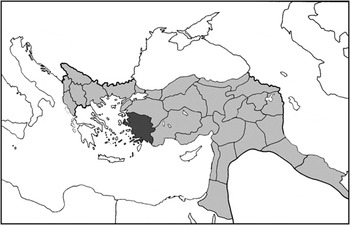
Mihail, son of Hristo, was a carpenter working in construction who had left his home in Manastır (in Macedonia) in approximately 1846, in search of work. His first stop was the Imperial Shipyards in Istanbul, where he worked for some time. He then relocated to Sire, where he remained for three and a half years. From there, he moved to Kuşadası (part of Izmir Province), where he met several friends, who apparently worked with him in the same division at the shipyards. After moving about, sometime around early 1850 a construction master from Aydın named Yanni Kalanarko took him to Tire (located 93 kilometres south-east of Izmir almost halfway between Izmir and Aydın; see Figures 1 and Figure 2) to work in construction.
Map of the greater Izmir area including Tire. Source: Scott Walker.

Map of the Ottoman provinces in the nineteenth century; the province of Aydın is shaded black. Source: https://en.wikipedia.org/wiki/File:Aydin_Vilayet,_Ottoman_Empire_(1900).png

The two men took a room in an inn, and 3 or 4 days after Mihail's arrival, on a Saturday, as he sat in a coffee shop, some 5 to 10 policemen arrived. Their commander, Sergeant Şişlioğlu Hüseyin, asked the owner of the place several questions. He then called Manastırlı Mihail, and asked, ‘Where are you from?’. Manastırlı Mihail replied, ‘I am a foreigner’. He was then asked about his place of origin, his occupation and his whereabouts. After Manastırlı Mihail had answered all these questions, the sergeant arrested him.
As luck would have it, Manastırlı Mihail had arrived in Tire at a time when the police were in pursuit of a member of the gang of Katırcı Yani, who was known to be hiding in the town. Katırcı Yani's's gang had robbed three opium merchants some two weeks earlier (opium was still legal at the time). Mihail was randomly arrested by the police, who suspected him of being the gang member they were after.
Once arrested, Mihail was taken to the governor's house, which also served as the local police base and detention centre. After a night in detention, he was taken for interrogation by Cavalry Sergeant Kayserili Deli (‘Crazy’) Ahmet. The sergeant's nickname ‘Crazy’ is suggestive of a ruthless or violent reputation. The sergeant asked Mihail for the standard personal details, and for his friends’ names, writing the information down in a notebook. After an hour or so of interrogation, the jailer, named Mustafa, entered the room. At the sergeant's order, the jailer began to torture Mihail. About three hours later, an individual described as ‘a fat man’ interfered and stopped the torture.
The next day, Manastırlı Mihail was brought before Tire's council, which had jurisdiction over criminal matters by law. The council members sent Mihail to stand trial before Izmir's council. I explain the structure of the legal system below, but for the sake of clarity I should add here that district-level councils, such as Tire's, tried misdemeanours, and provincial-level councils, like that of Izmir, tried felonies. Since Mihail was suspected of committing a felony, he was sent to Izmir. After being held in detention in Izmir for 28 days, Mihail was brought before the council. No proof connected Mihail to the opium robbery or the gang, but in order to gain his freedom, he had to find a person who would post bail. Tire's Christian notables performed this service for him.
Now that the facts of the story are clear, it is time to explore its meanings layer by layer, contextualising each by embedding it within wider developments and the relevant theoretical framework.
2.2 The experience of the immigrant in nineteenth-century Anatolia
The Ottoman Empire witnessed migration throughout its history. All across the empire, tribes, merchants, students, administrators and individual workers were on the move.Footnote 11 However, the nineteenth and early twentieth centuries were a most challenging period for Ottoman policymakers in terms of population movement.Footnote 12 The following paragraphs describe the general immigration trends into the Ottoman Empire in general and into Anatolia in particular during the nineteenth century, in order to help contextualise Mihail's story.Footnote 13
Migration policies in the Ottoman Empire began towards the end of the eighteenth century, or at the beginning of the ‘long nineteenth century’,Footnote 14 when the government of Sultan Selim III (r. 1789–1807) restricted immigration into the capital Istanbul.Footnote 15 This policy was typical of those followed throughout Europe when dealing with similar problems faced by big metropolises which had to contain an influx of immigrants from the countryside to the capital.Footnote 16 However, restricting entry to the capital did not solve the problem of farmers leaving their lands. The desedentarisation policy of the seventeenth and eighteenth centuries collapsed in the early part of the nineteenth century, and nomadism grew in scope. Part of the problem lay in the decentralisation of imperial power and the expansion of tribal power.Footnote 17
The basic objective of the Tanzimat reforms of the 1830s to the 1880s was to extend control of the central government to all aspects of Ottoman life in both the centre and the provinces.Footnote 18 As part of its centralisation programme the imperial government was alarmed by the movement of farmers to Istanbul. Stability of life in the imperial capital was not their only concern; there were financial issues at stake. Fewer farmers meant fewer taxpayers and food producers. Also, instability caused by migration meant less governmental control over the whereabouts of its subjects. Thus, decrees were issued ordering governors to prevent peasants from immigrating to the capital, and ensuring that they continued to work their fields.Footnote 19
According to British sources from the mid-nineteenth century, western Anatolia around Izmir and Bursa, where our story takes place, suffered a shortage of workers during the harvest season. This shortage propelled the seasonal migration of nomadic tribe members, who took part in the harvest for relatively high wages.Footnote 20 A shortage of labour also attracted people from the Balkan provinces and the new nation states, in search of work. Workers moved back and forth between parts of the Balkans, the Aegean islands and Anatolia.Footnote 21 This group was far from homogeneous. While some were unskilled, single men in search of temporary employment, moving about in groups, others were men with families who were seeking both work and a place to settle down, to be followed by their families.Footnote 22 Ottoman Christians from the Balkans and the Aegean islands (known as Greek-Orthodox), who immigrated to the Izmir area for work, imagined Anatolia as ‘the promised land’. As opposed to the option of immigrating to the United States, this area was accessible, familiar, and their skills were still ‘local’. Far from the common sentiment of alienation, all too familiar to immigrants, local Muslims welcomed these newcomers, who came to see Anatolia as their homeland soon after.Footnote 23
We have no way of knowing the number of ‘Romans’ (i.e. Greek-Orthodox) living in western Anatolia. Muslims formed the overwhelming majority. During the nineteenth century, Christians made up about a quarter of the empire's population, but most of them lived in the Balkan provinces. In western Anatolia non-Muslims never exceeded 20 per cent. Around Izmir, however, their number was on the rise throughout the nineteenth century, from 20 per cent in the 1800s to a slight majority in the early 1900s.Footnote 24
This rise resulted from immigration of many islanders to western Anatolia throughout the second half of the nineteenth century. They immigrated to escape poverty and debt collectors.Footnote 25 These immigrants moved not only to towns, but also to villages to work as seasonal workers in agriculture.Footnote 26 During the ‘long nineteenth century’, many peasants found it more difficult to make a living due to high taxation, land reforms, rising commodity prices and mass migration. In the young state of Greece, all of the above made living very difficult, and western Anatolia seemed to offer a better future.Footnote 27 Mihail belonged to this wave of immigrants into Anatolia.
Perhaps the most challenging wave of immigrants into the western Anatolian provinces, however, was that consisting of refugees who fled the war zones of the empire's frontiers, as a result of territorial losses in the Balkans, the Caucasus, Crimea and the Middle East.Footnote 28 The entire Muslim population forced to immigrate into Ottoman territories between 1829 and 1914 is estimated at between five and seven million.Footnote 29 From the end of the Crimean war until the early 1860s, as many as 300,000 Muslims left the Crimea for the Ottoman Empire, which was roughly two-thirds of the entire Muslim population in the Crimea.Footnote 30 The number of Circassian refugees forced to leave the Caucasus during the 1850s and 1860s was assessed by the Ottomans at around 1.5 million.Footnote 31 From the beginning of the First Balkan War until the end of the First World War nearly 414,000 former Ottoman Muslim subjects from former Ottoman territories fled the Balkans to Anatolia.Footnote 32
As we saw, the volume of migration into and within the Ottoman territories in the nineteenth century was enormous. The key difference between nineteenth-century migration and that of previous periods was that the immigrants were now faced with a central government increasingly interested in their movements, and in monitoring them. This policy was aimed at increasing state revenue through taxation, creating a database for future army mobilisation, and achieving greater internal security.Footnote 33 Mihail's case reveals something of the encounter that immigrants had with the central government as experienced on the ground, a point we return to below. Before doing so, we undertake closer investigation of the lives of skilled workers in the Anatolian countryside.
2.3 Mihail's social background
Mihail was a carpenter working in construction. But he was not a master (usta), which means he had to be employed by one. In most Ottoman towns, houses were constructed of light wooden frames with brick or earth infill, and, later, made of wood cladding.Footnote 34 Construction was a seasonal occupation stretching from April through to October.Footnote 35 Therefore, although wages were relatively high when compared with those of unskilled workers, no income could be expected for a period of approximately five months. At the time, building techniques still differed in various localities. Carpentry, however, served as a useful skill in many of those areas.Footnote 36
A skilled worker outside Istanbul made 6–9 kuruş a day on average, or about 250 kuruş per month potentially,Footnote 37 yet in reality his income was around 180 kuruş. A daily worker could experience days with no income, having to make do with a lower monthly wage. Inflation was high in the 1840s and 1850s, and true economic stability was only reached in the 1860s.Footnote 38 Therefore it is difficult to assess the income that a building worker would have needed. The value of wages is better understood when compared with a price index, which is unfortunately not easy to produce.Footnote 39 We do know that the cost of living was greatly influenced by the cost of housing. In times of migration such as the mid-nineteenth century, rent constitutes an important ingredient in the cost-of-living equation. Yet, no adequate data are available on housing costs in the Ottoman Empire.Footnote 40 What is clear, however, is that men like Mihail were constantly on the move, usually in groups, looking for work.
2.4 Encountering the police
Mihail arrived in Tire, the town in which he was arrested, with his employer, Yanni Kalanarko, a construction master from Aydın, at a time when the police were tipped off that a member of a notorious gang that had committed a robbery a few weeks earlier was hiding in town. Both men took a room in an inn. Three or four days after his arrival, on a Saturday, Mihail was having a drink in a coffee shop. The police went into this coffee shop when conducting the search after the gang member, and asked the owner if he knew the men drinking coffee. He probably pointed out Mihail as a stranger.
Regulations concerning the use of internal passports were published as early as 1841 and instructions concerning passage from place to place were issued in 1844, to remain in effect until 1887.Footnote 41 Internal passports were aimed at controlling internal migration and especially at keeping economically and politically undesirable people, and potentially dangerous vagrants and beggars, out of the capital and other major cities. Yet, these passports were probably never very effective.Footnote 42
I have come across very few cases in which it was indicated that such documents were presented to the police, or in court. Mihail himself admitted he carried no such document that could verify his identity. Hence the police continued to rely on traditional Ottoman methods, namely those concerned with the familiarity or strangeness of an individual, and it was these that led to Mihail's arrest.
An anonymous person (Ottoman Turkish garip, literally a stranger) was seen as a threat to close-knit neighbourhoods, and various social devices were employed by communities in order to mitigate the effects of the arrival of anonymous migrants in the city. Therefore, the government viewed the neighbourhood as an instrument of control.Footnote 43 In the eyes of the central administration, heads of neighbourhoods and clergymen were extensions of the government operating through networks pervading the community and extending into the private sphere.Footnote 44 Familiarity and strangeness were major surveillance tools and viable categories by which levels of threat were set, well into the latter part of the nineteenth century. Lacking any identity papers and being a stranger led, eventually, to Mihail's arrest.
The Ottoman police force in the provinces was established in the 1840s along the lines of the French Gendarmerie.Footnote 45 Its main task was to allow the central government to gain control over the empire's vast territories, through its monopoly over the use of violence.Footnote 46 It was also meant to serve as a constant reminder of the state's potential threat of violence. The number of policemen in Anatolia at the time was estimated at 10,000.Footnote 47 The force consisted mainly of cavalry and infantrymen, most of whom were temporary unskilled working immigrants in search of work themselves, employed for a short period of time by the police. Officers were recruited from the army and could have a career in the force.Footnote 48
The underlying objective in the deployment of Ottoman police units was not crime fighting, and certainly not crime detecting, which only evolved at a later stage.Footnote 49 The main missions of the police were to patrol the countryside, mainly fighting gangs who made their living from highway robbery, kidnapping and taking protection money from farmers; to undertake night patrols in urban centres; tax collection; and carrying out censuses. The policemen maintained a military-like routine and lived in barracks at the governor's compound.
When the first police units were established (1840) in provinces close to the capital, there was no central command. Rather, each unit was subordinate to a local governor. In 1846, the Directorate of Police and Gendarmerie (Z aptiye Müşiriyeti) was formed.Footnote 50 However, this body basically remained a paramilitary force, and its tasks as Gendarmerie were emphasised, because the Directorate was an all-military body.Footnote 51
Theoretically, the Directorate was responsible for hiring, training and disciplining the troops, while the command of the units and police stations was in the hands of local governors.Footnote 52 In practice, this was not always the case. Provincial governors used the policemen to strengthen their hold over the provinces and, thereby, push forward the centralisation process.Footnote 53 But since governors and provincial councils were preoccupied with increasing the state's revenues, a key objective of the Tanzimat state, the force became a tax-collecting agency for the central government.
To return to our case: Mihail indicated that he was arrested by a police sergeant and policemen he referred to as zeybek. The Ottoman police force at the time, called Zaptiye, was made up largely of temporary personnel who were trained on the job. While police officers could expect a career in the service, non-commissioned officers (NCOs) and the rank-and-file were temporary. The rank-and-file could be employed for up to two years and most served for a few months; NCOs, on the other hand, served for two years and more, becoming the professional backbone of the force. Police sergeant Şişlioğlu Hüseyin, who arrested Mihail, belonged to this echelon.
But who were the so-called zeybek? Until the 1880s the Ottoman police employed regular and irregular policemen, and the latter carried different names such as Derbendci, Kırserdarı and Sergerde. ‘Irregular’ is a misleading label, as each group performed distinct tasks and was paid quite differently per month. Mihail was referring to the derbendcis mistakenly as zeybek. Zeybek is a general name denoting irregular militia employed in the Balkans and the Aegean Islands from the seventeenth through to the late nineteenth century. It was only during the pre-republican era (1919–1923) that zeybek gangs were found around Izmir.
As we saw earlier, once arrested, Mihail was taken to the governor's house (in Ottoman Turkish called konak), which also served as the local police base and detention centre. The following morning, having spent a night in detention, Mihail was taken for interrogation. His interrogation was conducted by a Cavalry Sergeant named Kayserili Deli (‘crazy’) Ahmet. We do not know much about this sergeant. He served as a cavalry sergeant under Halil Paşa Effendi for a year and a half, before the events that took place during interrogation. Being a cavalry sergeant meant he had no, or very little, training in interrogation and crime detection.
Until the establishment of the criminal courts and the police in the 1840s, suspects were taken to court, to be questioned by the judge (kadi), and evidence and witnesses were also brought before him. The newly established criminal court system continued this practice. However, not long after the criminal courts (discussed below) were established, the number of cases brought before them grew rapidly, resulting in overload and delays.
In the hope of overcoming this problem, the Supreme Council of Judicial Ordinances (Meclis-i Vâlâ-yı Ahkâm-ı Adliye, referred to hereafter as the Supreme Council) entrusted the police with pre-trial procedures such as interviewing witnesses, evidence collection, producing suspects and eliciting confessions.Footnote 54 Police officers produced suspects and submitted written testimonies to the courts, carrying out the tasks of the examining magistrate (müstantık), a function known from the French judicial system that was to be established in the Ottoman equivalent in the 1870s.Footnote 55 For this reason, Mihail was interrogated by the police before being brought to court. Yet, there was no written manual as to how to conduct an interrogation, and therefore officers developed their skills ‘on the job’.
As we have seen, the sergeant asked Mihail for his personal details, and for his friends’ names, writing the information down in a notebook. After an hour or so of interrogation, the jailer, named Mustafa, entered the room. Mustafa had served as a coffeemaker (kahveci) and as a jailer in Tire's governor's house for eight or nine years prior to the events in question (from about 1841–1842). At the sergeant's order, the jailer began to torture Mihail. Three hours later, according to Mihail's testimony, a person described by him as ‘a fat man’, probably Tire's governor, put a stop to the torture.
At the time, the rules of evidence still relied on either the testimony of two valid eyewitnesses (i.e. Muslim males) or a suspect's willing confession. Until 1840, torture was a legitimate tool used to extract confession, names of accomplices, and details of stolen goods and cash.Footnote 56 In 1840 torture became illegal,Footnote 57 yet the evidence shows that the police continued to torture suspects throughout the nineteenth century.Footnote 58
Governors headed both the police force and the criminal courts under their jurisdiction. As such, governors were under enormous pressure from the imperial government to show results in law enforcement and in the administration of criminal justice. This was especially true with regard to the aim of creating a stable and secure atmosphere, and obtaining higher conviction rates in court.Footnote 59 Lack of alternative means made governors use traditional methods to provide the necessary evidence in court.Footnote 60
2.5 In court
A day after Mihail was interrogated he was brought before Tire's local council to stand trial. However, being a district council it was allowed to try misdemeanours whereas Mihail was charged with a felony. He was therefore sent to stand trial before the provincial council in Izmir. The following explains the basis on which councils were charged with trying criminal cases, and outlines the logic of the court system.
Between 1840 and the late 1860s local councils served as criminal courts in the Ottoman provinces. This was the first time in Ottoman legal history that crime became a legal category in its own right, an innovation that was paralleled by the introduction of penal codes and criminal courts. Although the history of this court system is beyond the scope of this paper, a brief description of it is necessary to contextualise the proceedings in Mihail's case.Footnote 61
Local councils had existed since the late seventeenth century, long before the legal reforms of the mid-nineteenth century. Their business was mainly administrative, namely assisting governors in running their provinces. The council consisted of the governor, top-ranking bureaucrats and local dignitaries. Until the 1840s, the local council was a voluntary body. However, the councils also held on rare occasions a judicial function resulting in criminal sentences. When serving as a court, only the governor and the local judge (kadi) convened the council. It was the judge who issued a verdict, while the governor made sure punishment was carried out.Footnote 62 Yet, we should keep in mind that most trials, including criminal trials, were held in the Islamic (Şeriat) courts, known as local courts, and presided over by a single local judge.
As part of the imperial government's effort of centralisation, by the 1840s it made local councils obligatory, standardising their proceedings, and setting a fixed size and structure to them. As part of an Ottoman promise to promote legal equality for non-Muslims in districts and provinces inhabited by minorities, representatives of the non-Muslim communities (Greek-Orthodox, Armenian, Catholic and Jewish) were assigned a seat in the local council. Like their predecessors, councils engaged mostly in administrative matters.
In order to understand why the local councils became criminal courts in the 1840s it is necessary to explain the legal framework prior to the reforms. The Ottoman legal system was based on three pillars: Islamic Law, Imperial Law and Customary Law. The Courts of Islamic Law (Şeriat), the only state courts, were charged with implementing all three. In terms of criminal laws, the Ottomans defined two categories of crime, in line with Muslim legal doctrine: crimes committed against God, known in Muslim legal literature as ‘God's rights’ (hakk Allah), and crimes committed against individuals, known as ‘individual rights’ (hakk adami).
In theory, crimes violating God's rights (theft, highway robbery, wine drinking, illicit sexual intercourse, and slander), for which the Qura'n prescribed specific punishments, were required to be prosecuted by state authorities, which in the late seventeenth and early eighteenth centuries would have meant the local councils. All other offences fell under the category of private claims. Such claims had to be submitted to the court by the victim and usually involved physical and/or verbal offences against the person, or his/her property.Footnote 63
In most criminal lawsuits, which were private, conflicts could be settled through dispute resolution between the victim and the perpetrator.Footnote 64 In a private claim, the plaintiff could come to an agreement with the defendant that would solve their dispute. In a murder case, for example, the plaintiff could pardon the murderer and ask for blood money compensation, waiving his or her right to retaliate. Theoretically, the murderer was set free, an outcome that many governors resented.
Murder cases, which involved a violation of individual rights, fell outside governors’ jurisdiction. In order to intervene in murder cases, a governor had to prove that the offender was a habitual criminal, thereby allowing the governor to execute him or her.Footnote 65 It was in such trials that the judge adjudicated in the presence of the governor at the governor's council.Footnote 66 We know that sometimes Ottoman governors overlooked the outcomes of agreements reached in court between the victim and the perpetrator, and punished offenders nonetheless.Footnote 67 In order to avoid the overturning of a settlement by governors, Ottoman subjects sometimes chose to settle their matters outside the court.Footnote 68
During the 1840s, the reformers refashioned the Ottoman state as an activist state. An activist state could not accept a legal reality where felonies such as murder fell outside its jurisdiction. It was mainly for this reason that a new criminal court system was established. Other reasons that contributed to the establishment of this court system were the growing presence of foreign subjects and matters of extra-territoriality, the concept of legal equality before the law, and the fact that state bureaucrats were no longer the Sultan's slaves. Outside the capital local councils were invested with the task of implementing the new penal code of 1840, while in the capital, this task was assigned to the police.Footnote 69
Assigning this mission to the governor and his officers was a long-established Ottoman practice, based on the notion that punishment was the duty of the military–administrative elite. By the mid-nineteenth century, however, all crimes, those violating God's rights and those violating individual rights, were tried by the state. This change promoted centralisation, as the state set foot in private spheres that up until then were outside its control and interest. This move was also effective in relaxing the level of tension between the capital and the governors, tension which rose as the level of centralisation grew – a point I shall return to below.
The criminal court system that evolved between the 1840s and 1860s consisted of three tiers. District-level councils were authorised to try misdemeanours; provincial-level councils were authorised to try felonies.Footnote 70 The top-most tier, or Supreme Council, served as a Supreme Court. As seen before, Mihail was first brought before Tire's council, which was a district-level council. Since he was suspected of being a gang member involved in highway robbery – a felony – it could not try him, therefore he was sent to the provincial council in Izmir.
Court records show that sometimes a district-level council heard the case before sending the suspect to the provincial centre.Footnote 71 It was at this point that the head of the Christian community of Tire learned of Mihail's case and his claim of torture. The development of Mihail's case suggests that these Christian notables followed the case to Izmir, as we shall soon see.
Mihail was kept in detention for 28 days, in Izmir, before he was taken to court. Councils were frequently preoccupied with administrative matters, and their hearing sessions were few in number. Furthermore, a steep increase in the number of cases heard by the councils brought about a growth in their workloads that councils found difficult to cope with.Footnote 72 This increase was due to several developments that took place at that time, such as an increasing efficiency on part of the police that broadened the councils’ involvement in criminal proceedings, the consolidation of the councils’ working routine, and, most importantly, to the fact that Ottoman subjects learned to trust the new court system and bring their matters before it.
Unlike the local or Şeriat courts, the new criminal courts could be approached free of charge. It was noted above that in the seventeenth, eighteenth and early nineteenth centuries, governors were often oblivious to agreements between victims and offenders. This situation led Ottomans to resolve their disputes outside the court. With the reforms, the policy became pro-victim. Not only did the council make sure that victims would be compensated, it also made sure the offender was punished. As a result, more cases ended up in court. Again, bringing more criminal cases to the state's attention promoted centralisation. Its side effect was an overload of the courts, the price of which was long detentions before trials.
We are now in a position to enter the courtroom. Provincial councils were headed by the provincial governor, and district councils by a district governor. The provincial councils included the governor, the provincial treasurer, a judge, a Muslim scholar interpreter of Islamic law charged with issuing legal opinions (mufti, jurisconsult), four prominent members of the community, and representatives of the non-Muslim communities.Footnote 73
Council members convened at the governor's house, at his chambers, seated on a couch called a divan. At the centre of the divan was the governor. To either side sat all the other council members, according to their seniority. On stools on both ends of the divan were dragomen and the council's clerk. The person on trial would be led to the room by the police and placed in a position standing before the council. Defendants were not represented by attorneys, and council members spoke to him or her in plain language.Footnote 74
The verdict was determined by a vote of all council members present at the hearing, who reached their decision by a majority vote. In the event of a tie, the opinion of the chair was worth two votes. Any case that could not be resolved by the council was sent to the Supreme Council.Footnote 75
Ultimately, no charges were pressed against Mihail. He was not prosecuted for any offence, which is an extremely unusual result, as most suspects brought before the court were found guilty. Mihail brought up the issue of torture in court, and while the court might have had its doubts, Tire's non-Muslim representatives took them seriously. Claiming the use of torture was common, especially after confessions had been made to the police. The imperial government took such allegations seriously, yet when they were proven unfounded, the council would convict the defendant. The Supreme Council took action against council members who were unwilling to convict suspects based on the new finding.Footnote 76
Since Mihail was not a local, and the court wanted to make sure it could recall him should the need arise, it ordered him released on bail. Even though far from home, Mihail was required to produce a guarantor who would post bail for him. The Christian community of Tire came to his assistance, and its notables paid the necessary bail.Footnote 77 Hence, although he was a stranger, and an alleged ‘suspect’, Mihail found support from fellow members of his diaspora. Reading this case through the prism of diaspora studies may help us to better understand the last twist in Mihail's story and the gesture made by the notables of Tire.
3. MOBILISED AND PROLETARIAN DIASPORAS
Within the Ottoman state, much migration was internal, giving rise to what might be called labour diasporas.Footnote 78 Labour diasporas may be classified in one of two ways: mobilised (voluntary) and proletarian (involuntary).Footnote 79 Mobilised diasporas are non-territorial quasi-societies located within a larger, dominant polity.Footnote 80 There are two types of mobilised diasporas: archetypal and situational. While archetypal groups are ancient societies absorbed by a military power – as in the case of the European Jews – situational diasporas consist of highly skilled, educated groups who choose to migrate in order to improve their economic conditions. The latter groups are quickly absorbed and accepted into the new social setting due to their knowledge and professional skills. The Germanic peoples of eastern Europe and Russia may serve as historical examples of such a diaspora.Footnote 81 Workers in mobilised diasporas assisted the hosting elites in their modernisation projects and, in so doing, formed political alliances with them.Footnote 82 In the Ottoman context, parts of the Armenian and Greek-Orthodox communities may be regarded as mobilised diasporas.
The more relevant category for our purposes is that of the proletarian diasporas, which consist of unskilled persons who were compelled to migrate due to socio-political hardship in their homelands. Such groups were not well received by locals, were often stigmatised, endured a sense of alienation, and only with time were incorporated into the new social structure.Footnote 83 During the nineteenth century, worker migrations of the proletarian diaspora type constituted a global phenomenon.Footnote 84 In fact, proletarian diasporas are a modern phenomenon, as host countries need workers and technicians.Footnote 85
Robin Cohen finds this dichotomy between diasporas somewhat misleading. Within all mobilised diasporas, including those populations considered well-to-do, there could be a large proportion of proletarians.Footnote 86 This was the case with the Ottoman Armenian diaspora. The Armenians of Istanbul are usually thought of as wealthy. In fact, however, many Armenians were poor, and worked as porters and labourers. Cohen points to a mixed picture, that changed over time in most diasporas.Footnote 87
Our protagonist, Mihail, exemplifies Cohen's observation. Mihail was part of an archetypal group, but he was not part of that group's elite. He had some of the characteristics of a member of a proletarian diaspora. At the same time, Mihail was a skilled worker, even though he was not a master in his craft. Yet when he got into trouble with the law, the local elite of his co-diaspora came to his help. Would Mihail have received the same assistance from Tire's notables had he been an entirely unskilled member of a proletarian diaspora? It seems rather unlikely that Mihail was well received by Tire's Christian community simply because he was a Christian himself. Evidence suggests that unskilled workers, Muslim or non-Muslim, were not well received by their hosting communities.Footnote 88
Once the central government began to play a role in provincial life, it destabilised long-standing relationships between local powers such as office-holders, and local Muslim and non-Muslim elites. What is more, now agents of the central government had the authority to interfere in matters that were until then the sole business of local communities.Footnote 89 Arguably, therefore, we should understand the assistance of Mihail by Tire's Christian notables at two interconnected levels. First, it was an act meant to contain local and central government interference within their community. Demanding equality before the law, communities were unwilling to give up special privileges. Concurrently, they performed what they conceived as their obvious duty toward ‘one of their own’. Mihail's biography proved him a reliable person to Tire's headmen, who knew how to ‘read’ his background. Consequently, they accepted Mihail's complaint concerning torture at face value, and were willing to help bring his complaint to the authorities and to set him free on bail. However, assisting Mihail also helped these notables maintain power vis-à-vis the central government, the local government, and also before members of their diaspora locally and more generally.
During the Tanzimat reforms, civic methods of assisting newcomers changed, as did the nature of the migrants themselves.Footnote 90 Christian communities took it upon themselves to provide access to their social network only to those they thought were credible. Posting bail for Mihail constitutes one example of such assistance. This kind of solidarity was unique to the non-Muslim communities in the Ottoman Empire. Unskilled Muslim working immigrants could not expect help from local dignitaries or the well-to-do.
4. THE INVESTIGATION COMMISSION
I came across Mihail and his case in records left behind by an investigation commission sent by the imperial government to investigate the death of a detainee at Izmir's prison. At the time when Mihail was taken to Izmir, allegations against the police were mounting, and the central government had already launched an inquiry into these allegations.
Not long before Mihail's arrest – sometime in late 1849 or early 1850 – one Panayot, a vineyard owner, died in Izmir's prison. Together with his friend, Lekter, he was suspected by the police of being an accomplice to the criminal gang with which Mihail was mistakenly associated. Panayot died of unknown causes, but his partner Lekter claimed that both he and Panayot were subjected to torture during their interrogation, and that Panayot died as a result of torture.
The Sublime Porte appointed Ali Nihat Efendi, a clerk at the Porte's Translation Bureau (Tercüme Odası), to investigate these allegations.Footnote 91 Ali Nihat Efendi was charged with the task of establishing whether or not torture had taken place and, if so, who ordered it, who administered it, and who was subjected to it.
When Mihail was brought before the court, after 28 days in detention, the Izmir criminal court took his charges concerning torture more seriously because similar allegations were already under investigation and also due to the backing of Tire's Christian notables. It was then that the court drew the commission's attention to Mihail's complaints.
The commission conducted the investigation together with the local provincial governor – that of Aydın – and the Izmir criminal court. They left behind three thick notebooks containing the interrogation protocols of local (district) governors, policemen and officers, and suspects who claimed they were tortured.
The three notebooks were part of a new recording method called ‘Interrogation Protocol’ (istintakname), which was introduced in the early 1840s into the criminal justice system as a monitoring tool of the Supreme Council. Interrogation protocols contained a verbatim record of every statement and testimony given in court, in the form of questions and answers. Questions were asked by the judges, and answers were given by witnesses and suspects. The testimony that opens this article is taken from Mihail's interrogation by the commission. He gave his testimony to the commission after his release from detention, when on bail in Tire. The record of his interrogation and testimony allows the glimpses of Mihail's social background discussed in this article.Footnote 92
Torture is not the subject of this article, but if it had not been for the torture of Mihail, and the commission instructed to investigate Panayot's death, his story most probably would not have left any mark in the written record.Footnote 93 Officially, as already noted, the use of torture to extract confessions had been declared illegal by 1840, yet although there is ample evidence that the police continued to use it on suspects throughout the nineteenth century, only rarely did such cases reach the courts.Footnote 94
The government would initiate an investigation of claims about torture only when council members were convinced that torture had occured, or, alternatively, when the defendent had died as a result of an alleged torture. Conviction of the policemen took place, however, when one of the policemen involved admitted to the facts, which rarely happened.
The police officers involved in Panayot's death had denied the allegations made against them, and eventually were exonerated. Jailer Mustafa, a simple person with no understanding of the criminal process and in awe of the commission, admitted to torturing Mihail. By so doing he incriminated his superior, Cavalry Sergeant Kayserili Deli Ahmet, who refuted the charges throughout his interrogations. Aware of the law and the implications of a confession of his actions, the sergeant acted as most policemen did in such cases. Both men were kept for a year and a half in detention before the commission concluded its work. The Supreme Council decided that 18 months in prison and expulsion from the force was a suitable punishment for the two.
While torture was made illegal, confession was still the main evidence that the police could produce in court. Frustration with the fact they had no alternative tools to secure a conviction led governors, occasionally, to continue applying torture. There was apparent tension between the central government and local government over the criminalisation of torture.Footnote 95 By 1858, a policeman or officer who was convicted for torture in court was required to serve time in prison.Footnote 96 In other words, the central government was doing its best to root out the use of torture in the interrogation room.
Iris Agmon maintains that historians should be looking for ‘telling events’, unique and strange, which disclose tension and disharmony in a given unit of observation.Footnote 97 Mihail's case is one such episode, in that it exposes the tensions that existed between the central government and local forces over the introduction of new norms and regulations. This case, therefore, lends itself to a microhistorical reading.
Microhistory is sometimes criticised as being anecdotal. Critics claim that the generalisations and conclusions drawn from microhistorical research lack the necessary empirical basis, or ‘proof’. This sort of criticism is directed at two features of microhistory: the reduced scale of the analytical unit, and the lack of measurable categories for microanalysis. However, microhistorians strive to understand the historical process on both micro and macro levels, and, most importantly, to link the two.Footnote 98 This back and forth between the micro and the macro is exactly the analytical tool that makes it possible to draw generalisations regarding working immigrants who came from the Balkans to the Anatolian countryside. Such generalisations, illustrated and analysed through the experience of the individual, shed light on modern immigration in small towns and hamlets.
5. CONCLUSIONS
Mihail's encounter with the law left a footprint in history. This footprint was created by the new bureaucratic recording practices that had evolved since the late 1830s. The numerous papers documenting this encounter allow us to put Mihail at the forefront of the historical stage, and tell the story of this labour immigrant.
The underlying assumption of the present discussion has been that from the mid-nineteenth century onwards migration was, and still is, first and foremost a legal experience. To date, migration is rarely contextualised through the use of socio-legal studies. However, when we read it through a socio-legal prism, Mihail's story has the potential to capture the experience of many Ottoman labour immigrants. Court and police records allow us to give voice to these people – a voice so often missing – and shed light on a very widespread phenomenon from different angles. Furthermore, applying the perspective of diaspora studies to Mihail and to other labour immigrants from the Balkans, the Aegean islands and the Greek-Orthodox communities of western Anatolia has enabled us to reconstruct the unique socio-political strengths and weaknesses of both hosting communities and immigrants alike.
However, it is the microhistorical reading of this unusual evidence that allows us to link the micro-level events of Mihail's case to macro-level developments, turning it into an illustration that gives us a sense of the reality of working migrants in this particular historical setting. Mihail was caught between several forces striving to maximise their power. His case exposes tensions between local, imperial and communal forces, and between old and new norms.
Administrative centralisation came at the expense of local powers; therefore provincial strongmen constantly tried to regain power assumed by government officials. This is especially true of western Anatolia. Local notables, Muslim and non-Muslim alike, were unwilling to give up their power, and were trying to regain it through the new apparatuses that the central government developed. Centralisation also came at the expense of local bureaucrats. Before the mid-nineteenth century, and certainly before the emergence of the telegraph and train systems, governors had a substantial degree of autonomy, enabling them to govern their district and/or province as they saw fit. Centralisation meant that they were now under tight scrutiny by the imperial government.
Simultaneously, they were expected to cut their budgets, prevent emigration of peasants, provide better security and convict suspects in court. New conventions, such as suspect's rights and the criminalisation of torture, were not well received by law enforcement officers, the governors included. High officials from the capital frequently had to remind local governors of the new norms and laws.Footnote 99
Non-Muslim community headmen used this new political atmosphere to reclaim power. The new political atmosphere of the mid-nineteenth-century reforms promoted liberal ideas such as legal equality and individual rights. These new norms, and the fact that non-Muslim headmen gained a seat in the councils and courts, equipped them with an unprecedented measure of influence. The central government needed their collaboration to show that the Ottoman state did indeed act to extend equality to non-Muslims, local governors needed their vote in court and in the council to get a better grip on their districts or provinces, and the non-Muslim population needed them for protection. Muslims did not enjoy a similar protection against state power. All of these wider developments can be seen in Mihail's case.
The events discussed here occurred in the Anatolian countryside, the hinterland of a rising metropolis, Izmir. While migration, law enforcement and modernity are usually studied within an urban context, Mihail's case provides an opportunity to extend our attention to the rural areas, and explore the coming of modernity in the countryside.
The bigger picture revealed through this story is the Ottoman reform movement of the mid-nineteenth century, and the passage of empire to modernity. For many years these changes were represented in scholarship as ‘westernisation’, namely a poor imitation of western developments lacking the philosophy that stood at the bases of similar reforms in western societies. This is especially true of the legal and penal systems. The present discussion adds to a revisionist body of scholarship that provides alternative interpretations to the simplistic notion of ‘westernisation’ in the socio-legal sphere.
Finally, we have seen that as far as the experience of migration is concerned, modernity certainly did not bring a complete break with past conventions. Old Ottoman conventions targeted Mihail as the ‘usual suspect’, yet now this was done in the name of the surveillance state.
ACKNOWLEDGEMENTS
This article is based on a paper presented at a workshop entitled ‘The Middle East and the “First Modern Globalization”’ held at the Hebrew University of Jerusalem in January 2012. I would like to thank Liat Kozma and Avner Wishnitzer, the workshop organising committee and the other participants for their advice and comments. I am also grateful to Jane Hathaway and Avi Rubin, who read and criticised earlier versions of this manuscript and to Ebru Aykut for her advice. Finally, I would also like to thank the anonymous readers of the article for their wise, valuable and enlightening remarks.