Introduction
Adaptation to environmental changes, and especially climate change, is a major concern which receives much attention from evolutionists to shape how the genetic complement of plant species can determine the future of the communities (Davis and Shaw, Reference Davis and Shaw2001; Franks et al., Reference Franks, Sim and Weis2007; Hoffmann and Sgrò, Reference Hoffmann and Sgrò2011). Global warming and resulting drought determine the length of suitable growth periods, the photosynthetic efficiency and the triggering of plant reproduction (Patterson, Reference Patterson1995; Karkanis et al., Reference Karkanis, Ntatsi, Alemardan, Petropoulos and Bilalis2018). It impacts weeds and the crop-weed interference at different scales as pointed out by Peters et al. (Reference Peters, Breitsameter and Gerowitt2014): ‘(1) range shifts at the landscape scale, (2) niche (or crop) shifts at the community scale and (3) trait shifts of individual species at the population scale’. As for the last issue, programmes of ecological restoration demonstrate genetic adaptation to climate change in genuine wild habitats (Hodgins and Moore, Reference Hodgins and Moore2016). Other examples proceed by inference from observations, simulation modelling and subsequent checks. Temperature extremes, including freezing periods, may also have a direct impact (Katz and Brown, Reference Katz and Brown1992). Considerable variation for frost resistance was found in model species such as Arabidopsis (Hannah et al., Reference Hannah, Wiese, Freund, Fiehn, Heyer and Hincha2006) and grasses (e.g. Michalski et al., Reference Michalski, Malyshev and Kreyling2017). Within-population variation was also found in arable field weeds (Aujas and Darmency, Reference Aujas and Darmency1983; Agrawal et al., Reference Agrawal, Conner and Stinchcombe2004), thus leaving grounds for selection.
In the case of Avena fatua L., a hexaploid, autogamous grass weed whose presence in arable field is highly detrimental for crop yield, variation for many traits was reported, including fruit morphology and colour (Thurston, Reference Thurston1957), seed dormancy and germination (Naylor and Jana, Reference Naylor and Jana1976; Adkins et al., Reference Adkins, Loewen and Symons1986), and response to herbicides (see references in Darmency and Uludag, Reference Darmency and Uludag2018). The biology of A. fatua was intensively studied when it became the major, detrimental weed in cereals after the use of broadleaves killers around the sixties (2,4-D, etc.), and it is one of the weeds for which there are the largest number of published studies (Beckie et al., Reference Beckie, Francis and Hall2012). It is still used as a model plant to investigate the population growth rate and its control under various management options (Tideman et al., Reference Tidemann, Hall, Harker and Alexander2016; Menegat et al., Reference Menegat, Jäck and Gerhards2017; Burns et al., Reference Burns, Lehnhoff, Mckenzie, Maxwell, Dyer and Menalled2018). Seed dormancy (Jana and Thai, Reference Jana and Thai1987) and herbicide resistance (Darmency and Uludag, Reference Darmency and Uludag2018) were shown to trigger weed adaptation in response to man-made selection pressure, respectively crop rotation and herbicide use. Frost resistance could possibly allow better survival of autumn emerged plants during hard winter, which could result in more abundant tillering and seed production than for spring emerged plants. Such a phenomenon was purportedly related to the increasing frequency of a phenotype requiring vernalization observed in a field population monitored over 6 years of continuous winter crop rotation (Darmency and Aujas, Reference Darmency and Aujas1986). During this period, there were repeated occurrences of sequences of more than 10 and 40 days with temperatures below −10°C (for three winters) and −5°C (for five winters), respectively (on average 7.8 ± 2.1 and 43.8 ± 3.9 days per season), thus favouring frost-resistant plants relative to the frost-susceptible counterparts. Vernalization and frost resistance are shown to be associated traits in the related cultivated hexaploid oat (Tumino et al., Reference Tumino, Voorrips, Rizza, Badeck, Morcia, Ghizzoni, Germeier, Paulo, Terzi and Smulders2016), and also most often in cereals (Dhillon et al., Reference Dhillon, Pearce, Stockinger, Distelfeld, Li, Knox, Vashegyi, Vágújfalvi, Galiba and Dubcovsky2010). Threshold temperatures (i.e. temperatures that kill ‘wild phenotypes’ while more than 50% of the frost-resistant phenotypes stay alive) were −9°C (Aujas and Darmency, Reference Aujas and Darmency1983) for A. fatua and from −6 to −12°C (Marshall, Reference Marshall1966; Rizza et al., Reference Rizza, Pagani, Stanca and Cattivelli2001; Tumino et al., Reference Tumino, Voorrips, Rizza, Badeck, Morcia, Ghizzoni, Germeier, Paulo, Terzi and Smulders2016) for cultivated oat.
Faced with the emergence of herbicide resistance in weeds (Heap, Reference Heap2020), it was tempting to question the possible effect of other sources of selection on weeds of arable fields, i.e. whether frost resistance was actually the driver of the observed population shift in the 1978–84 study reported by Darmency and Aujas (Reference Darmency and Aujas1986) and may provide an adaptive response to extreme climate fluctuations. In addition, one can wonder how the uncertain, fluctuating hardiness of winter periods can allow the selection of frost-resistant phenotypes while many continuous man-made selection pressures occur in arable fields and contribute to select for other traits, thus resulting in apparent chaos. In order to carry out a study in the closest conditions to those encountered by A. fatua in that period, an experiment using a sample of the very plants whose frequencies increased or decreased was designed under the same winter crop rotation. Although this study terminated 20 years ago, the data were only recently analysed and are still valid and relevant to nourish the current debate on any prediction about the efficiency of selection processes in arable fields.
Materials and methods
Plants
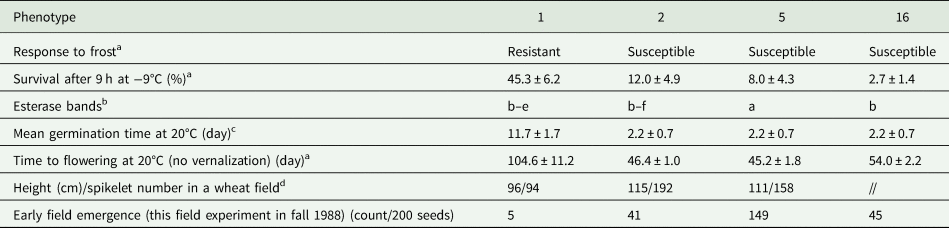
The seeds used in our experiment belong to the wild oat population described by Darmency and Aujas (Reference Darmency and Aujas1986). Based on the observation of vernalization requirements, seed colour and morphology, and on the polymorphism of seed storage protein and leaf isozymes, Darmency and Aujas (Reference Darmency and Aujas1987) identified several ‘phenotypes’ as combinations of these characters. Over the 6 years of monitoring in the original field, the most abundant phenotype was phenotype 1, a phenotype that needs vernalization and is frost-resistant; the other most frequent phenotypes were phenotypes 2, 5 and 16, which have no vernalization requirements, and are frost-susceptible. These four phenotypes represented 54–78.3% of the population according to the year (Darmency and Aujas, Reference Darmency and Aujas1987). These plants and their offspring are easily identified by the discriminant presence of four leaf esterase isozyme bands, i.e. the presence of a given banding pattern corresponds to the presence of all the other markers of a phenotype (Table 1). Besides, as these plants are assessed directly in the field, they displayed other characteristics such as differing germination dynamics, height, panicle length and seed production (Table 1), all being variably expressed according to the environment (Darmency and Aujas, Reference Darmency and Aujas1992). Since wild oats preferentially inbreed, isozyme and growth habit associations could be maintained over many generations, and therefore isozymes can be used as discriminating markers for the four phenotypes (Bervillé et al., Reference Bervillé, Breton, Cunliffe, Darmency, Good, Hall, McPherson, Métail, Pinatel, Vaughan, Warwick and Gressel2004 and references therein).
Characteristics of the four A. fatua phenotypes that made up the artificial populations (mean ± 95% CI)
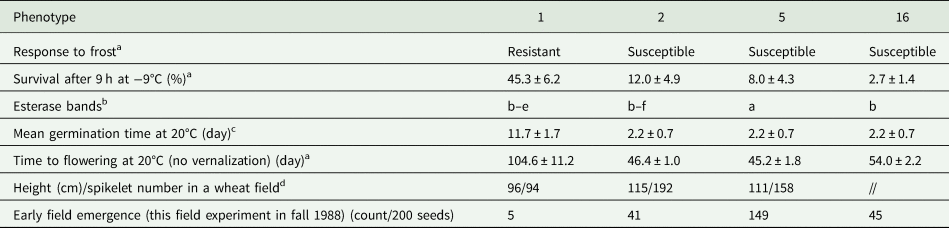
Frost resistance v. susceptibility was determined after 2 weeks germination at 4°C resulting in circa 50 days reduced flowering time.
a,b,c,dData from Aujas and Darmency (Reference Aujas and Darmency1983) and Darmency and Aujas (Reference Darmency and Aujas1987, Reference Darmency and Aujas1986, Reference Darmency and Aujas1992), respectively.
Ten seeds of individual panicles of the four chosen phenotypes were sown; the seedlings were vernalized and checked for the homozygosity of the isozyme markers within a panicle, and then grown separately for seed multiplication in the common garden in 1987, 1988 and 1989. Their germination was more than 92% in Petri dishes (20°C under a 12 h photoperiod after scarification: see Foley, Reference Foley1987). To confirm the germination and emergence differences previously observed among phenotypes (Darmency and Aujas, Reference Darmency and Aujas1986), two samples of 100 seeds (not dehulled, not scarified) of the 1988 seed lots were sown in the fall 1988 in the field. Emergence was recorded 5 weeks later.
Experimental design
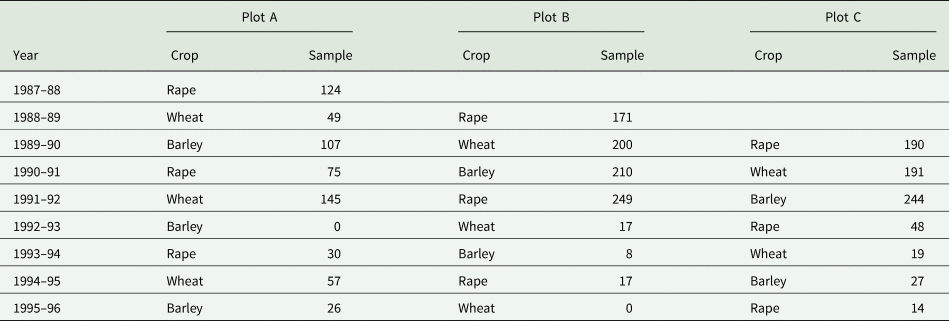
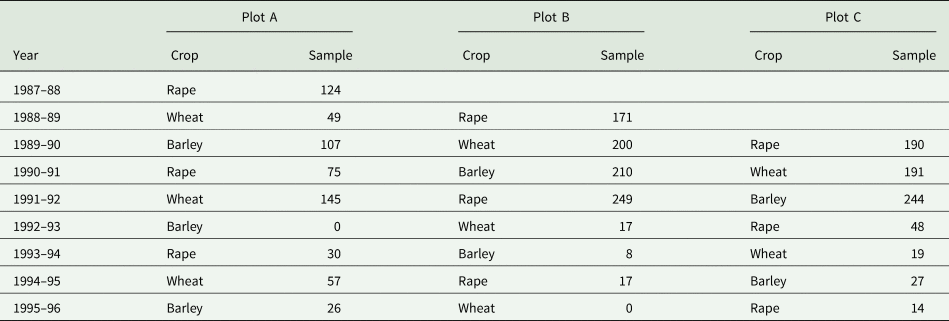
A field experiment was set up 500 m away from the field where the original A. fatua population was sampled (47°14′N, 5°06′E, 208 m a.s.l.), but there were no spontaneous wild oats occurring in that field. The field was divided into three parts. In the centre of the first part, a thousand seeds of the 1987 multiplication of each of the four phenotypes (i.e. a 1:1:1:1 mixture) were broadcasted on an 8 × 12 m plot (plot A) in September 1987, and then buried 5–8 cm deep using a rototiller. The field was immediately sown with oilseed rape. The same experimental design was used in the two other parts, in September 1988 (plot B) and September 1989 (plot C), with seed lots multiplied in1988 and 1989, respectively. In each plot, the crop rotation was winter oilseed rape, winter wheat and winter barley over 7–9 years (Table 2). The 1-year lag between replicates was aimed at avoiding confusing effects of weather and crop type.
Crop rotation in the three plots and number of sampled plants in the central, 100 m2 area of each plot
The plots were managed in a manner typical for the region, including stubble ploughing after harvest and deep ploughing (≈30 cm) before sowing. Initial P-K-Mg fertilizing after harvest was around 150-150-70 kg, and nitrogen supply during spring growth was around 200 kg depending on actual needs of the crop. Broadleaf herbicides were fluroxypyr (60 g/ha) and/or MCPA (1500 g/ha) when necessary during spring in wheat and barley, and metazachlor (2000 g/ha) before sowing in oilseed rape. There was no grass weed herbicide applied between 1987 and 1992, but in 1992, herbicide programmes containing trifluralin (1200 g/ha) and fluazifop-p (150 g/ha) in oilseed rape, and clopyralid + mecoprop (60 + 1800 g/ha) and/or diflufenican + diuron (190 + 1500 g/ha), flamprop (300 g/ha) and quizalofop-p-ethyl (120 g/ha) in cereals were applied to control A. fatua because the weed density became so great that it was irrelevant to normal arable field conditions.
Measurements
Every year, prior to final harvest in July, three spikelets were collected separately on up to 250 random and (as far as possible) independent oat panicles (Table 2). The number of panicles collected was roughly proportional to the plant abundance. The seeds were scarified and germinated in a greenhouse in pots containing vermiculite (8 h night at 11°C and 16 h days at 17°C). After 10–15 days, part of the first or second leaf was used to extract and analyse the esterase isozymes as described in Darmency and Aujas (Reference Darmency and Aujas1987). The observed isozyme pattern was attributed to the parent plant.
Minimum temperature was recorded daily at 10 cm above the soil surface at the weather station, 500 m away. The numbers of days with temperatures below −10°C were recorded as putatively causing the death of frost-susceptible plants. The number of days showing temperature between −5 and −10°C was also recorded as potentially causing damages but not death so that plants could be less productive.
Statistics
The numbers of plants of the four phenotypes on the first year of each plot were compared by a χ 2 test to the number of plants expected under the 1:1:1:1 proportion as initially sown. The percentage of presence of every phenotype every year was calculated with confidence values depending on the sample size under the binomial law. Yearly averaged percentages of the frost-resistant phenotype over the three plots were submitted to regression analysis using SYSTAT 13. A t test was used to compare the bulk of values before v. after grass weed herbicides use.
Results
Field emergence of the 1988 fall-sown seeds confirmed our expectation of the different germination capabilities of the different phenotypes: phenotype 1 had low emergence while phenotype 5 had high emergence, indicating a large difference in dormancy status (Table 1). In the plots, the abundance of plants was very variable across years and plots: the artificial population was better established in plots B and C than in plot A, and the population size dramatically decreased when grass weed herbicides were used, beginning in 1992–93 (Table 2). Generally, at least one of the six to seven seeds collected per plant germinated, but in two cases, the few panicles sampled had no ripe seeds, resulting in missing values in 1993 (plot A) and 1996 (plot C).
Out of a total of 2218 seedlings analysed, 12 were shown to be hybrid. However, two of the six possible hybrid types could not be detected on the basis of their isozyme banding patterns (hybrids between phenotypes 16 and 1 or 2 were identical to plants of phenotypes 1 or 2). Assuming that the outcrossing likelihood was the same for all phenotypes, one would expect about 18 hybrids, corresponding to 0.8% allogamy, and coherent with the known high autogamy of A. fatua. This low number of hybrids confirms that using isozyme markers was a reliable way of identifying the progeny of the initially sown phenotypes.
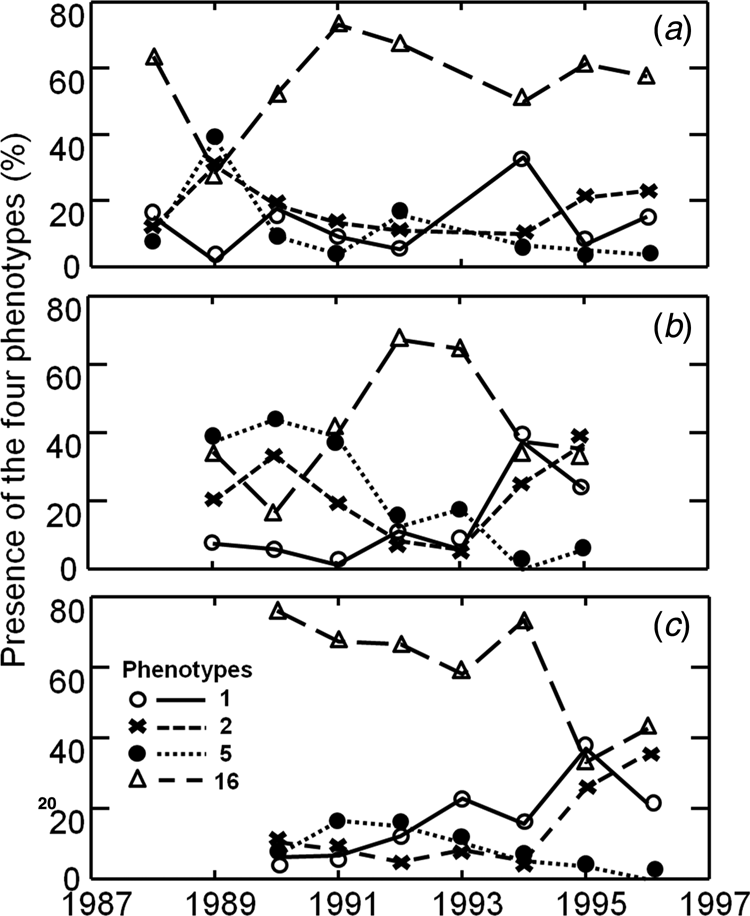
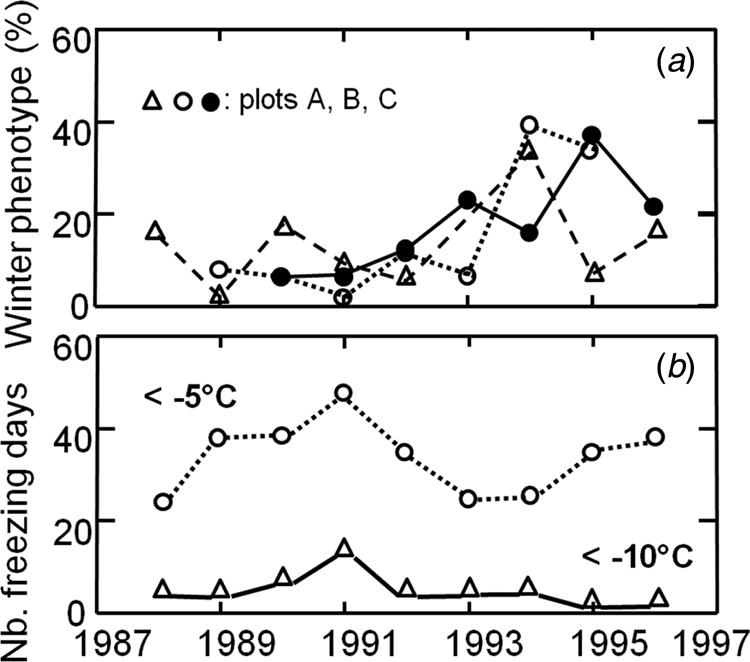
High variability in phenotype frequency was observed every year in each plot, except for phenotype 5 that continuously decreased throughout the experiment (Fig. 1). The first record for each plot (1988 for A, 1989 for B and 1990 for C) showed a large deviation from the 1:1:1:1 ratio of seeds sown (χ 2 values = 100, 39 and 267, respectively, P < 0.001). The first record was also different from what would be expected from fall emergence data in 1988 (Table 1, χ2 = 296, P < 0.001), thus indicating differential plant mortality of autumn-emerged seedlings of the different phenotypes and/or additional emerged plants in spring. There was no clear-cut increase of phenotype 1 through the years, whether the plots were considered separately or together. Instead, the percentage of plants from phenotype 1 was lower than the 25% expected from the sowing rate (Fig. 2a), but also that of phenotype 2 in plot C and phenotype 5 in all the plots, while that of phenotype 2 fluctuated around 25% in plots A and B, and phenotype 16 was dominant on average (Fig. 1). After the use of grass weed herbicides, the percentage of phenotype 1 increased, on average, in the three plots (P of t test = 0.002 when comparing 12 values before 1993 to 10 values after 1993); a similar trend, although not significant, was observed for phenotype 2. Regression fits using power family curves provided acceptable but poor trends (not shown, e.g. y = 6.8 + 0.23x 2, mean corrected R 2 = 0.312, Fig. 2a), with × being the number of years after 1987). No clear-cut crop effect was detected: phenotype 16 decreased after oilseed rape then increased after cereals in plots A and B on the earlier years, but this did not hold true in the following years and for plot C.
Evolution of the percentage of the four phenotypes of A. fatua after initial sowing in a proportion of 1:1:1:1 in the three plots A, B and C.

Evolution of the percentage of the frost-resistant phenotype of A. fatua after initial sowing in a proportion of 1 frost-resistant v. 3 non-frost-resistant phenotypes for the three plots (a), and the number of freezing days below −5 and −10°C between October and May (b).
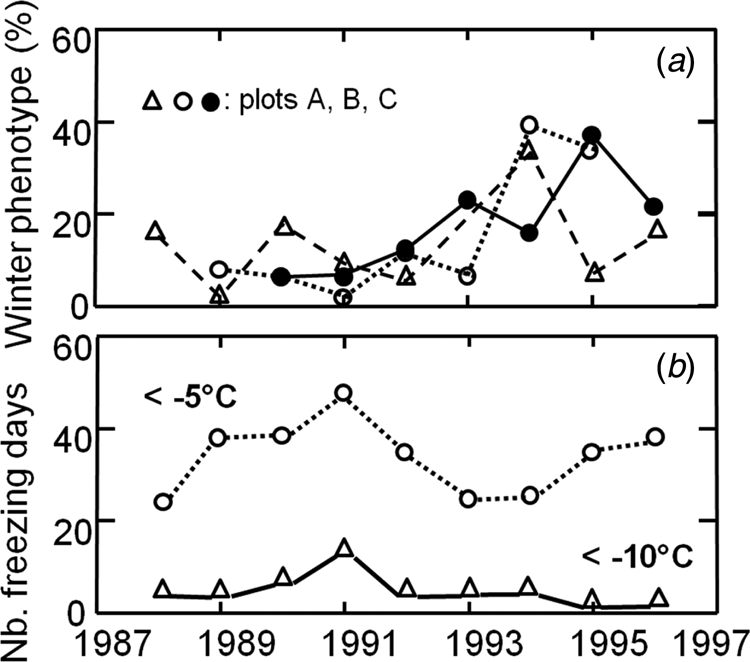
Climatic data showed only one winter (1990–1991) with more than 10 and 40 days with temperatures lower than −10 and −5°C, respectively (on average 5.3 ± 1.1 and 33.8 ± 2.4 days per season; Fig. 2b). Such freezing days did not occur in a single, continuous period, but rather in three to five periods, thus representing the number of opportunities to kill or to damage susceptible phenotypes. The apparent increase of phenotype 1 began 2 years after freezing temperatures peaked in 1990–91.
Discussion
Apart from a few hybrids produced among phenotypes, the four phenotypes evolved as separate genetic entities, therefore preserving their initial characteristics. Contrary to initial expectations, there was not an initial and straightforward increase in the proportion of frost-resistant phenotype in this experiment, and even its frequency remained below the sowing rate. It was certainly not due to a lack of vernalizing temperature that could have delayed flowering because appropriate low temperatures are always effective during the vegetative period in winter crops in the region (Darmency and Aujas, Reference Darmency and Aujas1986). Besides, low germination and emergence of fresh seeds from phenotype 1 certainly introduced a bias in the expected 1:1:1:1 phenotype ratio, decreasing phenotype 1 representation at the starting point. This could have been due to slow germination as previously described (Table 1, Darmency and Aujas, Reference Darmency and Aujas1986), resulting in abortive germination in the soil, or to high seed dormancy, which is frequent in A. fatua (Naylor and Jana, Reference Naylor and Jana1976; Adkins et al., Reference Adkins, Loewen and Symons1986) and would build up a soil reserve of seeds of this phenotype. In addition, except for the 1990–91 winter, the number of freezing days during our experiment was much lower than during the previously reported 1978–84 monitoring period (Darmency and Aujas, Reference Darmency and Aujas1986), probably imposing lower and inconsistent selection pressure, and thus providing no advantage to the frost-resistant phenotype with respect to the other phenotypes. Such a lack of selection should be more common again nowadays since there are fewer and fewer days below −10°C (e.g. on average 3.6 ± 1.1 and 18.1 ± 2.5 days with temperatures lower than −10 and −5°C, respectively, over the last 10 years at the same place).
However, the percentage of phenotype 1 increased in the three plots the last 3 years, as if after a lag time. This late increase could tentatively be explained by a conjunction of seed dormancy and frost selection, i.e. assuming the peak in low freezing temperatures in the 1990–91 winter had an actual selection effect for the frost-resistant phenotype, then it is possible that this phenotype produced more seeds than the others that year. As deep ploughing was carried out every year, most of the seeds produced that year were buried 20–30 cm under the soil surface and preserved from germination during the next year: survived seeds were brought back to the top layers for the second year, thus allowing germination and accounting for its frequency increase in 1993–95. Avena fatua is generally considered to have short seed longevity, with seed viability decreasing to 1% after 2 years of burial (Wilson, Reference Wilson1978; Barralis et al., Reference Barralis, Chadoeuf and Lonchamp1988). However, seed loss can take more time under different circumstances (Miller and Nalewaja, Reference Miller and Nalewaja1990) or for different genotypes (Adkins et al., Reference Adkins, Loewen and Symons1986). Differential seed loss dynamics were recognized early within an A. fatua population, although not explicitly related to different genotypes (Zorner et al., Reference Zorner, Zimdahl and Schweizer1984).
The three other phenotypes must also be considered to better interpret relative frequencies. Phenotype 16 appeared as the dominant phenotype with more than half of the sample size on average, but some decrease was observed after herbicide use. Variations in herbicide response among A. fatua populations are well documented (see references in Darmency and Uludag, Reference Darmency and Uludag2018). Phenotype 2 kept more or less at its initial proportion while phenotype 5 continuously decreased. The dramatic decrease in phenotype 5 may have been accelerated by the lack of seed dormancy that allowed rapid and abundant emergence, thus exposing most seedlings to herbicide sprays. In contrast, phenotype 1 could have been less sensitive to the herbicides than the other phenotypes used and gained relative importance due to the loss of phenotypes 5 and 16, thus showing an apparent increase during the herbicide period. Other traits may vary among plants in the field and might hide or buffer plant responses to various agronomic selection pressures. For instance, growth, reproduction and competitiveness with wheat were evaluated under various conditions for three of the phenotypes being studied here (namely 1, 2 and 5, Table 1), and the frost-resistant phenotype appeared as the least competitive and reproductive phenotype (Darmency and Aujas, Reference Darmency and Aujas1992), a feature that could oppose to a moderate frost-resistance advantage. However, intra-specific competition was probably not involved in the different fates of the four phenotypes because the A. fatua density ranged from around 0.1 to 2.5 pl/m2 (Table 2), which is very low compared to the crop coverage that imposes competition among plants. Finally, genetic drift cannot be excluded as the population sizes after herbicide use were too small.
Therefore, the experiment was unsatisfactory with respect to the initial question about the rapid selection of frost-resistant plants as it raised several hypotheses due to (1) the lack of a hard winter, (2) the abundancy of A. fatua that made it necessary to control it using herbicides as in a genuine farmer's field, resulting in a small sample size and introducing an additional selection pressure, and (3) secondary traits interacting with environmental conditions when using non-isogenic, genuine plants from the field. For the first issue, despite a weak trend of selection for the frost-resistant type, the experiment shows how apparently erratic the evolution of the genotypic composition of a weed population can be, given that plant polymorphism multiplies possible responses to selection pressures and farmers’ practices superimpose habitat unpredictability. In particular, traits related to temperature such as frost resistance can become neutral when facing climate-change and escape processes of genetic adaptation to new field conditions. Regarding the ability of weeds to adapt quickly to climate change and new farmers’ practices, traits related to other physiological characteristics merit further investigation. Traits more dependent on the farming system (e.g. seed longevity and germination v. crop rotation, seedling emergence v. ploughing depth, flowering earliness and tillering and seed production v. seed harvester efficiency, etc.) could offer more stability to the selection process and be better candidates for long-term experiments. For the second and third issues, there was a need to leave the system to run by itself, as in farmers’ fields. Especially, experimental manipulation was reduced to the minimum: producing seed stock every year in a similar environment, and then hand sowing to launch the system in every plot. Sowing seeds every year or preparing isogenic plant materials would have brought in too many artificial conditions to represent the farmers’ genuine field conditions. However, increasing the plot size could offer a larger space to include more phenotypes with the same characteristic being studied, in order to buffer the parasite effects of the non-studied genetic variability. It could also help to avoid an insufficient number of sampled plants, and random pulling up of plants in times of high infestation could help avoid having to use herbicides, thus lowering the risk of confusing responses to diverse selection pressures.
Conclusions
Although the selective value of frost resistance is apparently much lower than herbicide resistance and mainly dependent on climate conditions, this study showed that 6 years were sufficient to observe a weak increase of the frost-resistant phenotype, while lag times of about 10 years were observed between the former uses of given herbicides in the fields and the corresponding herbicide-resistant weeds (Heap, Reference Heap2020). Since harder winter conditions exerted higher selection pressure during the monitoring period of the initial study than during the present study, frost resistance was probably the driver of the increased frequency of the frost-resistant phenotype in that field population. Therefore, if climate change brings both higher mean temperatures and more extreme values, changes of apparent plant phenology could happen for weed species displaying the appropriate genetic variability, even for autogamous species such as A. fatua, within the time-frame of a farmer's career, thus necessitating correlative adaptation of farming practices.
Acknowledgements
None.
Financial support
This research received no specific grant from any funding agency, commercial or not-for-profit sectors.
Conflicts of interest
None.
Ethical standards
Not applicable.