Introduction
Older people (defined as people over 65 years) are the major users of health and social care systems across the Western world. The majority of hospital in-patients are older people, and many of these are at increased risk of readmission; in England, 14% of patients aged over 75 were readmitted within 30 days of discharge during 2008, Reference Zerdevas and Dobson1 at an estimated cost to the NHS of £2.6 billion each year. 2 Readmission is considered as an adverse outcome, although some readmissions will be clinically indicated and therefore represent good practice. In many systems, readmission rates above a certain threshold attract financial penalties. Reference Hansen, Young, Hinami, Leung and Williams3,Reference Billings, Blunt, Steventon, Georghiou, Lewis and Bardsley4 The recognition that older people are at particular risk of readmission has led to targeted research, and the development of initiatives to improve their outcomes. Whilst readmissions occur in all ages and all settings, the purpose of this article was to focus on readmissions in the general medical care of frail older people.
We undertook a critical analysis of recent reviews, also known as an umbrella review or review of reviews, to formulate an up-to-date summary of knowledge on readmission in older people, including risk factors for readmission and evidence-based interventions that can reduce readmission rates.
Methods
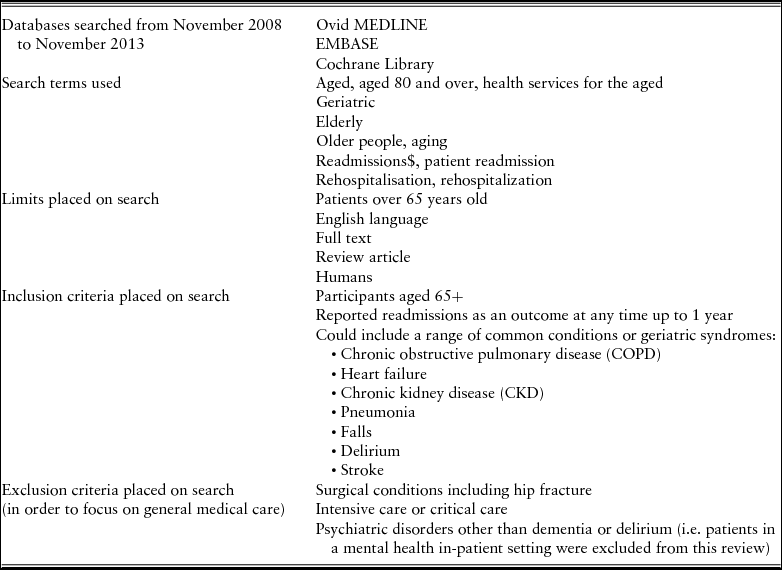
This paper aims to present evidence from high quality review papers, enabling further insight into best management for reducing readmissions in older people. MEDLINE, EMBASE and Cochrane online databases were searched. Target groups were older people (65+ years) with medical conditions, but not those on disease-specific pathways (Table 1) in order to maximize generalizability. In addition to formal database searches, papers were obtained from bibliographies of selected articles. These were only included if they conformed to the pre-specified selection criteria.
Details of search methods

Final papers for inclusion in the review were selected by consensus between two reviewers (S.C., E.C.). Full text articles were then graded by the reviewers using the Critical Appraisal Skills Programme (CASP) tool for systematic reviews. The CASP tool for systematic reviews consists of 10 questions, of which seven or eight (depending on whether or not there was a meta-analysis) can be scored 0/1/2, giving a maximum score per paper of 14–16 marks. We assigned a percentage rating to each paper to allow for differences in the scoring system, and papers scoring above 50% that met the selection criteria were included in the scoping exercise.
Reviews focusing predominantly upon psychiatric and surgical settings were excluded, to enable generalizable themes common to frail older patients to be studied. A time limit of papers from November 2008 to 2013 was placed in order to obtain recent evidence and to minimize duplications in original evidence cited. Papers that did not score 50% or more on the CASP tool were rejected.
Results
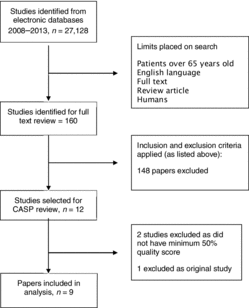
In total, 160 full texts were reviewed, from which 12 papers were selected for CASP review to assess quality. Figure 1 details the paper selection for the 12 papers from the initial search of EMBASE, Ovid and Cochrane.
Paper selection

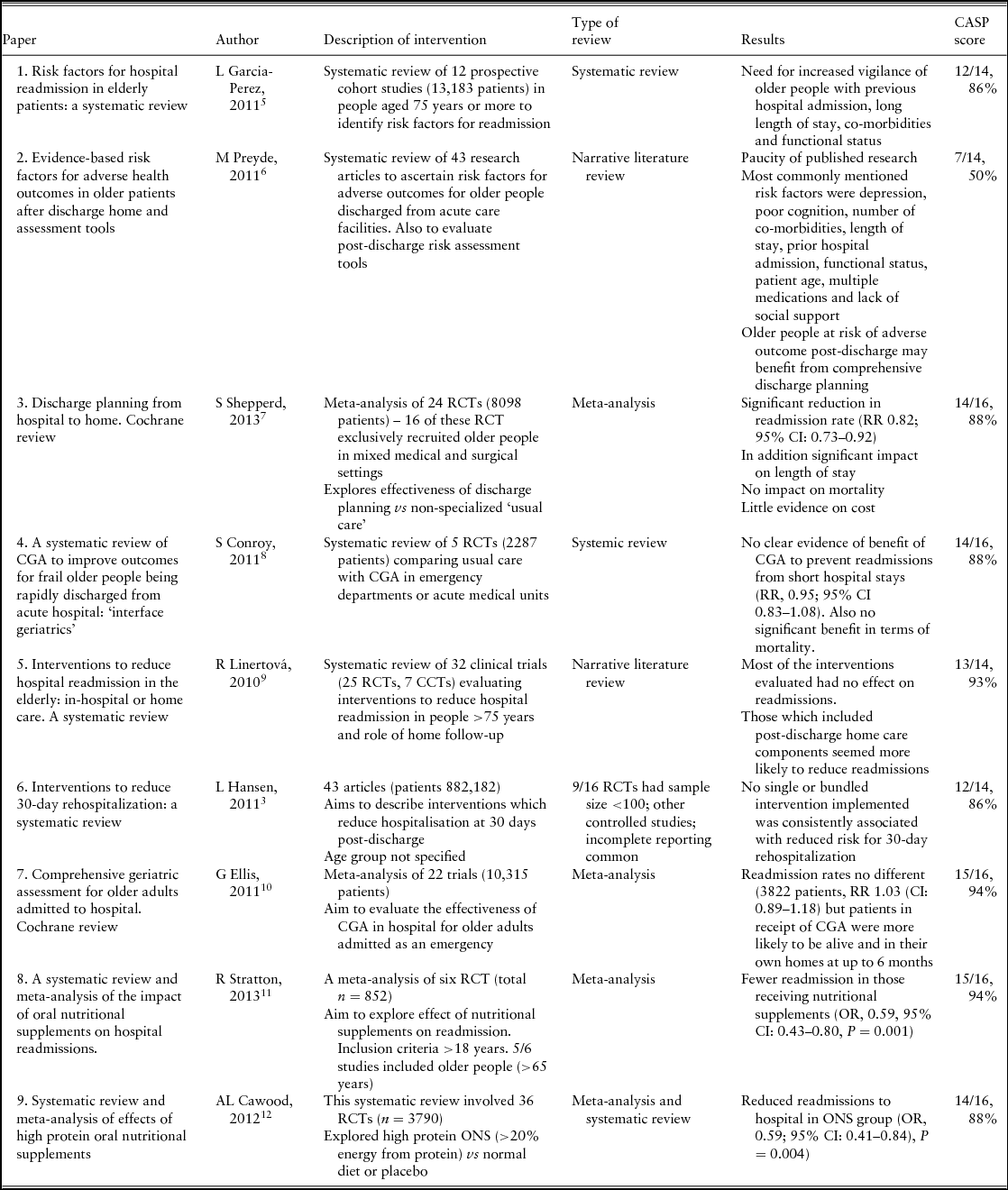
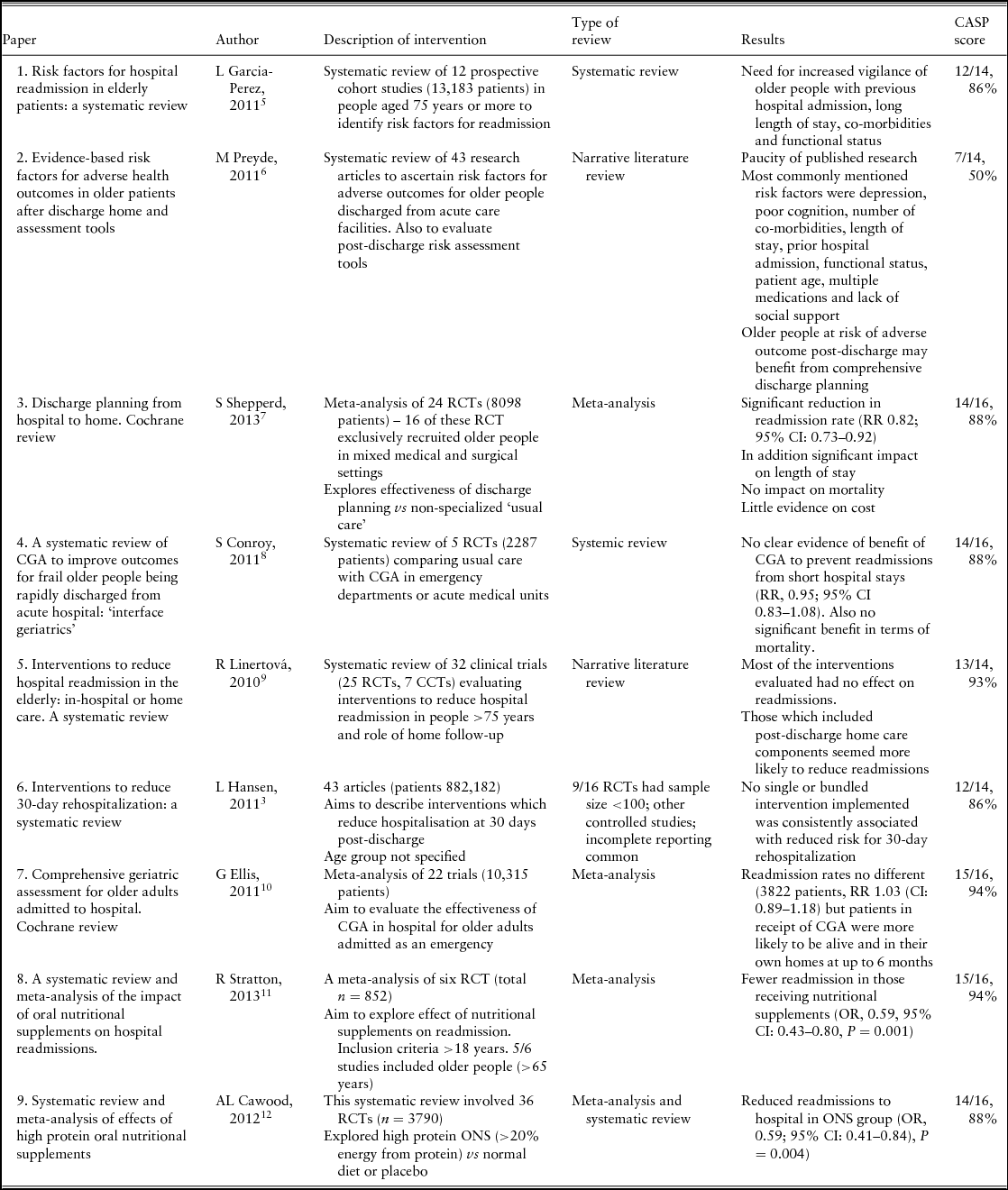
Overall, good quality review papers that fulfilled our inclusion criteria were sparse. Papers that scored less than 50% using the CASP criteria were excluded, leaving nine papers with three exclusions. The results of CASP review are summarized in Table 2. The nine papers selected were published between 2009 and 2013; the median CASP score was 13. Five reviews included formal meta-analysis, for which sample sizes ranged from just over 2000 participants through to nearly 900,000 participants. The reviews covered two main themes – risk factors for readmission and interventions to reduce readmission.
Summary of reviews on readmissions
Risk factors for readmission
Identifying risk factors for readmission is helpful for the development and implementation of targeted interventions to reduce hospital readmissions. Advanced age is a risk factor for readmission, both independently and through associations such as co-morbidities, falls, polypharmacy and poor nutrition. Reference Preyde and Brassard6 Functional status, defined as poor pre-morbid functional dependence for basic activities of daily living (ADL) is a major risk factor for readmission. Reference García-Pérez, Linertová, Lorenzo-Riera, Vázquez-Díaz, Duque-González and Sarría-Santamera5,Reference Preyde and Brassard6
Length of stay was a significant risk factor in three studies; longer stays were associated with increased risk of readmissions immediately post-discharge. Reference García-Pérez, Linertová, Lorenzo-Riera, Vázquez-Díaz, Duque-González and Sarría-Santamera5 However, the majority of trials (9 of 19) showed no significant relationship between length of stay and readmission. Reference Preyde and Brassard6 The number of previous admissions significantly increases risk of readmission, especially when categorized as emergency or unplanned. Reference García-Pérez, Linertová, Lorenzo-Riera, Vázquez-Díaz, Duque-González and Sarría-Santamera5
Depression is prevalent in older people and is a risk factor for readmission. Reference García-Pérez, Linertová, Lorenzo-Riera, Vázquez-Díaz, Duque-González and Sarría-Santamera5 Potential mechanisms linking depression and readmissions include associations with poor adherence to medication and reduced adherence to rehabilitation programmes. Depression is a modifiable determinant of readmission, yet it is often absent in many discharge assessment tools. Reference Preyde and Brassard6 Similarly, cognitive impairment, including delirium and dementia, was identified as a risk factor for readmission in four of five papers included within the review articles, with cognitive impairment thought to reduce adherence to medical regimes and increase carer distress. Reference García-Pérez, Linertová, Lorenzo-Riera, Vázquez-Díaz, Duque-González and Sarría-Santamera5,Reference Preyde and Brassard6
Malnutrition is a risk factor for readmission that is common in older people across all health and social care settings, including hospitals, care homes and sheltered housing. Malnutrition has a significant impact on increasing recovery time and increases the risk of readmission. Reference Preyde and Brassard6
Low socioeconomic status, including receipt of social assistance and poor living conditions were found to be associated with readmissions. Reference García-Pérez, Linertová, Lorenzo-Riera, Vázquez-Díaz, Duque-González and Sarría-Santamera5 Family caregivers are believed to help increase the recovery from acute illness, and may protect against readmission. Reference Preyde and Brassard6 Risk stratification tools such as the ISAR (Identification of Seniors At Risk) and TRST (Triage Risk Screening Tool) that attempt to synthesize risk factors for readmission into a scoring tool have recently been reviewed elsewhere and are not further discussed in this review. Reference Billings, Blunt, Steventon, Georghiou, Lewis and Bardsley4,Reference Braes, Moons, Lipkens, Sterckx, Sabbe and Flamaing13,Reference Kansagara, Englander and Salanitro14
In summary, the evidence-based risk factors for readmission include age (probably as a marker of complexity), poor functional status prior to admission, length of stay during the index admission, depression, cognitive impairment, malnutrition, social support and social networks/support.
Interventions to reduce readmission
Our search yielded seven high quality review papers that explored interventions to reduce readmissions in people aged over 65 years. The interventions were broad ranging and for ease of interpretation we have categorized interventions into five headings.
1. Discharge planning
Discharge planning is the ‘the process of identifying and preparing for the patient's anticipated health care needs on discharge from an inpatient facility’. Reference Shepperd, Lannin, Clemson, McCluskey, Cameron and Barras7 For older people this is often complex, involving detailed assessment from multiple disciplines. Discharge plans are broadly used to enable a smooth, safe transition from hospital to home. They can be stand-alone or embedded in systematic packages such as Comprehensive Geriatric Assessment. Reference Shepperd, Lannin, Clemson, McCluskey, Cameron and Barras7
The Cochrane review on ‘Discharge planning from hospital to home’ found that for older medical patients there is a significant reduction in readmission rates within three months (RR, 0.82; 95% CI: 0.73–0.92; 12 trials) when comparing discharge planning with usual care. Important additional benefits of discharge planning included increased patient satisfaction. Reference Shepperd, Lannin, Clemson, McCluskey, Cameron and Barras7 Early discharge planning can allow medical staff, the patient and family time to implement strategies to modify risk factors such as home hazard modifications. Reference Preyde and Brassard6
Discharge planning was explored in brief in the Hansen paper, which discusses discharge planning as a stand-alone intervention compared with usual care; a significant benefit was demonstrated on readmissions at 30 days (readmission rates intervention 24 vs 35% control group; P < 0.0001). Reference Hansen, Young, Hinami, Leung and Williams3
In summary, evidence suggests that structured and tailored discharge planning is associated with reduced readmission rates, by ensuring complex needs are addressed.
2. Post-discharge support
These interventions aim to improve support in the community and included telephone calls, home visits, out-patient follow-up and enhanced communication with a post-acute care provider. In many papers these interventions are combined or bundled, and often follow specialist geriatric input; however, in this section, we will consider these interventions in isolation.
Linertová reviewed health visitor interventions from four studies, with a range of timings involved. One study (Martin et al.) showed an effect on readmissions: 14% vs 38% (P < 0.01) where a health visitor attended at 24 hours; however, this study was small (n = 54) compared with the total study population (n = 3029). Dunn et al. examined home visits by health visitors on day 3 post-discharge, with focus on symptom monitoring, medication adherence and ambulatory care, and found a clinically important reduction, although this did not reach statistical significance (OR, 0.5; 95% CI: 0.3–1.1). Reference Hansen, Young, Hinami, Leung and Williams3
Pharmacist visits were explored by two papers; Nazareth et al. found no significant effect on readmissions, whereas Holland et al. found increased readmissions in their randomized controlled trial (RCT) of 850 patients who received standard care or home follow-up with a pharmacist (risk ratio for readmissions at 6 months, 1.3; range 1.1–1.6). District nurse review at 24 h followed by GP review at 2 weeks was explored by Hansen et al., but showed significant effect on readmissions. Telephone calls and home visits were explored in a review paper by Hansen, which explored readmissions at 30 days. Where explored in isolation in three papers, telephone follow-up was not effective, although Dudas and colleagues randomly assigned 221 patients after discharge to usual care or a telephone call at 48 h and showed reduced readmissions at 30 days: 15% vs 24%, respectively (P < 0.07). By way of contrast, Braun et al. randomly assigned 400 patients to usual care or a telephone call at week 1 post-discharge, resulting in readmissions at 30 days of 7.7% vs 7.2%.
In summary, many studies use a combination of interventions with few reported in isolation, hence it is difficult to disentangle the effect of one particular intervention. Telephone calls in isolation appear to be unsuccessful as stand-alone interventions, but appear to work well when combined with additional interventions such as home visits.
3. Bridging interventions
These interventions bridge the transition from hospital to home, preventing a sudden drop-off in care when patients are discharged. Such bridging interventions may include geriatric assessment with home follow-up, telephone calls or an intermediate care home programme. Patient Centred Discharge Instructions (PCDI) often contain a mix of the above interventions; however, they have the same care providers or ‘transition coaches’ who are felt to enable longitudinal relationships spanning hospital and community. There is also a focus on the patient being empowered to develop greater autonomy for their ongoing health needs.
Bridging interventions explored in the Linertová review included a total of 11 papers with a variety of different interventions. Five of the 11 showed a statistically significant improvement in readmissions and another paper had a partial effect, detailed below. The first paper by Al Rashed tested pharmaceutical counselling, medication discharge summaries and home visits with a pharmacist, and found reduced readmission in the intervention group (n = 83, readmissions 3 vs 15 patients; P < 0.05). Another paper by Caplan involved comprehensive geriatric assessment (CGA), multidisciplinary care and follow up at 1 month (n = 739, readmissions 16% vs 22%, P <0.05). Coleman included a transition coach with in-hospital and home visits, and telephone follow-up (n = 750, 30-day readmissions 8% vs 12%, P < 0.05). The paper by Thomas explored in-patient linking through to community-based geriatric assessment (n = 132, readmissions 30% vs 60%, P < 0.05). The final intervention by Naylor was comprehensive discharge planning and home follow-up (n = 263, readmissions at 6 months 49 vs 107 patients, P < 0.001). Koehler reviewed in-hospital visits by care co-ordinators and pharmacists with post-discharge telephone call; there was a significant reduction in readmissions at 1 month (10% vs 38%, P < 0.05), but this was not sustained at 2 months. Hansen reviewed 12 trials with PCDI. Seven of 12 had showed reductions in readmissions, although no papers reviewing PCDI in isolation found an effect on readmission.
The evidence suggests that written materials or telephone follow-ups are only effective where there is the support of a care worker. For example, Coleman (2004) found that a transition coach who supported patients in going home and identified ongoing needs reduced readmissions (n = 1393; adjusted odds ratio, 0.5; 95% CI: 0.3–1.0). In Jack et al., a nurse discharge advocate worked with patients during their hospital stay to arrange follow-up appointments, confirm medication reconciliation, and conduct patient education with an individualized instruction booklet that was sent to their primary care provider; readmission fell (n = 738; incidence rate ratio, 0.7; 95% CI: 0.5–0.9). Van Walreven conducted a cohort study tht explored the impact of follow-up by the same hospital doctor when in the community. In this paper, results are grouped as death or readmission in 30 days. Of patients studied, 7.7% died or were readmitted, the adjusted relative risk of death or readmission decreased by 5% (95% CI: 4–5%).
In summary, when compared with post-discharge interventions in isolation, bridging interventions, which include many components or bundled interventions, appear to have more success in reducing readmissions. It appears that there is an additive effect of multiple interventions or that organizational or cultural change is developed, adding quality to the delivery of care.
4. Comprehensive geriatric assessment
CGA is defined as a ‘multidimensional diagnostic process focused on determining a frail older person's medical, psychological and functional capability in order to develop a co-ordinated and integrated plan for treatment and follow-up’. Mindful of risk factors for readmission, GCA provides a structured tool for identifying and addressing modifiable risks allowing intervention to avoid adversity following discharge. Reference Linertová, García-Pérez, Vázquez-Díaz, Lorenzo-Riera and Sarría-Santamera9
A systematic review by Linertova et al. of 17 in-hospital trials compared usual care to geriatric assessment and comprehensive discharge planning. In three of the 17 studies, the intervention produced significant differences to the control group (19.4% vs 35.7%, P < 0.05; 10% vs 38.1%, P < 0.05; 30% vs 60%, P < 0.05). In one study a negative effect was observed (56% vs 50.4%, P < 0.05). Reference Linertová, García-Pérez, Vázquez-Díaz, Lorenzo-Riera and Sarría-Santamera9 Amongst the studies reporting positive effects on readmissions, comprehensive geriatric assessment followed by home care or by a hospital-based multidisciplinary outreach team demonstrated a lower rate of readmissions during the first 30 days, and an increased period at home prior to the first emergency readmission. However, these trials had relatively small numbers of patients (total n = 323), compared with other trials demonstrating no significant effect (n = 7595). Reference Linertová, García-Pérez, Vázquez-Díaz, Lorenzo-Riera and Sarría-Santamera9
For short-stay patients, a model known as interface geriatrics is an emerging concept that seeks to identify frail older people within the first 72 h of their hospital stay. This reflects a growing culture of ‘quicker and slicker’ discharges where appropriate patients are quickly sent home or transferred to community settings for ongoing care. Such discharges are usually from emergency departments (ED) or acute medical units (AMUs). Reference Conroy, Ansari, Williams, Laithwaite, Teasdale and Dawson15 A systematic review compared CGA with usual care in patients discharged from either emergency department (ED) or acute medical units (AMU) within 72 h from arrival at hospital. From the five trials (2474 patients), there was no significant difference in readmission rates between intervention and control groups at final follow-up (risk ratio, 0.95; 95% CI: 0.83–1.08). Reference Ellis, Whitehead, O’Neill, Robinson and Langhorne10 Thirty-day readmission was reported in three trials, with no overall difference in readmissions between the two groups (risk ratio, 1.0; 95% CI: 0.8–1.3). Reference Conroy, Stevens, Parker and Gladman8 In a similar meta-analysis by Ellis there was no significant difference between groups for readmission to hospital (odds ratio, 1.03; 95% CI: 0.89–1.18; P = 0.72; 9 trials, 3822 participants). Reference Ellis, Whitehead, O’Neill, Robinson and Langhorne10
In summary, the evidence for CGA improving readmission rates is limited and uncertain, with most recent studies suggesting that CGA is of little benefit for reducing readmissions in both acute and ward-based discharge.
5. Nutritional interventions
Oral nutritional supplements (ONS) are frequently prescribed for older people who are at risk of malnutrition secondary to inadequate dietary intake, or who are frankly malnourished. Optimizsing nutrition promotes a number of biological processes that aid healing and recovery from illness. Reference Cawood, Elia and Stratton12
Stratton and colleagues conducted a review and meta-analysis of ONS in patients of any nutritional status. ONS included more than one macronutrient (fat, carbohydrate or protein). In five RCTs reporting readmissions (n = 826 patients), significant reductions in readmission in the ONS group were observed (OR, 0.5; 95% CI: 0.4–0.8). Reference Stratton, Hébuterne and Elia11 A systematic review by Cawood et al. compared high protein ONS (protein >20% total energy) to usual dietary intake in all patients with any nutritional status and reported significant reductions in readmissions (OR, 0.6; 95% CI: 0.4–0.8). Reference Cawood, Elia and Stratton12
In conclusion, the targeted use of oral nutrition supplementation can reduce readmission rates.
Discussion
We identified nine reviews describing a range of interventions applicable to the general cohort of older patients. In terms of risk factors, poor functional status prior to admission, length of stay during the index admission, depression, cognitive impairment, malnutrition, social support and social networks/support were all important. These can loosely be described as frailty-related risk factors. Reference Rockwood, Andrew and Mitnitski16,Reference Rockwood and Mitnitski17 The bulk of the interventions to reduce readmissions identified tended to be multifactorial, and included: individually tailored discharge planning; post-discharge support – telephone calls with face-to-face contacts from a relevant health professionals; bridging interventions involving some form of post-discharge case management or ‘coaching’; and nutritional supplementation. Interestingly, the evidence for CGA being able to reduce readmissions was conflicting; this is somewhat surprising given that CGA is defined as: ‘a multidimensional, interdisciplinary diagnostic process to determine the medical, psychological, and functional capabilities of a frail older person in order to develop a co-ordinated and integrated plan for treatment and long-term follow-up’. Reference Rubenstein and Rubenstein18 This rather encapsulates the previously cited interventions in one care bundle, and so it would be expected to be effective. However, most of the CGA trials examined its role during the in-patient episode of care, with only one review addressing care across the interface; Reference Conroy, Stevens, Parker and Gladman8 this review examined short-term readmissions, but the studies were somewhat dated (latest publication 2004) and perhaps do not reflect more up-to-date approaches of integrating care across the interface. More recent interventions addressing care across the interface following urgent care episodes describe much more integrated acute-community pathways, which are different from those trials described up until 2004. Reference Conroy, Ansari, Williams, Laithwaite, Teasdale and Dawson15,Reference Wright, Tan, Iliffe and Lee19,Reference Foo, Siu, Tan, Ding and Seow20 Whilst these more recent interventions show promise, they have yet to be subjected to rigorous systematic review.
The methods used in this review mean that we did not include reviews or individual studies that might be illuminating, or that did not meet a minimum threshold of quality. In addition, the inclusion and exclusion criteria will have meant that some disease-specific interventions or papers with no age specification, which could be useful, may be overlooked in this review. Nevertheless we believe that the findings are scientifically robust and applicable to the care of frail older people in general medical settings.
Many of the papers reviewed highlighted the difficulties of reducing readmissions, with particular emphasis on heterogeneity of current interventions. The interventions available are diverse, and have been inconsistently examined in isolation and/or as a group or bundle of interventions. However, some key messages do appear to emerge: unifactorial interventions or interventions administered in isolation of the totality of the patient's care do not appear to be effective. This is also reflected in related studies, for example the UK evaluation of ‘community matrons’ (case-managers tasked with reducing admission (and thereby readmissions)), which failed to find an effect. Reference Gravelle, Dusheiko, Sheaff, Sargent, Boaden and Pickard21 More recent evaluations of ‘virtual awards’ that in part addressed readmissions and attempted to reduce them, have been similarly disappointing. Reference Lewis, Georghiou, Steventon, Vaithianathan, Chitnis and Billings22
Although much is known about the reasons for readmissions in older people, as highlighted by the risk factors summarized in this paper, less is known about the requirements for an effective intervention. Whilst bundles and bridging interventions appear promising, the optimum combination of interventions and time that they need to be implemented, as well as the optimum duration in order to be clinically effective, remain unanswered. Undoubtedly any effective intervention will need to be implemented using robust infrastructure – communication, co-ordination and continuity of information. In addition, there is a paucity of work on cost-effectiveness, and future works need to address this issue.
Conflicts of interest
None declared.