Introduction
In the United States, the 1996 Personal Responsibility and Work Opportunity Reconciliation Act (PRWORA) replaced Aid to Families with Dependent Children (AFDC) programmes with Temporary Assistance for Needy Families (TANF) programmes. In the wake of this change, US policy-makers have become involved in polarising debate about the wisdom of substance abuse screening for welfare recipients with addiction problems. On the one hand, conservative policy-makers have promoted drug screening of welfare applicants and recipients, with sanctions for those found to use drugs: the undeserving; such policy-makers want to end all government support of addictive habits (To Review Outcomes, 2006; Schmidt et al., Reference Schmidt, Wiley, Dohan, Zabkiewicz, Jacobs, Henderson and Zivot2006). In contrast, the liberal view advocates more effective drug screening, to ensure that recipients identified as addicted are sufficiently treated first, and only then get help developing their employability (Hearing on Welfare Reform, 2002; To Review Outcomes, 2006; Schmidt et al., Reference Schmidt, Wiley, Dohan, Zabkiewicz, Jacobs, Henderson and Zivot2006).
Since the launch of TANF programmes, drug screening those who apply for or enroll in TANF has become popular, and certain behavioural rules for eligibility have been established (De Jong et al., Reference De Jong, Graefe, Irving and St Pierre2006). In 1996, for instance, just two states required TANF applicants or recipients to undergo alcohol or drug screening; by 2004, 23 states and the District of Columbia did (Urban Institute, 1996, 2004). But interestingly, state officials' growing vigilance against welfare recipients' substance use is based on very limited data (Schmidt and McCarty, Reference Schmidt and McCarty2000). Despite officials' implied fear, illicit drug use has not been a predictor of welfare participation during the AFDC era or TANF era (Cheng and McElderry, Reference Cheng and McElderry2007).
To understand whether substance screening for recipients will be effective, theoretical and empirical evidence is needed supporting a relationship between welfare receipt and alcohol and drug use. Furthermore, substance screening can be considered effective only if screenings conducted to date are empirically shown to have reduced substance users' reliance on welfare. Using carefully selected and controlled human capital variables within its model, the present study explored the impact on mothers' welfare participation of (a) alcohol use, (b) implemented TANF policies requiring alcohol or drug screening and (c) social support networks.
Literature review
Concern about links between alcohol use and welfare participation originates in the notion that the potentially dysfunctional behaviour can hinder employment (a vital measure of human capital), resulting in the user's reliance on public assistance (Schmidt and McCarty, Reference Schmidt and McCarty2000). Although research has shown that current drug use has no significant impact on an individual's earnings, chronic drug use does have a negative, and prolonged, association with earnings (Bryant et al., Reference Bryant, Samaranayake and Wilhite2000).
Chronic alcohol use is relatively prevalent within the welfare recipient population. Studies put the rate of alcohol abuse or dependence among AFDC recipients at between 7.6 per cent and 9 per cent; of that group, 13.2 per cent to 27 per cent were heavy drinkers (Grant and Dawson, Reference Grant and Dawson1996; Jayakody et al., Reference Jayakody, Danziger and Pollack2000; Zabkiewicz and Schmidt, Reference Zabkiewicz and Schmidt2007). A study of both AFDC and TANF recipients (Pollack et al., Reference Pollack, Danziger, Seefeldt and Jayakody2002) found an alcohol-dependence rate of 7.5 per cent. Within the general population, the rate of heavy drinking is lower, at 6.9 per cent (Substance Abuse and Mental Health Services Administration, 2007). Policy-makers' alarm at such figures might be legitimate if it could be confirmed that heavy alcohol use promotes welfare participation.
It has not been the case, however. Findings from research that sought to relate alcohol abuse to welfare participation have been mixed; furthermore, only a limited amount of research on the topic has targeted TANF recipients. While substance dependence (including alcohol dependence) has been found to increase an individual's chance of receiving AFDC (Schmidt et al., Reference Schmidt, Dohan, Wiley and Zabkiewicz2002), studies do not show the duration of AFDC participation to have been affected by dependence (Schmidt et al., Reference Schmidt, Weisner and Wiley1998). Studies of AFDC recipients have also shown that neither alcohol dependence, nor problem drinking, nor drinking behaviour has any consistent impact on welfare participation or on the welfare-to-work transition (Jayakody et al., Reference Jayakody, Danziger and Pollack2000; Kaestner, Reference Kaestner1998; Zabkiewicz and Schmidt, Reference Zabkiewicz and Schmidt2007). A recent study of TANF recipients (Schmidt et al., Reference Schmidt, Zabkiewicz, Jacobs and Wiley2007) indicated that substance abuse (including problem drinking) did not affect whether recipients departed and returned to TANF.
Since 1996, a growing number of states have been implementing alcohol- and drug-screening requirements for TANF recipients (Urban Institute, 1996). But studies since then have shown poor enforcement of screening policy. In one California county, research associated substance abuse with TANF application (Schmidt et al., Reference Schmidt, Wiley, Dohan, Zabkiewicz, Jacobs, Henderson and Zivot2006), but it was also shown that the county's frontline welfare workers did not properly identify drinking behaviour (Henderson et al., Reference Henderson, Dohan and Schmidt2006). Similarly, a New Jersey county using paper-and-pencil screening measures properly identified only 15 per cent of substance-abusing welfare recipients (Morgenstern et al., Reference Morgenstern, Riordan, Dephilippis, Irwin, Blanchard, McCrady and McVeigh2001).
Welfare recipients' alcohol abuse usually co-occurs with other problems, such as low employability and depression (Cheng, Reference Cheng2007b; Jayakody et al., Reference Jayakody, Danziger and Pollack2000). Furthermore, substance abuse among welfare recipients may relate to their social support networks. A network of social support – often including family members, children's fathers and mothers' boyfriends – is a crucial element in many welfare recipients' lives (Edin and Lein, Reference Edin and Lein1997a, Reference Edin and Lein1997b). Not surprisingly, recipients demonstrating substance dependence have been shown to be relatively likely to exit AFDC for familial reasons (Schmidt et al., Reference Schmidt, Dohan, Wiley and Zabkiewicz2002). This phenomenon implies that social support network factors should inform our understanding of how alcohol use and welfare participation may be related.
Social support is the actual, as well as the perceived, support an individual obtains from social networks. It can take the form of money, housing, childcare, transportation, material goods, information and emotional caring (Harknett, Reference Harknett2006). A network of social support can buffer life stresses. Constituting such networks are the links between, for example, spouses, partners, family members, more distant relatives, friends, co-workers and neighbours (Thoits, Reference Thoits, Sarason and Sarason1985). Prior studies (Harknett, Reference Harknett2006; Sansone, Reference Sansone1998) demonstrate that receiving support from a social network reduces dependence on welfare. With such support, a welfare recipient may become employed, receive fewer benefits or leave welfare. One recent study found that perceived social support alleviated current and former TANF recipients' experience of material or economic hardship (Henly et al., Reference Henly, Danziger and Offer2005). On the other hand, their social networks can actually burden low-income families and welfare recipients. When welfare recipients' relatives and friends need help just as they do, their interactions may become stressors for the recipients. Moreover, social support does not alter the relationship between stressors and problem drinking (Mulia et al., Reference Mulia, Schmidt, Bond, Jacobs and Korcha2008). Social support networks, that is, do not necessarily cancel alcohol addiction's impact on welfare receipt.
In order to derive advantages from social support, welfare recipients must maintain adequate social support networks. Changes in marital, family and household status have significant impacts on welfare participation (Cheng and McElderry, Reference Cheng and McElderry2007; Mulia and Schmidt, Reference Mulia and Schmidt2003), although one study found that the number of persons in new mothers' social networks did not significantly affect the mothers' AFDC receipt (Nichols et al., Reference Nichols, Elman and Feltey2006). Of all relationships, spousal relationships are probably most important for predicting welfare participation. Single mothers are twice as likely as cohabiting mothers to be poor (Snyder et al., Reference Snyder, McLaughlin and Findeis2006), and they are also more likely than married mothers to be on welfare (Cheng, Reference Cheng1995, Reference Cheng2003, Reference Cheng2007a; Cheng and McElderry, Reference Cheng and McElderry2007). Furthermore, although single mothers receiving welfare typically prefer to accept cash or in-kind assistance (such as childcare) from a live-in partner or their child's father, rather than from relatives or friends, support from these men may not be available consistently (Edin and Lein, Reference Edin and Lein1997a). In addition, low-income mothers not receiving welfare are likelier to receive cash and in-kind assistance from live-in partners than from relatives or friends (Henly, Reference Henly and Munger2002; Radey and Brewster, Reference Radey and Brewster2007). Such findings suggest that the relationship with a spouse or live-in partner is crucial in determining welfare participation.
Mothers receiving welfare who want to attain and maintain employment and financial self-sufficiency often find that adequate childcare is an important resource. The majority of women in AFDC seem to provide their children's care themselves (Marcenko and Fagan, Reference Marcenko and Fagan1996); about one-third, however, have been found to rely on their own mothers to provide childcare (Edin and Lein, Reference Edin and Lein1997a; Henly, Reference Henly and Munger2002). This group also receives greater amounts of cash assistance from relatives and friends than from spouses or live-in partners (Henly, Reference Henly and Munger2002). Like many single mothers who work yet are poor and so turn to relatives for childcare (Radey and Brewster, Reference Radey and Brewster2007), over 70 per cent of TANF mothers have small (one- or two-person) social networks they can turn to for childcare, with 50 per cent relying on their own mothers to provide it (James et al., Reference James, Johnson and Raghavan2004). Another resource commonly provided through a social network is transportation, via a relative's or friend's car; most TANF mothers own no vehicle (Henly, Reference Henly and Munger2002). The common conclusion of these studies is that strong, close relationships with relatives and friends apparently do affect the mothers' likelihood of welfare participation.
This review of literature indicates that any relationship between heavy alcohol use and welfare participation will be qualified by social support network factors characterising TANF mothers (Schmidt et al., Reference Schmidt, Dohan, Wiley and Zabkiewicz2002). To better understand how heavy alcohol use may be linked to welfare participation, and how substance screening of applicants might serve TANF programmes' aims, the present study modelled temporal-ordered causal relationships among welfare participation, heavy alcohol use, substance screening, social support networks and social capital (see Figure 1). The model proposes a lagged effect of heavy alcohol use on welfare participation. Only a few studies (Cheng and McElderry, Reference Cheng and McElderry2007; Kaestner, Reference Kaestner1998) have examined substance use's lagged effect on welfare use, and those studies' results are mixed. While it is possible the relationship between alcohol use and welfare participation could be reciprocal, in this study the lagged effect was the focus.
Conceptual model of relationship among welfare participation, alcohol use, alcohol/drug screening, social support, and social capital.

The present study hypothesised (1) that heavy alcohol use, TANF programmes' alcohol- and drug-screening requirements and social support networks affect mothers' welfare participation, when human capital factors are controlled; and (2) that alcohol- and drug-screening requirements, as well as the social support network, moderate the relationship between heavy alcohol use and welfare participation. One implication of these hypotheses is that heavy alcohol users might be turned away from TANF programmes if screening were to be implemented.
The present study sought the mechanism that connects heavy alcohol use to welfare participation. It also addressed a methodological concern inherent in prior studies. Because welfare programmes were overhauled in 1996, research should differentiate participants in earlier AFDC programmes from those in later TANF programmes. In our survey of literature, however, only two reviewed studies specified a focus on TANF recipients. One was a longitudinal study (Schmidt et al., Reference Schmidt, Zabkiewicz, Jacobs and Wiley2007), but it included recipients from a single one of the 50 states; the other (Pollack et al., Reference Pollack, Danziger, Seefeldt and Jayakody2002) pooled cross-sectional, national data sets covering periods within the AFDC era and the TANF era. In general, studies examining state alcohol- or drug-screening policies have employed local or regional samples limited to one state (Henderson et al., Reference Henderson, Dohan and Schmidt2006; Morgenstern et al., Reference Morgenstern, Riordan, Dephilippis, Irwin, Blanchard, McCrady and McVeigh2001; Schmidt et al., Reference Schmidt, Wiley, Dohan, Zabkiewicz, Jacobs, Henderson and Zivot2006). The present study, in contrast, used a national, longitudinal data set describing welfare participation in 1996 and 2004. It investigated the possible impact of heavy alcohol use and of alcohol- and drug-screening policies on mothers' welfare participation during those years. The study is a significant first step toward addressing an important issue in social policy; it is, moreover, the first national study to investigate this issue.
Method
Sample
This study is a secondary data analysis of respondents from the National Longitudinal Survey of Youth (NLSY). The NLSY collected information beginning in 1979 from a nationally representative sample of 12,686 persons aged 14–22. The respondents were interviewed yearly through 1994, then biennially through 2004. At each interview, they provided information about the year preceding the interview. NLSY collected data on alcohol use in 1982, 1983, 1984, 1985, 1988, 1989, 1992, 1994 and 2002 only (Miller, Reference Miller and Miller2004). The present study's investigation of the impact of heavy alcohol use and alcohol- and drug-screening policies on mothers' TANF participation encompassed only longitudinal records dating from 1996 to 2004. The final sample included such records for 3,517 mothers without respect to their incomes or history of welfare participation; excluded from the present study were women who reported, for 1994 through 2004, that they had no children. In addition, from NLSY's Geocode data files, we obtained information about the states in which the mothers in the sample resided over time.
Measures
To understand causal relationships between the mothers' alcohol abuse and welfare participation, the present study employed temporal ordering between the outcome variable (welfare participation) and the explanatory variables (for example, alcohol abuse). The study examined the impact of drinking behaviour in 1994 on welfare participation in 1996, as well as the impact of drinking behaviour in 2002 on welfare participation in 2004. Most of the explanatory variables were measured for the current wave of interviews (1994 or 2002), while the outcome variable was measured for the subsequent wave of interviews (1996 or 2004). Thus most explanatory variables will show a lagged effect on the outcome variable (Finkel, Reference Finkel1995). A few of the explanatory variables (alcohol- and drug-screening policy, family income, employment status, education and number of dependent children), however, were assumed to exert fairly instantaneous impact on welfare participation; any lagged impact these few variables produce should lag only by a brief period (Finkel, Reference Finkel1995). Like the outcome variable, explanatory variables with instantaneous impact were measured for the subsequent wave.
The outcome variable, welfare participation (measured with a yes/no response), denotes whether a mother received TANF benefits in the subsequent wave. The explanatory variable welfare participation in the current wave (also yes/no) was expected to affect welfare participation in the subsequent wave.
Three variables represent alcohol abuse by a mother. Heavy alcohol use, a dichotomous variable, indicated a mother who consumed five or more alcoholic beverages on an average day. Five alcoholic beverages daily is a threshold for heavy alcohol use commonly employed in studies (Schmidt et al., Reference Schmidt, Dohan, Wiley and Zabkiewicz2002). Number of prior interviews reported heavy alcohol use is a continuous variable giving the number (seven maximum) of interviews, since 1982, at which a mother reported using alcohol heavily prior to the current interview year. To represent individual alcohol-related behaviour problems, history of losing social ties was used to measure weak relationships with a spouse or partner, relatives, friends and co-workers in 1994. It was measured with three items: ‘a spouse or someone you lived with threatened to leave or actually left you because of your drinking’; ‘lost ties with or drifted apart from a family member or friend because of your drinking’; and ‘kept drinking even though it caused you problems at home, work, or school’. A five-point response scale accompanied each item, ranging from 1 (never happened) to 5 (happened three or more times in past year). The higher the total points for the three items, the weaker the respondent's social ties. The Cronbach's alpha for the three items was 0.70. During the period 1994–2004, the three items were covered in NLSY interviews only once, in 1994. History of losing social ties as measured in 1994 is thus a time-invariant variable.
State's alcohol- and drug-screening policy denotes whether the state in which a mother resided implemented screening of TANF applicants or recipients in 1996 and 2004. The variable is time-varying, because different states launched screening policies in 1996 and 2004. NLSY itself did not collect information about states’ screening policies. The present study used reports from the Urban Institute (1996, 2004) to identify states implementing screening policies in 1996 and 2004.
Several social support network variables were involved in the present study. The variable spousal relationship described an interviewed mother's relationship with a spouse or partner. It was measured via the total score for 12 items meant to describe the relationship, including ‘How often do you and your spouse or partner argue about children?’ and ‘How often do you and your spouse or partner argue about money?’ The response for each item ranged from 4 (never) to 1 (often). The higher the total score, the stronger the spousal relationship. The Cronbach's alpha for the 12 items was 0.78.
Informal help with childcare and formal help with childcare provided indicators of mother's social support networks affecting childcare. Informal help was that from the other birth parent or a stepparent, from a partner, or from a sibling, grandparent, other relative, or friend; formal help was that from a daycare centre, nursery school, preschool, or other paid entity. The reference group for the study comprised mothers who themselves provided the childcare.
Each interviewed mother's human capital was designated by three variables. Family income level, a continuous variable, represented the ratio of a mother's family income to the federally established poverty level (assigned to families according to number of family members). The variable being employed provided a mother's current (at time of interview) employment status. The variable educational level provided the number of years of school a mother had completed.
Demographic variables in the study were single mother (yes/no), number of dependent children and age in 1996. The mothers’ ethnic/racial backgrounds were represented by several dummy variables: White, African-American, Hispanic and other ethnic minority. (White provided the reference group.)
TANF launched indicated whether the state in which a mother resided had launched the TANF programme in 1996. Different states launched their TANF programmes at different times; 24 of them launched TANF in 1996 (US Department of Health and Human Services, 1999).
The interview wave dummy variables 1996 and 2004 provide the time indicators of the outcome variable. The 1996 interview was the reference category. Assuming discrete time periods during the analysis offered the most flexible representation of the time function (Singer and Willett, Reference Singer and Willett2003).
Limitations
The generalisation of the study's alcohol use and social support network variables is limited by NLSY's irregular collection of information about drinking behaviour and social support. The present research could examine or compare heavy drinking's relationship with welfare participation only for 1996 and 2004. Moreover, the employed measure for heavy alcohol use was not a diagnostic indicator of alcohol dependence or abuse. And, since the measure relied on self-reports of consumption, the possibility of under-reporting must be acknowledged. Another limitation lies in the present study's data on alcohol- and drug-screening policies, which can only imply such policies’ power to deter behaviour. The study could not ascertain that screening policies were effectively implemented, nor could it distinguish between those who never applied because they knew they would fail the screen and those who applied and were sanctioned by the screening policies.
Data analysis
The present research employed the discrete-time model to examine temporal-ordered longitudinal data (Finkel, Reference Finkel1995). The longitudinal records of the 3,517 mothers studied were extracted from responses recorded during NLSY interviews conducted in 1994 and 1996 as well as in 2002 and 2004. The longitudinal records were eventually separated into person-waves. This was accomplished by restructuring the longitudinal records so that each wave became a case or record in a data file. A total of 5,935 person-waves, the unit of analysis, were generated for data analysis.
The outcome and explanatory variables were measured for each person-wave. All of these variables are time-varying (in other words, measures could vary from wave to wave), except for those describing racial/ethnic background, history of losing social ties and TANF launched. The application of the discrete-time model (that is, the use of the person-waves in data analysis) provided opportunity to observe changes in two waves simultaneously, with time indicators as the control variables.
Binomial logistic regression of STATA was used for data analysis. This study assumed constant variance, the absence of autocorrelation between repeated observations, and no correlation between welfare participation in current waves and explanatory variables in subsequent waves (Finkel, Reference Finkel1995). These assumptions placed limitations on the data analysis. The test statistic and odds ratios were examined to determine the significance of the tested model and explanatory variables. Our analysis also employed sampling weights (provided by NLSY) for each mother in 1996 and 2004. Preliminary analysis showed no problem of multicollinearity among the explanatory variables.
Results
Of the 3,517 studied mothers, 48.4 per cent were White, almost 30 per cent were African-American, 20 per cent were Hispanic, and the remaining 2 per cent were from other ethnic minorities. The mothers’ average age was 35 years in 1996 and their average score for history of losing social ties was 3.1 [3 (happened one time in past year)]. The average number of prior interviews during which heavy alcohol use was reported was 0.3.
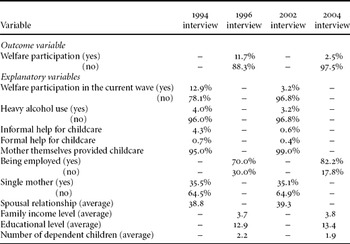
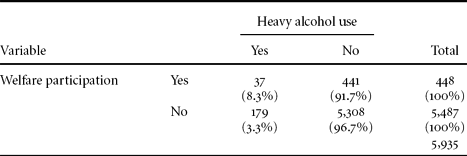
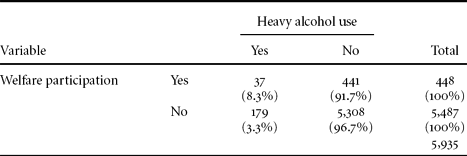
Mothers reported being a welfare participant in the current wave (that is, 1994) in 12.9 per cent of responses; and in the subsequent wave (that is, 1996) in 11.7 per cent of responses (see Table 1). In contrast, the rates of welfare participation in 2002 and 2004 were 3.2 per cent and 2.5 per cent, respectively. Comparing the 1990s to the 2000s, a drastic reduction in welfare participation occurred – even as the percentage of the mothers reporting heavy alcohol use remained relatively stable at 4.0 per cent in 1994 and 3.2 per cent in 2002. Two other obvious changes occurred over time: the rate of informal help with childcare fell from 4.3 per cent in 1994 to 0.6 per cent in 2002, and being employed rose from a rate of 70.0 per cent in 1996 to 82.2 per cent in 2004. All other variables reported in Table 1 remained fairly stable over time. In Table 2, the person-waves show a rate of heavy alcohol use among welfare recipients of 8.3 per cent and among non-recipients, of 3.3 per cent.
Descriptive statistics of time-varying outcome and explanatory variables (n = 3,517 persons)

Cross-tabulation between welfare participation and heavy alcohol use (n = 5,935 person-waves)
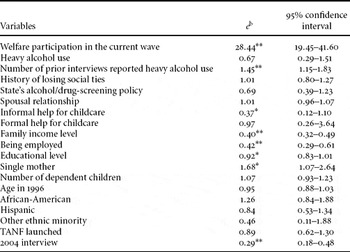
The multivariate analysis results (see Table 3) indicate that the hypothesised model differs significantly from the null model (Wald's χ2 = 623.22, p < 0.01). Welfare participation in the current wave significantly predicted welfare participation in the subsequent wave (e b = 28.44, p < 0.01). Another significant predictor of welfare participation was the number of prior interviews at which heavy alcohol use was reported (e b = 1.45, p < 0.01); more such interviews increased a mother's likelihood of being a TANF recipient. No significant impact on participation was observed for the variables heavy alcohol use, history of losing social ties and state's alcohol- and drug-screening policy.
Results of logistic regression on welfare participation in the subsequent years (n = 5,935 person-waves)

Notes: Wald's χ2 = 623.22**
** p < 0.01
* p < 0.05
Mother's spousal relationship showed no significant impact on welfare participation. Similarly, no significant impact was found for formal help with childcare, although informal help with childcare (e b = 0.37, p < 0.05) significantly reduced the chance of welfare participation, as did a high family income (e b = 0.40, p < 0.01) and mother's higher education (e b = 0.92, p < 0.05) and employment (e b = 0.42, p < 0.01).
Being a single mother significantly increased mothers’ likelihood of welfare participation (e b = 1.68, p < 0.05); in contrast, number of dependent children, racial/ethnic background and age showed no significant impact. Compared to mothers in the 1996 wave of interviews, mothers in the 2004 wave were significantly less likely (e b = 0.29, p < 0.01) to receive welfare. A 1996 launch of TANF showed no significant impact on welfare participation.
To test the hypothetical impact of state's alcohol- and drug-screening policy on the relationship between heavy alcohol use and welfare participation, an interaction term between the policy variable and the heavy alcohol use variable was created. Another was created between the policy variable and the variable measuring the number of prior interviews at which heavy alcohol use was reported. Neither of these interaction terms, however, yielded a statistically significant impact on the likelihood of welfare participation (Table 3 does not illustrate this finding). Nevertheless, interaction terms were also created between the social support network variables and the alcohol use variables; they tested a proposed moderating impact of social support on the relationship between heavy alcohol use and welfare participation. Here again, no statistically significant impact on mother's likelihood of welfare participation was observed (Table 3 does not show this finding).
Discussion
Analytical results from the present study confirm that current welfare participation predicts welfare participation in the subsequent year; findings of some prior studies are similar (Cheng, Reference Cheng2007a; Cheng and McElderry, Reference Cheng and McElderry2007). Furthermore, among mothers participating in welfare, the rate of heavy alcohol use (8.3 per cent, lower than the rate reported by Grant and Dawson in Reference Grant and Dawson1996) was 2.5 times that of mothers not participating (3.3 per cent). Heavy alcohol use, it appears, may promote welfare participation.
The present findings partially support the first hypothesis: that heavy alcohol use, alcohol- and drug-screening requirements for TANF recipients and the presence of a social support network affect the likelihood of welfare participation. The most important finding from this study is that chronic heavy alcohol use may be implicated in welfare participation, but current heavy alcohol use does not. The present study shows that a high number of earlier interview responses indicating heavy alcohol use is associated with welfare participation. This finding supports the notion that chronic heavy alcohol use has a prolonged impact on earnings (Bryant et al., Reference Bryant, Samaranayake and Wilhite2000) and, possibly, on welfare participation. However, chronic heavy drinking probably influences how long mothers keep jobs rather than their obtaining jobs to begin with.
The present study did not support the argument that substance-screening requirements have an association with welfare participation. In addition, the study demonstrated that current heavy alcohol use is not associated with likelihood of welfare participation. We may attribute the spurious relationship between current heavy alcohol use and welfare participation to current heavy drinking's possible driving role in welfare mothers’ unemployment. For instance, a prior study found that welfare mothers with drinking problems were likely to be unemployed, to have been fired or to have lost a job (Chandler et al., Reference Chandler, Meisel, Jordan, Rienzi and Goodwin2004). It is also plausible that current heavy alcohol use is itself driven by unmeasured co-occurring problems that welfare mothers experience: for example, childhood abuse (Gorske et al., Reference Gorske, Larkby, Daley, Yenerall and Morrow2006), domestic violence (Chandler et al., Reference Chandler, Meisel, Jordan, Rienzi and Goodwin2004) and other psychological distress (Cheng, Reference Cheng2007b).
Both Kaestner's study (Reference Kaestner1998) and the current study employed samples from NLSY and found a non-significant association between current alcohol use and welfare participation; Kaestner's earlier study involved an AFDC-era sample, however, while the present study involved a TANF-era sample. Since both studies employed a time-lag design, an alternative explanation of the consistent finding of a null association is that the time lag between current drinking and welfare participation was too long for an association to be observed. In any case, the present study included a measure of chronic heavy drinking not used in the prior study, and chronic heavy drinking was here shown to be associated with welfare participation.
Supporting some earlier findings (Harknett, Reference Harknett2006; Sansone, Reference Sansone1998), the present study also found that having informal help with childcare was significantly associated with welfare non-participation; having formal childcare help, however, showed no significant association. These findings suggest the important role for informal social networks in reducing low-income mothers’ welfare participation. In addition – contradicting many prior studies reviewed here – the present study found spousal relationship to have no significant association with welfare participation. While a strong, positive spousal relationship is probably helpful as one adjusts to difficulties such as financial insufficiency, that relationship in and of itself is unlikely to change the cold, hard fact of needing welfare.
It is also true, however, that, according to the present research, single mothers are likelier to use welfare than married mothers are, confirmation of results of prior studies (Cheng, Reference Cheng1995, Reference Cheng2003, Reference Cheng2007a; Cheng and McElderry, Reference Cheng and McElderry2007). An implication of this finding is that single mothers cannot count on unreliable material support from a live-in partner or former spouse to make participation in welfare unnecessary (Edin and Lein, Reference Edin and Lein1997a). Also similar to earlier results (Cheng, Reference Cheng2002, Reference Cheng2007a; Hollenbeck and Kimmel, Reference Hollenbeck and Kimmel2002; Kalil et al., Reference Kalil, Seefeldt and Wang2002), the present findings showed that human capital – specifically, family income, education and being employed – had a significant, negative association with mothers’ welfare participation. In terms of income, the present results imply that being a dual-earner family is vital to avoiding poverty and welfare participation.
The study's second hypothesis, that alcohol- and drug-screening requirements and social support networks moderate the relationship between heavy alcohol use and welfare participation, was not supported by the findings. This study found that welfare participation had an insignificant association with an interaction term between heavy alcohol use and screening policy (not shown). The implication is that state-mandated screening of TANF applicants or recipients after 1996 has created no significant change in heavy drinking mothers’ TANF participation.
Nor was there any association from the interaction term between number of prior interviews at which heavy alcohol use was reported and screening policy; this further supports the notion that screening does not prevent chronic heavy users from enrolling in TANF. These results substantiate those of prior studies suggesting that welfare recipients’ problem drinking can go unidentified – as the result, in part, of generic screenings, reliance on self-reports, questionable training of welfare workers and organisational barriers (Henderson et al., Reference Henderson, Dohan and Schmidt2006; Morgenstern et al., Reference Morgenstern, Riordan, Dephilippis, Irwin, Blanchard, McCrady and McVeigh2001; Schmidt et al., Reference Schmidt, Wiley, Dohan, Zabkiewicz, Jacobs, Henderson and Zivot2006).
Welfare participation was not found to be significantly associated with our model's interaction terms between the social support network variables and heavy alcohol use variables. Negligible associations arising may be explained by the following unique characteristic of welfare recipients’ social support networks: relatives and friends helped with childcare at times, but their possible expectations of reciprocation from the welfare mothers perhaps constituted a stressor promoting alcohol use (Mulia et al., Reference Mulia, Schmidt, Bond, Jacobs and Korcha2008). In other words, the give-and-take nature of social support networks means their influence does not negate chronic heavy drinking's association with welfare participation.
In the analysed sample there appear to be mothers who used alcohol heavily but did not receive TANF benefits. These women were likelier than heavy drinking welfare recipients to be married, employed and educated, and they tended to have more financial assets. That is, compared to TANF mothers, mothers not participating in welfare were likely to have additional resources and more family support (whether from a spouse or other relatives) for addressing their drinking and related problems and avoiding welfare enrollment.
The present study found that welfare participation was significantly less likely in 2004 than in 1996, helping to illustrate the dramatic reduction in the nation's welfare rolls since TANF was launched (Carter et al., Reference Carter, Dunbar, Micks, Brown and Davis-Johnson1997), but also reflecting the growing economy that characterised the early 2000s (Kaushal and Kaestner, Reference Kaushal and Kaestner2001).
Conclusion
The application of the discrete-time method furthered understanding of potential causal relationships between welfare participation and heavy alcohol use. Although mothers who in the past have been chronic heavy alcohol users do tend to seek help from programmes such as TANF, states’ tendency since 1996 to require alcohol- and drug-screening for TANF applicants or recipients has not much changed the way heavy drinking mothers participate in TANF (regardless of whether their alcohol abuse is chronic or current). The screening policies may have been ineffective due to poor implementation.
Nevertheless, any generalisation from the present study's results should be made cautiously, because – as has already been noted – the study did not take autocorrelation into account during the analysis. If the repeated observations within each wave proved to be correlated, the present estimates of likelihood of welfare participation could be misleading (Hardin and Hilbe, Reference Hardin and Hilbe2003).
It can be said that welfare participation for substance-using mothers may not be all bad, since welfare participation would sustain an addict or alcoholic (who, like anyone, requires food and shelter) through diagnosis and successful, comprehensive treatment. The key is enforcement of reliable screening and professional treatment. Given proper care and counsel, the addicted welfare recipient eventually, it may be hoped, will face the substance-use issue and tackle co-occurring challenges, including employability. What TANF officials might focus on, then, is effective implementation of effective screening, leading to comprehensive, effective treatment.
What social workers might want to consider doing is encouraging the informal childcare assistance provided through their clients’ social support networks. Such assistance appears to affect mothers’ ability to remain or become welfare non-participants. Mothers who can maintain networks of relatives and friends have help in avoiding welfare participation. Social workers can promote and help build informal social support networks, perhaps establishing outright a welfare recipient's network specifically for childcare aid. Mothers who participate in welfare programmes also will benefit from strengthened human capital, such as education, which is associated with welfare non-participation.