Introduction
The main aim of this paper is to illuminate the neglected, but critical, role of employers in the success of active labour market policies (ALMPs). In the past few decades, welfare states have increasingly deployed ALMPs, or welfare-to-work programmes, in order to move groups outside the labour market into work. In the UK, such programmes have emphasised the supply-side in terms of the employability of the individual (McQuaid and Lindsay, Reference McQuaid and Lindsay2005), prioritising ‘work first’ approaches and increasingly tougher conditionality for benefit recipients (Peck, Reference Peck2001; Ingold and Etherington, Reference Ingold and Etherington2013). There is a large literature regarding ALMPs and there remains much debate about their long-term effectiveness (Larsen, Reference Larsen2003; Eichhorst and Konle-Seidl, Reference Eichhorst and Konle-Seidl2008). ALMPs have to some extent proved effective during economic upturn, but have largely failed to reduce churn at the lower end of the labour market, particularly in economically depressed post-industrial areas in the UK (Peck and Theodore, Reference Peck and Theodore2000; Beatty and Fothergill, Reference Beatty and Fothergill2011a). However, with a small number of exceptions (Fletcher, Reference Fletcher2004; Gore, Reference Gore2005; McCollum, Reference McCollum2012), the focus of policy and analysis has, to date, largely been on the supply side, leaving a significant gap in relation to the demand-side dynamics.
Employers are crucial policy actors in welfare-to-work programmes, but their involvement and interest in such programmes is assumed. This paper seeks to understand employer engagement in the context of two important policy trends exemplified by the Coalition government's unified ‘work-first’ welfare-to-work programme, the ‘Work Programme’ (WP) introduced in England, Scotland and Wales in 2011: first, the shifting of responsibility for employment support away from the public employment service and towards contracted providers and, second, the use of ‘payment by results’ (PbR) models which intensify providers’ competition to engage with employers in order to obtain the job outcomes on which their performance is measured and upon which their financial rewards are based (Finn, Reference Finn2011). These two trends demonstrate the two ‘faces’ of employer engagement: employer involvement with ALMPs and providers’ necessary engagement with employers.
The introduction of the WP reflects an ideological shift in the conceptualisation of the role of the public and private sectors in ALMPs. New Labour focused on the public sector as an employer of last resort during recession (Future Jobs Fund) while the Coalition has placed restrictions on the public sector through cuts, outsourcing and the elevation of the private sector as the driver of growth and jobs. Providers predominantly operate in local labour markets largely comprised of small and medium-sized enterprises (SMEs). The Chambers of Commerce are therefore a useful route through which to examine employer engagement within the local labour market context. The paper presents data from a survey of businesses accessed through a Chamber in Yorkshire. Through this survey, the engagement of SMEs in the WP is explored, while providers’ engagement with both SMEs and large employers is explored in interviews with both providers and stakeholders, including business interest organisations.
The findings suggest that, despite the centrality of employers to WP policy delivery, both their involvement and engagement is lacking. The success of employer engagement activities was limited by employers’ lack of demand for labour in the context of the recession; although an economic upturn may not necessarily determine higher levels of employer involvement. Providers were developing strategies to engage employers, including attempting to intervene in their recruitment processes and become embedded in their workforce planning. However, the ‘two faces’ of engagement were limited by the intensification of competition on the supply side, a funding model which drives pursuance of large employers for higher numbers of repeat vacancies rather than resource-intensive engagement of SMEs, and the wider context of weak employer coordination.
The Work Programme
The Work Programme (WP) is predominantly targeted at recipients of Jobseeker's Allowance or Employment and Support Allowance (who have been assessed as capable of working) at a specific point in their unemployment spell.Footnote 1 Programme participants include the long-term unemployed, young unemployed, lone parents and disabled and chronically sick people. Once eligible, individuals are referred by Jobcentre Plus to a contracted provider and remain with them for up to two years. The programme operates under a ‘black box’ commissioning model: providers receive little prescription from government, with the intention that support is tailored to individuals’ specific circumstances to move them into ‘sustainable’ work (DWP, 2011). The initial WP contract established eighteen Contract Package Areas (CPAs), organised on a geographical basis, with at least two competing ‘Prime’ providers within each CPA, each constructing its own supply chain of delivery organisations. At the WP's inception, across all CPAs 18 mostly private for-profit Primes held 40 WP contracts, with a total of 852 organisations covering both Tier 1 (end-to-end service delivery) and Tier 2 (call-off support) contracts. The key difference between the WP and its antecedents is that, aside from minimal upfront fees (which will gradually be phased out), providers receive the majority of their income as ‘Sustainment Payments’ linked to ‘sustained’ jobs. These ‘payments by results’ are graded according to participants’ distance from the labour market (i.e. job-readiness) and the length of time they remain in employment. In the initial contract, the potential payments ranged from around £3,800 for a young unemployed person to £13,700 for a disabled or chronically sick person (DWP, 2011). Additionally, between 2012 and 2014 the Youth Contract Wage Incentive offered employers £2,275 for each unemployed eighteen- to twenty-four-year old they employed for at least twenty-six weeks from the Work Programme or through Jobcentre Plus.
Outcome statistics for the WP's first year were published in November 2012, leading to damning critiques among politicians and the media. The minimum performance level (job outcomes as a percentage of referrals) achieved by providers was 3.5 per cent, far lower than the government's anticipated benchmark of 5.5 per cent and below the expected level in the absence of any programme (HoC, 2013). In its second and third years, there was some improvement in performance in terms of achieved job outcomes, although this was still below predictions and outcomes were significantly lower for the most disadvantaged, particularly those receiving Employment and Support Allowance (Inclusion, 2014). The latter group face multiple barriers to work and tend to be concentrated in the weakest post-industrial economies (Beatty and Fothergill, Reference Beatty and Fothergill2011b). Following the end of the programme's second year, providers' market share (i.e. allocation) of participants was redistributed to the best-performing providers, the deciding factor being the number of successful job outcomes. Engagement of employers by providers is thus central to the WP model and ultimately to job outcomes as a measure of success.
Employer engagement
While the supply-side ideology underpinning ALMPs has been widely critiqued (Peck and Theodore, Reference Peck and Theodore2000; Serrano Pascual and Magnusson, Reference Serrano Pascual and Magnusson2007), there has been less examination of the demand-side dynamics (i.e., the role of employers). More widely, social policy has neglected employers’ power, agency and influence across a number of policy domains (Farnsworth, Reference Farnsworth2004). Understanding what motivates business interests, informs its views and influences its levels of involvement (Farnsworth, Reference Farnsworth2006: 838) can have a significant impact upon the construction of policies and their propensity to succeed or fail. Labour market policy is largely driven by a ‘supply-side fundamentalism’ (Peck and Theodore, Reference Peck and Theodore2000), which links joblessness to the failings of individuals, rather than to problems associated with the labour market. The needs and wants of employers in terms of labour demand is assumed, underpinned by an ideology that jobs are available if only the jobless could be persuaded to take them (Grover, Reference Grover2009: 496). The centrality of employer engagement to PbR models of welfare-to-work delivery introduces a new dimension: that jobs are available if only employers can be persuaded to offer them to unemployed people.
A small number of studies have explored the barriers to engaging employers in welfare-to-work programmes in the UK and internationally, largely focusing on employers’ concerns about recruiting and employing the jobless. The latter are self-evidently in a relatively weak labour market position, with potentially deficient labour market histories, as well as the likelihood of other barriers to employment, such as a lack of skills, experience or qualifications, or health and other social problems. Employers tend to view long periods of unemployment negatively (ILM, 2009), focussing upon the reasons for the jobless not being in paid work (Snape, Reference Snape1998). Employers may consider the jobless to be higher risk and of lower quality than other jobseekers (Quinto Romani and Larsen, Reference Quinto Romani and Albrekt Larsen2010) and are less likely to employ such groups during economic recessions, when a wider pool of job-ready labour is available (Nunn et al., Reference Nunn, Bickerstaffe and Hogarth2010). In this context, employers can respond by altering their hiring processes, for example by increasing their requirements for qualifications and experience (Holzer et al., Reference Holzer, Raphael and Stoll2006). In order to avoid being inundated with applicants, employers may utilise informal recruitment channels, such as word of mouth recommendations and networks, which may exclude the jobless (Shury et al., Reference Shury, Vivian, Gore and Huckle2012: 102). Conversely, some employers, particularly larger firms, are increasingly utilising formal recruitment methods (Urwin and Buscha, Reference Urwin and Buscha2012) which can disadvantage candidates with low literacy or low IT skills, or who lack recent interview experience. In low-skill, high-turnover occupations, employers may use statistical discrimination to sift out candidates based on personal characteristics such as age, gender or postcode, potentially disadvantaging already excluded groups (Bonoli and Hinrichs, Reference Bonoli and Hinrichs2010).
Despite this, some employers may have a preference for recruiting the jobless. Potential advantages include their immediate availability to start work and their accompanying lower wage costs (Hasluck, Reference Hasluck2011). Employing disadvantaged groups may benefit businesses by enhancing their corporate social responsibility agenda, or augmenting their brand (Bellis et al., Reference Bellis, Sigala and Dewson2011). Wage subsidies or other incentives can lower the costs of recruiting people who are perceived to be higher-risk recruits, as can initiatives such as ‘work trials’ or placements in which employers can ‘try out’ a potential employee for a defined period. To date, wage subsidies have produced mixed results in the UK compared with other countries (Vegeris et al., Reference Vegeris, Vowden and Bertram2010). This is possibly because subsidies are less ingrained in the UK model than in a country such as Denmark, which links its unemployment programmes more closely to a general training policy and funding (Martin, Reference Martin2004).
Labour market intermediaries such as recruitment agencies, the public employment service (PES) and organisations delivering welfare-to-work programmes can improve the effectiveness of recruitment, reducing employers’ recruitment costs and employee turnover (Forde, Reference Forde2001). Such intermediaries can offer interventions to improve jobseekers’ employability and operate as a ‘buffer’ (Gore, Reference Gore2005) between employers and jobseekers, correcting information asymmetries that could otherwise result in inappropriate job-matching (Larsen and Vesan, Reference Larsen and Vesan2012). However, welfare-to-work programmes can affect employer behaviour in negative ways. Imposing tougher job search requirements on benefit recipients and stringent performance management measures on frontline staff can lead to employers receiving large numbers of job applications from unsuitable applicants (Bellis et al., Reference Bellis, Sigala and Dewson2011). This can lead to negative perceptions about the quality of the service and reduce employers’ propensity to utilise such services, or to employ the jobless (Bonoli and Hinrichs, Reference Bonoli and Hinrichs2010; Hall et al., Reference Hall, Pettigrew and Mousley2008). In this context, providers can play a key role in attempting to overcome such negative views in order to engage employers.
To date, the most significant body of work which has explored employer involvement in ALMPs and social policy more broadly has been that of Swank and Martin (Martin and Swank, Reference Martin and Swank2001; Swank and Martin, Reference Swank and Martin2004; Martin, Reference Martin2004; Martin and Swank, Reference Martin and Swank2012). Martin (Reference Martin2004) has argued that employer involvement in ALMPs is influenced by the size of human resources departments (and by definition by business size) and that membership of (national) employer associations is a positive determinant of employer involvement in ALMPs in ‘corporatist Denmark’, but has a negative impact in ‘pluralist’ Britain in which such organisations are weak and conflicting (Martin, Reference Martin2004; Martin and Swank, Reference Martin and Swank2012). However, their analyses do not account for the different configurations and purposes of the variety of business interest associations operating at different spatial levels of welfare states. In the UK, business associations have historically had no real regulatory role in the policy process (Berger and Compston, Reference Berger and Compston2002) and employment regulation largely occurs at the workplace level. The Confederation of British Industry operates as a lobbying organisation for large businesses (Farnsworth, Reference Farnsworth2004) and took an interest in the WP's initial implementation in the context of its public service reform agenda. The effectiveness of local Chambers of Commerce tends to vary according to the local context; in some cases, such networks can act as functional equivalents of HR departments, but in others they may largely be irrelevant. By contrast, in Denmark, employers have long held a key role as social partners in the development of employment policy, leading to co-determined agreements covering specific sectors, although, latterly, the Danish models of ‘flexicurity’ and social partnership have come under pressure (Larsen, Reference Larsen, Brodkin and Marston2013). Swank and Martin largely link national differences in employer involvement to the political economic institutions of the state, and indeed this institutional level is important in setting the regulatory context for the social relations which take place between organisations. However, focusing upon this level is insufficient for exploration of implementation of PbR-based programmes involving a multiplicity of organisations engaged in relations at different spatial levels. This exposes a significant gap in knowledge about the complex processes involved in employer engagement, which cannot be explained by institutional and governance structures alone (see Blois, Reference Blois2002).
Examining these processes and relations requires a clearer exposition of what is meant by ‘employer engagement’. While it is common parlance among policymakers and practitioners, its meaning is unclear. Policy reports (for example, Bellis et al., Reference Bellis, Sigala and Dewson2011) have considered ‘employer engagement’ to mean employer involvement with a government policy, programme or agency. This emphasises one face of employer engagement: the actions of employers. While this is important, it underplays another important face: the activities undertaken by providers to engage employers. Our conceptualisation considers both faces of employer engagement.
Understanding the dynamics of employer engagement is crucial to improving policy design and delivery. The WP is the largest experiment in outcome-based funding in the history of the British employment service, with an overall cost to the public purse of £3–5 billion in its first five years (DWP, 2011). It is critical that more is known about which employers recruit the jobless and why and to what extent this is through ALMPs, such as the WP. Conversely, it is also critical to develop an understanding of which employers do not engage and why this is the case. This paper begins to explore these wider and significant questions. The study focused on the following research questions:
1. What are the characteristics of employers that have recruited staff from the Work Programme?
2. Why do employers choose not to recruit the jobless using a programme such as the Work Programme?
3. What do employers consider to be the advantages of recruiting staff via such a programme and what would encourage them to do so?
4. How are Work Programme providers seeking to engage employers?
Methods
Yorkshire and the Humber is a large and diverse region comprising four counties. Employment rates and gross household income per capita are among the lowest of all the English regions and an above-average number of working-age people are employed in occupations requiring a low level of skills or qualifications (ONS, 2012). The regional economy is based on a relatively high proportion of manufacturing, but also includes a diverse range of industries, ranging from financial and professional services in Leeds, to food production in East Yorkshire and seasonal employment on the East coast. By focusing upon this relatively disadvantaged but diverse region, the research aims to provide a unique study of employer engagement across two WP Contract Package Areas.
The survey of employers was undertaken in collaboration with the Leeds, York and North Yorkshire Chamber of Commerce, one of the accredited networks of Chambers supporting largely private and third-sector businesses at national, regional and local levels, including many small firms. Each Chamber conducts a Quarterly Economic Survey and this paper draws on the Quarter 2 survey in 2012, which was live from 21 May to 12 June 2012. The questionnaire was designed by the Chamber and included questions about a wide range of issues, including: home sales and orders, export sales and orders, employment prospects, recruitment difficulties, confidence and price pressures. The questionnaire included seven unique questions constructed by the authors about employer engagement with the WP over the previous year, preceded by a brief description of the programme. The survey was emailed to named contacts within 6,465 businesses, with two follow-up emails to chase non-response. Surveys were also completed with recipients over the telephone. All respondents were at least owner/manager, director, CEO or partner level within their business. In total, 643 respondents completed the survey, giving a response rate of 10 per cent.
These employer data were supported by in-depth face-to-face interviews with employer engagement staff in WP provider organisations in England, Scotland and Wales and by interviews with key informants, including from business interest organisations. Negotiating access to providers was a difficult and lengthy process, but the final achieved sample of forty covered the majority of CPAs. In order to directly complement the survey data, this paper specifically draws on nine interviews with organisations in the ‘West Yorkshire’ and ‘North East Yorkshire and the Humber’ CPAs, and from interviews with associations representing businesses of all sizes and sectors operating at both national and local levels. Four respondents were from Primes and five were from sub-contracted organisations. The interviews were semi-structured and the topic guide included questions about the provider's organisational structure, their methods for engaging employers and the barriers to and facilitators of employer engagement. On average, the interviews lasted around forty-five minutes and, in most cases, were recorded and transcribed verbatim.
Findings
What are the characteristics of SMEs that have recruited from the Work Programme?
The majority of respondents who replied to the survey were micro-businesses with up to nine employees (56 per cent), or small businesses with between ten and forty-nine employees (27 per cent). In terms of sector, 84 per cent were in the services industry (predominantly the professional services industry) and 16 per cent in manufacturing, reflective of the dominance of professional services in the Leeds city area. Most businesses that responded were SMEs (97 per cent), which was broadly representative of the Chambers’ membership. On the whole, the survey suggested that business confidence was low, with a slowing of both domestic sales and exports across both service and manufacturing. Although the majority of employers (64 per cent) had maintained a constant workforce, only 40 per cent were currently recruiting (LYNYCC, 2012).
In general, low-skill jobs tend to have a higher labour turnover, with vacancies being filled using cheap, fast and informal recruitment methods, particularly for smaller businesses (Atkinson and Williams, Reference Atkinson and Williams2003: 7). This suggests that employers seeking staff with entry-level skills may have much to gain from the WP. However, the majority of businesses (95 per cent) had not recruited any staff through the WP in the last twelve months. The low number which had recruited WP participants was slightly higher than the first year's performance measures for the WP overall. The implication of this first key finding depends upon how the 5 per cent figure is interpreted. Our survey suggests a possible higher rate of engagement in these two CPAs than across the WP as a whole. A Chartered Institute of Personnel and Development (CIPD) survey of its members and HR professionals suggested that 7 per cent of employers had ‘taken part’ in the WP, with businesses in the North of England being three times more likely to participate (CIPD, 2012: 2). However, this did not necessarily mean that they had recruited staff: employers can become involved in a range of ways, such as by advertising vacancies, providing work experience or being involved in pre-employment training. In the UK Commission for Employment and Skills’ Employer Perspectives Survey 2012 (Shury et al., Reference Shury, Vivian, Gore and Huckle2012), 9 per cent of establishments had used the WP to recruit staff. In this context, the 5 per cent figure appears low.
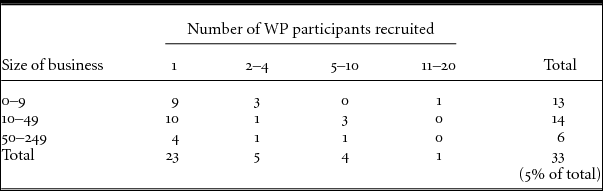
The type of jobs available in manufacturing and services are likely to be different, as are their labour pools and job sustainability. On the whole, sector was not significant but there were some notable differences. In terms of size, employers which had recruited WP participants were micro, small and medium sized (Table 1), the majority being in services. More than half (54 per cent) had recruited semi/unskilled employees, 31 per cent had recruited clerical staff, 9 per cent had recruited skilled manual/technical staff and a further 9 per cent had employed professional/managerial staff. In terms of contracts, 60 per cent were full-time and 34 per cent were part-time, with 40 per cent being permanent and 23 per cent temporary. In terms of pay, all were employed for less than the median wage: 18 per cent were in the £0–£8,000 bracket, with the majority (67 per cent) being in the band £8,001–£15,000, 12 per cent in the bracket £15,001–£20,000 and 3 per cent in the band £20,001–£25,000.
Numbers of employers recruiting Work Programme participants, by size (per cent)
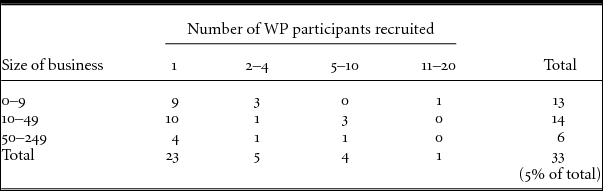
Notes: n = 643 (manufacturing = 106; services = 537); figures represent rounded percentages.
Why do SMEs choose not to recruit using the Work Programme?
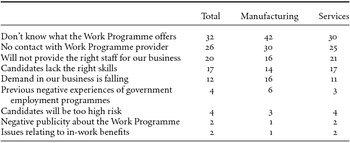
Given the small number of employers that had recruited from the WP, it is important to understand the reasons. Around a third (32 per cent) of all respondents stated that they did not know what the WP offered (Table 2) and this was higher for manufacturing than for services. Just over a quarter (26 per cent) reported that they had not received any contact from a WP provider (see also Newton et al., Reference Newton, Meager and Bertram2012). It is possible that employers may not realise that they have had contact from a WP provider, depending upon how providers present themselves and how far they overtly advertise the WP. Falling demand was mentioned by 12 per cent of employers and this was higher for manufacturing. Of those respondents who replied ‘Other’, 52 per cent said that they did not need any staff, with many once again specifically citing a lack of demand. A further 16 per cent stated that they did not have a business need to recruit and this tended to be the case if they were either a family business or a sole trader and were not looking to expand. Only one respondent stated that they would be recruiting in the near future. The CIPD survey similarly cited a lack of demand for new workers as a key reason why employers had not participated in the WP, particularly in the North of England (CIPD, 2012: 3).
Reasons for not recruiting staff through the Work Programme (multi-response, per cent)

Notes: n = 643 (manufacturing = 106; services = 537); figures represent rounded percentages.
There was evidence of a perception amongst employers that staff recruited through the WP would not provide the right ‘fit’ for their business (20 per cent), or that participants would not have the right skills (17 per cent). This is supported by other research which suggests that employers are concerned about a lack of soft or generic skills and whether jobless candidates would have the ‘right’ attitudes (Danson and Gilmore, Reference Danson and Gilmore2009: 1000). Four per cent stated that WP participants were too high risk (in terms of risks to the business, or the risk of increased costs in the form of line manager time or labour turnover) and another 4 per cent cited previous negative experiences of other government programmes. In terms of ‘Other’ reasons, one respondent commented that ‘people only take part otherwise they lose their benefits with little or no interest in the job’. Other respondents commented that they considered unemployed candidates to be ‘unsuitable,’ or perceived that they would not remain in the company in the longer term, for example: ‘don't want short-term staff but those who are committed to a future career and training’. The data suggest that only a minority of employers held negative perceptions of WP participants and that wider business factors and knowledge of the WP appeared to be more important.
What would encourage SMEs to use the Work Programme?
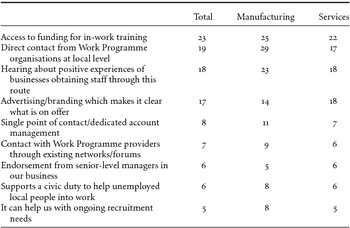
Businesses were asked about the factors that might encourage them to recruit staff through the WP (Table 3). In response, 23 per cent cited access to funding for in-work training, supporting the findings of the National Institute of Adult Continuing Education that, although WP participants were eligible for skills provision (funded by the Skills Funding Agency), there was little evidence that providers were facilitating access (NIACE, 2012). The other main factors that businesses said would encourage their involvement was direct contact from WP providers at local level (i.e., employer engagement) (19 per cent) and hearing positive stories from other businesses which had recruited staff (18 per cent). This suggested that businesses in the manufacturing sector were particularly open to provider contact. Businesses also wanted clear advertising about the WP (17 per cent). Only 8 per cent stated that a single point of contact or account manager was important. Of those that replied ‘Other’, 42 per cent of respondents stated that an economic upturn or increasing demand for their business would encourage them to use the WP to recruit staff. A further 12 per cent of respondents specifically mentioned the skills of candidates, either in relation to a need to tailor candidates to vacancies or to the business, or in relation to increasing their skills. For example, businesses cited their need for ‘better trained staff’, or ‘people with the skills we need’, linking this with the need for specialist skills for specific job roles. WP participants were not viewed as potential candidates as they ‘don't have the appropriate skillset’. One respondent suggested it would be beneficial to have ‘Mentors working with, shaping attitudes and endorsing candidates’.
Factors that would encourage employers to recruit using the Work Programme (multi-response, per cent)

Notes: n = 643 (manufacturing = 106; services = 537); figures represent rounded percentages.
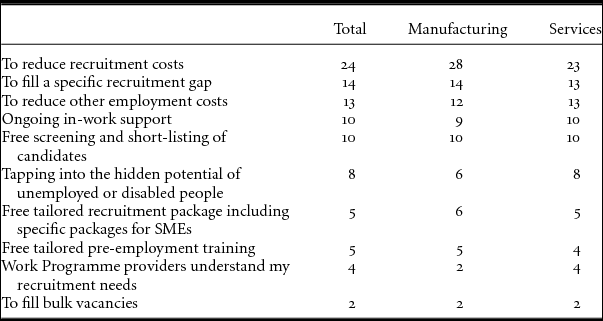
A key predictor of the extent to which employers can be encouraged to engage is whether policies are perceived to have an immediate and direct impact on productivity and profitability, including the quality, costs and supply of labour (Farnsworth and Holden, Reference Farnsworth and Holden2006: 484). Of the businesses surveyed, 24 per cent (highest for manufacturing) stated that one advantage of recruiting staff through the WP was a reduction in their recruitment costs (Table 4). The reasons for this included mainly filling a specific recruitment gap (14 per cent), or reducing other employment costs (13 per cent). Only 4 per cent thought that WP providers understood their needs. Of those who had replied ‘Other’, around a quarter (26 per cent) stated that they had not heard of the WP and 8 per cent said that they believed that unemployed and disabled people had untapped potential. A number of respondents again emphasised that they had no current business need.
Advantages of recruiting staff through the Work Programme (multi-response, per cent)
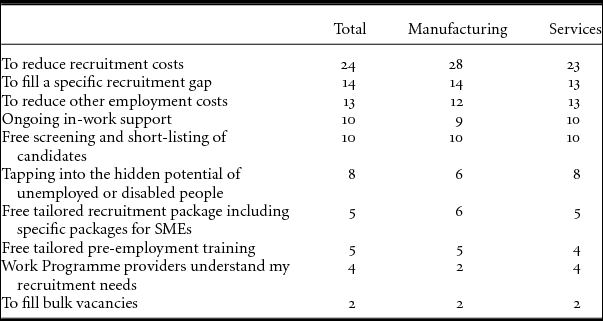
Notes: n = 643 (manufacturing = 106; services = 537); figures represent rounded percentages.
Martin and Swank (Reference Martin and Swank2012) have argued that, in Britain, employer associations have a negative effect on employer participation in ALMPs. The survey data presented here do not necessarily suggest that Chambers of Commerce have a negative effect on employer engagement, but that there is a critical information gap in terms of employers’ knowledge and requirements. Notwithstanding the impact of the recession, employers appeared to have a potential demand for the WP's services and participants. In the UK context, business interest associations are weak actors in ALMPs compared with countries with corporatist models. In the absence of employer bodies that negotiate with the state, organisations involved in policy implementation must try to establish what employers’ needs are and respond to them in a direct manner. In the context of the WP, providers thus have a potentially key role to play in addressing employers’ information gaps and in persuading employers to engage. The interviews sought to explore this dimension.
Employer engagement by Work Programme providers
Having examined the first of our two faces of employer engagement, i.e., employer involvement with the programme, the following qualitative data explore the second aspect: the engagement between providers and employers. The data presented are specific to the area of Yorkshire covered by the survey but are illustrative of the total of the forty interviews conducted with providers and stakeholders across England, Wales and Scotland.
Although the survey did not suggest that employers overwhelmingly held negative perceptions about WP participants, providers highlighted that this was a key barrier to engaging employers and considered that they had an important role to play in overcoming such perceptions (see Larsen and Vesan, Reference Larsen and Vesan2012):
It comes down to the old preconceived stereotypes and it's our job to overcome those and we can do that by demonstrating to them the kind of clients that we’ve got and we work with. Explaining the reasons why these guys are out of work, the difficulties that they’ve had. Explain the local job market to these employers, because just because they had this understanding of what they perceive these unemployed people to be, they don't necessarily understand how difficult the labour market is. (Prime)
In order to overcome such barriers, providers needed to convince employers to offer jobs to participants on their caseload – this could involve intervening in, or overcoming aspects of, employers’ recruitment processes which could disadvantage the jobless (Shury et al., Reference Shury, Vivian, Gore and Huckle2012):
My job is there to assist them in getting in front of employers . . . I’ve got to be the one that steps in front of the employer and say I know you’re advertising, I can take the legwork out of what you’re actually doing. Let us sift through our candidates that are further away from the job market as you would look at them. (Sub-contractor)
An important facet of this was providers’ capacity to offer a ‘free, tailored recruitment service’ (see also Hall, Reference Hall2010):
It's important to tailor the service – we have discussions with employers to find out what they want . . . Our USP is ‘service at no cost’ – it's an attractive proposition. We take away the advertising cost, sift, pre-employment training can be any length, tailored, can cover what the employer wants. (Prime)
With large numbers of candidates applying for each advertised job vacancy, providers felt that a potential benefit of their service was the capacity to reduce employers’ transaction costs when recruiting. However, the funding model and providers’ desire to meet employers’ requirements could unsurprisingly require providers to prioritise the most job-ready candidates in their caseloads (see also Fletcher, Reference Fletcher2004; Newton et al., Reference Newton, Meager and Bertram2012):
The thing that appeals to employers is that in the current climate they could put an advert in the paper and get a thousand applications for a warehouse operative, whereas if they come to us we will market that role internally here, we might get a thousand applications to ourselves, but we will take that thousand and we will whittle that down to the criteria the employer wants. (Prime)
The WP model requires providers to engage in fierce competition to access employers. There is competition between Primes, within and between supply chains and also with commercial recruitment agencies and training providers. Despite the government's claim that the WP is a unified welfare-to-work programme, there still exists a plethora of employment and skills programmes vying for employers’ attention, with differentiated provision in Scotland and Wales. This constitutes a confusing offer for employers (CBI, 2012) and, in this context, WP providers may be ‘crowded out’:
if an employer took every sales call from somebody that is offering a free service, there's so many incentives and pre-employment training and all types of stuff that an employer can access, they’re probably confused about what's going on . . . I appreciate the government is trying to drive growth . . . but it has an impact with all these different things being thrown at employers. (Prime)
The survey data suggested that the WP was not well-understood by the majority of employers. The business interest associations interviewed had had no involvement in the development of the WP and acknowledged that lack of employer awareness was a problem. Although some of the Primes included Chambers of Commerce in their supply chain, in general they described limited success in engaging employers through this route. One dimension of this was the ‘embeddedness’ of providers in their local areas (see also Granovetter, Reference Granovetter1985; Curran and Blackburn, Reference Curran and Blackburn1994: 170; Newton et al., Reference Newton, Meager and Bertram2012): only ten of the eighteen Primes had previously held welfare-to-work contracts and nine of these were delivering contracts in new areas (NAO, 2012: 29):
Part of our challenge . . . is getting the name out there and not just our name, but what the WP is . . . some employers I can guarantee will never have heard of us, it's still an on-going challenge for us. (Sub-contractor)
All providers interviewed emphasised the importance of forging strong, ‘localised’ relationships with employers. Many providers were attempting to engage SMEs by focusing on the potential benefits they could offer in the absence of formal HR functions. This, however, was very resource-intensive. Furthermore, the WP funding model potentially drives providers to focus upon developing relationships with larger employers, which can supply more regular higher-volume vacancies, as illustrated by the following stakeholder comment:
Labour market policies and employment policy more broadly tend to be ‘one size fits all’, mainly decided with larger firms in mind. And this whole economies of scale issue with the WP and providers seems to be a case in point. (Stakeholder)
For some providers, one way of engaging employers was to broker national service-level agreements with large employers, although such relationships still required development at the local level through building trust between providers and employers. Some providers explicitly stated that their strategy was to broker ‘exclusive’ access to employers’ ‘hidden’ vacancies, removing the need for employers to publicly advertise jobs (see Green and Hasluck, Reference Green and Hasluck2009: 35).
the opportunities are there but not yet advertised. So it saves the employer having to go through the advertisement and it gives our clients first choice, first bite of the cherry if you like, because nobody else knows about them. (Sub-contractor)
Brokering exclusive access was intended to secure repeat business in order to become an employer's ‘recruiter of choice’:
They’re looking to get in with the ‘employer–pipeline’, get to the hidden vacancies . . . Success is when we move into key account manager roles, relationship-building and maintaining those relationships. Of course we want repeat business. (Prime)
If you open the door to an employer you don't just want one job, you want every single job they ever advertise, that's what we’re after doing. (Sub-contractor)
These developments are reflective of the competitive nature of the market-driven WP, which intensifies competition on the supply side for both participants and providers (cf. Peck and Theodore, Reference Peck and Theodore2000). ‘Exclusive’ access or formalised agreements carry the risk that providers become reliant on particular employers to supply vacancies, and, in practice, could affect the job choices available to programme participants. It also operates against the collaboration that providers highlighted was important for employer engagement. Providers gave examples of successful engagement involving a lead organisation approaching an employer on behalf of a number of providers, with any resulting vacancies being shared between organisations.
Additionally, the survey data indicated that vacancies may not be merely hidden, but may not exist at all. This challenging economic context was also acknowledged by providers. For example, one stated that the biggest barrier to engaging employers was simply ‘The labour market’. Similarly, another provider stated that:
there are still some companies that are not recruiting which are key employers in the area, so the economy still has a factor and impact. (Sub-contractor)
Employers are key to the success of ALMPs and providers clearly have a role to play in encouraging employer engagement. Firstly, by addressing employers’ negative perceptions of the jobless (Gore, Reference Gore2005) and helping jobless groups to negotiate employers’ recruitment processes. Secondly, by demonstrating their expertise and developing an understanding of businesses and their labour requirements and tailoring their services to employers’ needs. However, focusing on employers’ requirements may risk legitimising the discriminatory behaviour that disadvantages particular groups from entering the labour market in the first place (Fletcher, Reference Fletcher2004: 127). This underscores the tension within ALMPs that are focused on the supply side but which implicitly rely on the demand side for success, based on a level of intervention which is superficial. Ultimately, employer engagement is preceded by demand. A lack of demand for labour, as well as specifically for WP participants, may fundamentally undermine the aims of work-first programmes such as the WP in promoting ‘sustainable’ jobs.
Conclusion
The UK Coalition government has argued that through a ‘payment by results’ (PbR) model, the WP will incentivise contracted providers to move the jobless into sustained work. Employer engagement is crucial to the success of ALMPs such as the WP, but, to date, this demand-side factor has been neglected. This paper has aimed to provide a clearer exposition by examining the ‘two faces’ of employer engagement: employer involvement with the WP and providers’ engagement with employers. The paper has drawn empirically from a survey of largely private and third-sector SMEs, accessed via a Chamber of Commerce in Yorkshire, and from interviews with providers and stakeholders from business interest associations about provider engagement with SMEs and large employers in the same area.
The survey suggested a lack of SME engagement in, and knowledge of, the WP. Employers recognised the potential advantages of the WP to reduce their recruitment costs, but most did not know about the programme and had not been contacted by providers despite some modest demand for this. The interview data suggested that providers were attempting to engage with both SMEs and large employers, but that the funding model had so far driven providers to pursue large employers for higher numbers of repeat vacancies. Providers were attempting to engage employers in a number of ways, including by intervening in their recruitment process and becoming embedded in their workforce planning.
The success of employer engagement activities was undoubtedly limited by employers’ lack of demand for labour during the recession. However, an economic upturn may not necessarily determine higher levels of employer involvement, given inherent tensions within work-first ALMPs. Such programmes are predicated on a supply-side ideology while at the same time implicitly relying on the demand side for success but based on a level of intervention which is superficial and fragmented. The result is that such programmes further concentrate competition on the supply side, both at the level of providers and of participants, intensifying the ‘supply-side fundamentalism’ of ALMPs (Peck and Theodore, Reference Peck and Theodore2000). This overarching and constraining context for employer engagement reflects an underlying discourse which assumes that the problem of joblessness lies with the individual, and overlooks the critical role of employers. Consequently, ALMPs have tended to be based on the assumption that jobs are available if only unemployed people could be persuaded to take them (Grover, Reference Grover2009: 496). The centrality of employer engagement to ALMPs (particularly those involving PbR) introduces a new dimension: that jobs are available if only employers can be persuaded to offer them to the jobless. Despite providers’ efforts to market such groups to employers, to become recruiters of choice, or to access hidden vacancies, employers need to have a requirement for their labour in the first place. It is from this very simple, but too often overlooked, starting point that policymakers can better understand how policy can seek to shape employers’ propensity to engage in ALMPs.
Martin and Swank (Martin, Reference Martin2004; Martin and Swank, Reference Martin and Swank2012) have highlighted the different roles and effects of employer associations in the development and delivery of ALMPs. It is not possible for the UK to emulate more successful corporatist models without the accompanying institutional context. In the absence of strong business associations as key policy actors, and wider frameworks of co-determination, policymakers need to account for the weak structures for employer engagement rather than making flawed assumptions about employers’ needs and wants. Although evaluation evidence has suggested that employer engagement should start at the stage of policy development (GHK Consulting, 2005), data presented in this paper suggest that, in terms of the WP, employer engagement has been missing since its inception. In this overarching context, it is left to providers to fill the gap. This research offers an initial step in the analysis of employer engagement in ALMPs, and the data presented in this paper suggest important aspects for further investigation in this under-researched area in order to shed light on the larger project of ALMPs in a changing landscape of delivery. In particular, there is a case for further research which compares different country contexts to examine the two faces of employer engagement operating at different levels, from the institutional regulatory context to the local level of implementation. There is also a need for more grounded qualitative analysis of the role of different types of employers and providers within the context of local economies.
Acknowledgement
The authors would like to thank the Leeds, York and North Yorkshire Chamber of Commerce for their assistance with this research and the two anonymous reviewers for their comments.