Introduction
Bovine respiratory disease (BRD) remains the primary cause of mortality in feedlot calves and is the most costly health problem in these cattle with an estimated cost of $49.55–$151.18 US/animal (Smith, Reference Smith2009). Vaccines and antibiotics are the major tools used to control BRD, but despite increasing use of these treatments, the first 2 weeks in a feedlot remains a high-risk period for calves to develop fatal respiratory disease (Snowder et al., Reference Snowder, Van Vleck, Cundiff and Bennett2006; Duff and Galyean, Reference Duff and Galyean2007). This risk is most pronounced in 400–600 lb beef calves which have no prior vaccinations for respiratory pathogens, have been recently weaned, transported, and co-mingled with calves from multiple sources (Ribble et al., Reference Ribble, Meek, Shewen, Jim and Guichon1995; Stanton, Reference Stanton2009).
Management of BRD has focused primarily on the many different viruses and bacteria that cause respiratory infections in cattle. Vaccines and antibiotics have reduced the impact of these infections but BRD still remains the primary health problem in the feedlot. This has led to the suggestion that it may be more effective to focus on the host, rather than the pathogens, to further reduce the economic cost of this disease (Miles, Reference Miles2009). Epidemiological investigations have identified host factors contributing to BRD morbidity and mortality and psychological and physical stressors have been identified as important contributing factors in high-risk calves. Psychological stressors include separation from the cow, transport, co-mingling, exposure to new environment, and restraint while calves are processed. Physical stressors include transport, limited access to feed and water, dietary change, and exposure to a variety of new pathogens.
It is difficult to measure and quantify stress responses and determine how much individual stressors or combined stressors contribute to the severity of BRD clinical disease and mortality. Using an experimental BRD challenge model, we demonstrated that combining abrupt weaning and transportation increased mortality from 40–50% to 80–90% (Hodgson et al., Reference Hodgson, Stookey, Popowych, Potter, Babiuk and Griebel2012). Furthermore, metabolomic analysis of serum samples revealed stress-induced metabolic responses that changed rapidly with time (Aich et al., Reference Aich, Babiuk, Potter and Griebel2009). We now present evidence that individual stressors, alone and in combination, have differing effects on immune responses following respiratory infection.
Modeling stress and BRD infection
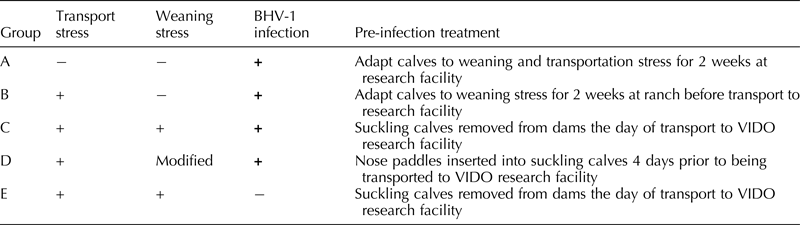
Crossbred (Angus X Hereford), suckling calves of either sex were selected from a single herd (Gaffe Ranch, Swift Current, SK) where cows were vaccinated pre-breeding with a multivalent, modified-live viral vaccine. Calves were born in April and May, and in August serum samples were collected from these calves to screen for antibody titers to BHV-1. Forty seronegative calves (n = 8 calves/group) were randomly assigned to five experimental groups (Table 1) to determine the effects of transport stress, either alone or in combination with abrupt weaning on clinical disease and immune responses following BHV-1 infection. The effect of abrupt weaning was further investigated by including a group that was weaned using a two-step protocol, previously described by Haley et al. (Reference Haley, Bailey and Stookey2005). The day prior to BHV-1 challenge, calves were transported for 3.5 h prior to being housed in a single pen at the research facility. The average weight of calves on arrival was 218 kg with body weights ranging between 174 and 242 kg. The day following transport, calves were aerosol challenged with a clinical BHV-1 isolate (Isolate 108; 5 × 10⁷ PFU animal−1) using a nebulizer (Babiuk et al., Reference Babiuk, Lawman and Gifford1987).
Summary of stressors in each experimental group

Monitoring clinical and immune responses to infection
Body weight, rectal temperature, and virus shedding in nasal secretions were monitored daily by a clinical veterinarian blinded to treatment groups. Nasal secretions were analyzed for interferon-gamma (IFN-γ) levels on days 0, 3, 5 and 7 post-BHV-1 challenge by capture ELISA (Raggo et al., Reference Raggo, Habermehl, Babiuk and Griebel2000). Systemic inflammatory responses following BHV-1 infection were monitored by quantifying the level of serum haptoglobin with a capture ELISA (Godson et al., Reference Godson, Baca-Estrada, Van Kessel, Hughes, Morsy, Van Donkersgoed, Harland, Shuster, Daley and Babiuk1995). Tumor necrosis factor (TNF) production by peripheral blood mononuclear cells (PBMCs) was assayed by plating 5 × 10⁵ PBMC per well and stimulating cells with 100 ng ml−1 lipopolysaccharide (LPS). Culture supernatants were collected 24 h later and stored at −80 °C until TNF levels were assayed using a capture ELISA (Mookherjee et al., Reference Mookherjee, Wilson, Doria, Popowych, Falsafi, Yu, Li, Veatch, Roche, Brown, Brinkman, Hokamp, Potter, Babiuk, Griebel and Hancock2006). Statistical analyses were performed using GraphPad Prism Version 6.10 software (GraphPad Software, Inc., San Diego, CA). The Shapiro–Wilk normality test was performed to determine if data sets were normally distributed. When appropriate either an ANOVA or a Kruskal–Wallis analysis were used with Dunn's post-test for analyses of differences (daily body temperatures, body weight, serum haptoglobin, IFN-γ and TNF secretion) among treatment groups.
Results
Clinical data
All BHV-1 infected calves displayed a marked decrease in body weight and similar increases in rectal temperature following BHV-1 infection (Fig. 1). Calves undergoing two-step weaning (Group D) were the only group to display a significant difference in body weight during the first 24 h after BHV-1 infection and after day 4 post-infection (PI) all infected groups displayed similar reductions in weight relative to uninfected controls (Group E). Neither transportation alone nor combined weaning and transportation altered fever responses following BHV-1 infection. In contrast, the stress of transportation and abrupt weaning significantly (P < 0.05) increased viral shedding relative to Group A, which was pre-adapted to these stressors for 2 weeks (Fig. 1c). There was, however, no significant difference in the duration of virus shedding with fewer than 3 animals/group shedding low but detectable levels of BHV-1 on day 11 PI (Fig. 1c).
Clinical response to BHV-1 infection was monitored daily by measuring changes in body weight (a), temperature (b) and virus shedding in nasal secretion (c). Calves in Groups A–D were infected with BHV-1 and Group E provided an uninfected control. Weight changes were normalized relative to day 0 to eliminate variation in initial body weights among animals. The number of plaque forming units (PFU) ml−1 of culture medium were used to quantify infectious virus particles in nasal secretions. Data presented are mean values for each group (n = 8). Significant changes in BW relative to control Group E are indicated only for the first 4 days PI. Increased Virus shedding, relative to Group A, was observed in Groups B, C, and D on day 3 and Group B on day 7 PI. *P < 0.05.
Innate immune responses
BHV-1 infection is a potent inducer of IFN production (Hodgson et al., Reference Hodgson, Stookey, Popowych, Potter, Babiuk and Griebel2012) and transportation alone (Group B) resulted in significantly higher (P < 0.05) IFN-γ secretion on day 5 PI relative to calves acclimatized for 2 weeks (Group A). Combining abrupt weaning (Group C) or two-stage weaning (Group D) with transportation reduced IFN-γ secretion but these levels still exceeded Group A (Fig. 2a). Serum haptoglobin provides a measure of inflammatory responses following infections, such as a BHV-1 respiratory infection (Hodgson et al., Reference Hodgson, Stookey, Popowych, Potter, Babiuk and Griebel2012). Combining transportation and abrupt weaning (Group C) resulted in the highest serum haptoglobin concentration 3 days after BHV-1 infection (Fig. 2b). Transportation alone (Group B) did not result in a similar elevation in haptoglobin and two-step weaning also resulted in a significantly (P < 0.05) lower inflammatory response. Serum haptoglobin levels were similar among Groups A, B and C on day 5 PI, indicating that abrupt weaning had a transient effect on the inflammatory response to BHV-1 infection. A remarkable observation was that modifying the stress of maternal separation, with two-step weaning, significantly reduced the inflammatory response on day 5 PI (Fig. 2b). TNFα is a potent mediator of tissue damage and inflammation which contributes to lung pathology during bacterial infection. LPS stimulation of PBMCs prior to BHV-1 infection induced very low levels of TNFα secretion. On day 3 PI, however, TNFα secretion increased significantly (P < 0.05) in all BHV-1 infected animals but combining transportation and abrupt weaning (Group C) resulted in a significantly (P < 0.05) greater elevation of this response (Fig. 2c). Transportation alone (Group B) did not enhance LPS responsiveness and using two-step weaning, to modify the stress of maternal separation, also reduced TNFα production.
Immune responses following BHV-1 infection. (a) IFN-γ production in nasal secretions following BHV-1 infection. (b) Changes in serum haptoglobin levels following BHV-1 infection. Data presented are mean values for each group. (c) LPS-induced production of TNFα by PBMCs following LPS stimulation. *(P < 0.05).
Discussion
A variety of stressors have been associated with an increased risk of fatal secondary bacterial respiratory infections in people (Graham et al., Reference Graham, Douglas and Ryan1986) and animals (Hoerlein and Marsh, Reference Hoerlein and Marsh1957; Jensen et al., Reference Jensen, Pierson, Braddy, Saari, Lauerman, England, Keyvanfar, Collier, Horton, McChesney, Benitez and Christie1976). There is, however, contradictory evidence regarding the contribution made by transportation stress to undifferentiated BRD in feedlot calves (Cole et al., Reference Cole, Camp, Rowe, Stevens and Hutcheson1988; Ribble et al., Reference Ribble, Meek, Shewen, Jim and Guichon1995), but weaning and maternal separation are highly correlated with an increased incidence of undifferentiated BRD (Step et al., Reference Step, Krehbiel, DePra, Cranston, Fulton, Kirkpatrick, Gill, Payton, Montelongo and Confer2008). We recently confirmed that maternal separation and weaning, in combination with transportation, doubled mortality and enhanced inflammatory responses when naïve calves were aerosol challenged with BHV-1 followed by a secondary bacterial infection with Mannheimia haemolytica (Hodgson et al., Reference Hodgson, Stookey, Popowych, Potter, Babiuk and Griebel2012). These studies did not, however, determine the contribution of transportation and maternal separation as individual or combined stressors to enhanced pro-inflammatory responses following BHV-1 infection.
Monitoring clinical responses, including body weight and temperature, confirmed that all calves, with or without stress, develop clinical signs typical of an acute primary BHV-1 infection (Fig. 1). Divergent changes in body weight during the early PI period suggest, however, that stressors may induce significant physiological differences among treatment groups at the time of BHV-1 infection. This is consistent with transportation resulting in significantly (P < 0.05) higher virus shedding on days 3 and 5 PI (Fig. 1). Serum from stressed calves enhanced BHV-1 replication in vitro (Blecha and Minocha, Reference Blecha and Minocha1983) and stress plays an important role in the recrudescence of latent BHV-1 infections (Pastoret et al., Reference Pastoret, Babiuk, Misra and Griebel1980). Therefore, further investigation may be warranted to determine if transportation stress is a factor that influences the severity of a primary BHV-1 infection.
Daily handling of calves to collect samples and data represents a potentially significant stressor in and of itself that may contribute to the values obtained, but all treatment groups were exposed to this same handling stressor. Nevertheless, the stressors we intentionally manipulated had differential effects on a variety of innate immune responses (Fig. 2). These differential effects on pro-inflammatory cytokines are of particular interest because our previous investigations revealed that an increased inflammatory response was significantly correlated with fatal secondary M. haemolytica respiratory infections (Hodgson et al., Reference Hodgson, Stookey, Popowych, Potter, Babiuk and Griebel2012). Of particular interest is that using two-step weaning to modify the stress of maternal separation significantly (P < 0.05) reduced pro-inflammatory responses. These observations provide the first evidence that management procedures altering psychological stress may have a direct impact on immune responses following a respiratory infection.
Acknowledgments
This work was supported by the Saskatchewan Agriculture Development Fund and the Natural Sciences and Engineering Research Council of Canada (NSERC). Philip Griebel holds a Tier I CRC in Mucosal Immunology which is funded by the Canadian Institutes of Health Research (CIHR).