Introduction
Since strict regulations limit the availability of synthetic pesticides in greenhouses, new strategies are designed for the control of different phytophagous pests. Recent evidence has revealed that biological control methods can be used for various pests that are dangerous to different crops. After hymenopteran parasitoids, acarid predators are well known as the most effective and important group of organisms used for the biological control of phytophagous mites and insects on greenhouse crops (Buitenhuis et al., Reference Buitenhuis, Murphy, Shipp and Scott-Dupree2015). For the explicit reason that phytoseiid predatory mites can feed on different food sources including spider mites, different insects, fungi, pollen, plant exudates, and nematodes (McMurtry et al., Reference McMurtry, De Moraes and Sourassou2013), they have been given much interest in the last decades. The preference of different food items including different pollen grains (Riahi et al., Reference Riahi, Fathipour, Talebi and Mehrabadi2016, Reference Riahi, Fathipour, Talebi and Mehrabadi2017a; Khanamani et al., Reference Khanamani, Fathipour, Talebi and Mehrabadi2017a), powdery mildew (Zemek and Prenerova, Reference Zemek and Prenerova1997; Duso et al., Reference Duso, Pozzebon, Capuzzo, Bisol and Otto2003), factitious prey (Riahi et al., Reference Riahi, Fathipour, Talebi and Mehrabadi2017b), as well as artificial foods (Nguyen et al., Reference Nguyen, Bouguet, Spranghers, Vangansbeke and De Clercq2015; Riahi et al., Reference Riahi, Fathipour, Talebi and Mehrabadi2017c; Khanamani et al., Reference Khanamani, Fathipour, Talebi and Mehrabadi2017c) to support the various phytoseiid mites’ population has been frequently addressed.
It is generally accepted that generalist phytoseiid mites bear some advantageous traits ensuring the long-term control of greenhouse pests. Predator population can be sustained by feeding on either alternative food such as pollen and alternative prey or plant secretions in greenhouses and fields, especially in the absence of target pest species (van Rijn et al., Reference van Rijn, Van Houten and Sabelis2002). Bluntly put, the presence of pollen as an alternative or supplementary food source not only provides important nutrients including proteins, free amino acids, carbohydrates, lipids, vitamins, flavonoids, and minerals for predators, but also allows the predators to establish their population before the prey population (van Rijn et al., Reference van Rijn, Van Houten and Sabelis2002; Nomikou et al., Reference Nomikou, Janssen and Sabelis2003). The role of pollen from different plants for various generalist predatory mites in both field and laboratory has been well documented (van Rijn et al., Reference Van Rijn, Van Houten and Sabelis1999; Hoogerbrugge et al., Reference Hoogerbrugge, van Houten, Knapp and Bolckmans2011; Riahi et al., Reference Riahi, Fathipour, Talebi and Mehrabadi2016; Khanamani et al., Reference Khanamani, Fathipour, Talebi and Mehrabadi2017a).
Better performance of generalist predators, as well as an increase in their density, may be an incentive factor in the ability of the predators to exploit more than one food item or mixed diets (Momen and El-Borolossy, Reference Momen and El-Borolossy2010). Hoogerbrugge et al. (Reference Hoogerbrugge, van Houten, Knapp and Bolckmans2011) reported that the presence of pollen on strawberries accelerated the growth rate of Amblyseius limonicus Garman and McGregor, with increased Trialeurodes vaporariorum Westwood control as a consequence. In addition, it has been demonstrated that when pollen was supplemented on cucumber, two species of predatory mites, Iphiseius degenerans Berlese and A. limonicus, developed faster and resulted in the suppression of thrips population (van Rijn et al., Reference Van Rijn, Van Houten and Sabelis1999). Furthermore, the effectiveness of Neoseiulus californicus (McGregor) in the control of Tetranychus urticae Koch was improved in the presence of maize pollen (Khanamani et al., Reference Khanamani, Fathipour, Talebi and Mehrabadi2017b). In another study, the presence of almond pollen augmented the control potential of Amblyseiuss wirskii (Athias-Henriot) against T. urticae (Riahi et al., Reference Riahi, Fathipour, Talebi and Mehrabadi2017a).
Neoseiulus californicus, a type II selective predator, is one of the most important biological control agents used in augmentative biological control against various pests (McMurtry et al., Reference McMurtry, De Moraes and Sourassou2013). While it is true that this predator is mostly active on tetranychid mites, especially tetranychids producing heavy webbing, the fact still remains that they can exploit other mite species, small insects, such as thrips, and even pollen (McMurtry and Croft, Reference McMurtry and Croft1997). Many new publications that deal with different aspects of biology, ecology, and practical use of N. californicus against tetranychid mites are attributable to the wide efficiency of this predator (Barber et al., Reference Barber, Campbell, Crane, Lilley and Tregidga2003; Khanamani et al., Reference Khanamani, Fathipour, Talebi and Mehrabadi2017a, Reference Khanamani, Fathipour, Talebi and Mehrabadi2017b). Interestingly, despite this content of researches, the knowledge on alternative food spectrum accepted by this predator, as well as the effects of mixing natural prey with pollen on its efficacy, still remains insufficient.
Considering our previous study (Soltaniyan et al., unpublished data), which reflected the nutritional value of four different pollen grains compared with main prey (T. urticae), it was revealed that both development and reproduction of N. californicus were conditioned by the type of pollen. The fact remains that the presence of different pollens as a supplementary food source can affect the performance, together with the life table parameters of N. californicus for the control of T. urticae. Therefore, this study describes the effects of the addition of four pollen grains in a mixed diet with main prey on the development, reproduction, and growth rate of N. californicus.
Materials and methods
Stock culture of mites
The initial population of T. urticae was collected from infested greenhouses in Pakdasht region (South-Eastern part of Tehran). The mite colony was established on bean plants (Phaseolus vulgaris var. Khomein) at 25 ± 5°C, under natural humidity and photoperiod of greenhouse.
The population of N. californicus was obtained from Koppert Giah-Bazr-Alvand Company (Tehran, Iran). The individuals were reared on experimental rearing arena at 25 ± 1°C, 65 ± 5% RH, and a photoperiod of (16:8) L:D hours. Each experimental rearing arena consisted of a plastic sheet (23 × 14 × 0.3 cm) put on a water-saturated sponge placed inside a plexiglas box (23 × 14 × 9 cm) half-filled with water. In order to not only provide a water source, but also prevent mites from escaping, small layers of towel were used for covering all margins of plastic sheet. Bean leaves heavily infested with T. urticae were added to each arena as a food source every 2 days.
Pollen sampling
Pollen of cedar (Cupressus sempervirens), pear (Pyrus communis), apricot (Prunus armeniaca) and pistachio (Pistachio vera) were collected from aforementioned trees not treated with pesticides in East Azarbaijan province, Iran, during March 2016. The blooms of each plant were gathered separately by hand during the spring season. After separating the flags, they were oven dried (at 37°C for 48 h), and then severely taken on a newspaper to the laboratory. Pollen was aggregated into a glass vial and stored in a refrigerator (at 4°C) awaiting the experiments.
Experimental unit
The experimental units comprised of a bean leaf disc (3 cm diameter) placed upside down on water-saturated cotton located on a fiber in a plastic saucer (17 × 8 × 8 cm). The leave margins were covered with moist tissue paper which served as a water supply source, as well as prevented predators from escaping. Some of the cotton strings, together with a piece of fiberglass, were placed in the center of the bean leaf disc as a shelter and oviposition site for the predatory mites.
Diets
The treatments tested were as follows:
(a) About 0.05 mg of apricot pollen + either 15 (during immature stages) or 40 (during adult stage) T. urticae nymphs
(b) About 0.05 mg of pistachio pollen + either 15 (during immature stages) or 40 (during adult stage) T. urticae nymphs
Experimental design
To assess the effects of mixed diet on the development and reproduction of N. californicus, mites were reared on the experimental units and fed with one of the four treatments. After two generations, the eggs of adults were used for initiating the experiments. By considering the same rearing history, obtained eggs were transferred individually to the experimental unit, and from the larval stage onward, the mites were provided with the respective diet. The foods were replenished every day. Experimental units were daily checked by recording the development as well as the survival of individuals by removing the exuviae of the moulted stages. Upon adult emergence, females and males were coupled and then transferred to a new experimental unit and immediately fed with the same diet with which they were reared on formerly. In addition to adult survival and longevity, the number of eggs produced by females was recorded daily until the death of all individuals. All experiments were conducted in a growth chamber at 25 ± 1°C, 65 ± 10% RH, and a photoperiod of 16:8 (L:D) hours.
Data analysis
The age-stage, two-sex life table procedure was chosen for data analysis to allow considering both variable developmental rate among individuals and stage differentiation (Chi and Liu, Reference Chi and Liu1985). All parameters including the age-stage-specific survival rate (sxj), age-specific survival rate (lx), age-specific fecundity (mx), as well as all population growth parameters [the intrinsic rate of increase (r), the finite rate of increase (λ), the gross reproductive rate (GRR), and the net reproductive rate (R 0)] were calculated according to the method of Chi and Liu (Reference Chi and Liu1985) and Chi (Reference Chi1988) using TWOSEX-MS Chart (Chi, Reference Chi2016). Multiple comparisons of all estimated parameters including developmental duration of the different life stages, fecundity, reproduction periods, as well as population growth parameters were performed by a paired bootstrap test using TWOSEX-MS Chart with 100,000 samples.
Results
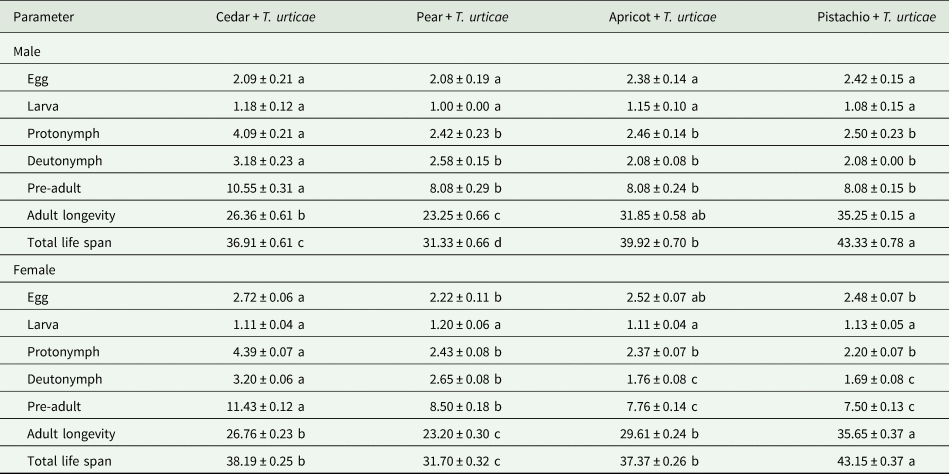
Table 1 provides the effects of four different mixed diets on the development and reproduction of N. californicus. It is apparent from this table that although male incubation period differences were not significant among different diets, it was significantly different for females (table 1). Paired bootstrap test showed that the completion of both protonymphal and deutonymphal development was slowest on a diet of cedar pollen + T. urticae for males, while there was not any significant difference among other diets (table 1). The longest female deutonymphal duration was obtained on cedar pollen + T. urticae, followed by pear pollen + T. urticae, apricot pollen + T. urticae, and pistachio pollen + T. urticae (table 1). As it is clear from table 1, female individuals fed on pistachio pollen + T. urticae, along with apricot pollen + T. urticae, reached the adulthood more rapidly than those fed on pear pollen + T. urticae than those reared on cedar pollen + T. urticae.
Comparative duration (day, mean ± SE) of immature stages, longevity, and total life span of Neoseiulus californicus reared on four different mixed diets

The standard errors were calculated using the bootstrap procedure with 100,000 bootstraps. The means followed by different letters in the same row are significantly different between diets using the paired bootstrap test (P < 0.05).
The longest and shortest female, together with male adult longevity, were obtained by feeding on pistachio pollen + T. urticae and pear pollen + T. urticae, respectively. Males reared on pistachio pollen + T. urticae survived significantly more days than those fed on apricot pollen + T. urticae, than on other diets. Females reared on the mixed diet that comprised pistachio pollen reflected the longest total life span duration, while the shortest was on the diet that included pear pollen (table 1).
Feeding on different diets caused differences in the reproduction periods and fecundity of N. californicus (table 2). The lowest fecundity, as well as the shortest reproduction period, was determined on the diets that included pear pollen, while the highest fecundity and the longest reproduction period were observed on pistachio pollen + T. urticae. The total pre-oviposition period (TPOP) on pistachio pollen + T. urticae was significantly shorter than that of the other three diets (table 2). The presence of pistachio pollen interestingly reduced the duration of adult pre-oviposition period in contrast to apricot and cedar pollen (table 2).
Comparative duration of reproductive periods and fecundity (Mean ± SE) of Neoseiulus californicus reared on four different mixed diets.

APOP, adult pre-ovipositional period; TPOP, total pre-ovipositional period.
The standard errors were calculated using the bootstrap procedure with 100,000 bootstraps. The means followed by different letters in the same row are significantly different between diets using the paired bootstrap test (P < 0.05).
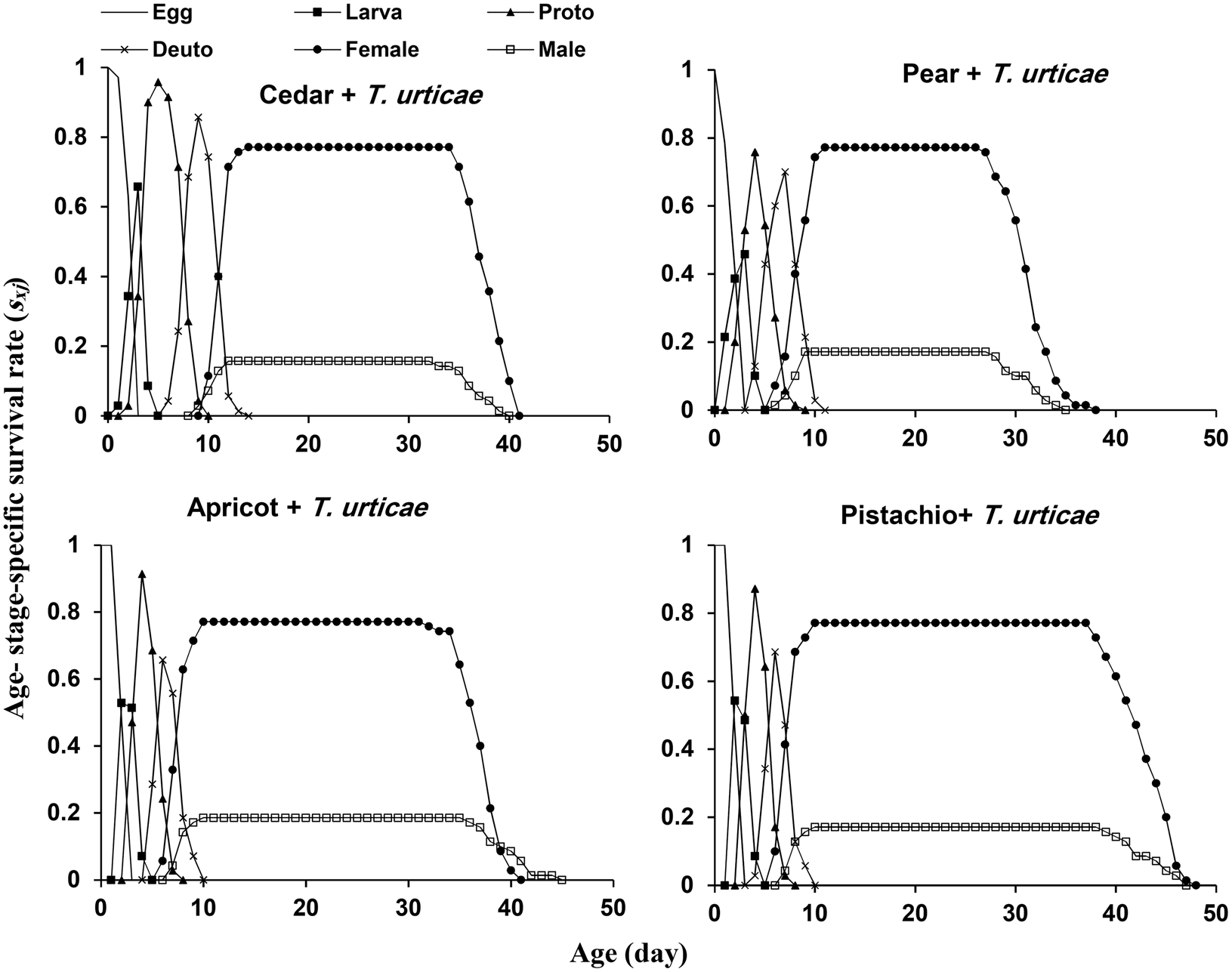
Fig. 1 presents the age-stage-specific survival rate (sxj) representing the probability that a newly born individual will survive up to each age-stage unit, on four different diets. The highest value of sxj for adult stage on all diets was 0.771 for females and 0.171, 0.157, 0.171, and 0.186 for males on the mixture of T. urticae with pistachio, cedar, pear, and apricot pollen, respectively. The interesting thing about this figure is that besides the survivorship, stage differentiation can be easily seen. What is more, it is by virtue of variable developmental rate among individuals that overlapping between curves has occurred (fig. 1).
Age-stage-specific survival rate (sxj) of Neoseiulus californicus fed on four different diets.

Table 3 presents the means, together with the standard errors of the population growth parameters estimated using the bootstrap procedure. The intrinsic rate of increase (r) and finite rate of increase (λ) were highest on pistachio pollen + T. urticae, followed by the mixture of either apricot, pear, or cedar pollen with immature T. urticae. Net as well as gross reproductive rate was significantly conditioned by the type of diet; as their highest values were obtained in the presence of pistachio pollen, cedar and pear pollen resulted in the lowest values of the mentioned parameters (table 3).
The mean (±SE) of population growth parameters of Neoseiulus californicus reared on four different mixed diets.

The standard errors were calculated using the bootstrap procedure with 100,000 bootstraps. The means followed by different letters in the same row are significantly different between diets using the paired bootstrap test (P < 0.05).
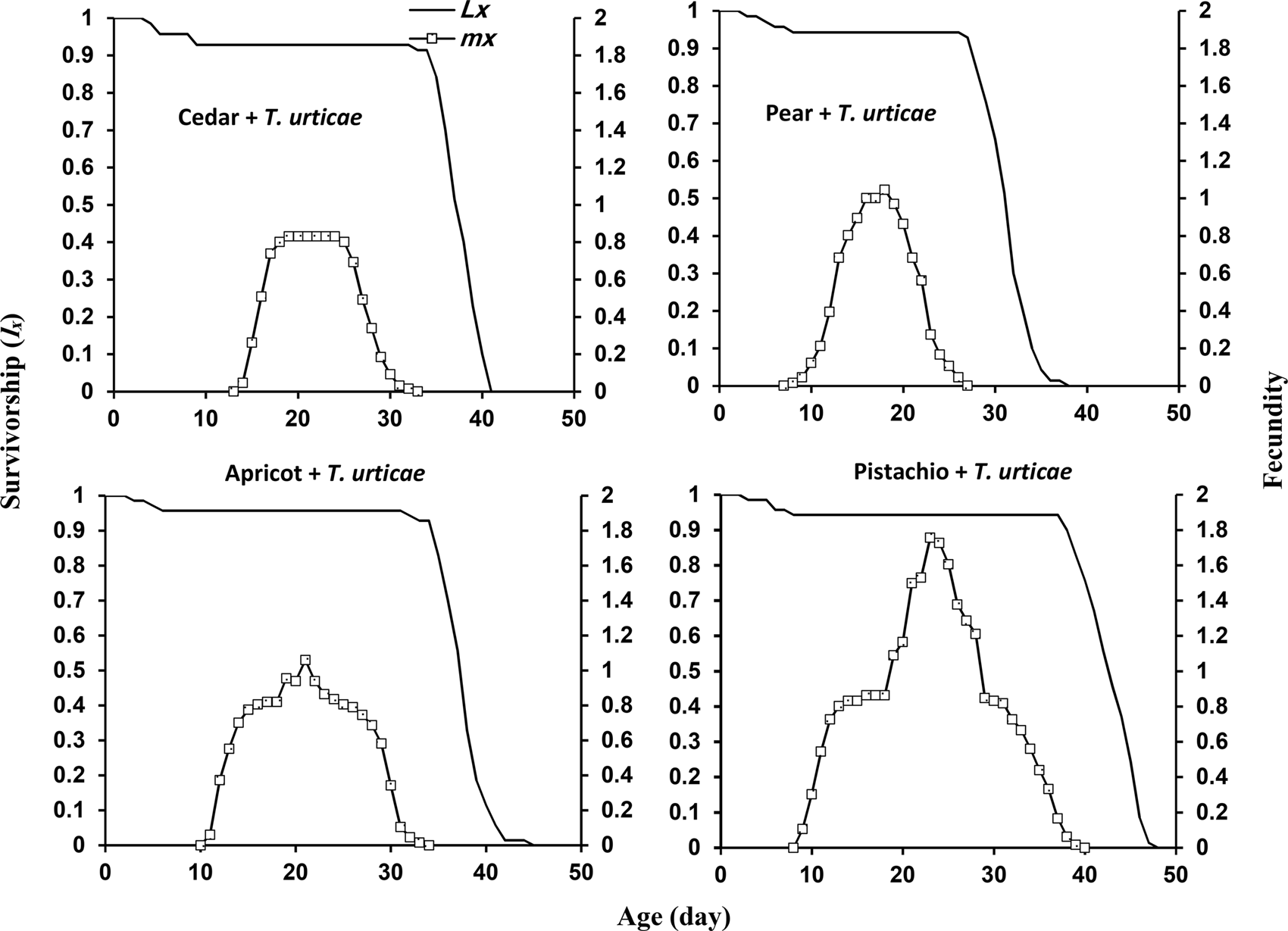
The age-specific fecundity (mx), mean number of offspring produced by individuals at age x, as well as age-specific survivorship (lx), and the probability that a new born individual will survive to age x, of N. californicus on different combinations of diet, have been depicted in fig. 2. The highest daily oviposition was 0.83, 1.05, 1.06, and 1.76 eggs on the combination of T. urticae with different pollen including cedar, pear, apricot, and pistachio, respectively, which occurred at the age of 19, 18, 21, and 23 days, respectively (fig. 2).
Age-specific survivorship (lx) and age-specific fecundity (mx) of Neoseiulus californicus fed on four different diets.

Discussion
Over the past decade, there has been a dramatic increase in the use of age-stage, two-sex life table procedure to investigate the effects of different variable factors on various organisms. In contrast to the traditional female age-specific life table, not only the emergence of each stage, but also the overlaps between stages could be completely characterized, as a result of considering stage differentiation. In addition, ignoring stage differentiation has a serious effect on lx and mx curves, as a consequence of considering adult age (Huang and Chi, Reference Huang and Chi2012). Akkopru et al. (Reference Akkopru, Atlihan, Okut and Chi2015) published a paper in which the difference between the standard statistical procedure and the bootstrap technique was described. These two procedures are different from each other in using the data of all individuals or the means of all resampling for the estimation of SE. It is true that estimated SE is almost the same, but what is surprising is that a normal frequency distribution, which is essential for the following analysis and comparison, is only produced by bootstrapping (Akkopru et al., Reference Akkopru, Atlihan, Okut and Chi2015). This is why in this study, age-stage, two-sex life table procedure was used for data analysis and bootstrapping was used for calculating the standard errors (SE) of all parameters including stage duration, developmental time, longevity, fecundity, as well as population growth parameters.
With the comparison of four diets, this study aimed to investigate the efficacy and performance of N. califotnicus in controlling T. urticae in the presence of different pollen grains. The single most striking observation that emerged from the data comparison was that the presence of pistachio pollen resulted in reduced pre-adult development and increased oviposition rate, as well as population growth rates of N. californicus. These results could be attributed to the desirable nutritional quality of pistachio pollen for N. californicus compared with other pollen tested. Mixing cedar pollen with natural prey resulted in the drastic reduction in oviposition rate and prolonged pre-adult development compared with the other three pollens. Inferior nutritional quality of cedar pollen for N. californicus is the simple reason for this result. In another study, the effects of the combination of T. urticae with three pollen grains on the performance of N. californicus were compared (Khanamani et al., Reference Khanamani, Fathipour, Talebi and Mehrabadi2017b). On the basis of the mentioned study, the composite of maize pollen caused the best efficiency (r = 0.1409), which is lower than the highest growth rate in the current study (r = 0.1540). There are grounds for suggesting that pollen grain size does not have an important effect on its quality as a food source for the mites (van Rijn and Tanigoshi, Reference van Rijn and Tanigoshi1999); therefore, other pollen features, such as exine thickness and structure, as well as nutritional composition are the contributory factors in these differences.
It is generally accepted that the nutritional value of a diet for predatory mites can be compared by the estimation of the life table parameters. Among them, intrinsic rate of increase is the most important parameter. In the present study, this parameter varied from 0.1010 to 0.1540 day−1. Variable growth rates of N. californicus as a consequence of different diets including natural prey such as Panonychus ulmi (Koch) (0.25 day−1; El Taj and Chuleui Reference El Taj and Chuleui2012), T. urticae (0.1545 day−1; Khanamani et al., Reference Khanamani, Fathipour, Talebi and Mehrabadi2017a), and Thrips tabaci Lindeman (0.041 day−1; Rahmani et al., Reference Rahmani, Fathipour and Kamali2009); artificial diets (−0.2089 to 0.0782 day−1; Khanamani et al., Reference Khanamani, Fathipour, Talebi and Mehrabadi2017c); and different pollen grains (0.0057–0.2318 day−1; Khanamani et al., Reference Khanamani, Fathipour, Talebi and Mehrabadi2017a) have been reported. Such variation may be attributed not only to different food items offered to predators, but also to different experimental conditions, genetic variation among predator populations, and/or different data analysis procedures.
The presence of pollen beside natural prey and its effects must be considered in both positive and negative aspects. On one hand, pollen grains may change the predator's behavior into feeding on pollen, consequently resulting in the reduced control of target pests in the short term (van Rijn et al., Reference van Rijn, Van Houten and Sabelis2002; Nomikou et al., Reference Nomikou, Sabelis and Janssen2010). On the other hand, pollen grains may give rise not only to an increase in the predator's offspring production, but also eliminate their negative effects on the predator's functional response which will result in the reduction in pest population over a long period of time (van Rijn et al., Reference van Rijn, Van Houten and Sabelis2002; Nomikou et al., Reference Nomikou, Sabelis and Janssen2010). In addition, it is adequate to say that during periods where natural prey are scarce or absent, predators can maintain their population on pollen (Riahi et al., Reference Riahi, Fathipour, Talebi and Mehrabadi2017a; Khanamani et al., Reference Khanamani, Fathipour, Talebi and Mehrabadi2017b). It could be reasonably argued that supplementation of natural prey with pollen grains may lead to complicated effects in its nature for the simple reason that it depends on the feeding preference of predator. While it is true that reduction in predation rate by virtue of the presence of pollen besides prey has been reported for different phytoseiid mites (Nomikou et al., Reference Nomikou, Janssen, Schraag and Sabelis2002; Riahi et al., Reference Riahi, Fathipour, Talebi and Mehrabadi2017a), the fact still remains that this was compensated for by increasing the predator's egg production, together with growth rate (Nomikou et al., Reference Nomikou, Janssen, Schraag and Sabelis2002; Hoogerbrugge et al., Reference Hoogerbrugge, van Houten, Knapp and Bolckmans2011; Pappas et al., Reference Pappas, Xanthis, Samaras, Koveos and Broufas2013; Khanamani et al., Reference Khanamani, Fathipour, Talebi and Mehrabadi2017b; Riahi et al., Reference Riahi, Fathipour, Talebi and Mehrabadi2017a). With the results of Khanamani et al. (Reference Khanamani, Fathipour, Talebi and Mehrabadi2017b) in mind, the present results indicated that different pollen species showed large differences in changing the quality of T. urticae as a food source for N. californicus. By way of comparison, it is difficult to elude the obvious conclusion that the performance of N. californicus fed on the diet comprising both pistachio pollen and T. urticae was better than the diets that included solely T. urticae (Khanamani et al., Reference Khanamani, Fathipour, Talebi and Mehrabadi2017b). Pre-adult development as well as TPOP was shorter, while the values of R 0, r, and λ were higher on the mixture diet than T. urticae solely. A possible explanation for this might be that pistachio pollen is full of nutrients which are in accordance with the need of this species.
In conclusion, from the control point of view, the presence of pistachio pollen in the field or greenhouses infested with T. urticae can enhance both the development and growth rate of N. californicus, especially during the periods of prey scarcity. This event will help the predators to build up a population before the pest mites reach outbreak levels and consequently will control the pest population while they are still at non-damage levels. On the other hand, this phenomenon will allow predators to sustain and increase their population. Therefore, in order to achieve the positive effects of pistachio pollen in the efficacy of N. californicus to control T. urticae, it is suggested to plant pistachio in and around croplands and orchards, or spray the crops in greenhouses with stored pollen. In particular, uncertainty still prevails as to whether a reduction in predation rate due to feeding on pollen is compensated for by a greater amount of predation due to an increased predator population during the season after T. urticae starts to increase. This is an important issue for future research.