Implications
Rabbits are a source of animal protein and improving rabbit production could contribute to increasing life standard worldwide practically in developing countries. The effect of soybean lecithin in rabbit nutrition is not completely known because of lack of data on semen quality and reproductive indices and antioxidant status. The use of lecithin could contribute toward an increase in reproductive efficiency and it may be an important resource as a supplement in rabbit nutrition.
Introduction
Soybean lecithin (SL) is a by-product from the processing of soybean oil that, apart from being a source of energy, also serves as an emulsifier and has the potential to facilitate fat absorption (Lechowski et al., Reference Lechowski, Bielecki, Sawosz, Krawiec and Klucinński1999). Lecithin is also a polyunsaturated phosphatidylcholine (PPC), which is high in energy functional and structural elements of all biological membranes. Lecithin, as a PPC, is a naturally occurring mixture of diglycerides of stearic, palmitic, linoleic and oleic acids that links to the choline ester of phosphoric acid (Fiume, Reference Fiume2001). PPC plays a rate-limiting role in the activation of numerous membrane-located enzymes, including superoxide dismutase (SOD) and glutathione (GSH), which are important antioxidants and protect cell membranes from damage by reactive oxygen species (ROS). ROS-induced damage to mitochondrial DNA may lead to reduced mitochondrial function. Lecithin may protect mitochondrial DNA, preserving the age-related decline in mitochondrial membrane potentials and hence their activity (Ulkowski et al., Reference Ulkowski, Musialik and Litwinienko2005).
Lipids are involved in the structural and functional functions of the sperm, and their profile may be modified according to physiologic events and/or diet (Mourvaki et al., Reference Mourvaki, Cardinali, Dal Bosco, Corazzi and Castellini2010). Animals cannot synthesize polyunsaturated fatty acids (PUFA) n-6 or n-3 fatty acids de novo as they lack the appropriate fatty acid desaturase enzymes. The n-6 PUFA linoleic acid (LA) and the n-3 PUFA α-linolenic acid therefore need to be provided in the diet as they are absolutely necessary for numerous processes, including growth, reproduction, vision and brain development (Gurr et al., Reference Gurr, Harwood and Frayn2002). There is considerable evidence that dietary PUFA supplementation can influence biosynthetic pathways involved in both prostaglandin synthesis and steroidogenesis that play multiple roles in the regulation of reproductive function. Furthermore, the PUFA composition of the cell membranes of the sperm and oocyte is important during fertilization (Aitken and Baker, Reference Aitken and Baker1995).
Lecithin has been widely used in animal diets, such as in sheep (Jenkins and Fotouhi, Reference Jenkins and Fotouhi1990), lambs (Lough et al., Reference Lough, Solomon, Rumsey, Elsasser, Slyter, Kahl and Lynch1991), horses (Holland et al., Reference Holland, Kronfeld, Rich and Kline1998), fish (Liu et al., Reference Liu, Barrows, Hardy and Dong2004), swine (Soares and Lopez-Bote, Reference Soares and Lopez-Bote2002) and laying hens (Attia et al., Reference Attia, Hussein, Tag El-Din, Qota, Abed El-Ghany and El-Sudany2009a). On the other hand, the use of lecithin in rabbit diets is rare. Supplementation of animal diets with oils rich in PUFA, such as LA, has positively influenced reproductive functions (Fellner et al., Reference Fellner, Sauer and Kramer1995; Rocha et al., Reference Rocha, Cunha, Ederli, Albernaz and Quirino2009).
SL is also a rich source of alpha, gamma and delta tocopherol; however, the contents of tocopherol vary considerably from 13 (Scholfield, Reference Scholfield1981) to 25.5 mg/100 g (Wang and Wang, Reference Wang and Wang2008). SL was also shown to decrease hepatic cellular damage and improve oxidative stability, and exerted neuroprotective activity through its antioxidant action (Aabdallah and Eid, Reference Aabdallah and Eid2004; Das and Vasudevan, Reference Das and Vasudevan2006; Das et al., Reference Das, Gupta, Rao and Vasudevan2007; Wang and Wang, Reference Wang and Wang2008). The effect of the antioxidant properties of lecithin could be attributed to the synergistic influence between amino-alcohol phospholipids and γ- and δ-tocopherols (Judde et al., Reference Judde, Villeneuve, Rossignol-Castera and Le Guillou2003). Therefore, the aim of this study was to investigate the effect of SL supplementation on semen quality, blood testosterone concentration, blood and seminal plasma biochemistry including antioxidant status and fertility traits.
Material and methods
The experimental work of this study was carried out at El-Sabahia Poultry Research Station (Alexandria), Animal Production Research Institute, Agricultural Research Center, Ministry of Agriculture, during 2010 to 2011.
Animals, experimental design and diets
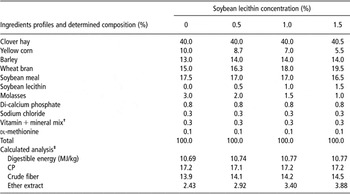
A total of 28 male V-line rabbits (aged between 7 and 8 months) were randomly distributed among four dietary treatments in a straight-run experimental design. The first treatment served as a control (Con; 0% SL); the second, third and fourth treatments were supplemented with 0.5%, 1.0% and 1.5% SL in the diet, respectively (Table 1). The diets were formulated based on the National Research Council (NRC, 1977) to meet rabbits’ nutrient requirements. The rabbit bucks were individually housed in galvanized wire cages, offered free access to fresh water and feed and subjected to a 14 : 10 light–dark cycle.
Proximate analysis of pelleted basal diet (% on a dry matter basis)

†The vitamin and mineral premix/kg contained the following IU/g for vitamins or minerals: A – 4 000 000; D3 – 5 000 000; E – 16.7 g; K – 0.67 g; B1 – 0.67 g; B2 – 2 g; B6 – 0.67 g; B12 – 0.004 g; B5 – 16.7 g; pantothinc acid – 6.67 g; biotein – 0.07 g; folic acid – 1.67 g; choline chloride – 400 g; Zn – 23.3 g; Mn – 10 g; Fe – 25 g; Cu – 1.67 g; I – 0.25 g; Se – 0.033 g and Mg – 133.4 g (Rabbit premix produced by Holland Feed Inter. Co.).
‡Based on National Research Council (1994).
Feed intake and BW gain
Daily feed intake (g/kg BW) and weekly BW (g/buck) were recorded.
Semen quality
Semen collection occurred weekly over the 12 weeks; thus, 84 ejaculates were obtained per treatment. Ejaculates were collected using an artificial vagina maintained at 45°C to 46°C and a teaser doe. The volume of each ejaculate was recorded after removal of the gel mass. The reaction time (RT) was the time interval from the introduction of the teaser doe into the male's cage to ejaculation; it was measured in seconds using a stopwatch and was considered as an indication of libido. Immediately after collection, semen was maintained at 35°C in a water bath for evaluation.
Fresh semen (two drops) was placed on a warm slide and covered with a cover slip (20 × 20 mm) to determine mass motility. Mass motility from at least three fields was examined at 37°C under a microscope with phase-contrast optics, at 40×, and assessed from 0% to 100%.
A weak eosin solution was used at a rate of 1 : 99 before counting the cells for the evaluation of sperm concentration (×106/ml) according to Smith and Mayer (Reference Smith and Mayer1955) using the improved Neubauer hemocytometer slide (GmbH+Co., Brandstwiete 4, 2000 Hamburg 11, Germany).
The total sperm output was calculated by multiplying semen ejaculate volume and semen concentration. Assessment of live and abnormal spermatozoa was performed using an eosin–nigrosin blue-staining mixture (Blom, Reference Blom1950). The percentage of live, dead and abnormal spermatozoa was determined using stains that penetrated cells with damaged membranes. Normal live sperm exclude the eosin stain and appear white in color, whereas dead sperm take up eosin and appear pinkish in color because of loss of membrane integrity. Normal sperm have an oval head with a long tail. Abnormal sperm have head, midpiece or tail defects, such as a large or a misshapen head or a crooked or a double tail.
The total number of motile sperm was calculated by multiplying the percentage of motile sperm and the total sperm outputs. The total functional sperm fraction (TFSF) was also calculated by multiplying the total sperm output and sperm motility and normal-morphology sperm (Correa and Zavos, Reference Correa and Zavos1996).
Semen and blood plasma constituents
Blood samples were collected from the ear vein of each buck every other week and placed immediately on ice in heparinized tubes. Blood and seminal plasma was collected from blood by centrifugation at 860 × g for 20 min at 4°C and stored at −60°C (Attia et al., Reference Attia, Al-Hanoun and Bovera2009b).
Total protein (TP), albumin (Alb), total lipid (TL), the activities of aspartate aminotransferase (AST) and alanine aminotransferase (ALT), alkaline phosphatase (AlP) and acid phosphatase (AcP) in blood and seminal plasma samples and globulin, urea, creatinine, triglycerides and cholesterol in blood plasma were determined by colorimetric enzymatic methods using commercial kits purchased from bio-diagnostic company (Recycling Crusher-SBM®).
Thiobarbituric acid-reactive substances (TBARS) were assayed in the seminal and blood plasma using the method of Tappel and Zalkin (Reference Tappel and Zalkin1959). Seminal and blood plasma GSH was determined using commercial GSH reduced kits according to the method of Beutler et al. (Reference Beutler, Duron and Kelly1963). Glutathione peroxidase (GPx) activity was assayed using the method of Chiu et al. (Reference Chiu, Stults and Tappel1976). SOD activity was assayed according to Misra and Fridovich (Reference Misra and Fridovich1972). Glutathione S-transferase (GST) activity was determined according to Habig et al. (Reference Habig, Pabst and Jakoby1974) using p-nitrobenzylchloride as a substrate.
Blood testosterone
The testosterone concentration in plasma was measured using immunoassay commercial kits (Biosource-Europe S.A. 8, rue de L'lndustrie.B-1400 Nivelles, Belgium).
Reproductive traits and economic efficiency
Reproductive criteria such as conception rate and litter size at birth (total born and total born alive) and at weaning were recorded. In addition, litter weights at birth and at day 28 were recorded. Bucks of each group were mated with 30 nulliparous female rabbits and their parameters were recorded according to the International Rabbit Reproduction Group (IRRG, 2005). Conception rate was also estimated as the number of kindled does divided by the number of mated doe × 100.
Economic efficiency was assessed following the guidelines of El-Deek et al. (Reference El-Deek, Attia and Al-Harthi2010) using input–output analysis.
Statistical analysis
Data were analyzed as a randomized design using the General Linear Model procedure of SAS (1996). The Student–Newman–Keuls test was used for testing the mean differences. P-values < 0.05 were accepted as significant.
Results
Dietary fatty acid profiles
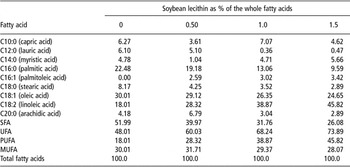
Table 2 shows the fatty acid profile of the experimental diets. The results showed that SL-supplemented diets contained higher concentrations of unsaturated fatty acids (UFA) and PUFA, especially C18:2, than the unsupplemented group, and their contents increased with increasing concentration of SL. Both saturated fatty acids and monounsaturated fatty acids exhibited a progressive decrease with increasing SL above 0.5%.
Fatty acid profiles of the experimental diets

SFA = saturated fatty acids; UFA = unsaturated fatty acids; PUFA = polyunsaturated fatty acid; MUFA = monounsaturated fatty acids.
BW and feed intake
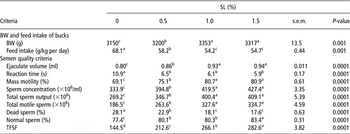
Table 3 shows that SL significantly increased BW of bucks; however, a stepwise increase was shown in BW up to a 1% concentration, although a further increase in the SL content did not affect BW over that of 1%. On the other hand, SL showed the opposite trend in feed intake.
BW, feed intake and semen characteristics of V-line male rabbits as affected by supplementation with different SL concentrations

SL = soybean lecithin; s.e.m. = standard error of mean; TFSF = total functional sperm fraction.
n = 7 animals per treatment (the value represents 84 ejaculates per treatment).
a,b,cMeans within a row with different superscripts are significantly different (P < 0.05).
Semen characteristics
Table 3 indicates that rabbit bucks that received SL up to 1% exhibited a stepwise significant increase in the ejaculate volume, mass motility, sperm concentration, total sperm output and the total motile sperm (P < 0.05), while a further increase did not induce an improvement over that of 1% in SL. However, the opposite trend was shown in the RT and percent dead sperm, although the difference among the different concentrations of supplemented SL was not significant for RT. Dead sperm decreased progressively up to 1% SL and stabilized thereafter.
Normal sperm significantly increased gradually as the SL supplementation increased compared with the Con group but the difference between 0.5% and 1.0% was not significant. A stepwise significant increase with increasing SL supplementation was shown in TFSF.
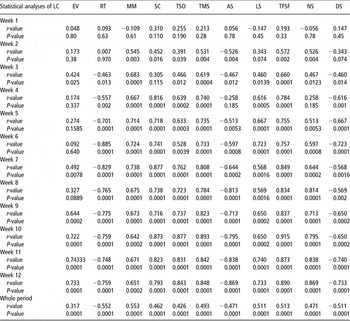
Correlation analysis (Table 4) showed that the relationship between dietary lecithin content and semen quality was not significant after 1 week of supplementation. The correlation between lecithin content and most of the semen quality traits was significant in week 2, except for ejaculate volume and RT. Only the correlation between lecithin concentration and sperm concentration was not significant in week 3, lecithin concentration and ejaculate volume or abnormal sperm in week 4 and lecithin concentration and ejaculate volume in weeks 6 and 8. By week 10, all correlations between lecithin concentration and semen quality traits were significant. The r-value showed a progressive increase over time and had a strong correlation from week 8 onward, indicating that 8 weeks was the minimum period to obtain a significant effect of dietary treatments on semen quality. For the entire period, the correlation between lecithin concentration and semen quality criteria was significant and of intermediate magnitude. It should be mentioned that the negative correlation obtained for RT, abnormal sperm and dead sperm indicates that increasing the lecithin concentration decreased RT and percentage of abnormal and dead sperm.
Correlations between SLC and semen quality of V-line rabbits at different ages

SLC = soybean lecithin concentration; EV = ejaculate volume; RT = reaction time; MM = mass motility; SC = sperm concentration; TSO = total sperm output; TMS = total motile sperm; AS = abnormal sperm; LS = live sperm; TFSF = total functional sperm fraction; NS = normal sperm; DS = dead sperm.
Blood and seminal plasma biochemical constituents
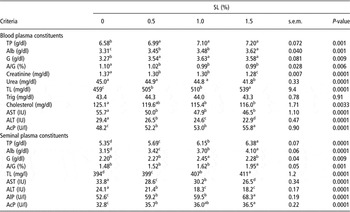
Data in Table 5 show that blood and seminal plasma TP, Alb and globulin were significantly increased with the inclusion of SL in buck diets. Blood plasma Alb to globulin ratio decreased significantly due to SL supplementation, while the opposite trend was shown in seminal plasma when SL was supplemented at only 1.5%.
Seminal plasma (TP, Alb, TL, ALT, AST, AlP and AcP) by supplementation with different SL concentrations

TP = Total protein; alb = albumin; TL = total lipid; ALT = alanine aminotransferase; AST = aspertate aminotransferase; AlP = alkaline phosphatase; AcP = acid phophatase; SL = soybean lecithin; s.e.m. = standard error of mean; G = globulin; A/G = albumin/globulin ratio; Trig = triglycerlids.
n = 42 samples per each treatment.
a,b,c,dMeans within a row with different superscripts are significantly different (P < 0.05).
Blood plasma urea and creatinine were significantly decreased due to SL supplementation; however, the decrease was significant in plasma urea only when 1.5% SL was supplemented. However, the decrease in blood plasma creatinine was maximized at 1.5% SL, with no difference between 0.5% and 1.0% SL.
Blood and seminal plasma TL increased significantly with SL supplementation and the increase was maximized at 1.5% concentrations. However, SL supplementation at 1% and 1.5% significantly decreased blood plasma cholesterol compared with the Con group, whereas the effect of 0.5% SL was intermediate. On the other hand, supplementation of SL had no significant effect on blood plasma triglycerides.
Blood plasma and seminal plasma AST and ALT were significantly decreased with increasing SL supplementation that was minimized at 1.5% SL for blood plasma ALT and seminal plasma AST.
Rabbit bucks exhibited a significant increase in blood plasma AcP and seminal plasma AlP and AcP that maximized at 1.5% SL.
Blood and seminal plasma antioxidant status
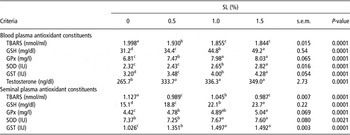
Table 6 shows that blood and seminal plasma GSH, GPx, SOD and GST activities increased significantly with increasing SL content while decreasing blood and seminal plasma TBARS. These improvements were maximized at 1.5% for TBARS and GSH in blood and seminal plasma and SOD and GST in blood plasma. The effect of SL on blood and seminal plasma GPx and seminal plasma GPx, SOD and GST was maximized at 1%. Blood plasma testosterone concentration increased significantly due to SL additions, with no differences between various supplemented concentrations.
The blood and seminal plasma TBARS, GSH, GPx, SOD, GST and blood plasma testosterone concentration by supplementation with different concentrations of SL

TBARS = thiobarbituric acid reactive substances; GSH = glutathione content; GPx = glutathione peroxidase; SOD = superoxide dismutase; GST = glutathione S-transferase; SL = soybean lecithin; s.e.m. = standard error of mean.
n = 42 samples per each treatment.
a,b,c,dMeans within a row with different superscripts are significantly different (P < 0.05).
Reproductive performance and economic efficiency
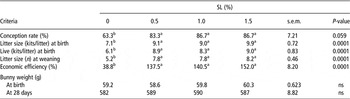
Table 7 indicates that the conception rates of females mated with rabbit bucks supplemented with different concentrations of SL were significantly improved compared with the Con group. The total and live litter size at birth and litter size at weaning as well as economic efficiency were also significantly higher than those of the Con group but without a difference in the various SL contents. However, no significant differences were found between SL groups in bunny weight at birth and at 28 days of age.
Reproductive indices of bucks supplemented with different concentrations of SL

s.e.m. = standard error of mean.
Economic efficiency = net revenue/feed cost.
Net revenue = litter size at weaning by 12 litter per kit.
Feed cost = feed intake by price per kg of feed with or with lecithin supplementation.
a,bMeans within a row with different superscripts are significantly different (P < 0.05).
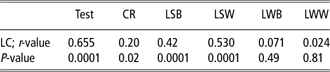
The correlation between lecithin concentration and plasma testosterone was strong and significant while it was intermediate and significant for litter size at birth and weaning and weak but significant for conception rate (Table 8). The relationship between litter weight at birth and weaning was not significant.
Correlation between SLC and reproductive traits

SLC = soybean lecithin concentration; Test = testosterone; CR = conception rate; LSB = litter size at birth; LSW = litter size at weaning; LWB = litter weight at birth; LWW = litter weight at weaning.
Discussion
The results indicated that SL is a rich source of PUFA and n-6 was the dominant fatty acid, and this was in agreement with the results of Jenkins and Fotouhi (Reference Jenkins and Fotouhi1990), who found that the addition of 5.2% SL led to an increase in the dietary concentrations of LA and linolenic fatty acid. The LA (n-6) is now regarded as a nutritionally essential fatty acid (Holman, Reference Holman1998), and all the classic symptoms of essential fatty acid deficiency (dermatitis, growth retardation, infertility) can be completely cured by the use of n-6 fatty acids alone. These symptoms are related to the biological functions of n-6 fatty acids: (1) 18:2; n-6 is a structural component in the ceramides of the water barrier of the skin (Hansen, Reference Hansen1989). (2) Arachidonic acid (20:4; n-6) is a precursor of eicosanoids, which are local hormones that participate in a number of physiological as well as pathophysiological conditions, for example, parturition initiation, platelet aggregation, renal electrolyte regulation, blastocyte implantation and activation of immune cells (Newberry et al., Reference Newberry, Stenson and Lorenz1999). (3) n-6 fatty acids possibly also play a role as a second messenger in the process of signal transduction across cell membranes (Chen et al., Reference Chen, Wang, Falck, Capdevila and Harris1999).
The effect of SL on productive performance and semen quality of rabbit bucks is rare in the literature. It was found that SL increased BW and decreased feed intake compared with the Con group. The positive effect on BW of bucks were 2%, 7% and 5%, meanwhile, the decrease in feed intake was 14%, 20% and 20% for 0.5%, 1.0% and 1.5% concentrations of SL, respectively. This indicated that SL at 1% was adequate for improving feed utilization and semen quality of bucks despite the decrease in feed intake. The decrease in feed intake could be attributed to the increase in the availability of energy, essential fatty acids and choline and stimulation of lipid absorption (Attia et al., Reference Attia, Hussein, Tag El-Din, Qota, Abed El-Ghany and El-Sudany2009a). In the literature, a high content of PUFA in the chicken sperm membrane influences sperm function and modification of dietary fatty acids can affect spermatozoa (Bongalhardo et al., Reference Bongalhardo, Leeson and Buhr2009). In addition, Mourvaki et al. (Reference Mourvaki, Cardinali, Dal Bosco, Corazzi and Castellini2010) concluded that daily supplementation with n-3, n-6 and n-9 fatty acids significantly increased semen volume and concentration, while decreasing abnormal spermatozoa.
SL improved semen quality, biochemical constituents of blood and seminal plasma and the antioxidant status of both fluids, which could be attributed to increasing dietary tocopherol intake, which was at least doubled when SL was added at 1%. Thus, the improvements in semen quality could be attributed to increasing oxidative stability (Scholfield, Reference Scholfield1981; Judde et al., Reference Judde, Villeneuve, Rossignol-Castera and Le Guillou2003; Ulkowski et al., Reference Ulkowski, Musialik and Litwinienko2005; Wang and Wang, Reference Wang and Wang2008), a neuroprotective effect (Aabdallah and Eid, Reference Aabdallah and Eid2004), decreasing cellular damage (AST and ALT) and TBARS while increasing GSH, SOD, GST and GPx (Das and Vasudevan, Reference Das and Vasudevan2006; Das et al., Reference Das, Gupta, Rao and Vasudevan2007). These enhancements were accompanied by better reproductive performance (conception rate) and litter size up to weaning.
Blood and seminal plasma constituents exhibited positive significant responses to SL, showing a constant effect of SL on both fluids. The improvements found herein are in general agreement with those reported by Al-Daraji et al. (Reference Al-Daraji, Al-Mashadani, Al-Hayani, Al-Hassani and Mirza2010) and Das et al. (Reference Das, Gupta, Rao and Vasudevan2007). The latter authors showed that lecithin decreased AST and ALT activities and TBARS, indicating a decrease in sperm damage while increasing spermatozoa livability and concentration. The increase in the AlP and the AcP observed in blood and seminal plasma is in agreement with the result of Al-Daraji et al. (Reference Al-Daraji, Al-Hassani, Al-Tikriti and Abd-Alabaas2001), who reported that both AlP and AcP are involved in the metabolism of spermatozoa via the hydrolysis of carbohydrates.
The increase in the antioxidant status of both blood and seminal plasma (GSH, GPx, SOD and GST) and the decrease in TBARS showed higher cell stability. In fact, vertebrate sperm included rabbit display high rates of metabolic activity and are rich in PUFA (Castellini et al., Reference Castellini, Lattaioli, Bernardini and Dal Bosco2000 and Reference Castellini, Cardinali, Dal Bosco, Minelli and Camici2006), rendering them particularly susceptible to ROS-induced oxidation. It is known that lipid peroxidation is one of the major reactions leading to phospholipid loss, membrane damage and the loss of motility in mammalian spermatozoa (Mann and Lutwak-Mann, Reference Mann and Lutwak-Mann1981). Previous results showed that the sperm of rabbits supplied with dietary PUFA are more susceptible to oxidative damage and undergo an early acrosome reaction in vitro (Castellini et al., Reference Castellini, Lattaioli, Dal Bosco, Minelli and Mugnai2003). However, in this study, supplementation with SL induced the opposite trend due to its higher tocopherol content as an antioxidant agent of SL (Aabdallah and Eid, Reference Aabdallah and Eid2004; Wang and Wang, Reference Wang and Wang2008; Attia et al., Reference Attia, Hussein, Tag El-Din, Qota, Abed El-Ghany and El-Sudany2009a) and resulted in higher cell stability of higher antioxidant enzymes and lower TBARS (Table 6). The GPx enzyme plays a particularly important role in the antioxidant protection of the cell by converting hydrogen peroxides into less harmful components (Olafsdottir and Reed, Reference Olafsdottir and Reed1988) and GPx plays an important role against lipid peroxidation in spermatozoa in vitro (Alvarez and Storey, Reference Alvarez and Storey1989).
In this study, SL not only increased the productive performance, semen quality and antioxidant profiles but also improved blood plasma testosterone (Table 5). Testosterone is required for the maturation of male germ cells and sperm production and quality (Attia et al., Reference Attia, Burke, Yamani and Jensen1993 and Reference Attia, Burke, Yamani and Jensen1995; Walker, Reference Walker2009). The PUFA or their derived eicosanoids with the hypothalamo–pituitary–gonadal axis play an important role in the hormonal control of spermatogenesis (Etches, Reference Etches1996) and modulate steroid synthesis in different steroidogenic tissues (Mohn et al., Reference Mohn, Fernandez-Solari, De Laurentiis, Prestifilippo, de la Cal, Funk, Bornstein, McCann and Rettori2005). Gromadzka et al. (Reference Gromadzka, Przepiórka and Romanowicz2002) found that dietary fat significantly influenced plasma testosterone concentration and the activity of 17β-hydroxysteroid dehydrogenase, the key enzyme in the testosterone synthesis pathway in male rat gonads (Korach, Reference Korach1997). Animals received rapeseed oil diets as a UFA source, which stimulated the testicular function in rats, suggesting that UFA stimulates enzyme activity and androgen secretion into blood (Korach, Reference Korach1997). Testosterone is metabolized to estrogens by aromatase (Simpson et al., Reference Simpson, Mahendroo, Means, Kilgore, Hinshelwood, Graham-Lorence, Bilal, Ito, Fisher, Michael, Mendelson and Bulun1994) and estrogens seem to regulate sperm motility (Carreau et al., Reference Carreau, Silandre, Bois, Bouraima, Galeraud-Denis and Delalande2007).
SL not only improved semen quality of bucks (Table 3) but also reproductive indices as an increase in the conception rate and litter size at birth was observed (Table 6). In this regard, Cerolini et al. (Reference Cerolini, Kelso, Noble, Speake, Pizzi and Cavalchini1997) suggest that the PUFA may play a role in maintaining the survival of the spermatozoon in the female reproductive tract before interaction with the oocyte. In mammals, the lipid composition of sperm membrane was found to play a major role in the physicochemical modification leading to fertilization (Langlais and Roberts, Reference Langlais and Roberts1985). Phospholipids are the major lipid components of spermatozoa; they contain large amounts of PUFAs; thus, a diet enriched with lecithin as a rich source of n-6 PUFAs and antioxidants may be utilized successfully to improve the reproductive capacity of animals (Maldjian et al., Reference Maldjian, Penny and Noble2003). Lipid and fatty acid compositions of spermatozoa may be important predictors of fertility. Similar to the present findings, Kelso et al. (Reference Kelso, Cerolini, Noble, Sparks and Speake1996) and Bongalhardo et al. (Reference Bongalhardo, Leeson and Buhr2009) also indicated that fish oil or corn oil increased fertility and this effect may be more pronounced and may persist for longer durations. In addition, Brun et al. (Reference Brun, Theau-Clément and Bolet2002) found that the mass motility (number of motile sperm per ejaculate) significantly influenced the conception rate but volume, percentage of motile sperm and concentration had no effect. They also found that litter size (total born) was significantly influenced by concentration and all variables dependent on it, particularly the number of total and motile sperms.
In conclusion, SL significantly increased productive and reproductive performance and semen quality of rabbit bucks and 1% is an adequate concentration.