Introduction
Secession in stable democracies is rare, but some territories witness relevant movements asking for independence from their states: two referenda on the issue were held in Quebec (1980 and 1995) and one has been called in Scotland (2014). In recent years, public opinion polls have shown a steep and sustained increase in support for independence among Catalan citizens: in the period 2006–14, those that chose an independent Catalan state in a multi-option question regarding their preferred constitutional arrangement have tripled, from 14% in 2006 to around 45% in 2014.Footnote 1 Traditionally, support for independence has been considered a consequence of alternative national identities and nationalist movements. However, there has been no equivalent level of change in the Catalans’ national identification, and alternative explanations thus deserve serious attention. Indeed, many have pointed to the effect of utilitarian motivations, linked to expected economic gains from secession.
In this article we analyse the effect of national identity, elite cues and economic expectations on preferences for secession. Our main contribution lies in identifying the effect of economic considerations. As it has been shown in the case of Quebec, we argue that economic expectations are an important driver of preferences for secession in Catalonia as well. The perception that an independent Catalonia would perform better economically, based on the idea that the current fiscal relationship is detrimental to Catalonia’s interests, partly explains current support for independence. We also contend that this consideration is especially important for citizens with ambivalent identities and those less directly exposed to the cueing influence of pro-independence parties.
The literature has thus far found an obstacle to the identification of the causal effect of economic considerations on support for secession: the rationalization of pre-existing preferences has been claimed to be a strong driving force for the expectations that citizens hold regarding the economic outcomes of each option (Howe, Reference Howe1998; Mendelsohn, Reference Mendelsohn2003). In other words: when asked about their expectations on the economic consequences of independence, citizens would express a view congruent with their own preferences.
Although the economic consequences of secession have been increasingly relevant in the decentralization debate in Catalonia, there is a limited amount of trustworthy information on the actual effects of secession. Therefore, there is little citizens can rely on when forming expectations other than elite cues and their own pre-existing preferences. However, even if their expectations are based on biased information from political elites and other partisan actors in the debate, they can still have an independent, net effect on citizens’ preferences towards secession.
If the relationship between economic expectations and preferences is bi-directional, then we cannot trust the results obtained by the standard observational approaches, since there would be a serious problem of reverse causation that might heavily bias the estimates. In that case, the empirical association would not express that those citizens who are more optimistic about the economic consequences of secession tend to favour it, but the other way round: those with pro-independence orientations tend to look on the bright side when evaluating the potential implications of secession.
This article aims to contribute to the debate by identifying the effect of economic expectations, using a two-fold strategy: first, we build a multivariate model with observational data that estimates the effect of economic expectations net of the influence of the main variables deemed relevant by the literature (identity and elite cues). The model estimates a strong and highly significant effect for economic expectations. We also see that this effect is especially strong for citizens with dual identifications with Catalonia and Spain, and for those that have no party identification or are partisans of parties with less clear-cut positions on the issue.
To address the issue of rationalization and reverse causation, we run a survey-embedded experiment in which we attempt to manipulate expectations randomly to see whether they have an exogenous effect on support for independence. Although expectations on a salient issue such as this prove difficult to manipulate experimentally, we are able to find a significant effect of our treatments, so we can safely say that there is, beyond rationalization, an effect of economic expectations on support for secession. We also find, experimentally, the same sort of heterogeneous effects we identified with the observational data: the role of the economy is stronger for respondents with dual identity.
The second section reviews the literature and presents the theoretical arguments that support our hypotheses. The third section briefly introduces the case and provides some context for the analysis, while in the fourth we include our observational, survey-based empirical analysis and in the fifth section we introduce the experiment and report its outcomes. Finally, we discuss the implications of our results, the limits of our analysis and directions for further research.
Identity, politics and the economy: explaining support for secession in consolidated democracies
Conventional accounts, such as those that are more prevalent in media reports, tend to basically explain secessionism as a function of the ethnic and identity-based distinctiveness of groups. The naive approach to the topic is thus based on the idea that ‘distinctive’ groups, concentrated in a specific territory within a nation-state, will have a tendency towards demands for sovereignty. However, social-scientific explanations go beyond this idea and consider economic and political factors as well: demands for secession do not necessarily stem from ethnic or cultural distinctiveness neither is such distinctiveness a sufficient condition for the development of self-determination movements.
While ethnic and national identities are, of course, present in the explanation, economic grievances and self-interest are often placed at the center of the accounts. The dominant prediction in the literature is that regions or groups that are better off than the rest of the country will have a higher likelihood of demanding secession since they often sustain poorer regions (Bartkus, Reference Bartkus1999; Hechter, Reference Hechter2001; Spolaore, 2008; Sambanis and Milanovic, Reference Sambanis and Milanovic2011). The mechanism is quite straightforward: by separating, they would have more disposable resources because they would no longer be subject to fiscal imbalances with respect to the rest of the state, and could provide more public goods and do so more efficiently, as a consequence of an increased homogeneity of preferences (Alesina and Spolaore, Reference Alesina and Spolaore2003).
While country-level or, for that matter, group-level theoretical and empirical models provide useful insights; they miss a fundamental part of the picture. In almost every territory in which secession is a politically salient issue, there is variation in individual preferences among the population. Not all members of the group share the same position on the issue, and groups or regions are often internally heterogeneous as well. Using groups as the unit of analysis imposes an oversimplifying assumption of internal homogeneity that is worth relaxing, at least for two reasons. On the one hand, addressing the individual-level variation is crucial in order to provide the micro-foundations of aggregate-level causal claims such as those, for example, that relate economic self-interest to demands for increased sovereignty. On the other hand, individual variation in preferences for sovereignty is politically relevant as well: in democratic contexts, if at all possible, secession could only be the consequence of a democratic decision-making process, so it is clearly relevant to inquire into the factors that explain this variation.
Identity as the main driver
Research on individual preferences for sovereignty has been particularly well-developed in the case of Quebec, where two referenda on the issue have been held. These models often consider national identity to be the main driving factor for support for sovereignty, and this is true in Quebec (Blais and Nadeau, Reference Blais and Nadeau1992; Howe, Reference Howe1998), as well as Scotland (McCrone and Paterson, Reference McCrone and Paterson2002), Catalonia (Serrano, Reference Serrano2013) or the Basque Country (Costa-Font and Tremosa, Reference Costa-Font and Tremosa2006). More precisely, Blais and Nadeau (Reference Blais and Nadeau1992) report that identification with Canada matters the most, because identification with Quebec displays little variation within the province.
However, although the models consistently show their strong predictive power, the role of national identity on influencing support for secession has received scant theoretical attention. This is probably the case for two reasons: on the one hand, this relationship is considered commonsensical and thus does not puzzle researchers. On the other hand, national identity is commonly regarded as a highly stable political attitude that does not change easily, at least in the short term. Therefore, identification with the sub-state unit and the state would only explain the stable patterns of support for secession, but not changes in this support (Blais and Nadeau, Reference Blais and Nadeau1992; Howe, Reference Howe1998). But there are reasons to question these arguments. First, the existence of many non-secessionist nationalist movements and citizens that aim to achieve more power for their territories within the state, but not full secession, implies that a link between identification and pro-independence attitudes is by no means definite. Moreover, in Catalonia there is some evidence of intrapersonal changes – even in the short term – in national identification (Hierro, Reference Hierro2012) that raise doubts about its purported stability.
There are exceptions to this lack of theory. The effect of national identity on constitutional preferences has been treated as an analogue of party identity (Blais and Nadeau, Reference Blais and Nadeau1992): it summarizes socialization and past experiences, and conditions citizens’ attitudes and reactions towards certain political issues. Costa-Font and Tremosa (Reference Costa-Font and Tremosa2006), following Akerlof and Kranton (Reference Akerlof and Kranton2000), propose a model in which identity determines preferences, basically because individuals attain a ‘symbolic utility’ in order to act in accordance with their identity.
Elite cues
Even if identity is, presumably, a strong predictor of support for secession, the link is neither necessary nor sufficient. The economic expectations might provide a relevant, additional, explanation for individual preferences, but as we discuss below citizens are, most likely, ill-informed about the actual implications of independence. If identity is not the full story, and economic calculations are difficult to attain, to understand citizens’ preferences we have also to look at the political sphere.
Indeed, Clarke et al. (Reference Clarke, Kornberg and Stewart2004), alongside a critique of Nadeau et al.’s (Reference Nadeau, Martin and Blais1999) model of referendum voting for Quebec, provide consistent evidence for the role of intermediating agents such as parties, leaders and governments, as suggested in previous studies (Clarke and Kornberg, Reference Clarke and Kornberg1996; Pammett and LeDuc, Reference Pammett and LeDuc2001). According to this argument, identification, closeness or support for specific parties and leaders might have an independent effect on citizens’ choices with regards to sovereignty.
As Torcal and Mota (Reference Torcal and Mota2013) have shown for the Spanish case, political party effects are key for the formation of citizens’ preferences for the territorial organization of the state. According to their analysis, partisanship with nationalist regional parties favours preferences for decentralization, and the effect is contingent not only on voters’ national identification but also on the characteristics of the party system, especially the overall presence of non-state wide parties in the system, that makes the decentralization issue more salient.
Theoretically, these findings fit well in what we know about political choice in low-information contexts: ‘cues offered by informed actors can influence the opinion of less informed individuals on complex issues’ (Hellström, Reference Hellström2008: 1130). In the case we are analysing, this might be especially true: the consequences of secession are highly uncertain. Citizens will resort to available heuristics to overcome the difficulties in evaluating the costs and benefits of the various options. Leaders and parties provide such reliable and available cues (Sniderman et al., Reference Sniderman, Brody and Tetlock1991; Bartels, Reference Bartels1996), and it is reasonable to expect that citizens will use them in a high-stakes and high-uncertainty decision.
In Catalonia, the issue of self-determination and secession has become ever more salient in recent years, and party positions in some respects have become more polarized, with moderate nationalist parties holding increasingly clear pro-independence stances, and state wide parties opposing with increasing clarity the idea of holding a self-determination referendum. Both salience in the agenda (Amat, Reference Amat2012) and elite polarization (Ray, Reference Ray2003; Druckman et al., Reference Druckman, Peterson and Slothuus2013) have been found to favour the leading role of political and party elites on public opinion. Intra-party dissent has also been shown to condition parties’ influence on voters’ positions: those parties that have a unified position on an issue are more able to influence their followers (Ray, Reference Ray2003; Gabel and Scheeve, Reference Gabel and Scheve2007; Steenbergen et al., Reference Steenbergen, Edwards and De Vries2007). Under these conditions, citizens might just echo their party’s position on the issue and therefore, once we take into account partisanship, we might not find an effect of other issues such as economic expectations, or a fairly limited one.
As it is well known from the literature on party cues, the identification of the causal effect of parties on public opinion is not straightforward. The direction of the relationship could be either way: both parties influencing voters, and voters influencing parties (Steenbergen et al., Reference Steenbergen, Edwards and De Vries2007). Disentangling the direction of the effect is a rather complex question that lies beyond the scope of this paper,Footnote 2 so we will just show to what extent congruence between partisans and parties explains citizens’ preferences for secession.
A role for the economy?
While identity, and to a lesser extent, party cues, are generally found by the models to be the primary driving forces of support for secession, they might not be the end of the story. Other variables have been consistently found to play a role in determining constitutional preferences. Perceived economic costs and benefits of the secession (Blais and Nadeau, Reference Blais and Nadeau1992; Blais et al., Reference Blais, Martin and Nadeau1995; Howe, Reference Howe1998; Mendelsohn, Reference Mendelsohn2003; Bélanger and Perrella, Reference Bélanger and Perrella2007) have received more attention from the literature, especially in the Quebec case. A so-far consistent finding states that cost-benefit calculations on the potential economic consequences of sovereignty play an important role in explaining support for independence in Quebec.Footnote 3
Since, as we shall discuss below, the economic question has become, in recent years, relatively central to the decentralization debate in Catalonia, we expect these considerations to play a role in determining citizens’ preference for secession. The parties favouring secession or greater devolution in Catalonia have agreed on the perception that the fiscal treatment received by the Catalan government is unfair, and that it limits Catalonia’s ability to develop stronger social policies and promote economic growth. Under these circumstances, secession has often been presented as an alternative that would increase the available budget of the Catalan government and remove obstacles to desired policies.
However, there is a fundamental objection that makes these estimates difficult to interpret in causal terms: voters have limited reliable information on the actual consequences of secession. The implications of such a choice might well be deep and wide. Often, experts disagree on the estimation of such costs and benefits, and political elites convey opposing views on the consequences of secession. Under these circumstances voters still could gather information and make up their minds about the expected outcome of each option, even if the available information is biased. However, they could simply rely on their pre-existing preferences (most likely identity-driven) or, alternatively, just follow the cues offered by political elites when forming their preferences about secession and therefore their views on the economic consequences of secession would not have an independent effect.
Economic evaluations of the consequences of sovereignty might well be a rationalization of individuals’ pre-existing preferences on sovereignty and, therefore, the relationship would be endogenous (Howe, Reference Howe1998; Mendelsohn, Reference Mendelsohn2003). Being in favour of secession in the first place might lead you to over-estimate its economic benefits and minimize its costs, and vice versa. If citizens’ prospective economic evaluations of sovereignty are a function of their current preferences on the issue, we cannot establish the causal link between cost-benefit calculations and support for independence. Howe (Reference Howe1998) provides compelling evidence that, indeed, the rationalization of pre-existing preferences is the main mechanism that explains prospective economic assessments on an independent Quebec, and suggests that new indicators should be designed to capture the exogenous component of these assessments. But, as Howe himself acknowledges, there is a high degree of uncertainty with respect to the economic consequences of separation that, considered together with cognitive biases such as ‘status quo effects’ (Costa-Font and Tremosa, Reference Costa-Font and Tremosa2006), raises serious doubts regarding the feasibility of an observational estimation of the causal relationship.
This is an issue that parallels the problem identified in the economic voting literature: several scholars have pointed out that economic perceptions are largely endogenous to party preference, and some even argue that this effect dominates the traditional economic voting argument (Duch et al., Reference Duch, Palmer and Anderson2000; Evans and Anderson, Reference Evans and Anderson2006; Duch and Stevenson, Reference Duch and Stevenson2008). It is probably more serious in the case of support for secession, given the high uncertainty involved in such a process, expectations are less likely to be derived from rational calculations and more dependent on previous preferences and/or elite cues.
There are a priori two feasible strategies to address the endogeneity problem arising from observational data: on the one hand, an instrumental variable estimation as proposed by Howe (Reference Howe1998) that, however, would require the identification of exogenous factors affecting people’s perceptions on the economic consequences of independence. On the other hand, one can use a purely experimental setup, in which respondents are randomly presented with different credible scenarios to see how they affect attitudes towards secession; this is the strategy we develop in this article.
Finally, the literature has also considered the heterogeneous effects of economic calculations that might interact with national identification. It has been shown that they also have a stronger impact among citizens with weaker Québécois identities than among those with strong attachment to Quebec vis-à-vis Canada (Howe, Reference Howe1998). Therefore, the economy seems to play an important role in shaping support for sovereignty among those citizens with ambivalent national identifications, while strong Quebeckers do not seem to rely on these sorts of reasons when forming their preferences towards secession, or at least do so much less than weak identifiers. The rationale behind this heterogeneous effect is that citizens with strong identities will be less affected by other kinds of considerations, and will hold strong attitudes on the issue. While this might as well be a by-product of rationalization, our experimental approach also addresses this issue and makes the identification of heterogeneous effects much more robust.
Hypotheses
Starting from the literature reviewed above, we can formulate a set of hypotheses on the determinants of support for independence in Catalonia to be tested in the following sections:
Hypothesis 1: National identity will be the first and strongest predictor of support for independence. Those citizens identifying as primarily or exclusively Catalan will have a higher probability of being in favour of independence.
Hypothesis 2: Partisanship will have an independent effect on support for secession, especially in the case of parties with more clear-cut positions on the issue and less intra-party dissent.
Hypothesis 3: Economic considerations will also play a role in explaining support for independence. Those citizens foreseeing economic benefits from secession will be, everything else being equal, more in favour of independence.
Hypothesis 3a: Expectations on the economic consequences of secession will have a stronger impact among those citizens that do not have a party identification, and those whose parties provide less clear-cut cues.
Hypothesis 3b: The impact of economic calculations is moderated by identity: they will be more important for citizens with ambivalent identity positions and less so for those with clear-cut, exclusive identifications either with Catalonia or Spain.
The case
Most of the literature reviewed has dealt with the case of Quebec. Similar conditions exist in other contexts, such as Scotland, the Basque Country, Flanders or Catalonia: a salient and widespread debate on the possibility of secession in a fully democratic and relatively affluent society with existing self-government institutions within a federal or regional scheme. This article focuses on the Catalan case, in which, notwithstanding a long tradition of Catalan nationalism, the debate on independence from Spain has become central only recently.
In 2005 the Catalan Parliament passed, with the support of almost 90% of its MPs, a proposal for a new Statute of Autonomy, aimed at increasing Catalan political and fiscal autonomy, but with no reference to self-determination or secession. This text was then sent to the Spanish Parliament, where it was amended, approved and sent back to Catalonia to eventually be passed on a referendum. Both pro-independence and centralist parties called for a no vote, but the amended text was voted favourably by 75% of the voters, with a 49% turnout (Colino, Reference Colino2009; Keating and Wilson, Reference Keating and Wilson2009).
However, the Spanish rightist Popular Party appealed against the text before the Spanish Constitutional Court. In 2010, the Court issued a ruling abolishing several key passages of the statute, including the highly symbolic definition of Catalonia as a ‘nation’. The Court ruling was followed by a massive demonstration in Barcelona asking for self-determination, and contributed to an intense mobilization cycle of the pro-independence movement (Lluch, Reference Lluch2009; Muñoz and Guinjoan, Reference Muñoz and Guinjoan2013; Serrano, Reference Serrano2013), which culminated with one of the most massive demonstrations ever held in Catalonia, in September 2012. After the demonstration, the Catalan president Artur Mas asked the Spanish government for a new fiscal arrangement, and when this proposal was rejected, he called for early elections and ran on the promise of calling a referendum on Catalonia’s self-determination (Martí, Reference Martí2013). Despite suffering electoral losses, he was re-elected and reached a parliamentary agreement with the pro-independence leftist ERC, based on the commitment to hold a referendum within the next term. However, the Spanish government ban makes it highly uncertain whether or not it will be held.
Currently in the Catalan Parliament conflicting views on the issue coexist. The Popular Party (PP) and Ciutadans (21% of the seats) are completely opposed to a referendum. They strongly support the institutional status quo based on the 1978 Spanish Constitution. The Socialist Party (PSC-PSOE, 15% of the seats) claims to be in favour of a referendum but only if it is the result of an agreement between the Catalan and Spanish government, and therefore rejects the current attempts to call a referendum even without the Spanish government’s agreement. The socialists openly reject secession, and defend the federalization of Spain via a constitutional reform. The remaining parties (CiU, ERC, CUP, and ICV, 64% of the seats) are in favour of the referendum. In December 2013 these parties agreed to call a referendum in November 2014 with a double question asking, first, if citizens want Catalonia to become a state and, second, if they want this state to be independent. Among those parties, only ERC and CUP are unambiguously pro-independence. The center-right nationalist federation ‘CiU’ is more divided: whereas its major partner (CDC) has already shifted towards a pro-independence stance, the minority partner (UDC) supports a confederation with Spain. The eco-socialist ICV tends to favour federalism, even though some of its members support independence as well.
Although the core of the debate has been political, related to the political status of Catalonia in relation to Spain, the economy has been present throughout the whole process. One of the key demands of the new Statute was higher fiscal autonomy, regarded as a way of addressing what most Catalan parties portray as a long-term problem of unfair distribution of resources within Spain. The idea that the difference between Catalonia’s contribution and what it receives in transfers and investments from the Spanish government is too large has fuelled many of the most heated discussions, and a sense of grievance has been spread across a significant portion of the Catalan public opinion.
Catalan nationalism was traditionally focused on language and cultural issues, but in recent years economic issues have gained salience in the debate. Already in the new Statute debate, the issue of the fiscal balance between the Catalan and the central Spanish government was highly salient, and Catalan parties placed the focus on it. The aim of Catalan nationalist parties was to obtain a specific fiscal regime close to the Basque one, in which the autonomous institutions collect all the taxes and transfer a negotiated quota to the central government. Since this sort of agreement was not reached, this gave rise to a new type of pragmatic or economic secessionism in which appeals to the Catalan identity and culture are less salient and economic reasons are gaining ground. The deep economic crisis that started in late 2008, but became fully evident in 2010, has further stirred the debate, since the harsh spending cuts by the Catalan government have been portrayed by Catalan nationalist parties as being a consequence of the so-called fiscal deficit, estimated by the Catalan government to be about 8% of the GDP.Footnote 4 A more specific debate on the potential economic implications of secession has also erupted in Catalonia, led by political parties and mainstream Catalan and Spanish media, but also with the participation of intellectual elites aligned either with the pro-independence movement or with the defence of the status quo. Therefore, it is important to know to what extent the economy enters the equation that explains support for secession among Catalan citizens.
Empirical analysis (I): observational evidence
We used a survey of the Catalan population performed by the official institute for public opinion research in Catalonia, the Centre d’Estudis d’Opinió (CEO).Footnote 5 Our dependent variable is support for independence. The CEO has used a trichotomous question on voting behaviour in a hypothetical referendum in its quarterly political barometers since 2011. The exact wording of this question is:
P39. And more precisely, if a referendum to decide about the independence of Catalonia was to be held tomorrow, what would you do?
Read response options
-
1. Vote in favor of independence
-
2. Vote against independence
-
3. Abstain / would not vote
-
80. Other responses (DO NOT READ, WRITE THE LITERAL RESPONSE)
-
98. Do not know
-
99. Do not answer
Results show a majority in favour of secession: 55.6% of the respondents declare they would vote in favour of independence, more than the 23.4% that would vote against and 15% that declare they would abstain.Footnote 6
Yale and Durand (Reference Yale and Durand2011) have shown that asking for voting intention in a referendum vis-à-vis a general orientation towards secession is consequential, at least in Quebec. According to their analysis, asking about voting intention elicits a weaker support for secession. However, this might not be the case in Catalonia, where a referendum is, unlike in Quebec, a mere hypothesis so far. Therefore, we should expect little or no difference among the two alternative wordings. Indeed, an opinion poll fielded in June 2013 by a Catalan newspaper (El Periódico, 10 June 2013) using different wording not related to a referendum, displays even higher support for independence (57%), but also more clear opposition (31%).
Independent variables
Our main independent variables are national identity, party preferences and economic considerations. In Catalonia, national identity is usually measured by means of a bipolar scale ranging from ‘only Spanish’ to ‘only Catalan’, through ‘more Spanish than Catalan’, ‘as Catalan as Spanish’, and ‘more Catalan than Spanish’. We use the central category (as Catalan as Spanish) as a reference, given that it is the modal category. We collapsed the only Spanish and more Spanish categories, since they have very low frequencies: combined, they represent no more than 6.5% of the sample.
The survey contains an explicit question about the economic prospects of an independent Catalonia: respondents are asked to evaluate whether standards of living would improve, worsen or remain the same if Catalonia was to become an independent state.
As we have argued, we expect political parties and leaders to play a key role in providing cues to the electorate about each of the options in a referendum. In this respect, we include party identification or preference as an independent variable. In the survey, party preference is measured with a standard open-ended question that requests the respondent to answer what party s/he feels more close to. In the models, we use a set of dichotomous variables for each party in the Parliament of Catalonia, keeping as a reference category those respondents that did not declare a preference for any party.
Finally, we also include a generic indicator of political support at the Catalan level (trust in Catalan politicians) given that it might operate as a reassuring heuristic beyond the specific parties. To measure the framing effects of mass media, we use a dichotomous variable that splits the sample into two groups: those who follow the Catalan news broadcast of Televisió de Catalunya to receive political information and those who follow other TV channels (state-wide and Spanish-speaking). As control variables, we include interest in politics, language, gender, age, and education level.
Analysis: Explanatory model of support for independence
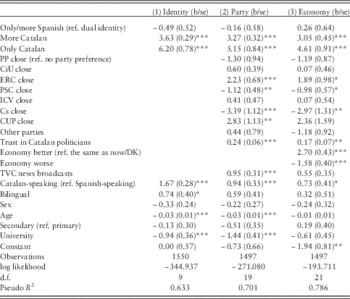
In order to get a grasp on the actual role of the three main explanations we have advanced (identity, party cues, and economic expectations) in shaping preferences for secession, we present in Table 1 three logistic regression models in which we introduce the explanatory factors in a stepwise fashion.
Support independence

*P<0.1, **P<0.05, ***P<0.01.
The first model considers only national identity plus demographics. Here we can see how identifying as more Catalan than Spanish or, especially, as only Catalan exerts a very strong effect on the probability of supporting independence. In terms of average marginal effects, the probability of supporting independence increases by 0.6 if the respondent feels more Catalan, and 0.68 if she feels only Catalan with respect to the baseline dual identification. Detailed average marginal effects coefficients for each variable in the model not shown for the sake of simplicity. These strong effects, together with the high model fit (pseudo-R 2 of 0.6) point to a remarkable importance of identity in structuring citizens’ preferences for secession (Table 1).
The question, then, is whether this is the end of the story or there is room for an independent effect of the political agency and economic considerations. Model 2 incorporates partisanship together with trust in Catalan politicians and source of TV news followed by the respondent in order to capture these cueing and framing effects. The coefficient for identity is smaller when we introduce these variables but nonetheless retains a strong effect. The new variables improve the model fit (pseudo-R 2 up to 0.7), and some of them exert a significant effect on the probability of supporting independence.
Regarding partisanship, what we see is that, as expected by the theory on party cues, it is closeness to parties with the clearest positions on the issue that matters the most. This is true both for overtly pro-independence parties (ERC and CUP) and anti-independence ones, such as Ciutadans. The only exception to this is the non-significant effect of closeness to the PP, but this is probably more related to the large standard error, due to the reduced number of respondents that declared feeling close to the Spanish conservative party in the survey (only 39 cases).
General trust in Catalan politicians and following the TV news through the Catalan public broadcasters also have positive effects on support for independence. Controlling for the other factors in the model, those that follow Catalan TV news have a 0.05 higher probability of supporting independence, and every additional point in the 0–10 trust scale adds about 0.01 to the predicted probability of supporting secession. Detailed average marginal effects coefficients for each variable in the model not shown for the sake of simplicity.
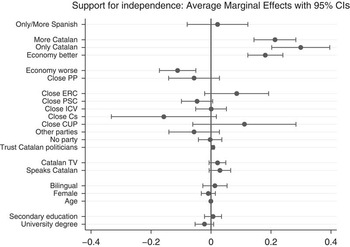
To test whether there is still room for an independent explanatory effect of economic expectations, we include them in the third model. And they seem to matter. First, they add to the model fit up to a pseudo-R 2 of 0.78, which is a remarkable overall fit. The logit coefficients are statistically significant, and the average marginal effects show how thinking that the economy would get better increases the probability of supporting independence by 0.18 with respect to those that think it would not matter or that they do not know. On the other side, considering that things would get worse depresses the probability of supporting independence, on average, by 0.11 points. Between these two groups, therefore, there is almost 0.3 points of difference, after controlling for identity and partisanship. However, the model we present now does not preclude the possibility that instrumental considerations were in fact a rationalization of actual preferences about independence; that is, that we face the type of endogenous effect commented on by Howe (Reference Howe1998) for the Quebec case, which is what we address in the next section.
Those that are more interested in politics are more likely to support independence, although the effect is rather small, especially once we control for all the theoretically relevant factors in the third model. Speaking Catalan does have a slight positive effect on the likelihood of supporting independence. The other control variables included in the model – age, sex, and education – do not display a statistically significant net effect in the final model. Figure 1 summarizes the marginal effects of the full model.
Support for independence. Average marginal effects and 95% IC.

Does the economy weigh the same for everyone? Exploring heterogeneous effects
If identity, elite cues and economic calculations are the three main drivers of support for secession, it is reasonable to explore their interaction: as we have argued, one could expect these factors to influence support for independence in a more nuanced way than the purely additive one we have specified so far. We expect, following what has also been suggested in the case of Quebec (Howe, Reference Howe1998), that cost-benefit considerations will be more important for those citizens with dual identification. In order to explore this heterogeneity we introduced an interaction term between both variables in the model. Although the interaction terms do not have a statistically significant effect, following Brambor et al. (Reference Brambor, Clark and Golder2006), in Figure 2 we represent the marginal effects of the variable of interest across the categories of the moderator, alongside their confidence intervals.
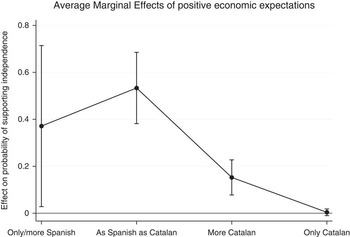
The conditional effect of economic expectations and identity.

Figure 2 displays the interaction between identity and the perceived positive economic expectations of secession. It shows how, as expected, economic considerations play a greater role when national identity is more ambivalent. They have a strong and highly significant effect for citizens with dual identities, a lower effect for those with a predominantly Spanish or Catalan identification and virtually no effect whatsoever for those with a Catalan-only identification. Although the inverted U-shape follows our expectations, it is asymmetrical: holding positive economic expectations is more consequential for the Spanish end of the identity distribution than for the Catalan one.
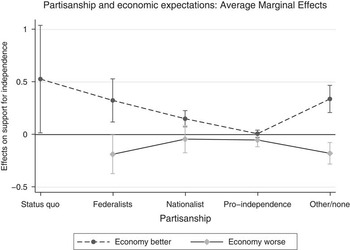
Similarly, we expect the economy to interact with partisanship: those that feel close to parties with a more clear position on the issue shall be less affected by economic considerations. The cues provided by their parties are stronger and therefore there might be less room for additional considerations. On the contrary, for those citizens that do not have a clear party preference, or feel close to a party with a less clear-cut position, economic considerations should matter more. Figure 3 displays the marginal effects of positive and negative economic expectations regarding independence for five different groups of partisans: overtly anti-independence parties (PP and Cs), those that are not pro-independence but aim for more decentralization (PSC+ICV), the main nationalist coalition (CiU) and the clearly pro-independence parties (ERC+CUP).Footnote 7
The conditional effect of economic expectations and partisanship.

The interaction shows how the biggest and more clear effects of economic expectations are to be found among those that do not have any party identification, and those that identify with those parties (PSC and ICV) that have so far been less homogeneous and clear in their positions. It is also the case, up to some extent, for the followers of CiU – that has some degree of internal dissent. On the contrary, those respondents that identified with overtly pro-independence parties (ERC and CUP), are virtually unaffected by economic considerations. However, in the case of those that identify with overtly anti-independence parties (PP and Ciutadans) the results do not fit as well in our hypothesis. The point estimate of the effect of positive economic expectations on the likelihood of supporting independence is the largest one, although the estimation is less precise and has a large confidence interval. Moreover, the effect of negative economic expectations cannot be estimated, because none of those that identify with these parties and hold negative expectations would support independence.
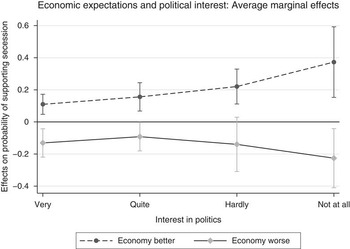
Summarizing, we see a similar story in both interactions to some extent: the role of economic expectations is especially strong among those that have less clear predispositions towards supporting or opposing independence. In other words, the economic debate may have an impact at the margins of public opinion, among those that are less likely to hold a strong predisposition in either direction. An additional piece of evidence that supports this idea is the interaction between economic considerations and interest in politics, which is represented in Figure 4. There, we can see how indeed the economic expectations, either positive or negative, have a stronger impact among those with lower levels of political interest. The less politically aware citizens are more prone to be influenced by this sort of consideration, as were those with dual identities and no partisanship, or partisans of parties with internal dissent. This result reinforces the idea that economic considerations act as an additional driver of preference formation that is especially important when the other alternative factors have a smaller impact in either direction.
The conditional effect of economic expectations and interest in politics.

Empirical analysis (II): experimental evidence
Considering the previous discussion on the rationalization problem, we contend that, in order to estimate the exogenous causal effect of the economic considerations on preferences for independence, we have to move beyond observational research towards an experimental setting. We designed a survey experiment (Mutz, Reference Mutz2011) in which respondents were randomly presented with different credible scenarios on the economic consequences of a hypothetical secession. The aim of the experiment is to exogenously manipulate the respondents’ perceptions of the economic consequences of the hypothetical secession of Catalonia and then see whether this has an effect on their propensity to support or oppose independence. Therefore, we randomly divided the sample into two treatment groups: the first one was presented with a piece of information containing expert judgements that underlined the benefits of independence, while the other group received a similar treatment with negative inputs on the costs of secession. After exposing our respondents to the treatment, we collected information on their preferences and voting intentions in a hypothetical referendum.
The experiment was administered to 800 Catalan respondents from an online commercial panel. Recruitment to the panel is based on databases of the main commercial websites in Spain, and it is only possible to access the panel by invitation, thus excluding self-selection.Footnote 8 The sample was selected using age, gender, education, size of habitat and province quotas in order to ensure enough variety of respondents. The survey was administered online in the language (Catalan or Spanish) chosen by the respondents.
Treatment conditions
Treatments consisted of a hypothetical piece of information that we wrote based on arguments and estimates that had been advanced in real debates between economists.Footnote 9 While keeping texts as realistic as possible to improve external validity (Barabas and Jerit, Reference Barabas and Jerit2010), we tailored them in order to make positive and negative treatments as equivalent as possible. At the beginning of the survey, respondents had been told that they would read short texts similar to those that appear in the press. The positive treatment regarding the benefits of independence was as follows:
Catalonia’s independence would bring great economic benefits, experts say
Several university experts in the field of economics have shown that independence would bring great economic benefits for Catalonia, since it would put an end to the so-called fiscal deficit. Fiscal deficit is the difference between the taxes Catalans pay to the Spanish state and what they receive in exchange. Currently, this deficit is estimated at about 8% of the Catalan GDP or, equivalently, around 16.735 million Euros a year that could be recovered and, according to the experts, would by and large overcome the hypothetical costs of independence.
Indeed, the debate on the fiscal deficit has long been at the top of the Catalan political agenda, and there is a vast amount of public debate on the issue. It has been used by pro-independence parties and movements as one of their main arguments. Conversely, the negative treatment on the economic costs of secession was based on the fear of losing access to the Spanish market, which is a common response in Catalonia to pro-independence claims. The deep integration of the Catalan economy within Spain is often cited as the main economic argument against secession.
Catalonia’s independence would bring great economic costs, experts say
Several university experts in the field of economics have shown that independence would cause great economic damage in Catalonia, since Catalan companies’ trade with the rest of Spain would drop sharply. Currently, Catalonia’s main external customer is Spain. The loss of the Spanish market, together with the costs of setting up a new State, would greatly damage the Catalan economy. It is estimated it could lose about 8% of its GDP, circa 16.735 million Euros a year that, according to the experts, would by and large overcome the hypothetical benefits of independence.
Dependent variables and manipulation checks
Following the administration of treatments, we recorded individuals’ preferences on independence. To do so, we used a categorical measure on the voting intentions in a hypothetical referendum (respondents were given the option to vote in favour, against or abstain) as well as a 0–10 scale ranging from ‘completely sure that I would vote against independence’ to ‘completely sure that I would vote for independence’.
After recording individual preferences and voting intentions, we also included as manipulation checks questions on the perceived mid-term economic consequences of independence and continued belonging to Spain. These questions were based on work by Blais and Nadeau (Reference Blais and Nadeau1992) in Canada. The goal of the manipulation checks was to see whether our treatment had taken effect and if we had been able to manipulate individuals’ perceptions on the economic outcomes of secession.
Results
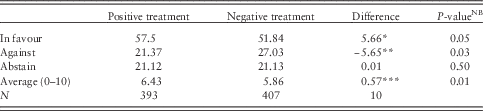
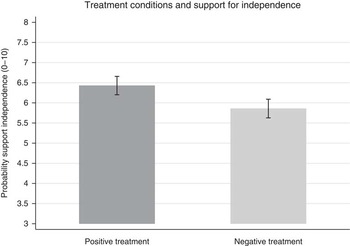
The main results of the experiment show how exposure to positive or negative information on the economic consequences of secession is indeed able to modify individuals’ preferences and voting intentions in a hypothetical referendum: there is a difference of about 5.6 percentage points in the proportion of those that would vote for or against independence between the two groups. Accordingly, the 0–10 scale that recorded the subjective probability of voting in favour of independence vs. voting against shows a 0.57 difference in averages across the two treatment groups. All differences are statistically significant at conventional levels, except for the case of the abstainers, which is almost exactly equal across the two groups.Footnote 10
Main results, experiment

NBOne-tailed z-tests for proportions, t-test for averages.
*P<0.1, **P<0.05, ***P<0.01.
We can say, therefore, that the inputs received by our respondents were able to modify, at least in part, their preferences regarding independence. The main finding, thus, indicates that the entire effect of economic considerations on support for secession is not due to the pure rationalization of pre-existing preferences, there is also an exogenous causal link between expectations regarding the economic outcome of independence and preferences (Figure 5).
Experimental results.

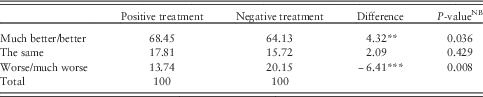
The magnitude of the effect is modest, which might point either to a weak treatment or to the weak impact of our independent variable on the outcome. Were we able to effectively modify respondents’ perception on the economic outcomes of secession? Since this is a politically salient topic in Catalan politics, most respondents might have pre-existing expectations (real-world pre-treatments) that may make it difficult for our treatment to really manipulate them. In order to test the effectiveness of the experimental manipulations, Table 3 shows the distribution of responses to our manipulation check, administered after the dependent variable: the question about the economic situation in 10 years from now if Catalonia became independent for the two treatment conditions.
Manipulation check, Catalan economic situation in 10 years if independent

NBOne-tailed z-tests (two-tailed for ‘the same’).
*P<0.1, **P<0.05, ***P<0.01.
Results show that we were able to modify the expectations of a segment of the sample (about 6.4%) that was only slightly higher than the difference in voting intentions we registered (5.6%). There is thus a clear correspondence between our ability to manipulate the expectations on the economic outcomes of secession and the registered change in voting intention. The amount of change induced by our treatment is limited by its strength and the pre-existing perceptions of the issue that most respondents may have due to its political salience. Most probably, party cues and the framing of the debate in the public sphere shape an expectation that has proven difficult to manipulate experimentally.
This situation points to a strong pre-treatment effect that would cause a downward bias for the estimates of the causal effects (Gaines and Kuklinski, Reference Gaines and Kuklinski2011). In that sense, our estimated treatment effects should be more correctly interpreted as an average marginal effect of an additional treatment (Gaines et al., Reference Gaines, Kuklinski and Quirk2007): the difference in means found across our two treatment groups has to be regarded as the effect of being exposed to an additional negative vs. positive piece of information on the economic consequences of secession. On the one hand, this makes the direct interpretation of our estimate less relevant, but on the other hand it points to the fact that the real effects of economic expectations are larger. In the presence of strong pre-treatment, the fact that we managed to find an effect of our treatment indicates that we are pointing to a relevant variable.
Heterogeneous effects
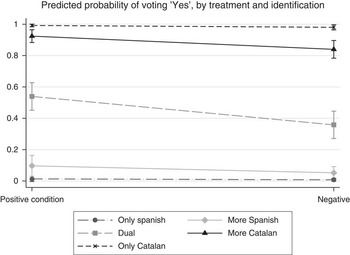
As discussed previously, our expectations regarding the impact of the experiment also include heterogeneous effects. We hypothesized that the treatment would have a stronger effect on those individuals with dual identification with Catalonia and Spain than on those with exclusive or dominant Catalan or Spanish identities. In order to test that hypothesis, we run a regression model with identification, treatment, and the interaction between them as predictors of voting in favour of or against independence. The coefficient of the interaction term did not emerge as statistically significant, but the calculation of the predicted probabilities and confidence intervals shows that the difference between the two treatment conditions is indeed higher among the dual identifiers than between those with more exclusive identities. Indeed, for groups with exclusive Catalan or Spanish identities, there was no effect of the treatment whatsoever. The heterogeneity of the effect can be appreciated in Figure 6.
Heterogeneous treatment effects.

Conclusions
In this article, we have analysed the determinants of support for independence among the Catalan population, applying a theoretical model based, mainly, on previous research performed in Quebec. Starting from observational survey evidence, we have seen, first, that identity factors as well as arguments of an economic nature have a relevant effect on Catalan citizens’ preferences for secession. Moreover, political parties, as intermediary agents, also play an important role in determining attitudes towards independence.
To overcome the limitations of observational survey research in identifying the causal effects of economic considerations on preferences for secession, we have defined an experimental design. By randomly presenting respondents with positive or negative information on the expected economic outcomes of independence from Spain, we have been able to estimate the effect of these exogenously changed expectations on their voting intentions in a hypothetical referendum on the issue. Our results show how, indeed, there is an exogenous effect of the expectations about the economic outcomes of secession on citizens’ voting intentions. The magnitude of the effect is modest, which is probably due to our limited ability to effectively change citizens’ expectations – as indicated by the manipulation checks – but also to the upward bias in observational estimates related to a process of rationalization, as discussed in the literature (Howe, Reference Howe1998; Mendelsohn, Reference Mendelsohn2003).
In this way we have addressed the main concern of the literature on the topic, and we have set up a framework for identifying the micro-foundations of the aggregate-level research on secessionism, which increasingly favours economic explanations (Sambanis and Milanovic, Reference Sambanis and Milanovic2011). We have shown how, indeed, there is a clear effect of instrumental considerations in the formation of secessionist preferences. This provides the literature with evidence on the mechanisms at the individual level that drive the aggregate associations identified thus far.
However, our study suffers from some limitations. On the one hand, the limited change in economic expectations that followed our treatments might point to the presence, to a higher degree than expected, of ‘real world pre-treatments’ (Gaines and Kuklinski, Reference Gaines and Kuklinski2011), limiting our ability to effectively manipulate the independent variable and therefore inducing a downward bias in our estimates. A second issue is related to the absence of a control group without treatment (Gaines et al., Reference Gaines, Kuklinski and Quirk2007). Budget constraints prevented us from including a replication of the experiment with a control group, which could provide more insights into the relative effectiveness of the positive vs. negative inputs on the economic consequences although this issue has already been addressed by a recent experiment (see footnote 10). Finally, a cross-country comparison would be a logical extension, in order to see whether the instrumental component in preferences for secession can be generalized beyond the Catalan setting, as hypothesized by the comparative literature.
There is an additional caveat to be taken into account. The issue of reverse causation and rationalization of preferences might affect the other main independent variable of our model as well: national identification. Traditionally, it has been regarded as an exogenous – even ‘pre-political’ – orientation, but recent research points to the endogenous nature of national and ethnic identities. The so-called ‘constructivist’ approach to the study of ethnicity and ethnic identity argues that ethnic identities can change and often do change precisely as a result of the phenomena we aim to explain with them (Chandra, Reference Chandra2012: 5). Well-documented examples of such processes can be found in several works (Laitin, Reference Laitin1998, Chandra, Reference Chandra2004; Posner, Reference Posner2005) and, in the case of Catalonia, Hierro (Reference Hierro2012) has shown that identification does indeed change, even in the short term. It is indeed highly plausible that a process of this sort is taking place in Catalonia, through which citizens are changing their national identification to ‘match’ their new constitutional preferences, and not the other way round. While this is hard to identify empirically, there is some relevant qualitative evidence in Hierro (Reference Hierro2012) pointing in this direction. It should thus be taken into account when interpreting our results, and merits further attention.Footnote 11
The theoretical implications of our findings point to the need to consider processes of preference formation based on instrumental calculations when trying to explain support for secession and, therefore, transcending an oversimplified vision that establishes an automatic and/or necessary link between identity (or, even worse, socio-demographic characteristics such as place of birth or language) and constitutional preferences. We have shown that identity is a crucial explanation of support for independence, but our analysis reveals that, in addition, we have to consider other factors of an instrumental character, as well as the agency of political elites.
Finally, the conclusions of this analysis also have evident political implications. First, our results point to a certain success of the strategy of mobilization based on instrumental/economic arguments pursued by the Catalan pro-independence movement, which has been capable of convincing a part of the Catalan population for which identity considerations do not seem relevant. This also has implications for the possibility of altering levels of support for independence. The fact that economic considerations about independence do play a relevant role in explaining support for secession for an important part of the population means that such individuals are potentially much more open to change attitudes as a consequence of exposure to evidence or arguments about the economic consequences (either positive or negative) of a hypothetical secession from Spain. While the perception of the current economic situation and of the consequences of the fiscal relationship with Spain seems to have brought a segment of the Catalan public opinion to support independence, the question on whether this perception can be modified through a change in the context, such as economic recovery, through institutional reform – increased fiscal autonomy – or simply a process of framing the issue differently remains open.
Acknowledgements
A preliminary version of this article was presented at the XXIInd IPSA World Congress of Political Science, Madrid 2012, and at the UAB Workshop ‘Change in Political Attitudes: Panels and Experiments’, Barcelona 2012. The authors thank participants to those events for their helpful comments, especially André Blais, Yotam Margalit, and Eva Anduiza as well as the anonymous reviewers of EPSR.
Financial Support
Research funded by the project ‘Stability and Change in Political Attitudes’, Financed by the Spanish Ministry of Science and Innovation (CSO2010–18534).