Coronavirus disease 2019 (COVID-19) is a highly transmissible viral illness caused by severe acute respiratory syndrome coronavirus 2 (SARS-CoV-2). The impact of COVID-19 on population health varies widely.Reference Cruz, Santos and Cervantes1 While respiratory symptoms are prominent in the early stages of infection, a substantial number of COVID-19 patients suffer from various long-term mental health problems, including increased levels of stress, anxiety, and depression.Reference Rogers, Chesney and Oliver2, Reference Badenoch, Rengasamy and Watson3 Mandatory isolation in the early stages of infection, which is necessary to prevent the spread of the virus, can cause significant psychological stress for COVID-19 patients. Patients who are hospitalized may experience emotional stress that is severe enough to induce post-traumatic stress disorder.Reference Lorant, Smith and Van den Broeck4, Reference Moseholm, Midtgaard and Bollerup5 Higher levels of psychiatric distress are closely related to delayed recovery in the acute phase and can lead to severe long-term consequences.Reference Nishimi, Neylan and Bertenthal6 A significant number of COVID-19 patients in mandatory isolation at home or in community treatment centers have reported feelings of depression, and some have even reported suicidal ideation.Reference Farooq, Tunmore, Ali and Ayub7 It is crucial to manage the mental health of isolated infectious disease patients. Research identifying and managing the causes of depression in COVID-infected patients has increased.
The fear response to COVID-19 infection can be dysfunctional and is a crucial factor in the development of COVID-19-related depression.Reference Tang, Hu and Hu8 COVID-19 patients are exposed to various stressful situations, including social stigma, discrimination, and uncertainty about the disease process, which causes fear.Reference Cheng and CSk9–Reference Seo12 In particular, restrictive measures such as lockdowns could slow the spread of the virus, but they brought sudden and dramatic changes to various aspects of daily life, such as people’s jobs, health, and finances, increasing levels of fear during the pandemic.Reference Rahman, Hoque and Alif13, Reference Stanton, To and Khalesi14 While fear is a natural response to threats and stressful events, excessive fear can impede coping mechanisms. Fear of COVID-19 was associated with high exposure to media and frequent interpersonal communication related to COVID-19. Additionally, it was reported that some individuals attempt to regulate their fear by downplaying the severity of the COVID-19 threat, but this can lead to maladaptive coping strategies, such as noncompliance with COVID-19 measures.Reference Li15 Furthermore, a study conducted during the early stages of the pandemic on university students found that denial, as a coping style, had a weak association with fear of COVID-19. This suggests that avoidant or passive coping strategies, such as denial, may increase fear of virus infection, whereas adaptive coping strategies, such as cognitive restructuring, were negatively associated with fear of COVID-19.Reference Hasratian, Nordberg and Meuret16 Moreover, higher levels of fear and anxiety related to COVID-19 are linked to PTSD, depression, and anxiety symptoms,Reference Sakib, Akter and Zohra17–Reference Sharif-Esfahani, Hoteit, El Morr and Tamim19 potentially leading to a vicious cycle of maladaptive coping that sustains these issues. Pandemic-related stress has been linked to increased smoking and alcohol consumption, with many self-medication hypotheses assuming that substances such as alcohol are used to alleviate distress.Reference Khantzian20 During the COVID-19 pandemic, uncertainty about the future, as well as concerns about the economy and employment, exacerbated psychological stress, leading to increased consumption of alcohol and nicotine as a coping mechanism, as indicated by several studies.Reference Stanton, To and Khalesi14, Reference Rodriguez, Litt and Stewart21–Reference Elsayed, Schönfeldt-Lecuona and Welte23 A multi-country study conducted in Italy, India, South Africa and the United Kingdom and the United States found that during the COVID-19 pandemic, cigarette smokers exhibited more irrational coping strategies. Due to fears that stores might run out of stock or close during lockdown periods, smokers purchased more cigarettes than usual, and increased smoking at home led to greater exposure of family members to secondhand smoke.Reference Yach24 Especially, fear of COVID-19 can cause social isolation and loneliness, which are associated with an increased risk of depression,Reference Balakrishnan, Ng and Kaur25 and one study has also reported that smoking increased in isolated situations, such as during stay-at-home orders.Reference Knell, Robertson, Dooley, Burford and Mendez26 Therefore, controlling fear is critical in managing depression in isolated patients.
Mindfulness refers to an awareness of thoughts, emotions, and bodily sensations that occur in the present moment,Reference Kabat-Zinn27 and it alleviates various mental health problems and strengthens positive psychological strengths.Reference Grossman, Niemann, Schmidt and Walach28, Reference Gu, Strauss and Bond29 Treatments that increase mindfulness have been used in various ways to improve fear and emotional distress.Reference Boettcher, Åström and Påhlsson30–Reference McCracken and Keogh32 A meta-analysis of the role of mindfulness in depression and anxiety in the context of COVID-19 also found that the tendency to pay attention to and be aware of current experiences in everyday life was a significant moderator of mindfulness and showed an inverse association between mindfulness and anxiety and depression.Reference Xu, Zhu and Chen33 Other systematic review found that mindfulness-based interventions improved emotional distress scores and reduced anxiety symptoms in people whose mental health had been affected by COVID-19. Interventions that aimed to promote mindfulness and non-judgmental acceptance of traumatic experiences appeared to be effective.Reference Duarte, Libório and Cavalcante34 Other recent studies have shown that mindfulness-based interventions alleviate depression, anxiety, and stress in college students, individuals who have experienced lockdowns, and COVID-19 patients.Reference Weis, Ray and Cohen35–Reference Shaygan, Yazdani and Valibeygi38 And previous studies have demonstrated that mindfulness is effective in controlling the level of fear by focusing on the present moment.Reference Greeson and Brantley39 Additionally, some studies have reported that mindfulness plays a mediating role in the relationship between fear of COVID-19 and symptoms of depression and anxiety, reducing depression caused by COVID-19.Reference Belen40, Reference Vos, Habibović and Nyklíček41
This study aimed to investigate 2 main objectives. The first was to confirm the relationship between fear of COVID-19 and depression in patients who are isolated at home due to COVID-19 infection. The second objective was to explore the mediating effects of mindfulness on fear of COVID-19 and depressive symptoms. Notably, previous studies have explored the mediating effect of mindfulness on fear of COVID-19 and depression in the general population, but this study focuses specifically on isolated COVID-19 patients.
Methods
Participants and Procedure
Data were collected from February-April 2022 through an online survey of patients undergoing at-home treatment at Myongji Hospital. The survey was conducted during a surge in the number of Omicron-infected patients. According to the Korea Infection Control Policy,42 all infected patients must be quarantined for 7 days at their place of residence. All participants responded to the survey on the first day of their quarantine after COVID-19 was confirmed.
The study protocol was approved by the Institutional Review Board (IRB) of the authors’ medical center (IRB approval No. MJH 2022-07-007) and was conducted in accordance with the Declaration of Helsinki. Since this was a retrospective study, the requirement for informed consent was waived by the IRB. A total of 380 patients undergoing at-home treatment at Myongji Hospital participated in this study.
Measures
Korean Version of the Fear of COVID-19 Scale (KF-COVID-19S)
The Fear of COVID-19 Scale developed by Ahorsu, Lin, Imani, et al.Reference Ahorsu, Lin, Imani, Saffari, Griffiths and Pakpour43 is a measure of fear, concerns, and anxiety related to COVID-19 and it has been validated in Korea.Reference Hwang, Choi and Yang44 This scale has been investigated in relation to various psychiatric symptoms such as depression and anxiety.Reference Şimşir, Koç and Seki18, Reference Sharif-Esfahani, Hoteit, El Morr and Tamim19, Reference Bitan, Grossman-Giron and Bloch45 The KF-COVID-19S consists of 2 factors – emotional fear and physical fear – and 7 items measured on a 5-point Likert scale where 1 = strongly disagree, 2 = disagree, 3 = neither agree nor disagree, 4 = agree, and 5 = strongly agree. The total score ranges from 7-35 points.Reference Hwang, Choi and Yang44 We verified an acceptable item-total correlation (0.61-0.83), internal consistency (α = 0.88), and strong factor loadings (0.73-0.92).
Korean version of the Mindful Attention Awareness Scale (K-MAAS)
The Mindful Attention Awareness ScaleReference Brown and Ryan46 measures mindfulness and has been validated in Korea.Reference J-h, W-K and S-J47 The questionnaire was designed to rate the participants’ degree of attention and awareness. The MAAS consists of 15 items on a 6-point Likert scale ranging from 1 (almost always)-6 (rarely). In the study,Reference J-h, W-K and S-J47 the verified acceptable item-total correlation (0.24-0.68), internal consistency (α = 0.87), and the single-factor model explained 37.94% of the total variance.
The Korean Version of the Patient Health Questionnaire-8 (PHQ-8)
This study used the Korean version of the PHQ-8 developed by Kroenke et al.Reference Kroenke, Spitzer and Williams48–Reference Park, Choi and Choi50 The PHQ-8 consists of 8 of 9 symptoms on which the DSM-5 diagnosis of major depressive disorder is based.Reference Edition51 The ninth question in the DSM-5 assesses suicidal and self-injurious thoughts and was deleted because the research staff could not provide adequate intervention if required. The research suggests that omitting this ninth question has a small effect on scoring because this question is rarely endorsed in the general population. PHQ-8 consists of 9 items on a 4-point Likert scale (0–3 pts), and 10/27 was set as the cut-off point for depressive symptoms. A PHQ-8 score of ≥10 has a 100% sensitivity rate and 95% specificity rate for major depression and has been shown to represent clinically significant depression. The reliability of the PHQ-8 was high in the present sample (Cronbach’s α = .91).Reference Kroenke, Strine and Spitzer49
Statistical Analysis
Before conducting the main analyses, we performed a descriptive analysis to identify the mean and standard deviation of the research variables, as well as the skewness and kurtosis statistical assumptions of normality (Table 1). Pearson’s correlation coefficient analysis was conducted to assess the relationship between fear of COVID-19, mindfulness, and depression. Baron and Kenny’s hierarchical multiple linear regression was used to determine whether mindfulness mediated the relationship between fear of COVID-19 and depression.Reference Baron and Kenny52
Descriptive statistics of data

†KF-COVID-19S = Fear of COVID-19 Scale; PHQ-9 = Patient Health Questionnaire-9 (PHQ-9); K-MAAS = Mindful Attention Awareness Scale
To test mediation, we estimated the following 3 regression equations: first, the independent variable (fear of COVID-19) must be statistically associated with the mediator (mindfulness); second, the independent variable (fear of COVID-19) must be statistically associated with the dependent variable (depression); and third, we regressed the dependent variable (depression) on both the independent variable (fear of COVID-19) and the mediator (mindfulness). If the mediator remains significant when regressed on the dependent variable, and the independent variable and the dependent variable are not statistically significant, the mediation is fully mediated. If the association between the independent and dependent variables is lower than the second step, it is considered partially mediated. Finally, the statistical significance of the mediating effect was verified using bootstrapping method with the SPSS PROCESS macro (model 4, version 4.1, written by Andrew F. Hayes).Reference Hayes53 To test the statistical significance and obtain the 95% bias-corrected confidence level for the indirect effects, standard maximum likelihood bootstrapping was performed by estimating 5000 bootstrap samples. The 95% confidence interval (CI) does not include 0, which indicates a significant indirect effect at the 0.05% level. The collected data were analysed using the SPSS software (version 26.0; IBM SPSS statistics for Windows, Armonk, NY, IBM Corp).
Results
Participants’ Characteristics and Differences of Variables
A total of 380 patients undergoing at-home treatment and aged between 11-93 years (M = 60.1±11.79) participated in this study. The subjects were 40.8% women and 59.2% men. All participants responded to the following scales: Fear of COVID-19 (M = 15.6±6.34), Mindfulness Attention and Awareness (M = 4.87±0.88), and Patient Health Questionnaire-9 (M = 5.81±5.22). The level of fear of COVID-19 and depression were higher in women than in men. When comparing across age groups, the level of fear of COVID-19 was highest in those aged 65 and older, and post-hoc tests showed a significant difference compared to adolescents under the age of 17 (Table 2).
Characteristics of the study population and differences of variables

M=mean, SD=standard deviation, t=values of t test, F=values of ANOVA, *P < 0.05, **P < 0.01.
Relationship between fear of COVID-19, depression, and mindfulness
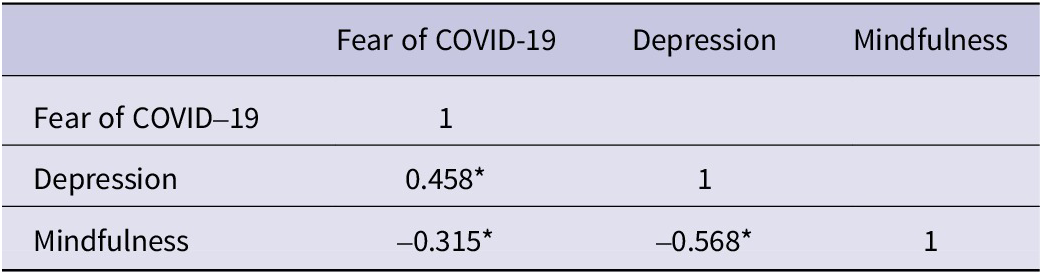
The relationships between the major variables are shown in Table 3. Fear of COVID-19 was positively correlated with depressive symptoms (r = 0.458, P < 0.01), while an inverse correlation was found with mindfulness (r = -0.315, P < 0.01). Furthermore, mindfulness was negatively correlated with depressive symptoms (r = -0.568, P < 0.01).
Pearson’s correlations among clinical variables

†F-COVID-19S = Fear of COVID-19 Scale; PHQ-9 = Patient Health Questionnaire-9 (PHQ-9); MAAS = Mindful Attention Awareness Scale *P < 0.05; **P < 0.01.
Mediation effect of mindfulness on the relationship between fear of COVID-19 and depression
The results of the mediating effect of mindfulness on the relationship between fear of COVID-19 and depression among COVID-19 patients are presented in Table 4. Multiple linear regression was used to analyze the mediating effect. In the first step, the effect of fear of COVID-19 on mindfulness was analysed and a significant effect was confirmed (β = -.044, P < 0.0001). In step 2, the effect of fear of COVID-19 on depression was analysed (β = .377, P < 0.0001). In the third step, the effect of fear of COVID-19 and mindfulness on depression was analysed. Both fear of COVID-19 (β = .255, P < 0.0001) and mindfulness (β = -2.801, P < 0.0001) had a statistically significant effect on depression, but the influence of fear of COVID-19 decreased. These results suggest that fear of COVID-19 and depression are partially mediated by mindfulness. Fear of COVID-19 explained 20.8% of the variance in depression, while the model including fear of COVID-19 and mindfulness explained 40.6% of the variance in depression. The model depicting the mediation effect is presented in Figure 1.

Mediating effects of Mindfulness on the relationship between Fear of COVID-19 and Depression.

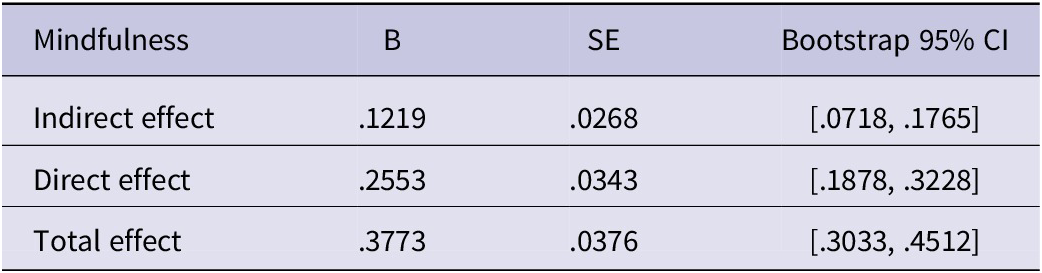
We conducted bootstrapping using PROCESS macro to verify the mediating effects (Table 5 presents the direct and indirect effects of the mediating variables); 5000 samples were re-extracted from bootstrapping, and the lower and upper limits of the indirect effect coefficient were analysed in the 95% CI. The analysis shows that the indirect effect is 0.12, which accounts for 32.3% of the total effect. As a result of the mediating effect test, mindfulness between fear of COVID-19 and depression did not include zero between the lower limit value (0.07) and upper limit value (0.18) of the confidence level (Indirect effect=0.12). Therefore, this was statistically significant.
Verifying the bootstrapping mediation effect

Discussion
This study aimed to examine the relationship between fear of COVID-19 and depression among patients receiving at-home treatment during the acute phase of COVID-19 and to determine if mindfulness mediated this relationship. The relationship between fear of COVID-19 and depression was found to be significant, with mindfulness mediating this relationship. The results suggest that implementing mindfulness interventions could be a beneficial therapeutic approach to manage fear and improve COVID-19-related depression in isolated patients undergoing at-home treatment.
The study found that fear of COVID-19 was positively correlated with depression in isolated patients, which is consistent with previous research indicating a link between fear and depression in COVID-19.Reference Tsang, Avery and Duncan54–Reference Bakioğlu, Korkmaz and Ercan56 Additionally, women exhibited greater fear and anxiety about COVID-19 than men, and compared to adolescents, individuals aged 65 and older had higher levels of fear regarding COVID-19. This is generally consistent with previous studies and may be attributed to cultural gender roles and the biological characteristics of women, which lead to different coping mechanisms in stressful situations.Reference Hidayati, Tan and Yamu57 However, further investigation is needed on this matter. Moreover, older adults may experience greater fear of COVID-19 due to their higher risk of health complications and mortality from the infection.Reference Mukhtar58 Meanwhile, despite being isolated, the patients in this study exhibited fear levels similar to those of the general population,Reference Luo, Ghanei Gheshlagh, Dalvand, Saedmoucheshi and Li59 and their levels of fear were lower than the normative data from wave 1 (2020) when COVID-19 first emerged in Korea.Reference Hwang, Choi and Yang44 Additionally, depressive symptoms were within a mild range compared to Korea’s data.Reference Shin, Lee, Han, Yoon and Han60 This may be explained by the fact that this study was conducted during wave 2 (2022), a period when the SARS-CoV-2 Omicron variant, which had relatively mild symptoms, was dominant. Furthermore, mental health issues related to COVID-19, such as “Corona-blue,” had already been recognized by this time, and patients were receiving home treatment provided by hospitals.Reference HEALTH61, 62 The timing of data collection and the availability of treatment may partially account for these differences. This study is significant in providing data from wave 2, a period when COVID-19 symptoms and mortality rates were relatively lower. Given the significant association between fear of COVID-19 and depression found in this study, interventions aimed at regulating fear may be necessary for managing depression.
The study found that mindfulness partially mediated the relationship between fear of COVID-19 and depression in isolated patients. This suggests that patients with higher levels of mindfulness experienced a lower effect of fear of COVID-19 on depression. These findings are significant as they reveal that mindfulness can have a mediating effect on the relationship between fear of COVID-19 and depression in isolated patients, as well as the general population.Reference Belen40 Previous studies on the general population have shown that online Mindfulness-Based Interventions (MBIs) have had beneficial effects on mental health, particularly depression, anxiety, and stress during the COVID-19 pandemic.Reference Spijkerman, Pots and Bohlmeijer63, Reference Antonova, Schlosser and Pandey64 Our results suggests that online MBIs can also be effective for COVID-19 isolated patients.
Various mechanisms have been proposed for the mediating effect of mindfulness between COVID-19 fear and depression. First, Mindfulness has a beneficial effect on the normalize mal adaptive autonomic nervous system and disrupted stress hormones system from fear.Reference Greeson65 Disrupted immune and hormonal systems contribute to fear causing neuropsychiatric symptoms.Reference Michopoulos, Powers and Gillespie66 A randomized control trial review study also confirmed that mindfulness is effective according to specific markers of the immune system.Reference Black and Slavich67
Second, mindfulness aids in the regulation of emotions by reducing experiential avoidance, a significant contributor to psychopathology.Reference Hayes and Feldman68 Individuals experiencing clinical levels of emotional distress often attempt to avoid painful inner experiences (e.g., through alcohol use, nicotine, or maladaptive cognitive strategies), which can further exacerbate or prolong their distressing emotions.Reference Chawla and Ostafin69, Reference Hayes, Wilson and Gifford70 Mindfulness promotes engagement with present experiences, fostering openness and acceptance, thus mitigating maladaptive coping strategies.Reference Greeson and Brantley39, Reference Barnhofer and Crane71 Mindfulness-based interventions involve practices such as body scanning and breath meditation, aimed at the intentional self-regulation of attention. These practices promote engagement with the present moment, enabling non-judgmental observation and reappraisal of thoughts, feelings, and behaviors.Reference Kabat-Zinn27, Reference Arch and Craske72 Research on mindfulness-based interventions for individuals affected by COVID-19 has demonstrated that by focusing on the present moment, mindfulness reduces future-oriented worry, enables cognitive reappraisal of perceived stress and fear, and increases tolerance to uncertainty, thereby preventing fear from becoming overwhelming. Furthermore, mindfulness helps to reduce rumination-excessive, repetitive and uncontrolled thoughts, which can alleviate depressive symptoms and maintain emotional balance.Reference Bossi, Zaninotto and D’Arcangelo73–Reference Polizzi, Sleight, Aksen, McDonald and Lynn75 The Mindful Attention Awareness Scale (MAAS) used in our study measures the ability to pay attention to and be aware of present experiences, a key component of mindfulness. It is hypothesized that dispositional mindfulness may act as a buffer between fear and depression. Therefore, mindfulness can serve as an effective intervention to protect mental health during the COVID-19 pandemic.
Third, during the pandemic, strict lockdown, isolation of infected individuals, and other necessary actions that could induce fear were inevitably implemented, and people were exposed to uncertain information regarding these measures. In such situations, individuals must have adaptive coping strategies to manage their fear and prevent widespread confusion. As discussed earlier, cultivating mindfulness is expected to play a crucial role in promoting individual mental health and resilience, as well as reducing social disruption, through flexible adaptation in future pandemic.Reference Antonova, Schlosser and Pandey64, Reference Wald76 By fostering adaptive coping strategies, mindfulness can help individuals adhere to pandemic-related regulations and mitigate larger-scale disruptions. According to recent study, individuals with higher levels of mindfulness were less negatively affected by COVID-19 in terms of sleep and mood. Regarding prophylactic measures, participants with higher mindfulness were more likely to comply with lockdown and physical distancing and were more likely to cough into their sleeves. However, they were also more likely to neglect handwashing, wearing masks, or avoiding touching their faces.Reference Wen, Rafaï and Duchêne77 Therefore, future research should investigate the role of mindfulness in compliance with and the effectiveness of COVID-19 preventive measures.
Limitations
The study has some limitations. First, the physical health status of the respondents could not be considered a variable, and the study design did not reflect the effect of patients’ health status on depression. Additionally, sufficient demographic data of the participants were not collected. Second, participants were not placed in a completely isolated environment because our study provided a following online mindfulness programme to isolated patients after survey; accordingly, the level of fear of COVID-19 patients isolated may have been underestimated. Third, this study was conducted retrospectively and cross-sectionally, making it difficult to determine causal relationships. Additionally, since it focused only on home-treated patients managed by a single hospital, it may not fully reflect the psychological characteristics of all home-treated patients nationwide. Nevertheless, given the limited research on the psychological characteristics of individuals isolated due to COVID-19, our findings are still meaningful. Future longitudinal studies and research on mindfulness-based psychological interventions would be valuable.
Conclusion
Our study adds value to the existing literature as it is the first to identify the role of mindfulness in managing fear and depression in COVID-19 patients treated at home. Furthermore, the results of our study provide valuable insights into the development of an online mindfulness program for patients in isolation and quarantine, which may help improve mental health outcomes in this population. This study highlights the importance of incorporating mindfulness-based interventions into mental health treatment plans, particularly for patients who are isolated and may be experiencing high levels of fear and anxiety related to the COVID-19 pandemic. Future research should further investigate the efficacy and feasibility of online mindfulness programs for COVID-19 patients, and explore the potential for integrating such programs into routine care for this population. Furthermore, pre-existing mindfulness capacity is expected to serve as an effective protective factor during public health crises like pandemics.
Competing interests
This work was supported by a Korea Evaluation Institute of Industrial Technology grant funded by the Korea government (No.20008748, Development of universal homecare product and system linked to IoMTbased on community health care service design).