Introduction
Protected areas and land reform have important implications for treasured landscapes and threatened biodiversity. The spatial pattern of protected area establishment is well documented to favour less economically productive areas (Pressey Reference Pressey1994, Venter et al. Reference Venter, Magrach, Outram, Klein, Possingham, Di Marco and Watson2018). The spatial patterns of land reform have not been well studied. Land reform can downgrade or upgrade land-use restrictions and nature conservation benefits of existing legal arrangements. Downgrading legal protections occurs when land reform driven by economic liberalization privatizes land and removes restrictive leases or concessions (Lambin et al. Reference Lambin, Meyfroidt, Rueda, Blackman, Börner and Cerutti2014). Land reform can create protected areas or be a form of protected area downgrading, downsizing and degazettement (PADDD) when it removes legal land-use restrictions or decreases the size or number of areas (Mascia & Pailler Reference Mascia and Pailler2011, Mascia et al. Reference Mascia, Pailler, Krithivasan, Roshchanka, Burns and Mlotha2014). This paper examines the spatial patterns of land reform decisions covering 1.2 million ha of New Zealand’s (NZ) high country.
The International Union for Conservation of Nature (IUCN) describes protected areas as clearly defined geographical spaces dedicated and managed ‘through legal or other effective means, to achieve the long term conservation of nature’ (IUCN Reference Dudley2008). PADDD downgrading is ‘a decrease in legal restrictions on the number, magnitude, or extent of human activities within a protected area (i.e., legal authorization for increased human use)’, downsizing is ‘a decrease in size of a protected area as a result of excision of land or sea area through a legal boundary change’, and degazettement is ‘a loss of legal protection for an entire protected area’ (Mascia & Pailler Reference Mascia and Pailler2011). Land reform may be PADDD, depending on the circumstances. For instance, it may depend on whether agencies and community members interpret restrictive leases and concessions as creating protected areas to conserve nature.
Protected area creation shows a consistent historical preference for protecting places that are less productive, less threatened, steeper, higher altitude and further from roads and amenities. In contrast, economically productive areas are more often developed for housing, commercial or intensive agricultural use (Margules & Pressey Reference Margules and Pressey2000, Scott et al. Reference Scott, Davis, McGhie, Wright, Groves and Estes2001) due to economic and political drivers (Fairfax et al. Reference Fairfax, Gwin, King, Raymond and Watt2005, Symes et al. Reference Symes, Rao, Mascia and Carrasco2016).
It is less clear whether the same trends hold for PADDD and the complex dynamics of land reform, although spatial patterns of PADDD are becoming more evident (see http://www.padddtracker.org). In the tropics and subtropics, larger protected areas in densely populated areas were more likely to undergo PADDD, possibly due to higher opportunity costs than protecting smaller, more remote areas (Symes et al. Reference Symes, Rao, Mascia and Carrasco2016). In Australia, 2% of the protected area network was downsized or degazetted over 17 years, distributed across bioregions both well represented and underrepresented in the protected area network (Cook et al. Reference Cook, Valkan, Mascia and McGeoch2017). Upgrading land protection status does not guarantee greater protection on the ground due to location and social conflict (Ferraro et al. Reference Ferraro, Hanauer, Miteva, Canavire-Bacarreza, Pattanayak and Sims2013).
Land reform changes the laws and regulations governing land ownership and can be a powerful tool of neoliberal economic development, especially in agricultural contexts (Sayre Reference Sayre2009). Neoliberal projects seek to enable capital accumulation and economic development through decentralization, deregulation and privatization (Ojeda Reference Ojeda2012). This is part of economic liberalization, which removes government controls in an effort to boost private-sector growth (Derthick & Quirk Reference Derthick and Quirk1985).
Neoliberal efforts to ‘create or restore private rights to property for the purpose of … increasing efficiency and production through security of title’ are increasing (Wolford Reference Wolford2007). The spatial pattern of land reform is important and varied, contributing to diverse forms such as megacities in China (Liu et al. Reference Liu, Zhan and Deng2005), gated suburban communities in the Philippines (Ortega Reference Ortega2012) and agricultural intensification in Sub-Saharan Africa (Holden & Otsuka Reference Holden and Otsuka2014). Although agricultural and forestry leases and concessions can reduce biodiversity, they can also prevent more intensive housing, mining and cropping (Lambin et al. Reference Lambin, Meyfroidt, Rueda, Blackman, Börner and Cerutti2014). Privatization of state-owned land with leases, licences or concessions can produce a process akin to PADDD.
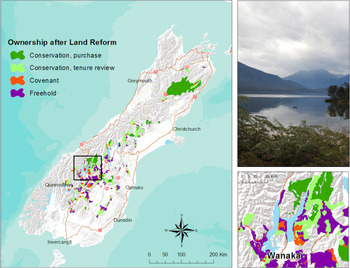
We examined the spatial pattern of land reform’s conservation and privatization outcomes in NZ, a recognized leader in both conservation (Young Reference Young2004) and neoliberal economic reforms (Boston et al. Reference Boston, Martin, Pallot and Walsh1991). Before 1991, NZ’s Crown (i.e., state-owned) pastoral estate comprised one-fifth of NZ’s South Island, clustered largely on the eastern slopes of the Southern Alps (Fig. 1). The Crown has run 33-year perpetually renewable pastoral leases on stations, subject to conditions such as weed and pest control, since 1856. Until reforms, subdivision and industrial uses were expressly prohibited and any intensification required explicit government consent. Pre-reform Crown pastoral lands resemble IUCN Protected Area Category 6: ‘protected areas with sustainable use of natural resources’ (IUCN Reference Dudley2008).
Map of the ownership and conservation status of leases after land reform on New Zealand’s South Island. Insets: photograph of the view from the south-west side of Lake Wanaka; map around the town of Wanaka showing more remote areas conserved while lower-elevation areas closer to towns became freehold (privatized without covenants).

NZ’s neoliberal economic reforms of the 1980s had left many uncomfortable with government rights in multiple-use land. NZ removed agricultural subsidies, privatized all of its exotic forestland and protected the indigenous forests under the Department of Conservation (DoC). In 1991, NZ began voluntary negotiations with leaseholders to determine how to divide each Crown pastoral lease into public conservation land (administered by DoC), freehold land privatized to the former leaseholder and freehold land with a covenant of some sort (Brower 2008, LINZ 2015). A covenant is similar to a conservation easement in the USA, which restricts some land uses (Rissman & Merenlender Reference Rissman and Merenlender2008). NZ covenants vary in size, duration, strictness and effectiveness (Brower & Page Reference Brower and Page2017).
All stations had the option to enter the voluntary tenure review process, which was authorized by Parliament in the Crown Pastoral Land Act 1998 (CPLA). The CPLA’s hierarchical purposes were to (Part 2, Section 24): (1) promote ‘ecologically sustainable’ land management; (2) enable protection of land with significant inherent values (SIVs) by covenants or ‘preferably’ by DoC management of public land; (3) make public recreation access easier; and (4) enable the freehold disposal of land ‘capable of economic use’, thus freeing it of pastoral constraints.
NZ’s conservation legal framework aims to protect ‘representative samples of all classes of natural ecosystems and landscape which in the aggregate originally gave New Zealand its own recognisable character’ (Reserves Act 1977 s. 3). As another land reform mechanism in addition to tenure review, some pastoral leases were purchased outright by the Nature Heritage Fund as public conservation land.
Before tenure, pastoral leases were Crown land leased to farmers, designated as ‘suitable for pastoral purposes only’ (NZ Land Act 1948), much like Australian pastoral leases and similar to US Bureau of Land Management lands with private grazing licenses (Page Reference Page2009). This means that privatization of the stations was de facto – but not de jure – downsizing of protected areas and downgrading of their protection, allowing for intensified agriculture and housing (Lee Reference Lee2018). In simultaneously conserving the rest under DoC management, NZ upgraded protection through tenure review. The financial aspect of tenure review has been surprising – leaseholders were paid over NZ$60 million net by the government to give up grazing leases on new conservation lands while obtaining the option to develop newly privatized land (Brower Reference Brower2016).
Before a tenure review negotiation begins, DoC staff or contractors often identify areas containing ecological and recreational SIVs meriting conservation. The net effect of NZ land reform was upgraded protection for the least threatened habitats and downgraded protection (indeed, privatization) of the most threatened habitats (Walker et al. Reference Walker, Price and Stephens2008). We provide the first analysis of the roles of covenants and science advice about SIVs in land reform.
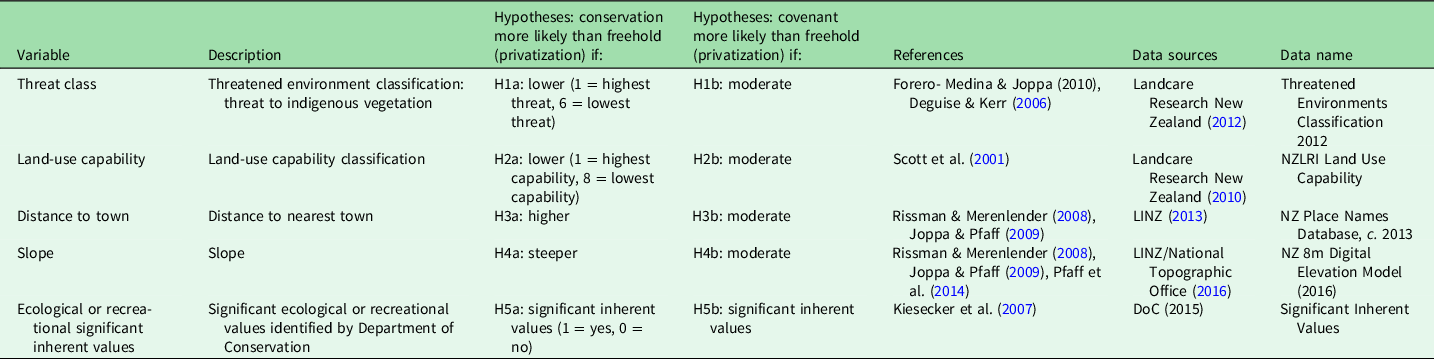
We examine the central question: how do probability of freeholding (privatization) and conservation after land reform vary with land characteristics and the designation of SIVs? We hypothesize (Table 1) that lands were more likely to be conserved as public land (hereafter, ‘conservation’), rather than privatized (hereafter, ‘freehold’), if they had: H1a – lower threat of vegetation conversion; H2a – lower land-use capability; H3a – greater distance from towns; H4a – steeper slopes; or H5a – ecological or recreational SIVs.
Definitions of study variables, hypotheses for status after land reform and data sources; many hypotheses come from research on protected area establishment.

We hypothesize that lands were more likely to become freehold with covenants that restrict development (hereafter, ‘covenant’) if they had (Kiesecker et al. Reference Kiesecker, Comendant, Grandmason, Gray, Hall and Hilsenbeck2007, Rissman & Merenlender Reference Rissman and Merenlender2008): H1b – moderate threat of vegetation conversion; H2b – moderate land-use capability; H3b – moderate distance from towns; H4b – moderate slopes; or H5b – ecological or recreational SIVs.
Methods
Spatial data layer processing
We downloaded the pastoral lease spatial data and cleaned it to analyse 159 leases that went through tenure review (135 leases, 772 000 ha) or were purchased (24 leases, 402 000 ha (hereafter, ‘conservation, purchase’)) between 1991 and 2014 (LINZ 2016). We present analyses on the full dataset of 159 leases (hereafter, ‘all leases’) and a subset of 81 leases that went through tenure review following the survey to identify SIVs (hereafter, ‘tenure review with SIV’).
The DoC appointed people with some technical expertise to identify and map SIVs for most (81 of 159) leases at an early stage in the review process. We obtained DoC spatial data about SIVs through an information request under NZ’s Official Information Act 1982 (DoC 2016). Of the 135 leases that went through tenure review, 33 went through before the CPLA passed in 1998, so these were not surveyed to identify SIVs and were excluded from the ‘tenure review with SIV’ subset. Furthermore, to ensure that leases in our subset had an SIV survey, we also removed 21 leases with less than 5% of their area designated SIV to remove leases containing slivers of SIV designations from nearby properties. Visual analysis confirmed that this threshold removed leases with slivers of SIV from adjacent leases and not polygons of SIV designation fully within the lease boundary. We received personal communication confirming that it would be very unlikely to identify no SIV or only small slivers of SIV if an SIV survey had been conducted, supporting the conclusion that these leases did not have an SIV survey. We grouped SIVs into ecological (comprising original categories of ecological, fauna and flora) and recreational (comprising original categories of landscape and cultural).
We used NZ’s ‘threatened environment classification’ as an indicator of the threat of indigenous vegetation conversion to an alternative land use (Walker et al. Reference Walker, Cieraad, Grove, Lloyd, Myers, Park and Porteous2007). In this threat class dataset, researchers assigned one of six threat categories to each of NZ’s 500 land environment units according to percentage of indigenous vegetation left and percentage in protected areas.
Sampling
To identify location-specific predictors of land reform outcomes, we selected a stratified random sample of points for statistical analysis (Jensen Reference Jensen1996, Baldwin & Leonard Reference Baldwin and Leonard2015). Because high-threat areas make up a small proportion of the leases, we weighted the sample towards high-threat areas to ensure that we would have sufficient representation of these points in our sample. We first intersected ownership outcome and threat class polygons (1 = highest threat, 6 = lowest threat) to generate a polygon for each area with the same land reform outcome and threat class (ArcGIS v.10.3.1). We excluded polygons under 1 ha to remove ‘slivers’ or strips of land unattributable to a designated land reform outcome and threat class.
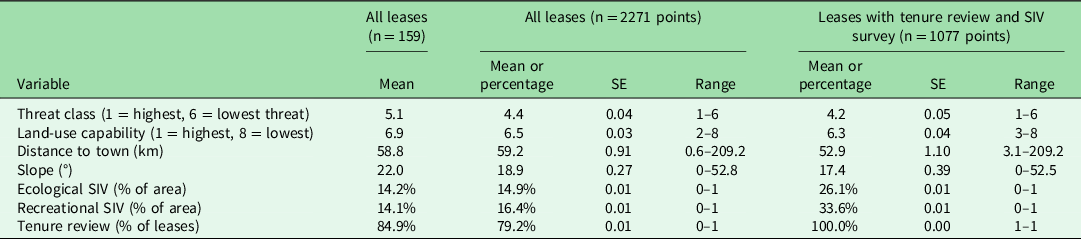
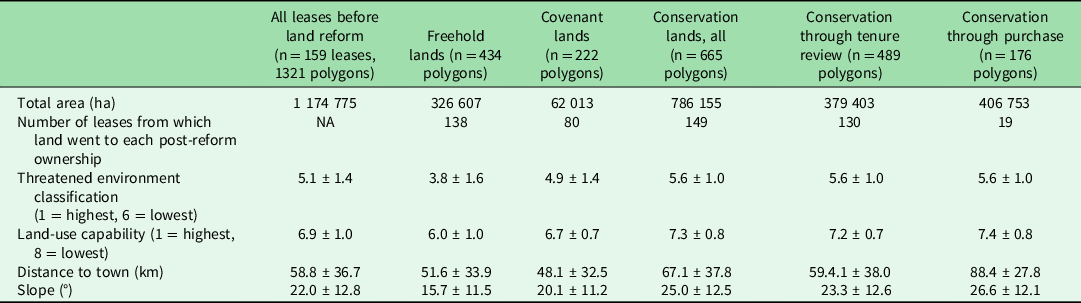
Each polygon received at least one point. To ensure that larger polygons had greater representation, we assigned one point per 1000 ha. We generated the specified number of random points per polygon with the ArcGIS tool ‘create random points’. Finally, we calculated the attributes of sampled points (Table 2) by post-land reform outcomes (Supplementary Tables S1–S6, available online). Summary statistics by area are given in Table 3.
Summary statistics for 159 leases that underwent land reform and for sampled points.

SIV = significant inherent value.
Summary statistics for pre-land reform leases and post-land reform ownership by area (mean ± SD).

Regression analysis
The objective of the regression analysis was to examine relationships between sampled point characteristics and post-land reform outcomes. Importantly, observations made at different locations may not be independent from one another. For example, measurements made at locations nearby may be closer in value than measurements made at locations farther apart. This phenomenon, called spatial autocorrelation, is defined as the dependency found in a set of cross-sectional observations over space. Akin to temporal autocorrelation in time series data, a failure to accommodate for this in modelling risks generating biased parameter estimates and therefore spurious inferences. Our data exhibited the presence of spatial autocorrelation in observations of conserved, covenant and freehold outcomes (Moran’s I, p < 0.01; Geary’s C, p < 0.01).
We specified separate regression equations for each of the three post-land reform outcomes: conserved, covenant or freehold. In this way, the dependent variable in each regression took a binary value, with each regression identifying which factors are specific drivers of that outcome. When the dependent variable in a regression analysis is discrete rather than continuous, as is the case here, a discrete-choice modelling approach is needed to accommodate associated inherent statistical properties. In these circumstances, we applied spatial probit modelling (McMillen Reference McMillen1992, Arbia Reference Arbia2014) rather than the logit version (Arbia Reference Arbia2014), in part due to Anselin’s (Reference Anselin2002) criticism that, in the logit version, the error term is analytically intractable.
We performed spatial probit model estimation (in R 4.0.3; R Core Team 2020) with the spprobitml routine from the McSpatial package (McMillen Reference McMillen2015) using the inverse of the distance matrix between sampled points of the dependent variable to describe spatial proximity. Accounting for spatial dependence follows the general strategy of identifying between spatial lag or spatial error specifications as appropriately fitting the observed data. Spatial lag models account for direct spill-overs from an outcome in one area to those in neighbouring areas, while spatial error models account for spatially autocorrelated unobserved variability in an outcome. Our analysis found support for the spatial error specification as the preferred formulation, thus we used it in reporting.
We ran models for: (1) the full dataset of points from all leases; and (2) the subset of points from leases that went through the tenure review process and had an SIV survey. We standardized continuous and ordinal independent variables to compare coefficients, but we did not standardize binary variables. The correlation matrix of model variables revealed high correlations (>0.7) between elevation and other variables. To avoid multicollinearity concerns, we excluded elevation in regressions. We also observed collinearity between the independent variables of threat class and land-use capability, so we developed separate models containing each variable. Due to the important conservation relevance of threat class, we report the models with threat class in the main manuscript and the models with land-use capability in the Supplementary Materials. Variance inflation factors were under 2, indicating no problematic multicollinearity in the reported models. For the ‘tenure review with SIV’ subset, we added an independent variable to the regression models, expressing whether the point was identified as ‘ecological’ or ‘recreational’ SIV. We added interaction terms for threat class and ecological SIV, as well as threat class and recreational SIV, to examine whether SIV status had an impact on the relationship between threat class and post-land reform outcomes. We similarly developed interaction terms for land-use capability and ecological and recreational SIV.
Results
Privatizing the most threatened areas, conserving the least threatened areas
Of the 1.2 million ha in pastoral leases in our dataset, 772 000 ha went through tenure review and 402 000 ha were Nature Heritage Fund purchases (‘conservation, purchase’). Out of the lease area that went through tenure review, 382 000 ha (50%) went to public conservation land (‘conservation, tenure review’), 61 000 ha (8%) were privatized with a covenant to limit development (‘covenant’) and 326 000 ha (42%) were privatized without protection (‘freehold’). Of the land that was privatized, just 19% had a covenant.
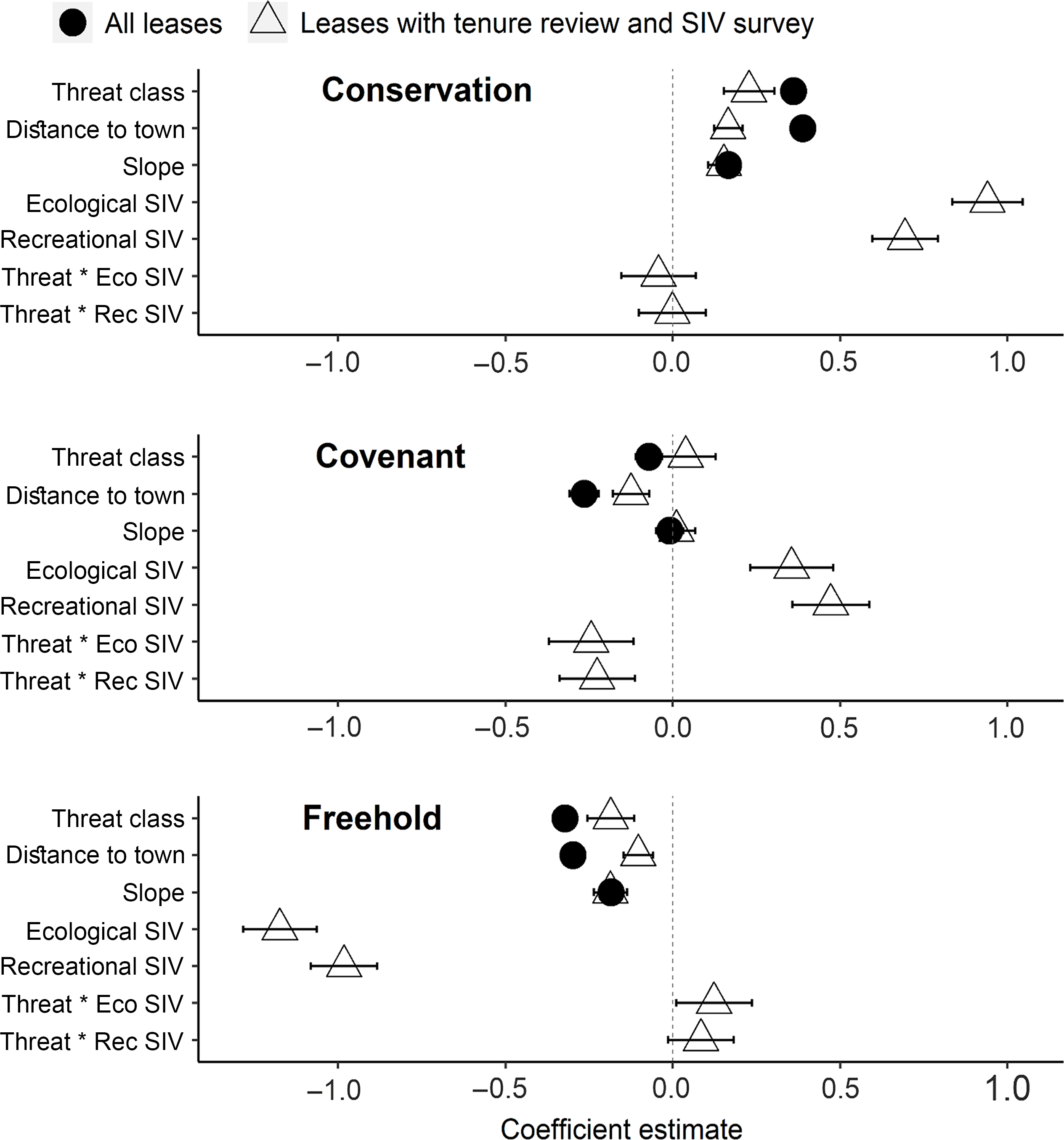
Collectively, land reform outcomes were consistent with our hypotheses. Conserved lands were under less threat (H1a), farther from towns (H3a) and on steeper slopes (H4a) than freehold or covenant lands (Fig. 2). Conserved lands were also of lower productivity (H2a) (Table S11). New freehold lands were the most threatened, most productive, closest to towns and least steep, in comparison with conservation and covenant lands. In other words, they were the most desirable for conversion of land to development or agriculture (Table 3).
Coefficients of spatial probit models with standard error reveal the different characteristics of lands that became conservation (n = 1254 all leases, n = 479 subset with tenure review and significant inherent value (SIV) survey), covenant (n = 250 all leases, n = 167 subset) and freehold without protection (n = 767 all leases, n = 431 subset) after land reform, based on sampled points. Eco = ecological; Rec = recreational.

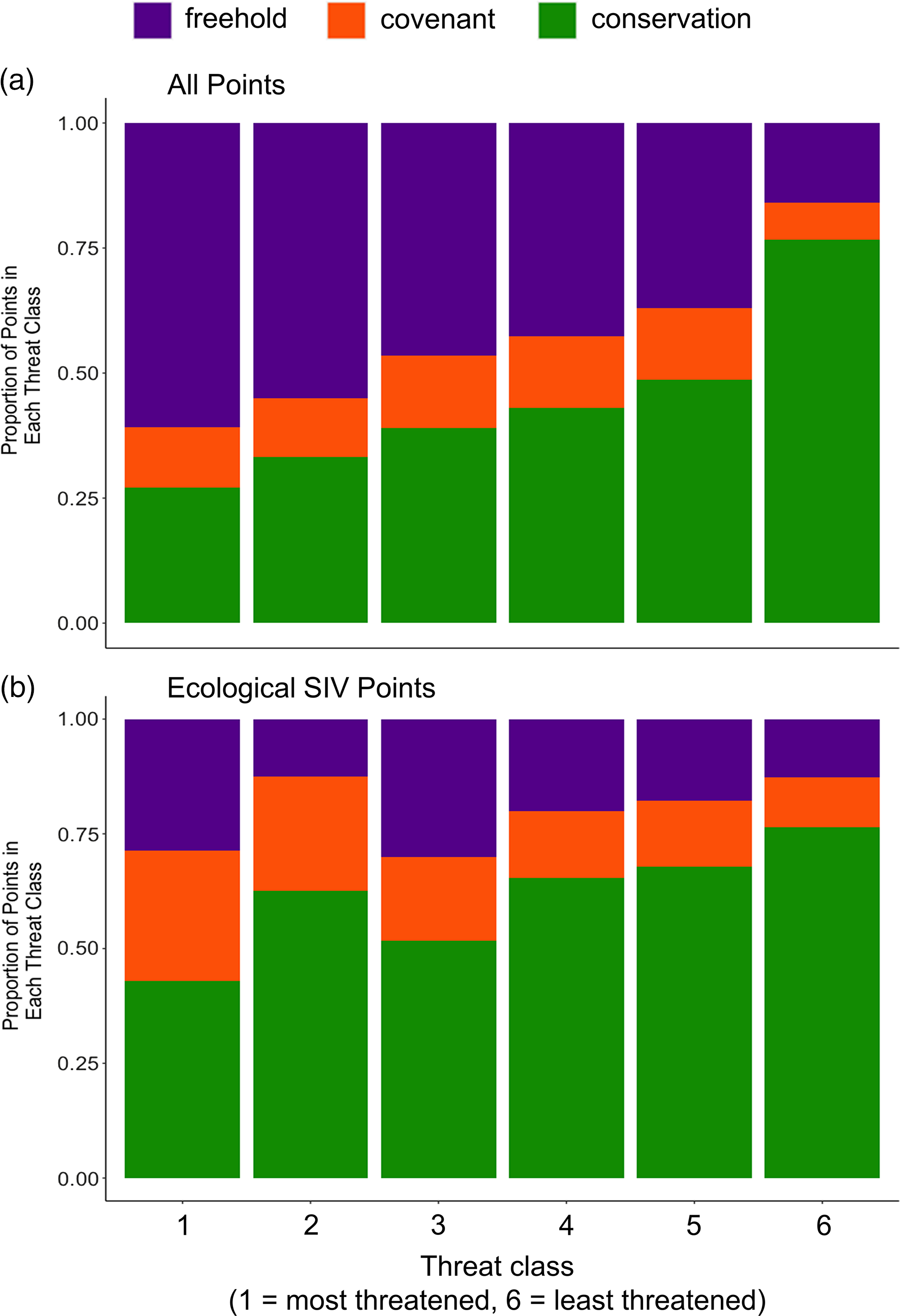
The spatial probit model regressions of sampled points revealed similar patterns and allowed us to isolate the role of each variable while controlling for other variables in the model. Predictors of land reform outcomes were very similar for ‘all leases’ and the ‘tenure review with SIV’ subset. Being in the high country, most of the land in the leases was of high elevation, with a low degree of threat (threat class 5 or 6) and a low land-use capability. Within the leases, areas with threatened vegetation were less likely to be conserved and more likely to be freehold or privatized (Fig. 2; a positive coefficient means conservation was associated with lower threat since threat class is scaled from highest (1) to lowest (6)). Of the lowest-threat areas, 77% became conservation and 16% became freehold, while of the highest-threat areas, 27% became conservation and 61% became freehold (Fig. 3).
Proportion of sampled points in each threat class that were designated as freehold, covenant and conservation after land reform for (a) all points and (b) ecological significant inherent values (SIVs).

Covenanted lands were not statistically different from combined freehold and conservation lands in terms of threat (H1b), land-use capability (H2b) or slope (H4b), but covenant lands were closer to town (H3b) and more likely to be designated ecological or recreational SIV (H5b). Covenant lands had intermediate values between conservation and freehold lands. Freehold land was likely to have greater productivity than land under covenant.
The interaction terms between threat class and ecological and recreational SIV were not significant for conservation and freehold areas, which means having an SIV designation did not change the relationship between threat class and probability of conservation or freehold outcome. However, the interaction terms were significant for covenants, indicating that an SIV designation increased the chance that higher-threat areas were likely to be designated as covenants.
Not all land with SIV was conserved
Regression of the ‘tenure review with SIV’ subset suggests that DoC identification of SIV was a strong predictor of a decision to conserve or covenant land. However, only 71% of land with SIVs was conserved in public conservation land, 9% became freehold with covenant and 17% became freehold with no covenant. SIVs were identified on 29% of lease areas (14% ecological-only SIVs, 14% recreation-only SIVs, >1% both ecological and recreation SIVs). However, the SIV designations themselves underrepresent highly threatened valley-floor ecosystems, and the selection of SIV lands to conserve or covenant compounds this underrepresentation of highly threatened areas (Fig. 3(b)).
Discussion
The high and far story of protected areas
Land reform in NZ is a modern example of the ‘high and far’ story of protected areas (Joppa & Pfaff Reference Joppa and Pfaff2009), and it supports a ‘low and near’ story of degazetting and downgrading. This finding is consistent with Hypotheses 1–4 and with the tendency of powerful economic interests to dominate land reform processes (Binswanger Reference Binswanger, Deininger and Feder1995). Multivariate models revealed that land with high-threat vegetation and higher land-use capability was more likely to become freehold or privatized among all leases and among those that went through tenure review and had an SIV survey. These findings are also consistent with the recreational value of dramatic scenic vistas (Dorwart et al. Reference Dorwart, Moore and Leung2009), even though high mountains are already overrepresented in reserve networks (Joppa & Pfaff Reference Joppa and Pfaff2009).
The role of ecological assessment in land reform decisions
One factor that makes this finding surprising is the inclusion of a role for ecological assessment in the decision process. Conservation decisions relied on ground-truthed, fine-scale scientific assessments of ecological SIV. Consistent with Hypotheses 5a and 5b, SIV designation led to a greater likelihood of an area being conserved or covenanted, but this was far from 100%.
The ecological assessment process itself yielded a spatial pattern that underrepresented high-threat areas. Even within lands designated as ecological SIV, low-threat areas were more likely to be conserved. This might reflect a low priority being placed on the protection of ‘working’ and ‘used’ landscapes with active grazing operations, even though working lands have often emerged as conservation priorities (Brunson & Huntsinger Reference Brunson and Huntsinger2008). After land reform, privatized grasslands were highly vulnerable to conversion to pasture and other agricultural uses, while vegetation on conserved lands was maintained with the exception of small areas of forestry tree weed spread (Weeks et al. Reference Weeks, Overton and Walker2013). SIV designations did not change the relationship between threat and land reform outcomes, except for covenants.
Commitments to conservation
A second factor making these findings surprising is NZ’s stated legal, political and cultural commitments to environmental protection. The privatization of substantial significant resource lands seems to contradict the goals of the CPLA that governs tenure review. Indeed, NZ’s Environment Court said: ‘Without a covenant it is difficult to see how the [Commissioner of Crown Lands] can justify freeholding as consistent with the purpose of tenure review under the CPLA’ (Federated Farmers of New Zealand (Inc) v Mackenzie District Council [2017] NZEnvCourt 53 at [551]). The Minister of Conservation said in 2018: ‘The tussock lands, wetlands, shrublands, outwash plains and landscapes … have paid the price for a disconnect between agencies and muddled responsibilities’ (ODT 2018).
In 2019, NZ’s Cabinet and the government agency in charge of land reform recognized ecological losses from land reform (CBC 2019, LINZ 2019), noting that land reform ‘encouraged a focus on processes at the expense of outcomes’, and ‘Overall, the combination of stronger farming links, poor or variable quality ecological advice, and the desire to complete deals has meant development has resulted’ (LINZ 2019).
As of publication in 2021, the Crown Pastoral Land Reform Bill was under consideration in Parliament. If it passes, it will end tenure review. Until the legislation changes, tenure review processes continue and appear to be accelerating (Williams Reference Williams2020).
Land reform can create tremendous benefits for a small number of rights-holders who have incentives to participate vocally through years of administrative process. The economic benefit to NZ farmers from land reform was high. After privatization, some of the freehold lands remained in sheep grazing, while other lands were intensified to vineyards or row crops, or were subdivided and developed (Brower et al. Reference Brower, Meguire and DeParte2012). Sales prices from properties that were subsequently subdivided suggests that the government underestimated the price of privatized land by about 49 000% on average (Brower et al. Reference Brower, Meguire and DeParte2012).
Legal protections beyond public conservation land
Our findings are critical for the Convention on Biological Diversity and other global efforts to protect biodiversity and rare vegetation (Díaz et al. Reference Díaz, Settele, Brondízio, Ngo, Guèze and Agard2019). Narrowly defining protected areas as lands managed by the DoC makes land reform appear as a net gain for conservation. However, the significant losses due to land reform are visible with a broader definition of protected areas and other effective area-based conservation measures on lands with legal land-use restrictions that result in conservation.
Lands that are legally protected from economic development but may or may not be designated as protected areas is an important category, but one that is often overlooked (Kamal et al. Reference Kamal, Grodzińska-Jurczak and Brown2015). This is critical since biodiversity persists in the de facto world, not the de jure one within the narrower constraints of protected area recognition. Furthermore, the interpretation of whether leases and concessions create protected areas can be contested and will likely change over time, complicating reporting on progress towards the Aichi targets. A broader look at conservation strategies is particularly important as agricultural intensification and conversion continue to reduce habitat for rare and threatened species in NZ (Monks et al. Reference Monks, Hayman and Walker2019) and globally (Díaz Reference Díaz, Settele, Brondízio, Ngo, Guèze and Agard2019). Reporting systems can also mask loss of ecosystem protections when some areas are downsized and others are upsized, such as that which occurred after the collapse of the Soviet Union (Mancheno et al. Reference Mancheno, Zazanashvili and Beruchashvili2017).
The increasing use of covenants represents a shift towards blending public and private property rights for conservation (Owley & Rissman Reference Owley and Rissman2016). Freehold lands with covenants were situated in moderately threatened landscapes that offered economic production value as well as ecological value, consistent with Hypotheses 1b and 2b. This approach recognizes the potential for private lands to offer conservation benefits, particularly with relatively secure legal protections against development (Kamal et al. Reference Kamal, Grodzińska-Jurczak and Brown2015). The legal protections offered by covenants are variable and markedly less protective than public conservation land status (Brower & Page Reference Brower and Page2017).
Our research contributes to the growing literature on the spatial patterns of PADDD, land reform and public ownership. The spatial scale of PADDD and land reform dynamics is an important future research area (Cook et al. Reference Cook, Valkan, Mascia and McGeoch2017). Future research on NZ tenure review would benefit from analysis of changing dynamics over time, access to detailed SIV reports and analysis of land cover change. While many land reform efforts globally have sought to divide large holdings into smaller ownerships, and many arise from grassroots, popular movements (Wolford Reference Wolford2007), NZ’s tenure review was not driven by a populist call for equity of land access; rather, it resulted from a quiet series of negotiations with leaseholders (Brower et al. Reference Brower, Meguire and Monks2010). This research is relevant as governments seek to reduce protected area management expenses through PADDD and shift legal land restrictions through land reform.
Conclusions
Land reform is an important challenge for international efforts to achieve biodiversity and protected area targets. Continued research on the spatial patterns of land reform and PADDD is needed (Qin et al. Reference Qin, Golden Kroner, Cook, Tesfaw, Braybrook and Rodriguez2019). We suggest the need for greater attention by conservationists to land reform efforts, even if they appear as private legal transactions in opaque administrative processes. Even fine-grained ecological and recreation evaluations may fail to protect threatened habitats.
Supplementary material
For supplementary material accompanying this paper, visit https://doi.org/10.1017/S0376892921000126
Acknowledgements
Thank you to Carina Pohnke and Matt Bougie for research assistance.
Financial support
Adena R Rissman acknowledges the receipt of a fellowship from the OECD Co-operative Research Programme: Biological Resource Management for Sustainable Agricultural Systems in 2016. Support was also provided by the Vilas Research Fund, University of Wisconsin–Madison.
Conflict of interest
None.
Ethical standards
This research did not involve human subjects.