Implication
Of all the mammals of the world, the yak lives at the highest altitude area of more than 3000 m, and over 90% of the world’s yaks live at the Tibetan Plateau in China. Yaks have special physiological structures that equip them for living at strong solar radiation, deprived of oxygen, low pressure and arctic alpine environment. Comparison between yak and cattle of the low-altitude areas will be informative in studying animal adaptation to higher altitudes. Our results establish the groundwork for further studies on yaks’ meat quality and will be beneficial in understanding the muscle energy metabolism in high-altitude animals.
Introduction
Of all the mammals of the world, the yak lives at the highest altitude area of more than 3000 m, and over 90% of the world’s yaks live at the Tibetan Plateau in China. Yaks have special physiological structures that equip them for living at strong solar radiation, deprived of oxygen, low pressure and arctic alpine environment. More than 14 million yaks provide the basic resources (such as meat, milk, transportation, dung for fuel and hides for tented accommodation) that are necessary for Tibetans and other nomadic pastoralists.
The yak genome sequencing was completed in 2012, in which an expansion of gene families related to sensory perception and energy metabolism, as well as an enrichment of protein domains involved in sensing the extracellular environment and hypoxic stress were identified by genomic comparisons between the yak and cattle. Positively selected and rapidly evolving genes in the yak lineage are also found to be significantly enriched in functional categories and pathways related to hypoxia and nutrition metabolism. These findings may have important implications for understanding adaptation to higher altitudes in other animal species and for hypoxia-related diseases in humans (Qiu et al., Reference Qiu, Zhang, Ma, Qian, Wang, Ye, Cao, Hu, Kim, Larkin, Auvil, Capitanu, Ma, Lewin, Qian, Lang, Zhou, Wang, Wang, Xia, Liao, Pan, Lu, Hou, Wang, Zang, Yin, Ma, Zhang, Wang, Zhang, Zhang, Yonezawa, Hasegawa, Zhong, Liu, Zhang, Huang, Zhang, Long, Yang, Wang, Lenstra, Cooper, Wu, Wang, Shi, Wang and Liu2012).
In fact, the yak meat contains rich trace elements and essential fatty acids beneficial to the human body, and the living environment make it pollution-free and peculiarly tasted. Because of the high quality, green yak meat products have been developed in full swing. However, yaks also has some shortcomings, such as slow growth, low production performance and so on. To overcome these shortcomings and accelerate meat quality improvement by molecular breeding technology, it is necessary to investigate the gene expression regulations of the yak skeletal muscle. To compare the meat quality traits, a Chinese domestic yellow breed Qinchuan cattle was used. The Qinchuan cattle is ranked one of the best livestock breeds and promoted across the country by the Ministry of Agriculture in China (Zhang et al., Reference Zhang, Zan and Wang2011). It has been bred for meat for about 60 years, and the meat quantity and quality have been obviously improved.
In this study, 12 chemical–physical characteristics related to the meat quality of the 36-month Qinghai yak and Qinchuan cattle’s longissimus dorsi muscle (LDM) were compared and the LDM gene expression profiles of these two breeds were identified and compared by utilizing bovine genome array. Differentially expressed genes, functional categories and pathways were also being exploited. We believe that our study will be beneficial in clarifying the molecular mechanisms of meat production and quality trait in the yak, and these data will also contribute to improve the yak meat performance by using molecular breeding technology.
Material and methods
Animals
Six male yaks were prepared in Xi’ning city Qinghai province, and six male Qinchuan cattle were prepared in Baoji city Shaan’xi province. Both groups were with similar genetic backgrounds and the yaks were born within a 30-day period. The animals were stunned with a captive bolt and slaughtered according to commercial standard procedures. Three animals were randomly selected from each group and used for microarray hybridization. Approximately 5 g LDM tissues, adjacent to the 12th section of the LDM, were removed promptly after slaughter and frozen in liquid nitrogen before being stored at −80°C before RNA preparation.
Meat quality evaluation
Two days after slaughter, the pH was measured at the same position in the LDM on the right side using a Thermo Orion pH meter (C310P-43; Orion, Hudson, NH, USA). Twelve days after slaughter, a portion of steak from the LDM between the 8th and 12th ribs was taken from the right side of each animal. After aging, these samples were kept at 2°C throughout the following analyses, each performed in triplicate. Water content was measured by weight loss after drying at 100°C for 24 h (AOAC, 1984). CP content was determined by the Kjeldahl procedure (AOAC, 1984). The ether extractable content was evaluated by extracting with petroleum ether for 8 h, and the ash content by ashing at 600°C for 8 h (AOAC, 1984). Lightness, chroma and hue were determined using a WSC-S colorimeter (Shanghai Precision and Scientific Instrument Co., Ltd., Shanghai, China). Drip losses were calculated on a steak weighing about 80 g and 1.5 cm thick and kept for 48 h in a plastic container with a double bottom (Lundström and Malmfors, Reference Lundström and Malmfors1985). Cooking losses were measured on a 4 cm thick steak, sealed in a polyethylene bag and heated in a water bath to an internal temperature of 70°C (Destefanis et al., Reference Destefanis, Brugiapaglia, Barge and Lazzaroni2003). Shear values were determined on cylindrical cores 2.54 cm in diameter, taken parallel to the muscle fibers and obtained from the steaks used to determine cooking losses; the shear force was measured using an C-LM3 digital display tenderness instrument equipped with a shearing device (XIELI Sci. Co., Ltd., Harbin, China) and calibrated at 100 mm/min. Hydroxyproline content was determined according to the International Organization for Standardization. Separated fat content was evaluated by esterification using KOH-CH3OH solution and individual FAs were identified and quantified with a GC663-30 gas chromatograph (Hitachi) and flame ionization detectors fitted with a 2 m×3 mm capillary column; the apparatus was programmed with an initial temperature of 150°C for 4 min, allowing increases of 1°C to 3°C /min up to a final temperature of 195°C. The temperature of the injector and detector was 250°C. Hydrogen was used as the carrier gas (30 ml/min). The system did not allow for the identification of cis/trans isomers. The data were analyzed by one-way ANOVA (SPSS 13.0, 2004). Differences between the two groups were compared using a post-hoc test.
Gene expression profiles analysis
Six LDM samples, three derived from yaks and three from the Qinchuan cattle, were collected to screen differentially expressed genes. Total mRNA was isolated from 0.2 g LDM tissues with TRIzol® (Invitrogen Life Technologies, Carisbad, CA, USA) according to the manufacturer’s instructions using an RNeasy MinElute Cleanup Kit (Qiagen, Valencia, CA, USA) and quantified by spectrophotometry (ND-1000; NanoDrop Inc., Wilmington, DE, USA). The purity and yield of RNA were determined by the OD 260/280 ratio and OD 260. RNA integrity was examined by electrophoresis on a 1.2% formaldehyde denaturing gel. An aliquot of 1 μg of total RNA was used to synthesize double-stranded cDNA prepared by T7 oligo(dT)-primed reverse transcription using a Eukaryotic Poly-A RNA Control kit (Affymetrix Inc., Santa Clara, CA, USA ); biotin-tagged cRNA was produced using the Custom MessageAmp™ IIBiotin aRNA Amplification Kit (Ambion, Austin, TX, USA). Bio-tagged cRNA (15 μg) was fragmented to produce strands 50 to 200 nt in length using protocols from Affymetrix. The fragmented cRNA was hybridized to Affymetrix bovine genome array containing 23 000 transcripts. Hybridization was performed at 45°C for 16 h (Affymetrix® GeneChip Hybridization Oven 640). The GeneChip arrays were washed and stained (streptavidin–phycoerythrin) on an Affymetrix® Fluidics Station 450 (Affymetrix Inc.) followed by scanning on an Affymetrix® GeneChip® Scanner 3000. Hybridization data were analyzed using GeneChip operating software (Gcos 1.4). The scanned images were assessed visually and then analyzed to generate raw data files saved as CEL files using the default setting of Gcos 1.4. A global scaling procedure was performed to normalize the different arrays using dChip software (Li and Wong, Reference Li and Wong2001a and Reference Li and Wong2001 Reference Li and Wongb). In a comparison analysis, significant analysis of microarray (SAM) was used to identify genes that were significantly differentially expressed between yak and Qinchuan cattle. Gene ontology (GO) and pathway analyses of these differentially expressed genes were performed using a free Web-based Molecular Annotation System 2.0 (MAS 2.0, www.capitaltio.com), which integrates three different open source pathway resources–KEGG, BioCarta and GenMAPP. All analyses were based on annotation information from cattle databases.
Quantitative real-time PCR (qRT-PCR) confirmation
The same RNA from the LT muscle samples were used to confirm the microarray data. Total RNA from each of the six Qinchuan cattle were subjected to genomic DNA digestion using DNase I (Taraka, Dalian, China). First-strand cDNAs were synthesized with Oligo (dT) 18 primers using a RevertAid™ First cDNA Synthesis Kit (Fermentas Life Sciences, Ottawa ON, Canada) and gene-specific qRT-PCR primers (the sequences were shown in Supplementary Table S1) were added. Parallel reactions using GAPDH were performed to normalize the amount of template cDNA. The protocol for qRT-PCR was as follows: using the ABI PRISM 7500 qRT-PCR System (Applied Biosystems, Foster City, CA, USA), initiation with 30-s denaturation at 95°C, followed by 40 cycles of amplification with 5-s denaturation at 95°C and 34-s annealing at 60°C. A melting curve was produced from 60°C to 95°C to check the specificity of the amplified product. Each of the amplifications was duplicated and the mean value was calculated using the ΔΔC
t method. The results (fold changes) were expressed as
 ${\rm 2}^{{\Delta \Delta }} ^{{C_{{\rm t}} }} $
:
 $${\rm \Delta \Delta }C_{{\rm t}} =\left( {C_{{\rm t}} _{{_{{ij}} }} {\minus}C_{{\rm t}} _{{_{{GAPDHj}} }} } \right){\minus}\left( {C_{{\rm t}} _{{_{{i1}} }} {\minus}C_{{\rm t}} _{{_{{GAPDH1}} }} } \right)$$
where
 $C_{{\rm t}} _{{_{{ij}} }} $
and
 $C_{{\rm t}} _{{_{{GAPDHj}} }} $
are the C
t values for gene i and for GAPDH in a sample (named j);
 $C_{{\rm t}} _{{_{1} }} $
and
 $C_{{\rm t}} _{{_{{GAPDH1}} }} $
are the C
t values in sample 1, expressed as the standard (Bourneuf et al., Reference Bourneuf, Hérault, Chicault, Carré, Assaf, Monnier, Mottier, Lagarrigue, Douaire, Mosser and Diot2006). Student’s t-test of independent data was used to assess the statistical significance of differential expression levels of each gene or transcript within the six samples.
Results
Meat quality comparison
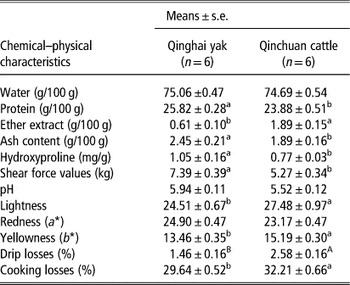
The composition of yak meat compared with the Qinchuan cattle is shown in Table 1. The yak contains significantly more protein and hydroxyproline than Qinchuan cattle (P<0.05), whereas the Qinchuan cattle had greater ether extractable contents and lower ash content than yak (P<0.05). The yak meat had lower tenderness and deeper color than the Qinchuan cattle (P<0.05). It is important to note that the yak had significantly lower drip losses (P<0.01) and cooking losses (P<0.05) than the Qinchuan cattle.
Comparison analysis of chemical and physical characteristics between Qinghai yak and Qinchuan cattle

Means with different superscript letters (a, b; A, B) within the same rows differ significantly (P<0.05; P<0.01).
The LDM gene expression profiles of yak and Qinchuan cattle
The pattern of gene expression in the LT muscle from yak and Qinchuan cattle were analyzed by GeneChip® bovine genome array containing 24 027 probe sets representing over 23 000 transcripts. All the data gained here have been deposited in NCBI Gene Expression Omnibus (GEO, http://www.ncbi.nlm.nih.gov/geo/info/linking.html) and are accessible through GEO Series accession number: GSE488096, GSE488097, GSE488098, GSE488105, GSE488106 and GSE488107. Normalized data were used to analyze the total expressed genes. Approximately 11 000 probe sets were detected in the LDM of yak and Qinchuan cattle. The scatter plot of each probe was shown in Supplementary Figure S1 that could easily compare the expression relationship between the two species.
Highly expressed genes analysis
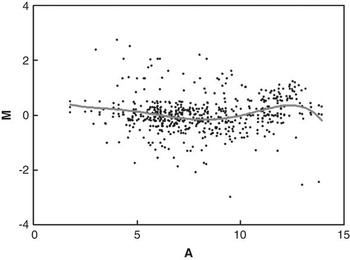
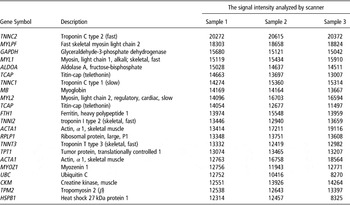
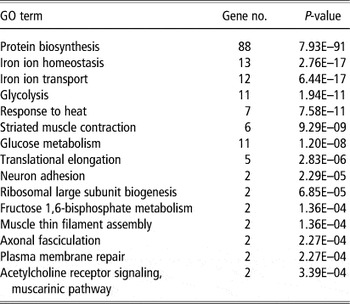
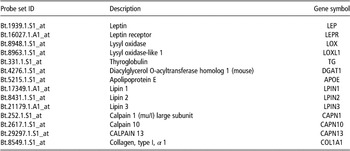
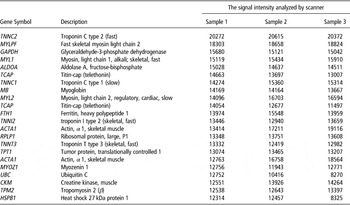
Genes highly expressed in a certain tissue were believed to play important roles in the development and differentiation of the tissue. According to the level of gene expression, the top 1% genes were considered as the highly expressed genes in the LDM tissue (Wang et al., Reference Wang, Li, Wang, Zhang, Wang, Wang and Wang2007). Part of the highly expressed genes and their GO analysis were showed in Table 2 and Table 3, respectively. In contrast, we also found some genes that were not detected in the adult yak muscle tissue, although they were reported to be expressive in domestic cattle (see Table 4), which seems most likely a technical artifact. To contrast the muscle transcriptomes of the two species, we performed the gene enrichment analysis by using the Gene Trail. Genes expressed in the whole six samples were used for analyzing. From the analysis results, total 557 genes involved in striated muscle contraction, glucose metabolism, iron ion metabolism and fat metabolism were used for making the MA plot (see Figure 1).
MA plot between two species highlighting key genes. Note: Genes expressed in the whole six samples were used for analyzing. Moreover, from the analysis results, a total of 557 genes involved in striated muscle contraction, glucose metabolism, iron ion metabolism and fat metabolism were used for making the MA plot. M=log2PMy−log2PMQC, A=(log2PMy+log2PMQC)/2. Where PM means the intensities for perfect match, y represents Yak and QC represents Qinchuan Cattle

Part of the highly expressed genes of yak
Partial results of the GO analysis of the highly expressed genes in yak

GO=gene ontology.
Some ‘not expressed’ genes in the skeletal muscle tissues of the Qinghai yak

Identification of differentially expressed genes between yak and Qinchuan cattle
SAM analysis of the microarray data from six samples (three yaks and three Qinchuan cattle) showed that a total of 1922 genes were significantly differentially expressed. A total of 663 genes were upregulated and 1259 genes were downregulated in the yak compared with the Qinchuan cattle. The SAM plot for Qinghai yak v. Qinchuan cattle was shown in Supplementary Figure S2 and the clustering of the differentially expressed genes are displayed in Supplementary Figure S3. Genes upregulated were predominantly involved in ubiquitin-dependent protein catabolism, nucleotide-sugar transport, protein amino acid ADP-ribosylation, tRNA splicing, γ-aminobutyric acid metabolism and so on. In contrast, the genes downregulated were mainly related to cell adhesion, immune response, complement activation, classical pathway, response to hypoxia, negative regulation of DNA repair, oxidation reduction and so on. Part of the differentially expressed genes was showed in Supplementary Table S2 and S3. Total 68 significant GO terms and 77 pathways were identified in the upregulated genes, and 207 significant GO terms and 101 pathways were found in the downregulated genes. (Part results of the GO and pathway analysis of the upregulated and downregulated genes were shown in Supplementary Tables S4 to S7.)
Validation of gene expression data by quantitative real-time PCR
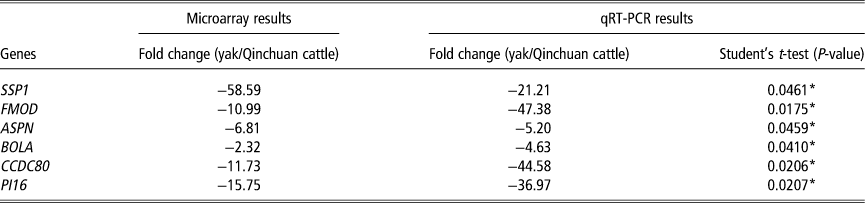
To validate the microarray results, we performed quantitative real-time PCR for six differentially expressed genes (SSP1, FMOD, ASPN, BOLA, CCDC80 and PI16). The real-time RT-PCR fold differences were in complete correspondence with the microarray data. Table 5 compares the microarray and real-time RT-PCR results.
Comparison of microarray and qRT-PCR analyses for Qinghai yak v. Qinchuan cattle

* P<0.05, − indicates means downregulation in yak.
Discussion
In recent years, as people pay more and more attention to yaks’ development and utilization, research on nutritional quality of yak meat have become a hotspot in China. Our study reveals that there are significantly different meat characteristics between yak and domestic cattle. The yak meat contains higher protein but lower fat than Qinchuan cattle, which reveals that yak meat may be healthier. The water-holding capacity of yak meat is also better than the Qinchuan cattle. The water-holding capacity of fresh meat often described as drip loss or cooking loss is an important property of fresh meat as it affects both the yield and quality of the end product (Otto et al., Reference Otto, Roehe, Looft, Thoelking, Henning, Plastow and Kalm2006; Luciano et al., Reference Luciano, Monahan, Vasta, Biondi, Lanza and Priolo2009). Although the meat color of yak was deeper, the tenderness measured by shear force value in the yak meat was unsatisfying. These two indexes are the most important quality attributes affecting purchase decision of consumers (Huffman et al., Reference Huffman, Miller, Hoover, Wu, Brittin and Ramsey1996; Miller et al., Reference Miller, Carr, Ramsey, Crockett and Hoover2001; Platter et al., Reference Platter, Tatum, Belk, Chapman, Scanga and Smith2003). Failla et al. (Reference Failla, Gigli, Gaddini, Signorelli, Saňudo, Panea, Olleta, Monsón, Hocquette, Jailler, Albertí, Ertbjerg, Christiansen, Nue and Williams2004) found that the primitive cattle breeds in Europe usually have more pH value, higher shear force value, better water-holding capacity and deeper flesh color than modern beef breeds. As one of the original species, the yak also presented such meat characteristics.
Yaks live mainly in the Tibetan Plateau, which has an average altitude of more than 3000 m; the unique plateau environment has created its unique biological and economic characteristics, such as cold-resistant, anti-anoxia and so on. Yak is an original ancient breed with slower growth and lower production performance. As for the meat quality traits, thicker muscle fibers, less intermuscular fat and poorer juiciness need improvement, and these are the important contents on yak breeding and improvement. An in-depth understanding of the genetic mechanism of regulating the yak muscle material energy metabolism will set solid foundations for yak molecular breeding.
The GO analysis results of the yak muscle tissues highly expressed genes revealed that genes implicated in protein biosynthesis were highlighted. In different cell state, the ribosomal protein genes coregulated each other and constitute a gene regulatory network (Meyuhas and Perry, Reference Meyuhas and Perry1980; Li et al., Reference Li, Zhong and Wong2005). One of the distinctive features of the yak meat is high protein content, which is higher than the yellow cattle. Such physiological characteristics are closely related to the high levels of ribosomal genes expressed in the yak muscle tissue from a molecular perspective. Genes involved in iron ion homeostasis and transport were also highly expressed in the yak muscle. Iron is a key factor in carrying and transporting oxygen of hemoglobin. Yaks live in the high-altitude area with low oxygen levels or hypoxia for years, and therefore it is extremely essential for them to store large amounts of irons in the muscle tissues, ensuring stable myoglobin and stored oxygen used for organism metabolism.
In addition, genes related to skeletal muscle contraction, glycolysis and glucose metabolism were highly expressed in the yak muscle tissue. Research has shown that lack of MYH genes will not only lead to muscle weakness but also muscle degeneration, causing muscle dysfunction (Tajsharghi et al., Reference Tajsharghi, Thornell, Darin, Martinsson, Kyllerman, Wahlström and Oldfors2002 and Reference Tajsharghi, Darin, Rekabdar, Kyllerman, Wahlström, Martinsson and Oldfors2005). MYH1 and MYH2 subtype mainly express in the fast muscle fibers (Smerdu et al., Reference Smerdu, Karsch-Mizrachi, Campione, Leinwand and Schiaffino1994), which determine the explosive power and speed. ACTA1 gene-encoding actins, which attach to the skeletal muscle actin filaments, play a very important role in the process of muscle contraction (Clarke et al., Reference Clarke, Ilkovski, Cooper, Valova, Robinson, Nonaka, Feng, Marston and North2007). Genes involved in hypoxia response and thermal response were also detected rich in the yak muscle tissue that may play very important roles in adapting to deprived oxygen, low pressure and arctic alpine plateau environment.
On the other hand, some genes closely related to meat quality traits in domestic cattles were not detected in the yak muscle, such as genes affecting tenderness, Calpain 1 and Lysyl oxidase (Page et al., Reference Page, Casas, Heaton, Cullen, Hyndman, Morris, Crawford, Wheeler, Koohmaraie, Keele and Smith2002 and Reference Page, Casas, Quaas, Thallman, Wheeler, Shackelford, Koohmaraie, White, Bennett, Keele, Dikemean and Smith2004), genes associated with marbling traits, Didacylglycerol-O-acyltransferase, Thyroglobulin, Leptin, and so on (Buchanan et al., Reference Buchanan, Fitzsimmons, Van Kessel, Thue, Winkelman-Sim and Schmutz2002; Lagonigro et al., Reference Lagonigro, Wiener, Pilla, Woolliams and Williams2003; Thaller et al., Reference Thaller, Kühn, Winter, Ewald, Bellmann, Wegner, Zühlke and Fries2003). The possible reasons may be because yak and cattle belong to Poephagus and Bos, respectively, owing to the differences in genome between two bovine species, the gene regulation mode may change. Casas et al. (Reference Casas, White, Riley, Smith, Brenneman, Olson, Johnson, Coleman, Bennett and Chase2005) have demonstrated that the allele frequencies of some molecular marker locus in chromosomes 14 and 29 associated with carcass traits are different between the domestic cattle (Bos taurus) and zebu cattle (Bos indicus). SNPs in the TG gene were significantly associated with the marble scores in domestic cattle, but no association in zebu castles, suggesting that new suitable molecular markers need to be found in zebu populations. Similarly, molecular markers applied in domestic cattle may not be suitable for yaks, and further exact biological experiments need to be validated and discover in the yak population.
A total of 1922 differentially expressed genes were screened out when comparing Qinghai yak and Qinchuan cattle muscle gene expression profiles. Our analysis results revealed that the expression levels of some important genes implicated in ubiquitin-dependent protein catabolism were upregulated in yaks. The skeletal muscle contains the most abundant protein in the body, and the protein metabolism in the muscle tissue will directly affect the organism amino acid and protein metabolism. Research has demonstrated that the protein degradation is extremely complex and orderly. In the eukaryotic cells, most of the protein degradation is completed by the ubiquitin-mediated proteolysis system, which is a highly selective dependent ATP protein degradation pathway (Ciechanover et al., Reference Ciechanover, Orian and Schwartz2000). Ubiquitin ligase, such as CUL5, covalent binding to the protein with ubiquitin, degrades proteins with the action of the proteasome. This process is very important for maintaining normal physiological activities, participates in cell cycle regulation, transcription, antigen processing, DNA repair, cell differentiation and apoptosis and so on (Strous and Govers, Reference Strous and Govers1999). The degradation speed of the skeletal muscle protein changes with the nutrition, endocrine and enzyme activity. The living environment of yaks force them to spend a lot of energy, which may cause the muscle protein degradation to be more active than in the domestic cattle.
It makes sense that genes involved in the glucose metabolism and energy metabolism were differentially expressed between the Qinhai yak and Qinchuan cattle. PFKFB3 has a high ratio of kinase and phosphatase, which maintain a higher level of fructose-2,6-diphosphate in the body and speed up the glycolysis (Sakakibara et al., Reference Sakakibara, Kato, Okamura, Nakagawa, Komada, Tominaga, Shimojo and Fukasawa1997; Chesney et al., Reference Chesney, Mitchell, Benigni, Bacher, Spiegel, Al-Abed, Han, Metz and Bucala1999). PFKFB4 encode the isoenzyme of 6-phosphofructo-2-kinase/fructose-2, 6-biphosphatase. Studies have shown that PFKFB4 expression level increased by the activation of hypoxia response elements in low oxygen condition (Minchenko et al., Reference Minchenko, Opentanova, Minchenko, Ogura and Esumi2004). Compared with the domestic cattle living in the plains, the yaks have to struggle against the strong solar radiation, deprived of oxygen, low pressure and arctic alpine environment. Research on the histoheredity characteristics of the yak skeletal muscle revealed that yaks have more number of mitochondria number and lesser average volume in the skeletal volume than the domestic cattle (Zhang et al., Reference Zhang, Yu, Jing, Li, Wei, Niu, Xue and Liang2013). Therefore, we could suppose that yaks adaptive to plateau hypoxia environment may attribute to more number of mitochondria and lesser average volume in the skeletal muscle, and it will meet the oxygen demand on resting or sedentary. Not only that, yaks are the best means of transportation for carrying cargo in the plateau regions. When yaks are running or carrying cargo in the plateaus, the energy consumption increases sharply, and the anaerobic metabolism (mainly glycolysis) plays an important role for providing energy.
It is notable that genes related to lipid metabolism were differently expressed between the yak and Qinchuan cattle. Considering the living environment of yaks, it is impossible for them to accumulate lots of fat. From the analysis results of yak meat’s chemical and physical characteristics, on the one hand, lower fat and cholesterol in the yak meat are popular as a healthy food nowadays that reveal that yak meat has high developmental potential; on the other hand, it is demonstrated that the fat content is closely related to meat quality (Wood et al., Reference Wood, Enser, Fisher, Nute, Sheard, Richardson, Hughes and Whittington2008; Webb and O’Neill, Reference Webb and O’Neill2008), and the intramuscular fat directly affects the juiciness of beef and indirectly influences its tenderness (Hocquette et al., Reference Hocquette, Gondret, Baéza, Médale, Jurie and Pethick2010). The meat quality of yak is inferior to domestic cattle, largely because of the less fat deposits. Therefore, an important direction of yak breeding is to improve fatty deposits’ ability.
In conclusion, in this study, the meat’s chemical and physical characteristics of the Qinhai yak and Qinchuan cattle were compared, skeletal muscle gene expression profiles of the two cattle species were constructed and 1922 differentially expressed genes were screened out. Our results establish the groundwork for further studies on yaks’ meat quality and will be beneficial in improving the yaks’ breeding by molecular biotechnology.
Acknowledgments
The authors thank all the investigators, research assistants and laboratory technicians who have contributed to this study. This work was supported by the National Natural Science Foundation of China (No. 31000998; No. 31272411), Chinese Universities Scientific Fund (No. QN2011103) and Natural Science Foundation of Shaanxi province (No. 2010JQ3011).