The Central European History Society (CEHS) sponsors a book prize (since 1988) and an article prize (since 1995) named after the pioneering social historian Hans Rosenberg (1904–1988). The prizes are given for books and articles considered to be the best work done in Central European history during a given time period. The book prize is awarded every year (since 2008); the article prize is awarded every other year for essays published during the previous two years.Footnote *
Book Prize
1988–1989 James Van Horn Melton, Absolutism and the Eighteenth-Century Origins of Compulsory Schooling in Prussia and Austria (Cambridge University Press, 1988)
1990–1991 Jonathan Sperber, Rhineland Radicals: The Democratic Movement and the Revolution of 1848–1849 (Princeton University Press, 1991)
Robert Gellately, The Gestapo and German Society: Enforcing Racial Policy, 1933–1945 (Oxford University Press, 1990)
1992–1993 David G. Blackbourn, Marpingen: Apparitions of the Virgin Mary in Nineteenth- Century Germany (Knopf, 1993)
1994–1995 Heide Fehrenbach, Cinema in Democratizing Germany: Reconstructing National Identity After Hitler (University of North Carolina Press, 1995)
1996–1997 Kathleen Canning, Languages of Labor and Gender: Female Factory Work in Germany, 1850–1914 (Cornell University Press, 1996)
1998–1999 Kathy Stuart, Defiled Trades and Social Outcasts: Honor and Ritual Pollution in Early Modern Germany (Cambridge University Press, 1999)
2000–2001 Harold Marcuse, Legacies of Dachau: The Uses and Abuses of a Concentration Camp, 1933–2001 (Cambridge University Press, 2001)
2002–2003 William Hagen, Ordinary Prussians: Brandenburg Junkers and Villagers, 1500– 1840 (Cambridge University Press, 2002)
2004–2005 John Edward Toews, Becoming Historical: Cultural Reformation and Public Memory in Early Nineteeth-Century Berlin (Cambridge University Press, 2004)
2006–2007 Chad Bryant, Prague in Black: Nazi Rule and Czech Nationalism (Harvard University Press, 2007)
2008 Tara Zahra, Kidnapped Souls: National Indifference and the Battle for Children in the Bohemian Lands, 1900–1948 (Cornell University Press, 2008)
2009 Hilary Earl, The Nuremberg SS-Einsatzgruppen Trial, 1945–58: Atrocity, Law, and History (Cambridge University Press, 2009)
2010 Monica Black, Death in Berlin: From Weimar to Divided Germany (Cambridge University Press, 2010)
2011 Michael Meng, Shattered Spaces: Encountering Ruins in Postwar Germany and Poland (Harvard University Press, 2011)
2012 R. M. Douglas, Orderly and Humane: The Expulsion of the Germans after the Second World War (Yale University Press, 2012)
2013 Lars Maischak, German Merchants in the Nineteenth-Century Atlantic (Cambridge University Press, 2013)
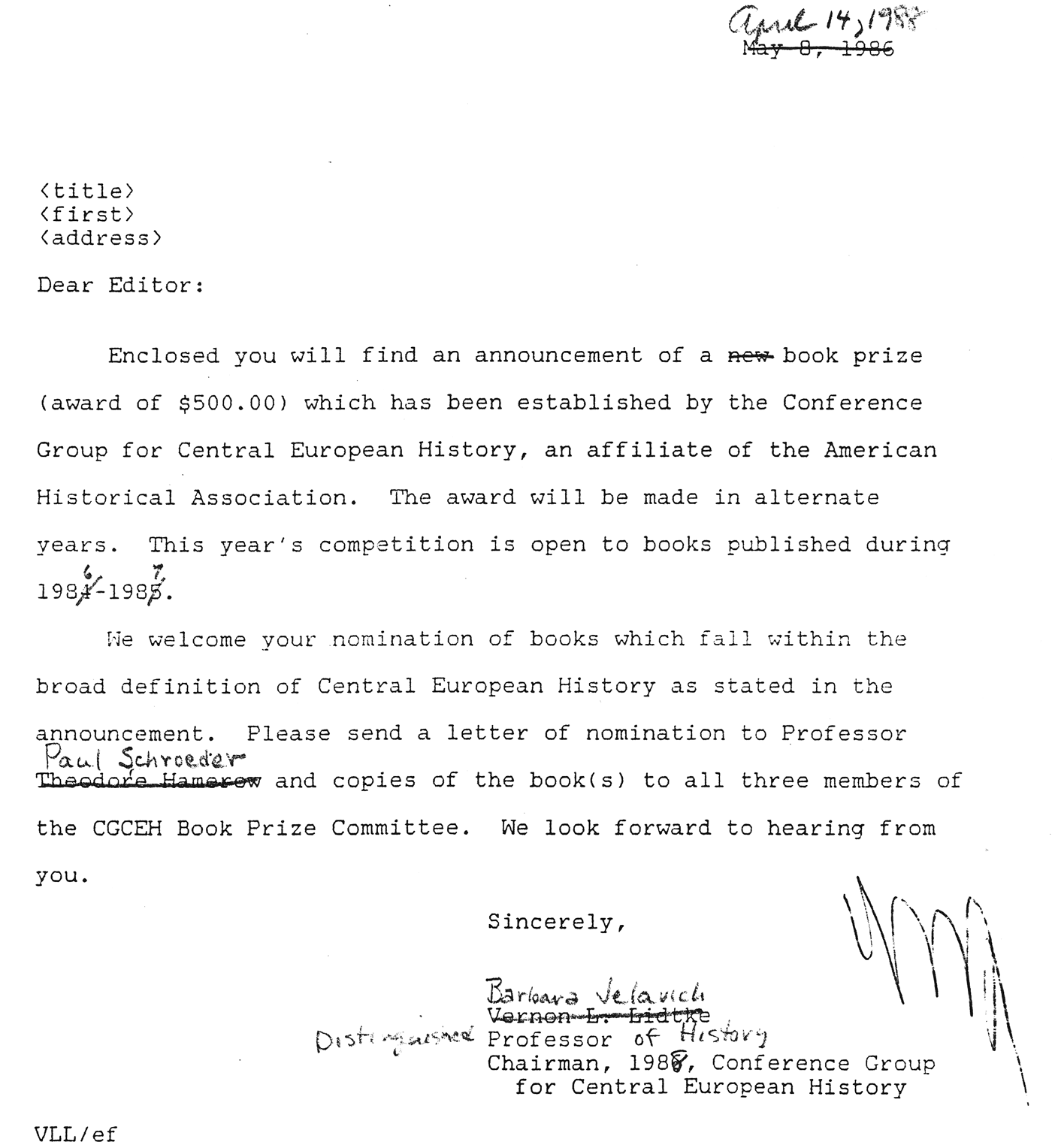
Letter announcing the creation of the (as yet unnamed) book prize in 1988.

2014 Benjamin Carter Hett, Burning the Reichstag: An Investigation into the Third Reich's Enduring Mystery (Oxford University Press, 2014)
Brian E. Vick, The Congress of Vienna: Power and Politics after Napoleon (Harvard University Press, 2014)
2015 Karen Hagemann, Revisiting Prussia's Wars Against Napoleon: History, Culture, and Memory (Cambridge University Press, 2015)
2016 Erin R. Hochman, Imagining a Greater Germany: Republican Nationalism and the Idea of Anschluss (Cornell University Press, 2016)
Article Prize
1995–1996 Robert G. Moeller, “War Stories: The Search for a Useable Past in the Federal Republic of Germany,” American Historical Review (October 1996)
1997–1998 Karl Bahm, “Beyond the Bourgeoisie: Rethinking Nation, Culture, and Modernity in Nineteenth-Century Central Europe,” Austrian History Yearbook (1998)
1999–2000 George S. Williamson, “What Killed August von Kotzebue? The Temptations of Virtue and the Political Theology of German Nationalism, 1789–1819,” Journal of Modern History (December 2000)
2001–2002 Michael Geyer, “Insurrectionary Warfare: The German Debate About a Levee en Masse in October 1918,” Journal of Modern History (September 2001)
2003–2004 Benjamin Carter Hett, “The Captain of Köpenick and the Transformation of German Criminal Justice, 1891–1914,” Central European History (March 2003)
2005–2006 Mary Nolan, “Germans as Victims during the Second World War: Air Wars, Memory Wars,” Central European History (March 2005)
Robert G. Moeller, “Germans as Victims? Thoughts on a Post-Cold-War History of World War II's Legacies,” History and Memory (Spring/Summer, 2005)
2007–2008 Kathy Stuart, “Suicide by Proxy: The Unintended Consequences of Public Executions in Eighteenth-Century Germany,” Central European History (September 2008)
2009–2010 Jonathan R. Zatlin, “Unifying without Integrating: The East German Collapse and German Unity,” Central European History (September 2010)
2011–2012 Duane Corpis, “Marian Pilgrimage and the Performance of Male Privilege in Eighteenth-Century Augsburg,” Central European History (September 2012)
2013–2014 Jacob M. Baum, “From Incense to Idolatry: The Reformation of Olfaction in Late Medieval German Ritual,” Sixteenth Century Journal (Summer 2013)
2015–2016 James Retallack, “Mapping the Red Threat: The Politics of Exclusion in Leipzig before 1914,” Central European History (December 2016)