Recent school tragedies worldwide indicate a need for improving youths’ preparedness and awareness.Reference Borum, Cornell and Modzeleski 1 - Reference Johnson, Ronan and Johnston 6 Although early planning, proper educational program, and training may improve the state of preparedness, there are very limited activities available for youth.Reference Mutch 5 - Reference Khorram-Manesh 8 Moreover, most of the available activities are descriptive and result in handbooks, recommendations, and lectures, which lack the needed interactivity for their engagement.Reference Borum, Cornell and Modzeleski 1 - Reference Khorram-Manesh 8
In adults, two validated simulation training “MacSim (Mass Casualty Simulation) and three-level collaboration (3LC),” are used to raise the individuals’ awareness of and involvement in incidents and their management (see Online Appendix for “3LC and MacSim”). The information to bolster the need for this type of training approach in youth is limited. Both methods are based on “Blended Learning” and have proven to improve the interactivity, collaboration ability, and knowledge retention by creating an environment in which participants learn by doing, and improve their skills and knowledge by learning from their mistakes in a repetitive scenario play.Reference Khorram-Manesh 8 - Reference Hobfoll, Watson and Bell 10
We designed, a combined and adjusted 1-day MacSim and 3LC simulation training, “Emergency Management and Preparedness Training for Youth” (EMPTY), for a group of Swedish young students and in collaboration with high-reliability organizations (HROs), for example, police, in order to raise the youth’s ability to understand; (1) how to be prepared for different aspects of an incident and its management, (2) how to act in a group and to collaborate with higher confidence, (3) how the HROs work and make their decisions, (4) physical and psychological consequences of a major incident, and finally (5) how they may maintain their own safety (see Online Appendix “course program”).
Method
Participants
In total, 25 16-year-old students (17 females and eight males), from an upper secondary school in western Sweden, were chosen by the school and included in this study. Students with former traumatic experiences and those with language difficulties were excluded. All students and their families consented to participate in the study after being informed orally and by written letter, describing the exercise, its duration, design, goal, and aims. The students were divided into three groups, that is, Police group (n=8), Rescue team group (n=8), and Health care group (n=9) in order to allow individual rotation and supervision in small groups by each professional staff, respectively.
Expert group
An expert group was formed consisting of a pediatric physician, pediatric psychologist, specialist in disaster medicine, police, rescue team, emergency medicine nurses, pedagogic and simulation specialists, school teachers, and school security staff. They conducted a risk and vulnerability analysis before the simulation to identify potential medical and psychological consequences for the participants. The county security unit approved the simulation training.
Study group
A study group consisting of specialists in disaster management and simulation training was formed. They also recruited three observers with health care background and nine supervisors; three prehospital nurses, five rescue team officers, and one police officer to guide students in each group during the exercise. Furthermore, four teachers and one security officer from the school were included. In order to obtain the student’s perspectives, four independent students’ representatives could critically comment on the set-up and potential pitfalls, before the training session.
Topics to teach and evaluate
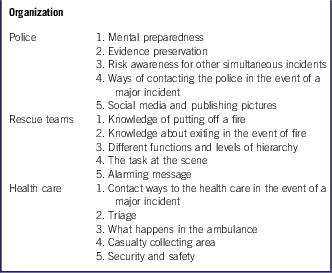
In order to teach and evaluate the outcome, important “take-home messages” for each participating HROs were defined in the preparatory meetings. These points were approved by the reference group and were transferred into topics and bullet points by each organization (five each and 15 in total) (Table 1) and were used in lectures, during discussions, in the seminars and reflection hours, and as pre- and post-tests evaluation of the exercise.
Shows the Five Take-Home Messages Chosen by Each High-Reliability Organization

Pre- and post-tests
Based on Table 1, pre- and post-tests for self-assessment and evaluation were created and the knowledge retention was measured. The answers were presented as four possible alternatives; no knowledge (0 points), a little knowledge (5 points), good knowledge (10 points), and very good knowledge (15 points). The questionnaire was anonymous. Each test was numbered. Each student used her/his number in both tests.
Secondary evaluation
A secondary evaluation was conducted by three observers in each group, consisting of three parts:
1. Each discussed topics (Table 1) during the exercise/discussion was registered in order to ensure that all topics are discussed properly in each group or after full group rotation.
2. Free space for five positive bullet-points/comments with regard to group activity and interaction.
3. Five bullet-points for further improvements.
Third evaluation
Using audience response system, each student could evaluate the course quality by using their mobile devices in a scale with points from 0 (dissatisfaction) to 10 (complete satisfaction).
Final assessment
The expert group and the staff, including teachers, were gathered after the training for oral comments.
Program
Registration, followed by pre-test, three shorts lectures (police, rescue, and health care staff, 15 minutes each), scenario 1 (school fire, 45 minutes), group discussions and reflection hour and own safety, lunch, scenario 2 (school attack, 45 minutes), group discussions and reflection, post-test, and finally, a diploma was awarded.
Results
Pre- and post-tests
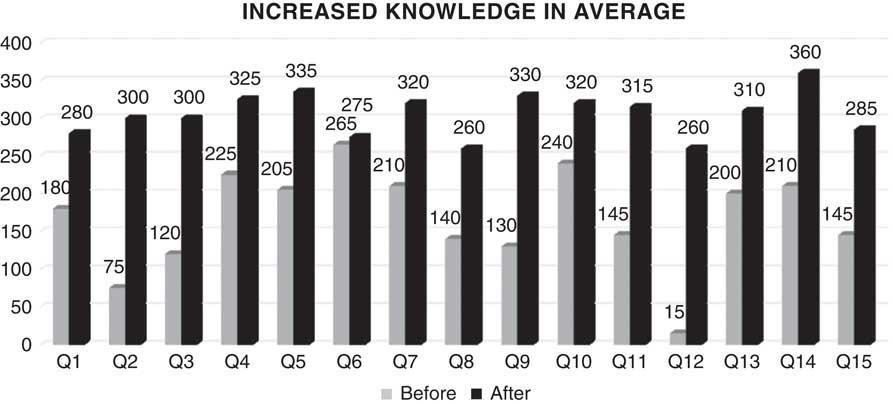
As shown in Figure 1, there was a difference between pre- and post-tests. Although the sample size was not enough to achieve statistical significance, all questions showed an improvement except question number six which dealt with the knowledge needed to put out a fire. The most prominent increase was in question number 12 (triage), followed by other topics, for example, police needs for evidence preservation, awareness about risks for a second threat, the tasks of each team at the scene, and the need for safety at the scene.
Shows the Overall Increased Knowledge in All Topics.

Scenario observations
The most common topics discussed in all groups were mental preparedness, the impact of social media, risk awareness, triage, and safety. There was a variation in how many topics were used in each group, but all topics were discussed during the reflection hours.
In the second part of the template, the observers could positively note the establishment of clear roles and leadership among the students, their active engagement, high interest for triage, and increased communication with the supervisors about their own safety. In the second scenario, they could observe a good communication between the groups, an interest about the way HROs make their decisions, and finally an active participation of normally shy and silent student in the scenario play.
At the last part of the template, some points for improvement were added. Defining the concept of hierarchy, technical terms and the balance between needs and available resources, the need for repeating the same scenario, access to technical instruments and other resources such as clothing, etc. were some of the points presented.
Third evaluation
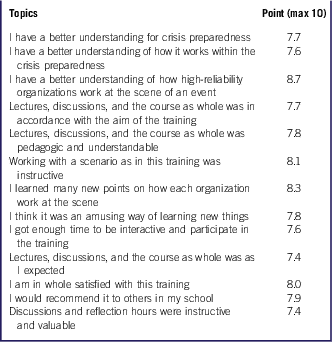
All 25 students used their mobiles for online evaluation of the course by giving a point between 0 (completely disagree) and 10 (completely agree) concerning 13 statements about the course. The course was given >7.7 points, which indicates a good correspondence to the aims of this pilot study (Table 2).
Shows the Third Evaluation of the Course

Each student was asked to give a point between 0 (total disagree) and 10 (completely agree) concerning 13 statements.
Final assessment
The final assessment was held between the expert group, organizers, and school staff. The most important points reported were the good interactivity in all groups, the active participation of normally shy and quiet students, and an increasing self-confidence among students to voluntarily take part in decision-making. In addition, some students also demonstrate their knowledge in other areas such as first aid, rescue teams tasks, etc.
Discussion
To promote a sense of security, peace, self- and group effectiveness, solidarity, and hope are all needed for a successful management of a disaster.Reference Hobfoll, Watson and Bell 10 Together they create a sense of protection, support, and buoyancy, and a greater resilience and preparedness.Reference Hobfoll, Watson and Bell 10 The main goal of this study was to evaluate whether a simulation exercise adapted to young students can improve their preparedness, ability to act, confidence, and understanding of major incidents and disasters. Being tentative in our conclusions despite the small number of this sample, this pilot study indicates that these points can be achieved by an educational initiative such as EMPTY.
Recent school tragedies introduce new concepts of evacuation and barricading. The comprehension of and distinction between these concepts need education and practice. Active participation of youth in various risk management and risk reduction programs have improved their knowledge and understanding on security issues and measures and resulted in a better preparedness.Reference Mutch 5 - 7 Furthermore, their involvement in various activities before, during, and after a disaster or serious incident, has also increased their ability to handle the situation practically and mentally. As most of the existing educational initiatives are descriptive, they lack the interactive elements needed to engage the students, and thus cannot increase their awareness about the society and its reaction to an incident.Reference Ronan, Alisic and Towers 4 - Reference Khorram-Manesh 8
EMPTY enables students to learn by doing, to understand the reasons for any measures and the concept of their own safety. It engages students in group work and gives them a responsibility toward the same goal. Such sense of responsibility minimizes the propensity of youth to act in a contra productive way during a disaster, makes them confident and affects their experience positively. There are examples on how young people have re-triaged themselves to a higher label in order to gain a faster transport from the disaster area.Reference Suserud 11 Roles and missions promote increased understanding of various official missions and thus can also increase the attractiveness of recruitment for these professionals. Finally, it may create a better relationship between youth and authorities instead of promoting an ongoing increased contempt which in turn creates alienation in society.
In conclusion, “EMPTY,” may raise the youth’s basic knowledge and ability to understand the concept of preparedness by being mentally prepared, available for collaboration, gaining a higher confidence, understanding the tasks and missions of HROs, realizing the physical and psychological consequences of a major incident and finally understanding the importance of their own safety.
Supplementary material
To view supplementary material for this article, please visit https://doi.org/10.1017/dmp.2017.144