‘Democracy is a way of personal life controlled not merely by faith in human nature in general but by faith in the capacity of human beings for intelligent judgment and action if proper conditions are furnished … I am willing to leave to upholders of totalitarian states of the right and the left the view that faith in the capacities of intelligence is utopian.’
John Dewey, ‘Creating Democracy – The Task before Us’ (1939)
Students have long played roles in some of the more momentous uprisings over the course of modern history. Most recently, disaffected college students took to the streets calling for democracy in the Arabic countries of Africa and the Middle East.Footnote 1 This is a result, to which academic scholarship can attest, of the nature of schooling and its effects on the development of students. Dewey discussed the importance of individual growth and its relation to a healthy democratic system.Footnote 2 Almond and Verba built upon this individual-level focus to argue that democratic attitudes were most effectively inculcated through education, while Lipset noted the salving effects of education levels on social stability, including increased toleration and greater capacity to comprehend available policy choices.Footnote 3 Though authoritarian regimes may attempt to undermine these developments when they pose a threat to the stability of their rule, we argue that this is often a fool's errand. A survey of the literature over the last hundred years largely supports this claim, providing testament to the power of schools to bring about democratic change.
Not all scholars are ready to assume that education leads to democratization.Footnote 4 An educational system that is only open to the children of wealthy parents may reinforce economic cleavages in society and make conflict more likely.Footnote 5 The widespread provision of education can also create a surplus of highly-educated workers, driving down wages and employment rates. This is particularly dangerous if the ‘excess capacity’ exists for a long duration, without prospects for remedy.Footnote 6 Taken together, this debate in the literature suggests that the effects of education might have little impact on democratization, work against democratization, or be conditional upon a host of factors.
Several questions about the influence of education on democratization extend well beyond this debate. First, education is not a single concept. Families provide an initial education of basic preferences and social skills. Primary education systems offer support and reinforcement for literacy and other basic skills. Institutions of higher education may provide students the chance to attain the most marketable skill sets through the pursuit of university degrees.Footnote 7 Thus, we might expect different levels of schooling to have complementary effects on the likelihood of democratization.Footnote 8 Second, substantial variation exists across states and over time in regards to the quality of education, the level of education across populations, and the distribution of these levels. Third, the influence of education on democratization is likely to be influenced by a host of conditional factors, including who the state deems worthy of education, the availability of information, and the level of wealth in society.
Given that little work has addressed these specific contentions, researchers are in a poor position to make recommendations to policy makers on how to implement education reform.Footnote 9 This is unfortunate, as the importance of understanding more about the impact of education on democratization cannot be overstated. Today, both states and international organizations currently push education to improve a multitude of factors, including democratization.Footnote 10 While promoting education has strong support in the academic literature in general, policy makers working under tight budgets need a better understanding of where to allocate their resources to get the biggest return on their investment. The inability of researchers to provide evidence to guide these decisions has unfortunately led to a universal approach, with policy makers advocating broad policies under the tenuous assumption that improved access to education will cure a variety of social ills.Footnote 11 Our goal is to shed light on the education–democratization relationship by considering a multitude of ways in which education might promote democratization, and to improve our understanding of the context in which education is apt to have its strongest impact on promoting democracy.
Why educate?
Before moving to our theoretical argument, we must first understand the conundrum faced by authoritarian leaders in deciding whether and how much to invest in education. Based on much of the work described above, it would seem that authoritarian rulers have little incentive to invest in education, which is apt to undermine their rule. Indeed, as some have previously argued, education is typically underfunded in authoritarian regimes.Footnote 12 However, authoritarian rulers must weigh the potentially destabilizing impact of education versus a plethora of factors that influence their grip on power.
First, we must recognize that democratic revolutions led by the (potentially educated) masses are only one of the many ways a leader can be removed from office. The failure of authoritarian regimes to provide education to children may be a grievance on its own, and empirical work has shown that both coups d’état and civil wars are strongly associated with poor education.Footnote 13 For example, the failure of the Sudanese government to educate the people in the southern region has been cited as a major grievance leading to a civil war that lasted twenty-two years.Footnote 14 While democratic transitions increase the risk of leaders losing their positions, leaders facing coups or rebellions also risk losing their lives. This gives all authoritarian leaders an incentive to provide education to the population, as it is better to lose one's position via a democratic transition than to lose one's life in a coup or armed rebellion.
Second, the positive impact of education on economic development gives leaders a strong incentive to educate the population. A more educated workforce is a more productive one, making it easier for authoritarian rulers to generate revenue and returns on their investment, including foreign investment.Footnote 15 If the regime provides education for the entire population, laborers do not have to spend money and resources on acquiring education and can focus on simply acquiring wealth.Footnote 16 In general, increased inequality produces lower growth throughout society, and an increase in the provision of education may serve to address this.Footnote 17 Overall, the increased economic growth allows leaders to both increase their personal riches and build defenses to ward off attacks from external enemies.Footnote 18 Thus, it is no surprise that authoritarian states like China and Singapore continue to outpace even long-standing democracies in their investment in education.Footnote 19
We see authoritarian rulers attempt to strike a balance. They attempt to provide education to placate the people and stimulate the economy, while not undermining regime stability. This is no small feat and, as we demonstrate below, can often lead to their downfall.
Education and Democratization
Primary Education
We begin our argument by focusing on how the government provides education to the masses through its primary school systems, first considering how primary systems of education produce effective citizens who are apt to push for democracy. The foremost scholar of education and democracy, John Dewey, made a long career of arguing for the necessity of creating schools that produced individuals who respected the rights and opinions of others. Dewey recognized that to be good citizens, individuals must be placed in situations where they can interact with others on a repeated basis. Through experience, students learn that actions have context and that views and opinions are part of a multitude. Other individuals have their opinions too, and compromise must be reached when the preferences of multiple actors are not aligned. Students also learn that disagreements and conflict can be resolved through debate, without the threat of violence and instability.Footnote 20 As seen through this lens, democracy is defined by addressing the concerns of as many individuals as possible and by promoting equality.Footnote 21
More modern scholars of education and democracy push Dewey's argument a step further by noting the importance of primary education in not only producing effective citizens, but also contributing to democratization. Feng and Zak focus on the importance of cultural and economic factors, but also find that the number of years of school attended has a positive effect on the onset of democracy.Footnote 22 Schooling may only be available initially to the wealthy in these developing countries, a symptom of economic inequality. As these regimes make education more widely available, the social order is undermined and the control held by authoritarian governments is destabilized.Footnote 23 In this way, increased education moves more members of the population out of their traditional stations in society. A rise in social heterogeneity (and greater tolerance of this) makes maintaining a repressive regime, or one that is not accountable to the populace, particularly difficult.
Primary education may provide other benefits beyond developing citizenship skills and respectful challenges to authority. Those students that go to school come into contact with individuals from different groups within society. This makes them better prepared for the representation of various interests that democracy promotes.Footnote 24 Individuals learn the basics of tolerance during their educational adolescence. The more students enrolled in the primary system, the more adults are produced who are conditioned to the requirements of democratic society, such as the peaceful resolution of disputes.Footnote 25 Teachers are vitally important throughout this process. Through suggestion and reinforcement of values, as well as the monitoring of social interactions, these educators can foster the educated skepticism necessary for an effective and vibrant democracy.Footnote 26
Increased enrollment in primary schools may also work to address a collective action problem that inhibits the establishment and growth of democracy.Footnote 27 Without widespread education, the appeal of democracy is not well known. This makes the coordination of pro-democracy movements problematic; the costs of engagement are high and the benefits provided from agitation are perceived to be small, as well as spread out among a number of individuals. Authoritarian regimes can maintain their hold on power by appealing to a much smaller group of individuals, manipulating the collective action problem that emerges amongst the wider population. Increased education lowers the costs for participation as students learn how to work together and engage in democratic practices.
Primary education may also be thought of as working in aggregate as a means of empowering a growing middle class.Footnote 28 With the rise of the bourgeoisie, government leaders must respond to a class of citizens that have acquired property and a higher standard of living, yet do not have the independent wealth to secure these assets. As education increases amongst this class, so too does the cohesiveness and cogency of its expectations of the smaller, ruling class, making it a formidable influence on government action.
Primary school systems themselves may serve as training grounds for stable societies. Africa has often been cited as a case where the lack of political knowledge and democratic values has led to a number of paternalistic and corrupt states. Properly organized educational systems, some argue, could combat these authoritarian regimes and create more prosperous, democratic states.Footnote 29 Primary school education may serve to build socialization skills and tolerance among the population at large. While students gain basic literacy skills, they also learn what it means to be a good citizen. In countries without a uniform drive to indoctrinate, this would seem to lead to a predilection toward democratic regime preference. Prior work has demonstrated a relationship between democracy and mass education, as well as how forms of general education can produce the civil society needed for a liberal regime.Footnote 30 In contrast to systems that reinforce authoritarian order or ethnic strife, as in Zimbabwe or Rwanda, there is evidence that primary education with a focus on individualism and respect for others, such as Uganda's ‘child for the child’ policy, can instill and reinforce democratic values.Footnote 31
Ultimately, it appears that the provision of primary education leads to more support for democracy. As more and more citizens from across society work their way through the school system, they develop the socialization skills necessary for democratic community. They also gain economically productive abilities and critical-thinking skills vital to the implementation of a freer, liberal system. Increased enrollment in primary schools helps to erode, or transform, the inequalities in society by providing a means for achievement, reinforced through the equality of opportunity guaranteed by democratic governance. This discussion leads to our first hypothesis:
HYPOTHESIS 1: As levels of primary education increases, democratization is more likely to occur.
Higher Education
In contrast to the focus on primary education, many scholars have argued that higher education makes democracy more likely to take hold.Footnote 32 As noted by Dahl, there is an overwhelming consensus in the literature linking higher education with democratic values.Footnote 33 Crick and Porter's program of political education reasoned that the type of knowledge learned in early levels of education (e.g., history, sociology, economics) are preconditions for understanding political issues, which are, therefore, best addressed in higher levels of education.Footnote 34 For example, Costa Rica has often been promoted as a success story of democratic consolidation and institutionalization.Footnote 35 It may not be surprising to find that Costa Rican society has championed the growth of education since the nineteenth century, despite issues with bureaucracy and funding throughout the second half of the twentieth century.Footnote 36 Much of this support arises specifically from higher education, where university students and faculty prove a formidable constituency.Footnote 37
Higher education provides a means to prepare the future leaders and policy makers of the state by cultivating them into nuanced, analytical thinkers. Given that university-educated individuals tend to participate at a higher rate than those with much less schooling, or none at all, governments that seek to develop a crop of motivated, self-aware citizens do well to develop tertiary systems of schooling. Consistent with our argument regarding primary education, we expect college education to provide more opportunities for socialization efforts. This level of schooling provides an additional benefit in fostering a population with higher-level analytical abilities that allow citizens to analyze the world around them to make a better assessment of their own interests. As noted by Hillygus, ‘Higher education imparts the knowledge, skills, and political familiarity that help in navigating the political world.’Footnote 38 Faced with a state allowing few roles for the educated to pursue their post-graduate goals, the highly educated are apt to take to the streets to force the government to make meaningful reforms, as they did in Argentina (1955), Hungary (1956), Japan (1960), China (1989), and elsewhere. Beyond having the foundational characteristics of effective democratic citizens, the highly educated in these countries had the capacity to understand the failures of their government, recognize other potential avenues of governance, and evaluate how best to achieve meaningful change. We expect this type of higher-order thinking to be found in countries where a large percentage of the population has attained university-level education, which leads to our second hypothesis:
HYPOTHESIS 2: As levels of tertiary education increase, democratization is more likely to occur.
Theoretical Extensions
While our argument thus far moves the literature forward in articulating the connection between levels of education and democratization, it is largely naïve in assuming that the pathway from education to democracy is independent of a host of conditional factors. Authoritarian leaders might use schooling for indoctrination, for example, in the interests of perpetuating their rule. They might also be highly discriminatory in allowing access to education, perhaps favoring one ethnic group over another. Though these and a plethora of other factors deserve consideration, we extend the primary theoretical argument by focusing on three additional concepts that we deem particularly important for policy and theory. These include gender equality, the availability of information, and economic development.
Gender Equality in Education
With only around a third of states having achieved gender parity in primary education, scholars from a variety of disciplines have focused on how gender equality influences society.Footnote 39 Much of this work focuses on the economic benefits of gender equality in education, showing that educated females contribute more to family income and increase national economic productivity.Footnote 40 Others highlight the broader negative social and psychological effects of educational inequality, including studies on health and life satisfaction.Footnote 41 We seek to move this literature forward by considering how gender inequalities in education influence democratization.
One of the foremost barriers to female participation is the cultural idea that public life, whether it be transitioning to democracy or participation in the status quo, is best left to the males in society.Footnote 42 Though many actors like non-governmental organizations and foreign governments can help to challenge this stereotype, we see education as the most direct path to promote gender equality. At their most basic level, schools produce students with analytical and critical minds who are able to recognize and take action to address gender inequities.Footnote 43 Teachers can act as the agents of change in classrooms, providing opportunities for students to contest traditional gender roles in society. Likewise, school leaders are able to promote gender equality by ensuring that gender is a focus of enrollment and retention in decision making.Footnote 44 In this sense, though traditional ideas towards gender equality may continue to permeate families and the public at large, schools can provide a clear path towards challenging the traditional norms of inequality in society.
If it is true that educating females alongside males indeed produces more empowered females, as well as males who are able to see females beyond their traditional gender roles, we see two clear mechanisms to explain how gender equality in education might eventually produce democratization. First, with both the awareness of inequalities embedded in the status quo and the tools to address these inequalities, females may take a leading role in agitating for political change in the country. For example, mothers’ groups in Argentina, Chile, and El Salvador arose in the 1970–80s to address human rights violations perpetrated by military regimes.Footnote 45 The efficacy of these movements spread both outward, with the creation of regional and eventually global movements to address gender issues, and inward, with groups focusing on the promotion of democracy to address many societal ills.
Second, even when females do not lead movements, the breaking of traditional norms of gender inequality empowers male leaders of democratization movements to lead more effective movements, recognizing that females can play a crucial role in agitating for political change. When male leaders of political liberalization movements in Guatemala came to appreciate the power of female movements in the region, for example, they supplemented their ranks and extended leadership positions to females. Thus, not only does gender equality in schools improve leadership of political liberalization movements, it also produces more citizens agitating for democratization. This discussion leads to our third hypothesis:
HYPOTHESIS 3: As gender equality in education increases, democratization is more likely to occur.
Globalization and Information
Our second extension focuses on how the influence of education on democratization might be conditional on globalization, focusing specifically on the availability of information. We posit that foreign influence enhances the effect of increased education on democratization. Put another way, democracy may be more likely to emerge as the effect of education is amplified by globalization. College-educated citizens in particular may be better able to process the ramifications of global politics for their everyday lives, especially those that join the public realm.Footnote 46 For example, a study by the Russian Moscow State Institute of International Relations (MGIMO) illustrates the importance that the Russian government places upon education of its youth as geopolitical actors who are knowledgeable about languages and world affairs and can, therefore, help to engineer the state's reemergence as a great power.Footnote 47 More generally, educated citizens may follow international events more closely and place their own situation within the context of world events. Consequently, these citizens may stand to gain the most from more openness under an authoritarian regime, because they are likely to travel more and participate in the world economy.Footnote 48 As interconnectedness increases, news about democratic systems and movements may find its way into a state through these avenues and destabilize the regime.Footnote 49 This development of transnational values is institutionalized through the spread of education across the globe. As the world moved on from the Second World War, countries became more interdependent, which contributed not only to evaluations of power and security, but also to growth in the values of democratic politics and knowledge of and about citizens in other places.Footnote 50
A conduit is required for this information to permeate society. We expect several facets of globalization to increase information, including tourism, the size of the foreign-born population, and direct communications via telephone and mail. Likewise, we expect the media to play a crucial role in providing the type of information that could provide critically-minded thinkers with ideas on how their government could be improved via education.Footnote 51 Absent these mechanisms of globalization, it is unlikely that relevant alternatives to the status quo can be considered, and even less likely that they will provide motivation to pressure the government for change. Thus, we expect higher levels of education to have their strongest impact on democratization when states become more firmly integrated into the globalized world.
HYPOTHESIS 4: As globalization increases, the impact of education on democratization should strengthen.
Education and Wealth
Our final theoretical expectation considers how the influence of education on democratization may be conditioned on state wealth. Our argument here might rightly be dubbed the ‘Arab Spring Hypothesis,’ as the conventional explanation for the protest movements in northern Africa and the Middle East focuses on the confluence of a highly educated population and few economic opportunities. Prior to the Egyptian revolution, for example, an analysis conducted by the Egyptian government showed that more than 43 percent of the unemployed in Egypt had university degrees.Footnote 52 Even in better economic times, high rates of underemployment among the educated can result in pressure for political change. For example, the dramatic growth in educational services in Nigeria has created a situation where its ninety-seven universities simply produce far more graduates than its weak economy can absorb, resulting in continued poverty and high rates of both unemployment and underemployment.Footnote 53
While we continue to expect the highly educated to agitate for political liberalization in a general sense, we should expect this relationship to grow even stronger when the educated find themselves in societies that are unable to allow them to reach their full potential. Two mechanisms drive this expectation. First, we expect educated people to be more motivated to push for democracy when the expected benefits of their personal investment in higher education conflicts with the poor opportunities provided by an impoverished state. Though Gurr's focus was on violent movements, this argument is akin to his contention that conflict is likely to emerge when one's value expectations (such as employment upon graduating from a university) diverges from one's value capabilities (in this case, few employment opportunities in a poor state).Footnote 54 Such a condition, which Gurr refers to as ‘relative deprivation,’ is likely to increase one's level of frustration, motivating an individual to challenge the status quo.
Second, as argued earlier, we expect highly educated people in poor societies to have enhanced abilities to organize a push for democratization. However, because protesting for meaningful political change takes considerable time and effort, we might expect the highly educated in wealthy societies to be more likely to accept authoritarianism, because they are likely to expend their time and resources on economic advancement. In poor states with few opportunities for economic advancement, however, we expect the highly educated to use their abilities to agitate for political change. This argument again coincides well with the literature on opposition movements that focuses on how the opportunity costs of mobilization increase as opportunities for advancement (for example, earning money via employment) decrease.Footnote 55 This argument leads to our final hypothesis:
HYPOTHESIS 5: As wealth increases, the impact of higher education on democratization should decrease.
Data, Methods and Measurement
Our general expectation is that democratization is more likely to occur as education levels increase. This should happen both as primary education increases due to the democratic socialization of education (H1), as higher levels of education produce enhanced analytical thinkers (H2), and as gender equality in education increases (H3). We also present two expectations for how the impact of education on democratization is likely to be conditioned on the level of globalization (H4) and the level of wealth in a society (H5). Our unit of analysis to test these hypotheses was the country/year for all authoritarian states from 1970 to 2008. We defined a state as authoritarian if it was coded below +6 on the Polity IV index. This included ninety-five instances of authoritarianism, fifty-one of which had failed prior to the end of our time period. The remaining cases were censored in 2008. States were permitted to re-enter the sample after democratization if they had lapsed back into authoritarianism. Our dependent variable, democratization, was coded 1 in the year in which the state was coded +6 or greater on the Polity IV index.Footnote 56 We used logistic regression to test our hypotheses, while controlling for authoritarian years and cubic splines for temporal dependence.Footnote 57 Robust standard errors were clustered by authoritarian period.Footnote 58 With this set-up, positive coefficients indicate an increase in the likelihood of democratization, while negative coefficients suggest the continuation of authoritarianism.
The unit of analysis and dependent variable provide many advantages over earlier approaches to the examination of the processes driving democratization. Studies from Bollen and Jackman, Muller, and Barro, for instance, analyzed how a variety of independent variables impact the level of democracy for all states.Footnote 59 Two concerns make this approach unacceptable for our tests. First, our theory does not speak to minor changes in democracy or changes within states that are already democracies. We are interested in major shifts towards democratization among states that are already authoritarian regimes. Second, as explained by Papaioannou and Siourounis, analyzing the long-run changes in the level of democracy makes it difficult to be sure that democracy itself is not causing the change in the independent variables instead of the hypothesized relationship.Footnote 60 Lagging the covariates helps in this regard, though the slow-changing nature of both the dependent and independent variables leaves the door open to endogeneity concerns. Dropping states from the sample once they democratize largely eliminates this issue.
Primary Independent Variables
The levels of education in each state are captured using data from the International Institute for Applied Systems Analysis (IIASA).Footnote 61 These data come from an ambitious project to capture education levels for 120 states from 1970 to 2000, and forward-projections to 2050. These data are preferable to other datasets because they capture educational attainment (rather than enrollment rates or expenditure), include education in developing countries, and contain information on educational attainment at various levels (no schooling, some primary, completed lower-secondary, completed tertiary) and for both genders. They also correct many deficiencies in previous data-collection efforts. First, the data are complete in the sense that each country/year included has a value, while other datasets (such as that of UNESCO) have significant temporal gaps. This is largely achieved by using data from censuses performed around 2000, and then back-dating the education data based on the state's demographic profile. For instance, because the highest level of education is generally achieved early in life, we can assume that educational attainment for the sixty-year old cohort in 2000 come from the same population group in 1990 (the fifty-year olds). These back-projections are then refined by differential mortality rates, and updated based on other known historical data. Also, given that education levels can vary in meaning across countries (for example, the meaning of ‘secondary’ or ‘tertiary’), the dataset also uses standard definitions across the entire time period. Finally, the dataset is fully transparent in coding decisions and methodology, and the coders provide many cross-dataset analyses to assure the robustness of the final product. The IIASA project provides a second effort to project education data from 2000 to 2050 using a similar methodology to that described by Lutz et al.Footnote 62 Using identical countries and similar demographic measures, this effort provides several projections of education data. We use the global education trend (GET) scenario, which assumes that a country's educational expansion will converge on an expansion trajectory based on the historical global trend. This allows us to update our data to 2008, which is the final year included in our dependent variable.
Given that these data are provided for many five-year age groups and for both genders, we made several decisions to make the analyses manageable. First, our primary analyses ignore gender imbalances in using the IIASA values for both genders. Second, we combine age groups into a single yearly value for ages 20–59.Footnote
63
Third, we analyze three levels of education. These include the percentage with some education (
 $$$\bar{X}\, = \,{\rm{58}}{\rm{.8}}$$$
, sd = 27.9), which we refer to as ‘mass education’, and the percentages completing primary education (H1;
 $$$\bar{X}\, = \,{\rm{31}}{\rm{.1}}$$$
, sd = 17.9) and tertiary education (H2;
 $$$\bar{X}\, = \,{\rm{4}}{\rm{.7}}$$$
, sd = 4.7).
Our theory also provides three main extensions to the basic hypotheses. The first predicts that democratization is more likely to occur as the ratio of female to male education increases. This concept is captured by dividing the female value of ‘Percent with some education’ measure by the male value (H3;
 $$$\bar{X}\, = \,{\rm{66}}{\rm{.4}}$$$
, sd = 24.7).Footnote
64
We expect to see a positive coefficient to support the third hypothesis. Our final hypotheses predict conditional relationships for both mass and tertiary education. We expect education to have its strongest influence on democratization when plenty of information is available to the people and under conditions of poverty. These expectations are best tested by interacting the primary independent variables (mass and tertiary education) on the conditioning variables (globalization and wealth).
We use the ‘Personal Contact’ measure from the KOF Swiss Economic Institute to capture globalization.Footnote
65
Available on a yearly basis for 208 countries from 1970 to 2009, this index is comprised of measures for international telephone traffic, transfers, tourism, foreign population, and international letters, each of which we expect to expose people to the ideas that might spur democratization efforts. This measure ranges from a maximum of 92.8 (Bahrain) to a low of 3.76 (Myanmar) (H4;
 $$$\bar{X}\, = \,{\rm{35}}{\rm{.0}}$$$
, sd = 18.3). Our final measure, gross domestic product per head (GDP/capita) (H5), is meant to capture the level of wealth in society. Because this measure is in all models, we explain it below as a control variable.
Control Variables
Studying the predictors of democratization is certainly not a new enterprise. Among the dozens of variables that have been found to have a significant impact on democratization in past studies, our final model includes measures that we found to have the most consistent and substantively significant impact on our dependent variable.Footnote
66
The first control variable is wealth, measured as ‘GDP/capita’ (
 $$$\ln \,\bar{X}\, = \,{\rm{7}}{\rm{.2}}$$$
, sd = 1.0), from Gleditsch with updates from the World Bank's WDI dataset.Footnote
67
Wealth has been found to lead to democratic consolidationFootnote
68
and democratic transitions. Second, previous work has also suggested that states colonized by the United Kingdom have had an easier path to democratization.Footnote
69
Thus, we next include a dummy variable, ‘Former British colony’ (28.4 percent of observations), coded 1 if the state was a colony of the United Kingdom.Footnote
70
Third, lessons from both the Arab Spring and Huntington's description of the three waves of democratization suggest that states cluster spatially when it comes to democratization.Footnote
71
Thus, we include a dummy variable called ‘Neighbor democratization’ coded 1 if any of the state's neighbors democratized within the last two years (11.0 percent of observations). Finally, we control for ‘Percent urban’, expecting that countries with more population in urban areas are more likely to democratize (
 $$$\bar{X}\, = \,{\rm{20}}{\rm{.2}}$$$
, sd = 16.5).
Analyses
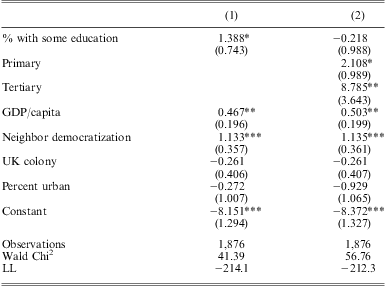
We present our preliminary analyses in Table 1. The first model tests the basic expectation that education should lead to democratization regardless of the level. We see strong support for this expectation with a positive and significant coefficient (p < 0.031) when education is measured as the percentage of the population with at least some education. We test our first two hypotheses more directly in Model 2 by including a measure for Primary and Tertiary education. In this model, we see the basic measure used in Model 1 drop from significance, being replaced with the expected positive and significant coefficients for Primary (p < 0.017) and Tertiary (p < 0.008). These results provide strong support for H1 and H2, respectively.
The Impact of Education on Authoritarian Failure, 1970–2008

Note: Robust standard errors in parentheses. Authoritarian years and splines not shown.
***p < 0.001; **p < 0.01; *p < 0.05 (one-tailed).
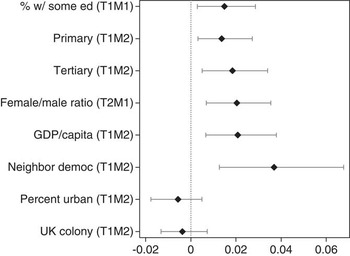
Beyond statistical significance, we can gauge the impact of the independent variables by calculating each variable's marginal effect on the dependent variable using the Clarify package in Stata 12.0.Footnote 72 The results for these calculations are presented in Figure 1. This figure displays how we should expect the likelihood of authoritarian failure to vary when each independent variable is adjusted from one standard deviation (sd) below the mean to one sd above for continuous variables, and from 0 to 1 for dichotomous variables while holding all other variables constant (means and modes).
The impact of education on democratization, 1970–2008: Substantive effects Note: Values reveal first difference (FD) estimations (
 $$\[--><$>\blacklozenge$$$
) with 95 percent confidence intervals (|—|).

We first see that the measure for mass education from Model 1, measured as the percentage of the population with at least some education, has a strong impact on democratization. The likelihood of democratization increases by 104.2 percent (from 0.013 to 0.026) when this value ranges from 1 sd below the mean (29.9 percent) to one sd above (85.7 percent).Footnote 73 Focusing specifically on primary education, we see a slightly weaker impact when looking at Model 2. The likelihood of democratization increases by 107.4 percent (from 0.012 to 0.026) when the percentage of the population having completed primary education varies from 13.2 percent to 49.0 percent. Focusing on tertiary education reveals similar conclusions in support of the second hypothesis with substantive results appreciably stronger than those for primary education. We can expect a 121.8 percent (0.012 to 0.027) increase in the likelihood of democratization as the percent of the population completing tertiary education varies from 0.0 percent to 9.5 percent. Taken together, these results provide strong support for both the first and second hypotheses.
Regarding the control variables, we see results that are generally consistent with previous work and our theoretical expectations. States are significantly more likely to democratize as wealth increases. We can expect the likelihood of democratization to increase 185.8 percent (0.011 to 0.030) on average as wealth increases from 6.2 to 8.3, which represents the second strongest effect across our models. Having a neighbor that democratizes is also a strong predictor of democratization across all models, and this represents the single strongest predictor of democratization in substantive terms. We can expect a 206.3 percent (0.018 to 0.055) increase in the likelihood of democratization on average when at least one neighbor has democratized in the past two years. Beyond these control variables, we see inconsistent findings for the measure of percentage of the territory which is urban and of its having been a British colony.
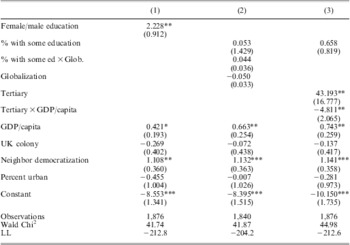
Our final expectations are presented in Table 2. We first predict that states are more likely to democratize when both males and females are educated (H3). This expectation receives strong support in Model 1 with a positive and significant coefficient for ‘Female/male education’ (p < 0.008). In substantive terms, we can expect a 177.2 percent (0.011 to 0.030) increase in the likelihood of democratization on average when gender parity ranges from 41.8 to 91.1. Compared to the education measures from Table 1, the measure for gender equality has the strongest impact on democratization.
The Impact of Education on Democratization: Secondary Analyses

Note: Robust standard errors in parentheses. Authoritarian years and splines not shown.
***p < 0.001; **p < 0.01; *p < 0.05 (one-tailed).
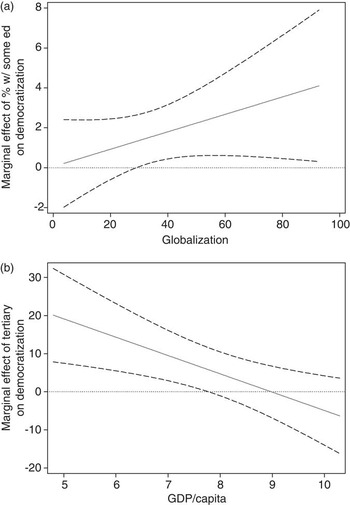
The final two expectations predict that the impact of education on democratization should be conditioned upon globalization (H4) and the level of wealth in the state (H5). These expectations are tested by interacting mass education with globalization (Model 2) and tertiary education with GDP/capita (Model 3). We see the predicted positive coefficient for the interactive term in Model 2, indicating that the effect of education on democratization increases as information becomes available. Likewise, we see the predicted negative coefficient for the interactive term in Model 3, indicating that the impact of education on democratization decreases as the state becomes wealthier. Though the significance of these interactive terms provide some information, Brambor, Clark, and Golder explain that interactive effects are best analyzed by plotting the marginal effect of the primary independent variables versus the conditional variables while holding control variables constant (means and modes).Footnote 74 Following this advice, we present the findings from Table 2 in Figure 2 using Boehmke's ‘grinter’ data utility.Footnote 75 Figure 2a presents the impact of mass education on democratization across the range of the globalization measure. Consistent with our expectation, we see that education has an insignificant impact on democratization at low levels of globalization. However, the marginal effect increases and becomes significant as globalization approaches 35, which represents around half of observations. Thus, consistent with our fourth hypothesis, we conclude that education has its strongest impact on democratization when states become integrated into the globalized world.
The effect of education on democratization: Conditional relationships Notes: GDP per capita in US$'000.

We next expect tertiary education to have its weakest impact on democratization in wealthy societies. This is tested by interacting tertiary education with GDP/capita. Looking at Figure 2b, we see that tertiary education indeed has its strongest effect on democratization in the poorest of societies, and that the impact decreases as wealth increases. In fact, once the state nears the mean of GDP/capita (around 7.75, comprising around one-third of observations), the influence of tertiary education on democratization becomes insignificant. This strongly supports our fifth hypothesis and the narrative provided by the Arab Spring uprisings, indicating that education and poverty provide a convincing recipe for political change.
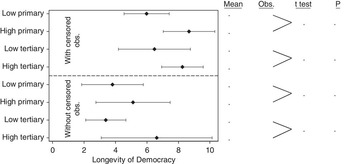
Our final concern is in regard to the longevity of democracy that is spurred from education. To this point we have shown that initial democratic transitions are more likely when both primary and tertiary education is high, and we have provided evidence that education is particularly helpful in promoting democratization under conditions of gender parity and poverty. However, we have said nothing about the quality of democracy that is spawned from education. As it would require a theory grounded in the democratic consolidation literature alongside empirical tests of this nature, a thorough examination of this issue both theoretically and empirically is beyond our scope. Our goal here is to provide at least some evidence that will allow us to speak to the quality of democracy that is produced by education. One of the most basic concerns is how long democracies last if they arise in highly educated societies. We examine this by counting the years that democracy held in states with high versus low education, using the mean of primary and tertiary education to differentiate high from low. We present statistics for these categories in Figure 3.
Longevity of democracy, 1970–2008 Notes: Black diamonds display the mean longevity of democracy for each group; whiskers show the 95 percent confidence interval. Two-tailed t-tests and P values compate low/high levels of democracy for primary/tertiary levels of education.

The top half of Figure 3 shows results for all instances of democratization, while the bottom half removes the cases if the state remained a democracy until 2008. On the whole, difference of means t-tests indicate that democracies that were born in educated societies last longer than those that came about in poorly educated societies. The only exception is seen in the difference between high/low primary education when states that were censored at the end of our sample (2008) are removed (p < 0.406). This is a more sophisticated theory and analyses would be necessary for conclusive results, but, taken together, we have robust evidence that education promotes democratization, and at least preliminary evidence indicating that education promotes democratic consolidation.
Democratization in Tunisia
Though our quantitative analyses have provided robust support for our theoretical expectations, demonstrating a strong link between education and democratization is a complex process with a multitude of different pathways. One way we can shed light on these pathways is with a more focused look at one of the most recent instances of democratization. Coded as a solid non-democracy from its inception in 1956, Tunisia underwent a radical change with the ousting of President Ben Ali in early 2011, ultimately leading to free and fair elections later that year. As we will see, the highly educated Tunisian population was integral to this transition. Our purpose in this case study is to illustrate the mechanisms by which education led to democratization in Tunisia, focusing specifically on how these mechanisms relate to our more general theory.
Various regimes have promoted advanced educational attainment over the previous century in Tunisia. As early as the 1880s, the French colonial administration implemented an expansion of higher education to produce students who possessed more vocational and technical skills. Over the course of the first half of the twentieth century, primary and secondary school enrollment grew dramatically.Footnote 76 While this system was initially intended to educate the children of French residents, Tunisians were able to enroll their children in these schools.
The educational foundation built by the French was further strengthened after Tunisia gained independence in 1956. The first president of the modern Tunisian state, Habib Bourguiba, ran a staunchly authoritarian regime during his thirty-year tenure.Footnote 77 However, Bourguiba quickly understood the importance of educating the population in spite of the potential instability it might eventually bring. Throughout his tenure he championed liberal policies that included greater equality for women and widespread public education.Footnote 78 These reforms were meant to serve a number of purposes. The growth of a more literate and educated population would support a modern state and make it a more attractive haven for economic investment and development. It would also promote a common, Tunisian identity across the entire country, replacing the fragmented groupings cultivated by the French. Finally, the provision of a secular education would limit the influence of Islamic leaders, whom Bourguiba saw as a threat to his regime.Footnote 79 Consistent with our theory, we see that Bourguiba made the decision that has been chosen by many authoritarian leaders. Though he undoubtedly understood that educating his population might eventually bring about calls for democracy, the benefits of economic growth, social solidarity, and the alienation of a possibly radical opposition simply outweighed these potential costs.
As the initial investments in Tunisian education began to pay dividends, further emphasis on Tunisian education led to measured improvement in educational access from 1960 to 1990. As a World Bank publication studying this period noted, ‘Tunisia is among the best performers in terms of expanding the average level of education and in improving the distribution of education opportunities.’Footnote 80 While educational attainment was not spectacular overall, the government successfully provided education to wide segments of the population. Tunisian government statistics illustrate the magnitude of this growth. Overall primary school enrollment in 1958 was roughly 320,000 students. By 1975, this figure had risen to just under one million students.Footnote 81 In addition, literacy rates increased to over 50 percent by 1980, and to better than 66 percent by the mid-1990s.Footnote 82 The only countries with a similar level of expansion over that time period were China and South Korea.
The rise in education in Tunisia led to several developments in line with our theoretical expectations. Sack notes the advancement of education in Tunisia was a step toward promoting ‘individual modernity,’ as measured by a series of attitudinal items including efficacy, beliefs in ‘universalism,’ conformity, trust, and fairness.Footnote 83 Consistent with our theory regarding primary education, therefore, we see Tunisian schools serve a socializing purpose in educating students on both the formal and the informal requirements of society. As Sack further illustrates, former students do not think of themselves as simple individual actors. Rather, they consider the context of their actions. Sack's description of Tunisian education also closely parallels our discussion of tertiary education and the role of globalization. He explains that the highly educated in Tunisia have wider perspectives on their behavior and the behavior of their fellow citizens, and that they are also more likely to follow the mass media and travel overseas. While performance in school matters, it is ultimately how long they have attended school that best predicts support of democratic ideals like trust and efficacy that, in a modern context, promote democratization.Footnote 84
The Tunisian case provides links with our theory, finally, by illustrating how the combination of high education and poverty promote democratization. While outside observers hoped that the growth of schooling with a concurrent economic advance would generate greater demand for governmental accountability, the economic growth necessary to support a schooled populace never materialized. The Tunisian government provided the funding that produced increasingly knowledgeable citizens, but could not deliver the requisite, high-skill positions to support this base.Footnote 85 Instead, economic growth emerged from an increase in exports – not from an internal expansion of the economy. The Tunisian economy remained dominated by labor-intensive activities like textiles or by traditional activities like agriculture.Footnote 86 These sectors were especially hard hit during the 2008–09 world financial crisis, when unemployment spiked even higher in countries with economies so exposed to the global market.Footnote 87 Unemployment noticeably hit both the youth and college-educated in Tunisia. In 2007, those aged 15–24 had an unemployment rate of over 30 percent, higher than any other age group. Individuals who had completed university studies had the highest unemployment rate (19.0 percent) of any educational category, and this figure worsened to over 30 percent by the end of 2011.Footnote 88 It is no surprise, then, that dissatisfaction reached a boiling point as the opportunity cost of protest decreased for the highly educated.Footnote 89
The prevalence of a spoils system and corruption only compounded these economic problems. Numerous accounts of bribes and graft flowed out from Tunisia during the 2011 revolution. Tellingly, it was the self-immolation of Mohamed Bouazizi, a Tunisian street vendor, that precipitated the protests. Bouazizi was reportedly no longer able to afford the numerous bribes demanded by local officials. He was not only publicly castigated for his inability to pay, but also had his goods and wares confiscated. His subsequent entreaties to the local governor were ignored. Bouazizi proceeded to set himself on fire as a protest against the corruption that pervaded the system, which had proved even more pernicious during a time of economic upheaval.Footnote 90
While this singular tragedy that spurred on the Arab Spring protests was a clear example of unbridled corruption, it also served as a touchstone for the disaffected graduates of the Tunisian education system who could not find work: ‘It is not that Tunisia was in a state of grinding poverty, but rather that education resulted in lack of professional fulfillment (sic). Poorer people could expect no justice.’Footnote 91 The scale of illicit benefits for those in power was ‘breathtaking.’Footnote 92 Consistent with our theoretical expectations, an educated population living in poor economic conditions galvanized opposition to the regime.
Those in power were neither blind nor deaf to the frustrations of the educated population even well before the Arab Spring protests, but the repressive response to challengers only stoked the flames of unrest. Economic hardship, along with the growth of pro-Islamic groups, produced grievances that contributed to the fall of the Bourguiba regime in 1988. His successor, Zine al-Abidine Ben Ali, initially cracked down on these potentially destabilizing movements with great success.Footnote 93 Unfortunately for Ben Ali, the strong educational system had already laid the foundation for government upheaval prior to his taking office. The limitations on speech and association he imposed served as further motivation to protest for an increasingly educated populace, making the eventual move to democratization all but inevitable.
Summary, Conclusion, and Implications
We began this paper with an overview of how both primary education, which instills democratic social values, and tertiary education, with its emphasis on analysis and higher-order thinking, promote democracy. Our preliminary analyses of authoritarian failure from 1970 to 2008 provided strong support for both expectations, with the impact of higher education being somewhat stronger than that for primary education. We then extended the discussion to provide further insight into the multitude of contexts under which education is most likely to have a democratizing impact. These extensions support the notion that gender equality in education is apt to produce democratization, and that the influence of education on democratization is strongest when the state is both integrated into the globalized economy and under conditions of poverty.
This article provides important information for researchers and policy makers. For the former, this work confirms findings of similar processes, such as the positive impact of education on political participation,Footnote 94 attitudes toward democracy,Footnote 95 and political efficacy.Footnote 96 We extend this work by considering the impact of education on democratization both theoretically and empirically, which helps researchers to understand the causal mechanisms behind the education–democratization relationship. While we have extended the basic education expectations by considering gender equality, poverty, and globalization, plenty of work remains for future scholarship. To this point, for example, we can say very little about the types of authoritarian regimes that are most likely to democratize given their education system. Military-led dictatorships, monarchies, and theocracies might be less amenable to pressures from the welleducated, for example, while education might have a different impact in single-party and multi-party authoritarian regimes. We also know little about the cultural make-up of regimes that might impact the education–democratization relationship. Western-leaning regimes might be more susceptible to democratization, for example, while more education in more traditional cultures might work to solidify the regime in power. We likewise know little about the type of education that is important. While states like Singapore have seen heavy investment in mathmatics and the sciences pay dividends economically, it is unclear how this investment versus investment in history and the social sciences, for example, might influence democratization. We have also only touched upon the role that the international community might play in pushing education for democratization. While international organizations like the World Bank pledge financial assistance for education programs, we know little about whether these resources impact regime transitions.Footnote 97
For policy makers, we recognize a number of ramifications of our research. First, we should not expect an immediate impact when improving educational access for the masses. Given that the baseline likelihood of democratization is low and education systems can only be improved gradually, it may take decades to see a significant change in how people make demands on their government. Our empirical results suggest, however, that these efforts will eventually bear fruit. Second, improving access to education for females is integral in promoting democracy. Thus, those promoting education must look beyond basic literacy rates by paying attention to who is actually receiving the education. We expect equality in education to have its greatest benefits when the curriculum is designed to socialize students to the democratic ideal of gender equality. Third, increased access to tertiary education is unlikely to produce the type of critical thinkers necessary to speak for political liberalization when they lack access to unbiased information about their system and alternative forms of governance. Thus, pressing for more access to tertiary education should be coupled with the promotion of mechanisms tied to globalization, such as a free press or improvement in information technologies. Finally, policy makers must face the reality that educated people are unlikely to agitate for democracy in wealthier states. Though wealthy authoritarian states are few, mechanisms beyond education – like foreign pressure – have a role to play in pushing these states toward democratization.
Ultimately, leaders and policy makers attempting to promote democracy have many tools at their disposal to pressure regime change. With the high costs that come with more drastic tools, such as invasions, sanctions, or other tools of alienation, this article suggests that promoting education should be seen as an effective and more universally palatable tool to promote democratization.