Introduction
Vestibular schwannomas are benign tumours that develop from the vestibulocochlear nerve sheath.Reference Myrseth, Pedersen, Møller and Lund-Johansen1 They generally present as unilateral, sporadic tumours that cause symptoms such as progressive hearing loss or sudden deafness, and unilateral tinnitus among other symptoms. Bilateral vestibular schwannomas are a hallmark for neurofibromatosis type 2, where the management is multidisciplinary and individualised due to the variety in tumour load and symptoms.Reference Myrseth, Pedersen, Møller and Lund-Johansen1,Reference Kontorinis, Nichani, Freeman, Rutherford, Mills and King2 Tumour size is an important factor in decision making. The Koos classification, which is the most widely used, ranges from grade I to IV, where grade I is an intra-canalicular tumour (< 15 mm in size), grade II is a cerebellopontine angle tumour with some extension (< 20 mm in size), grade III is similar to grade II but with greater extension and no cerebellar trunk displacement (< 30 mm in size), and lastly, grade IV is a larger tumour involving brainstem displacement (> 30 mm in size).Reference Erickson, Schmalz, Agee, Fort, Walters and McGrew3
Vestibular schwannoma management is based on several factors such as the Koos grade, tumour growth, patients’ symptoms and preferences as well as age. While the indication for active treatment can vary, the main management regimes include watchful waiting, microsurgical resection or radiosurgery. Typically, for larger tumours, microsurgery is the preferred choice of treatment and is carried out most commonly via the translabyrinthine or retrosigmoid approach.Reference Sweeney, Carlson, Ehtesham, Thompson and Haynes4 Acute vestibular symptoms after surgical resection of vestibular schwannomas, such as nausea, vertigo and postural imbalance, are key factors in the post-operative recovery of the patient.Reference Balatkova, Cada, Hruba, Komarc and Cerny5
Intratympanic gentamicin can be used pre-operatively to ablate remaining vestibular function. Intratympanic gentamicin is vestibulotoxic that can be used to gradually ablate peripheral vestibular function pre-operatively. This prevents sudden loss of peripheral vestibular function post-operatively, which occurs due to dissection of the vestibular nerve during tumour resection or even labyrinthectomy during translabyrinthine approach, subsequently improving vestibular compensation and post-operative recovery.Reference Balatkova, Cada, Hruba, Komarc and Cerny5,Reference Tarnutzer, Bockisch, Buffone, Huber, Wettstein and Weber6 Previous studies have shown that the use of intratympanic gentamicin pre-operatively reduced inpatient stay in patients with small- to medium-sized vestibular schwannomas (up to 20 mm) who have undergone a resection via the translabyrinthine approach.Reference Tarnutzer, Bockisch, Buffone, Huber, Wettstein and Weber6–Reference Potdar and Kontorinis9
However, very few studies have assessed the effects of pre-operative intratympanic gentamicin on post-operative recovery for patients after retrosigmoid resection with particular focus on larger tumours. Thus, our aim was to assess the effect of intratympanic gentamicin on the duration of inpatient stay in patients with large vestibular schwannomas undergoing resection via the retrosigmoid approach.
Methods
Basic settings
We conducted a prospective case control pilot study over a 24-month period in a tertiary university centre. Ethical approval was granted by the local Ethical Committee; additional informed consent was obtained by each patient.
Patient selection
We included patients who underwent a retrosigmoid resection of a large vestibular schwannoma. Thirteen patients were enrolled, where seven received intratympanic gentamicin pre-operatively while six did not. We included patients with large sporadic vestibular schwannomas only, which were classified as Koos grades III and IV. In addition, we only included patients with no serviceable hearing and who had no previous intervention for their vestibular schwannoma.
The use of intratympanic gentamicin was discussed with all patients, who subsequently decided to opt in or out. The main reasons not to pursue pre-operative injections were the patient's preference not to have any intervention prior to the vestibular schwannoma resection and the need for semi-urgent surgery, which did not allow time for intratympanic injections.
Intratympanic injections
In patients who received intratympanic gentamicin pre-operatively, two to three injections of 40 mg/ml solution of gentamicin (0.6–0.8 ml solution) were administered into the middle ear with a 22-gauge spinal needle under topical anaesthesia. An interval of one week between injections allowed patients to be assessed clinically and via video head impulse test to determine whether additional injections were needed. The intratympanic gentamicin administration and subsequent retrosigmoid resections of the vestibular schwannoma took place in the same tertiary university centre.
Outcome measures
The main outcome measure was duration of inpatient stay. Additional analysed factors were age, gender, vestibular schwannoma size and body mass index (BMI in kg/m2) as well as financial cost of inpatient stay based on surgical bed occupation (surgical costs related to resection not included, as these are standardised).
Vestibular schwannoma size was determined by magnetic resonance imaging (MRI) scans conducted pre-operatively, recording size in mm of the maximum intracranial component only, and classified according to Koos classification, where all the patients have a grade III or grade IV vestibular schwannoma.Reference Erickson, Schmalz, Agee, Fort, Walters and McGrew3
Inpatient stay was counted in days from the day of operation to the day of discharge. Cost analysis was based on the emergency surgical bed from the Scottish population.Reference Wohlgemut, Ramsay, Boyers and Jansen10 Only costs related to inpatient admission and not to the actual theatre time were calculated in British pound sterling.
Smoking was taken into consideration but none of the patients were smokers, hence, this was excluded. In addition, co-morbidities were heterogeneous and, as a result, this was also excluded.
Analysis
We used Jamovi (version 2.3) with R language and associated packages.Reference Wohlgemut, Ramsay, Boyers and Jansen10–14 The Shapiro–Wilk test was used to assess the data distribution. An unpaired t-test (t) was utilised in parametric data while the Mann Whitney U-test (u) was used for non-parametric data. Subsequently, inpatient duration associations against the covariates of interest were explored with Pearson (r) or Spearman (rho) correlation based on data distribution. Linear regression analysis was also performed to evaluate the effects of the covariates on inpatient stay. Statistically significant value was set at 0.05.
Results
Basic Demography
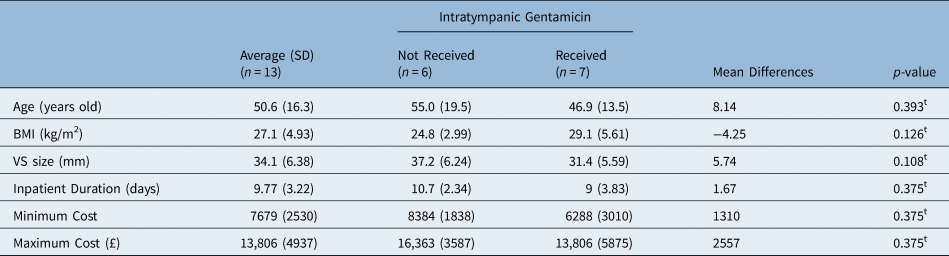
Overall, 13 patients (Table 1) were evaluated; six patients received intratympanic gentamicin injections pre-operatively while seven patients underwent vestibular schwannoma resection without intratympanic gentamicin injections. Vestibular schwannoma sizes were 25–41 mm (grades III and IV), and all patients underwent retrosigmoid vestibular schwannoma resection. Those that did not received intratympanic gentamicin injection pre-operatively had slightly longer hospital stays, were older, had lower BMI and larger vestibular schwannoma sizes (Table 1). Nevertheless, no statistically significant differences were seen between the cohort for age (years old), BMI (kg/m2), vestibular schwannoma size (mm) and inpatient duration (days) (Table 1).
Basic demography and recorded data. SD = standard deviation; BMI = body mass index; VS = vestibular schwannoma

t unpaired t-test
Correlation for inpatient stay
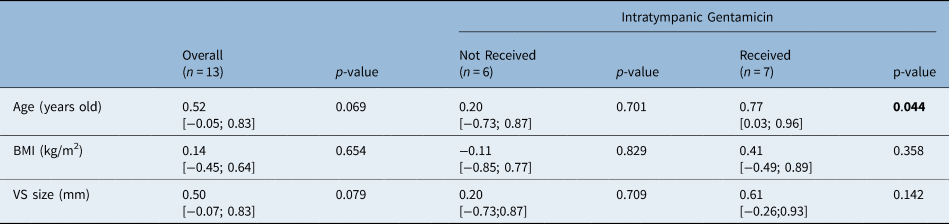
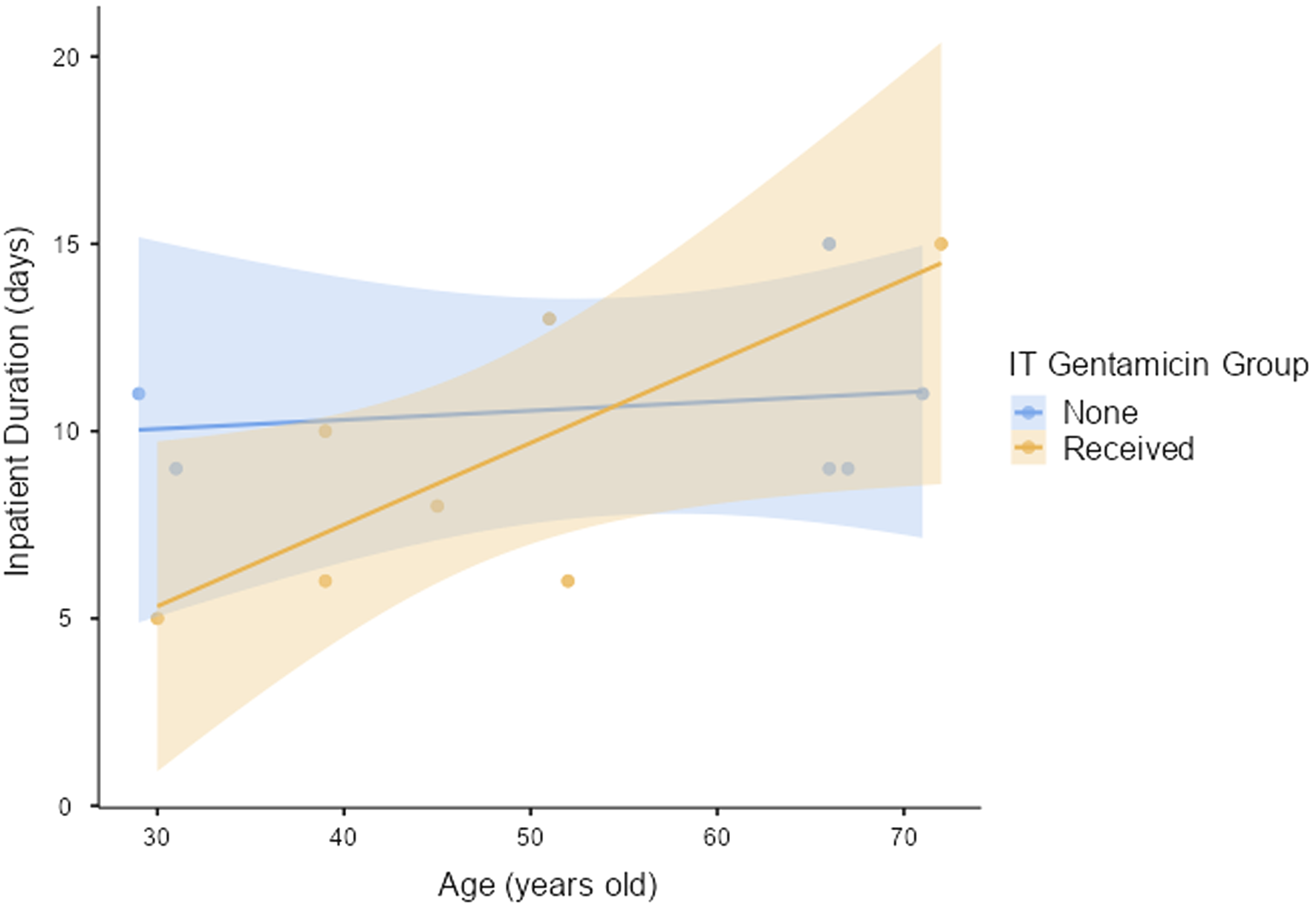
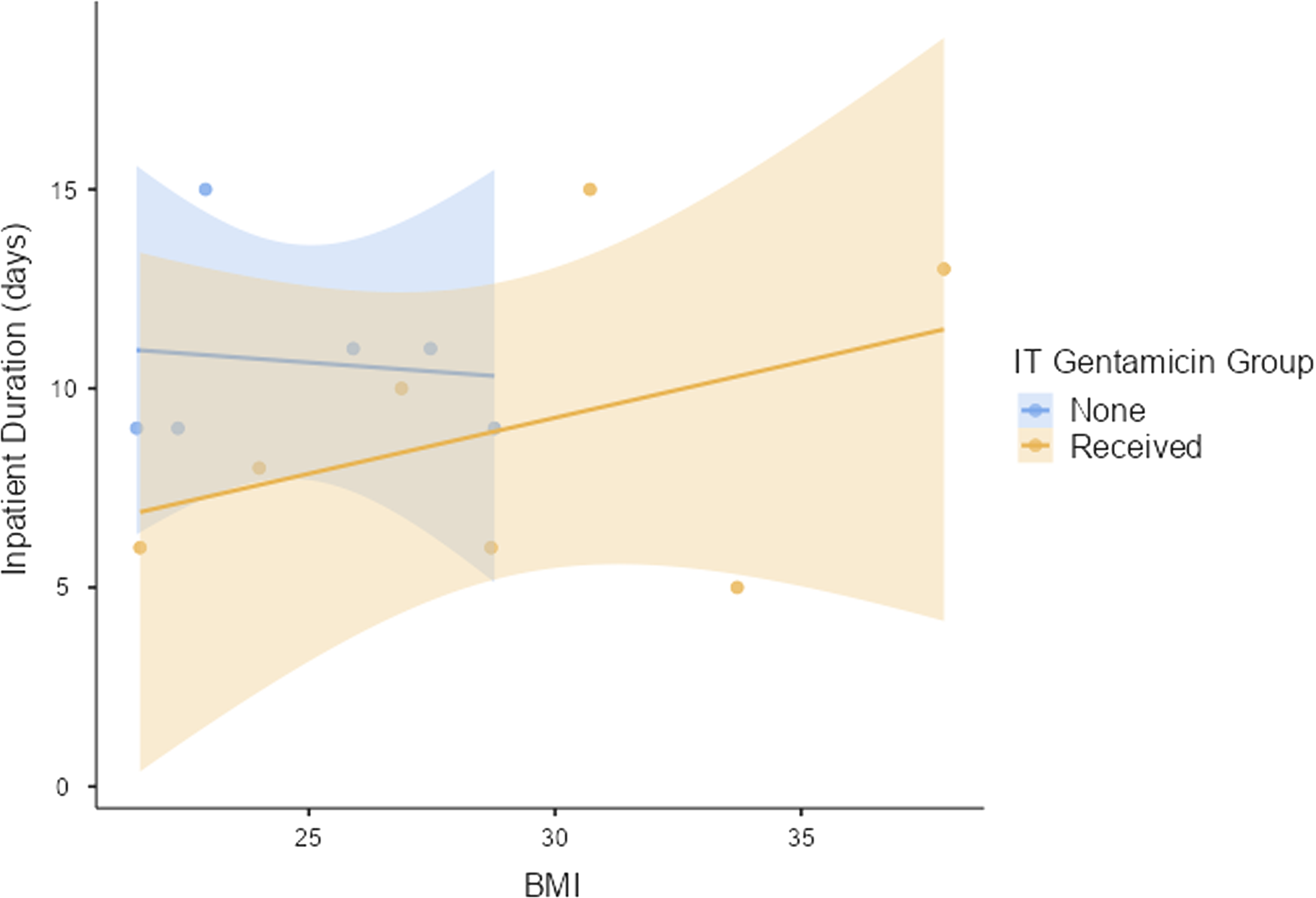
Overall, age has the highest association for longer duration of inpatient stay (r = 0.52, p = 0.069, Table 2) but not statistically significant. This effect was more significant, however, in those who received gentamicin pre-operatively (r = 0.77, p = 0.044, Table 2, Figure 1). Body mass index has the lowest association with inpatient duration stay and was not significant (Figure 2).
Inpatient duration correlations (Pearson correlation, r). BMI = body mass index; VS = vestibular schwannoma.

Scatter plot for age versus inpatient stay. IT = intratympanic.

Scatter plot for body mass index (BMI) versus inpatient stay. IT = intratympanic.

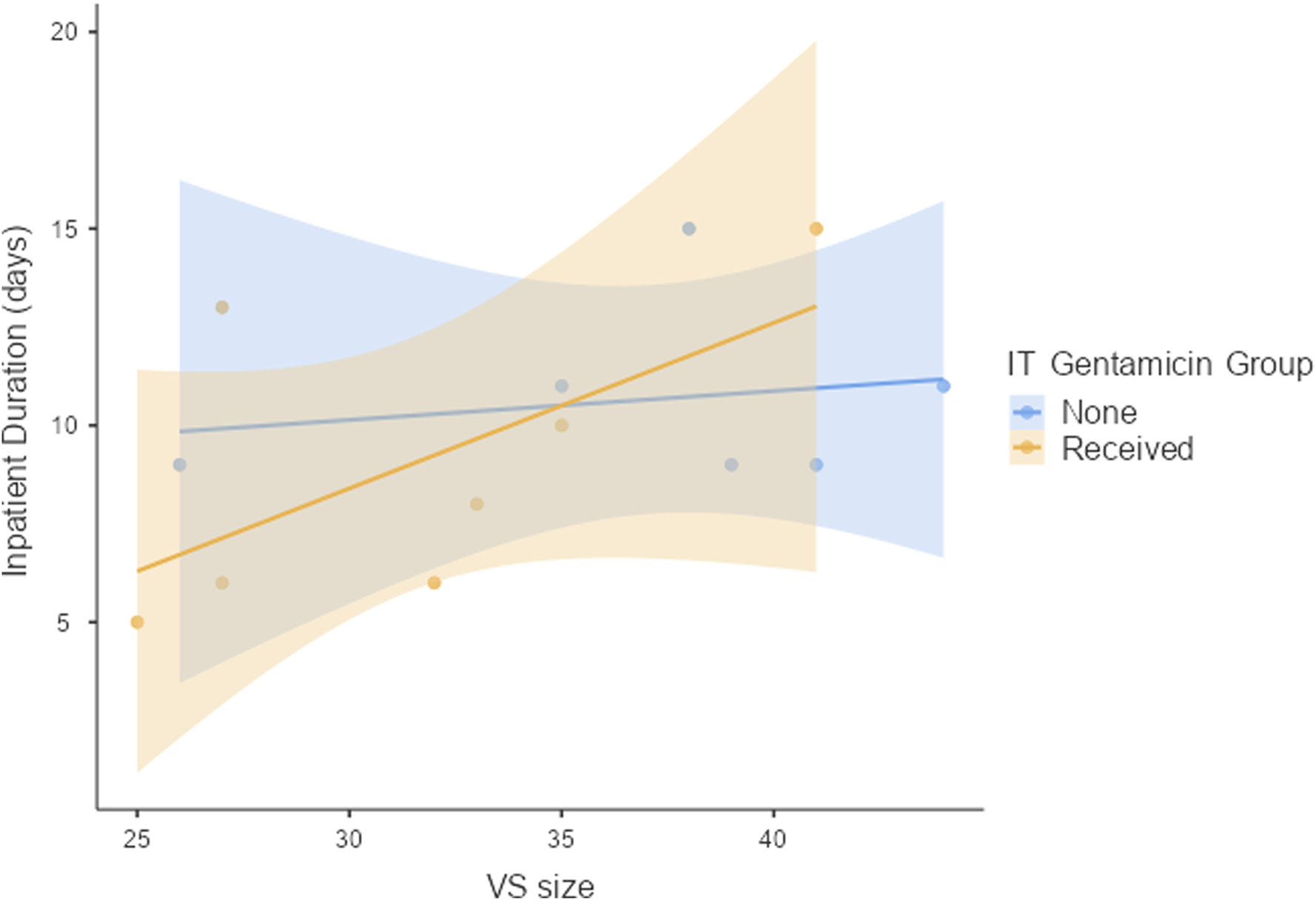
Interestingly, there is an association for patients with larger vestibular schwannoma sizes who received gentamicin to require longer inpatient stay, although not significant (r = 0.61, p = 0.142, Table 2, Figure 3). As Figure 3 illustrates, while patients with large vestibular schwannomas, but smaller than 35 mm, who receive intratympanic gentamicin tended to spend fewer days in hospital, whereas patients from the same group but with larger tumours tended to stay in hospital longer.
Scatter plot for vestibular schwannoma (VS) size versus inpatient stay duration; interestingly, intratympanic gentamicin is linked to shorter stay for patients with large vestibular schwannomas, but smaller than 35 mm, but to longer stay for patients with larger than 35 mm vestibular schwannomas. IT = intratympanic.

Linear regression modelling base on intratympanic gentamicin exposure
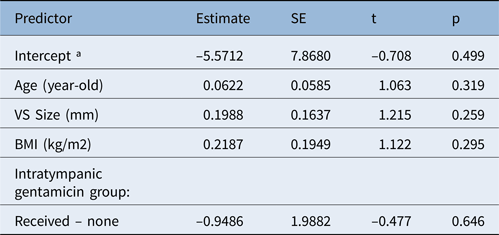
Inpatient hospital duration for patients that did not receive intratympanic gentamicin injection is weakly affected by age, BMI and vestibular schwannoma size in 45% (R Reference Kontorinis, Nichani, Freeman, Rutherford, Mills and King2) of patients here and is not statistically significant (F = 1.63, p = 0.257, adjusted R Reference Kontorinis, Nichani, Freeman, Rutherford, Mills and King2 = 0.174, Akaike information criterion = 70.5, Table 3). This was also seen based on the minimum and maximum cost that patients could incur.
Linear regression modelling evaluating the impact of in-patient stay.

ᵃ Represents reference level
Discussion
Main findings
Several studies have demonstrated a statistically significant effect on post-operative recovery and use of pre-operative intratympanic gentamicin injections in patients undergoing mostly translabyrinthine resection of small- to medium-sized vestibular schwannomas (up to 20 mm), and very few studies for larger vestibular schwannomas (> 25 mm).Reference Balatkova, Cada, Hruba, Komarc and Cerny5–Reference Potdar and Kontorinis9,Reference Amiraraghi, Gaggini, Crowther, Locke, Taylor and Kontorinis16 Herein, we assessed the effect of prehabilitation with intratympanic gentamicin on patients with large vestibular schwannomas only undergoing resection, exclusively via the retrosigmoid approach.
Although our results did not reach statistical significance, we observed a tendency for shorter inpatient duration in the intratympanic gentamicin group in patients with tumour intracranial diameters less than 35 mm; patients from the same group with larger vestibular schwannomas stayed longer in hospital. Additionally, younger age was statistically linked to shorter inpatient stay regardless the use of gentamicin. Body mass index had no effect on the duration of stay.
While our results are preliminary, it is sensible to consider the use of intratympanic gentamicin as prehabilitation in patients with vestibular schwannomas smaller than 35 mm undergoing retrosigmoid approach but not in patients with larger tumours. Further research in this evolving field should be encouraged.
The concept of prehabilitation with intratympanic gentamicin
Intratympanic gentamicin is a vestibulotoxic substance that can ablate peripheral vestibular function. Previous studies have highlighted its benefits when used as prehabilitation in patients undergoing vestibular schwannoma resection in the sense that gentamicin allows a more ‘gentle’ ablation of the vestibular function prior to the instant and radical effect of the vestibular schwannoma and vestibular nerve resection as well as labyrinthectomy (in translabyrinthine approach).Reference Balatkova, Cada, Hruba, Komarc and Cerny5–Reference Potdar and Kontorinis9,Reference Amiraraghi, Gaggini, Crowther, Locke, Taylor and Kontorinis16 In particular, those studies focused primarily on post-operative postural control, quality of life and vestibular testing as outcome measures,Reference Balatkova, Cada, Hruba, Komarc and Cerny5–Reference Potdar and Kontorinis9 while only one study assessed the duration of the inpatient stay.Reference Amiraraghi, Gaggini, Crowther, Locke, Taylor and Kontorinis16 Most of these studies included a wide range of tumour sizes and predominantly translabyrinthine resections. Our study assessed exclusively large tumours resected through the retrosigmoid approach; these inclusion criteria can explain the results, to some extent.
Indeed, it is sensible to hypothesise that the combined effects of tumour dissection, vestibular nerve resection and labyrinthectomy in translabyrinthine approaches, is more severe than the effects in retrosigmoid approaches where the labyrinth is anatomically preserved. The first report of the concept of prehabilitation with intratympanic gentamicin did not focus on the approach; however, it did demonstrate absence of true vertigo post-operatively, which enhanced the patients’ recovery.Reference Magnusson, Kahlon, Karlberg, Lindberg and Siesjö18 Reports purely looking into retrosigmoid vestibular schwannoma resections did not show statistically significantly better vestibular compensation for the gentamicin groups in the early post-operative period;Reference Balatkova, Cada, Hruba, Komarc and Cerny5,Reference Hrubá, Chovanec, Čada, Balatková, Fík and Slabý19 however, they did show significantly lower levels of patient anxiety and less sensitivity to optokinetic stimulation,Reference Hrubá, Chovanec, Čada, Balatková, Fík and Slabý19 factors that can improve recovery.
Still, both of the above studies included a wider range of vestibular schwannoma size compared to our study. The only study that included only patients with large vestibular schwannomas (Koos grade III and larger), by Amiraraghi et al.,Reference Amiraraghi, Gaggini, Crowther, Locke, Taylor and Kontorinis16 only included patients undergoing translabyrinthine resections, which resulted in significantly shorter duration of stay and milder effects on the contralateral side, as assessed through six-canal video head-impulse test.
While one could argue any contralateral effect of intratympanic gentamicin, a negative effect has not been proven in human. Indeed, animal studies have identified traces of gentamicin following intratympanic administration, in the contralateral inner ear of chinchilla (only light anti-gentamicin staining was observed), probably migrating to the contralateral ear through a pathway involving the cochlear aqueducts, without clarifying what the exact clinical implication of such laboratory finding could be.Reference Roehm, Hoffer and Balaban20 However, these results have not been evident in human. On the contrary, previous work has shown that patients with vestibular schwannomas undergoing translabyrinthine resection, who have had intratympanic gentamicin, all had normal contralateral vestibular responses six weeks post-operatively, while patients who did not, had abnormal responses from at least one contralateral semi-circular canal.Reference Amiraraghi, Gaggini, Crowther, Locke, Taylor and Kontorinis16 This would indicate that, by ablating the vestibular responses in a more gradual manner, pre-operatively, the contralateral ear had to work less hard to compensate.Reference Amiraraghi, Gaggini, Crowther, Locke, Taylor and Kontorinis16 On these grounds, one would identify a potentially positive effect of gentamicin on the contralateral ear, at least in this specific group of patients.
Our results showed some tendency for shorter stay for the gentamicin group with tumours smaller than 35 mm in size, but still absence of any statistical significance. This can be either because of the small numbers or due to an overall ‘milder’ direct effect on the vestibular organ through the retrosigmoid approach. For even larger tumours, intratympanic gentamicin did not carry any benefits; on the contrary, patients seemed to stay in hospital longer. A probable hypothesis for such an observation would be the direct effect of such large tumours as well as the subsequent surgical dissection on the brainstem and the post-operative central compensation, which is expected to be more challenging in such large tumours (> 35 mm intracranial diameter). Notably, a recent systematic review identified statistically significant improvement in half of the patients treated with intratympanic gentamicin injections prior to vestibular schwannoma resection, highlighting the overall limited number of patients and the need for further research.Reference Potdar and Kontorinis9
Financial cost and other considerations
Considering the challenges faced by healthcare services, any potential cost-saving actions could be of benefit. While the effects of age, vestibular schwannoma size and BMI on inpatient stay were not statistically significant, there is a cost benefit as a reduced inpatient duration by 1.6 days would save £1300–2570, which would equate to a two-bed capacity.Reference Wohlgemut, Ramsay, Boyers and Jansen10 These numbers do not include the costs of the intratympanic gentamicin injection, which is an office/outpatient procedure and therefore carries minimal costs. Even in the absence of statistical significance for inpatient hospital duration, the admission costs were lower for every patient in the gentamicin group compared to the non-gentamicin group.
Another consideration point is the concept of hearing preservation in vestibular schwannoma surgery. Should such a concept be explored, then the injection of gentamicin should be arguable given the potential effect of such medication on hearing. In our study, none of the patients had serviceable hearing pre-operatively, hence the concept of hearing preservation was not relevant. Furthermore, in patients with such large tumours, even via the retrosigmoid approach, hearing loss should be expected even if any degree of hearing is measurable prior to the procedure.Reference Betka, Zvěřina, Balogová, Profant, Skřivan and Kraus17
Limitations and strengths
The main limitations of this study are primarily related to the small size of the cohort, where a possible selection bias due to a small sample size could limit the randomisation process and increase the potential of error. However, this was mitigated by conducting a thorough data collection using standardised detailed measurements, and subsequent meticulous statistical analysis via a generalized linear model as well as appropriate statistical tools. While we used duration of inpatient stay as our main outcome measure, we accept that additional and/or alternative measures can be used to assess patient recovery. Additionally, this is a pilot study and further evolving reports are pending.
On the other hand, there are several strengths to this study, the main one being the prospective nature of the data collection. Longitudinal analysis provides greater insight into outcomes that may be different among groups, thus limiting selection bias and strengthening the study in comparison to other similar studies with retrospective data collection. In addition, the novelty of this study is a strong point as most of the existing studies in this field have assessed either smaller tumours or a mixture of sizes and approaches. We focused on only a retrosigmoid approach and large tumours that typically involve more time-demanding and challenging dissection and post-operative care.
• Pre-operative intratympanic gentamicin injections have shown the potential of improved recovery following vestibular schwannoma resection
• Patients with large tumours operated via the retrosigmoid approach showed no statistically significant effects of the intratympanic gentamicin injections on the duration of inpatient stay
• Patients with large vestibular schwannomas but smaller than 35 mm in the cerebello-pontine angle trended towards shorter inpatient stay, but not for patients with even larger tumours
• Overall, younger patients demonstrated shorter durations of stay
• Despite the absence of statistical significance in the duration of inpatient stay, the associated costs of stay for the gentamicin group were significantly less, which is an important factor for the health services
Conclusion
This pilot study did not show any statistically significant effect of intratympanic gentamicin on inpatient hospital stay in patients with large vestibular schwannomas undergoing retrosigmoid resections. We did observe a trend towards shorter hospital stays in patients receiving gentamicin with tumours smaller than 35 mm in size, but for larger tumours the intratympanic injections were not beneficial. Despite the absence of statistical significance, costs related to inpatient stay were less for the gentamicin group. Finally, younger patients had shorter inpatient stays.
Competing interests and financial disclosure
None to declare; there was no funding available for the present study.
Ethical Standards
Ethical approval and informed consent obtained.
Author Contributions
TP: data curation and analysis, writing and revising the initial and final draft, approval of the final draft; MAMS: data analysis, writing and revising the initial draft, approval of the final draft; GK: conceptualisation, data analysis, revising the initial draft, finalising and approving the final draft, supervision.