INTRODUCTION
The Gulf of Gabès (Southern Tunisia, 35°N and 33°N) has experienced a substantial decrease in fish resources over the last two decades, and studies suggest that such a decrease might have resulted from industrial and urban activities (Hamza-Chaffai et al., Reference Hamza-Chaffai, Cosson, Amiard-Triquet and El Abed1995, Reference Hamza-Chaffai, Roméo and El Abed1996, Reference Hamza-Chaffai, Amiard-Triquet and El Abed1997; Zairi & Rouis, Reference Zairi and Rouis1999). This degradation of water quality has also been reported along the Mediterranean coastline (Duarte et al., Reference Duarte, Agusti and Agawin2000; Verlecar et al., Reference Verlecar, Desai, Sarkar and Dalal2006) in which phytoplankton communities are believed to be phosphate limited (Krom et al., Reference Krom, Brenner, Kress and Gordon1991; Thingstad et al., Reference Thingstad, Zweifel and Rassoulzadegan1998). Despite the fact that Gulf of Gabès harbours diverse algal species, field investigations of the change in the phytoplankton community structure along the coast and in the open sea are very scarce. Only the plankton-pigment signatures (Bel Hassen et al., Reference Bel Hassen, Drira, Hamza, Ayadi, Akrout, Messaoudi, Issaoui, Aleya and Bouaïn2009a, Reference Bel Hassen, Drira, Hamza, Ayadi, Akrout, Messaoudi, Issaoui, Aleya and Bouaïnb) and the spring ciliate distribution (Hannachi et al., Reference Hannachi, Drira, Bel Hassen, Hamza, Ayadi, Bouain and Aleya2009) in this area have been the subject of investigations. On the other hand, numerous studies have shown that the phytoplankton abundance and species composition is governed by factors such as light, temperature, nutrients, grazers and water movements, in systems ranging from freshwater to man-made coastal solar salterns (Aleya, Reference Aleya1991; Reynolds, Reference Reynolds1997; Danilov & Ekelund, Reference Danilov and Ekelund2001; Paerl et al., Reference Paerl, Valdes, Pinckney, Piehler, Dyble and Moisander2003; Oren, Reference Oren2005; Abid et al., Reference Abid, Sellami-Kammoun, Ayadi, Drira, Bouain and Aleya2008; Ayadi et al., Reference Ayadi, Elloumi, Guermazi, Bouain, Hammami, Giraudoux and Aleya2008). We therefore investigated the abundance and species composition of phytoplankton assemblages along the coast and in the open sea of the Gulf of Gabès in relation to the physical and chemical factors as well as the abundance of ciliates and copepods. We hypothesized that phytoplankton species should exhibit interspecific differences in relation to both the environmental variability and potential planktonic predators such as ciliates and copepods. To test these hypotheses, we explored the summer phytoplankton structure and biomass and their relationships with environmental factors together with ciliates as potential consumers, and copepods as potential competitors with ciliates upon phytoplankton prey. We used common statistical methods and both cluster and canonical correspondence analysis (CCA) to analyse the samples from 33 coast-to-offshore stations along 10 transects during a summer cruise in the Gulf of Gabès.
MATERIALS AND METHODS
Study area
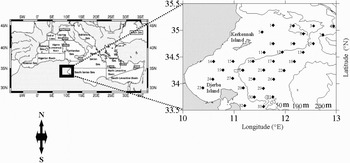
This preliminary study was carried out in the Gulf of Gabès whose climate is dry (average precipitation: 210 mm) and sunny with strong easterly winds. The Gulf of Gabès (between 35°N and 33°N) extends from ‘Ras kapoudia’ at the 35°N parallel level to the Tunisian–Libyan border (Figure 1) and includes various islands (Kerkennah and Djerba) and lagoons (Bougrara and El Bibane). Along the Tunisian coast, and during the cold period (winter–spring), the Atlantic water is characterized by low salinity very close to the surface. Conversely, during the other periods, higher salt content and more pronounced local circulation patterns within the water column suggest an enhancement of mixing and a weakening of the advection of the Atlantic water eastward. Semidiurnal tide characterized the Gulf of Gabès with a maximum range of about 2 m.
Map of the sampling stations in the Gulf of Gabès.

Sampling
Samples (N = 120) were collected in July 2005 in 33 coast-to-offshore stations on one cruise (Figure 1) with a conductivity–temperature–depth profiler (CTD: SBE 9, Sea-Bird Electronics, USA) equipped with a 12 Niskin bottle rosette sampler lowered from the surface to nearly the bottom. Water samples for physico-chemical (120 ml) phytoplankton and ciliate examination (1 l) were collected from 3 various depths (surface, middle of water column and bottom) in coastal stations between 20 m and <50 m deep; and from 5 various depths (surface, −10 m, −20 m, thermocline and bottom) in deeper stations >50 m in deep.
Physico-chemical factors
In each station, measurements of temperature, salinity and sigma-t (sigma-t = water density−1000 kg. m−3) were collected with the CTD profiler; pH was measured immediately after sampling using a Met Röhm® type pH meter. Samples for nutrient analysis were frozen immediately upon collection (−20°C, in the dark). Nutrients (NO2−, NO3−, NH4+, PO43− and Si(OH)4) and total-nitrogen (T-N) and total-phosphate (T-P) (after transformation into NH4+ and PO43−, with potassium persulphate at 120°C, respectively) were analysed with a BRAN and LUEBBE type 3 autoanalyser and concentrations were determined colorimetrically using a UV-visible (6400/6405) spectrophotometer (APHA, 1992). We calculated also the N/P:DIN (DIN = NO2−+NO3−+ NH4+) to DIP (DIP = PO43−) and Si/Ni/Pi:silicate/DIN/DIP ratios. The concentration of the suspended matter was determined by measuring the dry weight of the residue after filtration of 1 l onto Whatman GF/C membrane.
For phytoplankton and ciliate enumerations, aliquots of discrete depth samples were preserved with Lugol's fixative (4% final concentration). Zooplankton were collected using a cylindro-conical net (30 cm aperture, 100 cm height and 100 µm mesh size) equipped with a flow meter. The net was towed obliquely from a depth near the bottom to the surface in each station during day and at night at a mean speed of 1 m s−1 for 10 minutes. After collection, zooplankton samples were rapidly preserved in 2% buffered formaldehyde solution (Drira et al., Reference Drira, Belhassen, Ayadi, Hamza, Zarrad, Bouaïn and Aleya2009).
Phytoplankton, ciliate and copepods enumeration
Sub-samples (50 ml) were counted under an inverted microscope after fixation with a Lugol (4%) iodine solution (Bourrelly, Reference Bourrelly1985) and settling for 24 to 48 hours using the Utermöhl method (Reference Utermöhl1958) for phytoplankton and ciliate enumeration. Identification of algal taxa was achieved according to various keys (Tregouboff & Rose, Reference Tregouboff and Rose1957; Huber-Pestalozzi, Reference Huber-Pestalozzi1968; Dodge, Reference Dodge1985; Balech, Reference Balech1988; Tomas et al., Reference Tomas, Hasle, Steidinger, Syvertsen and Tangen1996). Ciliate identifications were carried out according to Kofoid & Campbell (Reference Kofoid and Campbell1929, Reference Kofoid and Campbell1939) and Balech (Reference Balech1959). Cell numbers were expressed as cells l−1 and biovolumes were calculated from cell dimensions (Lohman, Reference Lohman1908; Hillebrand et al., Reference Hillebrand, Dürselen, Kirschtel, Pollingher and Zohary1999), were converted to carbon biomass with the conversion factors proposed by Menden-Deuer & Lessard (Reference Menden-Deuer and Lessard2000): 1 µm3 = 0.216 ×10⁻⁶ µgC, for all phytoplankton taxa except diatoms, and 1 µm3 = 0.288×10⁻⁶ µgC, for diatoms. Samples for chlorophyll-a analysis (2 l), were filtered by vacuum filtration onto a 0.7 µm pore size and 47 mm-diameter glass fibre filter Whatman GF/F. Filters were then immediately stored at −20°C until analysis. Pigment analysis was performed by high performance liquid chromatography (HPLC) according to Pinckney et al. (Reference Pinckney, Richardson, Millie and Paerl2001).
Community structure was assessed by H′ diversity index of Shannon & Weaver (Reference Shannon and Weaver1949). We also calculated the evenness (J) proposed by Pielou (Reference Pielou1975) to prevent weighting of H′ index by rare species; it is expressed as:

where

S: number of species of the community.
Copepods were stained with rose Bengal to identify their internal tissues and to facilitate the dissection of various appendices and of leg 5 of the different species. Copepods were identified according to Rose (Reference Rose1933) and Bradford-Grieve et al. (Reference Bradford-Grieve, Markhaseva, Rocha and Abiahy1999) and counted under a vertically mounted deep-focus dissecting microscope (Olympus TL 2). The zooplankton density was expressed as: X = N/((Π r2 s)/3), where N = number of individuals sampled, r = 15 cm: half of the diameter of the plankton net and s = turn numbers shown by the flowmeter (Drira et al., Reference Drira, Belhassen, Ayadi, Hamza, Zarrad, Bouaïn and Aleya2009).
Statistical analysis
Mean and standard deviation (SD) are reported when appropriate. The potential relationships between variables were tested by Pearson's correlation coefficient using XL-stat software. Cluster analysis (CA) was performed using PRIMER v5.0 for Windows XP (Clarke & Gorley, Reference Clarke and Gorley2001) to identify significant differences between study stations in the distribution of phytoplankton populations. CA was undertaken according to the Ward-algorithmic method. Results are illustrated in a dendrogram where steps in the hierarchical clustering solution and values of the squared Euclidean distances between clusters are shown.
A canonical correspondence analysis (CCA) was applied to physical (temperature, salinity and sigma-t), chemical (NO3−, NO2−, NH4+, PO43−, T-N, T-P, N/P ratio, Si(OH)4 and Si/Ni/Pi ratio) and biological parameters (chlorophyll-a concentration, total phytoplankton, Dictyochophyceae, Bacillariophyceae, Dinophyceae, Cyanobacteriae, Euglenophyceae and total ciliates, copepods densities) assessed by over 33 observations (33 stations) were considered (Ter-Braak, Reference Ter-Braak1986).
RESULTS
Physico-chemical parameters
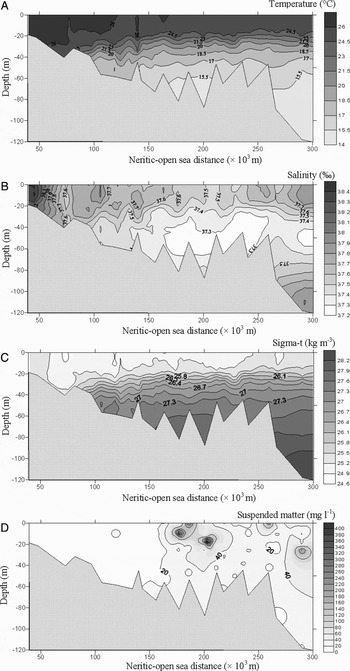
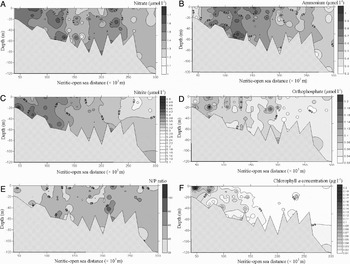
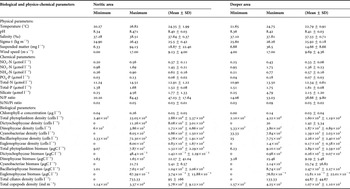
The physico-chemical characteristics of the study are summarized in Table 1. The temperature of coastal waters was higher than that offshore and it decreased from surface to bottom (Table 1; Figure 2A). The pH was distributed homogeneously throughout all the monitoring stations (Table 1). The lowest salinity (37.20‰) was recorded in the deeper stations, in Station 2 at a mean depth of 52 m; whereas the highest was in coastal waters (38.51‰), in Station 24 at a mean depth of 33 m (Table 1; Figure 2B). The salinity minima are generally considered as characteristics of the Modified Atlantic Water (MAW) (Astraldi et al., Reference Astraldi, Gasparini, Vetrano and Vignudelli2002). Moreover, the isohaline of 37.5‰ has been used to define the interface between Atlantic and Mediterranean waters (Rodriguez et al., Reference Rodriguez, Blanco, Jimenez-Gomez, Echevarria, Gil, Rodriguez, Ruiz, Bautista and Guerrero1998). Sigma-t, mainly driven by the temperature, was homogeneously distributed both along the coast and in the open sea (Table 1; Figure 2C). It exhibited a high gradient from the surface to the bottom. The stratified layer corresponding to the sigma-t level between 25.5 and 26.7 kg m−3 is situated roughly at 25 m deep. This causes the confinement of the cool MAW in the deep water layers, which corroborated with the description of the MAW circulation in the Ionian Sea made by Béranger et al. (Reference Béranger, Mortier, Gasparini, Gervasio, Astraldi and Crepon2004). At 50 m depth, high sigma-t coincided with both low salinity (r = −0.242, P < 0.05, df = 119) and temperature (r =−0.816, P < 0.001, df = 119) (Figure 2A–C). However, the coast is characterized by a low sigma-t and a high salinity (r = −242, P < 0.05, df = 119) probably as a result of water evaporation. Concentrations of suspended matter in neritic stations were higher than in the open sea (Table 1). Nitrate, which was the dominant nitrogen form, was concentrated chiefly in coastal waters. Orthophosphate concentrations were rather low and did not exceed 0.2 µmol l−1; highest concentrations were recorded in the coastal area, whereas in the offshore area concentrations were below the limit of 0.06 µmol l−1. Total nitrogen and total phosphate were homogeneously distributed throughout the neritic and deeper areas (Table 1). However, N/P: DIN (DIN = NO2−+NO3−+NH4+) to DIP (DIP = PO43−) ratio was generally greater than the Redfield ratio (16) which suggests potential P limitation. N/P ratio of coastal waters (mean±SD = 47.03±17.64) was higher than deeper waters (mean±SD = 38.66±9.80) (Table 1; Figure 3A–E). Silica concentrations were slightly more important in deeper stations (2.15±1.20 µmol l−1) than in neritic areas (1.77±1.33 µmol l−1) (Table 1) contributing to a higher Si/Ni/Pi ratio in deeper stations (0.05±0.02) than in coastal (0.03±0.01) areas.
Contour plots of temperature (A), salinity (B), sigma-t (C) and suspended matter (D) along a longitudinal gradient in the 0–120 m layer.

Spatial distribution of nitrate (A), ammonium (B), nitrite (C), orthophosphate (D) concentrations and N/P ratios (E) and chlorophyll-a concentration (F) along a longitudinal gradient in the 0–120 m layer.

Physical, chemical and biological parameters in neritic and deeper areas of the Gulf of Gabès in summer 2005.

Phytoplankton community structure
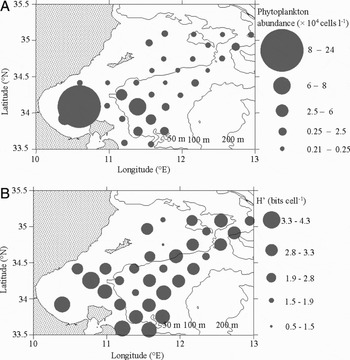
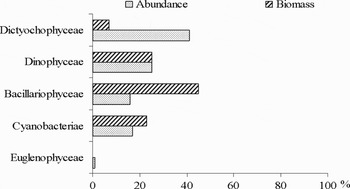
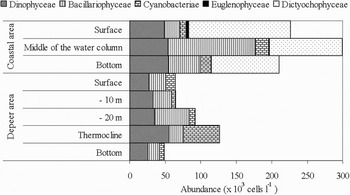
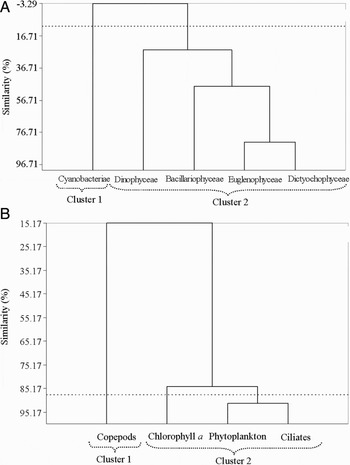
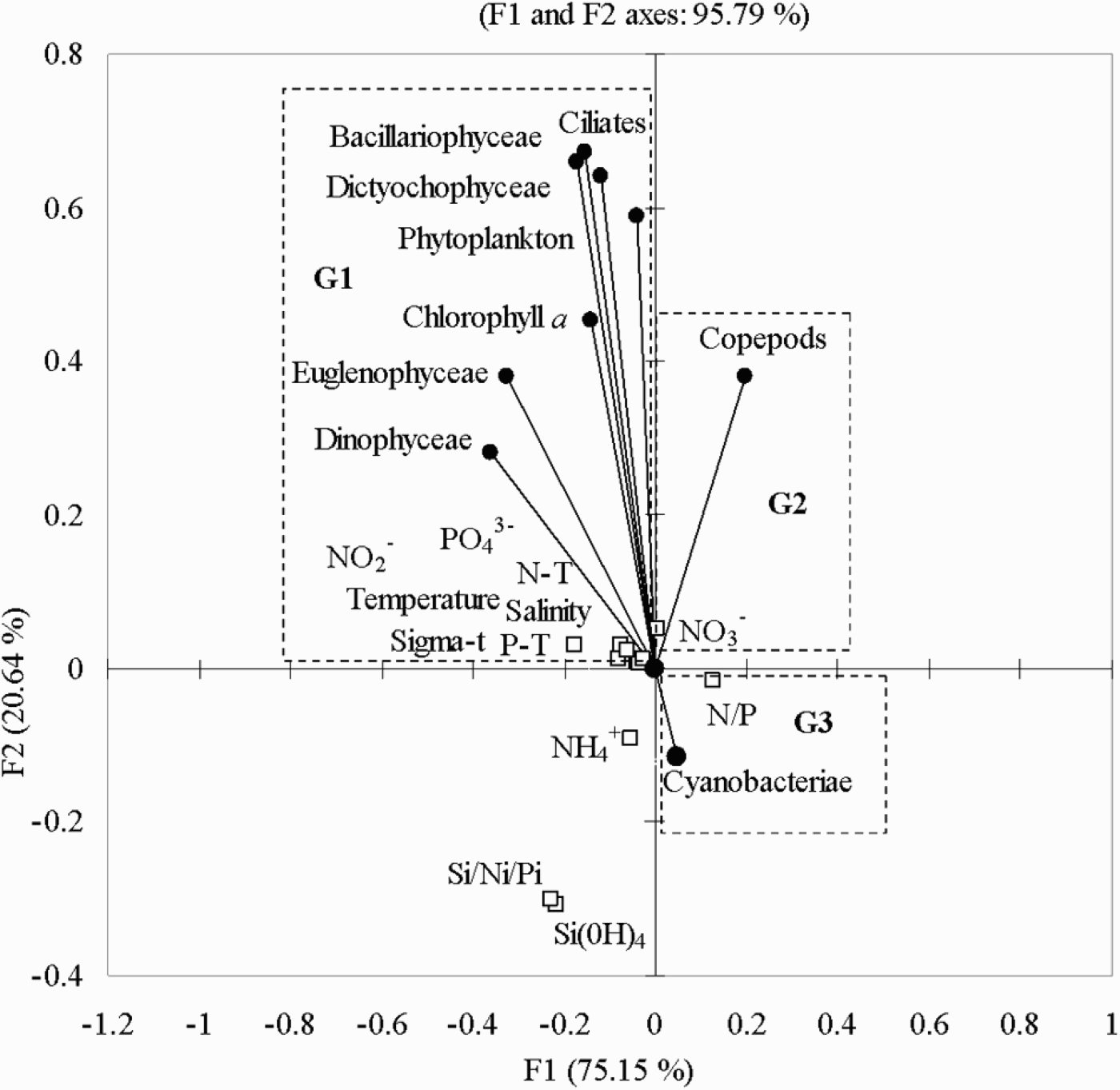
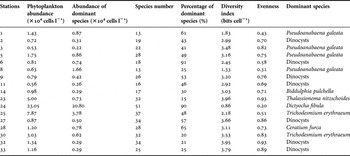
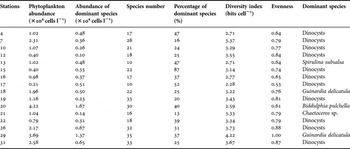
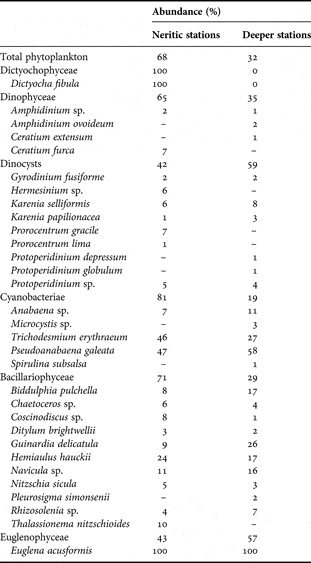
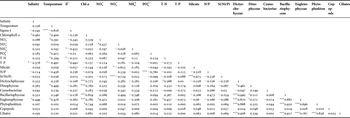
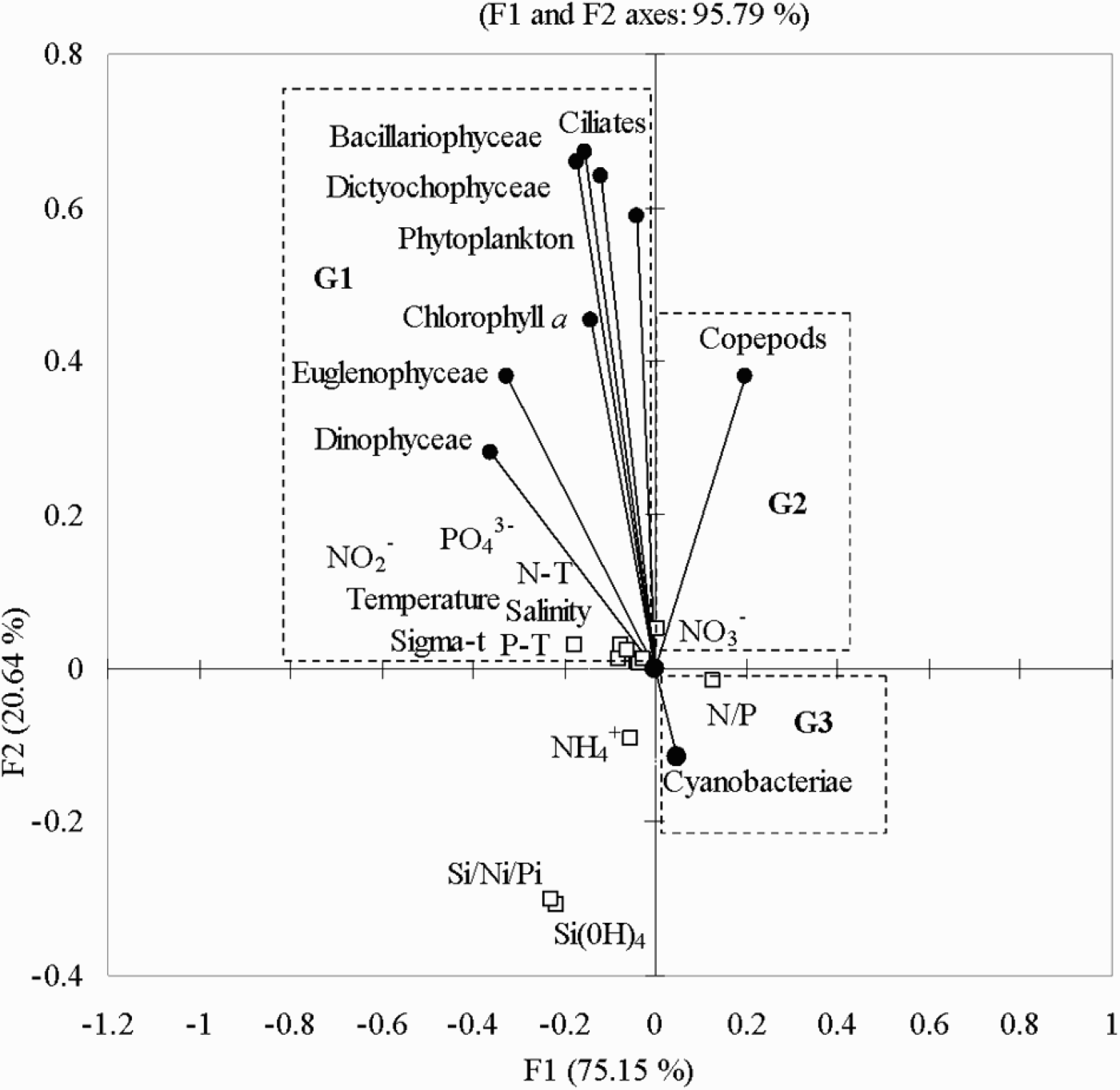
The phytoplankton community consisted of Dictyochophyceae (represented by only one taxon Dictyocha fibula), Dinophyceae (78 taxa), Bacillariophyceae (33 taxa), Cyanobacteriae (5 taxa) and Euglenophyceae (one taxon, Euglena acusformis) which contributed 41, 25, 16, 17 and 1% of the total abundance, respectively. The diversity of the phytoplankton community was less pronounced on the coast of the gulf than in the open sea (Figure 4A, B; Table 2A, B). This was especially clear in Station 24 where D. fibula dominated (H′: 0.86, J: 0.20, Table 2A; Figure 4) reflecting presumably favourable growth conditions along the coast. This also applied to Stations 1 and 8 where the relative abundance of the cyanobacterium Pseudoanabaena galeata, resulted in a low diversity of the assemblage (Table 2A). The phytoplankton community was more abundant on the coast of the gulf than in the deeper areas (Table 1). Total density ranged from 2.1×10³ to 2.3×10⁵ cells l−1 (mean±SD = 2.3 104±4.0×10⁴ cells l−1) (Figure 4A; Table 2A, B; Table 3). The phytoplankton community consisted of Dictyochophyceae (represented by only one taxon, Dictyocha fibula), Dinophyceae (78 taxa), Bacillariophyceae (33 taxa), Cyanobacteriae (5 taxa) and Euglenophyceae (one taxon, Euglena acusformis) which contributed 41, 25, 16, 17 and 1% of the total abundance, respectively (Figure 5). Diversity of the five groups was more pronounced on the coast of the gulf than on the open sea (Figure 4B). In terms of biomass, diatoms were the dominant group accounting for 45% of the total cell carbon (Figure 5). Dinophyceae abundance was significantly higher in both in-shore and off-shore areas (Table 1; Table 3; Figure 6), and so it was the case for diatoms. Dictyochophyceae were exclusively neritic (Table 1; Table 3; Figure 6). Cyanobacteriae were found throughout the water column and were more concentrated in the thermocline within the deeper zone (Table 1; Figure 6). This pattern is clearly illustrated by the dendrogram from the cluster analysis which shows 2 clusters at a linkage distance of 80%; cluster 1 segregates exclusively Cyanobacteriae and cluster 2 the remaining groups (Figure 7A). In addition, chlorophyll-a concentrations were higher along the coast than in offshore areas (Table 1; Figure 3F) and associated with the development of Dictyochophyceae (r = 0.775, P < 0.0001, df = 119), Dinophyceae (r = 0.760, P < 0.0001, df = 119), Bacillariophyceae (r = 0.829, P < 0.0001, df = 119) and Euglenophyceae (r = 0.780, P < 0.0001, df = 119) but no significant correlation was found with Cyanobacteriae (Table 4). The CCA allowed the discrimination of two groups around the F1 and F2 axes components (Figure 8) explaining 95.79% of the variance. These axes components selected positively the group G1 the biological parameters (chlorophyll-a, total phytoplankton, Dictyochophyceae, Bacillariophyceae, Dinophyceae, Euglenophyceae and total ciliates) with several physico-chemical (temperature, salinity, sigma-t, NO2−, PO43−, T-N and T-P). F1 axis, which extracted 75.15% of the variability selected positively group G2 formed by copepods and NO3−, and group G3 composed of Cyanobacteriae and N/P ratio. This association confirms observations that phytoplankton abundance decreases with depth and is more concentrated in the coastal areas than in the open sea. In addition, the different phytoplankton group depends on the nutrient availability (nitrate, nitrite, ammonium, orthophosphates, total-N and total-P) and especially on N/P ratios which seem to be the determining regulator of phytoplankton taxa. This association reflects the close links between the distribution of Dictyochophyceae and Dinophyceae (r = 0.461, P < 0.05, df = 119), between Dinophyceae and Bacillariophyceae (r = 0.511, P < 0.05, df = 119) and between Dinophyceae and Euglenophyceae (r = 0.571, P < 0.05, df = 119) (Table 4). We also found a significant correlation between nitrate concentrations and Dinophyceae abundance (r = 0.539, P < 0.05, df = 119), between Dictyochophyceae and total-N (r = 0.368, P < 0.05, df = 119) as well as between Euglenophyceae and total-N (r = 0.457, P < 0.05, df = 119) (Figure 7A; Table 4). These correlations confirm that the phytoplankton abundance was higher along the nutrient-rich coast than in the open sea. Clearly, there is a separation of nutrient-rich water masses with enhanced salinity along the coast (with high phytoplankton abundances) from poor-nutrient water masses with low salinity in the off-shore.
The spatial distribution of total phytoplankton abundance (A) and the diversity index (B) in the Gulf of Gabès in July 2005.

Relative abundance and biomass of the different phytoplankton groups.

Spatial and vertical distribution of the five phytoplankton groups along the water column in neritic and deeper areas of the Gulf of Gabès.

Dendrogram of the Euclidean distance between the five phytoplankton algal groups recorded (A) and between planktonic communities (total phytoplankton, ciliates and copepods) and chlorophyll-a (B) in the Gulf of Gabès in summer 2005.

Results of canonical correspondence analysis (CCA) of biological parameters (chlorophyll-a concentration, total and phytoplankton groups, ciliates and copepods) and selected environmental variables in the Gulf of Gabès during July.
Quantitative and structural characteristics of the phytoplankton community sampled in neritic (A) and deeper (B) areas in the Gulf of Gabès during July 2005.


The main phytoplankton taxa and their relative percentage in neritic and deeper areas of the Gulf of Gabès during July 2005.

Correlation matrix (Pearson test) made with Xl-stat for physical, chemical and biological variables under study in the Gulf of Gabès during summer 2005 (*P < 0.05; ***P < 0.0001; number of parameters = 18 and number of analysed samples: N = 120).

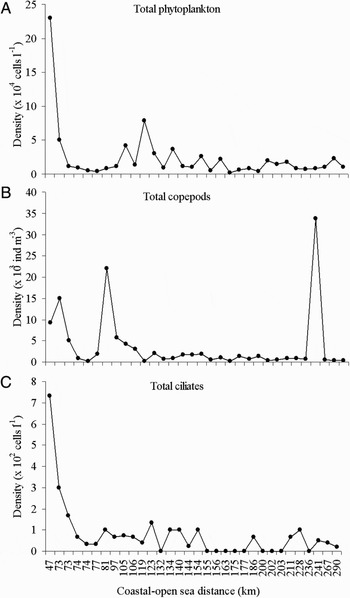
The spatial distribution of phytoplankton total abundance according to coastal–open sea gradient together with the prevailing potential predators (total ciliates and copepods) is illustrated in Figure 9. The abundance of phytoplankton (dominated by opportunistic Dictyocha fibula) and ciliates (dominated by the Tintinnid Tintinnopsis which accounted for 90% of total ciliate abundance) showed significant correlation for both groups (r = 0.836, P < 0.0001, df = 119). However, the abundance of phytoplankton did not correlate with that of copepods (r = 0.023, P < 0.05, df = 119) (Figure 9A–C). This was also confirmed by the CCA showing a linked ecological relationship between phytoplankton and ciliates while copepods seemed to be an independent planktonic group (Figure 7B).
Spatial distribution of total phytoplankton (A), copepods (B) and ciliate densities (C) along neritic open-sea distance.

DISCUSSION
The results indicate that the summer spatial distribution of phytoplankton assemblages along the coast and in the open sea was influenced by various environmental factors. On the whole, the phytoplankton community is more concentrated along the coast and especially near Djerba Island than in the deeper area. The striking finding is the strong proliferation in coastal samples of D. fibula (41% of the total phytoplankton abundance). Because of high surface to volume ratio, small cells like D. fibula take up nutrients, with low energy cost, reaching numerous assimilation surface points (Aleya, Reference Aleya1989; Agawin et al., Reference Agawin, Duarte and Agusti2000) and thus outperform large cells (Raven, Reference Raven1998; Sin & Wetzel, Reference Sin and Wetzel2000). High concentrations of D. fibula have also been observed in the French bay of Villefranche (Gomez & Gorsky, Reference Gomez and Gorsky2003) and in Mersin Bay (Eker & Kideys, Reference Eker and Kideys2000). However, these authors reported a decrease in the Dictyochophyceae abundance with increasing temperature, contrasting with our results which showed a warmer (24.35±1.99°C) water column along the coast than in the open sea (22.79±0.91°C), but conforming with those reported in the Gulf of Trieste (northern Adriatic) where D. fibula developed with a temperature optimum >20°C (Fanuko, Reference Fanuko1989). Other marine environments harbour the genus Dictyocha, especially the Mexican Pacific coasts (Hernandez-Becerril & Brovo-Sierra, Reference Hernandez-Becerril and Bravo-Sierra2001) and the North Pacific (Onodera & Takahashi, Reference Onodera and Takahashi2005) where D. fibula and D. californica remarkably dominated the phytoplankton community.
Nitrogen, which is the most common element limiting phytoplankton growth in most marine ecosystems (Vitousek & Howarth, Reference Vitousek and Howarth1991; Livingston, Reference Livingston2001), was found at substantial amounts along the coast of the Gulf of Gabès, while orthophosphate concentrations were low and N/P was higher than the Redfield ratio (16). This suggests that phosphate is more likely than nitrogen might be to limiting yields and to attainable growth rates. Furthermore, chlorophyll-a concentration (mean±SD = 0.05±0.05 µg l−1) is found in the Gulf of Gabès, a trend largely reported in the Mediterranean Sea: (0.40 µg l−1) on the Israeli coast (eastern Mediterranean Sea) (Gitelson et al., Reference Gitelson, Karnieli, Goldman, Yacobi and Mayo1996); in the Alboran Sea (Corsini et al., Reference Corsini, Grasso and Cipollini2002; D'Ortenzio et al., Reference D'Ortenzio, Marullo, Ragni, Ribera d'Alcalà and Santoleri2002); in the Gulf of Lions (0.06–0.10 µg l−1) (Bosc et al., Reference Bosc, Bricaud and Antoine2004) and in the coastal north-western Mediterranean Sea (0.50 µg l−1) (Bustillos-Guzman et al., Reference Bustillos-Guzman, Claustre and Marty1995). In the off shore of the Gulf of Gabès, low chlorophyll-a concentration together with an N/P ratio higher than the Redfield ratio indicate that this ecosystem is oligotrophic (OECD, 1982; Vollenweider et al., Reference Vollenweider, Marchetti and Viviani1992), confirming the observations reported from the off shore of the eastern Mediterranean basin (Krom et al., Reference Krom, Brenner, Kress and Gordon1991; Heurt et al., Reference Heurt, Zohary, Krom, Fauzi, Mantoura, Pitta, Psarra, Rassoulzadegan, Tanaka and Thingstad2005). However, the coastal area is showing signs of progressive eutrophication (Smaoui-Damak et al., Reference Smaoui-Damak, Hamza-Chaffai, Berthet and Amiard2003, Reference Smaoui-Damak, Rebai, Berthet and Hamza-Chaffai2006). This difference in the trophic status between the coastal and open sea areas is also illustrated by the difference in the size of the sampled dinoflagellates, with larger taxa, such as Ceratium (mean size±SD = 2.16×10²±2×102 µm), dominating in coastal waters; whereas smaller cells such as Protoperidinium (mean±SD = 41.26±18.56 µm), were exclusively oceanic (>100 km). Overall, the offshore eastern Mediterranean basin is oligotrophic (Krom et al., Reference Krom, Brenner, Kress and Gordon1991; Heurt et al., Reference Heurt, Zohary, Krom, Fauzi, Mantoura, Pitta, Psarra, Rassoulzadegan, Tanaka and Thingstad2005; Thingstad et al., Reference Thingstad, Krom, Mantoura, Flaten, Groom, Herut, Kress, Law, Pasternak, Pitta, Psarra, Rassoulzadegan, Tanaka, Tselepides, Wassmann, Woodward, Riser, Zodiatis and Zohary2005) characterized by the dominance of dinoflagellates. A similar phytoplankton community size-structure was found in the oligotrophic Levantine Basin of the eastern Mediterranean (Kress et al., Reference Kress, Thingstad, Pitta, Psarra, Tanaka, Zohary, Groom, Herut, Mantoura, Polychronaki, Rassoulzadegan and Spyres2005) and in the Strait of Gibraltar (Gomez et al., Reference Gomez, Echevarrià, Garcia, Prieto, Ruiz, Reul, Jiménez-Gomez and Valera2000). Moreover, because of the lack of deep mixing along the coast due to stratification, which gives an advantage to motile cells over non-motile ones (e.g. diatoms) (Paerl, Reference Paerl1997), dinoflagellates thrived along the coastal sea. Similar observations were reported in the Bay of Villefranche in the north-western Mediterranean Sea (Gomez & Gorsky, Reference Gomez and Gorsky2003) and in the hypertrophic costal waters of Tokyo Bay (Matsuoka et al., Reference Matsuoka, Joyce, Kotani and Matsuyama2003). The Bacillariophyceae density in the Gulf of Gabès was significantly correlated with N/P (r = 0.473, P < 0.05, df = 119) and NO3− (r = 0.494, P < 0.05, df = 119), concurring with previous results showing the well-known opportunistic strategy of this group as far as taking advantage of the nutrient availability is concerned (Fogg, Reference Fogg1991; Aleya, Reference Aleya1992). Despite having an obligatory requirement for silica, the diatoms in the Gulf of Gabès were weakly correlated with silicate concentrations, probably due to excess of silica compared to the other nutrients.
Cyanobacteriae developed throughout the whole water column with a high density recorded in the thermocline and associated with Trichodesmium erythraeum and Pseudoanabaena galeata which contributed 41 and 50% of the total cyanobacterial abundance, respectively. In these layers, Cyanobacteriae abundances were correlated with both NO3− (r = 0.343, P < 0.05, df = 119) and NH4+ (r = 0.344, P < 0.05, df = 119), and a significant correlation was recorded between Cyanobacteriae and N/P (r = 0.566, P <0.05, df = 119). This indicates that the cyanobacterial growth was probably induced by the nitrate replenishment of the upper stratified layers after release by the thermocline.
The spatial distribution of the abundance of phytoplankton, ciliates (dominated by the genus Tintinnopsis) and copepods (dominated by two species Oithona nana and Acartia clausi; Drira et al., Reference Drira, Belhassen, Ayadi, Hamza, Zarrad, Bouaïn and Aleya2009) suggests that the community of ciliates were consuming larger numbers of phytoplankton, especially Dictyocha fibula (r = 0.836, P < 0.0001, df = 119). In addition, there was a significant trend of increasing abundance in copepods coinciding with decreases in ciliate abundances. Although we did not conduct grazing experiments, these related patterns suggest that a competition between ciliates and copepods might have occurred for phytoplankton prey. Our assumption may be supported by the results reported from other aquatic environments where a substantial amount of the ciliate biomass was cleared by filter-feeding copepods (Lampert et al., Reference Lampert, Fleckner, Rai and Taylor1986; Atkinson, Reference Atkinson1996; Pérez et al., Reference Pérez, Dolan and Fukai1997) as well as in laboratory conditions (Hartmann et al., Reference Hartmann, Taleb, Aleya and Lair1993).
CONCLUSION
The phytoplankton community structure in the Gulf of Gabès showed clear variations along a coastal–open sea transect during a summer preliminary study achieved in July 2005. The phytoplankton community found along the coast was dominated by opportunistic small-sized species (e.g. D. fibula) that thrived as favoured by the nutrient-rich coast. The Gulf of Gabès is characterized by a summer stratification which impacts on phytoplankton development chiefly in the off-shore area, and the assemblage of different water masses; namely the Mediterranean water and the MAW could be determining factors of phytoplankton dynamics. On the other hand, trophic interplay between phytoplankton, ciliates and copepods suggests that factors other than hydrographic conditions and nutrients were also implicated in the environmental forcing of the summer phytoplankton dynamics in the Gulf of Gabès. In addition, phytoplankton may serve as a substantial food link between ciliates and copepods towards higher trophic levels of this area.
ACKNOWLEDGEMENTS
This work was supported by the Tunisian funded project POEMM (LR02INSTM04) conducted in the National Institute of Marine Sciences and Technologies (INSTM) and Plankton and Microbiology of Aquatic Ecosystems Research Unit of the University of Sfax. The authors wish to thank the crew of the RV ‘Hannibal’ for their assistance. This study was conducted in the framework of the PhD of Zaher Drira (University of Franche-Comté: Laboratoire de Chrono-Environnement UMR CNRS 6249, France–University of Sfax: Tunisia).