Many longitudinal studies have investigated the effects of phonological awareness and naming speed on word recognition. Similar longitudinal studies on word spelling are rare for both English orthography and languages with relatively more consistent orthographies. Such studies are nevertheless of importance to discover what naming speed measures with respect to spelling and to compare this information to what is known about children's word recognition. In the present study, the relations of phonological awareness and naming speed to spelling accuracy in Grades 1 and 2 are investigated longitudinally. It is hypothesized that phonological awareness will predominate over naming speed in the prediction of word spelling accuracy at the beginning of Grade 1, but that both skills will equally influence word spelling accuracy by the end of Grade 1 and, for that matter, the end of Grade 2.
EMPIRICAL STUDIES OF THE PREDICTORS OF WORD SPELLING ACCURACY
The most important predictors of word recognition and word spelling accuracy in Dutch are phonological awareness and naming speed (Aarnoutse, Reference Aarnoutse2004). Phonological awareness is the implicit or explicit knowledge that people have of the sound structure of spoken words. Phonemic awareness thus concerns knowledge of phonemes and the speech sounds or units of sounds used to build spoken words and distinguish meanings (Nagy & Scott, Reference Nagy, Scott, Kamil, Mosenthal, Pearson and Barr2000; Tunmer, Herriman, & Nesdale, Reference Tunmer, Herriman and Nesdale1988). Naming speed is the speed with which children name a series of well-known items when asked to do so as rapidly as possible (Wolf, Bally, & Morris, Reference Wolf, Bally and Morris1986). The stimuli are typically letters, digits, colors, or pictures of familiar objects, and it is assumed that most naming responses are overlearned (i.e., automatized). In a language with an alphabetic orthography, the spoken language is represented in spelling using letters and diacritics (Snow, Burns, & Griffin, Reference Snow, Burns and Griffin1998).
The specific relations of spelling with naming speed and phonological awareness have been investigated in a few studies. For a group of 61 Grade 3 (N = 30) and Grade 5 children (N = 31), for example, phonological awareness and naming speed for digits were both found to predict spelling skill in a regression analysis (Savage et al., Reference Savage, Frederickson, Goodwin, Patni, Smith and Tuersley2005). When Savage and Frederickson (Reference Savage and Frederickson2006) divided a group of sixty-seven 10-year-old children into average (>−1 SD) and below-average spellers (≤−1 SD), the below-average spellers scored significantly lower than the other children on phonological awareness and even lower on naming speed for digits.
When Sunseth (Reference Sunseth2000) compared a group of 18 children with a naming speed deficit (NSD) to a group of 15 children with a phonological deficit, both groups scored significantly below what could be expected for their grade on standardized dictation spelling tests. When Sunseth and Bowers (Reference Sunseth and Bowers2002) divided a group of 68 Grade 3 children into an NSD group (N = 18), a phonological deficit group (N = 17), a double-deficit group (N = 16), and a double-asset or control group (N = 17), both the single-deficit groups and the double-deficit group showed significantly lower spelling scores than the double-asset group and the age norms. The speed of word recognition was uniquely related to naming speed.
In other research, Wimmer, Mayringer, and Landerl (Reference Wimmer, Mayringer and Landerl2000) showed spelling problems in Grade 3 to be related to deficits in phonological awareness and naming speed at the start of Grade 1. The results of this study in a language with a relatively consistent orthography, like Dutch, are akin to the results of the four aforementioned studies of children learning to spell in English with its inconsistent orthography. In each study, significant associations between both naming speed and phonological awareness with spelling are found. As in the study of Sunseth and Bowers (Reference Sunseth and Bowers2002), naming speed relates uniquely to the speed of word recognition. Or, stated differently, phonological awareness related longer to word spelling accuracy than to word recognition, which can be illustrated by much research in languages with inconsistent orthographies and in relatively consistent orthographies (Bradley & Bryant, Reference Bradley and Bryant1983; Frith, Reference Frith, Patterson, Marshall and Coltheart1985; Juel, Griffith, & Gough, Reference Juel, Griffith and Gough1986; Landerl & Wimmer, Reference Landerl and Wimmer2008; Lie, Reference Lie1991; Lundberg, Frost, & Petersen, Reference Lundberg, Frost and Petersen1988; Mommers, Reference Mommers1987; Sunseth & Bowers, Reference Sunseth and Bowers2002; Tornéus, Reference Tornéus1984; Wimmer et al., Reference Wimmer, Mayringer and Landerl2000; Wimmer, Landerl, Linortner, & Hummer, Reference Wimmer, Landerl, Linortner and Hummer1991). In keeping with this, phonological programs in kindergarten have been shown to have effects after Grade 1 on children's word spelling in contrast to their word recognition (Bus & van IJzendoorn, Reference Bus and Van IJzendoorn1999).
THE RELATION OF NAMING SPEED TO ACCURACY OF WORD SPELLING AND SPEED OF WORD RECOGNITION
Although the results of research suggest that naming speed relates to the accuracy of word spelling, it is possible that the relation between naming speed and the accuracy of word spelling is mediated by a second variable that itself relates to naming speed after phonemic awareness has been controlled for, a possibility that also holds for word recognition. To start with the last possibility, Georgiou, Parrila, Kirby, and Stephenson (Reference Georgiou, Parrila, Kirby and Stephenson2008) reviewed studies and found naming speed to be a significant predictor of word recognition even after verbal and nonverbal IQ, prior word reading ability, short-term memory, articulation rate, speed of processing, letter knowledge, and phonological awareness were controlled for statistically. For the accuracy of children's word spelling, Savage, Pillay, and Melidona (Reference Savage, Pillay and Melidona2008) showed naming speed to be a unique predictor of word spelling accuracy after control for vocabulary and nonverbal intelligence, pseudoword recognition, and pseudoword spelling (i.e., phonological decoding), and extraneous motor and attention variables. In addition to this, naming speed appears to affect the accuracy of word spelling and speed of word recognition over and above phonological awareness. Naming speed appears to reflect the use of fully specified, word-specific orthographic representations (Bowers, Sunseth, & Golden, Reference Bowers, Sunseth and Golden1999; Manis, Doi, & Bhada, Reference Manis, Doi and Bhadda2000; Manis & Freedman, Reference Manis, Freedman and Wolf2001; Manis, Seidenberg, & Doi, Reference Manis, Seidenberg and Doi1999; Wimmer & Mayringer, Reference Wimmer and Mayringer2002; Wolf et al., Reference Wolf, O'Rourke, Gidney, Lovett, Cirino and Morris2002). These results suggest that the relation between naming speed and word spelling accuracy may, at least partly, be a relation between orthographic knowledge and word spelling accuracy.
As will be seen in the next section, Van den Bos (Reference Van Den Bos2008) relates the increased importance of alphanumeric naming speed for the prediction of word recognition speed to the growing importance of word-holistic features. The studies of Wimmer et al. (Reference Wimmer, Mayringer and Landerl2000) and Van den Bos (Reference Van Den Bos2008) concern relatively consistent orthographies. The other studies in this paragraph concern mainly the nonconsistent English orthography.
THE DEVELOPMENT OF WORD SPELLING ACCURACY AND HOW THIS MAY DIFFER FROM THE DEVELOPMENT OF WORD RECOGNITION SPEED
In older studies, word spelling accuracy and word recognition were assumed to constitute different skills (Bradley & Bryant, Reference Bradley and Bryant1979; Bryant & Bradley, Reference Bryant, Bradley and Frith1980; Campbell, Reference Campbell1987; Frith, Reference Frith and Frith1980, Reference Frith, Beech and Colley1987). Nevertheless, word spelling accuracy and word recognition predict each other quite well during early as well as later word spelling and word recognition (Carver, Reference Carver2003; Ehri, Reference Ehri, Perfetti, Rieben and Fayol1997; Hooper, Swartz, Wakely, de Kruif, & Montgomery, Reference Hooper, Swartz, Wakely, de Kruif and Montgomery2002; Jenkings, Johnson, & Hileman, Reference Jenkings, Johnson and Hileman2004; Leppänen, Niemi, Aunola, & Nurmi, Reference Leppänen, Niemi, Aunola and Nurmi2006). In keeping with this, it has been asserted in more recent studies that word spelling and word recognition are largely the same in principle, but that learning to accurately spell a word develops later than learning to accurately recognize the same word (Ehri, Reference Ehri, Perfetti, Rieben and Fayol1997; Perfetti, Reference Perfetti, Perfetti, Rieben and Fayol1997). The theory of Ehri (Reference Ehri, Snowling and Hulme2005) describes the development of spelling and word recognition in five phases (Ehri, Reference Ehri, Snowling and Hulme2005). Only the last three phases (full alphabetic phase, consolidated alphabetic phase, and automaticity phase) are relevant within the context of the present study, however, as the present study concerns Grades 1 and 2 word spelling accuracy and word recognition in a rather consistent orthography.
During the full alphabetic phase (Ehri, Reference Ehri, Perfetti, Rieben and Fayol1997, Reference Ehri, Snowling and Hulme2005), children learn to spell via the analysis of spoken words and the connection of the analyzed phonemes to graphemes. Children learn to recognize words by sounding out graphemes and synthesizing this information to access the right word (Ehri, Reference Ehri, Metsala and Ehri1998, Reference Ehri, Snowling and Hulme2005; Struiksma, Van der Leij, & Vieijra, Reference Struiksma, Van Der Leij and Vieijra1997). The full alphabetic phase is strongly associated with the phonemic skills of children, and children's spelling can therefore be expected to also possibly relate to their phonological awareness as well.
In the consolidated alphabetic phase of literacy development (Ehri, Reference Ehri, Snowling and Hulme2005), the speller relates well-known phoneme groups to well-known grapheme groups without direct consultation of underlying phoneme–grapheme relations. A necessary condition for the formation of such phonographic group relations is that all of the phonemes in a group be related to graphemes even when the phoneme–grapheme connections are inconsistent. For word recognition purposes, the reader similarly relates a well-known group of graphemes to the sounds of the corresponding well-known group of phonemes without checking underlying grapheme–phoneme connections.
In the final automaticity phase of literacy development (Ehri, Reference Ehri, Snowling and Hulme2005), the same processes occur as in the previous phase but the groups of graphemes and groups of phonemes are now entire words. After practice, a whole-word unit (Ehri, Reference Ehri, Perfetti, Rieben and Fayol1997, Reference Ehri, Snowling and Hulme2005) or lexical representation (Perfetti, Reference Perfetti, Perfetti, Rieben and Fayol1997) is thus formed out of the phonological and orthographic representations for a word that becomes bonded. According to Perfetti, there is much dynamic in the building of a bond between phonological awareness and orthographic elements.
The most important reason to consider word recognition and word spelling to be largely the same is that, according to Perfetti (Reference Perfetti, Perfetti, Rieben and Fayol1997), they share the same underlying lexical representations. The lexical representation is a bond between the phonological and the orthographic representation. For skilled word recognition, the perceived word is compared to word representations in the orthographic part of the bond (i.e., the bond between the phonological and the orthographic representation). When a match is found, the spoken word can then be activated as a unit. For skilled spelling, the spoken word is compared to the phonological word representations in the phonological part of the bond. When a match is found, the orthographic representation of the word is activated and retrieval of the relevant graphemes from the orthographic representation then occurs. When the phonologic representation of an entire word cannot be related to a whole-word orthographic representation for the spelling of a word, one or more of the component phonemes from the phonologic representation may be used to activate one or more of the sometimes only weakly bonded component graphemes in the orthographic representation. When this is further assumed to be the rule rather than the exception, it is possible that the use of such a lexical representation relates to both children's use of phonological information for purposes of compensation and relatively poor-quality orthographic representation. As seen in the previous section, the quality of orthographic representation can also be related to naming speed. Both the speed and accuracy of accessing relatively poor orthographic representations may then be associated with naming speed. We assume that this is what happens, as the spelling of a word is not yet automatized for the words on a standardized spelling test with a possible exception for the easy words of such a test. We further assume the development of phonologic representations to provide no serious problems for normally developing children in a language with a relatively consistent orthography (e.g., Mann & Wimmer, Reference Mann and Wimmer2002; Wimmer, Reference Wimmer1993).
In sum, naming speed for purposes of early spelling can be assumed to measure the speed and accuracy of accessing a relatively incomplete and/or weakly bonded orthographic representation to the phonological representation on one or more places. Phonological awareness can then be assumed under such circumstances to measure the extent to which phonological information must be called upon to compensate for incomplete and/or weakly bonded orthographic representations.
The preceding described just how the assumed development of spelling relates to the bond between the phonologic and orthographic lexical representation. Word recognition relates also to lexical representation, but involves easier access of lexical representations than spelling. Reading a word is easier than spelling a word for at least three reasons (Perfetti, Reference Perfetti, Perfetti, Rieben and Fayol1997). First, a reader can choose one word over a group of “orthographic neighbors” during the word recognition process and miss one or more letters during this process. Second, sounding printed words can provide a match to the phonological representation. Third, the recognition of graphemes for word recognition purposes is easier than the retrieval of graphemes for spelling purposes.
Van den Bos (Reference Van Den Bos2008) has formulated a theory that can add to the theory of Perfetti (Reference Perfetti, Perfetti, Rieben and Fayol1997), as we will see. Van den Bos (Reference Van Den Bos2008) states that word recognition speed relates more to word-holistic or lexical variables such as alphanumeric naming speed and less to word-analytic or sublexical variables such as phonemic awareness over time. Van den Bos (Reference Van Den Bos2008) emphasizes that the terms word-holistic and word-analytic are not meant to imply that the holistic is more visually oriented than the analytic. The term holistic should also not be taken to refer to purely nonphonological processes nor the term analytic to refer to purely to phonological processes. Although van den Bos (Reference Van Den Bos2008) does not provide actual examples of word-holistic variables, Perfetti (Reference Perfetti, Perfetti, Rieben and Fayol1997) provides examples of differences between reading and spelling, and these differences appear to involve word-holistic features. Perfetti (Reference Perfetti, Perfetti, Rieben and Fayol1997) states that the reader can choose one word over a group of orthographic neighbors during the word recognition process and skip one or more letters during this process. Word-holistic features thus appear to be at stake here. Moreover, sounding letter sequences can provide a match to the phonological representation, which points to a phonological word-holistic feature. In addition, Perfetti (Reference Perfetti, Perfetti, Rieben and Fayol1997) states that the recognition of graphemes for word recognition purposes is easier than the retrieval of graphemes for spelling purposes. This suggests to us that easily recognized word-holistic features may also be at work here and make words easier to recognize than to spell. Research by Rayner, Juhasz, and Pollatsek (Reference Rayner, Juhasz, Pollatsek, Snowling and Hulme2005) has indeed shown readers to recognize such parafoveal word-holistic features as word length and word frequency in addition to orthographic and phonemic word-holistic features: the greater the orthographic or phonological similarities between words, the more parafoveal perception can facilitate word recognition (Rayner et al., Reference Rayner, Juhasz, Pollatsek, Snowling and Hulme2005). The parafovea is the area on the retina that surrounds the fovea.
In contrast to word recognition, the speller can only retrieve graphemes from the orthographic representation of a word and cannot use whole word features via the printed word, according to Perfetti (Reference Perfetti, Perfetti, Rieben and Fayol1997). The retrieval of individual graphemes for spelling purposes is also particularly susceptible to error for two reasons. First, memory representations are often of a low quality (Perfetti, Reference Perfetti, Perfetti, Rieben and Fayol1997). Second, spellers may experience interference from competing letter strings during the spelling and writing of a word (Perfetti, Reference Perfetti, Perfetti, Rieben and Fayol1997). The speller can check a written word by reading over the word and correcting the spelling if necessary. However, this is time consuming, particularly for the beginning speller.
To summarize, the reader may have better and faster access than the speller to orthographic representations via the use of the holistic features of recognized words. These features also play a role in alphanumeric naming speed, although we do not know precisely which word-holistic features may be involved. The beginning speller, in contrast, must access an orthographic representation that is often incomplete and weakly bonded to the phonological representation and must compensate the poor quality by phonological awareness or knowledge. Therefore, spelling is related to compensating phonological awareness and naming speed, which measures the accuracy and possibly the speed of accessing the orthographic representation that has a relatively low quality.
RESEARCH QUESTION AND EXPECTATIONS
The purpose of the present study was to investigate the predictive effects of naming speed and phonological awareness for word spelling accuracy at the beginning of Grade 1 and the ends of Grades 1 and 2. It is expected that phonological awareness at the beginning of Grade 1 will uniquely relate to the accuracy of word spelling because beginning spelling is most likely to relate uniquely to phonemic awareness.
As noted previously, spelling is longer related to phonological awareness than to word recognition, especially to word recognition speed (Sunseth & Bowers, Reference Sunseth and Bowers2002; Wimmer et al., Reference Wimmer, Mayringer and Landerl2000). In an earlier study (Verhagen, Aarnoutse, & Van Leeuwe, Reference Verhagen, Aarnoutse and Van Leeuwe2008) we found that word recognition speed at the ends of Grades 1 and 2 was uniquely related to word recognition speed. These results were determined at the same times as for word spelling accuracy and for the same dataset and kind of analyzes as in the present study. If phonemic awareness relates longer to word spelling accuracy than to word recognition speed, that means that spelling at the ends of Grades 1 and 2 either relates uniquely to phonological awareness or relates to both naming speed and phonological awareness. From our assumed development of word spelling we expect, however, that naming speed and phonological awareness will be both related to word spelling accuracy.
METHOD
Participants and procedure
Two elementary schools from the suburbs of the Dutch city of Rotterdam were invited to participate in the present study. The schools were asked to participate on account of their large size: the first school had six classes per grade, whereas the second school had four classes per grade. The first school was situated in a new housing area; the second school was situated in a slightly older but still relatively new housing area. In both schools, the kindergarten groups had the Dutch equivalent of preschool students in them (i.e., the class was a combined preschool/kindergarten class). The type of elementary school instruction was relatively traditional and fairly structured. In first grade, initial spelling and reading skills were taught according to the Veilig Leren Lezen (“How to learn to read safely”) program (Mommers, Verhoeven, Van der Linden, Stegeman, & Warnaar, Reference Mommers, Verhoeven, Van Der Linden, Stegeman and Warnaar1990). This program is used in the majority of Dutch elementary schools and teaches students to structure words on a phonological–visual basis.
The original group of participants involved 238 kindergarten students who moved on to Grade 1. If a student missed a particular test, testing was undertaken as quickly as possible following the original testing date. In most cases, children who had moved away from their school could be tested in their new schools. Nonetheless, 12 children had moved too far away and thus dropped out. Accidental random missings (0.3%) were estimated using regression methods. The final number of students participating in the present study was 226 (148 from School 1, 78 from School 2). The average age of the participants at the time of initial testing was 5 years and 8 months (SD = 4.25 months); 48.7% of the participants were male and 51.3% were female. Dutch was the second language for 4% of the children.
The tests used in the present study were administered in the two schools by specially trained teachers and student–teachers in a number of sessions with duration of about 30 min per child or group. Internal supervisors coordinated the necessary communication and test administration for the two schools.
Research design
The data for the present study were collected on five measurement occasions. Measurement 1 took place after 3 months of kindergarten and was conducted in November. Measurement 2 occurred after 8 or 9 months of kindergarten and was administered in April or May. Measurement 3 took place after 2 or 3 months of formal reading instruction and was administered in October or November of Grade 1. Measurement 4 occurred after 8 or 9 months of formal spelling and reading instruction and was administered in April or May of Grade 1. Measurement 5 took place after 19 months of formal spelling and reading instruction and was administered in June of Grade 2.
MEASURES
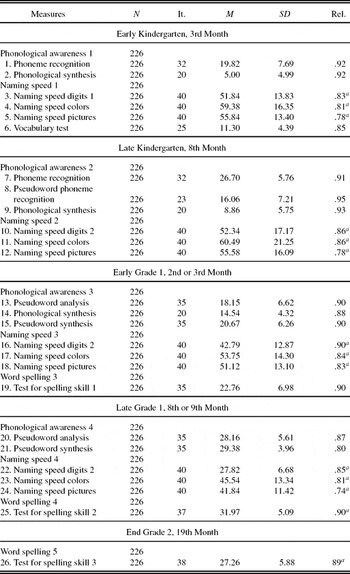
Table 1 presents an overview of the various measures and the descriptive statistics for the measures.
Measures and descriptive statistics according to administration

Note: It., number of items; Rel., reliability coefficient α.
aTest–retest reliability.
Phonological awareness
According to Blachman (Reference Blachman, Kamil, Mosenthal, Pearson and Barr2000), both treatment and prediction data suggest that phonological analysis and synthesis are the most important phonological factors for the prediction of reading and spelling in kindergarten and the initial elementary grades.
Phoneme recognition. This test measures the recognition of the first or last phoneme of a word (Aarnoutse & Beernink, Reference Aarnoutse and Beernink2002). For the first eight items, the children are asked to point at pictures to indicate which of two sounds they hear at the beginning of a pictured word. For the next eight items, a picture is named for the children and they are asked which sound they hear at the beginning of the word. In the second half of the test, the children are asked about what they hear at the end of a word. The procedure is the same as for the first phoneme of a word, with the exception that no pictures are shown for the last eight items. This test was administered in the third and eighth months of kindergarten.
Pseudoword phoneme recognition. This test measures the analysis of the first or last phoneme of a pseudoword (Verhagen & Aarnoutse, Reference Verhagen and Aarnoutse2001a). Similar to phoneme recognition, the children are asked to indicate what they hear at the beginning or the end of a pseudoword. The test was administered in the eighth month of kindergarten.
Phonological synthesis. This test measures the degree to which the child is able to construct a word that has been divided into its constituent phonemes (Aarnoutse & Verhagen, Reference Aarnoutse and Verhagen2001). The 20 items range from ijs (ice) to paraplu (umbrella). In the second month of kindergarten, four training items were presented to the children. The test was also administered in the eighth month of kindergarten and in the second month of Grade 1.
Pseudoword analysis. This test measures the ability to analyze a pseudoword into its constituent phonemes (Verhagen & Aarnoutse, Reference Verhagen and Aarnoutse2001b). The pseudowords ranged in complexity from ig to koosgruip. The test was administered in the second and eighth months of Grade 1.
Pseudoword synthesis. This test measures the ability to construct a pseudoword from constituent phonemes (Verhagen & Aarnoutse, Reference Verhagen and Aarnoutse2001b). The 35 items ranged in difficulty from oos to stoukwerp. The test was administered in the second and eighth months of Grade 1.
Naming speed
In the present study, naming speed requires that the child names digits, colors, and pictured objects as quickly and accurately as possible. All of the naming speed measures involved the presentation of five columns with 10 items each. The naming speed measures have been adapted from the tests of Van den Bos (Reference Van Den Bos2000). After the presentation of the fifth column as a practice column and the correction of any errors produced for that column, the child is asked to name the items in the other four columns. If the children in kindergarten did not know one or more of the digits, these were taught prior to administration of the naming speed for digits test. After the first 20 items (i.e., two columns of test items), a short break is taken. The child's test score is the time needed to name the 40 items in seconds.
Naming speed digits 1 and 2. Digits 1, 2, and 3 were used for the Naming Speed Digits 1 Test and digits 1, 2, 3, 4, and 5 were used for the Naming Speed Digits 2 Test. The number of digits that had to be taught prior to the two tests was negligible (Verhagen, Aanoutse, & Van Leeuwe, Reference Verhagen, Aarnoutse and van Leeuwe2006). Naming Speed Digits 1 was administered in the third month of kindergarten. Naming Speed Digits 2 was administered in the eighth month of kindergarten and the second and eighth months of Grade 1.
Naming speed colors. Five different colors had to be named: blauw (blue), groen (green), geel (yellow), rood (red), and zwart (black). The test was administered in the third and eighth months of kindergarten and in the second and eighth months of Grade 1.
Naming speed pictures. Five different pictures had to be named: boom (tree), vis (fish), stoel (chair), emmer (pail), and bed (bed). The test was administered in the third and eighth months of kindergarten and in the second and eighth months of Grade 1.
Vocabulary
Vocabulary Test. This test measures vocabulary within the context of a sentence or a short story (Aarnoutse & Beernink, Reference Aarnoutse and Beernink2002). The test administrator reads a sentence or short text fragment and omits the last word. The task of the child is, on the basis of characteristics of a concept referred to in the sentence or the short story, to state the concept. For example, “We go on holidays to a camping site. We don't sleep in a tent but we have a small home on wheels that is pulled by a car. Such a home on wheels is called a . . . (caravan).” The test was administered in the third month of kindergarten.
By the time children enter kindergarten, their vocabulary may have been influenced by teaching at home and in preschool, the children's verbal intelligence, or other influences that we would like to minimize. For this reason, the vocabulary test was administered and used as a control variable.
Word spelling
Test for Spelling Skill 1. This test consists of 35 one-syllable words that increase in difficulty from oom (uncle) to krant (newspaper; Verhagen, Reference Verhagen2002). The words are almost all phonologically consistent and involve graphemes that should be known to the children. First, a sentence is read aloud by the teacher; second, one word out of the sentence is dictated for the child to spell. The 35 words were administered in two sessions at the end of the third month in Grade 1.
Test for Spelling Skill 2. This test consists of 37 one-syllable words that range in spelling difficulty from wiel (wheel) to kwast (brush) and strik (bow; Van den Bosch, Gillijns, Krom, & Moelands, Reference Van Den Bosch, Gillijns, Krom and Moelands1993). The mostly phonologically consistent words involve almost all different types of graphemes. First, a sentence is read aloud by the teacher; second, one word out of the sentence is dictated for the child to spell. The 37 words were administered in two sessions during the ninth month in Grade 1.
Test for Spelling Skill 3. This test consists of 36 one- or two-syllable words that include almost all types of irregular Dutch words, which can nevertheless be spelled on the basis of phonological analysis in combination with specific spelling rules (Van den Bosch et al., Reference Van Den Bosch, Gillijns, Krom and Moelands1993). A sentence is read aloud by the teacher; then one word out of the sentence is dictated for the child to spell. The 37 words were administered in the ninth month of Grade 2 (i.e., after 19 months of spelling instruction).
DATA ANALYSES
Given that the teaching of reading and spelling skills only starts in Grade 1 in the Dutch school system and no formal preparatory spelling instruction is provided in kindergarten, the children's spelling ability could not be properly measured in kindergarten. The influences of phonological awareness and naming speed from the first, second, and third measurement occasions (i.e., in early kindergarten, late kindergarten, and early Grade 1) on the children's spelling skill in early Grade 1 were thus determined without the inclusion of autoregressors. The children's vocabulary knowledge was included as a control variable. On the fourth and fifth measurement occasions in late Grade 1 and late Grade 2, the relevant spelling variable from the preceding measurement was included as an autoregressor. In all cases, phonological awareness was treated as a latent variable and thus encompassed all of the available phonological test scores from a particular measurement occasion. Naming speed was also treated as a latent variable, and thus encompassed all of the naming speed test scores for pictures, colors, and digits from a particular measurement occasion.
Structural equation modeling (SEM) using Amos 5 (Arbucle & Wothke, Reference Arbuckle and Wothke1999) was performed in three sets of analyses with spelling at the beginning of Grade 1 as the dependent variable and the following independent variables: phonological awareness and naming speed at the beginning of kindergarten, phonological awareness and naming speed at the end of kindergarten, and phonological awareness and naming speed at the beginning of Grade 1. Vocabulary at the beginning of kindergarten served as a control variable in all of these analyses.
SEM analyses were also conducted with spelling at the end of Grade 1 as the dependent variable and phonological awareness and naming speed at the beginning of Grade 1 as the independent variables and spelling at the beginning of Grade 1 as an autoregressive variable. The children's kindergarten vocabulary skills served as a control variable.
In addition, SEM analyses were conducted with spelling at the end of Grade 2 as the dependent variable and phonological awareness and naming speed at the end of Grade 1 as the independent variables, spelling at the end of Grade 1 as an autoregressive variable, and kindergarten vocabulary skill as a control variable.
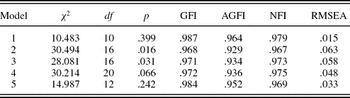
The fit of the factor model was judged by using the chi-square test, the goodness of fit index (GFI), the adjusted goodness of fit index (AGFI), the normed fit index (NFI), and the root mean square error of approximation (RMSEA). Following Hu and Bentler (Reference Hu and Bentler1999) and Jaccard and Wan (Reference Jaccard and Wan1996), a model fits reasonably well if the chi-square value does not exceed a limited multiple (3) of its degrees of freedom; the GFI, AGFI, and NFI are large (i.e., >.90); and the RMSEA is small (i.e., <.08).
RESULTS
Descriptive statistics
The means, standard deviations, and reliabilities for the different measures are presented in Table 1. It is clear from the last column in Table 1 that the reliability of the different measures was mostly high or very high. Phonological synthesis was difficult for the children at the beginning of kindergarten. Phoneme recognition was not too difficult at the beginning of kindergarten: 62% of the items were correctly responded to by the children on average although they had received no instruction on this, a related skill, or letter knowledge that might influence their phoneme analysis. By the end of kindergarten, the Phoneme Recognition Test was quite easy.
Structural equation model results
In the following, the relations of phonological awareness and naming speed to the children's spelling skill are described. The longitudinal data were analyzed along the lines of Wagner, Torgesen, and Rashotte (Reference Wagner, Torgesen and Rashotte1994).
Given that the models are multiple regression models with latent variables, lack of fit is caused exclusively by the wrong assignment of the observed variables to latent variables. The quite satisfactory fit of the five models, as indicated in Table 2, thus shows phonological awareness and naming speed to each be well-defined latent variables.
Fit measures for five models of spelling skill

Note: GFI, goodness of fit index; AGFI, adjusted goodness of fit index; NFI, normed fit index; RMSEA, root mean square error of approximation.
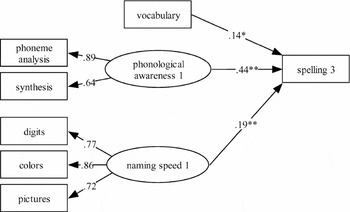
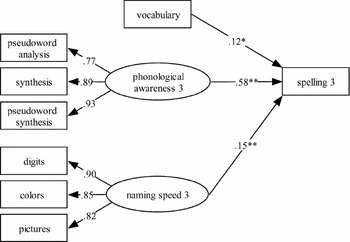
In Figure 1, the prediction of the children's spelling skill in early Grade 1 (i.e., measurement occasion 3) using the independent variables from one year before (i.e., early kindergarten) is depicted. The coefficients are standardized regression coefficients.
Children's spelling skill in early Grade 1 predicted on the basis of kindergarten variables from 1 year earlier (standardized regressions). *p < .05. **p < .01.

As can be seen, spelling at the beginning of Grade 1 is predicted mainly by the children's phonological awareness 1 year before. Vocabulary and naming speed are of minor but nevertheless significant importance. The percentage of the total variance in the dependent variable, explained by the independent variables (R 2), is .37. The correlation between the phonological and naming speed factors is .34.
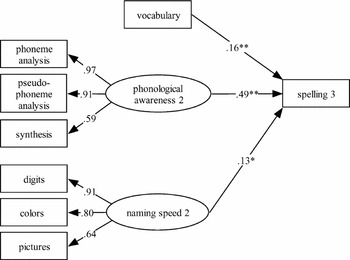
In Figure 2, the prediction of the children's spelling skill in early Grade 1 but now using the independent variables from only 6 months earlier (i.e., at the end of kindergarten) is depicted.
Children's spelling skill in early Grade 1 predicted on the basis of kindergarten variables 6 months earlier. *p < .05. **p < .01.

Once again, phonological awareness is found to be the predominant predictor for the children's spelling skill although the effects of vocabulary and naming speed are significant. The percentage of the variance explained (R 2) is .40. The correlation between the phonological and naming speed factors is .40.
In Figure 3, the prediction of the children's spelling skill again in early Grade 1 but now using the independent variables from just 1 month prior to the administration of the spelling test at the beginning of Grade 1 is depicted.
Children's spelling skill in early Grade 1 predicted on the basis of variables 1 month earlier. *p < .05. **p < .01.

As can be seen, phonological awareness is again found to be the most important predictor for the children's spelling skill. Minor but significant effects of vocabulary and naming speed nevertheless occur as well. The percentage of the variance explained (R 2) amounts to .50. The correlation between the phonological and naming speed factors is .39.
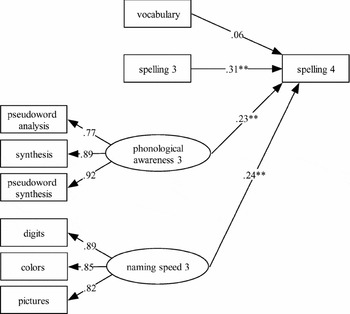
In Figure 4, the prediction of the children's spelling skill 6 months later is now depicted (i.e., at the end of Grade 1). The variables assessed in the second month of Grade 1 (i.e., 6 months prior) are now used as the predictor variables with the spelling variable assessed in the third month of Grade 1 included as an autoregressor.
The autoregressive model of children's spelling skill in the ninth month of Grade 1. *p < .01.

The most important predictor of the children's spelling skill in the ninth month of Grade 1 is found to be the spelling autoregressor (i.e., the children's spelling skill 6 months prior). The influences of phonological awareness and naming speed are also highly significant and now equally strong. The percentage of the variance explained (R 2) is .44. The correlation between the phonological and naming speed factors is .39.
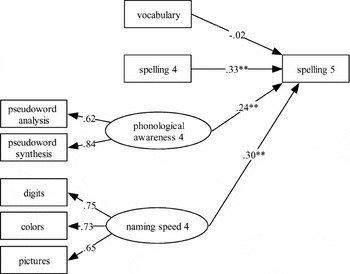
Finally, in Figure 5, the prediction of the children's spelling skill at the end of Grade 2 using the independent variables assessed in the eighth month of Grade 1 as the predictors and the spelling variable assessed in the ninth month of Grade 1 as an autoregressor is depicted.
The autoregressive model of children's spelling skill in the ninth month of Grade 2. **p < .01.

The most important predictor of the children's spelling skill is their previous spelling skill with highly significant contributions of naming speed and phonological awareness. The percentage of the variance in the dependent variable, explained by the independent variables, (R 2) is .44. The correlation between the phonological and naming speed factors is .25.
To summarize, phonological awareness and naming speed measured at an earlier point in time significantly predicted children's spelling in early Grade 1, end of Grade 1, and end of Grade 2. However, phonological awareness clearly predominated over naming speed for the prediction of the children's spelling in early Grade 1. The effects of phonological awareness and naming speed were found to be quite independent in relation to spelling. The fit of the five models was satisfactory.
CONCLUSIONS AND DISCUSSION
In the present longitudinal study, the relations of early phonological awareness and naming speed to children's later word spelling accuracy were examined. When measured on four different occasions, phonological awareness and naming speed were consistently found to explain distinct parts of the variance in children's later word spelling accuracy. Word spelling in early Grade 1 was predicted significantly by phonological awareness, naming speed, and kindergarten vocabulary. However, the regression coefficients for phonological awareness were very much higher than the coefficients for naming speed and vocabulary. In contrast, the children's word spelling accuracy at the end of Grade 1 was predicted equally by phonological awareness and naming speed in early Grade 1. The same was found for the effects of phonological awareness and naming speed from late Grade 1 on children's word spelling accuracy at the end of Grade 2. Naming speed and phonological awareness correlated low to moderately in all of the analyses.
The present results are in agreement with the results of Savage et al. (Reference Savage, Frederickson, Goodwin, Patni, Smith and Tuersley2005), Savage and Frederickson (Reference Savage and Frederickson2006), Sunseth (Reference Sunseth2000), Sunseth and Bowers (Reference Sunseth and Bowers2002), and Wimmer et al. (Reference Wimmer, Mayringer and Landerl2000). In all of these studies, however, the children were in Grade 3. Only the study by Wimmer et al. (Reference Wimmer, Mayringer and Landerl2000) was longitudinal and concerned a relatively consistent orthography as in our study. The present results extend those of Wimmer et al. (Reference Wimmer, Mayringer and Landerl2000) on the following fronts. First, children reading and spelling normally were investigated in the present study, whereas Wimmer et al. (Reference Wimmer, Mayringer and Landerl2000) investigated children with a phonological deficit and/or NSD. Second, the independent variables in the present study were measured on four occasions as opposed to just one occasion, and the dependent variables were measured on three occasions in the present study as opposed to just one occasion as in the study by Wimmer et al. (Reference Wimmer, Mayringer and Landerl2000). Third, phonological awareness was measured using two or three different tests in the present study, and naming speed was always measured using three different tests, whereas Wimmer et al. (Reference Wimmer, Mayringer and Landerl2000) used only one test in both cases. Fourth and finally, we measured word spelling accuracy in Grades 1 and 2, whereas Wimmer et al. (Reference Wimmer, Mayringer and Landerl2000) measured word spelling accuracy in Grade 3.
In our interpretation of the theory of Perfetti (Reference Perfetti, Perfetti, Rieben and Fayol1997), the finding that word spelling accuracy at the ends of Grades 1 and 2 was equally predicted by children's earlier phonemic awareness and naming speed, means that the children's underlying orthographic representations are not complete enough or sufficiently bonded to the phonologic representation to predict uniquely the scores on standardized dictation tests. Phonological representations must still be called upon to activate by phonemes missing or weakly bonded graphemes in the orthographic representation. In this interpretation, naming speed, as a correlate of the speed and accuracy of accessing the orthographic representation (see introductory section) and phonemic awareness can thus relate to the accuracy of children's spelling. The building of orthographic representations appears to start early, in that children's naming speed and phonemic awareness both predict the accuracy of their word spelling after 3 months of spelling instruction, although phonemic awareness, as already noted, initially predominates over naming speed in the prediction of the accuracy of the children's early word spelling.
In contrast to the accuracy of children's word spelling at the ends of Grades 1 and 2, the speed of their word recognition at the ends of Grades 1 and 2 was found in an earlier study using the same data set as in the present study to be predicted uniquely by earlier naming speed (Verhagen et al., Reference Verhagen, Aarnoutse and Van Leeuwe2008). Phonologic awareness, as expected, related longer to word spelling accuracy than to word recognition speed.
Although this study is mainly about word spelling accuracy, we tried to extend our study by comparing the relations of naming speed and phonologic awareness with word spelling accuracy, with those relations for word recognition speed in an earlier, similar study. To make such a comparison possible we combined in an interpretation the theories of Perfetti (Reference Perfetti, Perfetti, Rieben and Fayol1997) and Van den Bos (Reference Van Den Bos2008). From this interpretation we argued that word-holistic features, as measured by naming speed, can be expected to facilitate fast and accurate access of underlying orthographic representations during word recognition. When word-holistic features are used to facilitate word recognition, the reader can skip one or more letters and still read the right word, which is in contrast to what can be done for spelling purposes. For spelling it is not possible to compensate for incomplete and/or weak underlying orthographic representations using whole-word features via printed text. Phonological information must be used to compensate the relative poor quality of the orthographic representation in early word spelling. Word recognition and word spelling accuracy are nevertheless the same in that they both rely upon the same underlying lexical representation but make different demands upon the underlying lexical representation. Within the context of the present study and an earlier one (Verhagen et al., Reference Verhagen, Aarnoutse and Van Leeuwe2008) naming speed appears to predict the speed and accuracy with which a child can access underlying orthographic representations for both word recognition and word spelling accuracy purposes. This definition of naming speed comes close to that provided by Wolf and Bowers (Reference Wolf and Bowers1999).
Several questions remain unanswered. For example, the question of whether naming speed and phonemic awareness constitute independent variables has yet to be answered. The two variables correlated with each other to a low/moderate extent in the present study. This means that the question of independence cannot be answered with a simple “yes” or “no.” In addition, we could not verify the expectation that naming speed measures the speed of accessing the orthographic representation in spelling. Another question that remains to be answered is which words in the first grades of elementary school require compensation for incomplete and/or weakly bonded orthographic representations to their phonological representations. We assumed that the words from standardized dictation tests may require compensation for spelling purposes. However, such compensation may not be needed for the spelling of simple words, which are found on dictation tests. Good spelling on a dictation test may, moreover, be neither a guarantee nor a reflection of good spelling for entire texts or pieces of text. The results of the present study of word spelling accuracy should therefore not be extended to the spelling of texts, which may be less amenable to phonological compensation for incomplete or weak underlying orthographic representations and therefore more susceptible to error.
We have assumed that children's orthographic representations also convey word-holistic information that was not clearly mentioned in the theory of Perfetti (Reference Perfetti, Perfetti, Rieben and Fayol1997). However, if word-holistic features via printed words can compensate for incomplete and/or weakly bonded orthographic representations, than word-holistic features may be part of the orthographic representation, which may be used then in spelling also. A most important question is: which are those word-holistic features that word recognition speed and naming speed are assumed to have in common?
This present study has several possible limitations. For example, we did not measure the speed of word spelling for simple words on the dictation task. The children's spelling accuracy was also only measured using a single variable. We did not control for such other variables as short-term memory and attention capacity, although early spelling appears to be a unique predictor of later spelling (Savage et al., Reference Savage, Pillay and Melidona2008). In addition, Van den Bos (Reference Van Den Bos2008) formulated his theory about the relation of word-holistic (e.g, naming speed) and word-analytic variables with the development of word recognition speed for children's alphanumeric naming speed, but we measured a naming speed factor that was composed of naming speed for digits, colors, and pictures. For younger children, however, the difference between alphanumeric and nonalphanumeric naming speed has been found to play less of a role in the prediction of word recognition than for older children (Van den Bos, Zijlstras, & Spelberg, Reference Van Den Bos, Zijlstra and Spelberg2002; Wolf et al., Reference Wolf, Bally and Morris1986). Although the number of participants coming from the two schools was clearly satisfactory (N = 226), generalization of the present results to students in other schools or settings should be done with caution. Moreover, we used, inevitably we think, mainly theoretical and empirical studies in English orthography for the relative consistent Dutch orthography. Finally, the results of the present study are limited to Dutch orthography and more or less to other (relative) consistent orthographies.
The present findings in combination with the findings of our earlier study of children's word recognition (Verhagen et al., Reference Verhagen, Aarnoutse and Van Leeuwe2008) show that new insights and new questions can be formulated by studying the relations between children's naming speed and phonological awareness and both the accuracy of their word spelling and the speed of their word recognition. Future studies into the longitudinal development of literacy should include the speed of word spelling and the accuracy of word recognition as well. Research should also examine the relations between the speed of word recognition and naming speed using the techniques of Rayner et al. (Reference Rayner, Juhasz, Pollatsek, Snowling and Hulme2005) to highlight the role of word-holistic features in particular. It is possible, for example, that greater similarities will appear with regard to the components of word recognition speed and naming speed. For the studies of spelling eye movement studies can tell something about the eye movements during and after the writing of a word.