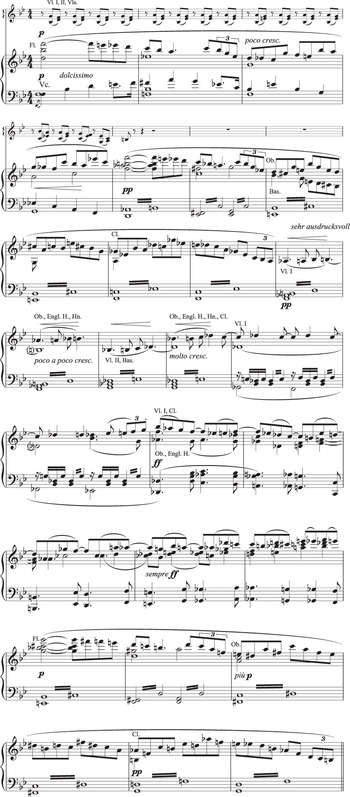
Perhaps Theodor Adorno had something like this passage from the beginning of Act II in mind when he upheld Wagner’s Tristan und Isolde as an exemplary instance of musical organicism (see Ex. 1). Melodic lines in the winds twist this way and that like so many fronds and tendrils, proliferating across the introduction with all the tenacity of a weed.Footnote 1 Elaborating upon the botanical metaphor in the essay ‘Vers une musique informelle’ (1961), Adorno remarked,
The minimal, as it were effortless, transition of semitone steps is regularly associated with the idea of growing plants, since it appears not to have been manufactured, but seems as if it were growing towards its final purpose without the intervention of the subject.
Richard Wagner, Tristan und Isolde, Act II, Prelude

In Adorno’s reading, organicism originates in the impression that music is self-generating, that it is invested with an entelechy not unlike that of a living being. Chromaticism, by enhancing the directedness of musical motion, only increases what Adorno referred to as ‘the semblance of the organic as mediated by this language’ – namely, the language of tonal music.Footnote 2
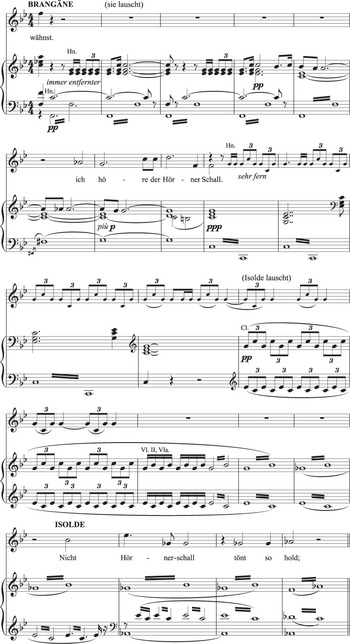
Yet music need not be highly chromatic to inspire thoughts of nonhuman forms of existence, a linkage deeply entangled with the discourse of organicism. The intricate motions of counterpoint put E.T.A. Hoffmann in mind of the ‘intertwining of mosses, weeds, and flowers’, while the musical enthusiasts depicted in his Kreisleriana hear the voices of ‘trees, flowers, animals, stones, water’ resounding in their favourite art.Footnote 3 Isolde too is drawn in by music’s apparent capacity to speak a nonhuman language. A few moments after the passage noted above, she and Brangäne argue over whether King Marke’s hunting party has retreated safely into the night – the sign that Tristan can make his approach. Brangäne distinctly hears the men’s horns, while Isolde hears only the sounds of the garden surrounding the two women – wind in the leaves, water in the fountain (Ex. 2). The orchestra’s music tracks the shift in Isolde’s perception.
Wagner, Tristan und Isolde, Act II, scene 1

Unable to hear what her mistress hears, Brangäne complains, ‘You are deluded by the wildness of your desire into hearing only what you choose to’.Footnote 4 In the wake of musicology’s attempt to purge its lingering Germanocentrism, one may be tempted to level the same accusation at proponents of organicism, who maintain that superior music develops in a manner redolent of the growth of plants.Footnote 5 As Lotte Thaler and Lothar Schmidt have recounted in studies of organicist discourse, critics and analysts such as Adolf Bernhard Marx, Eduard Hanslick and Heinrich Schenker advanced authoritative but unstable claims regarding what makes music organic, in hopes of establishing the superiority of formal principles exemplified by late eighteenth- and nineteenth-century Austro-German music, most of it (pace Wagner) instrumental.Footnote 6 Statements regarding the development of musical material out of a single seed and the reciprocity of parts and whole accrued rhetorical force despite the lack of consensus regarding their analytical demonstration.Footnote 7
Even worse, organicism today is commonly understood to entail distinctly regressive social and political values, thanks to its association with German nationalism and Idealist theories of the state.Footnote 8 In his provocative book The Ecological Thought, Timothy Morton claims that organicism does the ‘heavy lifting for homophobic Nature’, meaning that its apparent emphasis on autonomy, boundedness and internal versus external determination recapitulates a corrosive brand of heterosexual masculinity.Footnote 9 Yet if what is thought to constitute musical organicism varies with contemporary notions concerning organisms in general, as Thaler concludes at the end of her study, then perhaps it is time to take a different view of organicism’s shortcomings.Footnote 10 What if the problem is not with the thesis that certain musical processes create a semblance of the organic, but with the models of the organism brought in to give content to that semblance?
Nineteenth- and twentieth-century organicists favoured analogies between music and either human beings or plants. How might the significance of such analogies change in the face of biological research on plant cognition (summarized by Michael Pollan in a recent article for The New Yorker) and philosophical attributions of ‘mind’ to the simplest organic beings?Footnote 11 Or in the wake of appreciating the multiplicity of the human? Philosopher Michael Marder alleges that
The human body and subjectivity alike are not pure expressions of Spirit but strange archives, surfaces of inscription for the vestiges of the inorganic world, of plant growth, and of animality – all of which survive and lead a clandestine afterlife in us, as us.Footnote 12
Discerning the human in the plant and the plant in the human clears the ground for a post-humanist organicism that dispenses with humanism’s androcentric conceits and prompts creative reflection on the points of connection between musical and organic processes.Footnote 13
With these aims in mind, this essay critiques the conventional appeals to wholeness and end-oriented development usually associated with organicism before considering aspects of the Western musical tradition through the twin lenses of self-organization and the systems theory of German sociologist Niklas Luhmann.Footnote 14 In Luhmann’s theory, the self-reproduction of social systems is sustained by recursive networking among many different nodes of the system, which in music’s case include musical works, publishers and record companies, performing ensembles and venues, criticism and scholarship. The networks that result are both the outcome and the conditions of possibility for music’s status as a modern (meaning decentralized, self-regulating, and self-perpetuating) social system – a status whose attainment began around the end of the eighteenth century. By drawing attention to processes of self-organization and self-generation shared by living and non-living systems, Luhmann’s work opens up a vantage point from which human artefacts and cultural trends exhibit formal tendencies not unlike those witnessed in the natural world. Exploring such similarities broadens the scope of terms like ‘system’ and ‘network’ beyond the human technologies they tend to evoke. Indeed, tantalizing new research on forest ecology challenges the metaphorical supremacy by which the natural world is viewed through the lens of technology and expected to conform to the limitations of human understanding. Pollan describes how trees exchange chemical signals and life-giving resources by way of an underground network of mycorrhizal fungi – a kind of ‘wood-wide web’.Footnote 15 Reversing commonplace assumptions regarding which creatures are the most highly evolved, biologist Stefano Mancuso states that plants, not humans, are ‘the great symbol of modernity’. Plants, in short, help us to imagine a ‘future that will be organized around systems and technologies that are networked, decentralized, modular, reiterated, redundant – and green’.Footnote 16
Such views resonate with my own forward-looking but conservation-minded approach. That is, I wish to conserve affinities between music and the vegetal kingdom intuited by early nineteenth-century listeners while transposing organicism into a register more in keeping with contemporary scientific and philosophical thought. My goal is not to provide a definitive explanation of what makes music organic but to offer a fresh account of the musical features and philosophical outlooks that contributed to the critical turn toward organic metaphors in the years around 1800. This account is inescapably bound up with stylistic features of European instrumental music in the late eighteenth and early nineteenth centuries; however, I believe that music’s ability to create impressions of more-than-human vitality in the minds and bodies of its listeners is not the privilege of any particular style or tradition. By adding new nodes and lines of connection to a critical network established over two centuries ago, this article demonstrates that the legacy of organicism challenges us to think anew about what our bodies, our sociality, and our creativity share with other living entities and the ecologies in which they are enmeshed.
The Paradox of Part and Whole
What does it take to hear music, with Adorno, ‘as if it were growing towards its final purpose without the intervention of the subject’? The philosopher did not offer much explanation apart from the sense of forward motion generated by chromaticism.Footnote 17 In the twentieth century, Adorno thought, musicians had lost the ability, and more importantly the desire, to conceal their inherited materials behind a façade of inevitability. Those materials were now too stereotyped, too reified to sustain the illusion of naturalistic growth and development. Although Tristan und Isolde’s idiom of plant-like proliferation was a thing of the past, composers could nonetheless strive to mimic organic modes of organization. ‘Art as an organized object’, Adorno explained,
quite literally resembles the organism in the relationship which obtains between the parts and the whole. But with the growing similarity to the living organism, it gradually distances itself from the artefact which, after all, it must remain. The virtually total organization, in which every feature serves the whole and the whole on its side is constituted as the sum of the parts, points to an ideal which cannot be that of a work of art – that is to say, the ideal of a self-contained thing in itself.Footnote 18
If artworks cannot achieve this ideal, it is not, as we shall see, because such pristine self-containment characterizes organisms rather than human artefacts. Adorno’s conviction that organisms are distinguished by a special kind of relationship between parts and whole nevertheless had an illustrious history. In the Critique of Judgment, Kant defined the organism as a ‘natural purpose’, by which he meant a self-maintaining entity whose existence cannot be traced to some external intention or end.Footnote 19 He explicated the point with reference to trees, which propagate via reproduction and grow by dint of an internally driven process that converts nutrients into bodily matter. A mechanical watch, by contrast, does not generate the materials out of which it is constructed, and it is created to serve a purpose devised by an external agent (its designer). In a tree, parts and whole are interconnected such that ‘the maintenance of any one part depends reciprocally on the maintenance of the rest’.Footnote 20 This idea gives rise to the principle adopted by so many later commentators – namely, that an organism’s (or artwork’s) ‘parts should so combine in the unity of a whole that they are reciprocally cause and effect of each other’s form’. ‘Every part’, Kant continued, ‘not only exists by means of the other parts, but is thought as existing for the sake of the others and the whole’. Such a being is both ‘organized and self-organizing’, a formula that succinctly captures the complementary homeostatic and processual dimensions of organisms.Footnote 21
Something is amiss in Kant’s discussion, however, as anyone who has done some pruning around the yard or watched leaves fall from trees might suspect. Trees and other plants clearly lose parts without any threat to the whole. Kant’s elucidation of organic wholeness is doubly strange in that it refers to the practice of grafting, which combines different organisms in a manner that confounds any easy conceptualization of the relationship between part and whole. ‘A bud of one tree engrafted on the twig of another’, he wrote,
produces in the alien stock a plant of its own kind, and so also a scion engrafted on a foreign stem. Hence we may regard each twig or leaf of the same tree as merely engrafted or inoculated into it, and so as an independent tree attached to another and parasitically nourished by it.Footnote 22
Under such conditions, the ‘unity of a whole’ becomes distinctly multiple. Even Goethe, in his capacity as a botanist, couldn’t remain satisfied with the idea. In an early remark on morphology (c. 1795), he claimed, ‘The most perfect organism appears before us as a unified whole, discrete from all other beings’.Footnote 23 A decade of botanical studies was enough to overturn his earlier judgment: ‘No living thing is unitary in nature; every such thing is a plurality. Even the organism which appears to us as individual exists as a collection of independent living entities’.Footnote 24 Indeed, today it would be quite reductive to draw the boundaries of the human in a way that excluded the colonies of bacteria living symbiotically inside and upon it, or to isolate plants from the fungi which help roots absorb nutrients. As Donna Haraway colourfully puts it, ‘Organisms are ecosystems of genomes, consortia, communities, partly digested dinners, mortal boundary formations’.Footnote 25
Strangely enough, the mutability of plants aroused a certain suspicion regarding their credentials as organisms. Hegel’s Philosophy of Nature (1830), for example, initially followed Kant by defining the organism as a ‘totality of articulated members, so that each member is reciprocally end and means, maintains itself through the other members and in opposition to them’. But Hegel held that this relational ‘process’ results in a ‘simple, immediate feeling of self’ unavailable to plants.Footnote 26 Overturning Kant’s selection of the tree as the supreme embodiment of part–whole synthesis, Hegel reserved the status of organism for animals. Plants, in his view, did not display enough differentiation among parts to achieve the animal’s ‘higher’ totality. Recapitulating the argument of Goethe’s The Metamorphosis of Plants (1790), Hegel wrote that in plants, ‘the difference of the organic parts is only a superficial metamorphosis and one part can easily assume the function of the other’.Footnote 27 Whereas for Kant, the parts of plants were so independent as to be nearly separate entities, for Hegel they were not independent enough. Moreover, plants were too entangled with the elements of light, water and soil to develop a dialectical sense of self. Hegel concluded that ‘the plant is drawn towards the outer world but without truly preserving itself in connection with what is other’.Footnote 28 He thus disqualified plants from serving as a model for organic form based on autonomy and part–whole integration.
These philosophical disputes help to illustrate that what music critics took to be organic depended on what kind of organisms they looked to for inspiration (and how those organisms were understood at the time). Accordingly, aesthetic organicism in the early nineteenth century was less a coherent philosophy than a set of loosely related images, most of them botanical.Footnote 29 It emerged as critics appropriated new scientific language that sought to redress the failure of mechanistic philosophy to explain the purposeful organization and intentional activity of organisms.Footnote 30 While plants offered an attractive paradigm for continuous growth, blossoming and fruition, animals seemed better candidates for part–whole integration. These two aspects of organisms form an uneasy pair, in that one emphasizes transformation while the other is largely concerned with static organization (namely, the functional distribution and operation of discrete organs within single organisms). Adorno tried to have it both ways when he recommended that composers pursue an ‘organic ideal’ grounded in the ‘concrete process of a growing unity of parts and whole’, as if a musical work were some kind of plant–animal hybrid or, perhaps, an embryo.Footnote 31
Not surprisingly, early attempts to define music’s organic qualities had trouble reconciling the competing imperatives of persistent growth and overall unity. In his famous review of Beethoven’s Fifth Symphony (1810), Hoffmann contended,
Just as our aesthetic judges have often complained of a complete lack of real unity and inner coherence in Shakespeare, when only a deeper look shows the splendid tree, buds and leaves, blossom and fruit as springing from the same seed, so only a very deep penetration of the inner structure of Beethoven’s music can reveal the master’s high level of reflection, which is inseparable from true genius and nourished by continuing study of the art.Footnote 32
Hoffmann’s conceptual struggle here is almost tangible, in that he refers to the tree’s singular origin – something no longer present to perception – in order to bind its various phases of growth into a unity. The image does not translate very well to the musical sphere. Hoffmann tried to force the Fifth Symphony’s superabundance of musical ideas under the rubric of unity by proposing an essence common to them all – namely, their shared origin in a vaguely conceived ‘seed’. Yet he admitted that this seed could not be simply equated with the symphony’s opening motive, and his special pleading on behalf of the symphony’s organic integration fell considerably short of the mark.Footnote 33
Eduard Hanslick’s treatise On the Musically Beautiful (1854) picked up on Hoffmann’s image, claiming that a musical composition ‘develops itself in organically distinct gradations, like sumptuous blossoming from a bud’. ‘This bud’, Hanslick continued, ‘is the principle theme … Everything in the structure is a spontaneous continuation and consequence of the theme, conditioned and shaped by it, controlled and fulfilled by it’.Footnote 34 Evidently, Hanslick was hoping to capture the sense of rightness or necessity he experienced in good musical development – the sense that each passage of music grows naturally out of something that came before. But rather than explaining how the impression of unity arises out of such a resolutely temporal process, Hanslick merely evaded the problem by granting exaggerated powers of control to a single theme. Indeed, as his treatise soon makes clear, Hanslick’s notion of development was modelled not so much on organic growth – his example of the single bud considered apart from both parent plant and environment is highly artificial – as on the steps of a logical argument.Footnote 35
Yet does such necessity really characterize the lives of organisms? Marder’s philosophy of ‘plant-thinking’ renounces the deterministic, end-oriented conception of plant development upon which Hanslick’s comparison was based. Responding to Hegel’s unease over the plant’s ‘endless growth outwards’, Marder notes that botanical ‘bad infinity’ challenges the presumptions of traditional philosophy by thwarting completion and closure.Footnote 36 The sheer proliferation of plants, their production of many more seeds than can ever take root, means that the orderly sequence of germination, budding, blossoming and bearing fruit, so often invoked to make sense of human endeavours, is realized in only a fraction of cases. Even though plants are often treated as exemplars of a purely internal process of growth, Marder highlights that growth’s ‘hetero-temporality’, namely, its dependence on external factors such as weather conditions or human manipulation through the use of fertilizers, chemical ripening agents and other such tactics.Footnote 37 Marder’s analysis reminds us that the autonomy of organisms must be understood in relation to their environments – a point to which I will return.
Part of the challenge facing any would-be organicist discourse is that concepts such as totality, unity and wholeness are much easier to conceive as static achievements than as ongoing processes. Nevertheless, the organization of living beings, and accordingly their wholeness, is not like that of a well-organized desktop or piece of machinery. The wholeness of organisms is continually in the process of being produced, and it is not, as Adorno indicated, merely the sum of discrete parts. In a recent study of the emergence of mind, Terrence Deacon praises Kant for recognizing that intrinsic finality (orientation to an end) and the capacity for self-formation are essential features of organisms.Footnote 38 But Deacon argues that the conventional image of organisms as wholes composed of parts is too simplistic. This image, he maintains, applies more readily to machines than it does to organisms.Footnote 39 That is, machines have distinct parts that are engineered separately and then assembled, whereas the ‘parts’ of organisms, which develop through the multiplication and differentiation of cellular material, are not self-contained, independent units (despite Kant’s intimations to the contrary). Deacon suggests instead that organisms are made up of processes that together serve the purpose of self-maintenance, a conception that better suits phenomena like a tree’s shedding of leaves in autumn.Footnote 40 Organisms, from this perspective, are ‘(w)holes’, because the purpose to which they are oriented – the maintenance of life – is not something achieved once and for all, nor is it literally present in their physical substrate. This purpose is an end, but it is an end that forestalls the end. It is therefore misleading to refer, as Adorno did, to the final purpose of growth. Similarly, the purposive character of a musical work is expressed in its sounding, not in its coming to a close. Works of music, no less than organisms, demand to be understood in relation to what philosopher Evan Thompson calls the ‘dynamic co-emergence’ of parts and whole in complex systems.Footnote 41
One critic who seemed to appreciate this demand was Christian Friedrich Michaelis. In his 1806 meditation on the nature of music, Michaelis asserted that the ‘raw stuff’ of tones and melodies could not simply be placed next to one another to make music. The musical art resides in form, which involves the ‘demarcation and combination’ (Begränzung und Vereinigung) of raw materials. In Michaelis’s words,
Mechanical composition still does not yield an art form. For that organization is necessary; that is, the tones must enter into functional, reciprocal relations with each other, must exactly suit and agree with one another. Gradation, accentuation, the division of time, rhythm and proportion in the combination and progression of intervals lend the tones organic form.Footnote 42
Michaelis’s emphasis on organization and reciprocity shows him to be a careful reader of Kant. But Goethe’s botanical studies also seem to be lurking in his description of music as ‘change, variation, origination, growth, diminishing, fading away’.Footnote 43 Michaelis realized that temporality – the dynamism of music – had to figure into accounts of the ‘reciprocal’ organization of musical elements. What is more, he understood that a reductive approach – decomposing a piece into its building blocks – could never account for music as a perceptual experience. The listener’s imagination, Michaelis proposed, shapes music’s ‘organic constituents’ into a whole.Footnote 44 To illustrate this point, think of the recognition of a melody, a feat that has given phenomenologists food for thought for over a century.Footnote 45 After the first few notes, one begins to hear a continuous shape, and the moment when that shape ‘clicks’ reflects back on and draws together notes already heard.Footnote 46 Another moment passes, and the composition of the melodic present – a present that includes generous helpings of past and future – has already changed. While a score might display melody as a finished product, during the time of its performance a melody is more holistic – more ‘(w)hole’ – than whole.
Michaelis’s discussion points to the phenomenon of emergence in music, whereby, as Albert S. Bregman states, ‘properties of musical sound … emerge from perceptual integration of acoustic components over time and across the spectrum’.Footnote 47 The fundamental involvement of a perceiver in musical emergence – of what Michaelis called the listener’s ‘imagination and inner receptivity’ – suggests that his composer-centric concept of organization needs to be complemented with a notion of self-organization encompassing both musical works and individual acts of listening and performance.Footnote 48 Broadly speaking, self-organization is a dynamic process of pattern formation that occurs in both living and non-living systems.Footnote 49 Rather than describing the intentional activities of a discrete self, self-organization refers to the emergence of global forms out of local interactions among elements, similar to the way melody as a perceptual gestalt emerges out of local interactions among tones. Phenomena such as the V-shaped formations of flying geese, the repeating hexagons of a honeycomb, and the collective signalling of fireflies all result from processes that self-organize. Patterns in organisms, such the stripes on a zebra or the regular number of petals on a species of flower, are increasingly being understood as the result of self-organizing stages of growth and development rather than as the mere execution of a genetic program.
The sheer abundance of musical patterns – many of which are based on the recurrence of self-similar gestalts, a phenomenon often witnessed in the natural world – points to complex and largely unexplored processes of self-organization in musical activity, whose parameters include not just the intentions of composers and performers but the constraints of particular tonal and modal systems, the periodic rhythms of organic processes and bodily motions, the material construction of instruments, and the deep history of human physical and mental aptitudes.Footnote 50 The history of music – of developments in modal, metrical, tonal, formal and rhythmic organization – might profitably be rewritten from the standpoint of self-organization in cultural domains. This is not to say that cultural production assumes forms that can be reduced to those found in nonhuman settings. Rather, it is to explore how form-creating tendencies straddle inorganic, organic and human domains, and to ponder how aspects of the former are redeployed within the emergent settings of the latter.Footnote 51 While the challenges to such an approach are many, Luhmann has suggested that one path forward lies in viewing human cognitive development, for instance the way a child learns language, as arising from self-organization among coupled systems.Footnote 52 Eugene Narmour makes a similar argument with respect to how listeners become acculturated in a musical style.Footnote 53 Style is a ‘replication of patterning’, in Leonard Meyer’s words, and patterning informs music at multiple levels and in diverse dimensions: those of pulse, meter and scale; of intervallic collections, harmonic progressions and formal plans; of rhythmic and melodic motives, themes and conventions.Footnote 54
Strictly speaking, a performance of notated music does not qualify as self-organizing, since the score provides a top-down blueprint (if not a fully determinate one) for music’s patterned sounds.Footnote 55 Yet from an acculturated listener’s perspective, music unfolding in real time might justifiably be described as a dynamic process of pattern formation whose continuously shifting gestalts are not simply ‘caused’ by an external agent or agents (say, the performer, score, or composer) but emerge in a fashion peculiar to the musical art. The patterning of musical sounds gives rise not simply to abstract forms but to sonic analogues of gesture, movement and affect – analogues general enough to suggest forms of animation that overstep the boundaries of the human. The liveliness of music should be traced not simply to the vibratory force of what Michaelis called its ‘organic constituents’ (rhythmic and melodic motives, themes, and the like) but to the self-organization in which those constituents engage in so far as they create emergent auditory phenomena.
Organicism might be understood as an amplification of music’s emergent character such that gestalts like motives and themes appear to exceed their local contexts and become generative of form on larger scales. In other words, organicism names a musical organization that aspires to the condition of self-organization – to a self-determining formal patterning that ranges from the smallest motives to the shape of entire movements. Yet music’s self-organization must not appear to be like that of a non-sentient thing (such as a whirlpool); music that creates a ‘semblance of the organic’ must seem to engage in spontaneous and adaptive (even intentional) behaviours – even though those behaviours have been largely planned out in advance. Such music imitates not the look or sounds of nature but the mode of being of Kant’s organism as an ‘organized and self-organizing being’ that is ‘both cause and effect of itself’.Footnote 56 The locus of imitation shifts, as Mark Evan Bonds phrases it, from the products to the process of creation.Footnote 57 The next section turns to Luhmann’s social systems theory in order to clarify how musical works came to be understood as exhibiting a dynamics of self-generation similar to, if distinct from, that exemplified by living things.
Music Observing Itself
As his advocates frequently lament, Luhmann has received a less than enthusiastic reception among English-speakers, due to not only the abstractness and sheer volume of his writings but also what is taken to be his anti-humanist outlook.Footnote 58 His theory of social systems nonetheless offers a provocative alternative to standard notions of organic wholeness. Inspired by the cognitive biology of Humberto Maturana and Francisco Varela, Luhmann replaced the principle of part–whole integration with multiple system–environment relations.Footnote 59 For example, although the practice of dissection promoted a view of organic bodies as assemblages of separable parts, each so-called part of the body is a meeting place for interconnected but functionally independent systems – circulatory, nervous, immune, lymphatic, and so on. These systems are operationally closed in the sense that the pulmonary system cannot assume the function of the circulatory system, yet they are also coupled so that, in this case, the lungs can supply the blood with oxygen. Human existence, argues Luhmann, arises from couplings between three types of systems: bodily, psychic and social. He writes,
A human being may appear to himself or to an observer as a unity, but he is not a system. And it is even less possible to form a system out of a collection of human beings. Such assumptions overlook the fact that the human being cannot even observe what occurs within him as physical, chemical, and living processes.Footnote 60
The systems that converge in human beings are not so much external to one another, as assemblage theory might have it, as highly constrained in the kinds of interactions of which they are capable.Footnote 61 To further complicate matters, Luhmann did not consider social systems to be objective realities; rather, they must always be defined from the standpoint of particular observers, who are themselves embedded in (and expressions of) multiple systems.
One of Luhmann’s signal innovations was to argue that social systems engage in the self-generating and self-regulating behaviours normally associated with living organisms. To indicate these properties, he borrowed the term autopoiesis, or self-creation, from Maturana and Varela.Footnote 62 Biological autopoiesis (as in, say, a single cell) requires self-sustaining chemical reactions, the self-production and maintenance of physical components, and the self-generation of a membrane protecting the interior of the organism from its environment.Footnote 63 In the case of social systems, the boundaries between system and environment are not material but operational in nature. Luhmann posited that modern societies differentiate themselves into autonomous systems (legal, economic, political, and so on) that can perturb or couple with one another but can never be fully coordinated or controlled by individuals, not even Presidents or Chairmen of the Federal Reserve. Instead, modern social systems are self-maintaining, a trait they share with biological and psychic systems. Luhmann’s theory therefore does not support visions of a social order whose parts are fully consistent with or transparent to one another. It does, however, support the analysis of ‘micro-social’ relations and their incremental impact on the reproduction of social systems, which takes place through recursive operations confined to each system’s distinct sphere.Footnote 64 In this context, recursion can be understood as an iterative but not strictly algorithmic process which produces novelty by referring back to and altering something previously manifested. For example, speech acts take place by referring to and building on prior speech acts. By ensuring that changes of state are dependent upon prior states, recursion drives both organic and non-organic autopoiesis. Jürgen Habermas concludes that Luhmann’s theory is ‘metabiological’ in that it represents ‘a thinking that starts from the ‘for itself’ of organic life and goes behind it – [to] the cybernetically described, basic phenomenon of the self-maintenance of self-relating systems in the face of hyper-complex environments’.Footnote 65
Music, like the other arts in Luhmann’s theory, is a subsystem of the social system of communication. While the existence of music depends on the couplings it establishes with other systems – not least, the musicking minds and bodies of human beings – its systemic character resides in the musical sounds exchanged among composers, performers and listeners.Footnote 66 As Luhmann remarks, ‘artistic communication could never come about without society, without consciousness, without life or material. But in order to determine how the autopoiesis of art is possible, one must observe the art system and treat everything else as environment’.Footnote 67
Luhmann viewed modernity as the displacement of hierarchical social arrangements, or ‘stratification’, by a congeries of functionally independent social systems, a transformation that began in the Renaissance and culminated in the late eighteenth century. Glossing Luhmann’s conception of art history, Harro Müller writes, ‘In modernity, works of art are no longer regulated by rhetoric, rule-bound poetics, or various conceptions of mimesis … they are system/environment units within the system of art oriented toward innovation and yet also always involved in copying’ – copying, that is, from prior works in a fashion that supports the continued existence of the system.Footnote 68 Artistic evolution, from this perspective, consists of morphological changes brought about by the selection and variation of constructive elements deployed in artworks. As a system differentiated from religion or politics, art becomes, in Müller’s words, ‘autonomous’ and ‘independent’ in that it proceeds according to its own code (beautiful/ugly) and its own medium-specific operations.Footnote 69 Autonomy in this context measures a system’s self-referentiality, not its independence from society. ‘The concept of a self-referentially closed system’, Luhmann explains,
does not contradict the system’s openness to the environment. Instead, in the self-referential mode of operation, closure is a form of broadening possible environmental contacts; closure increases, by constituting elements more capable of being determined, the complexity of the environment that is possible for the system.Footnote 70
Luhmann’s theory sheds light on rising fortunes of instrumental music in the late eighteenth century, an idiom recognized at the time as the paragon of musical modernism.Footnote 71 What was new about the music of Haydn, Mozart and Beethoven was not its transcendence of the social, but the way that it undermined constraints imposed by ‘stratified’ artistic production – namely, the tethering of particular styles and genres to specific venues, such as the church or chamber – by threading together materials drawn from multiple generic and stylistic registers.Footnote 72 The stylistic diversity and semiotic density that resulted was supported by a mode of organization in which self-referential relationships within individual works multiplied, as if to compensate for the loss of the prosodic directives of a text or the dictates of functional use. These recursive relationships range from small-scale motivic recurrences to large-scale formal returns to playful manipulation of conventions. In such music, the connectivity (and effectivity) of musical operations becomes the explicit object of aesthetic interest and pleasure, as listeners learn to recognize and appreciate what James Webster refers to as the ‘novelty and originality’ of modern musical procedures.Footnote 73
The first movement of Haydn’s ‘Joke’ quartet (op. 33, no. 2) is a familiar example of music that features a high degree of recursion in its melodic and rhythmic discourse – music in which, as Luhmann might put it, ‘self-reference’ edges out ‘hetero-reference’ (these terms are roughly equivalent to ‘introversive’ and ‘extroversive’ semiosis).Footnote 74 Unlike, say, the strict recursion of a canon, the recursivity of late eighteenth-century music serves as the basis for the ‘self-referential manipulation of form’, which Daniel Chua identifies as the sine qua non of musical autonomy.Footnote 75 Chua argues that this autonomy is not just that of a ‘self-regulating system’; in his view, plenty of Baroque music exhibits operational self-referentiality. Instead, he proposes, the autonomy of a piece like the ‘Joke’ quartet consists in the knowingness the music displays toward its own operations. Another way to put this in the language of systems theory is that late eighteenth-century music accedes to the level of ‘second-order observation’ by appearing to observe its own observation (which means selection and variation) of prior artistic decisions, a shift that helps to account for the self-consciousness commentators routinely ascribe to this repertory.Footnote 76 For Chua, works of music conceived under this ironic regime ‘are not organic structures, but structures that try to see themselves as organic’.Footnote 77 If this is so, it is also true that listeners are meant to hear the music in the same way – as analogous to a living thing.
The trick appears to have worked. The music that inspired the first organicist descriptions is just that music which exhibits the recursivity, self-referentiality and second-order observation Luhmann attributed to the functionally differentiated system of art in modernity. In other words, late eighteenth-century instrumental music arose out of a larger process of functional differentiation while also recapitulating that process in the aesthetic dimension. Individual works redoubled their conditions of possibility so that they themselves, and not just the larger communication system from which they emerged, acquired system-like properties. The more a piece of music moves forward by referring back to and elaborating material already presented, remaking formal expectations along the way, the more it seems to enact in real time the ‘self-generating and self-reproducing’ operations of a dynamic system.Footnote 78 At the same time, Thompson’s remark that any system must be defined in relation to how ‘some observer sees and conceptualizes things’ reminds us that apprehending a musical work as a system characterized by the dynamic co-emergence of parts and whole is the act of an observer who, like the music she listens to, is embedded in social and aesthetic environments that shape expectations regarding the connectivity of musical operations.Footnote 79 In this way, music’s ‘semblance of the organic’ depends not only on the internal recursiveness of individual works but also on relationships between those works, the musical environment(s) in which they thrive, and the observers to whom they are addressed.
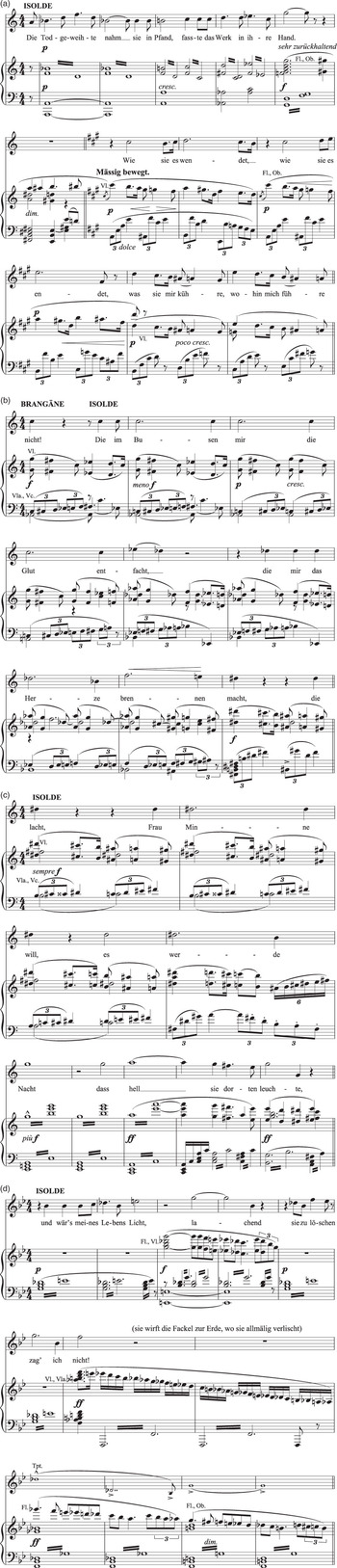
Consider once again Act II, scene 1 of Tristan und Isolde, whose music is punctuated not only by recurring leitmotivs but also by occasional reminders of music to which the opera relates and against which it distinguishes itself. For example, Isolde’s penultimate retort to Brangäne calls to mind the quickening tempo of a cabaletta (Ex. 3a), while her final words to her maid begin with something very much like the Ring’s so-called ‘Flight’ motive sounding in the orchestra (Ex. 3b). Isolde’s ode to the goddess of love culminates in a climax reminiscent of Sieglinde’s ‘O hehrstes Wunder’ from Die Walküre (Ex. 3c), and the clamorous peroration that closes the scene features a trumpet line suspiciously similar to the tetralogy’s ‘Curse’ motive (Ex. 3d). While traditional organicism might see such moments as a threat to the autonomy of individual works, an organicism informed by systems theory would interpret them as traces of the autopoiesis of the music system. Such moments, in short, complement a work’s recursive relationships with recursiveness vis-à-vis other music. Indeed, what Luhmann called the ‘self-programming’ artwork must establish some such relationships if it is to remake the forms it inherits from tradition.Footnote 80
Wagner, Tristan und Isolde, Act II, scene 1

Ultimately, then, Adorno’s remark in ‘Vers une musique informelle’ that modern music strives to realize an organic ‘ideal of a self-contained thing in itself’ overlooks the fact that every organism requires an environment in order to survive, and that the environment of an artwork includes not only other works but also observers. As Luhmann explains in Art as a Social System,
the artwork … only comes into being by virtue of its recursive networking with other works of art, with widely distributed verbal communications about art, with technically reproducible copies, exhibitions, museums, theaters, buildings, and so forth … A work of art without other works is as impossible as an isolated communication without further communications.Footnote 81
Although every modern artwork is subject to such conditions, the repertoire that concerned Adorno strove after composition sui generis by attempting to create musical sense out of piece-specific ‘contextual’ relationships. Adorno thought the continuous transformation of musical material in Schoenberg’s atonal works was enough to secure their organic status, but the troubled reception of those works suggests that defining organicism solely in terms of internal relations is insufficient. If music is indeed an ‘expression of life’, as Wagner once wrote, then its uncanny ability to suggest the animation of ‘trees, flowers, animals’ and humans needs to be conceived in equally holistic terms.Footnote 82 Music’s relationship to the other members of Hoffmann’s expansive list – stones and water – remains a question for another essay.