Assessing a ‘legacy’
Throughout the decade from 2010, austerity’s amorphous qualities and empirical imprecision have made it possible to point to the resilience of welfare states and the over-statement of austerity, especially beyond the UK. In its early stages, van Kersbergen et al. (Reference van Kersbergen, Vis and Hemerijck2014) argued that austerity was not the ‘only game in town’, while Eurofound (2016: 10) optimistically pointed to declining losses in jobs in public administration 2013 to 2015 as ‘reflecting an end to public sector budget cuts (or ‘austerity’) in many countries’. The existence of contemporaneous stimulus measures (for example, tax cuts, investment in infrastructure and so-called ‘social’ investment) also provided evidence to support the resilience arguments. More recently, two UK Chancellors of the Exchequer signalled the end of austerity in their Autumn budget statements in 2018 and 2019 and the Financial Times (2019) reported that other European countries were ‘turning on the spending taps as austerity comes to an end’.
And so the debate continues as to whether increased public spending signifies the end of austerity. Within this debate, however, austerity is reduced to a simple mechanism as though its presence produces an effect and its absence removes it. Public critique of government ‘end of austerity’ promises focuses largely on the remaining gap between pre-crisis spending and future pledges which fail to reach these levels, match inflation or demographic change. Not only does the promise of increases in some spending fail to end austerity, but co-incidental ‘stimulus’ promises for tax cuts (for higher earners) in the 2019 budgets of, for example, the UK and Australia reduce revenue available for closing the gap. In the 2017 Tax and Jobs Act, the US cut corporation tax (from 35 per cent to 21 per cent), taking austerity a step further as the consequent negative impact on the US debt to GDP ratio includes budget plans estimated to cut public health insurance (Medicare and Medicaid) and social security by $1.9 trillion 2020-30 (Center for Public Integrity, 2019). As the Director of the UK’s Institute for Fiscal Studies observed in an analysis of party manifestos (Johnson, Reference Johnson2019), even where there are no further cuts, austerity is ‘baked in’ to future plans.
A focus on the economics of austerity therefore presents a fuzzy picture in determining its beginning and anticipated end, particularly where cross-national comparisons are applied. Austerity is more than a strategy to impose economic logic, however, and its heritage long pre-dates the 2008 crisis (Blyth, Reference Blyth2013). It is arguable therefore that even when associated specific policies are no longer in place, their residue will be left on social, political and economic life. This is the theme that is captured in ideas of ‘enduring’ austerity (Jessop, Reference Jessop, Farnsworth and Irving2015), the ‘embeddedness’ of cuts (Taylor-Gooby, Reference Taylor-Gooby2016) and the ‘legacy’ of significant economic and socio-political transformation. It is argued here that even if the last decade has simply been a ‘turbo-charged’ neoliberalism (Farnsworth and Irving, Reference Farnsworth and Irving2018; see also Farrall and Hay, Reference Farrall and Hay2014), austerity leaves its own particular legacy for the future conditions of welfare.
Reflecting on the impact of the 2008 crisis, there have been more (Streeck, Reference Streeck2017) or less (Gamble, Reference Gamble2016) pessimistic prognoses on the future political economy (of welfare). However, while these analyses assess the increasingly untenable pact between capitalism and democracy they do not specifically examine the long-term effects of austerity on welfare as a socio-political project. The politics and impact of austerity measures have been subject to much critical scrutiny (e.g. McBride and Evans, Reference McBride and Evans2017). At their most stark, research studies indicate that austerity results in death. Following Stuckler and Basu’s (Reference Stuckler and Basu2013) early international analysis of post-crisis austerity-driven failures in public health, disease prevention and employment-related mental health trends, studies continue to indicate ‘excess deaths’ due to under-funding of health and social care in England (Watkins et al., Reference Watkins, Wulaningsih, Da Zhou, Marshall, Sylianteng, Dela Rosa, Miguel, Raine, King and Maruthappu2017) and the negative global impact on health (Basu et al., Reference Basu, Carney and Kenworthy2017). Health services are not the only area of welfare provision to experience cuts and there is ample evidence that in countries where austerity measures have been most widespread and sustained, the quality and outcomes of public services have deteriorated (Ocampo and Stiglitz, Reference Ocampo and Stiglitz2018). The evidence is most revealing in those services which are not only the most residualised but are delivered to people with the least political voice, and in spending terms ‘discretionary’. With a focus on England, an austere exemplar, all indicators for homelessness, the treatment of children in the care system, service provision in the areas of mental health, addiction, learning disability, domestic violence, youth justice and community services more widely, point to rapid declines in resourcing and consequent unmet needs (Marmot et al., Reference Marmot, Allen, Boyce, Goldblatt and Morrison2020).
If a declared end to austerity were true it would leave governments in countries such as Greece, Italy, Ireland, Spain and the UK with much to be done in repairing the social and economic damage of a decade of cuts to public spending. Social and economic compensation through increased spending, however, is not a simple antidote to the decade of austerity, even were the spending to exceed the levels of the pre-crisis period. It is argued here that this is because the legacy of austerity extends far beyond public spending budgets, and that reparation measures are themselves impeded by its vestiges. The following section will summarise the framework of ‘Thatcher’s enduring legacy’ as discussed by Wilding (Reference Wilding1992). This is followed by presentation of a revised analytical framework through which the legacy of austerity is assessed.
Thatcher’s enduring legacy revisited
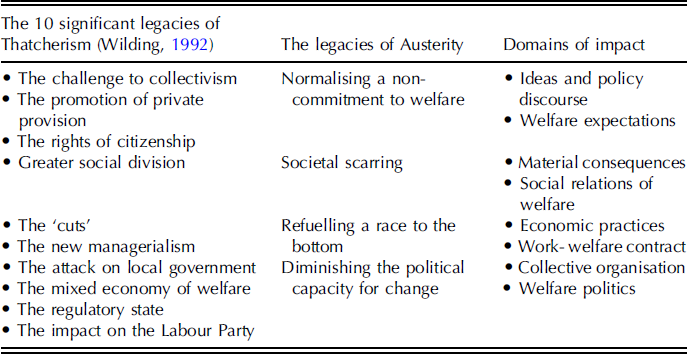
In 1992, Paul Wilding published ‘an exercise in analysis and prophecy’ (Wilding, Reference Wilding1992: 201) which laid out ten legacies that together represented ‘Thatcherism’s enduring legacy’ for the British welfare state. In this article he identified (in no specific order) a range of ideas, challenges, reforms, processes, effects and outcomes that had emerged incrementally during Thatcher’s eleven years as Prime Minister from 1979–90 which he detailed as constituting the most significant, or enduring changes to the welfare state. In 2020, with nearly three decades of hindsight it is clear that Wilding’s analysis was indeed a prescient assessment of the future conditions of the welfare state. The significance he attached to welfare pluralism – specifically, the decline of collectivist policy solutions and enduring shift to privatisation, marketisation and individualisation and the withdrawal of the state – has been borne out, as has demunicipalisation and the loss of power, control, status, and revenue-raising capacity of local authorities. At the level of welfare ideas, Wilding’s prediction that the rights of citizenship, as a ‘political artefact’ (Reference Wilding1992: 209), would be increasingly inimical to the aim of establishing the welfare consumer is also a now well-established battleground in social policy practice. It is also the case that the welfare ‘cuts’ he identifies, and the managerialist reforms to ensure that reductions in expenditure, efficiency savings and tighter restrictions on eligibility could be enforced have been institutionalised. In combination with the cuts, the pernicious effect of lack of trust (mainly in the non-state welfare providers) that he associates with the rise of the regulatory state has in fact fed into a more generalised lack of trust in institutions. Eurofound (2019: 12) observes that since its 2011 European Quality of Life Survey ‘the perceived quality of public services has consistently emerged as the most powerful determinant of trust in national institutions’.
Only for two of Wilding’s significant legacies, greater social division and the impact on the Labour Party, are the developments in subsequent decades less definitive. A position on their accuracy largely depends on judgement of the social policy achievements in tackling inequality of the Blair/Brown governments and the impact of Jeremy Corbyn’s leadership 2015-20. While Thatcher may have regarded ‘New Labour’ as her greatest achievement (Espiet-Kilty, Reference Espiet-Kilty2015), the picture is mixed in terms of socio-economic progress. The extent to which the Labour governments between 1997-2010 acted as a brake on a potentially rampant market fundamentalism and better protected capitalism’s losers is debatable (see Hills et al., Reference Hills, Sefton and Stewart2009). Up until the 2008 crisis, Wilding’s assessment that the Labour Party would unavoidably shift to the right and embrace the social market was correct. The post-crisis era has enabled a deeper challenge to free market fundamentals, however, and the (re)emergence of both socialist and populist/nativist political ‘answers’ in nations across the globe. Wilding’s argument that ‘supporters of state welfare will never look to collectivist answers with quite the same simple enthusiasm as before’ (1992: 202) is less convincing in this context, but it is partly the existence of austerity that has made it so. Similarly, regardless of possible mitigating effects of specific welfare gains that can be attributed to the Labour administrations in the UK, his assessment that increasing social divisions related to the labour market, race, income and wealth inequality and regional differences would be the inevitable result of Thatcher’s welfare legacy has been brought into sharp relief through the decade of austerity. This can be seen in increasing precarity in employment, a rise in recorded race-related hate crimes (Allen and Zayed, Reference Allen and Zayed2019), policy treatment of refugees, rapid dispersion of incomes and opportunities for wealth acquisition and the evidence that ‘the UK is indeed one of the most interregionally unequal countries in the industrialized world’ (McCann, Reference McCann2019: 1).
Ultimately, Wilding’s assessment of Thatcher’s legacy concludes with two core elements which can be located at the level of ideas and institutions respectively: the loss of unquestioning acceptance of conventional wisdom on the meaning and purpose of the welfare state, and the cumulative deposit of incremental reforms that successive governments (even antipathetic ones) would have neither political support nor policy energy to unpick.
With regard to both of these elements, it is arguable that the austerity project – and the means by which it has been implemented through austerity measures in the UK and elsewhere – is itself Thatcher’s legacy. ‘Thatcher’ in this sense is symbolic of neoliberal ascendance; and the heritage of austerity in neoliberal principles, objectives and discursive strategy is clearly recognisable (see Farnsworth and Irving, Reference Farnsworth and Irving2018). While there are key areas where austerity has provided continuity, sealed embeddedness and guaranteed the kind of irrevocable change that secures Thatcher’s legacy, it has at the same time produced enduring legacies of its own.
It is also important to recognise that Wilding’s assessment did not extend beyond the UK, and the consequences for the British welfare state. In the decades following his work the transmission of ‘Thatcherism’, the New right, Reaganomics and their parts in the global neoliberal turn has been widely interrogated (see, for example, Harvey, Reference Harvey2007). The absence of a legacy for Europe as a project and a policy sphere is also notable, when, as Espiet-Kilty (Reference Espiet-Kilty2015) notes, Euroscepticism is central to the Thatcher legacy and has claimed a victory in the exit of the UK from the European Union. In view of these benefits of hindsight, the following analysis is not limited to the UK and considers austerity as an international and global phenomenon. It must also be recognised that although austerity is a global phenomenon, in that it has left no country-level welfare discourse untouched, there are also significant differences in the extent to which states have embraced, accepted and resisted austerity measures (Farnsworth and Irving, Reference Farnsworth and Irving2012; Cantillon et al., Reference Cantillon, Chzhen, Handa and Nolan2017; Perez and Matsaganis, Reference Perez and Matsaganis2018).
The four legacies discussed below are also global in reach but variable in shape and impact. They encompass the ten legacies identified by Wilding, but for the purposes of this analysis are dealt with at a more abstract level to capture their global conditioning effects rather than their national character. Thus austerity’s legacies are condensed to four themes that represent significant change in the realms of ideas, societies, economies and politics as they pertain to social policy and the welfare state. While it is not possible to undertake detailed analysis of the legacies’ domains of impact they are indicated in Table 1 and illustrative evidence is discussed in the following sections.
The legacies of Thatcherism and austerity combined

The legacies of austerity
Normalising a non-commitment to welfare
At the level of ideas and in the vocabulary of Titmuss, austerity has normalised an ideological non-commitment to welfare through a revisionist, economically instrumental interpretation of social policy that disavows its integrative function and solidaristic aims. As Basu et al. (Reference Basu, Carney and Kenworthy2017) suggest, ‘Austerity is the original ‘alternative fact’’, which established the necessity (rather than the Thatcherite desire) of redirecting attention from distributive justice to the ‘burden’ of public debt, from the wider purpose of investment in public goods to the narrow reduction of ‘the deficit’ and profligacy in the public sector. The policy discourse of austerity sent a clear message that public expectations of what welfare states can or should do were unfounded and unsustainable. In this context, the ‘socially caused diswelfares’ (Titmuss, Reference Titmuss1968: 133) and the burdens on people of work (Gough, Reference Gough1979) for which the post-war welfare settlement had accounted (and which Thatcherism had rejected) have disappeared from policy discussion.
A non-commitment to welfare is experienced both directly through the material consequences of increasingly residualised provision, but also less tangibly through the absence of recognition of or concern for the need for the ‘welfare commons’ (Williams, Reference Williams, Irving, Fenger and Hudson2015), and more importantly the closure of routes and mechanisms to make claims for these parts of a policy agenda. The non-commitment to welfare is most obvious in the political ascendance of ethno-nationalism and xenophobia in advanced welfare states, even those such as Sweden which has hitherto held pole position on other measures of welfare stateness. This reflects both materialist responses to the limiting of economic resources (Inglehart and Norris, Reference Inglehart and Norris2016) and the divisive outcomes of residualisation. Xenophobic politics have filtered from the extremes to the mainstream (Schumacher and van Kersbergen, Reference Schumacher and van Kersbergen2016). At the supra-national level these politics are reflected in the European response to migration in the 2010s (Crawley and Skleparis, Reference Crawley and Skleparis2018) and the partial international engagement with the arguably soft UN Global Compact for Safe, Orderly and Regular Migration. Although it is implicit in the notion of ‘welfare chauvinism’ that a commitment to welfare remains, just in a more nativist exclusionary form, this reduces the commitment to promises of material protection and fails to reflect on the more significant long-term implications of dissolving solidarities.
The reduction of social policy to its productivist uses is a defining feature of the decade of austerity. In policy terms this replaces an altruistic impulse with a quid pro quo – the distinction between social and economic policy conceived by Kenneth Boulding and cited by Titmuss (Reference Titmuss1968: 21). The non-commitment to welfare is central to austerity’s repurposing of social policy as an economic tool, and it requires both political, electoral and cultural buy-in, even when in the case of pensions for example, retrenchment will come at some political cost. Where Thatcherism failed, according to Wilding (Reference Wilding1992) was in ‘changing hearts and minds’, since opinion surveys at the time indicated increasing sympathy for opposing goals – higher taxes and better services. However, an issue to which he also alludes is the ‘directness’ of translation of responses to public opinion surveys into political behaviour. This raises questions for austerity’s draining of the ‘demand for one society’ (Titmuss, Reference Titmuss1968: 191). The historical record of welfare state building does not indicate that public opinion is a determining factor in effecting change (Castles, Reference Castles1989; Flora and Heidenheimer, Reference Flora and Heidenheimer2005). According to the Wilenskian theorisation of public opinion and welfare state development, the extent to which an austerian transactional, investment approach to the provision of services and guarantees is reflected in social attitudes would be largely irrelevant because ‘mass attitudes about specific social programs’ are the same ‘under the ideological skin’ of all advanced welfare states (Wilensky, Reference Wilensky2002: 371) – positive regarding pensions and health and less so for the areas that better fulfil the integrative function. This view is reflected in the recent OECD attitudes survey data (2019a).
The resulting dissonance in electorates voicing ‘left’ but voting ‘right’ in the decade of austerity might be expected if it is the case that sympathy for the welfare state is more apparent in harder times. Attitudes to welfare hardened considerably over the period 1997–2011 in the UK for example, (see Park et al., Reference Park, Clery, Curtice, Phillips and Utting2012). Larsen’s (Reference Larsen2008) work using 1990 World Values Survey data suggests that residual welfare regimes beget social distancing in public attitudes, however, and with austerity as the most widespread socially and economically distancing project since modern welfare states emerged, it would be expected that public attitudes would harden rather than soften, and that greater cross-national convergence would apply. The 2018 Risks that Matter survey indicates that two thirds of respondents across twenty-one countries suspect undeservingness in public benefits received by others, while over half believe that they would not be able to access the benefits they need (OECD, 2019a: 68). In the UK, more revealing of the non-commitment is the question asked to people on low incomes in the 2017 British Social Attitudes Survey: who do you think has the most power to improve your life? Only 9 per cent of respondents cited the government while 73 per cent cited ‘myself’ (Taylor et al., Reference Taylor, Saunders and Toomse-Smith2017). Pre-welfare state self-reliance has thus become re-embedded in welfare expectations of those with greatest need. Some political scientists study the lowering of expectations as a ‘policy feedback effect’ but more than this it reflects a societal choice that the ‘social costs of the system should lie where they fall’ (Titmuss, Reference Titmuss1968: 133). The formal recognition, guarantee and realisation of shared interests via legitimate claims to universal and high quality public goods, weakened in the 1980s, has been successfully ruptured since 2010.
Societal scarring
In his inauguration speech in December 2019, the incoming president of Argentina, Alberto Fernandez remarked on the many ‘open wounds’ that needed to be healed following austerity under the previous president (Reuters, 2019). This analogy is representative of how the current conditions of the body politic and body economic are seen by austerity’s critics. However, even if these ‘wounds’ could be healed, the second legacy of austerity is the scarring effects that it will leave on societies both through the material consequences of the depletion of services, incomes and assets, and through the consequences for the wider social relations of welfare.
Scarring effects have been specifically studied in relation to unemployment (Gallie and Paugam, Reference Gallie and Paugam2000; Tumino, Reference Tumino2015). However, the concept of scarring is equally applicable as a generalised defining feature of austerity on the future quality of life for a significant proportion of people, particularly young people, but it has failed to register with contemporary governments of advanced economies as a policy crisis on the horizon. Arguably this is for two reasons. Firstly, the costs of austerity are not equally shared and inevitably fall on those with the least power to meet or challenge them. Secondly, the social costs of austerity have largely been passed from national to local government because the local level is where most discretionary spending is disbursed (Gray and Barford, Reference Gray and Barford2018). This has enabled both re-centralisation of spending power and the devolution of the social and political fall-out of spending cuts in many European countries, particularly those most affected by the financial crisis (Schwab et al., Reference Schwab, Bouckaert and Kuhlmann2017). The governance constraints within which local authorities operate, and the austerity measures which they themselves have endured, are thus manifested in an acute inverse welfare effect which is likely to become chronic through the 2020s.
The full extent of societal scarring inflicted by austerity is as yet unknown, but it is a ‘known unknown’ which can be extrapolated from the vast range of data sources that evidence the long-term outcomes of diswelfare. These outcomes are known at the level of the individual, for families, communities, localities, regions and countries. Following the recessions of the 1980s and 1990s, longitudinal studies focused on various dimensions of inequality and hardship indicated life opportunities lost and the long-term costs of social division (see, for example, Layte and Whelan, Reference Layte and Whelan2003). These include the effects of childhood deprivations as factors in adult disadvantage and social immobility, the negative impact on life chances of periods of mental and physical ill-health, clear associations between unemployment, economic insecurity, long-term sickness and its disabling effects, and mental ill-health. The advantages of less targeted and more citizenship oriented welfare arrangements in mitigating the societal effects of periods of disadvantage have also been identified, however (Layte and Whelan, Reference Layte and Whelan2002), as has the mitigation of scarring in employment by such provisions (Gangl, Reference Gangl2004). Since the 1980s there has also been ample spatial research that has documented deindustrialisation in local economies and analysed the degenerative impact of the absence of protective policy and solidarities (see, for example, Koch et al., Reference Koch, Fransham, Cant, Ebrey, Glucksberg and Savage2019). Added to this is the strain of households with overburdened housing costs, generalised housing insecurity amongst younger age-groups, rising levels of homelessness and communities with dwindling amenities and transport, labour immobility and environmental decline. The inferences to be made regarding future welfare needs generated through these material consequences are stark.
For the social relations of welfare, the consequences of austerity lie in its diminishing of the socially integrative function of social policy as discussed above. In practice this means the cementing of the principle of difference not commonality and the brake that this applies to any further extension or enhancement of rights and guarantees. Historically, the purpose of welfare state expansion has been to extend the means to secure social rights on an equal basis – formalising interdependence – and this is why universalism can be regarded as the most societally significant component of social policies, as well as the most effective in terms of redistribution as Korpi and Palme (Reference Korpi and Palme1998) revealed. It is also the reason why the expansion of life-enhancing services and the creation of a ‘welfare commons’ (Williams, Reference Williams, Irving, Fenger and Hudson2015) are so central to the commitment to welfare as a social condition. The economic logic of austerity has reduced universalism to a question of affordability rather than social purpose.
Residualisation on the other hand is conjoined with processes of othering – and a decade of austerity has instituted othering both within and between nations. From representations in the print and broadcast media to the physical representations of national borders (in the US and Hungary for example) divisions are more visible and accepted. Intergenerational solidarity has also weakened as age-related divisions in wealth and security now characterise housing and employment markets as well as political preferences. While the retirement promises and pension incomes accruing to older populations are not part of young generations’ futures, servicing the needs generated by ageing populations certainly will be. The damage to the principles of generational reciprocity underpinning the social relations of care are also unremarked even in the limited policy recognition of crises of care. Scaling up the wounds inflicted on the social relations of welfare to account for the macro-existential dimensions of what welfare states previously provided is summarised in the loss of security, trust and hope. Security is discussed in more detail below, but the question of trust is captured in both the problems of moral hazard as a precept of austerity (Blyth, Reference Blyth2013) and contemporary debate on political engagement.
Refuelling the race to the bottom
In the early phase of globalisation the reality of a ‘race to the bottom’ was questioned at the comparative cross-national level, given that nations compete in different markets with different investors and stability of social spending or ‘welfare generosity’ could be clearly identified until the 1990s, often as a central component of countries’ competitive strategy. Part of the purpose of this exposure of an exogenously determined ‘crisis myth’ was to challenge ideologically rather than evidentially driven welfare cuts in a period of relative plenty (see, for example, Castles, Reference Castles2004). In the decade of austerity in contrast, the failing of various economies, and the ubiquity of a narrative that demonised the role of national deficits in this, ostensibly provided both the evidence and the validation of the ideological position. Legitimation has in this way been boiled down to so-called ‘social investment’ (social policy as an economic tool), an approach which meets the limited financial commitment to welfare insofar as a competitive and/or stable economy is desired (Farnsworth and Irving, Reference Farnsworth, Irving, Farnsworth and Irving2015). Spending on human capital is nonetheless treated as elastic and this productivist impulse has itself come under pressure as the revenue base for public spending has declined. While the OECD (2019b) is keen to play up the increasing investment in tertiary education since 2006, as a proportion of GDP the overall importance of spending on education in the 2010s has not been maintained in many advanced economies, and many countries have similarly decreased spending on labour markets (OECD, 2020a; 2020b). The race to the bottom is nuanced by the nature, rather than just the extent, of financial commitments to human capital spending, of course, and is most effectively entered through the flexibilisation of workers.
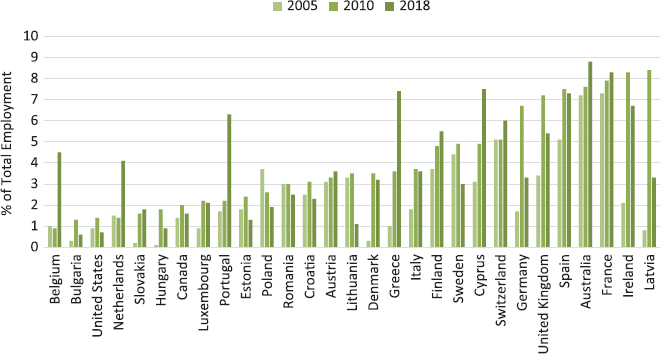
In economic practice, austerity has refuelled a race to the bottom through lowering the bar for national efforts to compensate labour market losses and dampening aspirations to make work decent. Processes of flexibilisation and the rising incidence of in-work poverty pre-date the financial crisis but austerity has facilitated labour ‘flexploitation’ by increasing labour market desperation, described in policy terms as required ‘supply-side reform’ (for comparative assessment of EU countries see Hastings and Heyes, Reference Hastings and Heyes2018). Much of the supply-side reform is simply employees adjusting to the reality of ‘marginal’ part-time employment (Messenger and Wallot, Reference Messenger and Wallot2015). By 2018, rates of ‘time-related underemployment’ (TRU) had increased considerably from pre-crisis levels and remained high across a range of countries (see Figure 1). This measurement disguises a range of comparative shortcomings but gives an indication of the extent of marginal employment, from zero hours in contracts in the UK (and some other advanced economies) to casual hourly paid employment. A significant level of re-regulation and restoration of labour rights would be required to halt employment practices that fail to provide guarantees of hours, securities of income, social protection and future prospects and in the context of weakened collective action (see below) the pressure to secure these protections is absent.
Time-related Underemployment Rate (% of total employment)
Source: International Labour Organization (ILO) (2020); data for 2005 for Ireland and Spain from Messenger and Wallot, Reference Messenger and Wallot2015: 3, Figure 3.
Note: Data shown for high income countries with data for all three years only ordered ascending by 2010 data.

Diminishing the political capacity for change
Finally, although the ‘end of austerity’ has been implied by national politicians and international actors, even if this were the case, the question of how welfare states can now be built and rebuilt remains, and herein lies the most significant achievement. The capacity for welfare state rebuilding is seriously diminished by austerity’s impact on vital forms of welfare mobilisation that have been key ingredients, essential in the early twentieth century welfare state formation and its subsequent expansion of rights: the power of labour and class solidarities.
The decline in power of organised labour is a well-established feature of global labour market change and it has also been central in the success of the strategy of austerity. Data on world union density change 2006-16 (ILO/OECD, 2018: 25, Figure 1.4) indicate declines in most high income countries Footnote 1 and regionally, a noticeable increase only in low and middle countries in Latin America. The contraction of the public sector workforce is particularly significant since these workers have an individual, as well as a collective, interest in resisting change (cf. Pierson, Reference Pierson1994). In the UK over half of public sector workers are union members compared to only 13.2 per cent of private sector employees (BEIS, 2019). With an underlying assumption that either the private sector or individuals themselves would crowd-in to make up the slack in support and service provision, public sector employment has long been a target for reform through austerity’s pre-cursor Structural Adjustment Programmes imposed by the World Bank in the global South. Although problematic to measure, OECD data indicate that while on average government employment is reported as ‘stable’ over time (OECD, 2019c) it decreased in the majority of OECD countries between 2009-17, even allowing for those with missing data. Reducing public sector employment both further diminishes collective strength, but also the implicit opportunities for building solidarities in other ways (see, for example, Laird, Reference Laird2017 on the effects on race inequalities).
Shaping economies so that a more atomised labour force is desirable for employers and less costly for states has not, to date, resulted in the rise of a transformative precariat class because intra-class solidarities depend on the recognition of shared interests and the space to consolidate them. In the absence of a precariat ‘class-for-itself’ (Standing, Reference Standing2014), middle class buy-in remains central to the integrative function of state welfare. The welfare politics of the middle class matter because, while it captures disproportionate benefits from the welfare state, it also has power in voicing and securing demands for more and better public services, defending the scope and generosity of existing provisions and protecting universalism.
Globally, the middle class is growing but fragile in low income countries, and its fortunes generate significant policy interest both amongst think tanks (e.g. Kharas and Hamel, Reference Kharas and Hamel2018) and international organisations (e.g. OECD, 2019d). In advanced economies, as the OECD has noted, middle class economic power has weakened. Since 2010, the top 10 per cent incomes have increased across the OECD countries while average median incomes have hardly changed (OECD, 2019d: Figure 1.2). For those whose income status has deteriorated their weakening economic power will inevitably be accompanied by a weakening of political voice. For those whose status is maintained or elevated to the top 10 per cent, opting out of reduced quality public welfare to pursue private options is more attractive, especially where states encourage this through tax relief. Private health insurance is growing in Europe (Insurance Europe, 2019) and globally, and combines with transnational mobilities and international trade in services to distort national demands for service development. In the UK, growth in voluntary health insurance (VHI) 2010-14 was concentrated in the richest consumption quintile where nearly a quarter of households held VHI compared to 3.9 per cent in the poorest quintile (WHO, 2018: 14). Defending middle-class advantage is problematic, but deterring middle-class flight is essential for successful welfare struggles (Goodin and LeGrand, Reference Goodin and LeGrand1987). The significance of the political capacities noted here is that they not only ‘override resistance’ (van Kersbergen, Reference van Kersbergen and Kuhnle2000: 27) but also prevent future coalescence of interests. The shrinkage of opportunity for recognising and acting upon collective interests, a once immovable object of welfare state reform is the critical legacy of austerity.
Conclusion
Austerity has been regarded as an acute problem for social policy, inflicting serious harm over a recognisable period, or as a report for the Resolution Foundation (Whittaker, Reference Whittaker2019: 43) understatedly observes ‘producing an unprecedentedly long pause in spending growth’. Contrary to the report’s conclusion, however, the argument presented here is that austerity is not ‘now over’.
Instead it has been argued that austerity has left a legacy of chronic societal harm which cannot be fixed simply through higher spending in the future. Other than this general prediction, the preceding discussion has sought to classify the limiting conditions or parameters within which welfare states and social policy will operate in the coming years in the absence of essential change.
Wilding’s (Reference Wilding1992) post Thatcher analysis represents a touchstone for the ‘welfare state’ at a time when, despite the political shifts, resilience could subsequently be more convincingly argued on the basis of popular support, electoral caution and institutional stickiness. A decade of austerity has stripped away these safeguards. While Thatcher’s legacy laid the groundwork for austerity’s success, austerity’s legacies will be felt through failure to forecast the long-term social and political costs of ideological myopia. Although the argument presented here was developed pre-Covid-19, there is little to suggest that the legacies of austerity have not been embedded to the extent that a ‘post-Covid’ social settlement will be different. The non-commitment to welfare has not ultimately been challenged by greater ‘universal’ pressures on health and care services. Borders are rendered more secure and people are more isolated both individually and as nations. Societal scarring is likely to be worse given the paucity of existing social and economic resources on which the demands of living in a pandemic have been made. Temporary and partial employment support schemes will not lead to decent work, particularly in the context of mass unemployment which will only exacerbate the flexploitation of workers. For the most critical legacy – political capacity for change – there are indications that some collective interests have been strengthened, most notably in the Black Lives Matter movement, and that alternative ideas, such as Basic Income, are gaining ground. But the traditional institutions and coalitions of collective power have not, so far, coalesced in a way that headway can be made in shifting political priorities to addressing the wider inequalities that the pandemic has exposed in sharp relief. This all suggests austerity will abide in the social and political relations of welfare long after austerity measures have ceased.
Acknowledgements
With thanks to the two anonymous referees whose comments were extremely helpful in clarifying and improving the arguments presented here.