Introduction
Paphiopedilum Pfitzer (Orchidaceae: Cypripedioideae) is widely distributed from India across southern China to Southeast Asia, including New Guinea and the Solomon Islands. The genus is well represented in Southeast Asia, which is its centre of diversity. Paphiopedilum section Barbata (Kraenzl.) V.A.Albert & Börge Pett. is the largest in the genus, most species being found on the islands of the Malay Archipelago and the Philippines (Cribb, Reference Cribb1998). In Sumatra, 11 species have been reported to date (Govaerts et al., Reference Govaerts, Bernet, Kratochvil, Gerlach, Carr, Alrich, Pridgeon, Pfahl, Campacci, Baptista, Tigges, Shaw, Cribb, George, Kreuz and Wood2016). Four of these belong in Paphiopedilum section Cochlopetalum Hallier f. ex Pfitzer (P. liemianum (Fowlie) K.Karas. & K.Saito, P. primulinum M.W.Wood & P.Taylor, P. victoria-mariae (Sander ex Mast.) Rolfe and P. victoria-regina (Sander) M.W.Wood), characterised by plain green leaves, multiflowered inflorescences in which the flowers open in succession, and spirally twisted ciliate petals. One species belongs in Paphiopedilum section Pardalopetalum Hallier f. ex Pfitzer (P. lowii (Lindl.) Stein), characterised by green, strap-shaped leaves, multiflowered inflorescences with flowers opening simultaneously, and an obovate staminode. The other six species belong in Paphiopedilum section Barbata (P. barbatum (Lindl.) Pfitzer, P. braemii H.Mohr, P. bullenianum (Rchb.f.) Pfitzer, P. javanicum (Reinw. ex Lindl.) Pfitzer, P. superbiens (Rchb.f.) Stein and P. tonsum (Rchb.f.) Stein), characterised by elliptic leaves tessellated with darker green on the adaxial surface, and inflorescences that bear single flowers.
Cox et al. (Reference Cox, Pridgeon, Albert and Chase1997) showed that speciation in Paphiopedilum section Barbata is recent and still in progress. In recent years, some new species of this section have been discovered in deep forests of the Malay Archipelago, namely Paphiopedilum inamorii P.J.Cribb & A.Lamb (Cribb & Lamb, Reference Cribb and Lamb2011) from Sabah, P. robinsonianum Cavestro (Cavestro et al., Reference Cavestro, Bougourd and Robinson2014) from Central Sulawesi, and Paphiopedilum nataschae Braem (Braem, Reference Braem2015), also from Central Sulawesi. With intensive botanical exploration of Indonesia's remote forests, hidden new species are expected to enrich global orchid diversity. Sumatra, in particular its remote forests, is one of the priority regions that are still urgently in need of more botanical exploration. Recent collections from the north of Sumatra have revealed two undescribed orchid species belonging to Paphiopedilum section Barbata. These magnificent-flowered new species were collected in the same district of Aceh Province, and are apparently endemic to that relatively small area.
Species Descriptions
Paphiopedilum lunatum Metusala, sp. nov. section Barbata
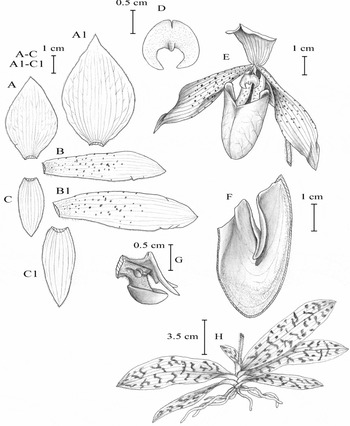
This new species is closely related to Paphiopedilum javanicum (Reinw. ex Lindl.) Pfitzer but differs in its longer, oblong-elliptic petals (6.3–8 cm long); oblong-elliptic and obtuse synsepal; lack of green reticulate pattern on the staminode; and obviously lunate staminode with strongly falcate-acute apical lateral lobes. – Type: Indonesia, Sumatra, Aceh Province, Central Aceh Regency, Jagong Jeget, c.1300–1600 m, 25 x 2016, Rio 9001 (holo BO). Figs 1, 2.
Paphiopedilum lunatum Metusala. A, A1, Dorsal sepal; B, B1, petal; C, C1, synsepal; D, staminode; E, flower, oblique view; F, lip, longitudinal section; G, column, side view; H, habit. (Drawing by Destario Metusala, based on living specimen and spirit collection.)

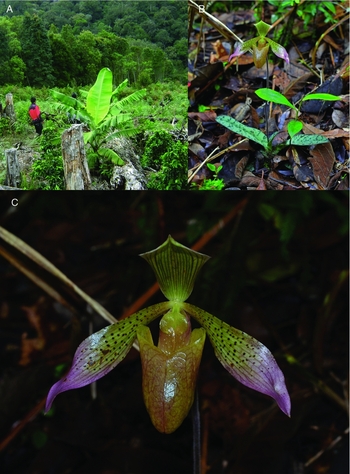
Paphiopedilum lunatum Metusala. A, One of its natural habitats in a relatively flat open area dominated by ferns, shrubs and grasses; B, plant habit in natural habitat; C, flower, front view. (Photographs: A, Destario Metusala; B and C, Frankie Handoyo.)

Terrestrial herb with a short stem; roots hairy, reddish brown. Leaves greyish green, adaxial surface mottled with darker green, longitudinal venation dark green, obscure to distinct, abaxial surface whitish to light greyish green, 4 or 5 per shoot, to 17 × 4.5 cm, distichous, spreading, oblong-elliptic, coriaceous, glabrous, adaxial surface slightly velvety, abaxial surface waxy and rather shiny, apex obtuse to shortly acuminate, minutely tridenticulate at tip, margin minutely, irregularly dentate. Inflorescence one-flowered, erect to arcuate, to 28 cm tall; peduncle cylindrical, brown to purplish brown, pubescent, indumentum white; floral bract green suffused purple towards the base, about one-third the length of the ovary, tightly encircling ovary at base, dorsal rib prominent, pubescent on outer surface, 1.5–2.4 × 1–1.5 cm at widest part, ovate, apex obtuse, margin ciliate. Flower large, 9–10.5 cm from top to bottom, spreading to 8–10 cm wide in natural shape. Pedicel and ovary green to purplish green, ribs purplish brown, 4–6.5 cm long, pubescent, indumentum white. Dorsal sepal erect to slightly hooded, yellowish white with green or purplish brown longitudinal venation, this venation terminating and sometimes branching a short distance from apex; 4.3–6 × 2.8–4 cm, broadly elliptic, apex obtuse to slightly acute, basal half of margin often reflexed, ventral/inner surface glabrous, pubescent on outer/dorsal surface, margin minutely ciliate. Synsepal yellowish green with darker green or purplish green longitudinal venation; 3–4.5 × 1.4–1.8 cm, oblong-elliptic, apex obtuse, ventral/inner surface glabrous, outer/dorsal surface pubescent, margin minutely ciliate. Petals green to yellowish green at basal half to two-thirds then turning purplish pink towards the apex with darker longitudinal venation, usually spotted with dark brown or deep purple on basal half, sometimes reaching basal two-thirds; spreading, held almost horizontal to about 45° downwards; 6.3–8 × 1.3–2 cm at widest part, oblong-elliptic to oblong-spathulate, apex obtuse, minutely ciliate at lower margin, becoming unevenly longer at basal margin, sometimes slightly undulate, apical third may be reflexed and/or slightly twisted upwards. Lip greenish brown with darker venation, sometimes suffused with purplish pink; 4.4–5 × 2.4–2.7 cm near the frontal mouth of the lip, deeply saccate, glabrous on outer surface, venation darker; side lobes cream or pale yellow, incurved and bearing some raised warts, with a triangular sinus at front of mouth of lip. Column 1 cm long. Staminode greenish yellow to pale green, 8–11 × 10–13 mm, lunate, minutely pubescent on surface, base shortly bilobed, apex trilobed; apical lateral lobes strongly falcate, incurved, acute; apical central lobe/tooth much reduced, short triangular, obtuse, tinged green, slightly raised.
Etymology
From the Latin word lunatus, meaning bent like a crescent moon, in reference to the obviously crescent-shaped staminode of this species.
Distribution
Indonesia, Sumatra, Aceh Province, Central Aceh Regency.
Habitat and ecology
Growing under shade as a terrestrial plant with roots in thick leaf litter or sphagnum moss. Its natural habitat ranges from open, flat areas dominated by forked fern (Dicranopteris sp.), low shrubs and grasses to slightly open forest on sloping hills dominated by rattan species, at 1300–1600 m altitude. Flowering so far only recorded in October and November.
Proposed IUCN category
Paphiopedilum lunatum is so far known only from a few sites of relatively small area in Aceh Province. It is a commercially prized species and already threatened with large-scale intensive collection to meet the high demand from collectors. The quality of habitat is declining by forest conversion, and thousands of plants have been sold out of the island. Hence I consider a category of Critically Endangered CR A4cd; B2ab (i,ii,iii,v) to be appropriate.
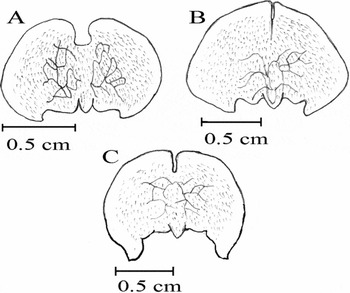
Paphiopedilum lunatum belongs in section Barbata and is most closely allied to Paphiopedilum javanicum (Reinw. ex Lindl.) Pfitzer and Paphiopedilum tonsum (Rchb.f.) Stein. This new species differs from Paphiopedilum javanicum in its oblong-elliptic petals (6.3–8 cm long), oblong-elliptic and obtuse synsepal, lack of green reticulate pattern on the staminode, and obviously lunate staminode with strongly falcate-acute apical lateral lobes. Paphiopedilum javanicum has shorter, narrowly oblong petals (4.2–4.8 cm long), a lanceolate acute synsepal, a staminode surface with an obvious green reticulate pattern, and a reniform-shaped staminode shallowly incised at the apex, with short, tooth-like apical lateral lobes (Fig. 5A).
The flower and plant habit of Paphiopedilum lunatum are also close to Paphiopedilum tonsum (Rchb.f.) Stein, especially the flower size. However, Paphiopedilum lunatum differs from P. tonsum in having light greyish green leaves that lack purplish streaks on the abaxial surface, petals suffused purplish pink towards the apex, a broadly elliptic dorsal sepal, a narrower lip, and a lunate staminode with strongly falcate-acute apical lateral lobes. In Paphiopedilum tonsum, the leaves are heavily purplish streaked on the abaxial surface, the petals are olive to yellow green without a purplish pink tinge towards the apex, the dorsal sepal is obovate and apiculate, the lip is wider (up to 3.3 cm), and the staminode is subreniform, shallowly incised at the apex (Fig. 5B).
Paphiopedilum bungebelangi Metusala, sp. nov. section Barbata
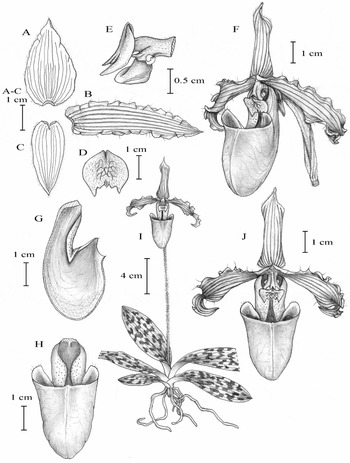
This new species is closely related to Paphiopedilum barbatum (Lindl.) Pfitzer but differs in its undulate, yellowish green petals with longitudinal darker green bold stripes, lacking blackish warts and deep pink-purple tinge; narrower, ovate-elliptic dorsal sepal less than 2.5 cm wide, strongly reflexed and revolute for most of the length of the margins; and broadly elliptic to suborbicular staminode. – Type: Indonesia, Sumatra, Aceh Province, Central Aceh Regency, Jagong Jeget, c.1550–1650 m, 25 x 2016, Rio 9002 (holo BO). Figs 3, 4.
Paphiopedilum bungebelangi Metusala. A, Dorsal sepal; B, petal; C, synsepal; D, staminode; E, column, side view; F, flower, oblique view; G, lip, longitudinal section; H, lip, front view; I, habit; J, flower, front view. (Drawing by Destario Metusala, based on living specimen and spirit collections.)

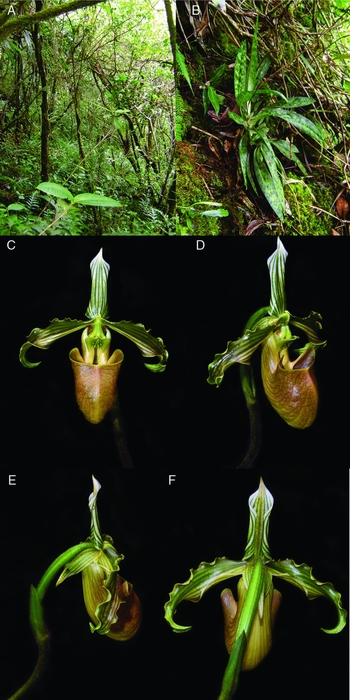
Paphiopedilum bungebelangi Metusala. A, Natural habitat; B, plant habit in natural habitat; C, flower, front view; D, flower, oblique view; E, flower, side view; F, flower, back view. (Photographs: A, B, Destario Metusala; C–F, Frankie Handoyo.)

Terrestrial herb with short stem; roots hairy, reddish brown. Leaves greyish green, adaxial surface heavily mottled with darker green, longitudinal venation dark green, obscure to distinct, abaxial surface whitish to light greyish green, 4 or 5 per shoot, to 23 × 6.2 cm, distichous, spreading, elliptic to oblong-elliptic, coriaceous, glabrous, adaxial surface matte to slightly velvety, abaxial surface waxy and rather shiny/glossy, apex obtuse to shortly acuminate, minutely tridenticulate at tip, margin minutely, irregularly dentate. Inflorescence one-flowered, erect to arcuate, to 48 cm tall; peduncle cylindrical, brown to purplish brown, 33–40 cm long, pubescent, indumentum purple in basal half turning white in apical half; floral bract light green, tightly encircling ovary at base, dorsal midrib prominent, pubescent on basal outer surface, 2.8–3 × 1.3–1.5 cm at widest part, triangular to lanceolate, apex obtuse to acute, margin ciliate. Flower up to 9 cm from top to bottom, spreading to 7–7.5 cm wide in natural shape. Pedicel and ovary green, 3.3–3.7 cm long, pubescent, indumentum purple in basal half, white in apical half. Dorsal sepal erect, white with green longitudinal venation, slightly glossy, 3.4–3.6 × 1.8–2 cm, ovate, apex acute, in natural shape usually strongly reflexed and revolute for most of the length of the margins, ventral/inner surface glabrous, pubescent on outer surface, margin ciliate. Synsepal white with light green venation, 2.7–3 × 1.3–1.5 cm, oblong-ovate, apex acute, ventral/inner surface glabrous, pubescent on outer/dorsal surface, margin ciliate. Petals yellowish green with darker green longitudinal stripes, sometimes with very light purplish tinge, spreading, held almost horizontal to about 45° downwards; 4.7–5.5 × 1–1.4 cm, oblong, apex acute to slightly acuminate, margin strongly undulate, minutely ciliate with some irregular long cilia, occasionally slightly twisted at apical third, reflexed or recurved near apex. Lip greenish brown to purplish maroon with darker venation, sometimes with a yellow band around apical margin, glossy to matte; 4–5 × 2.3–2.8 cm near frontal mouth of lip, deeply saccate, glabrous on outer surface, venation darker; side lobes yellowish brown to yellowish red, incurved and bearing few raised small warts, glossy. Column 1 cm long. Staminode light green to yellowish green with darker green reticulate pattern on the front surface, 1–11 × 10–13 mm, broadly elliptic to suborbicular, minutely pubescent on surface, base shortly bilobed, deeply incised at apex; apical lateral lobes tooth-like to subfalcate, acute; central apical lobe very short and much reduced, with an occasional marginal lobe on each side.
Etymology
The specific name is an adjective derived from the Gayo language (the Gayo people live in the highlands of Central Aceh), ‘bunge’ meaning flower and ‘belangi’ meaning beautiful, referring to the beautiful flower of this species.
Distribution
Indonesia, Sumatra, Aceh Province, Central Aceh Regency.
Habitat and ecology
Growing as a terrestrial plant with roots in thick leaf litter or sphagnum moss on sloping limestone hills from 1550–1650 m altitude. Plants were found growing in deep, shady forest with relatively low light intensity. Flowering so far only recorded in October and November.
Proposed IUCN category
Critically Endangered CR A4cd; B2ab (i,ii,iii,v). Paphiopedilum bungebelangi is known only from one small locality in Central Aceh, where it is restricted to rocky limestone hills. The quality of habitat is declining as a result of forest conversion, and the wild populations are under serious threat from large-scale collection to meet the high demand from collectors. Thousands of living plants have been collected from its natural habitat and commercially sold out of the island as an ornamental plant.
Paphiopedilum bungebelangi belongs in section Barbata and is most closely allied to P. barbatum (Lindl.) Pfitzer and P. javanicum (Reinw. ex Lindl.) Pfitzer. It differs from Paphiopedilum barbatum in its strongly undulate, yellowish green petals with longitudinal darker green bold stripes, lacking blackish warts and deep pink-purple tinge; narrower ovate-elliptic dorsal sepal, which is less than 2.5 cm wide, strongly reflexed and revolute for most of the length of the margins; and broadly elliptic to suborbicular staminode. Paphiopedilum barbatum has relatively flat to less undulate petals; an ovate to broadly ovate dorsal sepal (3.5–5.3 cm wide), spreading widely; and a wider lunate staminode (Fig. 5C). The colour of the petals in Paphiopedilum barbatum is quite variable, but they always have a distinct pink-purple tinge and are always with blackish warts (Leong, Reference Leong2014).
Staminodes of other species of Paphiopedilum. A, Paphiopedilum javanicum; B, P. tonsum; C, P. barbatum. (Drawing by Destario Metusala.)

Paphiopedilum bungebelangi is also close to Paphiopedilum javanicum (Reinw. ex Lindl.) Pfitzer but differs in its heavily mottled dark green leaves; strongly undulate petals lacking blackish spots/warts and yellowish green with darker green longitudinal bold stripes; reddish brown to purplish maroon lip; and broadly elliptic to suborbicular staminode. In contrast with the new species, in Paphiopedilum javanicum the leaves are very pale green, lightly mottled dark green; the petals are less to slightly undulate (usually in the apical half), with blackish spots/warts in the basal half to three-quarters; the petals are also pale green with an obvious pink-purple in the apical third to quarter; the lip is bright green or brown-flushed green; and the staminode is reniform (Fig. 5A).
Acknowledgements
The author would like to express his gratitude to the Indonesian Orchid Society Headquarters (Perhimpunan Anggrek Indonesia), with Rita Subowo as the current chairperson, for financial support for the field survey in Aceh Province. Also thanked are Ramadhani Prasetya and Frankie Handoyo for their companionship during the fruitful field survey in Aceh; Dr Irawati, for valuable discussion; and Ennie Satoto, Andi Widjaja, Nesya Anekda and F. Rahardi for their support of this research.