Introduction
Myopia has emerged as a major global public health concernReference Morgan, Kyoko and Seang-Mei1 with its rapidly increasing prevalenceReference Rudnicka, Kapetanakis and Wathern2,Reference Holden, Fricke and Wilson3 and heavy economic burden.Reference Smith, Frick and Holden4,Reference Fricke, Holden and Wilson5 East Asians, including Chinese,Reference Sun, Li, Xu and Pan6 showed the highest prevalence of myopia worldwide, reaching 69% at 15 years of age, which is more than two times higher than other ethnicities.Reference Rudnicka, Kapetanakis and Wathern2
Once myopia presents, progression can continue irreversibly throughout childhood, and particularly result in high myopia which could significantly increase the risk of future pathologic ocular changes.Reference Saw, Gazzard, Shih Yen and Chua7 Consequently, preventing the onset of myopia is of great public health significance. It is widely accepted that myopia onset usually results from eye growth that leads to elongated axial length, but the inner regulatory mechanism remains unclear.Reference Morgan, Kyoko and Seang-Mei1,Reference Lougheed8 Given that nearly 80% myopia develops during early and medium puberty (about 9~13 years),Reference Kleinstein, Sinnott and Jones-Jordan9 we can postulate that puberty development might contribute to myopia onset via regulating axial growth. This hypothesis is supported by the study of Yip et al which found that boys and girls with earlier puberty defined by height spurt also experienced earlier age of axial growth and myopia onset.Reference Yip, Pan and Lin10 However, another two cohort studies showed that height growth only explained less than 0.5% of myopia development.Reference Huang, Hou and Lin11,Reference Northstone, Guggenheim and Howe12 Therefore, indicators of puberty other than height spurt might explain the association between myopia and puberty.
Menarche is a milestone in girls’ sexual maturity and one of the most important indicators of puberty.Reference Gasser, Molinari and Largo13 About half of the variation of age at menarche is contributed by genetic factors.Reference Karapanou and Papadimitriou14 An earlier age at menarche could also be contributed by many environmental and behavioral factors, such as high body mass index, low physical activity, high animal protein intake, family stressors (e.g., single parenting), and exposure to endocrine-disrupting chemicals.Reference Karapanou and Papadimitriou14,Reference Yermachenko and Dvornyk15 Earlier menarche is associated with increased risk of many diseases in adulthood, such as reproductive cancers, metabolic syndrome, and cardiovascular diseases,Reference Walvoord16,Reference Remsberg, Demerath and Schubert17 but evidence about its relationship with myopia is controversial. In the study by Yip et al, no significant association was found between age of menarche and age of axial growth or myopia onset.Reference Yip, Pan and Lin10 By contrast, two cross-sectional studies in India and South Korea, respectively,Reference Nirmalan, Katz and Robin18,Reference Lyu, Kim and Baek19 found that earlier age at menarche could increase the risk of myopia in adulthood. Yip et al may suffer from selection bias and low statistical power because it only included 1779 children from three schools in Singapore.Reference Yip, Pan and Lin10 Meanwhile, recall bias could be a big problem in the Indian and South Korean studies,Reference Nirmalan, Katz and Robin18,Reference Lyu, Kim and Baek19 considering that their age of menarche and myopia-related covariates were all collected in adulthood. Accordingly, we need more studies with large sample sizes and good measures of menarche status to clarify the role of menarche onset in myopia acquisition. In addition, such evidence from China, the country with largest myopic population is still absent.Reference Sun, Li, Xu and Pan6 The Chinese National Survey on Student’s Constitute and Health (CNSSCH), a national survey of school-aged children, provides us with a great opportunity to address this question and suggest potential etiologies for myopia development.
Based on previous studies, we hypothesize that for girls of the same age those who have experienced menarche are more likely to be myopic than those who have not. This is equivalent to the statement that earlier menarche onset is associated with the higher risk of myopia. On the other hand, minimal outdoor activity,Reference He, Xiang and Zeng20 excessive near-vision requiring work,Reference Ramamurthy, Lin and Saw21 and insufficient sleepReference Jee, Morgan and Kim22 are suggested as the main alterable or intervenable risk factors for myopia, but little is known about how their impacts on myopia can be modified by other factors such as menarche status. Due to the potential rapid axial growth along with body growth during puberty,Reference Kleinstein, Sinnott and Jones-Jordan9 growth of axial length might become more sensitive to behavioral risk factors. As a result, the association between behavioral risk factors and developing myopia might increase during puberty growth. In other words, we hypothesized that menarche onset might enhance the adverse impacts of behavioral risk factors on myopia. Testing this hypothesis will help us to develop more targeted preventive strategies.
Methods
Study population
Data were extracted from the 2010 to 2014 cycles of the CNSSCH, a series of cross-sectional national surveys among school-aged children in China with identical stratified random cluster sampling procedure in each cycle.Reference Jan, Xu and Luo23,Reference Dong, Jan and Ma24 The CNSSCH covered 30 of the 31 mainland provinces, excluding Tibet. In each province, three cities or regions at different levels of economic development (“upper,” “moderate,” and “low”) were chosen. In each city or region, an equal number of primary and secondary schools were randomly selected from both rural and urban areas. Children aged 7–18 clustered by classroom were randomly chosen from these schools, ensuring that each sex × age combination in each city/region included at least 100 children. The CNSSCH only included children of Han ethnicity (all purely of Chinese ancestry), the dominant ethnicity accounting for 92% of population in mainland China.Reference Ramamurthy, Lin and Saw21
Exposure measure
Individual menarche data were collected by the status quo method.Reference Song, Ma and Wang25 Girls aged 9 years or above in each CNSSCH were interviewed by a school nurse or female physician and asked whether or not menarche had occurred. This study only extracted data of school girls aged 10–15 years, to ensure enough sample sizes for both premenarche and postmenarche girls in each age. Because almost all school girls of that age have some knowledge of menstrual periods from school health education, a dichotomous response (yes/no) for menarche status could be easily obtained. The school nurses or physicians were well trained to explain menstruation to young girls, so that it could be distinguished from other potential sources of bleeding.
Outcome measure
Myopia in this study was defined according to unaided distance visual acuity (VA) and subjective refraction method.Reference Sun, Li, Xu and Pan6,Reference Jan, Xu and Luo23 The unaided distance VA for both eyes was measured by certified optometrists using a retro illuminated logMAR chart with tumbling-E optotypes (Precision Vision, Denver Colorado). Reduced VA was defined as distance VA worse than 6/6 or 1.0.
Only for those eyes with reduced VA, subjective refraction was used to detect the refractive status. Participants’ distance VA was measured again wearing positive or negative diopter spherical lens of ±0.75 D. Compared with the unaided distance VA, if the distance VA wearing positive lens reduced ≥1 line, and the distance VA wearing negative lens improved ≥1 line, then the examined eye would be defined as “myopia”; if the result was reversed, then the examined eye would be defined as “hyperopia.” Any other situation would be defined as “other eye diseases.” If one of the two eyes was defined as myopia, then the participant was defined as having myopia.Reference Jan, Xu and Luo23
Reduced VA is a good surrogate of myopia, having a sensitivity of 84.0% and a specificity of 88.8% in a study on Singapore school-aged children.Reference Tong, Saw and Tan26 These two figures were even higher in another study among 12-year-old adolescents from Sydney.Reference Leone, Mitchell and Morgan27 Theoretically, reduced VA plus subjective refraction method in this study could make the diagnosis more accurate because it distinguishes myopia from hyperopia and other kinds of reduced VA. According to the validation trial conducted by our collaborators (see Supplementary Materials for detail), this definition of myopia in CNSSCH achieved a sensitivity of 91.9% and a specificity of 83.6%, taking the most common examination definition of myopiaReference Holden, Fricke and Wilson3 (spherical equivalent refractive error measured by cycloplegic refraction ≤ −0.50 D) as the gold standard.
Other measures
Participants in the cycles of 2010 and 2014 CHSSCH were asked to complete a self-administered questionnaire in the classroom with the guidance of trained investigators. The questionnaire was designed by a panel of experts in their respective fields. Pilot studies were carried out to test if the questionnaire could be understood and answered accurately by the students. Prior to filling in the questionnaire, students were informed that all their answers would be kept strictly confidential and would have no bearing on their grades. The questionnaire included questions about sleep duration, homework time, and frequency of weekend outdoor activity. Age by years and age by days were both calculated according to participants’ date of birth and date of physical examination in the survey. Data entry was done with double entry and verification by trained investigators using an identical software developed by the Chinese Ministry of Education and followed an identical protocol at each site. All data from each site were double-checked before submitting to national data center. We also obtained provincial population size in 2010 and 2014 from the China Statistical Yearbook, to ensure that all regression analyses were weighted by population.Reference Jan, Xu and Luo23
Statistical analysis
A total of 102,883 girls aged 10–15 with complete data of age, visual examination, and menarche status were included in the descriptive analyses. We compared the prevalence of myopia between premenarche and postmenarche girls in different ages and survey years using chi-square tests. Considering the design effect of cluster sampling by school, we used robust Poisson regression models based on generalized estimated equation (Poisson-GEE) to detect the association between menarche status and myopia. The regression analyses were weighted by provincial population, to make the results be more representative of China.Reference Jan, Xu and Luo23 This model adjusted for the cluster effect of school and estimate the prevalence ratios (PRs) which is an unbiased estimator of relative risk in cross-sectional studies.Reference Santos, Fiaccone and Oliveira28–Reference Zhou, Gao and Li30 Calculating PRs could avoid the problem that odds ratios (ORs) would overestimate the relative risk when the prevalence is higher than 10%.Reference Santos, Fiaccone and Oliveira28–Reference Zhou, Gao and Li30 The regression analysis was based on subset 1 and subset 2. Subset 1 (N = 98,656) was based on the descriptive sample (N = 102,883), excluding participants with hyperopia and other eye diseases, and participants without information of school code in 2010 and 2014 CNSSCH. While subset 2 (N = 95,803) was extracted from subset 1 excluding girls without full answer of any one of the three variables from questionnaire in 2010 and 2014 CNSSCH.
In all regression models, the dependent variable was myopia (1 = myopia, 0 = nonmyopia), and the independent variable was menarche status (1 = postmenarche, 0 = premenarche). Because both the proportion of myopic girls and postmenarche girls increased rapidly with age, age was the major confounder and was controlled as precisely as possible to avoid residual confounding.Reference Rudnicka, Kapetanakis and Wathern2,Reference Song, Ma and Wang25 We developed three models. Model 1 was a univariate model; model 2 adjusted for exact age (age by days); model 3 additionally adjusted for urban–rural location, survey year, sleep duration per day, homework time per day, and frequency of outdoor activity on weekends. The PRs and their 95% CI were estimated for each model. A two-sided P value < 0.05 was considered statistically significant. The interaction effects between menarche status and the behavioral factors on myopia were evaluated by sequentially adding one interaction term at a time. The data cleaning and descriptive analysis was completed with SPSS (version 20.0, IBM, Chicago, Illinois, USA); all regression analyses were completed by geeglm function of geepack package (version 1.2-1) in R (version 3.3.1).Reference Halekoh, Jsgaard and Yan31
Results
Myopia prevalence among pre-menarche and post-menarche girls
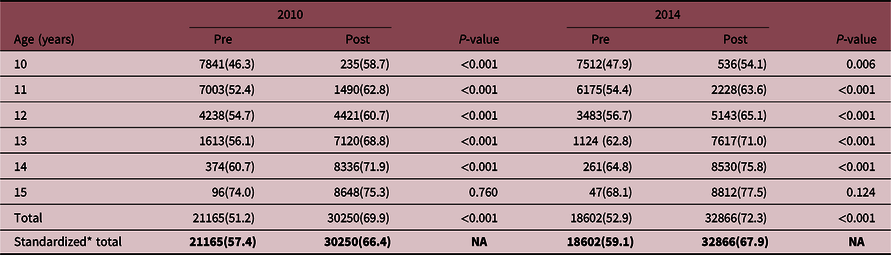
The myopia prevalence among postmenarche girls was consistently higher than premenarche girls, with the age weighted prevalence 66.4%(postmenarche) vs. 57.4%(premenarche) in 2010 and 67.9% vs. 59.1% in 2014. The difference was statistically significant (P < 0.05) in 10 of the 12 age-group x survey year combinations (Table 1).
Comparison of the myopia prevalence between premenarche and postmenarche girls aged 10–15 years, 2010–2014 CNSSCH [n(%)]

CNSSCH, Chinese National Survey on Students’ Constitute and Health. Standardized by age with each age had the same weight; NA, not applicable.
The association between menarche status and myopia
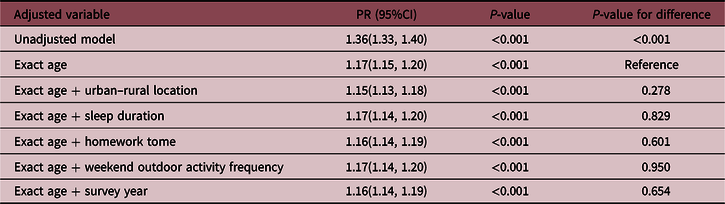
According to the robust Poisson-GEE regression analysis, postmenarche girls were at a 36% higher risk of being myopic than premenarche girls (PR = 1.36, 95%CI:1.33–1.40). After adjustment for age by days, the PRs (95%CI) reduced to 1.17(1.15, 1.20). Further adjusting for urban–rural location, survey year, and four behavioral factors, postmenarche girls still had a 13% (95%CI: 11%–16%)higher risk of being myopic than premenarche girls (Table 2).
The association between myopia and menarche status among Chinese school girls aged 10–15 in 2010 and 2014

PR, prevalence ratio; 95% CI, 95% confidence interval. All the three models adjusted for the cluster effect of school and weighted by provincial population. Model 1 is univariate model; model 2 adjusted for exact age (age by days); model 3 adjusted for exact age, urban–rural location, sleep duration per day, homework time per day, and frequency of outdoor activity at weekend, and survey year (if using both 2010 and 2014 dataset).
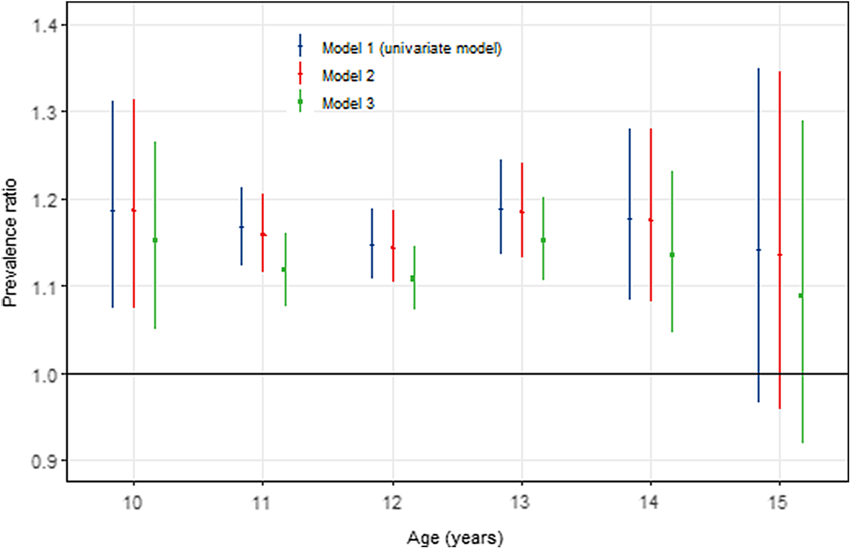
Age seems to be the most important confounder among all covariates. After adjusting for exact age, further adjusting for any other covariates did not change the effect estimate significantly (all P-values for difference > 0.05) (Table 3). The menarche–myopia associations were generally consistent among all ages between 10 and 15, and the nonsignificant results in 15 year olds might be explained by the small sample size of premenarche girls (Fig. 1).
The association between myopia and menarche status when adjusting for different covariates
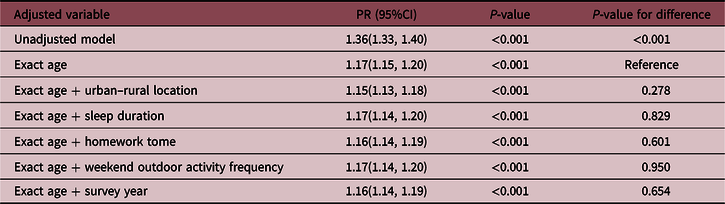
PR, prevalence ratio; 95% CI, 95% confidence interval. P-values for difference were estimated by fixed-effect meta-regression, which tested whether the difference between different models was statistically significant.
The association between myopia and menarche status, stratified analyses by age.

The interaction effects on myopia between menarche status and behavioral risk factors
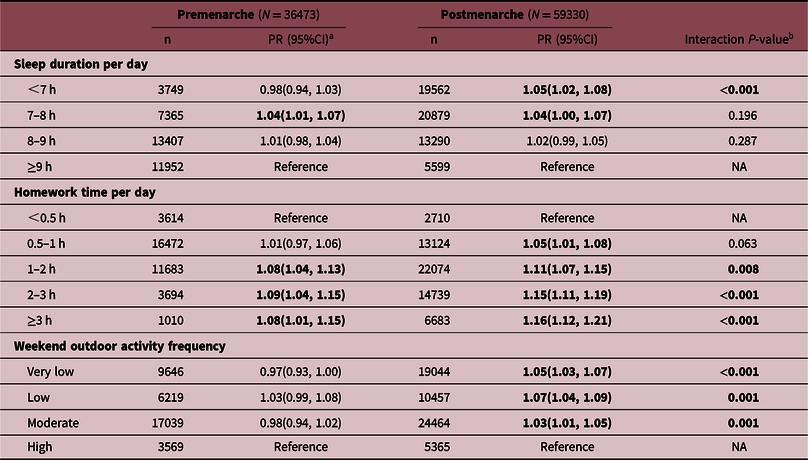
The effects of short sleep duration (<7 h/d vs. ≥9 h/d), long homework time (>1 h/d vs. <0.5 h/d), and low frequency of weekend outdoor activity (very low, low, and moderate vs. high) on myopia tended to be stronger in postmenarche girls (with higher PRs), and their interactions with menarche status were all statistically significant (P < 0.05, Table 3).
Multicollinearity diagnostics
The covariates in the regression models were correlated with each other, with the highest correlation coefficient (0.72) shown between age by day and menarche status (Supplementary Table S2 ). As age increased, more girls experienced menarche onset, and girls slept less, did less outdoor activity but had longer homework time. However, the multicollinearity in models in Tables 2 & 4 is not a statistical concern even applying the strictest threshold (Supplementary Table S3 ).
The interaction effects of menarche status and four behavioral factors on myopia
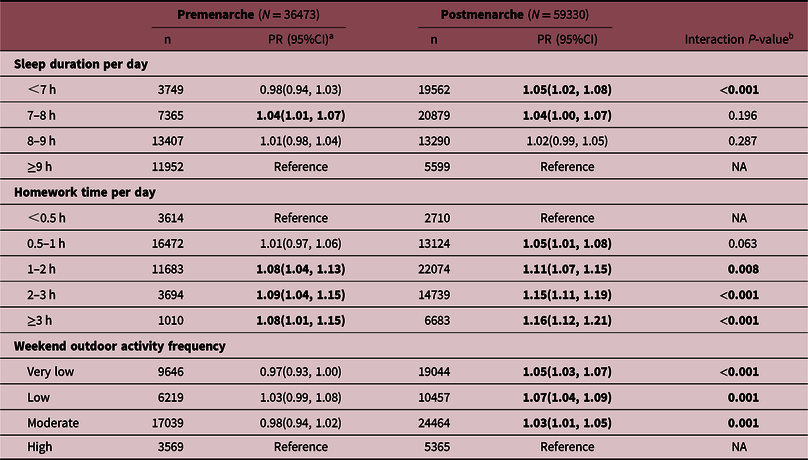
a. Adjusted for age by days, urban–rural location, survey year, and the other two behavioral factors in this table; b. evaluated by adding a interaction term (e.g., sleep × menarche) to the models.
Discussion
Our results indicate that menarche onset produced a 13% increase in the risk of myopia during adolescence after controlling for age and other potential confounders. Moreover, menarche onset may also enhance girls’ sensitivity to some myopia-related risk behaviors, such as insufficient sleep, long homework time, and low frequency of outdoor activity.
Menarche is a milestone of female puberty that every girl would experience, but different girls may experience it at different ages.Reference Gasser, Molinari and Largo13 Meanwhile, myopia onset and its progression usually stop when adolescents enter adulthood.Reference Morgan, Kyoko and Seang-Mei1 According to our findings, the earlier the girls reach menarche, the longer before adulthood they will be at increased risk of myopia and increased sensitivity to other myopia-related risk factors. As a result, those girls would be at higher risk of being myopic once they become adults, because of their longer and enhanced exposure to those risk factors before adulthood. This has been verified by previous studies,Reference Nirmalan, Katz and Robin18,Reference Lyu, Kim and Baek19 which found that earlier menarche was associated with higher risk of adulthood myopia. Also, those girls tend to have earlier onset of myopia, leaving more time for low myopia to progress to high myopia before adulthood. This could explain why earlier menarche was also increased risk of adulthood high myopiaReference Lyu, Kim and Baek19 which is more clinically important than low and moderate myopia due to its pathological impact (e.g., glaucoma, retinal detachment, and macular degeneration).Reference Saw, Gazzard, Shih Yen and Chua7 Given the secular downward trend of median age at menarche among Chinese girls from 13.41 in 1985 to 12.47 in 2010,Reference Song, Ma and Wang25 our findings might be increasingly important in China.
The results of our study are consistent with the Indian study and South Korean study but not consistent with the study by Yip et al which claims that among many indicators of puberty including menarche, only the timing of height spurt related to the timing of myopia onset. Compared to the first two studies, our study has the advantage that the menarche status and the covariates were gathered by well-trained nurses or physicians in participants’ adolescence rather than in adulthood, so the recall bias is minimized. In comparison with the study by Yip et al, the major strength of our study is the availability of a large, nationwide sample whose selection bias tends to be minimal. Moreover, two independent national datasets (2010 and 2014 CNSSCH) were used to test our hypothesis and the results were consistent. In summary, our study adds an important population-based evidence for the association between menarche and myopia, which may provide some implications for the etiology of myopia.
The mechanism underlying the association between menarche and myopia is still unclear. Human menarche onset is regulated by complex neuroendocrine pathways.Reference Karapanou and Papadimitriou14,Reference Allison and Hyde32 Briefly, it starts from the activation of Kiss-1 neurons in human hypothalamus that produces kisspeptin, a protein that could activate the hypothalamic gonadotropin-releasing hormone (GnRH) neurons. GnRH neurons then activate the GnRH secretory system, leading to secretion of GnRH which stimulates the pituitary to secret luteinizing hormone (LH) and follicle-stimulating hormone (FSH). LH and FSH stimulate the production of estradiol (a kind of estrogen) and progesterone, and the maturation and release of eggs from the ovaries. Estradiol and progesterone promote the growth of endometrium of uterus to prepare for the menarche onset. Circulation estradiol before menarche was found to drive the activation of Kiss-1 neurons. Therefore, the increased level of estrogen along with menarche might explain the association between myopia and early menarche.Reference Lyu, Kim and Baek19 However, this is not supported by two case-control studies, which did not find that myopic girls had a higher serum estrogen than nonmyopic girls.Reference Chen, Wang and Liao33,Reference Xie, Mao and Yang34 The rapid increase of insulin-like growth factor-1 (IGF-1) level along with menarcheReference Ryan, Mantle and Costigan35,Reference Juul36 may be another explanation of the menarche–myopia association. IGF-1 increases around menarche, possibly as a result of the increased insulin resistance and body fat during puberty onset.Reference Jeffery, Metcalf and Hosking37 IGF-1 in the brain contributes to the menarche onset by activating the GnRH neuron and possibly the Kiss-1 neuron.Reference Wolfe, Divall and Wu38 IGF-1 in scleral fibroblasts contributes to axial elongation of the eye and thus the development of myopia.Reference Galvis, Lópezjaramillo and Tello39–Reference Feldkaemper, Neacsu and Schaeffel41 The IGF-1 gene polymorphisms has been associated with both myopiaReference Metlapally, Ki and Li42 and the age at menarche,Reference Dvornyk43 suggesting a shared molecular pathway of myopia and menarche.
In this study, we found that insufficient sleep, low frequency of weekend outdoor activity, and long homework time were all risk factors for myopia among girls aged 10–15. In previous studies, no protective effects of indoor physical activity on myopia have been observed,Reference Rose, Morgan and Ip44,Reference Dirani, Tong and Gazzard45 while the outdoor activity has been demonstrated to prevent myopia in cohort studies and randomized clinical trials.Reference He, Xiang and Zeng20,Reference Dirani, Tong and Gazzard45,Reference Sherwin, Reacher and Keogh46 The homework time is an indicator of near work exposure.Reference Ramamurthy, Lin and Saw21 Therefore, our results were consistent with previous studies on outdoor activity,Reference He, Xiang and Zeng20 near work,Reference Ramamurthy, Lin and Saw21 and sleep duration.Reference Jee, Morgan and Kim22 Moreover, we found the effects of these risk factors on myopia were stronger or only statistically significant in postmenarche girls, implying that girls after menarche are more sensitive to these risk factors. This suggests that differentiated recommendations of sleep duration, outdoor activity, and homework time should be made for school-aged girls according to their menarche status. For example, for two nonmyopic girls at a similar age, where one has reached menarche while one has not, in order to prevent myopia onset, the postmenarche girl should undertake outdoor activity and study break more intensively than the premenarche girl because of her higher sensitivity to inadequate outdoor activity and long homework time.
The effects of these behavioral factors and their interaction with menarche status may also be explained by IGF-1. First, outdoor activity could retard axial elongation by increasing the dopamine secretion in human eyes.Reference Sherwin, Reacher and Keogh46,Reference Feldkaemper and Schaeffel47 IGF-1 may mediate dopamine’s effect, because high levels of dopamine could suppress the IGF-1 level.Reference Zielonka, Makhseed and Blau48 Second, near work may also impose its impact on axial growth by upregulating the IGF-1 receptor in retinal pigment epithelium according to an animal study.Reference Penha, Schaeffel and Feldkaemper40 Third, short sleep duration could greatly increase the risk of being insulin resistant,Reference Schmid, Hallschmid and Schultes49 which could increase the serum level of IGF-1.Reference Galvis, Lópezjaramillo and Tello39 Although the IGF-1 system seems to be a sound explanation for our results, this hypothesis needs to be tested with further clinical and experimental studies.
There are several limitations of our study. First, the definition of myopia is not the most widely used one, and may lead to a nondifferential outcome misclassification, which might well underestimate the effect of menarche. However, in such a large national sample, the current screening method is acceptable given its efficiency and high sensitivity and specificity (Supplementary Table S1). Furthermore, in the context of Chinese schools, where nearly 90% of vision impairment is due to uncorrected myopia, using unaided VA as a surrogate for myopia may be justified.Reference Jan, Xu and Luo23,Reference Lin, Shih, Hsiao and Chen50 Further studies with standard measurement of myopia are warranted to confirm our findings. Second, this is not a cohort study and the causal relationship between exposure and outcome cannot be established with certainty. Prospective studies might be helpful to definitively establish causality, although myopia is unlikely to affect the timing of menarche. Third, due to the limitation of the survey and its data, we only have one indicator of puberty for girls. We cannot exclude the possibility that the effect of menarche status might be caused by other unmeasured pubertal indicators such as breast development, since these indicators are highly correlated with each other. However, menarche is one of the most significant indicators of female puberty, so its association with myopia provides important information on the effect of puberty development on myopia. Also, menarche is the easiest pubertal indicator to identify, so public health strategies based on this indicator are more practical to implement. Finally, we do not have a suitable puberty indicator for boys, such as the break of voice, thus our study is limited to girls and further studies are warranted for boys.
In conclusion, among Chinese girls aged 10–15, earlier menarche appears to be associated with a higher risk of myopia. Menarche onset could also increase girls’ sensitivity to several behavioral risk factors for myopia, which might have some implications for the prevention of myopia.
Supplementary material
To view supplementary material for this article, please visit https://doi.org/10.1017/S204017442000077X
Acknowledgements
The authors thank Wenke Liao, Wenhua Xing, and Xing Zhang for their permission to access the 2005, 2010, and 2014 CNSSCH data. The authors also appreciate the students who participated in the surveys for their cooperation and contribution.
Financial Support
The present study was supported by the grants from National Natural Science Foundation of China (YS, grant number 81302442); China Scholarship Council (YS, grant number 201606015038), (RX, grant number 201806010405); and Australian Government Research Training Program (CJ).
Conflicts of Interest
None.
Ethical Standards
The authors assert that all procedures contributing to this work comply with the ethical standards of the relevant national guidelines on population-based cross-sectional studies and with the Helsinki Declaration of 1975, as revised in 2008, and have been approved by the Medical Research Ethics Committee of Peking University Health Science Center (application number: IRB00001052-18002).