Introduction
In recent decades, livestock-farming practices have evolved considerably. To face the increasing demand for animal products in developed countries, small farms with traditional systems have been replaced by confined animal feeding operations with higher stocking densities. These intensive systems have proven to be economically effective but are noted for their negative impacts on the environment (FAO, Reference FAO2006) through the production of ammonia (NH3) and greenhouse gases (GHGs). Ammonia contributes to water pollution via eutrophication and soil pollution via acidification (Bouwman et al., Reference BOUWMAN, VAN VUUREN, DERWENT and POSCH2002), while methane (CH4) and nitrous oxide (N2O) are two major GHGs responsible for global warming and climate change (IPCC, Reference IPCC2007). In livestock-production systems, these gases are emitted mainly from enteric fermentation (for CH4), from animal manure in housing or in storage facilities and during manure spreading or grazing (for CH4 and N2O). Many countries have performed national inventories of their gaseous emissions to estimate their contribution to these environmental issues. In these studies, poultry production has been identified as a major producer of NH3 (e.g. 16% of total NH3 emissions in the United States (EPA, Reference EPA2002, Reference EPA2004)). Poultry production contributes considerably fewer GHG emissions (e.g. less than 1% of total CH4 emissions in the European Union in 2008 (EEA, Reference EEA2010)) than does cattle production (about 40% of total CH4 emissions in 2008 (EEA, Reference EEA2010)).
Most inventories are based on average emissions factors (EFs) for each type of animal, the so-called ‘tier 1’ approach (IPCC, Reference IPCC2000). The factors that influence these emissions have not been integrated to update EFs for the large variety of commercial poultry-production systems (more than 75 identified in France alone (CORPEN, Reference CORPEN2006)). The first steps to improve inventories (the so-called ‘tier 2’ approach (IPCC, Reference IPCC2000)) and propose better management practices are (i) to understand the drivers of gaseous emissions better and identify key factors of NH3 and GHG emissions, and (ii) to check that the chosen EFs adequately represent the variability of emissions at national scales. The influence of climate on the effects should also be studied because the climate has a considerable influence on the temperature inside poultry housing and its ventilation rate and because climate variability is expected to change significantly over the next several decades.
This paper focuses on the first step. Its objectives are to (i) identify key factors from a review of peer-reviewed articles and proceedings papers, (ii) discuss their influence on NH3 and GHG emissions for different types of poultry-production systems, and (iii) discuss how to take this scientific knowledge into account in emissions inventories or mitigation scenarios.
To achieve these objectives, all values found in the literature were converted into the same unit (g of gas per day per bird, g d-1 bird-1), and key factors belonging either to rearing conditions or manure-management practices were identified and their effect on emissions were classified into seven categories of poultry-production factors: (i) dietary manipulations; (ii) age and weight at slaughter; (iii) manure moisture; (iv) manure renewal or built-up litter; (v) floor management; (vi) indoor conditions and ventilation rate; and (vii) litter treatment.
Dietary manipulation
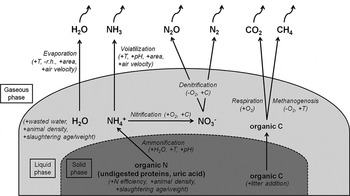
Ammonia is formed by the breakdown of undigested proteins and uric acid in manure (Figure 1). Theoretically NH3 from litter decreases when NH3 concentration is reduced. Reduction of N intake per bird should reduce the amount of N excreted and NH3 concentrations in litter. Therefore, dietary manipulations are expected to play a major role in NH3 emissions. Moreover, a regular update of feed composition (in partnership with poultry-production companies) in emissions inventories at a national scale should allow a better estimation of NH3 emissions from poultry production. The first approach to reduce N intake consists of reducing crude protein (CP) content in diets, as reported in many studies. (Summers, Reference SUMMERS1993; Ferguson et al., Reference FERGUSON, GATES, TARABA, CANTOR, PESCATORE, STRAW, FORD and BURNHAM1998; Aletor et al., Reference ALETOR, HAMID, NIEß and PFEFFER2000; Bregendahl et al., Reference BREGENDAHL, SELL and ZIMMERMAN2002; Keshavarz and Austic, Reference KESHAVARZ and AUSTIC2004). The decrease in excretion is about 10% for each 1% reduction in dietary CP. In terms of emissions, Angel et al. (Reference ANGEL, POWERS and APPLEGATE2008) observed a decrease of 22% in NH3 emissions with a reduced-CP diet fed to broilers. Similarly, a 1% decrease in CP content in a layer diet decreased NH3 emissions by 10% compared to those of a standard diet (0.81 and 0.90 g NH3 d-1 bird-1, respectively), even though Liang et al. (Reference LIANG, XIN, WHEELER, GATES, LI, ZAJACZKOWSKI, TOPPER, CASEY, BEHRENDS, BURNHAM and ZAJACZKOWSKI2005) found the difference in emissions between diets not statistically significant. Similarly, Roberts et al. (Reference ROBERTS, XIN, KERR, RUSSELL and BREGENDAHL2007) found no difference in NH3 emissions following a 1% reduction in CP content of a layer diet. To explain this result, the authors hypothesise that the reduced-CP diet could have been deficient in one or more amino acids. The other amino acids, present in excess, would have been deaminated so that uric acid excretion and NH3 emissions increased, as observed. To align protein supply in diets with animal needs and reduce N excretion, phase feeding generally is practiced in commercial facilities. The CP content of the diet is adjusted to the age of the animal, poultry being fed successive diets with decreasing CP content (starter, grower, and finisher). The highest decrease in CP content is achieved when supplying poultry with the amino acids they need rather than basing diets solely on CP content. As a result, diets contain fewer excess amino acids and maximum reduction in N excretion is achieved. However, dietary manipulations can lead to higher feed costs and lower growth or egg-laying performance; so, the benefits of reduced-CP diets need to be discussed in mitigating scenarios.
Another feeding strategy is based on acidification of the diet, which leads to a higher fraction of the NH3 content of litter as ammonium (NH4+), reducing NH3 volatilisation (Figure 1). Wu-Haan et al. (Reference WU-HAAN, POWERS, ANGEL, HALE and APPLEGATE2007) tested the influence of a diet for layers containing 7% of a gypsum-zeolite mixture and a slightly reduced CP content (0.6-1.5% less). Gypsum lowers manure pH, rendering the protonation of NH3 into less volatile NH4+, while zeolite binds preferentially to nitrogenous cations such as NH4+ preventing the volatilisation of NH3 (Figure 1). NH3 emissions were reduced by 39% with the acidified diet, while NH4 emissions were decreased by 17%. Similarly, Li et al. (Reference LI, XIN, BURNS, ROBERTS and BREGENDAHL2008) observed a 23% reduction in NH3 emissions with an experimental diet for layers supplemented with a commercial product (EcoCalTM). EcoCalTM is a combination of an acidogen (gypsum) and an indigestible cation exchanger (clinoptilolite zeolite) that acidifies the manure.
T: temperature; r.h.: air relative humidity; C: carbon; N: nitrogen.
Major factors influencing processes in parentheses. +: Factor directly proportional –: Factor inversely proportional.
Emissions also depend on concentration gradients between liquid and gaseous phases.
The increases in H2O, N and C during the rearing period depend on the balance between inputs by animals and gaseous losses; +H2O is meaningful when the manure has a significant free air space, not when the manure is very wet; O2 will increase with total porosity and decrease with moisture content.

Age and weight at slaughter
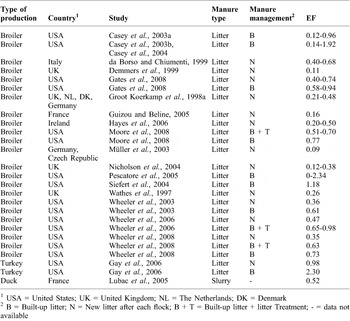
It has been demonstrated that during the rearing period, i.e. with increasing age and weight, N excretion per day per bird increases due to higher daily feed intake (NRC, Reference NRC1994; Smith et al., Reference SMITH, CHARLES and MOORHOUSE2000; Pope et al., Reference POPE, LOUPE, PILLAI and EMMERT2004; Applegate et al., Reference APPLEGATE, ADEDOKUN, POWERS and ANGEL2008). This increase in N excretion can lead to higher NH3 emissions, especially during the end of the rearing period. Consequently, reducing slaughter age would help to decrease emissions, since total N excretion would be lower. Pescatore et al. (Reference PESCATORE, CASEY and GATES2005) and Casey et al. (Reference CASEY, GATES, WHEELER, XIN, ZAJACZKOWSKI, TOPPER and LIANG2003a; Reference CASEY, GATES, WHEELER, ZAJACZKOWSKI, TOPPER, XIN and LIANG2003b; Reference CASEY, GATES, WHEELER, XIN, ZAJACZKOWSKI, TOPPER and LIANG2004) observed that broiler NH3 emissions were four to eight times higher during the finishing period than during the brooding period (Table 1). Although, no data on N excretion or feed intake was given, the observed increases in NH3 emissions can be partly explained by higher N excretion. Similarly, Wheeler et al. (Reference WHEELER, CASEY, GATES, XIN, ZAJACZKOWSKI, TOPPER, LIANG and PESCATORE2006) observed a 14 and 34% increase in NH3 emissions for broilers slaughtered at 49 and 63 days of age respectively, instead of at 42 days. Although no data were found in the literature, the same assumption can be made for turkey and duck production, since N excretion increases greatly with age, but not for layer production, because of the small variation in animal weight and N efficiency throughout the production cycle. In conclusion, shorter growth cycles in meat-poultry production could be a promising mitigating option. The benefits of this option are not known and need to be evaluated under commercial conditions.
Finally, it can be assumed that slaughter age and weight are likely major sources of variation in national inventories of emissions from poultry production because slaughter weights can vary greatly among countries. Gates et al. (Reference GATES, CASEY, WHEELER, XIN and PESCATORE2008) propose an alternative method for a national inventory in the United States (US), where animal categories depend on slaughter weight. Modelling the effect of age and weight can also help to represent the variability of N excreted per unit area among farms and countries due to animal density or to mortality.
Ammonia (NH3) emission factors (EF) (g d-1 bird-1) for different types of meat poultry production and manure-management practices.

1 USA = United States; UK = United Kingdom; NL = The Netherlands; DK = Denmark
2 B = Built-up litter; N = New litter after each flock; B + T = Built-up litter + litter Treatment; - = data not available
Manure moisture
Moisture is a major factor that influences NH3 emissions. In poultry houses, higher NH3 concentrations and emissions are usually observed when the litter has a high moisture content. Water plays a role in the aerobic decomposition of uric acid to NH3 by microorganisms (Figure 1). According to Groot Koerkamp (Reference GROOT KOERKAMP1994), the ammonification rate is highest when the moisture content of manure is between 40 and 60%, which is optimal for microbial growth.
In litter-based systems, such as broiler or turkey production, litter is often wetter near the drinkers because of water wasted by the birds. To limit water waste and its potential associated NH3 emissions, it is possible to replace bell drinkers with nipple drinkers. After doing so, Elwinger and Svensson (Reference ELWINGER and SVENSSON1996) observed a decrease (38-46%) in NH3 emissions, as did Nicholson et al. (Reference NICHOLSON, CHAMBERS and WALKER2004) (by 67%, albeit non-significant). Furthermore, Da Borso and Chiumenti (Reference DA BORSO and CHIUMENTI1999) observed that placing collecting bowls under nipple drinkers reduced NH3 emissions by about 40% (Table 1). The effect of drinkers on NH3 emissions should depend on animal density and outside temperature and humidity, but we found no published data to support this. Therefore, these EFs should be checked to determine if they would have significant effects on national emissions. To decrease its moisture content, litter can be dried using warm air blown through ducts placed above the litter surface. With such a system in aviary houses for laying hens, Groot Koerkamp et al. (Reference GROOT KOERKAMP, SPEELMAN and METZ1998b; Reference GROOT KOERKAMP, SPEELMAN and METZ1999a; Reference GROOT KOERKAMP, RAABEN, SPEELMAN and METZ1999b) managed to maintain litter dry-matter content above 90% and thus to limit NH3 volatilization, which was low compared to aviary houses without a litter drying system.
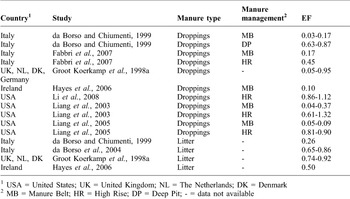
In commercial layer facilities, where laying hens are raised in cages and droppings are collected below the cages, two main manure-management systems are observed. In the first, known as a deep-pit or high-rise system (DP-HR), droppings are collected on baffles under the cages, where they remain for the entire laying cycle. In the second, known as a manure-belt (MB) system, droppings are collected on belts located under each tier of cages where the droppings dry before being removed to external storage. Concerning NH3, Groot Koerkamp et al. (Reference GROOT KOERKAMP, METZ, UENK, PHILLIPS, HOLDEN, SNEATH, SHORT, WHITE, HARTUNG, SEEDORF, SCHRODER, LINKERT, PEDERSEN, TAKAI, JOHNSEN and WATHES1998a) proposed EFs ranging from 0.05-0.95 g NH3 d-1 bird-1 for European laying hen facilities, with no specification of housing type (Table 2). However, the MB system (in combination or not with forced drying) decreases NH3 emissions and has been considered for several years the best technique available for NH3 mitigation in layer houses (European Commission, Reference EUROPEAN COMMISSION2003), mainly because droppings quickly dry on the belts (Groot Koerkamp, Reference GROOT KOERKAMP1994; Hartung and Philips, Reference HARTUNG and PHILIPS1994; van Horne et al., Reference VAN HORNE, BRAKE and WILLIAMS1998; European Commission, Reference EUROPEAN COMMISSION2003), which results in a decrease of hydrolysis of uric acid into NH3 (Figure 1). Chiumenti et al. (Reference CHIUMENTI, DA BORSO and PINOSA1992) observed that NH3 emissions could be more than 90% lower in MB systems than a DP-HR system. Similarly, Liang et al. (Reference LIANG, XIN, TANAKA, LEE, LI, WHEELER, GATES, ZAJACZKOWSKI, TOPPER and CASEY2003) observed an 83% decrease in NH3 emissions in this system. This observation was confirmed by Liang et al. (Reference LIANG, XIN, WHEELER, GATES, LI, ZAJACZKOWSKI, TOPPER, CASEY, BEHRENDS, BURNHAM and ZAJACZKOWSKI2005), who found a 92% decrease in NH3 emissions in MB compared to DP-HR systems. Furthermore, the MB value given by Liang et al. (Reference LIANG, XIN, WHEELER, GATES, LI, ZAJACZKOWSKI, TOPPER, CASEY, BEHRENDS, BURNHAM and ZAJACZKOWSKI2005) is consistent with that given by Hayes et al. (Reference HAYES, CURRAN and DODD2006). Fabbri et al. (Reference FABBRI, VALLI, GUARINO, COSTA and MAZZOTTA2007) proposed an EF for DP-HR systems 62% higher than that for MB systems. The decrease in NH3 emissions in MB systems can be higher when manure is dried on the belts by a manure drying system before being removed from the layer house. According to da Borso and Chiumenti (Reference DA BORSO and CHIUMENTI1999), NH3 emission decreases by 75-85% when a manure-drying system has been installed. These reductions were estimated in comparison with mean EFs for similar housing without a manure-drying system.
Ammonia (NH3) emission factors (EF) (g d-1 bird-1) for layer production for different manure types and manure-management practices.

1 USA = United States; UK = United Kingdom; NL = The Netherlands; DK = Denmark
2 MB = Manure Belt; HR = High Rise; DP = Deep Pit; - = data not available
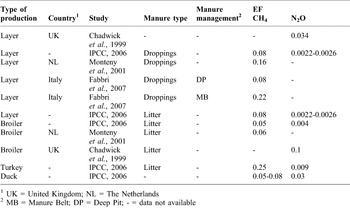
Concerning N2O emissions, Chadwick et al. (Reference CHADWICK, SNEATH, PHILLIPS and PAIN1999) proposed an EF of 0.034 g N2O d-1 bird-1 (assuming a mean live weight of 1.7 kg per hen), which is inconsistent with the EF given by the IPCC (Reference IPCC2006) of 0.0026 g N2O d-1 bird-1 (assuming the same mean live weight, Table 3). The value proposed by Chadwick et al. (Reference CHADWICK, SNEATH, PHILLIPS and PAIN1999) was obtained experimentally, whereas the IPCC's value was calculated from mean N excretion. Therefore, the order of magnitude of EFs (0.03 or 0.003 g N2O d-1 bird-1) should be checked if it has a significant impact on national inventories. In practice, moisture content should have a direct influence on N2O emissions, however no study was found in our review to document this effect. Unpublished observations have shown that at low moisture, moisture and N2O emissions are positively correlated, whereas they are negatively correlated at high moisture contents. An increase in moisture content may increase ammonification and nitrification due to higher microbial activity. At high moisture content, anaerobic conditions reduce nitrification and thus denitrification processes in manure (Figure 1). In poultry or layer facilities, we can assume that the level of representation of EFs for N2O emissions will depend on the variability in manure moisture among facilities.
Methane (CH4) and nitrous oxide (N2O) emission factors (EF) (g d-1 bird-1) for different types of poultry production and manure-management practices.

1 UK = United Kingdom; NL = The Netherlands
2 MB = Manure Belt; DP = Deep Pit; - = data not available
Concerning methane, the IPCC (Reference IPCC2006) and Monteny et al. (Reference MONTENY, GROENESTEIN and HILHORST2001) proposed EFs of 0.08 and 0.16 g CH4 d-1 bird-1 but failed to give any description of the manure-management system. These values are consistent with EFs given by Fabbri et al. (Reference FABBRI, VALLI, GUARINO, COSTA and MAZZOTTA2007): 0.08 and 0.22 g CH4 d-1 bird-1 for commercial DP-HR and MB systems, respectively. The authors explained the higher EF for the MB system was due to a higher moisture content of manure in this system, promoting anaerobic conditions. In practice, however, MB systems produce manure with lower moisture content; thus, since moisture promotes anaerobic conditions, CH4 emissions should be higher in DP-HR systems (Figure 1).
Only one study was found for slurry-based systems such as duck production (Lubac et al., Reference LUBAC, FORICHON, MARTIN PEULET, AUBERT and ROBIN2005), with an EF of 0.52 g NH3 d-1 bird-1. Although no water content of the slurry was given, we can assume that dilution of slurry also has an effect on NH3 emissions. Such an effect was indeed proposed for fattening pigs by Aarnink and Elzing (Reference AARNINK and ELZING1998), who showed an increase in NH3 emissions with increasing total ammoniacal N (i.e. decreasing dilution).
Manure renewal or built-up litter
In practice, reducing the time manure remains in the poultry house can decrease NH3 volatilisation both in litter and droppings systems (Groot Koerkamp, Reference GROOT KOERKAMP1994). In the US, litter frequently builds up over the course of several production cycles, whereas in Europe and Canada, litter is typically removed after each flock, and broilers and turkeys are raised on new litter. This management could explain the lower EFs found in Europe (Wathes et al., Reference WATHES, HOLDEN, SNEATH, WHITE and PHILLIPS1997; Groot Koerkamp et al., Reference GROOT KOERKAMP, METZ, UENK, PHILLIPS, HOLDEN, SNEATH, SHORT, WHITE, HARTUNG, SEEDORF, SCHRODER, LINKERT, PEDERSEN, TAKAI, JOHNSEN and WATHES1998a; Demmers et al., Reference DEMMERS, BURGESS, SHORT, PHILIPS, CLARK and WATHES1999; Müller et al., Reference MÜLLER, BRUNSCH, HÖRNIG and JELINEK2003; Guiziou and Beline, Reference GUIZIOU and BELINE2005; Hayes et al., Reference HAYES, CURRAN and DODD2006) compared to the US (Casey et al., Reference CASEY, GATES, WHEELER, XIN, ZAJACZKOWSKI, TOPPER and LIANG2003a; Reference CASEY, GATES, WHEELER, ZAJACZKOWSKI, TOPPER, XIN and LIANG2003b; Reference CASEY, GATES, WHEELER, XIN, ZAJACZKOWSKI, TOPPER and LIANG2004; Siefert et al., Reference SIEFERT, SCUDLARK, POTTER, SIMONSEN and SAVIDGE2004; Pescatore et al., Reference PESCATORE, CASEY and GATES2005). The corresponding EFs are reported in Table 1. Wheeler et al. (Reference WHEELER, CASEY, ZAJACZKOWSKI, TOPPER, GATES, XIN, LIANG and TANAKA2003; Reference WHEELER, CASEY, GATES, XIN, ZAJACZKOWSKI, TOPPER, LIANG and PESCATORE2006; Reference WHEELER, CASEY, GATES, XIN, TOPPER and LIANG2008) and Gates et al. (Reference GATES, CASEY, WHEELER, XIN and PESCATORE2008) compared both types of manure management in broilers. In these studies, changing the litter after each flock resulted in a reduction in NH3 emissions of 21-52%. The use of new litter after each flock seems an efficient option to limit NH3 emissions in turkey housing. Gay et al. (Reference GAY, WHEELER, ZAJACZKOWSKI and TOPPER2006) demonstrated that NH3 emissions increased by 135% when turkeys were raised on built-up litter rather than on new litter.
In layer houses using MB systems, manure can remain on belts for several days before being removed outside. The frequency of manure removal can decrease gaseous emissions, NH3 emission in particular, because the volatilization of NH3 increases with the amount of manure on the belts and the time manure remains on the belts (Groot Koerkamp et al., Reference GROOT KOERKAMP, KEEN, VANNIEKERK and SMIT1995; Groot Koerkamp and Elzing, Reference GROOT KOERKAMP and ELZING1996; Groot Koerkamp and Bleijenberg, Reference GROOT KOERKAMP and BLEIJENBERG1998). Liang et al. (Reference LIANG, XIN, WHEELER, GATES, LI, ZAJACZKOWSKI, TOPPER, CASEY, BEHRENDS, BURNHAM and ZAJACZKOWSKI2005) observed a 47% decrease in NH3 emissions when manure was removed daily instead of twice a week. EFs were 0.05 and 0.09 g NH3 d-1 bird-1 for daily and twice-weekly removal, respectively (Table 2).
Floor management
In litter-based systems, the nature of the initial bedding material used can influence NH3 emissions. Atapattu et al. (Reference ATAPATTU, SENARATNA and BELPAGODAGAMAGE2008) tested three types of broiler litter: sawdust, rice paddy husk and refused tea (a by-product of black-tea processing) and showed that litter type had a significant effect on NH3 emissions. With refused tea litter, NH3 emissions decreased by approximately 70% compared to sawdust or paddy-husk litters. Similarly, Lien et al. (Reference LIEN, HESS, CONNER, WOOD and SHELBY1998) reported a decrease (although not significant) in emissions in broiler-breeder pullet houses when peanut-hull litter was replaced by pine-shaving litter. Lastly, Nicholson et al. (Reference NICHOLSON, CHAMBERS and WALKER2004) demonstrated a 50% decrease in NH3 emissions by replacing straw (5 cm deep) with wood shavings (7.5 cm deep). EFs were 0.23 and 0.12 g NH3 d-1 bird-1 for straw and wood shavings (assuming a mean weight at slaughter of 2 kg), respectively (Table 1). These results can be explained by the influence of litter type on the structure and porosity of the litter and on the resulting microbial activity. Since NH3 volatilisation depends on the C:N ratio and nutrient availability (Paillat et al., Reference PAILLAT, ROBIN, HASSOUNA and LETERME2005), it can be assumed that the amount of litter influences NH3 emissions as a function of the N excreted by birds. Articles describing this effect were not found in our review of the available data. For layers raised in cages, floor type appears to have an influence on NH3 emissions, as shown by da Borso and Chiumenti (Reference DA BORSO and CHIUMENTI1999) who found that NH3 emissions were 28% lower on wire mesh floors than on solid floors.
Indoor conditions and ventilation rate
At first sight, NH3 emissions from poultry houses seem to increase in warmer conditions as observed by da Borso and Chiumenti (Reference DA BORSO and CHIUMENTI1999), Liang et al. (Reference LIANG, XIN, TANAKA, LEE, LI, WHEELER, GATES, ZAJACZKOWSKI, TOPPER and CASEY2003), da Borso et al. (Reference DA BORSO, CHIUMENTI and RODAR2004) and Hayes et al. (Reference HAYES, CURRAN and DODD2006), who found summer emissions were two to six times higher than winter emissions. However, the observed increase in emissions should be related to the increase in ventilation rates and not temperature, since in modern poultry houses, indoor temperature may have low variability, as Groot Koerkamp et al. (Reference GROOT KOERKAMP, METZ, UENK, PHILLIPS, HOLDEN, SNEATH, SHORT, WHITE, HARTUNG, SEEDORF, SCHRODER, LINKERT, PEDERSEN, TAKAI, JOHNSEN and WATHES1998a) concluded after they found a significant effect of outdoor temperature on NH3 emissions. Thus, Casey et al. (Reference CASEY, GATES, WHEELER, XIN, ZAJACZKOWSKI, TOPPER and LIANG2003a) observed a strong correlation (R² = 0.81) between the ventilation rate in broiler housing (m3 per hour per 1000 birds) and the NH3 EF (g NH3 d-1 bird-1), with a slope of 3.6x10⁻⁴. Since ventilation rate is positively correlated to bird age, the increase in emissions can be explained by an increase in N excretion and moisture. Nevertheless, increasing the ventilation rate can increase the air speed above the litter surface and have opposite effects on NH3 emissions (Figure 1). In the short term, this action will increase NH3 emissions because volatilisation depends on air movement close to the emitting surface (Groot Koerkamp, Reference GROOT KOERKAMP1994; Hartung and Philips, Reference HARTUNG and PHILIPS1994), while in the long term it will decrease NH3 emissions because it induces a drier litter (Groot Koerkamp, Reference GROOT KOERKAMP1994).
Indoor climatic conditions (relative humidity and temperature of air) can indirectly influence NH3 emissions through the moisture content of manure. Higher temperatures above the manure surface will increase the evaporation rate of water, while higher relative humidity will decrease evaporation (Groot Koerkamp, Reference GROOT KOERKAMP1994; Groot Koerkamp et al., Reference GROOT KOERKAMP, SPEELMAN and METZ1999a). Water and gas exchanges between air and litter decrease when animal density increases (in number and weight). The specific influence of animal density on water input and evaporation per unit area was not included in the model of Groot Koerkamp et al. (Reference GROOT KOERKAMP, SPEELMAN and METZ1998b; Reference GROOT KOERKAMP, SPEELMAN and METZ1999a; Reference GROOT KOERKAMP, RAABEN, SPEELMAN and METZ1999b). This influence can be neglected at a national scale, in which animal density varies in a relatively narrow range. But since animal density varies widely on an international scale, it should be included as independent variable in such a regression model applied at an international scale.
Temperature also has a direct influence on CH4 emissions. The IPCC (Reference IPCC2006) proposed two CH4 EFs for duck production (on litter) depending on ambient temperature (0.05 and 0.08 g CH4 d-1 bird-1 when annual average outside temperature is below or above 15°C, respectively). In slurry-based systems, the effect of temperature on methane emissions was also proposed by Vedrenne (Reference VEDRENNE2006) according to the following equation :
EFCH4(T) = EFCH4(20°C) x 1.12(T-20)
where T is the temperature (between 4 and 30°C) and EFCH4(20°C) the CH4 emission factor at 20°C.
Litter treatment
Manure pH is a major factor that influences NH3 emissions from poultry manure. The pH influences enzymatic reactions involved in the degradation of uric acid and undigested proteins (Figure 1). Above 5.5, pH increases degradation rates with the optimal pH for the degradation of uric acid being approximately pH 9 (Groot Koerkamp, Reference GROOT KOERKAMP1994). The pH also affects the equilibrium between NH4+ and NH3 (Figure 1). Manure pH below 7 prevents NH3 volatilisation because, under these conditions, NH3 is bound as NH4+ in the liquid phase (Groot Koerkamp, Reference GROOT KOERKAMP1994; Hartung and Philips, Reference HARTUNG and PHILIPS1994).
Litter can be treated to reduce NH3 emissions. A wide variety of treatments exist to lower litter pH to inhibit the production of NH3. These treatments are frequently used in housing with built-up litter to reduce NH3 emissions after several production cycles. Wheeler et al. (Reference WHEELER, CASEY, GATES, XIN, TOPPER and LIANG2008) reported a 14% decrease in NH3 emissions in broiler housing with built-up litter treated with acid compared to an untreated control. Moore et al. (Reference MOORE, MILES, BURNS, POTE and BERG2008) observed a decrease in NH3 emissions by 26-47% by adding alum to built-up litter (broiler housing) compared to an untreated control litter. They confirmed the results reported by Moore et al. (Reference MOORE, DANIEL, EDWARDS and MILLER1996), who observed that alum treatment reduced NH3 emissions by 71-95%, and phosphoric acid reduced emissions by 56-92% (Table 1).
Furthermore, as NH3 is a by-product of microbial degradation of urea, uric acid, and undigested proteins, a further strategy involves blocking enzymatic activities in litter. Singh et al. (Reference SINGH, CASEY, KING, PESCATORE, GATES and FORD2009) tested the effect of a urease inhibitor (N-(n-Butyl)thiophosphorictriamide; NBPT) on NH3 emissions from layer droppings and broiler litter. Results showed that NBPT has the potential to reduce NH3 emissions in layer production when applied frequently on droppings. Yet, no significant effect was observed when NBPT was applied to broiler litter, but the low litter moisture content (13-17%) could have reduced the impact of the urease inhibitor. Although these mitigation options seem efficient to prevent NH3 volatilization from manure, their performance and financial cost will depend on national contexts.
Discussion and conclusions
Several factors influencing emissions were identified from a literature review to outline major options to reduce NH3 and GHG emissions in poultry housing. Gaseous emissions are known to be directly influenced by:
• Flock management practices and rearing conditions:
o dietary manipulation (reduction in CP content, phase feeding, amino-acid supply, diet acidification)
o age and weight at slaughter
o ventilation rates and indoor temperature
• Manure-management practices:
o manure type and characteristics (moisture and N content, pH, litter type)
o manure drying
o manure-removal frequency
o manure treatment (acidification, urease inhibitors)
Other factors can be expected to have an influence, such as litter amount (initial amount or regular inputs), flocking density, mortality, temperature and moisture of outside air, but their effect on emissions could not be quantified from our review of the data currently available. Interactions and potential synergies or compensations between various effects have been little studied. The variability of results within the literature is high, and differences between expected results and real emissions in commercial farms are often observed. This variability cannot be fully explained because the level of knowledge is still poor and, as a consequence, the uncertainties in gas inventories are still important. To better understand interactions between influential factors and to improve inventories, empirical knowledge should be integrated in a modelling approach associating animal and manure modelling at the scale of a commercial poultry-house. The model should represent water, carbon and nitrogen dynamics; bird age and weight; and a variety of climate conditions and farming practices to predict their influence on NH3 and GHG emissions. It should be validated using animal, manure and emission measurements at the poultry-house level. This approach was begun by Groot Koerkamp et al. (Reference GROOT KOERKAMP, SPEELMAN and METZ1998b; Reference GROOT KOERKAMP, SPEELMAN and METZ1999a; Reference GROOT KOERKAMP, RAABEN, SPEELMAN and METZ1999b) in a model that represented only laying hens but did not consider animal density. If such a model were developed and its level of representation validated at the national level, it could be used to (i) decrease uncertainties in emissions inventories by updating EFs at national scales (‘tier 2’ approach (IPCC, Reference IPCC2000)) and (ii) determine mitigation scenarios on the basis of actual management options at a national scale. The efficiency of the options and the cost of the various scenarios should be evaluated before implementing these mitigation options on a large scale.
The literature review identified the need for further data and the lack of information concerning feed, growth rate, and animal density. Only one study (Aarnink et al., Reference AARNINK, HOL and BEURSKENS2006), evaluating gaseous emissions from poultry-production systems with outdoor access, was found in the literature. Yet these systems tend to develop quickly in response to social demand for high-quality products, improved animal welfare and environmental protection (extensive systems). More studies are required to improve estimates of NH3 and GHG emissions from both the housing and the associated outdoor runs of these systems. Likewise, data concerning GHG emissions from poultry houses remain scarce. Even though NH3 remains the major gas emitted by poultry housing, modelling and validating of EFs should also include GHG emissions since climate change is a strong societal concern and is considered one of the most important environmental issues of the 21st century (UNFCCC, Reference UNFCCC2009).
This paper focused only on emissions from poultry houses. To perform complete inventories of gaseous emissions from poultry production, the contribution of manure storage and manure spreading to total emissions should be evaluated (approximately 60% of total CH4 and N2O emissions from French poultry production and ~35% of total NH3, according to Gac et al., Reference GAC, BELINE, BIOTEAU and MAGUET2007). EFs for specific manure types and practices should be proposed and their influential factors identified so that best management practices can be implemented to mitigate emissions. To prevent pollution swapping, we suggest that NH3 and GHG-mitigation options should be evaluated simultaneously and at the farm scale, as recommended by Rotz (Reference ROTZ2004). Finally, other environmental concerns (e.g. reducing nitrate leaching) could also be included, as recommended by Monteny et al. (Reference MONTENY, BANNINK and CHADWICK2006). Such system-level multi-criteria analysis would provide a basis for comparing different poultry-production systems and the influence of potential impact-mitigation strategies.