Not very often does a work of art, which provoked very mixed reactions at the time of its completion, continue to stir the political and cultural waters nearly one hundred years later. The Slav Epic, a series of twenty large canvases created by Alfons Mucha (1860–1939) between 1909 and 1926 on the topic of Slavic history and myth, is such a work, and it has provoked critical comments from Czech art historians, politicians, and journalists.Footnote 1 The most recent disputes, which have arisen in the last couple of years, concern the city council of Prague, which has expressed a wish to house the work somewhere in Prague in fulfillment of the artist's wishes, and the town of Moravský Krumlov in Mucha's home region, where the Epic was exhibited for forty years and lays claims to it as well. The debate about its physical location has also been joined by a number of public figures, including Mucha's grandson and the secretary to the then Czech president Václav Klaus, who called the Epic “the kitsch of the millennium” and “sheer Pan-Slavic propaganda.”Footnote 2 Such negative comments only highlight the fact that the Slav Epic continues to generate controversy and has not yet found its place in the Czech, let alone European, context.
These mixed attitudes toward Mucha's grand project are nothing new. In the view of Mucha's contemporaries who criticized his work, the artist was a commercial bourgeois artist who should be disregarded.Footnote 3 At the same time, it is not surprising that Czech nationalists of the early twentieth century saw him as “a true patriot and a genius” who managed to express the fate of his nation and fellow Slavic groups in “his modern painting.”Footnote 4 The responses to Mucha's work at the time and the circumstances under which the Slav Epic was created frame this article, which aims to locate the work in the cultural and political context of its time. I am not so interested in offering interpretations of the individual paintings or in passing aesthetic judgments on them; these can be found elsewhere.Footnote 5 Rather, I focus on the ideological and intellectual setting in which it was created and in which Mucha's work can be found now. This includes an examination of the relationship between the work and the philosophical and political beliefs of the time, as well as the seemingly outdated views of nationalism and patriotism that permeated the Epic. I shall argue that these circumstances both had a strong influence on the content of the work and played a vital role in generating the diversity of reactions and responses about the intellectual, artistic, and physical place of Mucha's work.
Mucha and the Making of the Czech Nation
Alfons Mucha is mainly known as a decorative artist who represented “the spirit of Art Nouveau”Footnote 6 and was “a master of the Belle Époque.”Footnote 7 His lithographs for posters and magazine covers, jewelry, furniture, and theatre designs bear a recognizable visual language—“le style Mucha”—that is often associated with Mucha's stay in Paris in the late nineteenth century. After an interest in art nouveau was revived in the 1960s and 1970s, Mucha's reputation grew both in the West and in Central Europe.Footnote 8 Yet, although the amount of decorative work Mucha produced in Paris is large, it comprises only a fraction of his oeuvre. Some recent commentators, therefore, started pointing to other aspects of Mucha's work that go beyond his commercial designs and turned attention to his photographic works or those that depict historical themes.Footnote 9 The Slav Epic is amongst the works that have been recently rediscovered and reinterpreted, often in relation to their content and artistic merits or failings.Footnote 10
The Epic itself, financed by the American millionaire Charles Richard Crane (1858–1939), is a series of twenty enormous canvases, of which the eight smallest ones are 4.80 × 4.05 m in size, one 6.10 × 4.05 m, four 6.20 × 4.05 m, and the largest seven paintings of 6.10 × 8.10 m. The paintings explore the history of the Slavs from their earliest to modern history and present a combination of mythological and historical subjects in the tradition of Czech nineteenth-century history painting. The individual works of the Epic can be roughly grouped on the basis of their subject matter. The opening three works focus on the earliest history of the Slavs, which aim to outline their arrival at their mythical homeland between the rivers Oder and Dnieper, and early pre-Christian and Christian celebrations.Footnote 11 There is a further cluster of six paintings that depict the wider Slavic history of the Bulgarians, Croats, Serbs, Russians, and Orthodox Greeks,Footnote 12 as well as additional paintings on themes related to Bohemia that depict events, places, and individual figures from Czech history. In this group, Mucha first focused on the fourteenth- and fifteenth-century reformist movement of the Hussites formed after the preacher Jan Hus was burned at stake at the Council of Konstanz in 1415,Footnote 13 but he also included a selection of thinkers and rulers of Bohemia who preceded or succeeded the Hussites.Footnote 14 Finally, he added two paintings that represented the recent history of Bohemia and Slavdom more generally and focused on events from the late nineteenth century and the “emancipation” year of 1918.Footnote 15
In order to understand the cultural, artistic, and political environment in which the Slav Epic was created and the motivations that led to its final appearance, an overview of the historical and artistic context in which the author worked is necessary. Mucha started his studies at the Munich Art Academy in 1885 and eventually moved to France two years later. While still living in Paris, he became involved in the 1900 Exposition Universelle, for which he designed the unrealized Pavillon de l'Homme and some minor works, including the cover of the official catalogue of the Austrian section. More importantly in relation to the Slav Epic, a team of organizers from Austria-Hungary, represented by the Orientalist Georg Heinrich Moser and Wilhelm Franz Exner, the director of The Imperial and Royal Museum of Technology and Industry in Vienna, approached him with several commissions. This included designing one side of a poster for the Austrian Exhibition, which depicted a personification of Austria and Paris, as well as the cover of the official catalogue.Footnote 16 Mucha was also asked to decorate the pavilion for Bosnia and Herzegovina, which had been administered by Austria since 1878. The inclusion of this pavilion between the separate Austrian and Hungarian expositions was a political gesture intended to serve as evidence of the enlightened Austrian administration of the province.Footnote 17 The building was also the only one solely dedicated to an ethnic or administrative region in the Habsburg monarchy—individual pavilions of Galicia, Bukovina, Moravia, or Bohemia, for example, were not included in this exhibition.
The Bosnia and Herzegovina pavilion consisted of a central hall with mural paintings by Mucha and chambers to each side with individual sections on, for example, the contemporary Bosnian interior, the harem, or archaeology.Footnote 18 Mucha's historical, allegorical, and religious paintings, which won a silver medal at the Exposition, depicted narrative scenes from the history of the southern Slavs: their prehistory, antiquity, and arrival and the first Christian faith-bearers and religions, complemented by the mythological paintings of Bosnian legends and an allegory Bosnia Offers Her Products to the World Exhibition.Footnote 19
When preparing these murals, Mucha traveled several times to Bosnia and Herzegovina at the expense of the Austrian government and made a number of sketches of the countryside, local people, their costumes, and folk artifacts.Footnote 20 During these travels, he started creating a depository of images, poses, and sketches, which he would later use for his other works. Ironically, it was while working on the pavilion paintings—i.e., while executing a commission for the Austrian government, for which he was made the Knight of the Order of Francis Joseph I—that Mucha arrived at the idea of creating his own, personal homage to the Slavs and to the Czechs: the Slav Epic that would depict their journey through history to eventual emancipation from the Austrians and Habsburgs.
Such discrepancy is, however, not all that surprising when judged against other examples of Mucha's work. Although the artist saw himself as a Czech patriot from very early on, at the end of the nineteenth century, he was an enterprising artist who took on a variety of jobs, regardless of who commissioned them. This included, for example, his contribution to the celebratory publication on Francis Joseph in 1898, which portrayed the monarch in text and images as a single “beacon of stability in a changing world.”Footnote 21 In 1908, Mucha received a contract to decorate the German Theatre in New York, work that coincided with one of Mucha's seven trips to the United States made between 1904 and 1921, during which he worked on portraits and various decorative designs for wealthy American clients.Footnote 22
Alongside these international—and highly lucrative—commissions, Mucha gradually turned his attention to Bohemia and to topics related to its history, in which he could express his patriotic feelings, mobilized during his extensive stay abroad. As he noted during his Paris stay, he started feeling “indebted to the people … of Prague, of Bohemia” and decided to devote half of his life to his “debtor who is impatiently waiting.”Footnote 23 He began to form the idea of paying homage to the Slavs in 1912 when he was invited to decorate the Municipal House (Obecní dům) in Prague with allegorical human virtues and historical figures of Bohemia, which was his first large cycle depicting Czech history. And it was this work, or the reception of it, that announced the future controversies over Mucha's position within Czech cultural and artistic life.
Designed by the Czech architects Osvald Polívka (1854–1900) and Antonín Balšánek (1865–1921) between 1903 and 1912, the Municipal House was built for Czech cultural and social events. The representative building was initiated by the Czech Burgher's Club (Měšťanská beseda) as a celebration of the city of Prague, the Czech people, and the Slavic “nation.” Importantly, it was meant to serve as a lavishly decorated—and expensive—response to the older German House, run by the German association Deutsches Kasino in the center of Prague.Footnote 24 The Municipal House, built not far from its German counterpart, therefore served the Czechs as a concert hall, exhibition hall, and meeting place.
The interior and exterior drew on a number of artistic languages, but art nouveau was dominant. Yet, it also had many neo-baroque and neo-romantic references, and this proved to be a controversial choice for a patriotic building of this importance. Already at its opening, the Municipal House was criticized as an exercise in reactionary narrow-minded nationalism on the part of artists and architects who were quickly being replaced by a younger generation.Footnote 25 Criticisms were voiced by progressive Czech artists and critics who viewed art nouveau and Secessionist architecture as an anachronism from the nineteenth century that was completely unsuited to modern life. At the same time, Secessionism was also criticized by conservative Czech nationalists, who saw it as a Viennese import incongruent with a “Czech national style,” as it was being formulated from the end of the nineteenth century.Footnote 26
Nevertheless, Národní listy [The National Gazette], a prominent daily newspaper, saw the Municipal House with its “splendid, unique halls decorated in a truly fabulous fashion” as a mirror of the richness of contemporary Czech culture.Footnote 27 The debate about the Municipal House conducted in newspapers and journals in many ways reflected the broader attempts in Czech society to continue mobilizing Czech national sentiments and to make them relevant to the new century. Despite an increasing political polarization between Czechs and Germans in Prague, with growing divisions along lines of class or occupation and the emergence of new parties, including the Agrarians and the Catholics, the Czech politicians usually held together on national questions.Footnote 28 As nationalism on both Czech and German sides gained increasing force around the turn of the century, with Prague being transformed into a primarily Czech and Slavic city, the establishment of solely Czech institutions, including schools, universities, and cultural centers, such as the Municipal House, was widely promoted.
The political fragmentation of Prague had parallels in the development of the arts in this period. The completion of the Municipal House and Mucha's contribution to it was preceded and accompanied by a search for new and much more progressive means of expression in the visual arts. From the end of the nineteenth century onwards, new art clubs and groups were formed that attempted to engage with international developments in art and move away from the nationalist focus of previous decades. 1912 was the year when a number of cubist buildings were started or completed in Prague and around Bohemia as a response to the international cubist movement. These included the nearby House at the Black Madonna (dům U Černé Matky Boží) designed by Josef Gočár, Josef Chochol's apartment buildings in Prague, the designs by Pavel Janák in Pelhřimov, or Jan Kotěra's Regional Museum in Hradec Králové. Simultaneously, Czech artists such as Emil Filla, Bohumil Kubišta, and Otto Gutfreund started experimenting with new forms of cubist expression in painting and sculpture, and a number of exhibitions of contemporary art from abroad were opened.Footnote 29 Edvard Munch's work was exhibited in Prague in 1905, and a number of contemporary French artists, including Paul Cézanne and Honoré Daumier, were also shown in 1907. In 1912, works by Pablo Picasso, André Derain, Ernst Ludwig Kirchner, and Karl Schmidt-Rottluff were included in an exhibition staged by the progressive Group of Visual Artists (Skupina výtvarných umělců).Footnote 30 In this setting, Mucha's highly ornamental and decorative paintings for the Municipal House could easily be seen as out of fashion, as well as lacking the vigor of his previous work.Footnote 31 And indeed, in more critical terms, critics condemned them for their “ridiculous” monumentality and decorativeness and for the lack of any attempt to create ideological and material unity with the interior architecture.Footnote 32
On the other hand, the search for a “national identity” in art and architecture, which had been a crucial topic in Bohemia and Moravia for many previous decades, continued well into the twentieth century. Artists, architects, and theorists had been trying to establish typical Czech features in the visual arts that would relate to Czech history, character, and land, and which would be distinguishable from “foreign,” especially German, features. Examples of specific manifestations of attempts to project national identity into the arts can be found not only in the works of art that extended the academic tradition of the previous century, but also in, for example, the long-lasting interest in folk art that was closely associated with the distinctively Czech ethnicity and traditions.Footnote 33
Regionalism and vernacularism remained popular well into the twentieth century, and peasant motifs, especially from eastern and southern regions of Moravia and from Slovakia, continued to be used by many artists and designers. Applied and decorative arts, as well as architecture, which is often associated with modernist, especially cubist tendencies, frequently used explicit references to folk art. The work of Pavel Janák, an architect and designer associated with Artěl, a commercially motivated association of artists and designers, can serve as a good example of such application.Footnote 34 Janák's furniture or ceramics, as well as many of his architectural designs from the early 1920s, applied what he believed was “authentic” ornamentation and decoration that drew on what he held to be Moravian and Slovak vernacular culture and ancient, Old Slavic folk art.Footnote 35
Mucha, too, was captivated by the rural regions of his native Moravia, as well as by the regions further afield, and attempted to capture the ancient Slavic character of the people. In a number of paintings and posters for Czech and Moravian institutions and organizations, he depicted figures in idealized versions of regional costume, emphasizing their decorative and floral quality in the tradition of painters such as Mikoláš Aleš (1853–1913) or Josef Mánes (1820–1871), who painted idyllic village scenes and romanticized peasants. Mucha designed numerous posters for regional exhibitions, such as The Exhibition of Economy, Industries and Ethnography in Vyškov in 1902 or the Regional Fair in his hometown of Ivančice in 1912, or for large social events such as the Sixth Convention of the Sokol sports organization from 1912, with stylized ornamental details organized around a central figure. The main figure, or figures, materialized Mucha's image of the rural idyll represented as a female in a regional costume and with a dreamy expression. This dreamy innocence in the women's faces, reminiscent of images of the Virgin Mary, replaced Mucha's earlier emphasis on women stylized in the role of Mary Magdalene—the sexualized femme fatale with a seductive gaze, typical of his Parisian works.Footnote 36
Similar tendencies to find inspiration in folk art were also prominent in painting, in, for example, the work of Mucha's acquaintance, Joža Uprka (1861–1940), who often depicted peasants in colorful festive clothes. Uprka, educated in Prague and Munich and settled in his native east Moravia, used an academic approach influenced by impressionism to depict the atmosphere of the village life.Footnote 37 Mucha was friendly with Uprka from their first encounter in Munich and helped to organize a visit to his studio by August Rodin in 1902, who held an influential exhibition in Prague in the same year.Footnote 38 Mucha joined a group of Czech artists from Prague—e.g., Zdenka Braunerová, Josef Mařatka, and Stanislav Sucharda—to show Rodin the cultural and natural spectacles of Moravia in the hope that this would help Mucha enter the Czech artistic circles.Footnote 39 The connection between Czech and French artists that Mucha and Rodin represented, however, was not sufficient, and Mucha's involvement with the Austrian government on the commissions for the 1900 exposition universelle was used against him by many Czechs.Footnote 40
Mucha very much wished to reconnect with the Czech art world, despite the fact that for a long time he was unfamiliar with Prague as a result of his long absence from the city.Footnote 41 He nevertheless aspired to become a national artist and saw the Slav Epic as a means of repaying a personal debt to his homeland.Footnote 42 He was convinced that each work of art should be the honest and personal expression of the artist's soul so that it would reflect “his own authenticity from the point of view of the period as well as of the racial, or national belonging.”Footnote 43 Such works, in his view, should add to the riches of national art, and the inherent “authentic, Slavic beauty” of such works should be spread across other regions of the Slavic people.Footnote 44 The national traditions he wished to advance should be grounded in the art of the nation's ancestors, which would conserve and retain such traditions for the future.Footnote 45 The patriotism of such art would give people “spiritual elevation... happiness and love.”Footnote 46
Mucha admired the work of the Czech academic painters of historical scenes, and he strongly believed that this tradition of Czech painting should be preserved as it was endangered by modern art. He saw himself as a follower of painters often regarded by the Czech revivalists as authentically national; the influence of Václav Brožík (1851–1901), Vojtěch Hynais (1854–1925), and Luděk Marold (1865–1898) on Mucha's work is apparent in the composition, color scheme, or romanticized subject matters. At the end of the nineteenth century, both Brožík and Hynais attempted to combine historical or mythical figures with “typical” Bohemian landscapes in monumental compositions of historic scenes.Footnote 47 Marold's enormous panorama of the Battle of Lipany (1898), displayed for the first time at the Exhibition of Architecture and Engineering in Prague in the year of its completion, tackled the same subject as Mucha, for whom Marold's version symbolized a work to “[encourage] national enthusiasm in our dear Czech people.”Footnote 48 Mucha also found inspiration in the work of Aleš, who was also frequently associated with the tradition of depicting national subjects. His cycles representing the Slavs—The Life of the Old Slavs (1891), the Homeland (1877–1881), and the unrealized Slavia cycle—were, however, executed on a much smaller scale, which Mucha amplified in his project fifty years later.Footnote 49
Mucha's belief in the Slavic legacy of his art and its place within Czech national art was related to a more general tendency across Central Europe in the late nineteenth century. History painting linked to the idea of nation-building and national preservation survived not only in Bohemia, but also in Poland or Hungary.Footnote 50 A number of Polish painters, including Jan Matejko (1838–1893) and Juliusz Kossak (1824–1899), focused on Polish history or myths and legends that celebrated the Poles as a national group.Footnote 51 Similar attempts, but in relation to the Magyars of Hungary, were made by Árpád Feszty (1856–1914), whose paintings focused on the early history of Hungary.Footnote 52 Apart from their grand scale, these history paintings that were executed across Central Europe shared a descriptive and didactic approach to topics of national importance. They commonly mythologized the histories of the “nations in the making,” which were the primary subjects, as well as objects, of the works and served as propaganda for nationalist causes.
The conservative artistic tendencies in Mucha's work could be understood as congruent not only with his patriotic beliefs, but also with his own antagonistic attitude to modernism. In a turn away from his earlier embrace of art nouveau, Mucha became convinced that it was the ethical and moral responsibility of the artist to be embedded in the tradition of national painting, and he was critical of the idea of internationalism in art.Footnote 53 In a late speech at the opening of an exhibition of his graphic works in 1936, he described contemporary (modern) art as lacking the power to penetrate a man's soul or to collaborate in the spiritual development of mankind.Footnote 54 He attacked the idea of “the right of everyone to create art,” which was clearly directed at Czech futurists and constructivists, of whom the most prominent was the visual artist, art critic, and theorist Karel Teige (1900–1951). Teige openly despised the elitist status of academic, bourgeois art and had called for a proletarian art that could be created by all with the help of new technologies of production and reproduction.Footnote 55 Although Mucha did not want to deny anybody the right to create art, in his view, artists should not attempt to destroy other works of art in the way the futurists wanted. Any art, Mucha believed, belongs to the nation's tradition, and “the tradition of the nation is not owned by the artist—it is owned by the nation. If [the artist] was not able to augment these riches, he must, at least, pass them onto his successors undiminished and undestroyed.”Footnote 56
An Epic Journey
Czech artistic and political life in the late nineteenth and early twentieth centuries thus involved not a straightforward embrace of progressivism, modernism, and cosmopolitanism, on the one hand, or of conservativism, traditionalism, and academism, on the other. Rather, it was a complex combination of all of those tendencies. Mucha's work, especially the Slav Epic, was situated in a similarly mixed environment of continuing emphasis on Czech national identity, alongside a growing rationalism and emerging internationally oriented modernism, which were streams that sometimes stood in conflict, but at other times were rather complementary of each other.
In contrast to the murals in the Municipal House, which were very much influenced by the building's architects, the Slav Epic was a much more personal project of the artist, and Mucha was consequently able to express his sentiments toward his native Czech lands more freely. As early as 1912, the art historian Karel Chytil recognized Mucha's beliefs, referring to the “philosophy of Slavic history he constructed by intuition and imagination.”Footnote 57 A large part of the artist's image of what such history should consist of was influenced by his extended stay abroad—he left his homeland in the 1880s, at the height of the national revival, and returned in 1910, by which time much had changed. Yet, although the idea of creating a history of the Slavic peoples and the Czechs came from Mucha himself, it was executed with financial help from Charles Crane, whom Mucha met in 1904 while he was working on portraits and decorations in the United States. According to Mucha, Crane, an ardent Slavophile, was immediately sympathetic to the idea of creating a Slavic cycle of paintings and helped to realize his dream with the indispensable monetary support.Footnote 58
Crane, whose family made a fortune from plumbing and elevators, owned a rich collection of Russian orthodox icons and other artistic objects.Footnote 59 After the 1917 Soviet revolution, he supported the Russian Orthodox Church and exiled Russian intellectuals.Footnote 60 His engagement with Slavic cultural politics brought him to Russia several times. He visited the Czechoslavic Ethnographic Exhibition in Prague in 1895 and befriended the future Czechoslovak president, Tomáš Garrigue Masaryk, to whom he later became related through the marriage of his daughter Frances to Masaryk's son Jan.Footnote 61
Crane's enthusiasm for the Slavs, although based on limited knowledge, was typical of the feeling toward the Slavic peoples in certain circles of American society at the beginning of the twentieth century. Czech interests, for example, were frequently publicized by visits and lectures of Masaryk, who often traveled to Chicago, New York, or Boston (1902, 1907, 1918).Footnote 62 Many aspects of Czech culture were promoted at numerous occasions in the United States—the performance of Smetana's sentimental composition Má vlast [My Country] in Boston (1908) was a particular success (and Mucha attended this event), as was Antonín Dvořák's stay in New York a decade earlier (1892–1895).
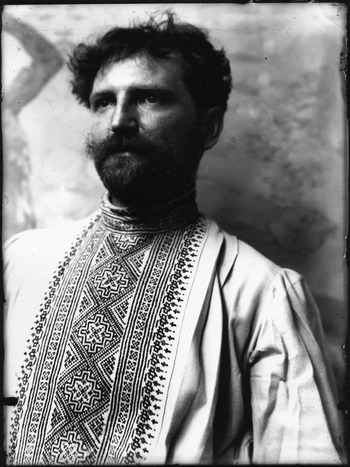
Mucha also enjoyed considerable success in the United States, although less with his portraits than with his decorative art and design, as he had hoped.Footnote 63 A number of newspapers and magazines published articles about him; the New York Daily News referred to him as “the Greatest Decorative Artist Alive in the World,”Footnote 64 while a correspondent for the Chicago Tribute claimed that Mucha's “work is never without the spark of his ever present genius.”Footnote 65 Mucha also fostered the image of an eccentric European artist here; he painted in a large, embroidered shirt that he wore for the American press and cultivated a “foreign” accent, which was a mixture of French and English (see fig. 1). In addition to portraits, panneaux, posters, and interior decoration of private houses or public buildings, such as the German Theatre, Mucha promoted himself and his art through lectures and art classes that he delivered at the Art Institute of Chicago and the New York School for Applied Design for Women, where he taught between 1905 and 1909.Footnote 66 It should also be noted that in both cities Mucha was surrounded by a substantial group of migrants from Bohemia, which included a number of artists. Indeed, New York was the seat of the Czechoslovak Arts Club while the Chicago Art Institute had a Czech professor of sculpture.Footnote 67 Mucha was also regarded as a kind of an expert on the questions of female beauty, and he commented on the topic for a number of American newspapers and journals. The publication of his praise of American women, whom he preferred over English “beauties,” or his comments on men's partiality to red-haired women, suggests that Mucha managed to gain wider popularity and good reputation in American society.Footnote 68
Alfons Mucha in an embroidered Russian blouse, ca. 1896. © Mucha Trust 2014.

Mucha also held several exhibitions in the United States, which contributed to his renown there; in 1920, he exhibited five of the paintings of the Slav Epic in the Chicago's Art Institute. In 1921, he displayed them along with other works at the Brooklyn Museum of Art and, later in the same year, at the New York School of Applied Design for Women.Footnote 69 All three exhibitions were a success, and his audiences were clearly sympathetic to his ideals. For the author of the Brooklyn Museum catalogue, “Alfons Mucha is an ardent apostle of nationalism in art” who created “imposing mural compositions, which so graphically depict the determination of the Slavic peoples to cast off the yoke of the oppressor, whether temporal or spiritual.”Footnote 70 Similarly, a review in the Chicago Tribune concluded that “Taking [the paintings] as a whole, one can say frankly that they typify excellence in composition, in drawing—a point that is not always true when such vast subjects are considered—in color harmony, in vitality, and in sincere exposition of a tragic history.”Footnote 71 The curator of the Brooklyn Museum, William H. Goodyear, sent a personal appraisal to Mucha, noting, “I consider your mural paintings to be of the greatest works of their class since the time of the early sixteenth-century Italian artists.”Footnote 72
For Goodyear, Mucha's Epic combined the worthiness of the national cause it pursued with the greatness of classical Italian art. The success and appreciation of Mucha's monumental work was the result of, in part, the prevailing taste in American art at the beginning of the twentieth century, for his artistic conservatism struck a chord with the American middle and upper classes.Footnote 73
Between Myth and Democracy: Inclusions and Exclusions
These positive responses significantly strengthened Mucha's personal belief in his project, the visual language he used, and the topics he chose to depict. As he spent almost two decades working on the Epic, the various cultural, artistic, and geographical conditions he lived in had an undeniable effect on him. Moreover, political and philosophical influences also found its way into the Slav Epic and linked both the artist and the work more closely to contemporary life in Bohemia and Czechoslovakia.
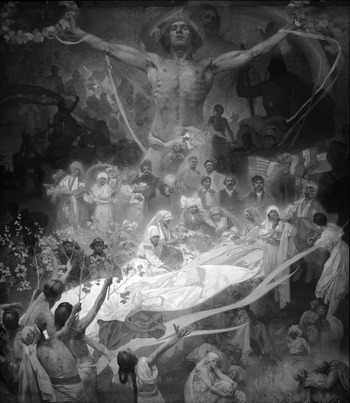
Many of these are most obvious in the final painting of the cycle, The Apotheosis of the Slavic History: Slavs for Humanity (see fig. 2). The painting contains many features characteristic of the entire cycle, including the subject, formal features, and references to the history and myth of the Slavs; and it depicts the imagined journey of the Slavs from prehistory, through times of plenty, then serfdom up to ultimate victory and freedom after the collapse of the Habsburg monarchy. As the title suggests, this journey culminates in the Slavic embrace of humanity (lidství), a concept that could be loosely linked to the philosophical position and views promoted by Masaryk. His concept of humanity or humanism (humanita) was grounded in the belief that the Czech (and Czechoslovak) people should take a democratic direction, which also put emphasis on the ethic and moral principles of the whole society. Mucha shared certain features of this attitude as well.
Alfons Mucha, Apotheosis of the Slavic History. The Slavs for Humanity. 1926, City Gallery Prague.

In Mucha's Apotheosis, the panorama of history is divided into four symbolic fields of different colors to make the historical stages clear. The dawn of the Slavs is in blue; the “glorious” Middle Ages of the Hussites are in red; the enemies, represented by barbaric figures, are in darkness; and finally there is the yellow of victory, which shines on the body of a young man who is surrounded by representatives of the nations created out of Austria-Hungary. These central figures show Mucha's only interpretation of recent events—the newly gained independence of the Central European states, celebrated by the various people in national costumes. The spiritual dimension of the entire scene is confirmed by the figure of Christ looming in the back and the supernatural light streaking through the canvas. As in so many other paintings of the Epic, it is a combination of allegory and history, of myth and reality.
The Apotheosis, completed in 1926 as one of the last works, may therefore be taken as the climax of the entire cycle, as well as the climax of Mucha's view of the direction that the Slavic people had taken. It explicitly spells out the main message of the work—the emancipation of the Slavs from oppression. This idea of breaking off from the constraints of historical slavery coincides with the future envisaged for the Slavs by Johann Gottfried Herder, who was enormously influential on Czech nationalist thinking well into the twentieth century.Footnote 74 The long-term popularity of his short 1791 text “Slawische Völker” partly came out of Herder's suggestion that the Slavs would eventually find freedom from foreign oppression in their own countries, where they would be “free to celebrate their ancient festivals of quiet industry and trade.”Footnote 75 Czech nationalists of the nineteenth and twentieth centuries who sought to mobilize and concretize a sense of common identity among the Slavs identified with such a positive outlook, despite its more or less vague timescale the text offered for the Slavic emancipation.Footnote 76 Later, Masaryk would follow in the wake of Herder, seeing the struggle for Czech identity as obstructed by external forces, a view that became the official Czechoslovak narrative after 1918.Footnote 77 Even though he was often critical of nineteenth-century nationalism, Masaryk also believed that at various historic occasions, it was out of the Czechs' control to free themselves from foreign oppression. Eventually, though, they rose to freedom with the help of Western countries, with whom they should be creating modern-day alliances.
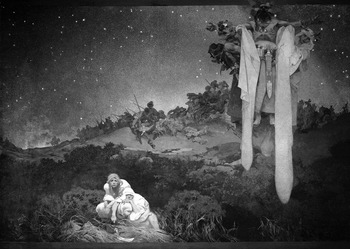
In “Slawische Völker,” Herder also described the love of the Slavs for agriculture, domestic arts, commerce, and music, for they “were never an enterprising people of warriors or adventurers like the Germans … They were charitable, hospitable to excess, lovers of free country ways, yet submissive and obedient, averse to pillage and robbery.”Footnote 78 This well-known observation was referenced by Mucha in a number of paintings of the Slav Epic. In the opening work, Slavs in their Homeland, with a telling subtitle Between the Turanian Whip and the Sword of the Goths, he depicted the original Slavic tribes settled between the rivers Dnepr and Oder, being constantly attacked by their Germanic enemies (see fig. 3). The two vulnerable women in the foreground hide from the hordes pillaging the Slavic villages on the horizon. A trio of allegorical figures, including a pagan priest, floats above this night scene. This composition made clear Mucha's emphasis on the need for the Slavs to defend themselves against enemies, while also not initiating warfare with other peoples themselves.
Alfons Mucha, The Slavs in their Homeland. Between the Turanian Whip and the Sword of the Goths, 1911, City Gallery Prague.

Mucha's idealization of the history of the Czechs and the Slavs subscribed to the clichés constructed during the nineteenth-century national revival, which included showing Germans in a highly partial way. The depiction of the Germanic tribes in The Apotheosis, for example, was limited to a stereotypical identification of Germans as threatening and hostile against the tame Slavs, a motif common in the writings of Czech national revivalists, including František Palacký (1798–1876), a highly influential Czech nationalist politician and historian.Footnote 79 The influence of Palacký's reading of Czech history can be detected in other works of Mucha's Epic; Mucha depicted the Hussite wars not just as a religious struggle, but also as a national conflict between Czechs and Germans.Footnote 80
Such popular and literary consciousness with its focus on Czech national history and traditions also influenced Mucha, who consulted with contemporary scholars about their understanding of history. These included the historians Jaroslav Bidlo (1867–1937), a Czech scholar of East European history and Bohemian Reformation, and the Ukrainian publicist and Slavic scholar, Dimitry Vergun (1877–1965).Footnote 81 Mucha based the first six paintings, which he started sketching while still in Paris, on his discussions with the French historian of Central Europe, Ernest Denis (1849–1921).Footnote 82 Denis, a professor at Bordeaux, Grenoble, and Sorbonne, was a specialist on Bohemian history and edited the magazine La Nation Tchèque. He was in frequent contact with Czech artists and politicians such as Masaryk and wrote a number of books on Czech history that asserted their right to political recognition.Footnote 83
Denis marginalized Catholicism, even though it had been dominant in Czech culture and history under Austria-Hungary, and Denis's stance also influenced Mucha's Epic. Apart from one painting of King George of Poděbrady, which depicts a papal legate as a minor character, the Catholic Church was notable by its near complete absence in Mucha's version of Slavic history. In Czech-speaking Bohemia, Catholicism had negative associations with Habsburg rule, and a number of historians and politicians, including Masaryk, saw Czech history as driven by reformatory, anti-Austrian, and anti-Catholic tendencies. For Masaryk, democracy, to which the Czechs aspired, was “a culmination of the separation of church and state,” and he consequently preferred Protestantism.Footnote 84 Mucha's references in the Slav Epic to the paganism of the early Slavic tribes, the prominence he accorded to the Orthodox Church, and the frequent allusions to the Czech Protestant tradition in the figures of Jan Hus, Petr Chelčický (the fifteenth-century religious reformer), and Jan Amos Komenský (a seventeenth-century teacher, writer, and philosopher) can therefore be seen as a reflection of this direction in Czech thinking of the time.Footnote 85
Mucha diverged from Masaryk in his understanding of the need for cooperation and links between the various Slavic groups. Throughout the Slav Epic, Mucha made several references to the common origins of the Slav peoples, and although he expressed his wish to remain above politics, the frequent allusions to the Eastern Slavs of Russia may be interpreted as his identification with the ideology of Pan-Slavic unity under Russian leadership.Footnote 86 Mucha's endorsement of Pan-Slavism at the beginning of the twentieth century nevertheless failed to reflect the complex changes that had taken place in recent decades in the relationships between various Slavic peoples and between the Czechs and the Austro-Germans.Footnote 87 Czech historians and politicians, such as Karel Havlíček and František Palacký, had turned away from romanticized images of the Slavs as early as the 1850s. Such images, as those contained in the works of literary figures like the Slovak poet and historian Jan Kollár (1793–1852), were replaced by the more practical idea of Austro-Slavism, which laid emphasis on closer cooperation between the Slavs within the Habsburg monarchy.Footnote 88
This idea of cooperation between the Slavs was revived in the twentieth century as neo-Slavism, promoted primarily by the Czech politician Karel Kramář as a more equal federation of Slavic states and not of Russian dominance.Footnote 89 The promotion of “a rapprochement between Russia and Austria-Hungary against German expansion” also aimed to meet the threat posed by the potential creation of Pan-Germanic or Pan-Latin unities in Europe.Footnote 90 A number of Slavic congresses, where these issues were discussed, were held across Slavic Europe, including one organized in Prague during the turbulent year of 1908.Footnote 91 Yet, neither this nor any of the subsequent congresses brought any concrete political resolutions, apart from a somewhat ambiguous agreement on a joint effort to fight German and Magyar dominance.Footnote 92
Kramář, a conservative nationalist and one of the main initiators of the Slavic congresses, nevertheless envisaged Slavic cultural cooperation as taking place under the auspices of the Habsburg monarchy, and as he stated in 1908, “we do not wish to topple thrones or to destroy states and empires.”Footnote 93 In fact, Mucha's approach to the Slavic idea can be seen as in line with Kramář's moderate efforts for cultural cooperation within Austria-Hungary. The Slavs in Their Homeland and The Apotheosis, as well as The Battle of Grunwald, which depicts the Poles and Lithuanians united against the Teutonic Knights, reflect Mucha's belief in the historic as well as the contemporary relevance of Pan-Slavism.
Indeed, Pan-Slavic sentiments survived even into the federation of the Czechs and Slovaks, created after 1918; they also took the form of a number of joint events, including exhibitions with other Slavic groups and, most prominently, the congresses of Sokol, the Czech movement and organization promoting sports, health, and Czech national identity. Mucha himself worked for Sokol as a poster, postcard, and set designer.Footnote 94 His involvement with this nationalistic organization, which was founded in 1862 to promote sport and Czech intellectual life, allowed him to reuse a number of motifs from previous works and, in return, to borrow the Sokol's main symbol, the falcon, for his banknote designs for the new Czechoslovak Republic.
Yet even before 1914, the attempts at closer cooperation between the various Slavic groups were overshadowed by the growing recognition of the importance of Western Europe (and mainly France) for Czech nationalist objectives of gaining more autonomy within the Habsburg monarchy, creating an independent state, or forming a federation with another Slavic group. As mentioned earlier, Masaryk had promoted a closer cooperation with the West long before he became president of Czechoslovakia, because he was wary of Russian expansionism.Footnote 95 His emphasis on interpreting Czech history within a predominantly Western European context, and his opposition to the idealization of the past and the excessive concern with the history of nineteenth-century national revivalists, was not reflected in the Slav Epic.Footnote 96
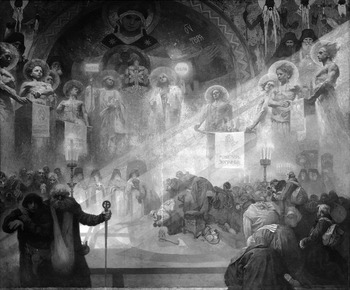
Masaryk's humanism, on the other hand, had closer parallels with his work in a number of ways, for it was very much linked with an aspiration to the greater good not only of individuals but also of society as a whole.Footnote 97 Masaryk was convinced that democracy's rule of law and egalitarian ethos would lead humanity toward a more moral, more fully human state marked “with tolerance, empathy, reasonableness, and self-restraint.”Footnote 98 The spiritual improvement of mankind was a topic that Mucha seemed preoccupied with in the Slav Epic, as well as in other works. Much of the content of the cycle reflects his religious and personal beliefs. His paintings and graphic works often contain a fusion of historical events and mythical legends, where the former take place on the ground, whereas the latter, such as mythical or spiritual scenes, are situated above in other paintings of the cycle. This pattern, the tradition of which dates back to medieval religious painting, is clearly visible in the painting of Mount Athos (Sheltering the Oldest Orthodox Literary Treasures), which depicts a Greek Orthodox church in Mucha's interpretation as a historic center of literature, arts, and faith of the Old Slavs (see fig. 4). Here, the male worshipers and priests on the ground are joined by cherubs, saints, and priests floating in midair, in front of a mosaic of the Virgin (who is nevertheless more reminiscent of a Moravian village girl than of a Byzantine icon). The interior is filled with half-naked or semiclad bodies, supernatural light that is coming from the side, and decorative details of the church.
Alfons Mucha, Mount Athos. Sheltering the Oldest Orthodox Literary Treasures, 1926, City Gallery Prague.

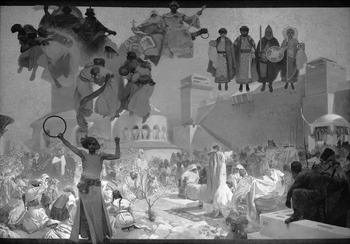
The inclusion of an entity floating above and behind the common man or people was typical of Mucha's work. In the Municipal House, such supernatural beings took the form of allegorical figures above the individuals on the ground. In the German theatre in New York, they were personifications of Tragedy and Comedy; elsewhere, they were female figures in the background of some later posters for Bohemian clients. In the Slav Epic, these entities are represented either by a Christian figure, such as Virgin Mary in Mount Athos and Christ in The Apotheosis of the Slavs, or a pagan god or gods and rulers, such as in The Slavs in Their Homeland, The Introduction of Slavic Liturgy, and The Oath of Omladina.
The Introduction of Slavic Liturgy evokes the efforts of two monks from Saloniki to civilize the Slavic language in Moravia in the eighth century by translating the Bible into Old Church Slavonic (see fig. 5). In the painting, one of them, Methodius, is returning to Rostislav, the Prince of Great Moravia, after a visit to Rome. Previous Slavonic rulers float above the scene, stylized as medieval icons, and oversee this event. The Oath of Omladina is an unfinished painting of a nationalist group of radical young Czechs formed in the late 1870s. Seminaked boys, surrounded by older members of political and cultural organizations, as well as figures representing national rural life, are depicted holding hands in a circle in front of a linden tree, the Czech national tree. The Slavic goddess Slavia sits in the tree as a prophet and patron.
Alfons Mucha, The Introduction of Slavic Liturgy. Praise the Lord in Your Native Tongue, 1912, City Gallery Prague.

The appearance of these figures on a level above ground suggests Mucha's belief in a spiritual existence beyond the mundane life. Mucha had a long-standing interest in spiritualism and theosophy, and this is often linked to the environment he encountered in Paris, where mysticism and occultism were popular with many artists, writers, and intellectuals.Footnote 99 For example, August Strindberg accompanied Mucha to spiritualist séances, and through his acquaintance with Paul Gauguin or Paul Sérusier, Mucha became acquainted with symbolism.Footnote 100 The choice of colors, the presence of an almost tangible light, and the idealized woman as a symbol of the great soul of the world are just a few examples of this influence. A female figure also often materializes as the savior of humanity, this time a concept congruent with valentinianism, a gnostic movement, based on a belief in the existence of a spiritual heaven.Footnote 101
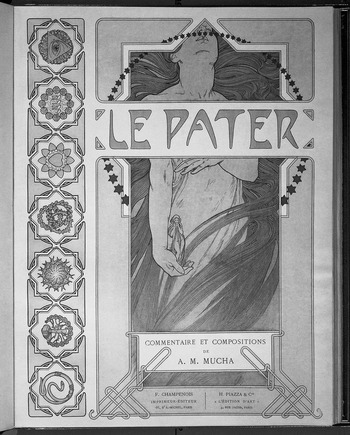
Although all of these references already appear in a number of Mucha's earlier works, the metaphysical dimension in the Slav Epic seems to be influenced by additional sources. The insertion of supernatural entities behind earthly or personified human beings can be ascribed to Mucha's membership with the Freemasons. In 1898, he had been initiated into a Masonic Lodge in Paris and later became grand commandeur of the Czech Masonic Lodge of Jan Amos Komenský.Footnote 102 His paintings and illustrations often included Masonic symbolism and esoteric, mystical references to the unity of humanity, which the organization promoted. Masonic symbolism is most visible in Mucha's illustration of the Pater Noster (1899) or his Czechoslovak banknote designs from 1919–1929. Whereas the Pater Noster (see fig. 6), commissioned by a member of the Parisian Masonic Lodge, contained straightforward references to the Order and its symbols, especially the spiral motif, the designs for the Czechoslovak banknotes had to have the Masonic references removed.Footnote 103 The Freemasons had affection for the arts that could express and materialize their teaching, symbolism, and messages quite well. The visual arts were suited for such tasks, and Mucha identified with the mission of professing Truth and Love “to the ignorant and blind,” despite the ungrateful nature of such a mission that required strict discipline and hard work from those who undertook it.Footnote 104
Alfons Mucha, Pater Noster, 1899, © Mucha Trust 2014.

Mucha's emphasis on securing the ethical and moral improvement of man is visible in many works of the Slav Epic. Many of the paintings represent the moral and educational power of the word: The Introduction of Slavic Liturgy emphasizes the need for sermons in the vernacular language, whereas Jan Hus celebrates the reformist priest preaching in Czech in the Bethlehem chapel in Prague, as does Petr Chelčický, which depicts the Hussite thinker, Bible in hand. The crucial historical role of reading and writing is also stressed in the paintings of Jan Amos Komenský and The School of the Moravian Church, both presented as guardians and promoters of the Czech language. The two latter paintings also evoke the Czech Freemasons' usage of the Bible of Kralice, a translation into Czech of the Bible undertaken in the late sixteenth century. For Mucha—as well as for the Freemasons—the Bible symbolized the unity of the people regardless of their social differences, and it was also a symbol of good, born from knowledge.Footnote 105
In line with the Freemasons' belief that God was not necessarily linked to a specific church, but rather was conceived as a spiritual entity for any religion, Mucha also referred to various other religious organizations beyond the Catholic Church. This comes across strongly in the multiplicity of references to various beliefs in the Slav Epic, for example in the emphasis on the above-mentioned Protestantism and reformed Catholicism, in the pre-Christian society with pagan priests and gods of The Slavs in Their Homeland, the Introduction of Slavic Liturgy with Byzantine missionaries, or in The Apotheosis of the Slavic History, where all the newly independent nations are united under Christ.
In his desire to reconnect with the history of the Slavs, Mucha included a wide range of references to historic and contemporary political, religious, or philosophical episodes that made the Slav Epic a complex work to interpret. Describing the first three paintings, Karel Chytil suggested already in 1912 that work of this kind “requires its audience to have historic and literary knowledge and engages their minds.”Footnote 106 Complimenting Mucha's monumental historical work, and along with Chytil's criticism of impressionist painting, the art historian argued that a work as challenging as Mucha's did not produce the sense of emptiness typical of so many other works by Mucha's contemporaries and predecessors, but rather represented “paintings of great depth and breadth, creations that were borne out of a strong will and enduring effort.”Footnote 107
Responses and Reactions
Chytil's observations from 1912 predated and anticipated the many reactions that came once the Epic was exhibited in 1928. Mucha officially handed over the completed cycle to the Czechoslovak state to mark the tenth anniversary of the creation of the Republic. He stipulated that this personal gift to the nation should be placed in a representative “hall expressly built for this purpose,” paid for by the city of Prague.Footnote 108 In initial discussions, the Prague City Council suggested locating the cycle in Liberty House, a building project promoted by the council as a monument to the “noble cultivation and perfection of the national culture.”Footnote 109 Because of a lack of finances, this project was never realized, and Mucha's cycle was first shown as a complete set of twenty paintings in a temporary exhibition in the Trade Fair Palace (Veletržní palác), after which it moved to Brno in the same year.Footnote 110
Designed by Josef Fuchs and Oldřich Tyl, the Trade Fair Palace was built between 1925 and 1929 near the old Prague exhibition ground to house trade exhibitions and fairs. As a functionalist building, it was an unlikely location for Mucha's cycle, which was exhibited here between 23 September and 31 October 1928. The opening was attended by a number of official guests from Czechoslovakia and abroad, including the Minister of Education Milan Hodža, the Mayor of Prague Karel Baxa, Charles Crane and representatives of the Parliament, the City Council, universities, and the more conservative art clubs and societies.Footnote 111 The cycle was celebrated as a great contribution not only to the Czechoslovak nation, but to all Slav peoples. Hodža, for example, appreciated Mucha's “correct interpretation of history” because, he argued, it contained elements of the future that could inspire national feelings and ideals.Footnote 112 He called Mucha “one of the moral leaders of our nation,” and official guests from other Slavic countries, including Bulgaria and the Kingdom of Yugoslavia, made similarly positive remarks.Footnote 113
There was also praise from nationalistic newspapers such as Československá republika (The Czechoslovak Republic) and Národní listy, which called the Epic “the pride of Czech modern painting, replete with the deep spiritual strength of the Slavic race.”Footnote 114 Shortly before World War II, in an increasingly tense political atmosphere and after Mucha's death, the same newspaper appreciated the Epic as a “superhuman work” that “shines as an exemplary document” of Mucha's persistent endeavor.Footnote 115 The cycle was also praised by Mucha's fellow Freemasons, who appreciated the patriotic content of the Epic.Footnote 116 This recognition was echoed in the United States, where Time emphasized Mucha's artistic genius, called him “a man of prodigious historic imagination,” and pointed to the importance of the work as a potential place of pilgrimage for all the Slavs.Footnote 117 The Time article concurred with Mucha's view of the Slavs as a homogeneous group or “race.” The “boundless Slavic intensity and energy” of Mucha's “spontaneous, vivid” work was a result of the Slavs' qualities, according to the author.Footnote 118
The strong Slavic theme, however, was a controversial issue for some, especially as the idea of Slavic unity lost its original appeal as a result of World War I, in which many Slavic groups had fought against each other. Even a great defender of Pan-Slavic ideology, such as the Czech art historian František Žákavec (1878–1937), criticized the “empty adoption” of superficial qualities and stereotypes associated with the Slavs (round female faces, Slavic “softness” and sweet colors, national costumes), which, he argued, made the work more decorative than “Slavic.”Footnote 119 At the same time, though with some sarcasm, he appreciated the work as a creditable deed that could entertain simple spectators, small children, and the artistically unaware broader public, which, with reference to Crane, could include an “American rich man of good will.”Footnote 120
Žákavec's criticisms also extended to Mucha's artistic technique, pointing out, for example, that Mucha often repeated the same postures and gestures in his figures, which were based on a limited vocabulary of forms that Mucha collected and kept in his sketches and photographs.Footnote 121 The Slavia Bank poster, for example, depicted a female figure taken from his portrait of Richard Crane's daughter, Josephine, and was also used on the design for the 100-crown banknote. Similar examples can be found in the figures of Comedy and Tragedy for the German Theatre, which reused postures from Mucha's commercial posters undertaken in Paris.Footnote 122
Just as the Slav Epic was presented to the Czechoslovak government, critics began to ask, “What shall we do with it?” Josef Čapek, the painter and brother of the writer Karel Čapek, posed this question, noting that Mucha's monumental work, despite the artist's best intentions, did not have sufficient artistic value to merit the building of the brand-new museum for which Mucha had asked.Footnote 123 Čapek concluded that in its enormous size the Epic had become a rather embarrassing gift for the City of Prague.Footnote 124
Many contemporary critics reiterated, sometimes in stronger terms, Čapek's assessment of the work's artistic limitations when it was first exhibited in 1928 and after Mucha's death in 1939. Despite the increased nationalism and return to “national culture” in the late 1930s, critical voices were present in Mucha's obituaries, too. For example, the painter Viktor Nikodém (1885–1958) claimed in the progressive newspaper Národní osvobození (National Liberation) that the Slav Epic's celebration of national history was an anachronism that lacked artistic qualities.Footnote 125 Pavel Kropáček (1915–1943), a Czech art historian, ascribed Mucha's failings to the artist's formulaic approach and his belief in creating monumental, historical paintings.Footnote 126 The Slav Epic was, in his opinion, “an evident mistake, an unnecessary mistake” that only harmed the art for which Mucha should be remembered: his art nouveau designs. Quite aptly, the author also noted that the Slav Epic should not be assessed for its aesthetic qualities, but rather for its value as an interesting historical document of some significance.Footnote 127
Harsher criticism came from more radical authors, represented in the first place by Karel Teige, who saw Mucha as a creator of “inexhaustible and inartistic slush” and regarded the Slav Epic as a continuation of the conservative reactionary romanticism he associated with the capitalist, bourgeois culture.Footnote 128 He argued that artists like Hans Mackart, Horace Vernet, Jean-Louis-Ernest Meissonier, and the Czech historicizing painters Brožík and Hynais, as well as Mucha with his Slav Epic, were official and servile painters of the “strongest bourgeois banality.”Footnote 129
Teige was a leading representative of the Czech avant-garde, but similar criticisms had been voiced some time earlier. From the late nineteenth century onwards, many Czech modernists had dismissed Mucha and either ignored or despised him for his earlier decorative posters or the overt nationalism of his later work. As early as 1897, the symbolist painter and poet Karel Hlaváček (1874–1898) criticized Mucha's retrospective of the same year; like Teige, he drew connections between the artist's decorative work (admittedly, in Hlaváček's view, technically apt and competent) and the bourgeois tastes that the work aimed to please.Footnote 130 Hlaváček described the paintings as “icy, transparent and stiff,” and superficial, lacking excitement or energy. This included the cheap symbolism of Mucha's posters (twinkling stars, bleeding hearts entwined by thorns, dew falling from flowers), “which could be purchased in Paris for two or three sous.”Footnote 131 These flaws were also visible in Mucha's historical paintings, which, as much of his poster work, were primarily governed by decorative and ornamental effects. Moreover, Hlaváček claimed, they lacked the very precondition for a successful historical work—that is, historicity. Instead, they were limited to a “pathetic-sentimental selection” of historical motifs that turned Mucha into an affichiste rather than a genuine history painter.Footnote 132
Mucha was criticized even more emphatically by the Czech poet, journalist, and art critic S. K. Neumann (1875–1947), author of a Czech Futurist Manifesto in 1913, which condemned “the kitschy superficiality of academism and impressionism, patina, monotonous artists, folklore, embroidery [from Slovácko].”Footnote 133 Neumann's manifesto was titled “Open Windows” (Otevřená okna), a proclamation to let the fresh air of modernism into the stuffiness of the Czech art scene. For Neumann, Mucha was a representative of the surviving academism of the nineteenth century.
Mucha's work was similarly disapproved of by the less radical Socialist left and interwar Communists, for whom it was “a tool of reaction and reactionism...the banner of those who most impede and prevent the development of art.”Footnote 134 Such criticism necessarily focused on Mucha's connections to the bourgeoisie and aristocracy. Nevertheless, after World War II, the attitude of the Communists changed. Once the Epic was installed in the chateau of Moravský Krumlov in 1963, the catalogue of the exhibition made a clear analogy between Mucha's effort to address the nation with the Slav Epic and Lenin's proclamations about the need for art to be comprehensible and able to elevate the people in their thinking, feelings, and will.Footnote 135 Mucha's choice of Russian subjects, the unity of the Slavs, and the revolutionary victory of the subjugated people over oppression suited the rhetoric of the postwar communist regime and were compared with the events of the October Revolution. Moreover, the catalogue even praised the sponsor of the Slav Epic, Charles Crane, whose social and economic status was omitted and his contribution to the “cultural world” emphasized.Footnote 136
Conclusion
In 2012, the Slav Epic was temporarily moved from Moravský Krumlov and put on display once more in the Trade Fair Palace in Prague, but this was not without controversy. Mucha's grandson John and the council in Moravský Krumlov, which quickly started reconstructing the dilapidated chateau to make it suitable for the Epic, expressed concern about the cycle's fragile condition and the future of the work and disputed the transfer to the capital. Nevertheless, the Slav Epic will remain under the custody of the Prague City Gallery and displayed in the premises of the National Gallery in Prague, at least until 2015.Footnote 137 Hence, eighty years after its completion and handover to Prague, a long-term solution about where to house it permanently has yet to be found, and the search to locate Mucha's Slav Epic both physically and historically remains unfinished.
Although many recognize Mucha as a successful commercial artist for his decorative and applied art designs, for them the place of his Epic within his oeuvre remains ambiguous. Recent retrospective exhibitions of the artist's work, held in a number of European cities in 2010 to commemorate the 150 years since Mucha's birth, confirmed the struggle to locate Mucha's paintings and the continuous uncertainty in interpreting his historical work. Whereas the exhibition Alfons Mucha, Master of Art Nouveau: A Retrospective staged in Munich, Montpellier, and Vienna acknowledged the place of the Epic among Mucha's other accomplishments, a simultaneous exhibition, Alfons Mucha: The Czech Master of the Belle Époque, held in Budapest and Brno, made very few references to his historicizing work, including the Slav Epic.Footnote 138 The titles of both exhibitions, nevertheless, recycled the same clichés about Mucha's mastery in fin de siècle, as well as the stereotypical view of Mucha as the painter of beautiful women. In the case of the show in Budapest, the main title “In Praise of Women” was used, though it was later dropped in Brno. The most recent catalogue accompanying the exhibition in the Trade Fair Palace, however, provides a more critical view of the Epic and its context.Footnote 139
Many of the problems with placing the work within the contemporary philosophical and political framework stem from the work's own numerous and often disparate historical and cultural references to various interpretations of the history of the Slavs and the Czechs—including their position and future, ranging from an open embrace of Pan-Slavism or visionary spiritualism to the Masarykian vision of democracy and morality through humanity. A key role in the work's negative reception and interpretation can also be ascribed to the preference for modernist art from the period in question and especially to the strong legacy of modernist critiques that associated Mucha's oeuvre with kitsch. And although the comments of Czech scholars and artists during the first half of the twentieth century ranged from its radical dismissal to the celebration of its nationalism, the Slav Epic comes across less as a significant work of art and more as a “historical document of some significance,” as Kropáček described.Footnote 140 This significance can primarily be seen in the fact that the work reflects the far from straightforward nature of the time in which it was created, marked by a diversity of political, cultural, and philosophical trends.