Introduction
Cercarial dermatitis, commonly called swimmer's itch, in humans is an allergic response of the skin following penetration of cercariae of the trematode family, Schistosomatidae, which can infect birds or mammals. The disease develops after host sensitization resulting from repeated contact with the cercariae (Olivier, Reference Olivier1949). The similarity in skin lipid composition between aquatic birds and humans may contribute to the abnormal penetration of human skin (Haas & Van de Roemer, Reference Haas and Van de Roemer1998). Cercarial penetration of the human skin results in a prickling sensation (primary itching) within 4–20 min which persists for approximately 1 h. The clinical symptoms are well known and include intense itching, maculae, papulae, urticariae and, in some cases, limb swelling, local oedema with enlarged lymph nodes, fever, nausea and diarrhoea (see review by Horák et al., Reference Horák, Kolárová and Adema2002). Cercarial dermatitis occurs seasonally, and is most prevalent during the warmer months when the release of cercariae from the intermediate snail hosts coincides with people's increased contact with water (cf. Horák et al., Reference Horák, Kolárová and Adema2002). In Europe, cercarial dermatitis seems to be mainly caused by bird schistosomes (Kolářová et al., Reference Kolářová, Horák and Sitko1997). It is recognized that cercarial dermatitis affects both sexes and all age groups (Chamot et al., Reference Chamot, Toscani and Rougemont1998; Verbrugge et al., Reference Verbrugge, Rainey, Reimink and Blankespoor2004). In a prospective study, Verbrugge et al. (Reference Verbrugge, Rainey, Reimink and Blankespoor2004) found that onset and severity of swimmer's itch were affected by how people interacted with the lake, e.g. how long, where and when people used the lake. Age and gender had no effect on incidence or severity. However, Appleton & Lethbridge (Reference Appleton and Lethbridge1979) concluded that children between 5 and 9 years of age are at the highest risk because their exposure to water during recreational activities is the highest, and Lévesque et al. (Reference Lévesque, Giovenazzo, Guerrier, Laverdiére and Prud'homme2002) found that the symptoms mainly affected children under 10 years of age. Schets et al. (Reference Schets, Lodder, Van Duynhoven and de Roda Husman2008) also reported that longer and more frequent exposure to fresh water resulted in an increase in reported symptoms of swimmer's itch among children.
The disease has been reported from every continent except Antarctica (Mulvihill & Burnett, Reference Mulvihill and Burnett1990), especially in lakes of temperate regions. However, cercarial dermatitis has also been reported from cold areas in northern latitudes around the world. In northern Europe the disease has been reported from Denmark (Berg & Reiter, Reference Berg and Reiter1960), Sweden (Thors & Linder, Reference Thors and Linder2001), Finland (Pirilä & Wikgren, Reference Pirilä and Wikgren1957; Aldhoun et al., Reference Aldhoun, Faltýnková, Karvonen and Horák2009), Russia (Voronin et al., Reference Voronin, Beer and Dobrovolskiy2002), Iceland (Kolářová et al., Reference Kolářová, Skirnisson and Horák1999; Skirnisson et al., Reference Skirnisson, Aldhoun and Kolářová2009) and Norway (Mehl, Reference Mehl1982, Reference Mehl1985, Reference Mehl1988; Thune, Reference Thune1994). Cercarial dermatitis is common in the USA (see Jarcho & van Burkalow, Reference Jarcho and van Burkalow1952; Leighton et al., Reference Leighton, Zervos and Webster2000), especially in the Great Lakes region, but it has also been reported from northern latitudes in Canada and Alaska (see Jarcho & van Burkalow, Reference Jarcho and van Burkalow1952; Harkema, Reference Harkema1953; Hoeffler, Reference Hoeffler1977). In Norway, cercarial dermatitis is mainly diagnosed and reported during the summer months (June, July and August) when people take baths, play and swim in freshwater lakes. This parasitic zoonosis is now considered an emerging disease in European countries (de Gentile et al., Reference de Gentile, Picot, Bourdeau, Bardet, Kerjan, Piriou, Le Guennic, Bayssade-Dufour, Chabasse and Mott1996; Kolářová, Reference Kolářová2007; Skirnisson et al., Reference Skirnisson, Aldhoun and Kolářová2009) and its public health impact needs to be evaluated globally (de Gentile et al., Reference de Gentile, Picot, Bourdeau, Bardet, Kerjan, Piriou, Le Guennic, Bayssade-Dufour, Chabasse and Mott1996).
During the summer months, the Norwegian Institute of Public Health receives random reports from both physicians and the general public suspecting cercarial dermatitis. The aim of our study presented here was to describe the occurrence and geographical distribution of this particular zoonosis in Norway, based on case reports that were obtained from 1980 to 2009.
Materials and methods
The data in the present study are based on random reports to the Norwegian Institute of Public Health from physicians and the general public suspecting cercarial dermatitis. An interview was performed with the person reporting swimmer's itch in order to eliminate other possible causes of the skin rash, such as bites from insects and ticks, stinging nettles, algae, bacteria, etc. Cercarial dermatitis was suspected when the persons reported a tingling, itching sensation of the skin immediately after swimming and experienced small, red, itching parts of the skin that reached a maximum after 24 h or later. Furthermore, when the correct clinical symptoms only appeared on parts of the body that had been in direct contact with fresh water, was evenly distributed over the exposed skin, and did not appear on parts covered by tight swim suits (e.g. neoprene swim suits), cercarial dermatitis was diagnosed. The clinical symptoms included maculopapular skin eruption accompanied by intense itching. Data were omitted from the study when the interview made us doubt that cercariae were the cause of the dermatitis, in cases where an interview was impossible to perform, and in a few cases where the persons could not state the name of the lake where the bathing took place. No serological studies were performed. The name and the location (county) of the lake or river where the bathing took place were noted.
Freshwater snails were collected on several occasions from selected lakes where swimmer's itch had been reported, in order to look for emerging cercariae. Snails were sampled from the following lakes: Lake Eikeren in 1982, Lake Sognsvann in 1987, 2001 and 2005–2009, Lake Bogstadvannet in 2003, 2005 and 2008, Lake Lutvann in 2003, Lake Middelalderdammen in 2003 and Lake Stordammen in 1992, all near Oslo in southern Norway, and from Lake Soløyvannet in 2003 near Bodø in northern Norway. The collected snails belonged to the genera Lymnea, Radix and Physa. No closer species identification was made as snail systematics are full of confusion, a condition that remains to be solved (cf. Horák et al., Reference Horák, Kolárová and Adema2002). All snails were transported back to the laboratory in lake water. They were subsequently isolated individually in small glass vessels containing lake water and placed under light. Emerging cercariae were examined by microscope, and determined to be schistosomatid bifurcated ocellate cercariae or not, as identification to the species level is only possible with molecular methods. Only one infected snail (collected in Lake Bogstadvannet in 2008) and its cercariae have been identified to species level. The identification of the snail was based on shell morphology, anatomy of the reproductive system, and ITS2 sequences. The cercariae were identified to species level by sequencing of the internal transcribed spacer (ITS) region of rDNA (this contains partial 18S and 28S and whole ITS1, 5.8S and ITS2). The sequences have not been submitted to GenBank.
Results
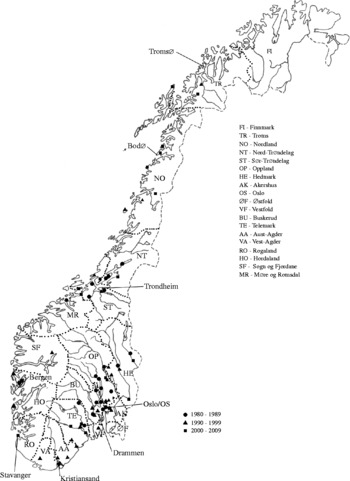
The first case report of cercarial dermatitis in Norway came in 1980 from Lake Jonsvatnet (see fig. 1) near Trondheim in the middle of Norway (Mehl, Reference Mehl1982). The following year cercarial dermatitis was reported from another lake (Lake Utnesvatn) in the same geographical area. In the summer of 1982 an outbreak of the disease was reported from four lakes in southern Norway. Physicians reported between 5 and 15 patients being treated each day during week 31 that year after bathing in Lake Eikeren (Mehl, Reference Mehl1982). The outbreak coincided with a very warm period in this part of the country. The causative agent was at that time unknown, and articles in newspapers reported the problem to be caused by ‘fleas’, ‘sand fleas’, ‘mosquitoes’, ‘stinging worms’, ‘sucking worms’ and/or ‘parasites’, etc. Mehl (Reference Mehl1982) identified the problem as cercarial dermatitis after isolation of schistosomatid cercariae from snails located at one of the affected lakes. The publication by Mehl (Reference Mehl1982) resulted in several new case reports from another 15 lakes in the south and central parts of Norway during the same summer (see fig. 1). In retrospect, reported cases of itching skin rash after freshwater bathing had appeared several years before 1980 in some lakes in Norway without recognition of the aetiology of the condition.
The geographical distribution of the 87 case reports of cercarial dermatitis in Norway from 1980 to the end of 2009. The first two reports were from the central part of the country near the city of Trondheim. Note that a single dot might represent several adjacent lakes in some areas. The locations of counties mentioned in tables 1 and 2 are indicated on the map.

The summers of 1983 and 1984 were cooler, and cercarial dermatitis was reported from only two new lakes in 1983. In 1985, 1986 and 1988, cases of swimmer's itch were reported in only one new lake each year. Published notes on the problem (Mehl, Reference Mehl1985, Reference Mehl1988) resulted in a few new case reports, as opposed to the situation in 1982. In 1989, people reported cercarial dermatitis after bathing in two new lakes. Up to this date the disease had only been reported from the south and central part of Norway, and the area around Trondheim, at 63.3°N latitude, was the northernmost affected area.
In the 10-year period from 1990 until the end of 1999, cercarial dermatitis was reported from 28 new lakes (fig. 1). This zoonosis was by now reported even from lakes at high latitudes in northern Norway. Case reports from Lake Bleiksvatnet in Nordland County and Lake Finnfjordvatnet in Troms County are both as far north as approximately 69.2°N latitude. In Lake Bleiksvatnet, the only bird species observed at the time of the cercarial dermatitis report was the black-legged kittiwake (Rissa tridactyla).
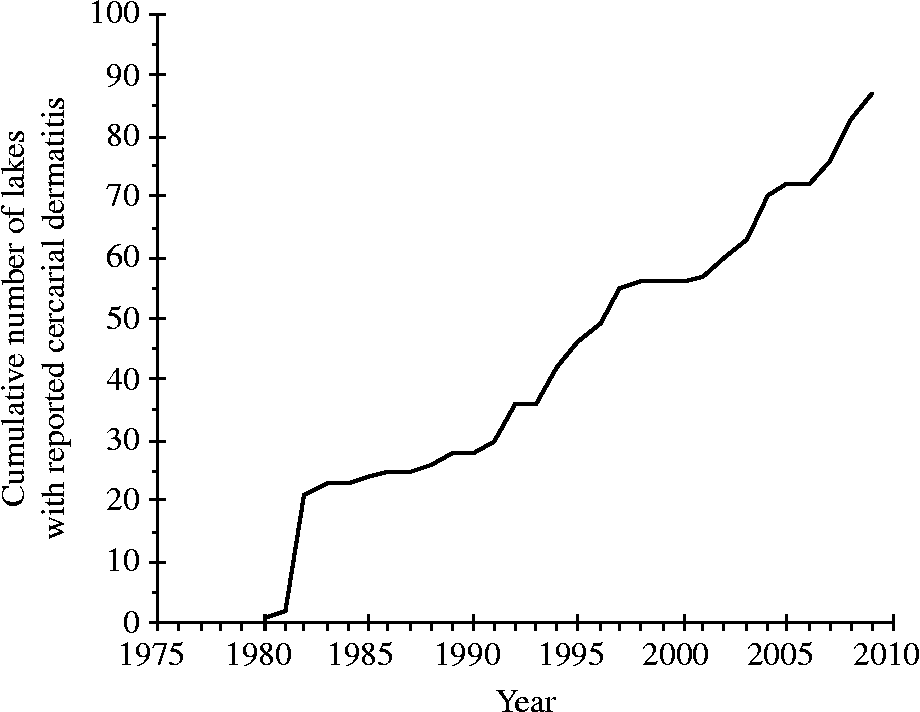
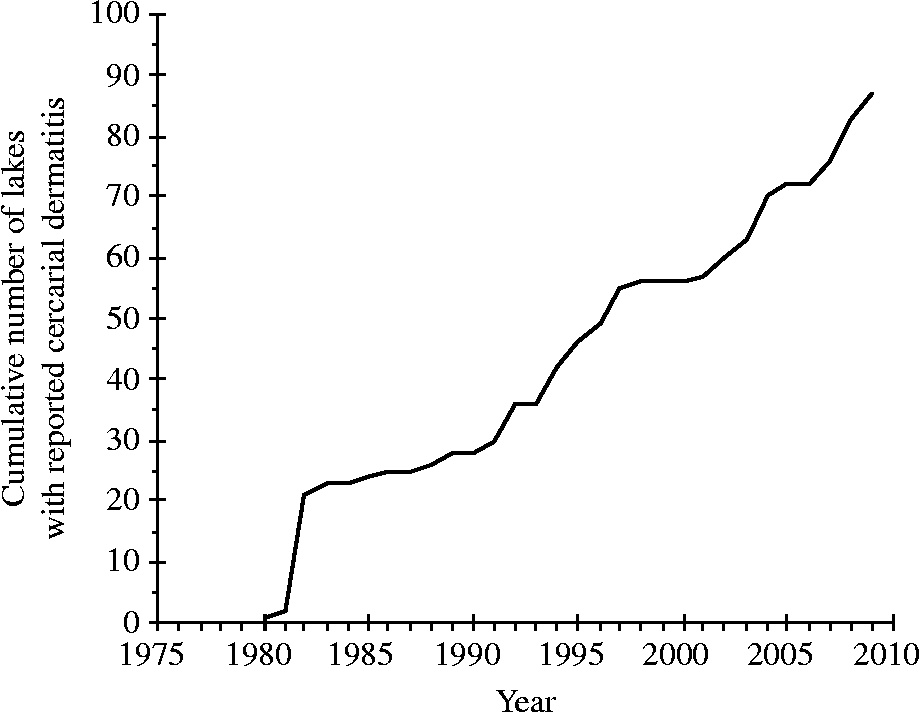
After the millennium, the increase in new affected lakes continued. In 2001 cercarial dermatitis was reported from one new lake, in 2002 from three new lakes, in 2003 from three new lakes, and in 2004 from seven new lakes. During the summers of 2003 and 2004 many reports came from lakes in northern Norway, which experienced two warm summers in succession. Furthermore, in 2005 cercarial dermatitis was reported from two new lakes. We have no reports from new lakes in 2006, but again in 2007 four new lakes were affected, in 2008 seven new lakes, and in 2009 four new lakes were reported. In total, cercarial dermatitis was reported from 87 freshwater ponds, lakes and rivers distributed all over the country during the past 30 years from 1980 to 2009.
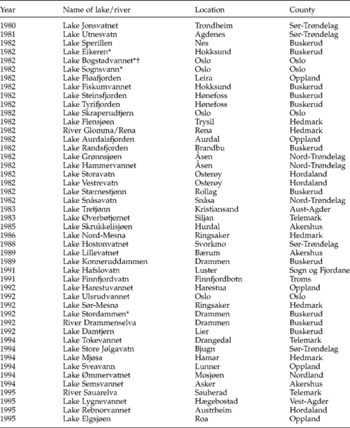
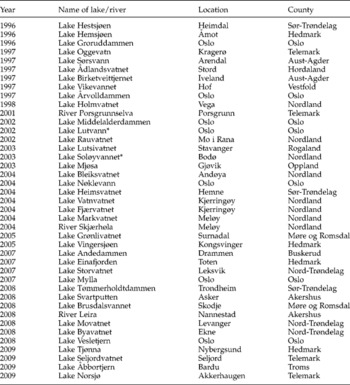
Figure 2 demonstrates the cumulative number of lakes involved with reported cercarial dermatitis in the 30-year period from 1980 to the end of 2009. In tables 1 and 2, the names of the lakes, the geographic location and the year of the first report of cercarial dermatitis are given.
Cumulative number of lakes with reported cercarial dermatitis in Norway during the 30-year period since the first report in 1980 to the end of 2009.
Lakes and rivers showing the occurrence of cercarial dermatitis in Norway from 1980 to 1995; each year indicates the timing of the first case report. See fig. 1 for the location of each county.

* Schistosomatid ocellate cercariae found in sampled snails (see Results for sampling year).
† Cercariae identified as Trichobilharzia franki (from one specimen of Radix auricularia sampled in 2008).
Lakes and rivers showing the occurrence of cercarial dermatitis in Norway from 1996 to 2009; each year indicates the timing of the first case report. See fig. 1 for the location of each county.

* Schistosomatid ocellate cercariae found in sampled snails (see Results for sampling year).
Snails of the genera Lymnea, Radix and Physa have been sampled from a number of lakes on several occasions and examined for the presence of cercariae. Schistosomatid ocellate cercariae were found in snails from Lake Eikeren in 1982 and Lake Stordammen in 1992 after reports of cercarial dermatitis. Several snails sampled in Lake Sognsvann were infected in both 1987 and 2001. Schistosomatid ocellate cercariae have also been found in snails from both Lake Lutvann in 2003 and Lake Soløyvannet in 2003. No cercariae were found in a limited number of snails from Lake Middelalderdammen in Oslo. Between 20 and 30 Radix auricularia were sampled from Lake Bogstadvannet in 2003, 2005 and 2008, and infected snails were found in each year. A single infected snail collected in 2008 was examined by polymerase chain reaction (PCR) for species determination of both the snail host and the cercariae. The snail species was determined to be R. auricularia, and the cercariae shed from this snail were Trichobilharzia franki. No birds or faecal samples from birds were examined, but in all the lakes where snails were sampled, we observed birds belonging to the Anseriformes and Lariformes.
Discussion
Based on the present study, cercarial dermatitis has been reported from 87 freshwater ponds, lakes and rivers in Norway during the 30-year period from 1980 to the end of 2009. As the case reports were based on random phone calls or e-mails from private persons or physicians suspecting cercarial dermatitis, the geographical distribution presented in this study can be misleading in some cases, as the disease could have been misidentified. Differential diagnosis of cercarial dermatitis is difficult due to the fact that several different agents can cause dermatitis (Hoeffler, Reference Hoeffler1977), e.g. bites from ticks, bed bugs, mosquitoes and black flies, stings from stinging nettles, exposure to different algae and bacteria, as well as stings from different jellyfish in sea water. However, all persons interviewed in the present study experienced different degrees of the well-known skin symptoms of cercarial dermatitis only after freshwater bathing and swimming, and the symptoms appeared only on parts of the body that had been submerged in water and not on skin covered by tight neoprene swimming suits. Many persons reported a tingling, itching sensation of the skin immediately after swimming, and all experienced small, red, itching parts of the skin that reached a maximum after about 24 h or later. Furthermore, in cases where we could not perform an interview, or when we doubted that cercariae had caused the dermatitis, data were omitted from the study. However, it is likely that many cases of swimmer's itch are often not reported. Therefore, we believe that the geographical distribution is, in fact, underestimated. Based on the case reports, cercarial dermatitis is distributed nearly all over Norway, from the south to as far north as 69.2° latitude. The case reports from northern Norway are, to our knowledge, the northernmost reports of cercarial dermatitis in Europe.
Horák et al. (Reference Horák, Kolárová and Adema2002) suggest that the disease is most prominently distributed along the major flyways of migratory birds. Consistently, it is not necessary for the birds to be permanently present in order to establish the parasites in the intermediate snail hosts, as parasite eggs can be released during the transient presence of infected migrating birds. For Trichobilharzia species, it seems that the spectrum of final bird hosts is broader than that of the intermediate snail hosts, and it is also clear that these fluke species can infect bird species other than waterfowl (Anseriformes) (Horák et al., Reference Horák, Kolárová and Adema2002). In Lake Bleiksvatnet, at 69.2°N latitude, the only bird species observed during the day at the time of the cercarial dermatitis report was the black-legged kittiwake (Rissa tridactyla). However, the prepatent period in snails is about 4 weeks and can be longer if in cold water. Therefore, the source of infection could potentially be a bird species that was present in the lake many weeks prior to the report of swimmer's itch.
The total number of case reports from each lake was variable. From some of the lakes, we received case reports every summer (e.g. Lake Sognsvann and Lake Bogstadvannet near Oslo, Lake Tyrifjorden and Lake Eikeren near Drammen), but from other lakes, we received only one single report. Thus, the disease seems to be endemic in some lakes, whereas in others it seems to appear more sporadically. This can be explained by the variation in water temperature in some cases, especially the sporadic reports from lakes at high altitudes and in northern Norway. These lakes are normally very cold and, subsequently, it is difficult for the flukes to complete their life cycle. Environmental temperature is an important factor influencing both the development and transmission of these parasitic organisms. McCarthy (Reference McCarthy1989) showed that the emergence of Echinoparyphium recurvatum cercariae is completely inhibited at 10°C, and that the transmission efficiency is zero at 5°C. At low temperatures the exposure of humans to cercariae is also very limited, as there is a positive correlation between frequency and duration of bathing and increasing water temperature. In the study presented here, reports of swimmer's itch appeared very frequently when the water temperature reached 20°C and above in July and August. This indicates that water temperature is an important factor explaining the incidence of swimmer's itch. Furthermore, observed differences in case reports between lakes and from different areas in the same lake can also be due to other general environmental conditions. For example, water currents and wind exposure, which cause cercariae to accumulate in certain areas of the lakes, can lead to great differences in human exposure to the parasite. Leighton et al. (Reference Leighton, Zervos and Webster2000) used plastic markers to measure surface water currents at Cultus Lake in Canada and suggested that large concentrations of cercariae could accumulate at the surface in hyperendemic areas and subsequently be transported into swimming areas of the lake. These authors suggest that such concentrations of cercariae could explain why the number of cercarial dermatitis reports is much greater on some days and from some parts of the lake compared to others. The most frequent reports of cercarial dermatitis in Norway were from Lake Sognsvann near Oslo, where cercarial dermatitis is reported every year by a large number of people. In this particular lake the most popular beaches, as well as the water outlet, are located at the southern part of the lake, where we would expect cercariae to accumulate. Furthermore, the density of potential host birds is larger in this part of the lake, suggesting that this is a hyperendemic area which is in close proximity to the bathing areas.
Most of our case reports of cercarial dermatitis are from lakes and ponds, but we have a few reports from rivers, a situation which is not normally reported as we would not expect lymnaeids (and their schistosomes) in fast-flowing rivers. However, these rivers are either slow flowing or in close proximity to lakes, probably explaining our findings of cercarial dermatitis.
Cercarial dermatitis is considered an emerging zoonosis in Europe (de Gentile et al., Reference de Gentile, Picot, Bourdeau, Bardet, Kerjan, Piriou, Le Guennic, Bayssade-Dufour, Chabasse and Mott1996; Kolářová, Reference Kolářová2007; Skirnisson et al., Reference Skirnisson, Aldhoun and Kolářová2009). This seems to also be the case in Norway, even though it is reported that people have experienced the problem of itching skin rash after freshwater bathing many years before our first case report in 1980. In Iceland, retrospective enquiries indicate that swimmer's itch has affected humans for almost a century (Skirnisson et al., Reference Skirnisson, Aldhoun and Kolářová2009). Nevertheless, several factors can explain why we have recognized an increase in the number of case reports in Norway during more recent years. First, we have observed that an increased focus on the problem in reports and the media increases the number of phone calls and e-mails from people and physicians suspecting cercarial dermatitis. Therefore, the increase in new case reports in 1982 is certainly partly a result of a published report distributed to physicians (Mehl, Reference Mehl1982) and several newspaper articles that focused on the problem. The internet has made it easier for people to find information about cercarial dermatitis, and people might feel that the threshold for contacting our institute is lower when using e-mail in recent years, as compared to phone calls which were more common before. Furthermore, during recent years we have encouraged the public and physicians to report cases of cercarial dermatitis.
Second, recent changes in environmental factors might have increased the problem, at least in the southern parts of Norway. Historically, southern Norway has been heavily influenced by freshwater acidification; the first reports documenting fishkills came as early as 1920 (Dahl, Reference Dahl1921). According to estimates, Norwegian lakes and rivers within an area of 86,000 km2 were severely influenced by acidification (Henriksen & Hesthagen, Reference Henriksen and Hesthagen1993), leaving a lot of lakes deprived of fish and invertebrates (Jensen & Snekvik, Reference Jensen and Snekvik1972; Økland & Økland, Reference Økland and Økland1981; Muniz, Reference Muniz1984; Rosseland et al., Reference Rosseland, Skogheim and Sevalrud1986; Hesthagen & Hansen, Reference Hesthagen and Hansen1991). Freshwater snails are known to be even more sensitive than fish to low pH values (Økland, Reference Økland1990). In acidic waters with low pH (4.0–5.0), H+ is a major toxin for freshwater invertebrates (Havas, Reference Havas1985; Frick & Herrmann, Reference Frick, Herrmann and Mason1990). Furthermore, low pH, caused by acidification, leads to the release of aluminium from the soil into freshwater bodies, and aqueous aluminium is a major factor responsible for the demise of biotic communities (Burrows, Reference Burrows1977; Havas, Reference Havas1985; Gensemer & Playle, Reference Gensemer and Playle1999). Subsequently, many lakes in southern Norway have been deprived of the snail intermediate hosts, making it impossible for the avian flukes to complete their life cycle. Furthermore, ectoparasites in general are influenced by abiotic environmental factors, and some species are very sensitive to aqueous aluminium and low pH (cf. Soleng et al., Reference Soleng, Poléo, Alstad and Bakke1999). The free-swimming miracidium and cercariae might also be more sensitive than snails to these environmental factors, thus limiting the existence of parasites even in places where snails are capable of living. The liming of lakes and rivers in the south of Norway, together with decreased problems of acid rain during recent years, could have led to a recent increase in both potential snail hosts, as well as an increase in bird life in general, as the ecosystems recovered. Thus, the environmental conditions are now more suitable for avian schistosomes in the southern parts of Norway, and this might lead to more case reports of cercarial dermatitis in humans in the future.
In Norway, information about swimmer's itch is given to the general public on the internet from the Norwegian Institute of Public Health. In some areas, where the problem is abundant, the local health authorities inform the public through newspaper articles and posters placed at popular bathing places. People are encouraged to limit their swimming or playing on wind-exposed beaches where the ceracariae frequently accumulate, and to avoid marshy areas where snails are commonly found. If possible, people should swim in the deeper parts of the lakes. Furthermore, people are encouraged to towel dry (or take a shower if possible) immediately after leaving the water. As infections may be prevented to some degree by the use of water-resistant topical formulations that inhibit skin penetration by the cercariae (Wulff et al., Reference Wulff, Haeberlein and Haas2007), such information is also given.
Based on the present study, it seems that cercarial dermatitis is uniformly distributed in Norway. However, the presence of schistosomatid cercariae should be demonstrated to verify the actual geographical distribution, as there is some uncertainty in the interpretation of the human skin symptoms of cercarial dermatitis. Information about the most important snail and bird hosts and their flukes is virtually absent in Norway, although schistosomatid ocellate cercariae have been found in snails sampled from six different lakes. Only one snail has been examined in detail in order to identify the species of both the snail host and the cercariae. Identification of the causative agent is important for estimating the potential health risk and designing appropriate control measures (Horák et al., Reference Horák, Kolárová and Adema2002). Thus, future studies should be planned that address this issue and thereby contribute to this important knowledge.
Acknowledgements
Thanks to the staff at the Department of Pest Control, Norwegian Institute of Public Health, for their contribution in receiving and collecting data and help with the sampling of snails. We are grateful to Kurt Stien who sampled snails from Lake Soløyvannet and identified schistosomatid ocellate cercariae from these snails. Torgrim Andersen kindly donated the infected snail used for PCR identification. Furthermore, Katerina Hunova and Jitka Asma Aldhoun are thanked for performing the PCR identification of, respectively, the snail and the cercariae. Professor Petr Horák kindly commented on the manuscript. Thanks to BioMed Proofreading for correcting the English language.