The Whole Book of Psalms (WBP), often referred to as ‘Sternhold and Hopkins’, was beyond all question the foundation of congregational singing in the English-speaking world.Footnote 1 The artistic level of its texts and tunes was not high by any standard. Musicologists and literary scholars studying the Elizabethan age have naturally concentrated their attention on branches of their art that may be of higher aim and value. But whatever their aesthetic merit, the metrical psalms and their tunes were widely disseminated in that era and were adopted and favoured by a large segment of the population, including many of the social and cultural elite. No other book − not even the Bible or the Book of Common Prayer − was more frequently printed in sixteenth-century England.Footnote 2 It was the basis not only for singing by the common people but also, in the form of ‘companions’ to the psalter for voices and instruments, for recreation in more cultivated circles. The texts were used in madrigals and consort songs, the tunes in plain and motet-like settings. No adverse criticism of the quality of either the psalm paraphrases or their tunes has been found from that period, although there is plenty from later times.
The history of WBP differs, though, in an all-important respect from that of the early congregational music of other European nations. It never became a permanent, national musical treasury like the collective, popular Lutheran chorale melodies that would eventually be crowned by Bach, or the magnificent songs of the Huguenot psalter of 1551, assembled with and backed by the full authority of Calvin.Footnote 3 While those repertories were building up in German- and French-speaking territories, nothing remotely like them developed in England during the early years of the Reformation under Henry VIII and Edward VI. Instead, there was a strictly secular movement based on dance music, while in the few recorded instances of metrical psalms sung in worship they were chanted by choirs.
When under Mary I’s restoration of the Roman Catholic Church (1553–8) many leading English Protestants formed colonies abroad, they found it necessary to compromise with reformers from other countries by accepting the custom of congregational singing and the type of tune that went with it. William Whittingham, who is believed to have supervised the Geneva psalm book of 1556 (the first edition of WBP with tunes; see Appendix 2, no. 3), had to accept Calvin’s rules. In place of the familiar style and values established in England for metrical psalm tunes, the Protestant expatriates had to adopt those of the French psalter, which in turn was a product of French prosody and Calvin’s expressed view that singing in church should not be ‘light or frivolous’. These compromises often had a fatal effect on the quality of the tunes. Moreover, the expatriate communities did not have the benefit of first-rate composers such as those responsible for the French psalter or those who had composed the Edwardian psalm tunes.
Until recently, historical studies have generally been content to focus on the origins of the 64 tunes that made up John Day’s 1562 edition of WBP. Some were adapted French or German tunes, brought back to England by the Marian exiles. The others, it is often assumed, were simply the native equivalent, developed by anonymous English composers at various times, starting soon after the publication of Thomas Sternhold’s first collection in 1547 or 1548, or even earlier, in some accounts (see Appendix 2, no. 1), continued by the exiles and completed in the early years of Elizabeth’s reign. Once established, they remained constant for the rest of the sixteenth century and beyond, as is shown by their continued presence in hundreds of editions of WBP far into the seventeenth century.Footnote 4
This picture turns out to be misleading in several respects. First, there is no evidence that any of the ‘English’ tunes printed in WBP existed in Edward VI’s reign (1547–53). The tunes that do survive from that era are quite different in intention and character, and gave psalm singing a meaning and purpose altogether distinct from those it acquired later. When the ‘Geneva psalms’ were introduced in London churches in 1559, they represented a style, practice and significance that were new and foreign to England, as contemporary reactions show.Footnote 5 Moreover, they had a religious and political purpose that has never been fully explored. Secondly, the 1562 WBP was by no means ‘the final edition’, as Robert Illing astonishingly labels it.Footnote 6 The selection of psalms and hymns was now largely set, but the music continued to evolve throughout Elizabeth’s reign and beyond: tunes were added, removed, revised and reassigned. Still more significantly, the printed tunes quite soon ceased to represent the actual practice of congregations, which returned to a popular type of tune similar to that of Edward VI’s time.
The true story can now be summed up as follows. The enormously popular singing of metrical psalms and other biblical paraphrases in Edward’s reign was a secular activity, and the simple type of tune that went with it had a strong underlying rhythm based on dance, matching its iambic verse. In so far as these psalms were used in church they were not sung to ‘tunes’ at all. When the Marian exiles began to sing metrical psalms in worship, first in Frankfurt and other early settlements, then in Geneva, a new type of tune was introduced, with the French Huguenot psalter as a model. The influence of French prosody, the misguided attempts to emphasize important words and the absence of competent musicians in the Anglo-Scottish colonies produced an unhappy compromise, especially at the cost of rhythmic strength. Most of the tunes published in the first Geneva psalm book (1556) were not readily adopted by the English-speaking congregations.
When ‘Geneva psalms’ were introduced to London in 1559, many people seized the novel opportunity to sing in church, but only a few of the imported tunes had characteristics that caught on. There were several attempts to make them more singable. But the printing of tunes in WBP remained under the control of the reformist faction within the church, which maintained Calvinist principles and reasserted itself strongly in a hitherto unnoticed revision of 1586 (see Appendix 2, no. 13, and the discussion on pp. 33–5 below). Long before 1600, congregations had abandoned most of the printed tunes and taken up a simpler style of ‘common’ tune that was closer to the Edwardian secular tradition. This became and remained the norm for English congregational singing, although it was still barely represented in the printed WBP.
The details and supporting evidence for a revised history are set out below.
Edwardian tunes
Not long after Henry VIII’s death in January 1547, Sternhold, inspired by the huge success of Clément Marot’s psalm paraphrases at the French court, produced a small volume entitled Certayne Psalmes chosen out of the Psalter of Dauid, & drawen into English Metre (see Appendix 2, no. 1), aimed at the social milieu of the court rather than the church.Footnote 7 Sternhold, who was groom of the robes in the royal chamber, dedicated his collection to the ten-year-old King Edward. He praised the king’s personal piety, evidenced by his preference for godly songs over wicked ballads: ‘Youre tender and godlye zeale doeth more delyghte in the holy songes of veritie than in any fayned rymes of vanitie.’ This goal of substitution in secular singing was stated in many collections of hymns, psalms and biblical paraphrases of the period, starting with Luther’s Wittenberg hymnal of 1524 and continued by Calvin, Coverdale and many others. After Sternhold’s death in August 1549, his publisher, Edward Whitchurch, brought out Al such Psalmes of Dauid as Thomas Sternehold late grome of y[e] kinges Maiesties Robes, didde in his life time draw into English Metre (ASP; see Appendix 2, no. 2), dated 24 December 1549, containing 18 more psalms by Sternhold and a further seven by John Hopkins, a country clergyman. The book went into at least 12 editions before the Protestant press was silenced soon after Mary’s accession − an unequalled record for a book with no official backing.Footnote 8
To what music were these verses sung? They could have been fitted to existing secular songs, and this was certainly a common practice of German, French and Dutch psalm versifiers.Footnote 9 If any of Sternhold’s and Hopkins’s psalms were treated in this way, no sources from Edward’s reign have survived. What evidence there is suggests that they were sung to dances, new or old, with instrumental accompaniment. As William Forrest put it in the dedication of his own metrical psalms to the Duke of Somerset in 1551:
In steade of balads / dissonaunte / and light.
godlye Psalmes / received are in place:
conveyed in meatre of number and feete right:
as unto Ryme / apperteynethe the grace.
songe to the Vyall / lute / treble: or base.
or other Instrument / pleasinge to the eare: […]
The firste that so endeavored his payne […]
was Thomas Sterneholde / by Attrapos slayne:
the pyked beste of all Psalmysters rowe.Footnote 10
The character of the tunes was unspecified, but there is evidence that they were actual dances. Many years later, Edmund Howes reported, ‘In the first and second yeare of [… Edward VI’s] Raygne, the mass was wholly suppressed, and part of king Davids Psalmes were turned into English verses, by Hopkins & Sterneholde, Gromes of the kings chamber and set them to severall tunes consisting of gallyards and measures.’Footnote 11 John Milsom points out that such a setting of Sternhold’s Psalm 4 has survived,Footnote 12 designed as a solo song or partsong with lute accompaniment. It is similar in style to a pavan and is in the company of a number of songs and dances scored for lute, cittern or guitar. Milsom further advances the idea that the ubiquitous iambic metre of Sternhold’s verses ‘may actually grow out of the rhythms of the courtly dances to which they were sung’. He continues:
Sternhold’s metrical psalms, unlike those of Wyatt or Surrey, seem to have been conceived from the start as words-for-music, and perhaps for music drawn from the world of pavans, galliards and passamezzo basses. If so, then their ‘jogtrot’ rhythms merely mirror the manner of courtly dance, and they are bound to sound mechanical when read as words alone. Only when viewed holistically as words-and-music do they properly make sense.Footnote 13
The link with dance helps to explain the sudden ascendancy of the verse form alternating four- and three-foot iambics, known to hymnologists as common metre (CM, or 8.6.8.6), which fits several traditional dance steps. All Sternhold’s psalms except two are in this metre or its double (DCM; 8.6.8.6.8.6.8.6).Footnote 14 It was often referred to at this time as ‘Sternhold’s metre’, and was adopted for nearly all the many biblical paraphrases that were published during Edward’s reign.Footnote 15 CM would not have sounded strange, but its rapid rise in popularity seems to have been due to Sternhold, who in turn was relying on dance steps in four- or eight-beat phrases as a basis for his verse.
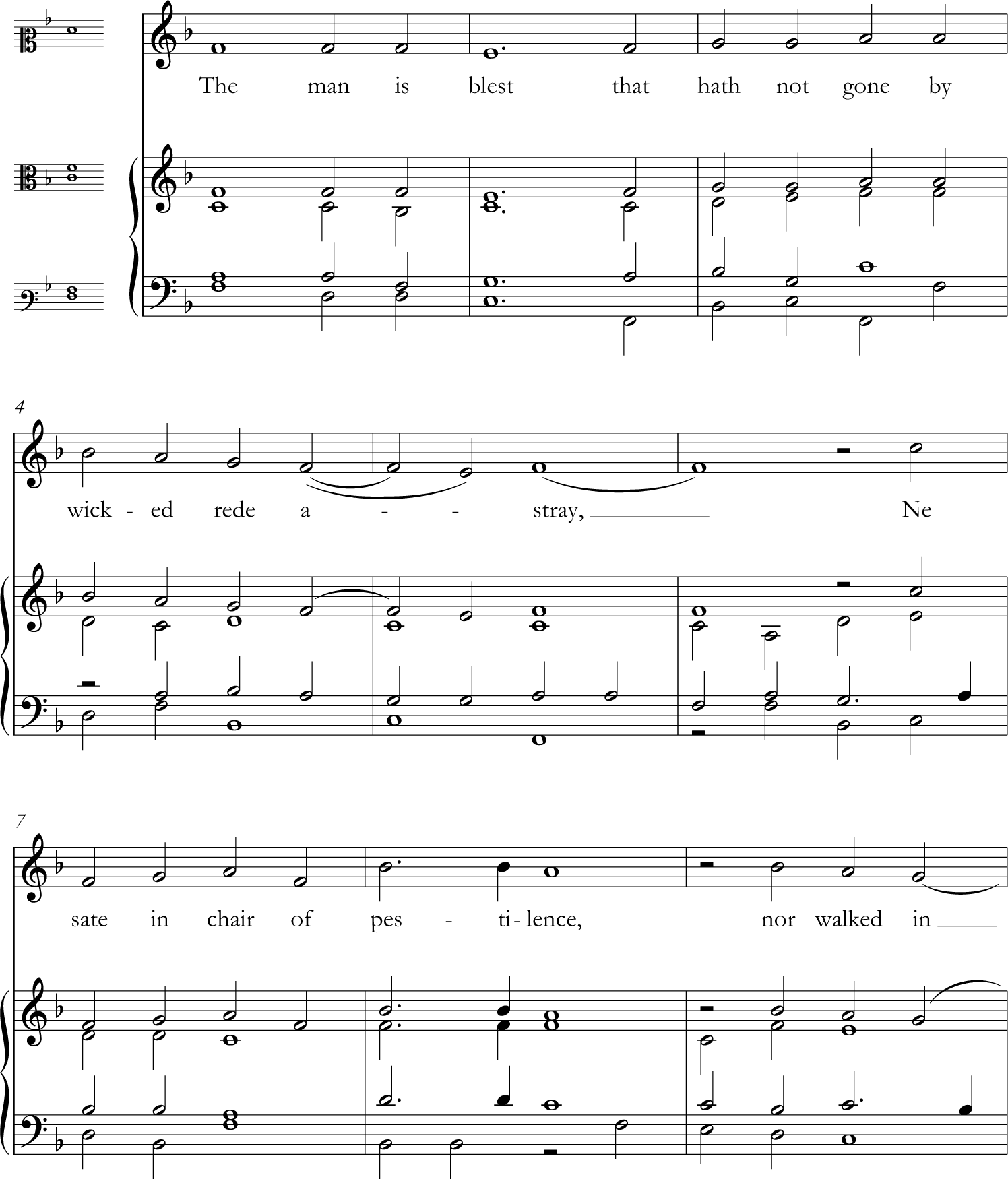
The publication that tells us most about the musical treatment of such verses is The Actes of the Apostles (1553), a paraphrase of chapters 1–14 of Acts, set to music for four voices by Christopher Tye, with one tune for all the verses of each chapter.Footnote 16 Like Sternhold, Tye was a minor courtier, and he too dedicated his volume to the king. But unlike Sternhold, he could set his own verses to music. All are in ‘Sternhold’s metre’, and the title page says they are intended to be sung or played on the lute. The settings have a clear melody in the top voice, which is an almost perfect fit to the iambic text (see Example 1).Footnote 17 The organization is in four-bar phrases, with interludes for contrapuntal entries in lower voices, and the frequency of dotted notes suggests dancing. The prevailing pavan rhythm was also a standard unit of English secular songs in common time.
Christopher Tye, The Actes of the Apostles (1553), chapter 2, verse 1, meane part. Barlines are editorial.

A sustained Edwardian effort to provide polyphonic settings of Sternhold’s and Hopkins’s psalms has partially survived in an early Elizabethan manuscript which has only recently attracted much attention.Footnote 18 It is a single treble partbook from a set of four that contained strophic settings by John Sheppard (c.1515–58) of each of Sternhold’s 37 psalms from ASP, followed by four of Hopkins’s, with the music repeated for several verses in each case. Some of them are distinctly ‘tunes’ in the domestic style already discussed. Four are in triple time, suggesting galliards. Those in common time are four-line tunes; in almost every case, the last two lines of the tune are marked to be repeated (ABB form), an increasingly common practice in secular songs.Footnote 19 These are followed by six more elaborate settings of some of the earlier Sternhold psalms (2, 3, 4, 5, 29 and 32), all of which had appeared in Certayne Psalmes: on this basis, Milsom argues that they are earlier settings than the others.Footnote 20 The copyist firmly attributes all the settings so far to ‘mr Shepardes doinge’. Most use between 16 and 28 lines of the psalm text, selected to make sense as independent sequences. The longest is 40 lines, consisting of the whole of Psalm 6. The manuscript also includes prose anthems by Sheppard, Tallis and others. Both Sheppard and Tallis were leading composers of church music for both the Latin and the English rites, and were members of the Chapel Royal under both Edward and Mary.
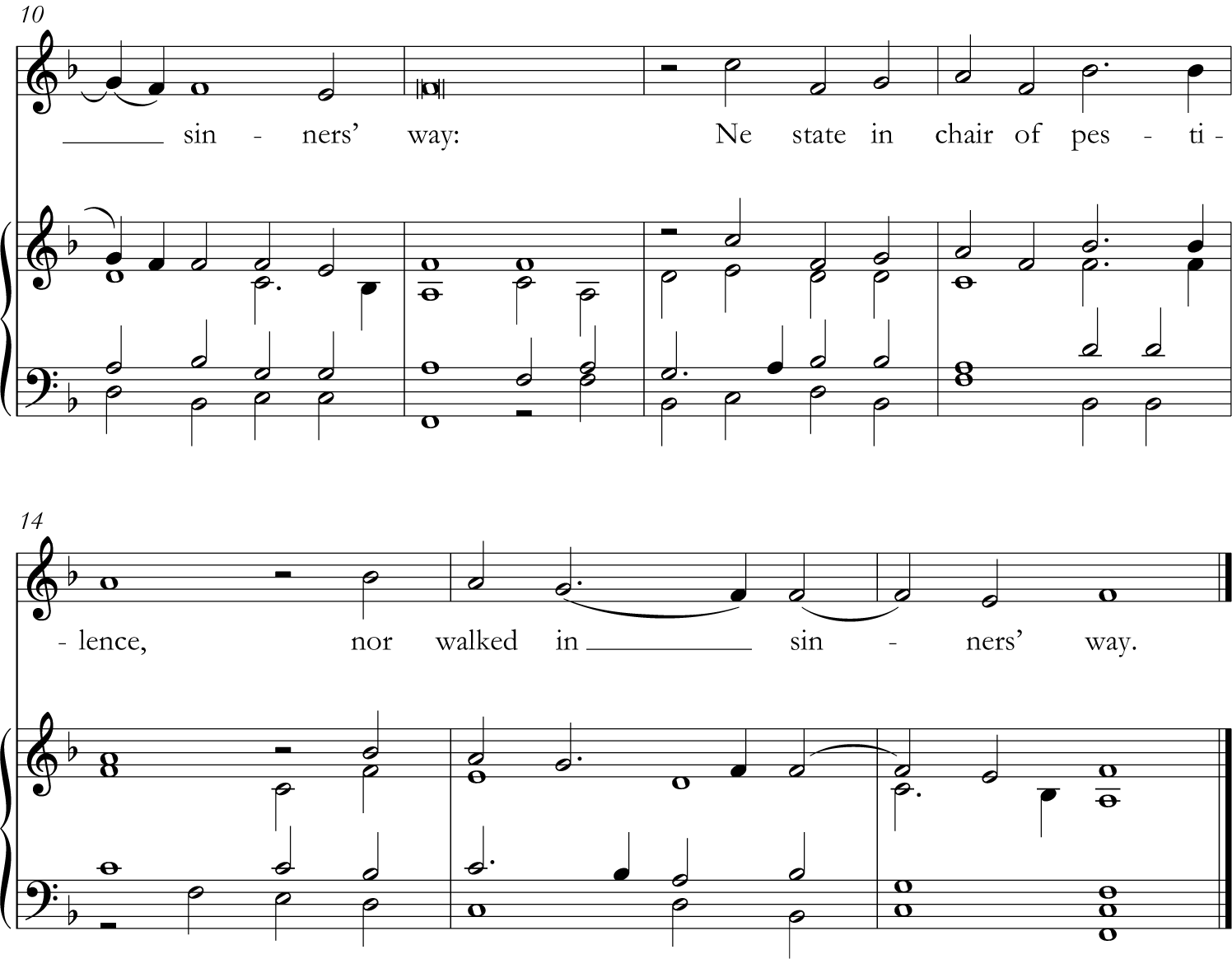
Sheppard’s music for Psalm 1 (see Example 2) is also found in the roughly contemporaneous Mulliner Book in the form of a keyboard reduction that probably corresponds to the full four-voice setting, displaying the same mildly contrapuntal support for the melody that we have already found to be typical of the period.Footnote 21 As Edward’s reign was a time of unprecedented experiment in church reform, one naturally wonders whether these developments led to the use of metrical psalms or other biblical paraphrases in church and, if so, whether they were sung to these or similar tunes. Certainly, there is nothing to suggest that this was part of Sternhold’s, Tye’s or Sheppard’s intention. Nor does it seem likely that settings modelled on dances or courtly songs were introduced in worship, even where active reformers were in charge. Their idiom was radically different from the chant-based and learned polyphonic styles that had been customary, and they would have required instruments of an unchurchly kind.
John Sheppard, Psalm 1 (Sternhold). Sources: text and voice-part, BL, Add. MS 15166, fols. 1r−2r; organ part, BL, Add. MS 30513, fol. 80v.

(cont.)

The psalms in reformed worship
There was a strong movement to introduce the psalms in English into the daily service, as part of the general reformation that followed rapidly after Henry VIII’s death.Footnote 22 The Act of Uniformity, passed in January 1549, required the use of the Book of Common Prayer from Whit Sunday (9 June) that year.Footnote 23
The prayer book directed that the canticles and psalms be ‘said or sung’, and for the first time divided the 150 psalms between the mornings and evenings of the 30 days of the month. To carry this out, choirs would need copies of The Psalter or Psalmes of Dauid after the tra[n]slacion of the great Bible, poincted as it shalbe song in Churches Footnote 24 − that is (unlike in the Great Bible itself), with each verse starting on a new line and a colon in the middle to mark the half-cadence. They could then easily be chanted to the Sarum versions of the Gregorian psalm tones. Surviving sixteenth-century sources of chants for the translated psalms are closely based on these.Footnote 25 This was in line with the general policy of the 1549 prayer book: to stay close to the familiar service, but to make it comprehensible to the people. As Quitslund points out, the Act ‘still construed the people primarily as listeners, not speakers, and certainly not as singers’.Footnote 26
However, there was nothing in the rubric that specified what translation was to be used, or that excluded metrical translation. To use it regularly would require a metrical version of all the psalms. Robert Crowley, an activist evangelical clergyman who would later join the Marian exiles, lost little time providing one. On 20 September 1549 he published it, in a rough form of Sternhold’s metre, adding by way of example the first verse of Psalm 1, with the seventh Sarum psalm tone in the tenor, harmonized for four voices in faburden style.Footnote 27
Only two examples have emerged from parish church accounts of a church acquiring metrical psalms in Edward’s reign. St Laurence, Reading, has the following entries:Footnote 28
| 1547 | |
| [p. 254] paid for ix bokes of the salmes | ij s. iij d. |
| 1548 | |
| [p. 256] paied for ii psalme bokes | vj d. |
| [p. 257] paid for vi salter bokes of the newe service | xij s. |
Both the title ‘psalm book’Footnote 29 and the price of 3d. each for the first two entries suggest a much smaller book than the prose psalter of the third entry, which usually cost about 2s.; and in 1547 – that is, no later than 25 March 1548 – this smaller book could hardly have been anything but Sternhold’s Certayne Psalmes. Later, St Laurence evidently acquired the prose psalter of the ‘newe service’. At St Dionis Backchurch, London, there is a specific entry for the purchase of Sternhold’s psalms:Footnote 30
| 1549 | Item payde for ye changyng of vi salters and for i od salter & for iiii bokes of sternall salmes | iv s. |
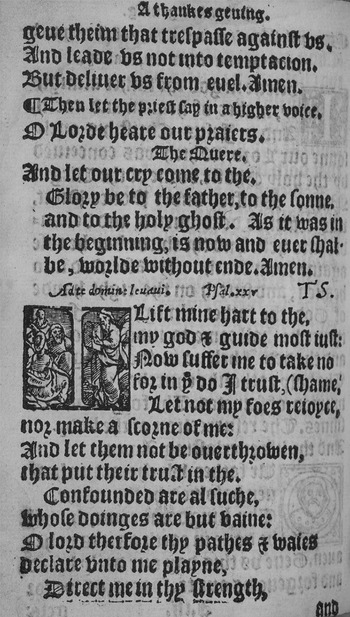
Two years later, the chanting of metrical psalms received explicit royal consent in the form of a special order of prayer entitled A thankes geuing to God, for relief of the sweating sickness that had spread quickly over the country.Footnote 31 Figure 1 shows, after the prose doxology taken from the prayer book, the beginning of Psalm 25 in short metre (SM) from this source, with Sternhold’s initials added by hand. Later come Psalms 28, 30 and 6 (CM), also taken from ASP, to be sung by ‘the Quere’.Footnote 32 One of them is headed: ‘After the lesson sing this psalm.’ All end with a rhyming, loosely metrical doxology of unknown origin: ‘To the father and the sonne, / And to the holy ghost. / Be all laude and praise, now and ever, / Throughout every coast. / Amen.’ In this context, and in the absence of published or widely known metrical tunes, it seems that these psalms were also chanted to Sarum psalm tones. Confirming this supposition, Figure 2 shows the prose Nunc dimittis taken from the prayer book and concluding with the metrical doxology just quoted. It is clearly set out as verse, and the word ‘coast’ has no valid function other than to provide a rhyme for ‘ghost’.
A thankes geuing to God vsed in Christes churche on the Monday Wednisday and Friday ([London]: Richard Grafton, 1551; STC no. 16504). Cambridge, Magdalene College, Pepys Library, 228 (2), fol. A3v. Reproduced by permission.

A thankes geuing to God vsed in Christes churche on the Monday Wednisday and Friday ([London]: Richard Grafton, 1551; STC no. 16504). Cambridge, Magdalene College, Pepys Library, 228 (2), fol. B1v. Reproduced by permission.

Another choral model was to treat metrical psalms like prose texts for vocal polyphony, in the manner of a Latin antiphon. There are a few surviving anthem-like settings of single stanzas, some allowing for strophic repetition, which probably found their way into choral services between 1549 and 1553. Leaver plausibly suggests that such pieces were sung before or after services on certain major festivals.Footnote 33 One is found in the Certayne Psalmes select out of the Psalter of Dauid of the poet and publisher Francis Seagar (also spelled Segar), for use with 12 of his own paraphrases.Footnote 34 Two more, with Sternhold texts, are in the Wanley partbooks, ‘easily the most valuable of the extant Edwardian sources’ of choir music.Footnote 35 One of these is strophic, with a text consisting of Psalm 49, verse 1, and Psalm 4, verses 1 and 3–9.Footnote 36 The other is a through-composed setting of Psalm 128, entitled ‘Wedding’.Footnote 37 A more ambitious five-voice setting of this standard wedding psalm was composed by another courtier, Philip van Wilder, who died in 1554.Footnote 38
To sum up: in so far as metrical psalms found their way into English church services before Elizabeth’s reign, surviving evidence shows that they did so in two forms, both choral. One was as a translation of the Latin psalms for chanting purposes; the other was as texts for antiphons and similar compositions that would develop into the standard English anthem.
Some writers have advanced the notion that congregational singing was widely practised in Edward’s reign.Footnote 39 It was certainly to be heard at the London church of Austin Friars, which had been licensed from 1550 for the use of French and Dutch reformed worshippers under the supervision of John à Lasco, a former Polish bishop. A similar licence was granted to Valérand Poullain for a small French Walloon community at Glastonbury.Footnote 40 Perhaps it was tried out here and there in English services. Only one report has come to light, from a not very credible source.Footnote 41
Two later sources leave little doubt that congregational singing of metrical psalm tunes in church was not widely introduced in Edward VI’s time, even under the more liberal prayer book of 1552. One, A Brieff discours, comes from the account of the ‘Troubles’ at Frankfurt in 1554, published retrospectively in 1574.Footnote 42 There were disagreements between the Prayer Book party led by Richard Cox and the more radical group led by John Knox and Whittingham, which adopted Calvin’s view that only psalms should be sung in worship and by all the people. The Brieff discours describes the proposal for a form of worship that the English exiles planned to submit to the Frankfurt magistrates in July 1554. It was a greatly modified version of the 1552 prayer book liturgy, omitting many non-biblical responses and other passages, but adding: ‘The people to sing a psalm in metre in a plain tune as was and is accustomed in the French, Dutch, Italian, Spanish, and Scottish churches’ before and after the sermon.Footnote 43 This clearly implies that it had not been the custom in English churches at the time.
A similar reaction was recorded later from a man who had stayed in England throughout Mary’s reign. When Henry Machyn recorded the first introduction of congregational singing in London after Elizabeth’s accession, at Morning Prayer in St Antholin’s Church on 21 September 1559, he described with evident astonishment how a psalm was sung: ‘in Geneva fashion: […] men and women all do sing, and boys’; he further noted the crowd ‘old and young’ singing ‘a psalm in metre, the tune of Geneva ways’ after a sermon at St Paul’s Cross on 17 March 1560.Footnote 44 What he found notable was that the whole flock, not just the choir, was singing, and that the tune was of an unfamiliar character. Machyn had been a parish clerk in London churches since 1550 at least. There is no hint here of an indigenous Edwardian tradition being restored. Clearly this kind of singing was new to London, and Londoners saw it as coming from Geneva, as was printed on the psalm books they were using.
The French factor
When Mary Tudor succeeded her half-brother in 1553 and reintroduced Roman Catholic worship, the English Protestant tradition was preserved chiefly by the few hundred exiles who fled to the Continent. They took with them, and developed, diverging opinions as to what a reformed religion should be, and were free to dispute details of worship with others. In the absence of a sovereign or bishop, the decisions in each community tended to be made by majority vote after much argument and were liable to be revised when a new group of exiles arrived. But they were also constrained by requirements laid down by local authorities.
In Frankfurt the magistrates demanded that the English exiles use the same type of broadly Calvinist worship as Poullain’s French Protestants from Glastonbury, who had already been granted the use of the Weiβfrauenkirche (Church of the White Ladies), but only on condition that they ‘shulde not discent from the french men in doctrine, or ceremonyes’. This was largely acceptable to the Calvinist group, but was resisted by some of the Prayer Book party, both from loyalty to English law and tradition and because rhyme and metre inevitably led to modification of the original meaning of the psalm texts.Footnote 45 But in the end, even after the Puritan group led by Knox and Whittingham had moved to Geneva, leaving Cox’s Prayer Book party in the majority, they had to give way to the requirements of the magistrates. The accepted liturgy of March 1555 opened Morning Prayer with ‘Ffirst a Psalme songe bye the whole Congregation’.Footnote 46
As soon as it was accepted – joyfully by the Calvinists, more reluctantly by the ‘Anglicans’ – that metrical psalms were going to be needed for worship, steps were taken to provide them, and the leading figure in this process seems to have been Whittingham. It was taken for granted that Sternhold’s and Hopkins’s collection was the only possible one for the purpose – as was also the case in Strasbourg, Wesel and other centres. Quitslund has shown in great depth how Whittingham’s revisions of the texts were made not only in the interests of greater accuracy but also to suit the exiles’ current situation, and how his additions to the corpus were made in a similar spirit.Footnote 47 These revisions would be printed in the Anglo-Genevan psalm book in February 1556.
If the psalm texts could be sung with little special effort in Frankfurt in 1554–5, either from printed booklets or from communal memory, by a group of English and Scottish people of mixed class, education and geographical origin, one might expect that there must have been a set of common tunes that were widely known. Even if they had not been much used in church, tunes by such accomplished musicians as Sheppard and Tye could surely have been brought into service. Only a handful of them would have been needed at first, thanks to the metrical uniformity of most of the ASP texts. Yet no such collection, nor even any individual settings, have come down to us from this period. Not one of the DCM tunes that have survived from Edward’s reign would find its way into the Anglo-Genevan psalm book.
One likely barrier stood in the way of such a development. Calvin’s own views were explicit:
One should always see to it that the singing is not light or frivolous: but has weight and majesty, as St Augustine said. And so there should be a great difference between music made to entertain men at the table and in their home, and the Psalms, which are sung in Church, in the presence of God and his Angels.Footnote 48
For Whittingham, who had taken on himself the responsibility of providing appropriate materials for the singing of the more radical group of exiles, these words had to be taken as law. Calvin’s views clearly ruled out the ‘pavan’ or ‘galliard’ type of tune that had been popular for devout recreation in Edwardian England. When the psalm book with tunes was published at Geneva in 1556 (see Appendix 2, no. 3), the editors (of whom Whittingham was almost certainly the leader) would claim they had presented it ‘to the judgement of the famous man John Calvin […] who approving it, as sufficient for a Christian congregation, we put the same in execution’.Footnote 49
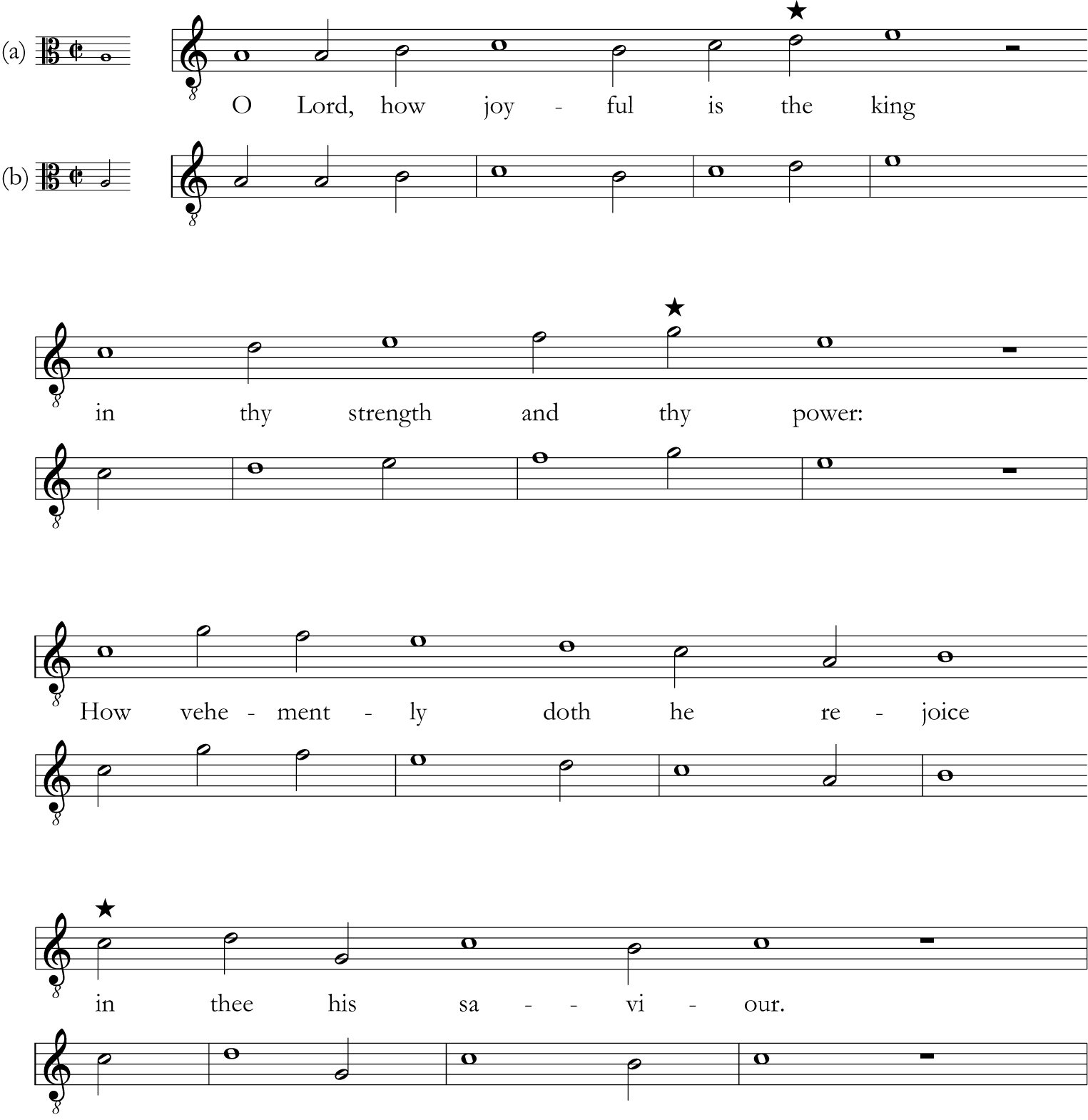
The obvious model – indeed, the only possible one under these circumstances − was the French psalter itself. But of the 83 tunes in the 1551 edition (or its reprints of 1554, 1555 and 1556),Footnote 50 not one was in ‘Sternhold’s metre’. Here was the other immovable barrier to any hope of a satisfactory compromise. The Edwardian psalm-tune concept seems to have been as firmly fixed in a set rhythm, metre and style as would be the minuet, the limerick and the waltz in later eras. Whittingham ransacked the French psalter for tunes that were near enough to CM for possible adaptation, but found only four candidates.Footnote 51 Example 3 shows the first half of his adaptation of Psalm 128 (7.6.7.6) to Sternhold’s paraphrase of the same text (8.6.8.6). The French tune, like all its fellows, is firmly in duple time. But when Whittingham inserted an extra minim before the last notes of phrases 1 and 3 to accommodate the extra syllable, he deprived the tune of its underlying rhythm. He could easily have substituted a minim for a semibreve in the sixth note of both phrases; perhaps he was afraid this would sound too much like a pavan. He made rhythmical changes of this sort in most of his adaptations, either unaware of the difficulties they would raise for the singers or deliberately to undermine the foot-tapping regularity of the tunes.
Psalm 128: (a) French psalter (1551); (b) Anglo-Genevan psalter (1556).

The remaining 48 tunes in the 1556 Anglo-Genevan psalter were new. All are set to iambic verse but are modelled on the French tunes that generally begin with a stressed semibreve. All but seven are in DCM.Footnote 52 To produce such a body of tunes in little over a year, let alone teach them to the Anglo-Scottish congregation, would surely have been an insuperable task for Whittingham and his supporters. By comparison, the completion of the 83 tunes in the 1551 French psalter itself had taken 12 years, even though it had been undertaken by a group of selected professional musicians − Louis Bourgeois and his associates. The result is a superb collection of tunes taking full advantage of many musical devices such as repetition, complementarity, sequence and climax.
Although Whittingham himself is said to have been ‘skillful in music’,Footnote 53 the sudden demand for four dozen new tunes in an experimental idiom would surely have stretched his skills beyond their limits. There may have been one or two other exiles with some musical ability. None is known to have had a professional background in music.Footnote 54 It seems an inescapable conclusion that he must have secured the services of one or more musicians in Poullain’s community in Frankfurt or, later, in Calvin’s circle in Geneva.Footnote 55 Such men were well equipped to compose or adapt tunes conforming to Calvin’s principles and to the models in the French psalter.
Learning to sing the new tunes in church services would also have been a formidable task for the Anglo-Scottish congregation without the help of a choir or organ (both of which had been outlawed by Calvin). Beyond their newness was the unfamiliarity of their style and character and of the way they were to be sung in worship. All these features were outside the norm for metrical psalm singing in English.
We may single out two characteristics – modality and rhythm – to see in detail how far and in what respects the tunes of 1556 departed from the Edwardian model.
Modality as an obstacle
The diagram in Figure 3 shows the distribution of modal scale types – each of which has a distinctive sound arising from the placement of semitones in relation to the final – in some corpora of psalm tunes and in certain other sixteenth-century English and Continental repertories.Footnote 56
Mode distribution in selected sources.

The source known as ‘Henry VIII’s manuscript’ consists of courtly songs, dances and instrumental pieces used at Henry’s court between (according to John Stevens) about 1510 and 1520.Footnote 57 Much of the music is in a ‘popular’ idiom, not in a social sense but in the sense of a relatively undemanding style. Figure 3 demonstrates that in this context there was a decided preference for Ionian, Dorian and Aeolian scales, while Mixolydian was fading and Phrygian had almost joined Lydian in extinction. It was from the same court three decades later that Sternhold’s psalms and their imitators would arise, so it is not altogether surprising to find a similar preference in the surviving early tunes for them by Sheppard and Tye, leaning further towards Ionian and Aeolian. This does not necessarily mean that English composers would have made the same choices for more solemn music, such as Latin church music. Tallis, for instance, composed a Mass and at least two antiphons in the Phrygian scale, and Byrd and Palestrina (see the last two rows) were still making full use of Mixolydian, Dorian and Phrygian scales after mid-century, though in very different proportions, as Figure 3 shows.
Calvin also, as we know, required church music to sound serious. In the French psalter (see the third row of Figure 3) we find that Dorian was the most in demand in 1551 (as it would still be in the completed version of 1562),Footnote 58 while Mixolydian and Phrygian also had a prominent place. This is also true of the Anglo-Genevan psalm book of 1556, which not only was modelled on the French psalter but also may have been in large part the work of some of the very musicians who created it. It contained six tunes in the Phrygian mode and even one, as printed, in the Locrian mode, a supposedly theoretical concept only.Footnote 59 But evidently these did not go down well with the singing congregation. The drastic revision of 1558 (see Appendix 2, no. 5) led to a more ‘modern’ distribution of scale types, with no less than 23 of the tunes in the Ionian mode and only one in the Phrygian. If tune cross references are taken into account, four fifths of the psalms and hymns were now set to tunes in Ionian or Aeolian mode − in other words, in major or minor keys. The process continued in the early Elizabethan editions. By 1567 the Phrygian mode was no longer present in WBP (see Appendix 2, no. 9), and cross references reflected the unpopularity of Mixolydian and Dorian as well.
Rhythm as an obstacle
Rhythm was probably the more important factor demarcating the tunes of 1556 from the English secular type of tune that the exiles might have known and loved. The tunes of the French psalter are, without a single exception, in strict duple time, which might have been a positive factor for the English. But except for the long at the end of every tune, all the notes are either minims or semibreves. There is a complete absence of the dotted notes that give many Edwardian tunes their dance-like character. There is an even number of minims (including rests) in each line.Footnote 60 Within these limits, the pattern of semibreves and minims presents a wide variety, since the French psalms have a great diversity of syllable counts.
The opening semibreve, found in all but 12 of the 593 lines in the 1551 French psalter, in no way contradicts the character of the verses, because French does not employ word stress as English does; that is, it does not distinguish strongly between stressed and unstressed syllables.Footnote 61 French verse metres are defined not by stress patterns but by syllable count, along with rhyme and, in some cases, a mid-line caesura. Even a final ‘e’ can be set to a strong musical beat: Example 4 is a well-known case.Footnote 62 That this was already true in the sixteenth century is confirmed in Frédéric Deloffre’s chapter on ‘L’oeuvre poétique de la Renaissance’.Footnote 63 Even the ‘feminine ending’, which had a clearly subordinate syllable at the end of a line, could be set to a semibreve or (as in Psalm 125) to the final long. Some British and American scholars, such as Maurice Frost and Waldo Selden Pratt, have misguidedly classified most of the French psalms as ‘iambic’, but the term has no true application to French prosody, at least in the sense in which it is used for ancient Greek or modern English verse.Footnote 64
La Marseillaise, verse 2.

We have seen how Whittingham weakened the rhythm of one tune he borrowed from the French psalter. For the 48 new tunes of the 1556 Geneva book, all set to iambic verses, he and his presumed musical helpers were confounded by their obligation to follow the French model, representing Calvin’s demand for ‘weight and majesty’. They too used only semibreves and minims except for the final long, admitting no dotted notes of any kind. With rare exceptions, they began every odd-numbered line with a semibreve, although it would now have to carry a metrically unstressed syllable in a metre where stress mattered.Footnote 65 This became a feature of English psalm tunes that would last for 300 years, and would later be explained away as a ‘gathering note’,Footnote 66 and even as an import from Scotland.Footnote 67
For distribution of the other syllables the editors allowed themselves much more variety, and in many cases fatally violated the duple-time structure − often, it seems, in order to place emphasis on semantically important syllables in the underlaid first stanza. At times this amounted to a deliberate avoidance of regular rhythm. For example, in the tune for Psalm 21 the semibreves largely correspond with syllables in the opening stanza that would receive the most emphasis in speech, but they weaken the iambic metre and destroy any sense of duple time (see Example 5). Of 390 phrases in the 48 new tunes, 76 have odd numbers of minims that undermine duple time.Footnote 68
Psalm 21 (Sternhold): (a) 1556; (b) 1560. Barlines are editorial.

(cont.)

Of course, irregular rhythms designed to emphasize particular words do not normally work in subsequent stanzas. The semibreve for ‘strength’ on an unstressed syllable in line 2 of version (a) of the tune for Psalm 21 overrules the prosodic pattern; not surprisingly, it does not fit the second stanza (‘and bles-sings ma-ni-fold’) or the third (‘thy be-ne-fit and aid’), and so on. When this tune was revised for the second edition, four minims were replaced by semibreves, which at least restored a sense of rhythmic regularity: these are marked with an asterisk in Example 5. (Version (b) is discussed below.) The assumption that a tune would fit later stanzas had worked well enough for the French psalms, where all that mattered was the syllable count. It did not work for English ones. The obvious policy would have been to write ‘iambic’ tunes like those of Examples 1 and 2; but even those did not perfectly fit every line of every stanza, because Sternhold and his successors occasionally departed from a strict iambic stress pattern (as in Example 1, bar 20). Whittingham seems to have felt compelled to reject anything as regular as those Edwardian tunes, presumably to satisfy Calvin’s strictures. But he came up against opposition from his people, as we can see from the great changes he had to make in the second edition of the book.
First, however, we should look briefly at the practice of one other colony of English exiles: that of Wesel in north-west Germany, where a group was located from 1553 to 1556. A single, incomplete copy of a book published for their use, the Psalms of Dauid in Metre (see Appendix 2, no. 4), has survived.Footnote 69 It begins with the set of paraphrases from ASP in unrevised form, inserting (in their proper numerical order) the eight new ones taken from the Geneva psalm book of 1556,Footnote 70 followed by a number of hymns and metrical canticles not found in any earlier source, some of which would eventually find their way into WBP. Footnote 71 This is clear confirmation that metrical paraphrases were becoming an indispensable part of English Protestant services. If the incorporation of congregational psalm singing in worship was itself inspired by Calvinism, the only practical source of English texts for the immediate need was ASP. Some of these must have been used in Strasbourg, Frankfurt, Wesel and probably other colonies.
The music of the Geneva book was greatly changed in several ways in the 1558 edition. There were fewer tunes to learn: 23 of the 64 psalms and canticles now had cross references to the tunes of other psalms, a new departure which would eventually lead to the uniquely English system of ‘common’ tunes and tune names. Only 25 of the 52 tunes of the 1556 edition were reused. Most Phrygian and Mixolydian tunes were dropped, as already noted. An effort was made, though hardly a decisive one, to deal with the problem of rhythmic ambiguity.Footnote 72 Whittingham translated a group of four psalms to fit their French tunes,Footnote 73 and at last finished paraphrasing the giant Psalm 119, which was set to a curious adaptation of the Lutheran tune for the Creed.Footnote 74 He probably had the help of John Pulleyne, who had arrived in Geneva in June 1557. Pulleyne contributed two paraphrases in unfamiliar metres; the one for Psalm 148 (6.6.6.6.4.4.4.4.) proved to be historically important in later English hymnody.Footnote 75
The tune for Psalm 30 provides an unusual insight into Whittingham’s criteria for determining note-lengths. As we have seen, he felt free to emphasize words in the underlaid opening stanza by lengthening individual notes, regardless of the ill effects this might have on the later stanzas. In 1558, Psalm 30 was shortened from triple CM to DCM by omitting phrases 5–8 of the original tune. The last four phrases now had new words underlaid, and Whittingham made certain consequential changes of rhythm that involved two examples of the still rare dotted semibreve (see Example 6). The words ‘O Lord’ were given longer notes for the sake of emphasis. Similar changes might have been desirable in the later stanzas of this or any other psalm, but Whittingham did nothing to bring them about − because the words were not underlaid in the psalm book.
Psalm 30 (Hopkins), last four lines: (a) 1556; (b) 1558. Barlines are editorial.

This also affects the possibility of word-painting. Timothy Duguid has asserted that melodic phrases in some tunes are intended to illustrate words or concepts in the text, not just in the underlaid verses but often in subsequent stanzas, or even in stanzas from other psalms cross-referred to the tune. The revision of the tune for Psalm 30 to suit the revised text makes that process seem highly improbable.Footnote 76 Duguid has made by far the most detailed effort to defend Whittingham’s tune matches and versifications,Footnote 77 but only a few of them succeeded in permanently attracting the public, most notably Psalms 51(1) and 124.
Later Geneva editions of the psalm book came out after Queen Elizabeth had allowed psalm singing before or after service in English churches.Footnote 78 They still had an influence on Day’s English psalm book, which survives in incomplete editions of 1561 leading up to his completed WBP of 1562 (see Appendix 2, no. 7). Many returning exiles were soon given parish benefices or higher church positions, or were made heads of colleges. Above all, Edmund Grindal, a member of the Prayer Book party among the exiles, was appointed bishop of London on 22 June 1559, and was ‘most zealous in presenting his companions in exile for ordination’, including many of the more radical kind.Footnote 79 So it is not surprising that those churches and colleges that first adopted congregational psalm singing, which was never required by law, tended to be led by strongly Calvinistic clergy, who wanted to continue the austere style represented in the Geneva psalm book.
London editions of the psalm book
John Day’s psalm book of 1559 has not survived: we know of its existence only because he was fined in October of that year for infringing William Seres’s copyright. It is difficult to follow who was in control of the copyright for metrical psalms in the early months of Elizabeth’s reign.Footnote 80
The first extant Elizabethan edition of the psalm book, the Psalmes of Dauid in Englishe Metre published in London in 1560 (see Appendix 2, no. 6), has interesting connections with the Wesel book discussed earlier. The Wesel book had printed, for the first time, metrical paraphrases of two of the canticles (Benedictus and Magnificat) prescribed in prose form for the daily services in the 1552 Book of Common Prayer; but it pointedly passed over the non-scriptural Te Deum and Benedicite, suggesting domination by the Calvinist wing of the exiles.Footnote 81 There are two missing leaves which would have accommodated the remaining scriptural canticle, the Nunc dimittis, already present in the Anglo-Genevan psalm book.Footnote 82
The 1560 London psalm book has the same versified canticles, but adds the Te Deum and Benedicite as well,Footnote 83 all now supplied with tunes. Cox’s Lord’s Prayer and the metrical Creed, with their tunes, also entered the English psalm book for the first time. The only surviving exemplar (at Christ Church, Oxford) of this significant edition is incomplete and has no publisher’s name on it.Footnote 84 There is much reason to think that it was published not by Day but by Seres, who was trying at this time to assert his privilege in rivalry with Day. It uses a music font not found in any Day versions of the metrical psalms,Footnote 85 and contains 19 tunes that were not taken up by Day in any later edition.Footnote 86 It seems quite likely that this edition was supported by some of the Prayer Book party, including Cox and Grindal, in an effort to forestall Day’s more Calvinistic version.
A feature of this edition not hitherto noticedFootnote 87 is a fresh attempt to deal with the problem of rhythmic uncertainty in many of the tunes, which we have already discussed at length. In view of the other links with Wesel it seems likely that this reflects musical experiments that were tried out there. A large number of notes in Geneva tunes, most of them the fourth note in a line, were now changed from minims to dotted semibreves.Footnote 88 This change strongly reinforced the iambic metre, and in many cases allowed the whole tune to be heard as if in a constant time signature, usually triple time (3/1). Because there are many misprints, especially in the first half of the book, the intended revision is imperfect in some cases, but there are at least 17 pre-existing tunes where it seems indisputably clear that this was the editor’s intention.Footnote 89 One of the most successful of these is shown in Example 5(b) above. In other tunes a different rhythm results.Footnote 90
Faced with the unrhythmical tunes of the 1556 Geneva book, the musicians guiding the Wesel exiles had probably initiated singing them in this way. Although they had their own (tuneless) psalm book, they must have had at least one copy of the 1556 Geneva book, since we know they copied Whittingham’s paraphrases from it into their own. So a musician or teacher may have used it to lead the pitches of the tunes, while supplying their own rhythms. When the exiles returned to England, they persuaded the editor of the 1560 edition to emend the tunes, as best he could, into the more rhythmical forms to which they had become accustomed.
But there are no signs of these revisions in Day’s early editions. He quickly commissioned texts and tunes to complete the collection.Footnote 91 Eight new paraphrases written by William Kethe for use in Geneva, with tunes from the French psalter in non-English metres, were permanently adopted in the English psalm book;Footnote 92 so was the Lamentation (DLM), Tallis’s haunting tune, already printed in Day’s Certaine Notes. Footnote 93 These were no doubt adopted because they were readily available. The task of finishing the translation of the remaining psalms was distributed between John Hopkins, Thomas Norton and John Marckant, who used CM almost throughout.Footnote 94
Of the 14 new DCM tunes first printed in the 1562 WBP, and presumably commissioned by Day, 11 are in the rather colourless style that we may call the Anglo-Genevan idiom.Footnote 95 They do, for the most part, maintain a duple metre, and all are firmly in a major or minor key, thus lessening both the tonal and the rhythmic pitfalls of 1556. But it is striking that Day did not take advantage of any of the distinguished composers now within his reach, except in the Lamentation. If, as Milsom speculates, the eight tunes by Tallis later published in Archbishop Parker’s psalter were originally intended for use in WBP it is hard to see why Day turned them down.Footnote 96
Some tunes in the 1562 WBP show traces of rather different ideals, however. The last three psalm tunes (Psalms 141, 145 and 147), all set to paraphrases by Norton, revert towards the more secular Edwardian style, reviving dance-like rhythms with dotted minims and crotchets. Psalm 147 even ends on a sharpened third degree, suggesting that it originated in a harmonized setting. The Complaint of a Sinner consists of eight lines of three-foot iambics; its tune uniquely repeats the words of the last line, and also ends on a major third. It is evidently based on an accompanied solo song. One DCM tune (Psalm 81) is a triple-time version of another (Psalm 77) and would become one of the handful of ‘proper’ tunes from WBP to gain permanent popularity. Two new tunes, Benedicite (8.4.10) and Psalm 136 (8.7.8.7.8.7.8.7), had to cater for repeated refrains in their texts, although it cannot be said that they took much artistic advantage of this opportunity. The tune for the German hymn ‘Preserve us’ (LM), which became notorious for its line ‘From Turk and Pope deliver us’,Footnote 97 originated (ironically enough) in a medieval tune for St Ambrose’s hymn Veni redemptor gentium. Footnote 98
From 1561 onwards, Day for the most part avoided the odd-numbered minim beats that had undermined duple time in the Geneva editions. But there are still enough irregularities to prevent the establishment of a predictable rhythm for many of the DCM tunes, whether in duple or triple time. This fact must have been one of the main reasons for the ultimate failure of most of them to win great popularity. The cheaper editions began to omit some of them, substituting cross references.Footnote 99 Day began omitting unpopular tunes as early as 1569. After 1580, the pruning became more ruthless.Footnote 100 In 1581 he started a barebones series, reducing the 66 tunes to 47 by 1584 (see Appendix 2, no. 12).Footnote 101 Of the 19 discarded (see Table), only eight had satisfactory cross references (‘tune suggestions’ in Duguid’s term); the rest were directed to psalms that had no tune or a tune in the wrong metre.Footnote 102 Evidently, Day or his deputy was not much concerned about readers’ ability to make use of the printed tunes provided. In all these economies the hymns were exempt from having their tunes removed, which suggests that Day was concerned to keep the Anglican establishment happy as well as appeasing Calvinistic demands for musical austerity.
TUNES DELETED FROM JOHN DAY’S 1584 EDITION OF WBP (SEE Appendix 2, NO. 12) AND CROSS REFERENCES PROVIDED THERE
| Tune deleted | ||||
|---|---|---|---|---|
| Psalm | HTI no. | Metre | Cross reference: ‘Sing this as …’ | Comment |
| 6 | 65 | DCM | Psalm 1 | — |
| 14 | 113 | DCM | Psalm 3 | — |
| 21 | 160 | DCM | Psalm 18 | — |
| 25 | 114 | DSM | Psalm 24 | wrong metre |
| 35 | 170b | DCM | Humble Suit | — |
| 41 | 88 | DCM | Psalm 51 | wrong metre |
| 46 | 171 | DCM | Psalm 35 | tune deleted |
| 50(2) | 172 | DSM | Psalm 25 | — |
| 52 | 161 | DCM | — | no tune provided |
| 61 | 174 | DCM | Psalm 35 | tune deleted |
| 88 | 176 | DCM | Psalm 81 | — |
| 95 | 177 | DCM | Psalm 69 | — |
| 111 | 145 | 666.666.667.667 | — | no tune provided |
| 120 | 121 | 6.6.6.6.6.6 | Psalm 124 | wrong metre |
| 121 | 122 | 8.6.6.8.7.7 | — | no tune provided |
| 125 | 148 | 8.8.8.8.6.6 | Pater noster | both in wrong metre |
| 134 | 150 | SM | Psalm 37 | wrong metre |
| 136(1) | 180 | 8.10.8.10 D | — | no tune provided |
| 141 | 181 | DCM | Psalm 44 | — |
In 1586, however, shortly after John Day’s death, a serious effort was made to overhaul the music of the entire collection (see Appendix 2, no. 13). Half-hearted attempts to improve the rhythms had previously been made in certain editions, such as an early 32mo of 1577 (see Appendix 2, no. 10).Footnote 103 Now came a more determined revision that was not a measure of economy but an effort to raise standards and at the same time to restore some of Calvin’s principles. Under Richard Day’s patent, inherited from his father, John Wolfe published five editions of WBP in which the tunes were systematically revised and corrected.Footnote 104 They share some 238 musical changes not found in any earlier edition, but adopted in all but a few subsequent ones. Most of these correspond exactly with John Cosyn’s musical companion to the psalter, published by Wolfe the previous year. Footnote 105 From this it seems clear that Cosyn was either himself the musical editor of the revised psalter or at least a strong influence on its contents. Cosyn had dedicated his companion to Sir Francis Walsingham, praising him as a ‘patron of godliness and mainteiner of true religion’, and indeed Walsingham’s known puritan leanings made him more likely to take a serious interest in popular psalm singing than most of his peers. Cosyn in his companion used 38 tunes from WBP, some more than once; he substituted psalms for all six hymns whose tunes he used, following Calvin’s view that only the psalms should be sung in church.
The newly revised WBP contained another determined effort at rhythmic standardization. The first tune in the book, Veni creator,Footnote 106 was turned into a model for the standard CM psalm tune, with French-style semibreves at the beginning and end of every phrase, minims for every other syllable and rests after all phrases. It set the trend for the rest of the book. Total war was waged on dotted notes: 35 dotted semibreves were replaced by minims, and only one was retained (probably an oversight); all 31 examples of the dotted-minim−crotchet dance pattern were replaced by two even minims. This was clearly a puritan initiative, reviving Calvin’s stricture on anything redolent of domestic music-making. Pairs of semibreves were treated with more discretion: 53 were removed, 21 retained. Syncopations and ‘fourteener’ patterns were retained; a few were even added. Some widely popular tunes of French or German origin, most notably Psalms 100, 104 and 111, were brought closer to the prevailing rhythmic pattern. Overall, the plan seems to have been to retain only two note lengths, semibreve and minim (with the usual exception of the final long). All this was clearly a return to the restrictions of the French psalter.
There was also an effort to modernize − or anglicize − the tonal system, a subject on which Calvin is not known to have expressed any views. In 24 instances, sharps were added as accidentals, generally at cadences; it is more than likely that they were already in use, especially in London churches, where leading citizens would have been familiar with current trends in English secular art music. The pitch of 45 other notes was altered. In some (but not all) cases there is an obvious reason. The endings of three tunes (Psalms 95, 134 and 147) were radically revised.Footnote 107 Some of the changes reduce or eliminate an unusual melodic leap; many make a phrase more conventional. Nearly all are in tunes of Elizabethan or Anglo-Genevan origin. The French and German tunes were largely untouched, probably because most of them were little used, owing to their unpopular metres. Also, of course, the French tunes had been approved by Calvin himself, and were not to be freely tampered with.
The popular tunes prevail
Most editions for the rest of the sixteenth century and beyond adopted these changes and carried anything between 47 and the full complement of 66 tunes. But there is evidence that the printed tunes were being used less and less. Musical misprints increased to staggering levels, and were often copied uncorrected year after year, as were tune cross references to psalms without tunes or with tunes in the wrong metre. In 1588, one printer, Henry Denham, brought out an edition based on the old Seres patent,Footnote 108 in which he included, for the first time, four of the short ‘common tunes’ that had begun to replace most of the traditional tunes in the psalm book.Footnote 109 Starting with a 1591 32mo, a slowly growing number of editions were printed without any tunes at all. Meanwhile, the various companions, containing harmonized tunes for domestic use, published slightly different selections of these common tunes. Cosyn in 1585 had used five. The editor of William Daman’s companion, in 1591, claimed that he had included ‘all the tunes of David’s psalms, as they are ordinarily sung in the Church’,Footnote 110 suggesting that the four common tunes he included were already in use there, even if they were not yet in the psalm books.
In 1592, Thomas East brought out his four-part companion to the psalm book, the first to print the complete texts and a tune with every psalm and hymn (see Appendix 2, no. 16). It preserved the proper tunes for all texts that had them in WBP and for a few others, but most were provided with one of nine four-line common tunes. The system was carried to its logical conclusion in East’s second edition of 1594 (see Appendix 2, no. 17), in which only the psalms and hymns with proper tunes were set to those tunes, and the remaining 111 were set to eight common tunes. In the new incipit index provided for his edition, East bracketed the four tunes that would later be named Oxford, Cambridge and Low Dutch (all in CM) and Southwell (SM), with the highly significant remark, ‘The Psalmes are song to these 4 tunes in most churches of this Realme.’Footnote 111 If this was accurate, it confirmed not only that the 35 DCM and two DSM tunes in WBP had become largely disused, but also that the tunes in individual metres, mostly of French origin (and hence also the psalms that went with them), had become obsolete. Indeed, Denham in 1589 had omitted several of them in an abbreviated octavo edition (see Appendix 2, no. 15),Footnote 112 and in 1603 Henry Dod would publish Certaine Psalmes of David, heretofore much out of vse, because of their difficult tunes. Footnote 113 In all these efforts to reduce or improve on the tunes, the hymns before and after the psalms were still exempt from interference, until in a 24mo edition of 1603, shortly after the queen’s death, the last three hymns were cut out, apparently to save the expense of starting another sheet (see Appendix 2, no. 19).
The last and most radical reform of WBP in Elizabeth’s reign was the introduction of ‘Middleburg’ editions. Their distinctive characteristic was that they carried the prose versions of each psalm from the Geneva Bible in the margin next to the verse, promoting the Calvinistic ideal that one should sing with understanding.Footnote 114 The 1601 edition (see Appendix 2, no. 18) contained tunes for 63 psalms, as well as the 18 hymns (more than any existing WBP edition), largely copied from East’s companion; some of these were repeated with more than one text, and 20 psalms were set to the three most popular common tunes. All the hymns were lumped together at the end, and some copies have been found without them, presumably offered to puritan buyers at a reduced price.
We can now clearly see that well before the end of the sixteenth century, the tunes in WBP were no longer an accurate reflection of the music sung by most English congregations. The fact that they continued to be printed in most editions may have been a surviving tribute to the pre-eminent position of Calvin as ‘the dominant theological influence in Elizabethan England’.Footnote 115 But it can also be explained by simple economics. The Company of Stationers, which would be granted a monopoly in the printing of WBP in 1604, often assigned the job to its lowest-paid and least skilful printers. It was far easier for them simply to copy the layout, text and music unchanged from a previous edition than to set up fewer or shorter tunes that would take up less space and hence require a resetting of most of the book.Footnote 116 And indeed those psalms that had proper tunes in WBP retained their connection with them in many later hymnals.Footnote 117
But the printed tunes were no longer serving their intended function. Instead, there was a group of some ten common tunes that everybody knew by heart, mostly in DCM but with a couple in DSM, which could be used for no less than 136 of the 156 psalm paraphrases.Footnote 118 In most cases their origins are unknown, but their general style is strikingly similar to that of the Edwardian tunes that the Calvinists had tried so hard to suppress. They are, indeed, the most natural and obvious way of setting four lines of DCM iambic verse. The number of common tunes in the popular repertory slowly increased. Some are first found in the Scottish psalter of 1615, in a set of ‘The XII. Common Tunes, to the which all Psalmes of eight syllables in the first line, and sixe in the next may be sung’;Footnote 119 a couple first appear in Edmund Prys’s Welsh psalter of 1621.Footnote 120 From these sources occasional short tunes were taken into WBP editions.
The tune Winchester (see Example 7) has an obvious general similarity to Examples 1 and 2, and is even closer to the second half of chapter 8 of Tye’s Actes, which has been identified by some as its source of origin.Footnote 121 It could also have been a reduction of the tune for Psalm 77. East used it for only one psalm in 1592 (Psalm 84) and withdrew it from subsequent editions, perhaps because he was afraid of Calvinistic criticism; but it was frequently published in later works. Windsor is markedly similar to a traditional tune for the song ‘How should I your true love know?’, used in Shakespeare’s Hamlet. Oxford may have originated in the song ‘Pastime with good company’, attributed to Henry VIII but also found as a French chanson printed in 1529.Footnote 122
Psalm 84 (Hopkins). Tune: Winchester, 1592.

These tune names were allotted by Thomas Ravenscroft, who in 1621 brought out his revision of East’s companion, The Whole Booke of Psalmes […] Composed [that is, harmonized] into 4. Parts by sundry Authors. Footnote 123 It retained the old texts in their entirety, but contained no fewer than 25 new tunes,Footnote 124 as well as ten derived from East. All but one were CM or SM common tunes, with a full range of names, most of them based on English cathedrals and choral foundations. Some editions of WBP between 1622 and 1647 would adopt a few of these tunes, generally for psalms that had not previously had tunes to themselves. These were mostly the Middleburg editions and two other short series.Footnote 125 But few of Ravenscroft’s newly printed tunes would become widely popular, unlike the earlier common tunes, which had gradually spread through the country by oral transmission.Footnote 126
George Wither would also find out how hard it was to challenge popular tradition when, in 1623, he brought out a collection of hymns, some scriptural, some original, with a superior set of new tunes mostly authored by Orlando Gibbons. It was intended for binding up with WBP for use in church. In his preface, Wither complained that some people
allow of Metre, but will give way to no new versions […] say they, every man almost, is so well exercised in the Psalmes and tunes allowable in our Church, that he can make one of the Quire, whereas if new notes and measures, should be brought in their steed, there would be few or none in our assemblies (as they thinke) to joyne together in that devotion.Footnote 127
The truth is that there was now a body of common psalm tunes that almost everybody knew and liked, and which sufficed for all but a handful of ‘foreign’ psalms and hymns that could be largely ignored. It was going to be very difficult to dislodge those tunes. When in 1644 Parliament replaced the liturgy with a form of worship devised by the Westminster Assembly of Divines, the music was left unchanged. They argued about whether William Barton’s or Francis Rous’s version of the psalms should replace Sternhold and Hopkins, but both were designed for use with the familiar tunes (not the ones printed in WBP), and were to be taught to the people by ‘lining out’. Barton said he had ‘collected the most choice and exquisite tunes that are or have been used in all England […] leaving multitudes of tunes (in Ravenscroft) as unnecessary and burdensome’.Footnote 128 Rous’s version was ‘fitted to such tunes as have been found by experience to be of general use’.Footnote 129 Both efforts failed in England, and people went on singing from Sternhold and Hopkins, which continued to be published year after year, though the printed tunes (now mostly obsolete) were more and more often left out.Footnote 130
In 1658, John Playford, the predominant music printer of his day, considered it was time to set down ‘The Tunes of the Psalmes As they are commonly Sung in Parish-Churches. With the Bass set under each Tune, By which they may be Play’d and sung to the Organ, Virginals, Theorbo-Lute, or Bass-Viol’.Footnote 131 As he pointed out, ‘There are many more tunes than I have here set down, but these I chose rather from the rest, as being all of them such as the congregations will joyn in, and are better acquainted with these than the other tunes.’Footnote 132 Again there is the clear notion of a core repertory. He provided 18 tunes. First came ‘The ten Short Tunes proper to any Psalm whose Measure is to eight Syllables on the first line and six on the next’ − the common tunes,Footnote 133 though in fact one was in SM − followed by Psalm 100 (LM). Next came three ‘Long Tunes that can be sung to any psalm whose Measure is 8 syllables in the first Line, and six in the next’: Psalms 1, 81 and 119, apparently the only tunes of the vast range of old DCM ones that had once entered the popular domain. Finally, there were four tunes in unusual metres that only suited particular texts: Psalm 51(2), 148 and 113 and the Commandments (also fitting Psalm 125(2)).
Four of these tunes are in triple time (3/2), the other 14 in common or duple time, strictly observed in every case; all but one are in F major, G major or G minor (Commandments is in C major). Only three are of French origin. In the common-time tunes the standard line begins and ends with semibreves, with minims in between: this, with a few French tunes, was perhaps the sole surviving legacy of the French psalter. But there are several variations of that pattern, the most frequent being the syncopated opening (minim–semibreve).
This basic group of tunes lasted for the rest of the seventeenth century. It is a striking fact that the first musical supplement to the 1698 edition of the ‘Bay Psalm Book’ − the earliest music printed in what is now the United StatesFootnote 134 − consists of 13 of these tunes, while the same 13, and two more of them, comprise the supplement to John Patrick’s Psalms, printed in London in the same year, which became a favourite with English dissenters.Footnote 135 Eight of the same tunes were also the first to be printed with Tate and Brady’s New Version. Footnote 136 In addition, a few of the old DCM tunes − Psalms 1, 81, 119 and 148 − were favourites; and a few in unusual metres (mostly foreign) − Psalms 51, 113 and 124, the German Lord’s Prayer and above all Psalm 100 − had been friendly enough to catch on.
What all this amounts to is that the English norm for congregational singing never departed from a strong iambic metre − common metre and its variants, whether in duple or triple time. It first arose as a derivative of dance music and secular song. Calvin’s views, the misguided imitation of French prosody and Whittingham’s urge to emphasize individual words in the underlaid first stanza almost obliterated this framework in many of the printed tunes, which became the victims of compromise. But the original concept survived and ultimately prevailed in oral tradition. The same was true of tonality, where musica ficta sped the departure of some of the old modal scales. A tune like Winchester could have originated in any period from Edward VI to Edward VII. It is as popular as ever for the carol ‘While shepherds watched their flocks by night’.Footnote 137 It is simple, easily memorized, tonal and iambic, has regular accents and some ‘secular’ dotted rhythms, and adds up to two balanced four-bar phrases. In other words, it is a quintessential English psalm or hymn tune of the kind that the Elizabethan Calvinists tried but failed to suppress.
APPENDIX 1
The following abbreviations are used in this article:
| ASP | Al such Psalmes of Dauid as Thomas Sternehold […] didde in his life time draw into English Metre (see Appendix 2, no. 2) |
| BL | British Library |
| CM | common metre (8.6.8.6) |
| D | doubled (following a verse metre) |
| DCM | double common metre (8.6.8.6.8.6.8.6) |
| DLM | double long metre (8.8.8.8.8.8.8.8) |
| DSM | double short metre (6.6.8.6.6.6.8.6) |
| Frost | Maurice Frost, English and Scottish Psalm and Hymn Tunes c.1543–1677 (London and Oxford: SPCK and Oxford University Press, 1953) |
| ‘GP’ | Robin A. Leaver, ‘Goostly Psalmes and Spiritual Songes’: English and Dutch Metrical Psalms from Coverdale to Utenhove 1535–1606 (Oxford: Clarendon Press, 1991) |
| HTI | Nicholas Temperley, assisted by Charles G. Manns and Joseph Herl, The Hymn Tune Index: A Census of English-Language Hymn Tunes in Printed Sources from 1535 to 1820, 4 vols. (Oxford: Clarendon Press, 1998); online at <https://hymntune.library.illinois.edu> |
| LM | long metre (8.8.8.8) |
| MEPC | Nicholas Temperley, The Music of the English Parish Church, 2 vols. (Cambridge: Cambridge University Press, 1979) |
| MPPP | Timothy Duguid, Metrical Psalmody in Print and Practice: English ‘Singing Psalms’ and Scottish ‘Psalm Buiks’, c.1547–1640 (Farnham: Ashgate, 2014) |
| RR | Beth Quitslund, The Reformation in Rhyme: Sternhold, Hopkins and the English Metrical Psalter, 1547–1603 (n.p.: Routledge, 2016) |
| SM | short metre (6.6.8.6) |
| STC | A Short-Title Catalogue of Books Printed in England, Scotland and Ireland 1475–1640, ed. Alfred William Pollard and Gilbert Richard Redgrave, 2nd edn, 2 vols. (London: Bibliographical Society, 1976) |
| WBP | The Whole Book of Psalms; for details of editions referred to in this article, see Appendix 2 |
| WBPCE | The Whole Book of Psalms Collected into English Metre by Thomas Sternhold, John Hopkins, and Others: A Critical Edition of the Texts and Tunes, ed. Beth Quitslund and Nicholas Temperley, Renaissance English Text Society Publications, 36 (Tempe, AZ: Arizona Center for Medieval and Renaissance Studies, 2018) |
| Wing | Donald Goddard Wing, Short-Title Catalogue of Books Printed in England, Scotland, Ireland, Wales, and British America and of English Books Printed in Other Countries 1641–1700, 3 vols. (New York: Index Society, 1945–51) |
APPENDIX 2 LIST OF PRE-1605 EDITIONS OF STERNHOLD’S AND HOPKINS’S PSALMS REFERRED TO IN THIS ARTICLE
| No. | Item | STC no. | HTI no. | WBPCE no. |
|---|---|---|---|---|
| 1 | Certayne Psal⸗ | mes chosen out of the | Psalter of Dauid, & draw⸗ | en into English Metre by | Thomas Sternhold | grome of y[e] kinges | magesties | Roobes. || Excudebat Londini Edo⸗ | uardus VVhitchurche. Cum priuilegio ad impri | mendum solum. (London: Edward Whitchurch, [?1548]) | 2419.5 | — | 1548 |
| 2 | Al such Psalmes of Dauid as | Thomas Sternehold | late grome of y[e] kinges | Maiesties Robes, | didde in his life | time draw in⸗ | to English | Metre. || Newly emprinted by Ed⸗ | warde Whitchurche. | Cum priuilegio ad imprimen⸗ | dum solum. ([London]: Edward Whitchurch, 1549; = ASP) | 2420 | — | 1549b |
| 3 | The forme of pray- | ERS AND MINISTRA- | tion of the Sacraments, &c. vsed in the | Englishe Congregation at Geneua: and | approued, by the famous and godly lear- | ned man, Iohn Caluyn. || […] || IMPRINTED AT GENEVA BY | IOHN CRESPIN M. D. LVI. (Geneva: John Crespin, 1556) | 16561 | ✻P AG1 | 1556 |
| 4 | Psalmes of | Dauid in Metre. [?Wesel: ?Hugh Singleton, ?1556] | 2426.8 | — | 1556w |
| 5 | THE FOR- | ME OF PRAYERS | AND MINISTRATION, | of the Sacraments, &c. vsed in the En- | glishe Congregation at Geneua: and ap | proued, by the famous and Godly lear- | ned man, Iohn Caluin. || […] || PRINTED AT GENEVA, | By Iames Poullain, and Antonie Rebul. | M. D. LVIII. (Geneva: James Poullain and Antonie Rebul, 1558) | 16561a | ✻P AG2 | 1558 |
| 6 | PSALMES | OF DAUID JN | Englishe Metre, by Thomas Sterne⸗ | holde and others: conferred with the Ebrue, & in | certeine places corrected, as the | sense of the Prophete requi- | red: and the Note ioy- | ned withall. | VERY METE TO BE VSED | of all sorts of people priuatly for their godly | solace and confort, laiyng aparte all vn⸗ | godly songes & ballades, which | tende only to the norishing | of vice, and corrupting | of youth. | Newly set fourth and allowed, according to the | order appointed in the Quenes Ma⸗ | iesties Jniunctions. || […] || 1560 ([London: ?William Seres], 1560) | 2427 | ✻P E1 | 1560a |
| 7 | THE WHOLE BOOKE | of Psalmes, collected into Eng⸗ | lysh metre by T. Starnhold I. Hopkins | & others: conferred with the Ebrue, | with apt Notes to synge the[m] with | al, Faithfully perused and alow⸗ | ed according to thordreappo- | inted in the Quenes maie- | sties Iniunctions. Very mete to be vsed of all sortes of people priuately for | their solace & comfort: laying apart all vngodly | Songes and Ballades, which tende only to the | norishing of vyce, and corrupting of youth. || […] || Jmprinted at Lo[n]don by John | Day, dwelling ouer Aldersgate. | Cum gratia & priuilegio Re | gie Maiestatis, persepten- | nium. | An. 1 5 6 2. (London: John Day, 1562) | 2430 | ✻P E3 | 1562a |
| 8 | TENOR [MEDIVS] | of the whole psalmes in foure partes, whiche | may be song to al musicall instrumentes, set forth for | the encrease of vertue: and abolishyng of other | vayne and triflyng ballades. || Jmprinted at London by John Day, | dwelling ouer Aldersgate, beneath | Saynt Martyns. | Cum gratia et priuilegio Regiæ Maiestatis. | per septennium. | 1563. (London: John Day, 1563) a | 2431 | #WPFP | Day 1563 |
| 9 | The whole | booke of Psalmes, collected | into Englishe Meter by Thomas | Sternhold, John Hopkins | and others, conferred with the | Hebrue, with apt Notes to sing | them withall. | Newly set forth and allowed to be | song in all Churches, of all the people toge- | ther, before & after morning & euenyng | prayer: as also before and after the Sermo[n], and | moreouer in priuate houses, for their godly so | lace and comfort, laying aparte all vngod⸗ | ly songes and balades, which tend one⸗ | ly to the nourishing of vice, and | corrupting of youth. || […] || Imprinted at London by Iohn Day. | Cum gratia & priuilegio, Regie | Maiestatis. (London: John Day, [1567]) b | 2438 | ✻P E8 d | 1567 |
| 10 | THE | WHOLE BOOKE | of Psalmes, collected into | Englishe Metre by Thom. Stern- | hold, Iohn Hopkyns and o- | thers, conferred with the | Ebrue, with apt notes to | sing them withal. || […] || Imprinted at London, | by Iohn Daye. | Cum Priuilegio Regie | Maiestatis. | Anno. 1577. (London: John Day, 1577) | 2449.5 | ✻P E20 a | 1577 |
| 11 | The whole booke of psalmes with the Note. || [Colophon:] Imprinted at London: by Iohn Daye, dwel- | lyng ouer Aldersgate. | An 1581. | Cum gratia & priuilegio Regiæ Maiestatis. (London: John Day, 1581) | 2459.3 | ✻P E25 a | 1582b |
| 12 | The whole Booke of Psalmes, | Collected into English Metre by | Thom. Stern. Ioh. Hopk. | and others, conferred with the | Ebrue, with apt Notes to | sing them withall. | Set forth and allowed to be song in all | Churches, of all the people together be- | fore and after morning & euening pray- | er: as also before and after Sermons, & | moreouer in priuate houses, for their | godly solace and comfort, laying apart all | vngodly songes and balades, which tend | onely to the nourishing of vice, and cor- | rupting of Youth. || […] || AT LONDON | Printed by Iohn Daye, dwelling | ouer Alders-gate. | 1584. | Cum Gratia & Priuilegio Regiæ Maiestatis. (London: John Day, 1584) | 2468 | ✻P E25 b | — |
| 13 | THE | VVHOLE BOOKE OF | Psalmes, collected into English | meeter by Thomas Sternhold, Iohn | Hopkins and others, conferred | with the Hebrue, with apt Notes to | sing them withall. | Set forth and allowed to be sung in all Churches, | of all the people togither before and after | Morning and Euening prayer: as also before | and after Sermons, & moreouer in priuate hou- | ses, for their godly solace and comfort, laying | apart all vngodly songs and Ballades, which tend | onely to the nourishing of vice, and corrupting | of youth. || […] || LONDON. | Printed by Iohn Wolfe, for the Assigns | of Richard Day. 1586. (London: John Wolfe, for the assigns of Richard Day, 1586) | 2471 | ✻P E16 d c | 1586a |
| 14 | THE | VVhole booke of Psalmes: col- | lected into English metre by T. Stern- | hold, W. Whitingham, I. Hopkins, and others. | Conferred with the Hebrue, with apt notes | to sing them withall. | Newlie set foorth and allowed to be soong of all | the people together, in all churches, before and after | Morning and Euening praier, as also before and after the ser⸗ | mons: and moreouer in priuat houses for their godlie solace and | comfort, laieng apart all vngodlie songs and balads, | which tend onely to the nourishing of vice, | and corrupting of youth. || […] || AT LONDON | Printed, in the now dwelling house of Henrie | Denham, being in Aldersgate-street | at the signe of the starre. | Cum priuilegio Regiæ Maiestatis. | Forbidding all others to print these Psalms, | or any part of them. | An. 1588. (London: Henry Denham, 1588) | 2475.2 | ✻P E31 a | 1588b |
| 15 | THE | whole booke of Psalmes, col- | lected into English Metre by Thomas | Sternhold, Iohn Hopkins, and others, | conferred with the Ebrew, with apt | notes to sing them | withal. | Set forth and allowed to bee song in all | Churches, of all the people together before | and after morning & euening prayer: as | also before and after Sermons, & moreo- | uer in priuate houses, for their godly solace | and comfort, laying apart all vngodly | songs and balades, which tend onely to the | nourishing of vice, and corrupting of youth. || […] || LONDON | Printed in the now dwelling house of | Henrie Denham, being in Aldersgate- | street, for the assignes of R. Day. | Cum priuilegio Regiæ Maiestatis. | 1588. (London: Henry Denham, 1588) | 2475.3 | ✻P E32 | — |
| 16 | THE | Whole booke of | psalmes: | WITH THEIR WON- | ted Tunes, as they are song | in Churches, composed into | foure parts: | All vvhich are so placed that foure may sing, | ech one a seueral part in this booke. VVherein the Church | tunes are carefully corrected, and thereunto added other | short tunes vsually song in London, and other places of | this Realme. VVith a Table In the end of the | booke, of such tunes as are nevvly added, | vvith the number of ech Psalme pla- | ced to the said Tune. | COMPILED BY SONDRY AVTHORS, | vvho haue so laboured heerein, that the vnskilfull | vvith small practice may attaine to sing | that part, vvhich is fittest | for their voice. || IMPRINTED AT LON- | don by Thomas Est, the assigné | of William Byrd: dwelling in Aldersgate | streete at the signe of the black Horse, | and are there to be sold. | 1592. (London: Thomas East, the assign of Willam Byrd, 1592) | 2482 | EastTWBP a | East 1592 |
| 17 | THE | Whole booke of | PSALMES: | WITH THEIR WON- | ted Tunes, as they are sung | in Churches, composed into | foure parts: | Being so placed, that foure may sing each | one a seueral part In this booke. VVherin the Church tunes | are carefully corrected, & thervnto added other short tunes | vsually sung in London and most places of this Realme. | VVith a table in the beginning of this booke, of | such tunes as are nevvly added, vvith the | number of each Psalme placed to | the sayd tune. | COMPILED BY X. SONDRY AVTHORS. | vvho haue so laboured heerein, that the vnskilful vvith | small practice may attaine to sing that part, vvhich | is fittest for their voyce. || IMPRINTED AT LONDON | by Thomas Est, the assigne of William | Byrd dvvelling in Aldersgate streete at the signe of | the black horse, & are there to be sold. | 1594. (London: Thomas East, 1594) | 2488 | EastTWBP b | — |
| 18 | THE | WHOLE BOOKE OF Davids Psalms, | both in Prose and Meeter, | with apte notes to sing | them withal. || AT LONDON | Printed by P. S. for the assignes | of W. Seres and R. Day. | 1601. (London: P. S. for the assigns of William Seres and Richard Day, 1601) | 2505 | ✻P E39 | 1601b |
| 19 | THE | WHOLE BOOKE | OF | PSALMES. | Collected into English | Meetre by T. Sternhold, I. | Hopkins, W. Whitingham and | others, conferred with the | Hebrevv with apt Notes to | sing them withal. | Newly set forth and allowed to bee | song in all Churches of all the people, | together before and after Morning and Euening | Prayer, as also before and after Sermons. | Moreouer in priuate houses for their god- | ly solace and comfort, laying apart | all vngodly songs and ballades, | which tend only to the nou- | rishing of vice, and cor- | rupting of youth. || LONDON | Printed by Iohn Windet for the | Assignes of Richard Daye. | 1603. (London: John Windet for the assigns of Richard Day, 1603) | 2510.5 | ✻P E41 a | — |