


Introduction
According to traditional Russian music history, the Russian national school was established in 1836, when Mikhail Glinka’s A Life for the Tsar was premiered in St Petersburg – a success that the composer attempted to repeat in 1842 with his Ruslan and Lyudmila. This narrative was largely constructed in the late nineteenth century, when the artistic accomplishments of ‘The Five’ had begun to eclipse these beginnings in the eyes of contemporary writers. Earlier works were equally eclipsed, not being recognised by critics as ‘authentically national’, all the more so once the Kuchka’s musical nationalism combined with Stalin-era scholarship that – from the mid-1930s onwards – regarded nationalism as an ideological prop for the Soviet Union. This fate befell the works of several significant composers, including Catterino Cavos, a Venetian maestro who, although having spent his extensive career serving the Russian Imperial Theatres and providing their stages with several operas in Russian, remains a footnote in the history of both Russian and European music, his image still the cliché of a minor composer. His case is representative of the pre-Glinka generation of composers, who were long disregarded for historiographical reasons, but now deserve to be reconsidered.
The traditional interpretation of their contribution to the musical life of early nineteenth-century Russia is best represented by Vladimir Stasov’s comment:
Some of the attempts and efforts made by amateurs in the time of Catherine, Paul, Alexander and Nicholas (for example, by Fomin, Nikolayev, Matinsky, Pashkevich, Cavos, Alyab’yev, Verstovsky and others) were absolutely insignificant, weak, colourless and mediocre. They were trying to imitate foreigners and therefore were never able to achieve anything themselves. Russian opera was bland, poor and lifeless, while instrumental music was totally absent.Footnote 1
A paradoxically similar evaluation persists in modern criticism, although from a distant critical position:
Before A Life for the Tsar there were no true Russian operas. Russians like Berezovsky and Bortnyansky had composed Italian operas in the eighteenth century, but these were composed on Italian soil and performed only in Italy. Opera performed in Russia to Russian texts (even if composed by Cavos) meant only singspiels or comédies mêlées d’ariettes.Footnote 2
Here Richard Taruskin is concerned mainly with formal issues – that is, the fact that these operas ‘performed in Russia to Russian texts’ were not entirely sung, but included spoken dialogues.
To the modern reader who approaches the history of Russian opera, the impression conveyed by the combination of these positions – the old one still extant in relevant literature, and the more recent one, though expressed by a scholar who has fully explored the historical and cultural biases of Stasov’s aesthetic values – appears double-faced: on the one hand, early Russian composers seem to have written operas that were not Russian enough, and no modern literature discusses them in terms of ‘Russianness’, since the concept is nowadays no longer valid as a parameter of assessment; yet on the other hand, early attempts at writing works in Russian are still not recognised as ‘true’ operas by the scholarly community (as represented by Taruskin). Leaving aside the internal discussions of the national school, for whom both A Life for the Tsar and Ruslan and Lyudmila by Glinka are paradigmatic,Footnote 3 it is clear that Russianness (or more precisely the supposed absence of such a value) appears associated with formal assumptions, thereby creating a knot that still remains untied in relation to pre-Glinka repertoire.
My research on eighteenth-century opera reveals that the distinctive criteria of Russian opera were no more absolute then than in the following century, when aesthetic criticism was embittered by personal rivalries and the exacerbation of pervasive political issues.Footnote 4 In both periods, the most common criticisms revolved around issues of libretto language, the supposed ‘Russianness’ of the subject and the introduction of folkloric music materials, together with formal issues such as the coherence of the whole, reflected primarily in the replacement of spoken dialogues with verse recitative set to music. As a result, Mikhail Glinka has remained a watershed in the history of Russian music, and his figure has divided the history of Russian opera into two main sections: before and after 1836, or prehistory and history – a division reflected in handbooks by the distinction between до- (pre-) and от- (post-) Glinka opera, which has long been accepted by Western scholarship.Footnote 5
Not that modern critics are unaware of the conventionality of this distinction: Taruskin himself has pointed out the shortcomings of the idea of a total withdrawal from Western patterns as a radical choice to establish an exclusively Russian style. In his Defining Russia Musically, he enumerated the elements involved in the ‘impure’ synthesis employed by Glinka in his first opera:
For all that his conventional reputation as founder of an insular Russian school suggests otherwise, such a man was Glinka, a prodigally eclectic composer, natural heir to the full range of operatic styles and conventions practiced in his day. The elaborate first-act cavatinas in both his operas, or especially the third act of A Life for the Tsar with its multipartite ensembles and its monumental finale, show his mastery of what Julian Budden has called the ‘Code Rossini’ – the set of formal molds that governed the Italian opera of the primo ottocento – to the point where, looking back, he could poke fun at his own ‘creeping Italianism’ (ital’yanshchina). At the same time, both Glinka’s operas conspicuously exhibit features of the French rescue genre – the genre of Grétry, Méhul, and Cherubini, not to mention Beethoven – with its ample choruses, its reminiscence themes and its ‘popular’ tone. As Berlioz was quick to notice, moreover, Glinka’s style, especially in Ruslan and Lyudmila, was heavily tinged with ‘the influence of Germany’ in the prominence accorded to the orchestra, the spectacular instrumentation, and the ‘beauty of the harmonic fabric’.Footnote 6
These observations invite further research that can integrate Glinka’s work within the international context in which he lived. As important, though, is to study the context preceding the composition of Glinka’s A Life within Russia; a task that leads us to the work of Catterino Cavos.
Cavos and his place in Russian music history
Catterino Cavos (1777–1840)Footnote 7 was a Venetian composer and conductor – son of Alberto, ballet-master and impresario of La Fenice theatre – who after the fall of the Republic of Venice (1797) moved to St Petersburg and began a long career at the Imperial Theatres. At first he was hired as a composer for the Italian and French opera troupes, and later for the Russian company. Despite referring to Cavos’s output as ‘opera performed in Russia to Russian texts’ rather than directly as ‘Russian opera’, Taruskin notes that
from the time of his appointment as music director at the Bolshoy kamennïy [Cavos] cast his lot totally with the Russian opera so far as composition was concerned, and wrote all his mature operas to Russian librettos, many by Prince Alexander Shakhovskoy, a popular playwright of the time, who was also the éminence grise on the Imperial Theatres Committee.Footnote 8
This goes some way to explain why Cavos does not tend to figure in histories of Italian opera, either in Russia or in the West, even if he can be considered the last proponent of the tradition of Italian maestri di cappella who had been coming to the Russian court since the early 1730s.
Cavos’s activities with the Russian troupe in fact completely integrated him into St Petersburg musical life, and his early biographers – Guillou, Zotov, Blokh and Cheshikhin – generally considered his work to be highly significant for the creation of Russian Opera, not only in terms of repertoire, but also for its milieu, which would deliver the celebrated productions of Glinka and later of ‘The Five’.Footnote 9 These writers belonged to a tradition distant from the Stasovian nationalist lineage, however, and their positions gradually faded out of the discourse. In their time, they all proposed that Cavos’s contribution was directed towards national opera in a context previously dominated by foreign models or by imitations of them. Zotov in particular stressed the galvanising effect of Cavos’s activity in St Petersburg:
When [Cavos] arrived in Russia, Russian opera was still in its infancy. It hardly existed at all … Our opera did not consider itself to be Russian. – Suddenly the extraordinary success of Rusalka (the first episode) opened everyone’s eyes … The Russian audience imagined it was looking at a national opera. The names of the main characters were Russian, – the princes were Russian, the mythology was Russian. What else? About other conditions of nationality there was not even a question … Cavos was the first who understood the audience’s needs. He started to study the characteristics and the spirit of Russian people; he saw that the Russian audience wanted to have something of its own.Footnote 10
Later, in 1948, Aleksandr Rabinovich considered him a ‘Russian composer’ – ‘not a musician on tour, as Araja had been, but a true citizen of his new homeland, and a zealous devotee to its artistic culture’.Footnote 11 Even Stasov’s aforementioned dismissal of Cavos as a ‘Russian imitator of the Italians’ is itself symptomatic of the degree to which the composer was integrated into the Russian musical scene, as acknowledged by the Soviet scholar Yury Keldïsh:
For an objective and unprejudiced appreciation of the contribution made by Cavos to the development of the Russian operatic theatre it is necessary to imagine its conditions at the moment when the young Italian composer was charged with its direction. An independent troupe did not even exist, there were only talented singers, who combined good vocal qualities with the skills of an actor, but this was not enough for the creation of a fully fledged ensemble. It was necessary to educate singers, who had to play difficult and responsible roles in the national and foreign operatic repertoire, and to foster their essential knowledge and skills. Finally, the repertoire itself needed to be modernised.
Cavos’s contribution to the solution of these issues is really considerable. He was able to take the National opera to a new level, and to increase its importance in the cultural life of Russian society. To do this it was necessary to be devoted to the cause.Footnote 12
When pondering the question of which Russian opera could be considered absolutely the first,Footnote 13 critics of different epochs often proposed Cavos’s works as possible candidates. Zotov considered his Il’ya the Hero (St Petersburg, 1806) as the first authentic, national (национальная – natsional’naya) opera;Footnote 14 a work understood by contemporaries and by later commentators as a conscious attempt to create a Russian opera, including folkloric elements.Footnote 15 Cavos’s Ivan Susanin, in this context, was widely considered a ‘genre-defining’ work by contemporary critics and early historians.Footnote 16 The present article, however, is not an attempt to propose this opera as yet another answer to this hoary question, which to modern musicology sounds anachronistic and misplaced. Rather, the aim is to shed light on features of Cavos’s Susanin that are common in Glinka’s opera A Life for the Tsar, as an argument against the idea of a fracture in the development of Russian operatic life. The comparison of these two operas – which are based on the same subject – will serve as a point of connection between their composers, who have so often been divided by historiography in a narrative that does not necessarily correspond to reality.Footnote 17
The two works were written twenty years apart, and grounded in different socio-cultural contexts. In terms of the historiographical distinction between pre- and post-Glinka music history, Soviet scholars long denied the possibility of aligning them at all. In 1966, for instance, Vladimir Protopopov outlined the importance for Glinka of Rïleyev’s Дума (Meditation, 1823), and suggested that the Russian composer of vaudevilles Aleksey Verstovsky (1799–1862), rather than Cavos, had influenced the composer of A Life.Footnote 18 Unable to ignore Cavos’s precedent entirely, meanwhile, Protopopov addressed the issue in a manner that reflects the anti-cosmopolitan spirit of his day:
The very emergence of a parallel between Glinka’s Ivan Susanin and Cavos’s Ivan Susanin is curious. As has already been said, the latter did not receive much favourable response in its time. However, when Glinka’s opera appeared and gained enthusiastic sympathy, a lover of Cavos’s opera emerged, too. This was R[afail] M[ikhaylovich] Zotov, a journalist and minor playwright, who had been working for the direction of the Imperial Theatres in St Petersburg. In his article ‘My Memoirs About Theatre’ he wrote that Cavos’s Ivan Susanin did not receive ‘a tenth of the success that it deserved’. Furthermore: ‘we now in all fairness admire Mr Glinka’s opera A Life for the Tsar, but it would be very unfair if, praising the present, we contemptuously forget the past. The music of Mr Cavos’s Susanin is beautiful, and everyone who has heard it would not place it below any new composition.’ This was written by Zotov himself, who in an official account of the year 1836 had been obliged to write about the outstanding qualities of Glinka’s opera. Zotov clearly had no sense of reality and was simply blinded by his sympathy for Cavos, with whom he had worked for many years, side by side, in the administration of the theatres.Footnote 19
Such an account shows the desire to emphasise the link between the assumed ‘progressive’ ideology of Glinka’s opera and later Soviet political purposes. This would be impossible to sustain if admitting any relationship with Cavos’s Ivan Susanin, since its libretto argued in favour of the monarchy, although, as we shall see, the ideological message of the two librettos in fact suggests just such a comparison.
From a completely different position, and over a century earlier, another author similarly denied the comparison on aesthetic grounds. On the occasion of the revival of Cavos’s opera on 18 July 1851, several years after the composer’s death, the composer and critic Aleksandr Serov suggested that:
The identity of the plot and the identity of the main actor (Mr Petrov plays the role of Ivan Susanin both in A Life for the Tsar and in the opera by Cavos) inevitably lead the audience to compare the two works. Trying to express some thoughts about Cavos’s music and its performance nowadays, we will only observe that the comparison between this opera and Glinka’s is, in our opinion, absolutely inappropriate. One can compare things that are of the same kind, but in this case we have: on the one hand a big, four-act opera with dances and recitatives, on the other hand something in the genre of the vaudeville, which does not have the same breadth of lyrical patterns, and which accords singing and orchestral music the same amount of space as in the short German popular plays called Singspiel, which are so different from true operas (even when they are themselves permeated by national tendencies and for this reason devoid of recitatives, as, for instance Der Freischütz or Die Zauberflöte).Footnote 20
Other points of view, however, suggest the possibility of comparison. According to Dekhtereva and Cheshikhin, for instance, Ivan Susanin was the prototype for Glinka’s A Life.Footnote 21 Gozenpud and Tedeschi also acknowledged some features common between the two operas.Footnote 22 In exploring the comparison further here, I will suggest that the discrepancies between these two heterogeneous objects will serve the cause of making acquaintance with this lesser-known composer and his output. And to this end I trace a comparison between the operas by Cavos and Glinka in several respects: ideology, dramaturgy, musical language and the use of musical folklore. Glinka’s masterpiece will not be examined separately, because of the general renown the opera enjoys among the scholarly community. Instead, this comparison will serve as an occasion to rediscover and discuss a neglected composer and the under-researched context in which he worked.
In addition, I will examine Ivan Susanin by considering a common predecessor to the opera, to situate Cavos’s output with respect to the Russian and European tradition of music theatre: Cherubini’s Les Deux Journées ou le porteur d’eau, a comédie lyrique in three acts on a libretto by Jean-Nicolas Bouilly.Footnote 23 Although I do not know of a specific study on this topic, various critics have mentioned Cavos’s Susanin and this opera. Similarly, parallels have been drawn between Glinka’s instrumental language and Cherubini’s overtures, something that for our purposes puts all three composers into productive contact.Footnote 24
Cavos’s Susanin
Composed on a libretto written in 1812 by Prince Aleksandr Shakhovskoy (1777–1846), Ivan Susanin, a ‘народная опера’ (narodnaya [national] opera) in two acts, was premiered at St Petersburg’s Maly theatre on 19 October 1815.Footnote 25 The plot takes place in Domnino, a village near Kostroma where the Romanov family resided after the liberation of Moscow from the siege of 1612. Ivan Susanin is a peasant in the service of young boyar Mikhail Fyodorovich, a candidate for the Russian throne who has just escaped from the siege. The action opens with a group of peasants waiting in a hayloft for the rain to pass. Among them are Susanin’s daughter Masha and her fiancé Matvey, who are expecting Susanin’s return from the Romanov residence. On his arrival, they revel in the news that Moscow has been liberated from the Polish enemy, and rejoice at the possibility of finally celebrating their marriage. Ivan, however, is still worried about the country’s destiny, and about the security of his lord Mikhail Fyodorovich, because bands of Cossacks are roaming the country searching for him, in order to avoid his ascension to the throne of Moscow. While Masha, Matvey and Susanin discuss the delay of the marriage, a group of Cossacks arrive, and ask to be led to Mikhail’s residence. Susanin pretends to lead them, sending Matvey ahead to warn the Romanovs of danger.
Act II takes place at sunrise in Susanin’s ‘изба’ (izba – peasant’s house), where his children Masha and Aleksey fear for their father. Susanin suddenly enters the house pretending to ask for directions, explains the situation to them and sends Aleksey to the Romanov’s residence. His subterfuge is discovered, and the whole family is threatened with death. At the last minute, a detachment of Russian soldiers saves the Susanins and arrests the Cossacks. The new tsar is safe.
Ivan Susanin was part of a series of stage performances based on national topics that were created during the period of the so-called ‘отечественная война’ (otechestvennaya voyna – the Patriotic War of 1812), and continued for some decades afterwards. These works celebrated the cohesion demonstrated by the Russian people and the support they offered to Tsar Alexander I in response to the Napoleonic invasion.Footnote 26 Many performances of this kind were produced by the fruitful fellowship established between Cavos and Prince Aleksandr Shakhovskoy, whose works glorified the heroes who made the rise of the Romanov dynasty possible, thus connecting the country’s past and present on the occasion of the bicentenary anniversary of the Romanovs’ rule (1612–1812).Footnote 27 In this vein, the figure of Ivan Susanin and his gesture in the struggle against Polish intervention at the beginning of the seventeenth century happened to be a particularly suitable allegory for the recent events in the Russian Empire.Footnote 28
The opera was performed by the Russian troupe, and various sources attest to its success, not only in St Petersburg but also in Moscow and in several provincial theatres. Its stage history runs until 1851, when it was revived in the capital city for the last time.Footnote 29 This means that Cavos’s opera would have crossed paths with the ‘other Susanin’, A Life for the Tsar by Mikhail Glinka, and Cavos and Glinka in fact first met in 1836, when Cavos conducted the premiere of A Life. As his great-grandson Alexandre Benois later recalled, the elder composer voluntarily withdrew his own Susanin from the stage, having acknowledged the superiority of Glinka’s new composition.Footnote 30 Cavos’s biographer Grigory Blokh records the testimony of Yury Arnol’d about the Italian composer’s role in the reception of the new opera:
It is well known that the director of the Imperial Theatre A. M. Gedeonov for a long time opposed Glinka’s opera; but in order not to shock Glinka’s influential friends, V. A. Zhukovsky and count M. Yu. Viel’gorsky, he wanted to put the blame on someone else. For this purpose Mr Gedeonov strictly followed the theatre statutes and passed Glinka’s opera to the kapel’meyster for his evaluation and decision, relying on the fact that Cavos would reject the work that was supposed to supplant Cavos’s own opera. But it did not go as Gedeonov expected.Footnote 31
In a much-quoted passage Glinka recalls:
I had been persuaded that the kapel’meyster Catterino Al’bertovich Cavos, who had composed, with some success, the music for the opera Ivan Susanin, was conspiring against me. Time proved the contrary, he more than anybody else convinced the Director to stage my opera, and later led the rehearsals as diligently and honestly as he could.Footnote 32
Arnol’d also mentions a conversation with Cavos himself about this matter, in which the composer explained the motivations for his conduct:
In the month of May (1836) once old Cavos himself announced: ‘Well, my son, in the Autumn we will have to produce a new opera: The Death of the Tsar by Lord Glinka.’ – ‘And what is the subject?’ – I asked. – ‘The same as my own opera, Ivan Susanin.’ – ‘And you, Mr Cavos, did you endorse it?’ – I marvelled, having often heard of the typical character of Italian musicians. Cavos kindly began to laugh: ‘Time passes for everything, my son! Older people must always give way to younger ones. Moreover’, – he continued, – ‘his music is much better than mine, and it shows autenthic national features!’Footnote 33
Dramaturgy
Although in his Memoirs Glinka admitted no influence of Cavos’s Susanin on his own project, acknowledging only the role the Venetian composer had played in the premiere, the dramaturgical structure of A Life shows that the musician and the co-librettist Rosen made use of Shakhovskoy’s layout: despite the two performances being different in scale (two acts of Shakhovskoy vs four in Glinka/Rosen), the general plan of the operas and the distribution of the roles look similar (see Tables 1 and 2).
Dramatis personae in Cavos’s Ivan Susanin and Glinka’s A Life for the Tsar

General plan of the two operas

As Table 1 shows, in terms of the principal roles, Glinka lacks only the characters of the Russian Commander and his soldiers; an omission justified by the different resolution of the plot (see below). Following Shakhovskoy’s model, Sobinin was possibly introduced into Glinka’s drama as an equivalent of Matvey: Ivan’s son-in-law did not actually participate in the historical episode, and his presence in Susanin’s legend could be due to the need for justification that he and his heirs, as descendants, enjoyed the dispensation of taxes that the crown had offered Susanin’s family. Moreover, Matvey’s presence functions to balance the voices, and opens the possibility of developing the love theme between him and the female character of Masha/Antonida. Similarly, in both operas the presence of the adopted child played en travesti, allowing the formation of a quartet that suited musical needs in a plot that mainly relies on male characters.
As the curtain rises, the setting is virtually the same (see Table 3). While the images of nature and weather in the first chorus can be understood as a typical topos for folk songs, and therefore cannot be considered a direct import from Cavos–Shakhovskoy’s opera, the references to recent events in Moscow recall the dialogues of the first scene written by Shakhovskoy (Act I, scene 1). This is particularly true in relation to the news of the liberation of Mikhail Fyodorovich from the Moscow siege, the people’s hope for the end of the troubles with the boyar’s return to the village, and the promise to defend the homeland from enemies (Table 4). Glinka’s scene closes with the women’s exclamation ‘Так будет беда лихим гостям!’ (‘Unwelcome guests will be in trouble!’ Act I, scene 1),Footnote 34 which recalls utterances in Cavos’s opera such as ‘Чужеземцaм не достанется / Руским Царством ни коли владеть!’ (‘We will never allow foreigners to dominate the Russian Kingdom!’).Footnote 35
Stage settings

A Comparison of the first scene of the two operas

In Act I of A Life, then, the presentation of characters and events adheres to that of Cavos’s Susanin. Characters appear in the same way and order, and it is possible to identify similarities between their lines, notably Susanin’s dialogue with the peasants (Susanin, Act I, scene 3, Scene and Chorus No. 3). Masha and Matvey’s duet and the two trios of Masha, Matvey and Susanin (Susanin, No. 5 and No. 6) are mirrored in the long trio and chorus scene of A Life (No. 4, Scene, Trio and Finale). The latter is divided into dramaturgical moments, with different emotional states, each of them seemingly a development of Shakhovskoy’s cues, emerging in different sections, as follows:
∙ Sobinin arrives with the news of Moscow’s liberation;
∙ he does not have Ivan’s permission to marry Antonida until the country is at peace;
∙ news arrives of the election of Mikhail Fyodorovich;
∙ the peasants rejoice at the approval of the wedding.
Antonida’s cavatina (A Life, No. 2) recalls, in content, the similar aria of Masha (Susanin, No. 3): ‘The celebration is near! / The [wedding] crown is waiting for us, and a cheerful feast is coming!’ (see Table 5).Footnote 36
A Comparison of Masha’s aria/Antonida’s cavatina

In the subsequent numbers of A Life (No. 4, Scene and Chorus, and No. 5, Scene, Trio and Finale), each of Shakhovskoy’s cues is developed, and these form different sections of the two scenes: the impossibility of getting married before the country is at peace, the still uncertain news of the election of Mikhail Fyodorovich, and the peasants’ joy when the wedding is approved. Note that in the Susanin tradition, the theme of the deferred marriage appears for the first time exactly in Shakhovskoy’s version, and this theme is further developed in Glinka’s opera, where it recurs from Act I until the Epilogue. In Glinka’s opera as well as in Cavos–Shakhovskoy’s, the characters’ private life is bound to that of king and country, and the librettist uses every opportunity to reassert the tsar’s legitimacy, as one can see in the dialogues of Table 6.
The election of the new Tsar

Glinka’s second act develops more autonomously. It is one of the main innovations of his opera, which led it to become a representative model of national character, as will be discussed below. After the symphonic Entr’acte (A Life, No. 9), Glinka’s Act III is set in Susanin’s izba and opens with Vanya, the adopted orphan, lamenting his condition (A Life, No. 10). Glinka’s indications refer to ‘the calm and sweet feelings of family life’;Footnote 37 the composer conceived the romance as ‘naïf, as the character of the orphan himself’.Footnote 38 These features recall those of Cavos’s Aleksey, even if Vanya’s vocal part turns out heroic, to the point that the critics of the period described it as ‘богатырская’ (bogatïrskaya, from bogatïr’, knight), expressing a preference for the simpler and more authentic character conceived by Cavos. In addition, while in its subject matter the text of the romance recalls Masha and Aleksey’s duet, this solo episode soon leads to a duet with Ivan, in which Vanya demonstrates his defiance, without any of the irony of his predecessor (see Table 7). In A Life’s Epilogue he sings with a lyric inflexion that could have been inspired by Cavos’s duet No. 9, but his image is more complete in the later opera than in the earlier. It is rather Ivan who preserves the character of the devoted father, although Glinka gave him, too, a decidedly more complete image.
Susanin’s children

In the following scenes of A Life (Chorus No. 10, Quartet No. 11, Scene and Chorus No. 12, Wedding Chorus and Scene No. 13, Romance and Chorus No. 14 and Finale No. 15), tragedy strikes at the heart of the peasant’s family, in a way that draws on the dramaturgical elements from the Finale 1 of Cavos–Shakhovskoy’s work (Susanin, No. 6): during the wedding preparations, Antonida promises that she will never forget her family (recalling Act I, scene 3 of Susanin), and Ivan sends his son (in Cavos–Shakhovskoy it is the son-in-law) to warn the tsar of danger. There is also the refusal of money and the soldiers’ threats. Here, too, Ivan resorts to pretence: when he realises that the Poles can find a guide other than him – Sobinin (Matvey in Cavos’s opera) – he comes forward to lead the enemies to the Romanovs’ residence. In Glinka’s opera the action seems to expand upon elements of the earlier version, while also developing hints from the second Finale (Susanin, No. 10): Antonida, who does not really understand the situation, guesses that something terrible is going to happen, and faints. Ivan’s farewell to his daughter is also exploited: Ivan asks her not to wait until his return to marry (Susanin, Act II, scene 4). His musical characterisation seems to be inspired by that of Cavos. In Glinka’s sketch it is possible to find references to his role: ‘His answers to the Poles (in my opinion) have to be short and assertive – and the shorter they are, the better the music will be, which will be not recitative, but singing with character (non motivé).’Footnote 39
In the fourth act the development sharply diverges from the former opera. In Cavos’s work the ending does not follow the historical episode, according to which Susanin was ultimately tortured and killed for having deceptively led the Cossacks into the nearby forest. In his libretto Shakhovskoy introduced a fictional conclusion, and had the eponymous hero rescued by a detachment of Russian soldiers alerted by Aleksey.
During the stage life of the opera, this departure from historical record was considered a major error. Possibly the most damning evaluation came from Morkov:
The libretto of this opera, based, as is clear, on a historical fact, proceeds from the beginning in proper fashion, but at the denouement of the play the author, taking advantage of authorial license, lapses into an unforgivable mistake. In the last scene of the second act, in which the Polish soldiers, led by Susanin into impassable forest back country and now convinced of his treachery, are obliged to kill him, a man guiding a Russian detachment pops up from behind the scenes, attacks the enemies, and sends them fleeing. Susanin, instead of giving his life to rescue the tsar (as, obviously, is the whole essence of the plot), calmly approaches the footlights and sings: ‘May the evil man fear / And grieve all life long. / The good one / Should rejoice.’
One may excuse such a departure from history perhaps only because, according to the conventions of that time, an author was accused of a crime if the virtuous hero of his play did not triumph, or, God forbid, died on the stage; be that as it may, a playwright of the likes of Prince Shakhovskoy, it seems to me, should not have obeyed ill-founded and senseless rules.Footnote 40
Even such a supporter of Cavos as Zotov preferred the real course of events:
The spectator is certainly grateful to [Shakhovskoy] for the pleasant and comforting feeling that he senses at the deliverance of the hero of the play; but every Russian knows Susanin’s fate, everyone is ready to sacrifice his own life for the Tsar and the Fatherland, and the change in the historical fact was not necessary at all. Susanin’s death belongs to the great and noble events of Russian History. Why take away from it such recollections, of which it is so proud!Footnote 41
Critics continued to debate about the conclusion until 1851. In a review of one of the final stagings of the opera at the Aleksandrinsky Theatre, Zotov explained it in respect of the theatre’s conventions, a justification already hinted at by Morkov:
The play in turn (the libretto) should be reproached for its anti-historical ending. In Shakhovskoy [Susanin] is rescued at the end; in our time of severe literary criticism one cannot even understand how one of the most cultivated personalities of his time, a member of the Russian Academy, could take the liberty of such a denouement. Alas! It was not his fault, but that of a condition created by the needs of that day. At that time the audience expected the happy ending. [Vladislav] Ozerov did not even dare make Oedipus die at the end of his tragedy [Oedipus in Athens, 1804]: breaking with the tradition and with Sophocles’s authority, he made Creon die. Prince Shakhovskoy, certainly, knew very well that Ivan Susanin accomplished the great exploit of giving his own life, but he bowed to contemporary demands, and had his hero’s life saved in the end. The audience too remembered Russian history well, but they were satisfied with this denouement. Note that spectators today still do not like cruel endings: they leave the theatre unsatisfied if the denouement of a drama is severe for the protagonists, and they demand good to triumph over evil, and evil to be punished. Unfortunately in reality it did not always go that way. However we, as men of the past century, will not make spectators feel totally guilty for this trend, and certainly will not dare to finish a play by diverting from history, but we should confess that we would be glad to see a happy ending rather than a cruel and bloody one. Thereby Prince Shakhovskoy’s mistake should be ascribed not to him, but to the taste of the audience of that time, to which authors used to bow.Footnote 42
Arapov concurs in justifying this distortion of reality due to conventions of the time, which did not allow the defeat of positive characters. And he, too, refers to Ozerov’s tragedy.Footnote 43 Zotov resorts to the same example, charging the playwright’s creative choices with external pressures: according to him the change was made because of direct requests by State Secretary Aleksandr Olenin – an argument, however, not supported by evidence.Footnote 44 In an article written on the occasion of the reprise at the Aleksandrinsky Theatre, Serov commented on the tradition of the happy end:
In the opera I. S. (on a libretto by prince Shakhovskoy), as is evident from the title, the plot is the same as in M. I. Glinka’s opera A Life for the Tsar, with the difference that as ‘at that time’ (in the second decade of our century) it was considered indispensable for an opera’s conclusion to be inevitably happy (!), Susanin in Cavos’ opera, in spite of history, does not die: he is rescued ‘just at the moment’ when the Poles pounce on him with their swords. We cannot avoid noticing this sudden turning point in European audiences’ taste, towards the operas’ plots [italics mine]. At the beginning of our century no dispensation was given to a tragic conclusion in operas. The most well-known, and even purely historical plots, were, on the operatic stage, radically modified according to this fundamental demand that the conclusion be happy: after all the vicissitudes and sorrow all turned out for the best (let us recall the conclusion of Der Freischütz etc.). Even the well known and moving story of Romeo and Juliet had been devoid of its central pathos, introducing in the plot a happy ending (in Steibelt’s today almost forgotten opera). But the terrific French literature of the thirties changed all that: ‘Nous avons changé tout cela!’ In Norma [and in] La Juive in the fifth act the heroine is burned at the stake and nobody comes in time to save her! In Les Huguenots all die in the St Bartholomew’s Day massacre, in Le Prophète even the play’s hero (Jean de Leyden) and the poor mother die in general fire and destruction!! ‘From Scylla to Charybdis.’ It seems to us that neither the first nor the second case should be taken as an indispensible condition for the operatic plot, or introduced as laws … But all this is meant to remain a passing note. In ephemeral observations one should not touch upon the serious laws of art.Footnote 45
Serov’s observations can also be extended to other details in the development of the plot, in which the tragic scheme set up by the author was subject to several unexpected faux pas. In Act I, scene 4, for instance, Susanin pretends to search for his gloves to delay going out with the Cossacks; and in Act II, scene 4 Aleksey clumsily tries to escape the izba through the window, but his difficulty in reaching the window results in comedy. It was for such reasons that the musicologist Gozenpud maintained in Soviet times that heroism (героическое начало – geroicheskoye nachalo) was totally absent from the score,Footnote 46 while much of the reputation of Glinka’s A Life hangs on its realisation of ‘tragedy in music’. Grachev categorised the libretto of the ‘first’ Susanin as a ‘hybrid genre’ positioned in a kind of limbo between the genres of tragedy in music and vaudeville.Footnote 47 Yet Shakhovskoy remained devoted to traditional forms, shaping the finale as a tribute to the French model of the rescue opera of his day. Consequently, Cavos’s Susanin is set to music according to that model (опера спасения in Russian), with spoken dialogues carrying the action, and musical numbers functioning as lyric interludes. On this level the two operas are clearly distinct from each other, belonging to different contexts of origin and referring to different dramaturgical and musical traditions. I want to emphasise, however, that Cavos’s intentions were to develop that model in order to create a national brand in the field of historical tragedy.
A French adventure in St Petersburg
In late eighteenth-century Russia, French opéra-comique eventually inspired a national brand of ‘опера комическая’ (opera komicheskaya): comic opera sung to Russian texts – themselves original or translated from French, German or Italian librettos, with original or newly composed music. The plots of these works were often comic, but sentimental subjects had also been common; they took place in varied settings, and touched social strata that previously had been rarely represented on stage. As far as I can determine, tragedy was not included in the range of possible subjects, but at the time Cavos was active in St Petersburg, opéra-comique in the Western European landscape was gradually losing its humorous aspect, retaining only the etymological meaning, where the French term ‘comique’ stood for ‘played by comédiens’ (dramatic actors) and was a definition that simply indicated a musical play with spoken dialogue. Cavos’s work can therefore be understood as an attempt to raise the Russian version of opéra-comique towards the level of tragedy, in line with developments elsewhere.
While Cavos was involved with the French troupe in St Petersburg, they gave the first Russian performance of Cherubini’s opéra-comique Les Deux Journées, ou le porteur d’eau (Pavlovsk, 10 May 1803).Footnote 48 The international renown of Cherubini’s opera and Russian stagings, in which Cavos and Shakhovskoy likely participated, suggest that the two artists knew this opera very well. Apart from several macroscopic discrepancies,Footnote 49 various similarities attest to the existence of a parent–child bond between this opera and Cavos’s Susanin. These affinities are first found in the librettos, Bouilly having apparently served as a source of inspiration for Shakhovskoy.Footnote 50
The plot of Les Deux Journées centres on the figure of Mikéli, a water carrier who lives in Paris with his children, Antonio and Marcélina. The action is set in 1647, during Louis XIV’s minority, when Cardinal Mazarin was in conflict with the privileged classes that sought to challenge the regime’s absolutism. While waiting for his father to come home from work, Antonio tells his sister how an unknown Frenchman saved him at the time when he, as a child, was starving in Berne. Mikéli returns accompanied by Count Armand, a member of the French parliament who opposed Mazarin’s oppressive measures, and his wife Constance, who beg Mikéli to save them from the Cardinal’s soldiers. Mikéli willingly offers his assistance, and tells Armand that Antonio will be married the next day to Angelina, a girl who lives in the village of Gonesse, outside Paris. Mikéli plans to smuggle Armand and Constance out of the city, which is ringed by Mazarin’s men, by disguising Constance as Antonio’s sister, and hiding Armand in his own water cart. Antonio recognises Armand as the Frenchman who had saved him, and therefore is eager to help the two refugees. In Act II Mazarin’s soldiers, who are stopping passers-by in their search for political fugitives, let Antonio and his supposed sister through, but they are suspicious of Mikéli’s cart. While the water carrier distracts them, Armand slips out of the cart and passes through the gate. Mikéli is turned back. Act III takes place in Gonesse, where the villagers are preparing for Angelina and Antonio’s wedding. A patrol of soldiers enters as Antonio, Armand and Constance arrive. Armand hides in a tree but gives himself away when they arrest his wife. At the climax, Mikéli appears with news that the queen has pardoned all the members of parliament, and all ends happily.
As we can see, then, the heroes of both libretti belong to a low social class, and both are widowers with two children; the rescued characters, Count Armand and Mikhail Fyodorovich, meanwhile belong to a higher social stratum, and their lives are connected with the destiny of the fatherland. The two operas are equally conceived in the spirit of gratitude and justice: in the case of Susanin, appreciation for the tsar’s steadfast care for the people (when expecting to be killed by the Cossacks the peasant-hero puts his children in the charge of the tsar батюшка – ‘father’); in the case of the Les Deux Journées, the emotions that motivate the action are gratitude to the count benefactor and love for the right causes. Moreover, it is from this source that Shakhovskoy may have drawn the idea of the wedding, which, as we have seen, appears for the first time in his version of the Susanin myth. This allowed for the introduction of the male character Matvey, later adopted by Glinka as Sobinin, but Aleksey may also be linked to Marcélina, also aged thirteen in Bouilly’s libretto.Footnote 51
At the beginning of Les Deux Journées, Antonio’s folk song ‘Un Pauvre Petit Savoyard (Romance No. 1 in the score) may also have inspired the choral introduction sung by peasants in Susanin’s first chorus (No. 1).Footnote 52 At very least, the initial dramaturgical situation seems to be borrowed by Shakhovskoy from Cherubini/Bouilly: Ivan’s family assembles and presents to the audience the inception of the plot. A near-quotation from Bouilly’s libretto can even be found in Act I, scene 2, with Masha’s declaration: ‘They say a prayer to the Lord is never in vain’ (Говорится же, что молитва за Богом не пропадет), which recalls the French motto ‘Bon Français, Dieu te recompense! / Un bienfait n’est jamais perdu’ (‘Good Frenchman, God reward you! / There is always a recompense to a good action’), which Antonio sings in his Chanson.Footnote 53 The protagonist’s entrance marks a turning point in the action: the news of the boyar’s return has the same function as Mikéli’s encounter with Count Armand. While the ideology informing the two operas is disparate (Shakhovskoy rejects Bouilly’s democratic positions, and clearly supports monarchy), both protagonists repeatedly assert their willingness to sacrifice themselves for the sake of the homeland, while Matvey and the peasants assert that they are ready to respond to any hostile incursion (Act I, scene 1):
Matvey
Yes, men, we may die, but we won’t surrender to the enemy!
A Peasant
No, Matvey, we won’t surrender.Footnote 54
Armand and Mikéli are also characterised by analogous stances, even if Armand is more openly political, and reveals democratic tendencies (Act I, scene 4):
So much devotion and courage must have excited the hatred of the Cardinal: I expected this. But when you are the custodian of the social pact and the Happiness of the people, you have to give your life to defend them.Footnote 55
Mikéli’s philosophy relies on the concept that good deeds are always rewarded, the risk notwithstanding (Act I, scene 8), an idea that surfaces at the end of the Russian libretto (Act II, scene 5).
I risk paying too much for the happiness to be able to say one day: ‘You see this judge and his spouse: it is me who saved them both; so that every time they take a breath, I see my name on their lips, they will not forget Mikéli.Footnote 56
Mikéli’s warm reception by his family is similar to that of Susanin, as are numerous other moments in the unfolding of the plot. As further examples, in the scene that closes the first act, Mikéli resorts to comedy to signal to his son (who enters and does not realise the danger), and disguises his incomprehension with foolishness, the same way Susanin does with Matvey when he offers to lead the Cossacks to the Romanov’s residence. Bouilly’s dialogues among the Italian soldiers, who plan to divide the reward offered for Armand’s capture, are recalled in analogous lines among the Cossacks.

The idea of diverting the enemy by futile wandering is also present in Bouilly’s text: ‘and then this cursed water-carrier made us run around this morning in Paris … It seemed as if he took pleasure in harassing us, to delay us in our march’ (First soldier, Act III, scene 7).Footnote 60 In both librettos the force of good deeds is opposed to the feebleness that strikes the spiteful: by Mikéli in the former (‘this the idea of a good deed, it gives you so much strength … so much courage!’, Act I, scene 3)Footnote 61 and by the Commander of the Russian soldiers in the latter (‘они почти не оборонялись. – Кто идет на злое дело, тот всегда робок.’ ‘They almost did not defend themselves. – Whoever goes to an evil deed is always shy.’ Act II, scene 6). Finally, the conclusions appear similar: thanks to a last-minute deus ex machina, Count Armand is rescued by Mikéli, who brings a letter from the queen, ordering his immediate release. The French opera ends with general jubilation, as a chorus invites benevolent people to rejoice (Act III, scene 10):
Chorus
Let’s all give ourselves to gaiety!
Shine, sweet accents of happiness.
Mikéli
Yes, my friends, of gaiety!
And none of us ever forget
That the first charm of life,
Is to serve humanity.Footnote 62
This finds an echo in the Russian refrain ‘Пусть злодей страшится / и грустит весь век, / должен веселиться / добрый человек’ (‘Let the evil person fear / And grieve all life long. / The good person / Should be happy’), which is sung for the first time by Matvey in the Trio (No. 5) with Masha and Susanin, but functions as a kind of summary of Susanin’s philosophy. This refrain will also be called upon later; here it is essential to notice that both works transcend their individual plots, realising the moral dimension of good triumphing over evil.
As for the musical treatment of the drama, both works have vocal roles with highly similar profiles: bass roles for Mikéli and Susanin, tenor parts for Armand and Matvey, first and second sopranos for Constance and Marcélina in Cherubini, as well as for Masha and Aleksey. And the same artists performed these operas at the Russian Theatre: Ivanova played Marcélina and both Masha and Aleksey (in different productions); Pyotr Zlov played both Susanin and Mikeli.
The orchestration underlines all these similarities: in a standard orchestral formulation (pairs of woodwinds plus occasional piccolo, two or four horns, trumpets, trombones, timpani and four string parts), Cavos’s use of flageolet in the entr’acte (No. 7) reflects the ‘flautino’ used by Cherubini, and seems to be a direct import from introduction to Act III of Les Deux Journées: here this timbre contributes to the description of the rural setting of the village of Gonesse; in Ivan Susanin it introduces the pastoral setting in the minor mode (6/8, G minor), emphasising by contrast the anxiety of the children as they wait for their father.
As an operatic composer, Cherubini exploited the conventions of opéra-comique, continuing the process started by Grétry of introducing serious subjects. The orchestra closely follows the sudden turning points of the plot: frequent use of dense rhythmic figurations and rough melodic accompaniment (tremolo of the strings, fragments of chromatic scales, syncopated patterns), suitable for creating and maintaining suspense; use of the entire orchestra and sudden smorzando, with dynamic contrasts even within a single bar; shifting rhythmic accents; a conspicuous use of diminished seventh chords and a tendency to change unpredictably between major and minor modes. All such elements, which were proposed by Asaf’yev as a connection between Glinka and Cherubini,Footnote 63 may also be first found in Cavos’s language, notably in the two ensembles (No. 6 and No. 10) and the overture, while in the other numbers the orchestra plays the accompaniment for couplets in a syllabic French vocal style, whose themes are sometimes based on pre-existing folkloric materials. In the ensembles as well as in the overture, patterns are repeated, even excessively, in order to follow a libretto that sometimes resorts to dramaturgical commonplaces to create suspense: this is the case of No. 10, for example, in which the gradual entrance of single characters – Masha, Ivan, the Cossacks, Matvey and finally the Russian soldiers driven by Aleksey – relies on a musically repetitive scheme.
Some of these elements are used symbolically to connect certain musical features with groups or specific characters, thereby bringing together different elements of the whole event; for instance, the dotted rhythm and syncopated chords that characterise the Cossacks recur in the Overture and in both the Ensembles, when the Polish soldiers are onstage. This is consistent with French opéra-comique of the turn of the century, in which recurring themes were used to identify characters, such as in Cherubini’s work (Antonio’s theme ‘Un pauvre petit Savoyard’), as well as in Grétry’s Richard Cœur-de-lion (the theme ‘Une fièvre brulante’), Catel’s Sémiramis and others. And Cavos also uses recurring themes. The refrain ‘Пусть злодей…’ which is recalled a few times: in the Overture and the Trio No. 5, in the finale of Act I (No. 6) and again in Finale No. 11, thereby transcending the structure of separated numbers which the composer seemingly perceived as ineffective for the drama.
In Cherubini, meanwhile, one can observe the effort to adapt and integrate the musical structure as much as possible to the dramatic action. Following Italian finales of late eighteenth-century opera, Cherubini creates numerous extended ensembles that overcome the French vaudeville structure, and merge narrative and lyric expression in ensembles with remarkable expressive strength. In these ensembles the orchestra maintains the continuity of the musical discourse. The vocal style is essentially declamatory: it lacks the virtuosity of Italian opera and expresses single moods to advance the action, rather than to impress listeners with the singers’ skill. These ensembles broaden the scope of the work, anticipating the more complex forms of mid-century opera.Footnote 64 Cavos borrowed Cherubini’s model in his own finales. In an attempt to integrate dramatic action and music, he integrates some lines of spoken dialogues in the vocal ensembles, and merges single scenes without decidedly interrupting the musical flow with prose dialogues: this is the case in scene 4 of Act I, and scenes 4 and 5 of Act II, which in particular, are melded into the long ensemble of Act II (No. 10).
And having established how Cavos’s work is linked to aesthetic developments elsewhere in Europe, I now turn back to the question of how Cavos’s Susanin should also be positioned within the Russian tradition.
The search for ‘Russianness’ in Cavos’s music
A Life was by no means the first attempt to create an opera that reflected ‘Russianness’. As Marina Frolova-Walker has suggested, ‘the discourse of cultural nationalism was already widespread and well developed in the Russia of 1836’.Footnote 65 By that point, musical features had evolved in response to new aesthetic demands that revealed the emergence of a national self-consciousness.Footnote 66 With some exceptions, these attempts were generally made in comic genres, and it would be unjustified to speculate on a direct link between Russian comic opera and Glinka’s masterpiece. If we speculate about the progression from the end of the eighteenth century to 1836, however, Cavos’s output clearly offers the most suitable material to fill the gap. And, alongside other work that still needs rediscovery, his Susanin performed a fundamental role in putting these distant traditions in contact.
An example is offered by Cavos’s instrumentation. On the one hand, thanks to Cherubini’s influence, his opera shows an evolution from earlier Russian comic operas by widening the classical orchestra: a further couple of horns are added, while the instruments form a dialogue with the voices rather than simply supporting them, something that appears closer to Glinka than to eighteenth-century Russian opera. While such a feature is not directly orientated towards ‘Russification’ at a general level, the use of string pizzicato for imitating the balalaika’s sound represents a device that directly connects the opera to the Russian tradition in Aleksey’s aria (No. 8; see Ex. 1).
Ivan Susanin, Aleksey’s aria, no. 8, ‘В тот же час от сел пущуся’ (V tot zhe chas ot sel pushchusya), bars 1–7.Footnote 67
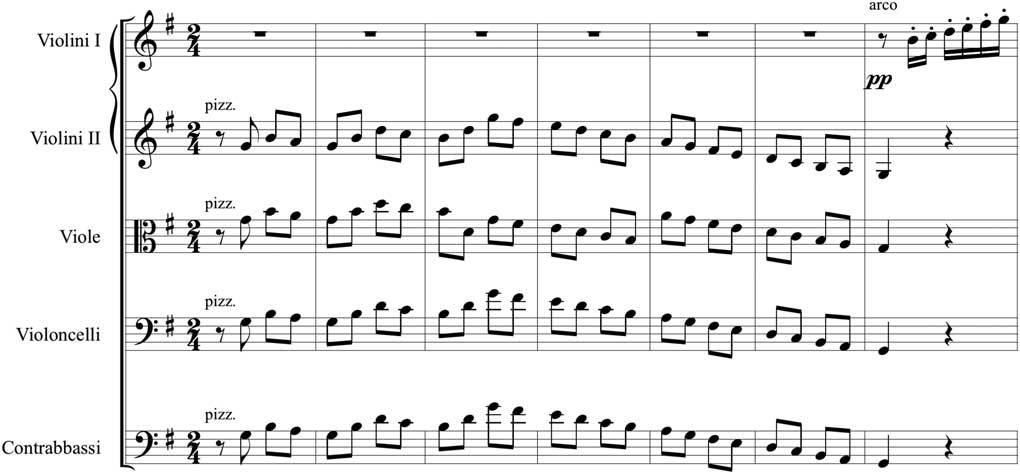
Evstigney Fomin (1761–1800) had already created such an effect in the Trio with the chorus of his Ямщики на подставе (Coachmen at the Relay Station, 1787), as had other composers in various Russian operas in the decades surrounding the turn of the century. In the wake of such examples, Glinka would exploit it in the Scene, trio and chorus ‘Здравствуйте, родные!’ (‘Hello, my dear!’, Act I), and in Lyudmila’s cavatina in the first act of his Ruslan, thus offering one type of connection between the ‘history’ and ‘prehistory’ of Russian music for the stage.
The attempt to present a national opera is ascertained most clearly in the use of Russian folksong. To provide his characters with musical expression consistent with their origins and context, Cavos resorted to folk themes, which he drew from one of the best-known collections of popular songs: the Collection of Russian Folk Songs by Nikolay L’vov and Ivan Pratsch (second edition, 1806).Footnote 68 The themes collected in such anthologies were ‘hits’ widespread in St Petersburg salons, and therefore directly in line with the expectations of theatregoers. According to the typical practice of eighteenth-century Russian comic opera, for which such collections were also conceived, popular themes were associated with new texts, and inserted into the drama as moments of diversion.Footnote 70 In Cavos’s Susanin we can observe two different attitudes towards such sources:
1. Direct quotation of music material associated with new literary texts, which was a borrowing from French comédies mêlée d’ariettes and their tradition of exploiting French popular tunes for moments of entertainment in the plot.
2. Use of musical folklore as a reference to create new musical themes.
In terms of the first category, Cavos quotes the nuptial song (свадебная – svadebnaya) Ах! Жарко в тереме свечи горят (Ah, the Candles Burn Hot in the Tower) as thematic material for Matvey’s couplets of No. 2 (‘Слава Богу милосердому’), and quotes two lyric songs, Чем тебя я огорчила (How Have I Hurt You) in Matvey’s duet with Masha No. 4 (‘Заране крущиться – даром жизнь губить’) and Не бушуйте ветры буйные (Don’t Howl, You Fierce Winds) in the chorus that opens the action (No. 1; for more on this chorus, see below).
In relation to the second category, Cavos permeates the overall musical flow of the opera with melodic profiles that were typical of the протяжные песни (protyazhnïe pesni – lyric, literally ‘drawn out’ songs) by integrating pre-existing and newly composed music. It is possible that the composer had studied the folksong collections of his day, and selected melodic fragments that seemed to him most emblematic of the folk tradition. As an example, compare the turns of the melody of the folksong shown in Example 2 with a passage from the duet of Masha and Aleksey (‘Горько с милыми разстаться’, No. 9) shown in Ex. 3.
‘Ивушка. ивушка’ (Ivushka, ivushka), L’vov-Pratsch’s Collection, No. 25, bars 1–4.Footnote 69

Ivan Susanin, Duet No. 9, ‘Горько с милыми разстаться’ (Gor’ko s milïmi razstat’sya), bars 5–7 (1st soprano part).

In Cavos’s duet, what appears as a quotation of the song Ивушка, ивушка (No. 27 of L’vov/Pratsch’s collection) is really a reduction of a melodic profile typical of lyric song. These melodic reductions do not precisely distinguish one song from another, but similar melodic fragments are found in other songs of the same orientation.Footnote 71 Direct citation clearly stimulated the composer’s creativity, and in this sense Ivan Susanin appears advanced in respect to eighteenth-century comic operas: folklore did not serve purely as decoration, but as an attempt to depict the characters more fully. My purpose here is not to examine the issue of authenticity in this process,Footnote 72 but from a historical perspective it is important to observe that such an idea would later be expanded by Glinka in A Life for the Tsar, during the Andante of Antonida’s Cavatina and Rondo, where he introduced the melismas, typical of ‘drawn out’ songs, with their irregular groupings of bars, cadential terminations with embellished fourths or fifths and free interplay of relative major and minor keys, without directly quoting a single title.Footnote 73
A further example of the use of folk music in Cavos’s Susanin is the first chorus (No. 1 – Don’t Howl, You Fierce Winds), sung at the opening curtain by a group of peasants. This chorus, which is a quotation of the homonymous lyric song from L’vov-Pratsch’s collection, draws on the practice that alternates a solo that sings the first notes of each strophe (запевало) and a male chorus. This practice had already been represented on the stage, as in the case of Fomin’s Coachmen at the Relay Station, as noted by Frolova-Walker.Footnote 74 Cavos’s elaborate treatment of folkloric material, however, does not simply fit with what Taruskin terms the ‘decorative periphery’,Footnote 75 but is arguably similar to the more organic forms that were later incorporated by Glinka. Looking at Shakhovskoy’s text, we observe that the first line shares the incipit of the quoted song, while the subsequent lines are his own creation, though following the style of folkloric poetry:

By replacing the text, Shakhovskoy creates a number that reflects this folk practice while remaining consistent with details in the plot. In comparison with the aforementioned eighteenth-century operas, the chorus is not merely an entertaining episode: rather than stopping the action for the amusement of protagonists and for the audience, it initiates the action, by opening the opera in medias res and by representing the peasants in their everyday activities. If a comparison can be drawn from the Russian tradition, it would be with the opening scene of the Russian comic opera Мельник колдун, обманщик и сват by Mikhail Sokolovsky (The Miller, A Sorcerer, Cheat and Matchmaker, 1779): here, a solo episode presents the protagonist in his daily life, playing the role of an ‘aria di sortita’. Distinct from the previous tradition though, in Cavos’s Susanin the action develops from this starting point much in the same way as in Cherubini’s Les Deux Journées, with the number of characters increasing as the act proceeds, leading to the choral Finale.
A similar dramaturgical structure is to be found in A Life: Glinka argues in his plan that in order for the opening chorus, ‘to express the strength and the light-hearted bravery of the Russian people, it has to be written in a Russian metre, and the comparisons [in the text] have to be drawn from objects of the countryside’.Footnote 77
From the musical point of view, Glinka conceived a fugue in the same key as Cavos’s No. 1 (A Life, No. 1, ‘В бурю во грозу’ [‘In storm and gale’]) in G minor:
At first the men go out, immediately followed by the women and when the voices and then the orchestra gradually disappear a boat flows on the river, with oarsmen singing a drawn-out song [протяжная] in unison (only tenors). This chorus has to express the same emotions as the chorus en fugue, but the comparisons have to be drawn from objects related to the river, the boat etc.Footnote 78
In both operas, meanwhile, the contrapuntal development shows features that are idiomatic within Russian folksong, such as a changeable number of voices brought into unison at cadences; ascending octave leaps after the cadence as a decoration of the tonal tonic (in Cavos we find this only in the instrumental parts, notably the winds, as shown in Ex. 4); and alternation of leading with note and natural seventh degree in minor scales.
: Ivan Susanin, Chorus No. 1, ‘Не бушуйте, ветры буйные’ (Ne bushuyte, vetrï buynïe), bars 1–11 (winds, horns and voices).

As Frolova-Walker has pointed out, this attempt to represent folk polyphony is strongly connected to the Russian tradition. Typical of popular singing such polyphony had been explored by several other composers: besides Fomin’s above-mentioned Coachmen, other examples might include Aleksey Titov’s female a cappella chorus from his Девичник (The Bride’s Party, 1809), and Verstovsky’s peasant chorus from Аскольдова могила (Askold’s Grave, 1835), performed on the very eve of A Life’s premiere.Footnote 79
The musical image of the enemy offers other ways to observe both similarities and differences between the two operas. For example, the representation of the Polish soldiers is certainly more developed by Glinka than by Cavos. Cavos symbolises rather than depicts the soldiers, using a laconic fragment in dotted rhythm which functions as a musical image that recurs when the Cossacks are onstage (in the two ensembles No. 6 and No. 10), but also forecasts their threat in the overture where the main turns of the plot are condensed by theme quotations.
On the contrary, in Glinka’s opera the entire second act is devoted to the construction of the Polish image in musical terms, represented by a series of national dances: polonaise (No. 5), krakowiak (No. 6), other Western dances in succession (‘Pas de trois, Pas de cinq etc.’ according to the composer’s indications; see No. 6b – waltz, in the vocal score), and finally a mazurka (No. 7). This is the episode where the Polish king is informed about the election of Mikhail Fyodorovich as the Russian tsar. The polonaise (No. 5) is later recalled in Act III, in contrast to the Russian elements (in both metre and melodic turns) introduced in Act I.
In this respect, it seems quite likely that Glinka found a precedent in sources other than Cavos’s Susanin, be it in the influence of incipient musical Romanticism (Weber’s Der Freischütz, first performed in Russia in 1824), or in the tradition of French grand opéra, since Act II of A Life for the Tsar also functions as a divertissement, in the spirit of what he would later develop in his Ruslan. Yet whatever the dangers of a posteriori-style criticism, Cavos can nevertheless still be considered as a valid exponent of Russian music of his generation. Just as Glinka’s opera would surpass previous commitments to a national production, so Cavos’s Susanin demonstrates that Cavos, too, was searching for some of the same qualities some twenty years earlier.
Having demonstrated all these connections, though, what finally are we to make of them? After all, as suggested by Frolova-Walker:
The mere presence of Russian-style material in A Life (whether romance or folklore) would not have been worth remarking upon at the première, given the many precedents over the previous decades. It was rather the consistency of Glinka’s Russian style throughout the opera that invited so much interest. In the Russian scenes of the operas, almost every number, and even the orchestral interludes were united by the Russian style, and the stylistic connections were further strengthened by the repetition of characteristic melodic patterns in different parts of each scene … The result was perceived as a change in quality, not merely a change in quantity, for the Russian style was now available as a default, sustainable over the course of the entire opera, whereas before it had only been used to give local colour to particular numbers.Footnote 80
This explains the judgements of those contemporaries (e.g. Serov) who considered a comparison between the two operas impossible.Footnote 81 And to be sure, Cavos’s Susanin lacks such consistency. Folkloric material is completely absent from the music of its ensembles (No. 6 and No. 10), for instance, which depart from the general musical style. In this regard, the influence exerted by Cherubini’s Les Deux Journées can be understood as double-faced: on the one hand, it helped the composer to develop a broad range of forms of which Cavos and the audience seemingly had perceived a need; on the other, it hindered the Russification of the music. Two different traditions were being followed, but they were not at this point completely synthesised.
These shortcomings may also be ascribed to slightly different aims pursued by the authors of the text and the music. Cavos attempted to surpass the lack of ‘organic unity’ of his former works (e.g. The Cossack Poet, 1812) – in particular the succession of couplets and spoken drama – to create a musical continuum that comprised both narrative and lyrical expression, thus transcending the frame of opéra-comique and its Russian equivalent. He had to deal, however, with a libretto that was structurally based on a French model, something that is reflected in the controversies of the plot, and in particular, the choice of the happy end.Footnote 82
These are exactly the features that attracted most criticism as we have seen, and still more recently, the Italian slavist Maria Carella considered Cavos’s work ‘culturally, historically and artistically meaningless’ because of its deviation from historical facts.Footnote 83 On the contrary, I would argue that the choice of the finale à sauvetage is historically meaningful: not in reference to the relationship between the subject and its real source, but in reference to the context of the opera’s genesis. The happy ending, in other words, is a tribute to the conventions of its historical and aesthetic context, and confirms Cavos’s starting point, but at the same time does not prevent an evaluation of his opera as a step towards the creation of a genre not yet established. After all, it is hardly news that as scholars we should not necessarily expect historical accuracy from an artistic performance, and that we should instead critically assess artistic work in reference to the work itself, its sources and its context. Possible discrepancies between the plot, its treatment and the original source are valuable indicators of the author’s ‘poetic’ intentions and the historical forces that shaped them.
In my comparison of the two Susanins, finally, I return to two final aspects in each play that reveal how once more formal issues are especially linked to the sphere of ideas. In Cavos’s Susanin the epilogue is represented by a very short ensemble in which Ivan sings his oft-quoted motto ‘Пусть злодей страшится’ (‘May the evil man fear’), later repeated by Masha and Matvey, and once more by the choir of Russian people onstage (soldiers and peasants – mixed four-part chorus) in a short vaudeville sequence.
In Glinka the conclusion undoubtedly has a wider scope. Susanin’s heroism as acknowledged by the Commander of the Russian soldiers in Cavos’s opera possibly inspired Rosen and Glinka to develop it musically in a complex scene: after a short instrumental entr’acte (No. 21), followed by the Epilogue, chorus and scene ‘Славься’ (Glory!, No. 22), a Trio with chorus (No. 23) and the ‘Славься’ Finale, which alternates solo quartet and full choir (No. 24). The scene takes place on Moscow’s Red Square after Susanin’s death, and shows Antonida, Vanya and Sobinin joining the celebrations of the tsar’s coronation. Bells ring out, and everyone celebrates the new tsar after all have promised to remember Susanin’s bravery.
A possible hint of this future expansion can be found in the performance practice of Cavos’s day: the Finale of his Susanin was perceived in its time as excessively ‘low’ in scale, especially in reference to the nature of the refrain, so that when the opera was revived at St Petersburg Bol’shoy Theatre on 20 November 1834, the evening’s programme included, at the conclusion of the opera, a performance of the new Russian hymn Боже, царя храни (God save the Tsar) by Aleksey L’vov (1799–1870). This was performed by the singers of the Russian troupe together with musicians of the regiment, with both groups representing the acclaim for the tsar by the Russian people, onstage and outside the theatre.Footnote 84
This performance is documented by the Affiches of the Imperial Theatres, 18 November 1834.Footnote 85 The following spring, Glinka composed the first two acts of his version of Susanin’s legend. No evidence proves the direct influence of this event on the conception of Glinka’s opera, but at that time the composer was in St Petersburg, having just returned from his travels with the specific intention of creating national opera. This programme (which included Kryukovsky’s tragedy Пожарский), performed in the most important theatre of the capital, is symptomatic of the spirit of the day, which Glinka shared and nurtured himself. It is possible to assume that this programme was repeated more than once, since a similar event is accounted for in a letter addressed by L’vov to the Director of the Moscow Imperial Theatre Aleksey Verstovsky on 15 January 1835:
Dearest Aleksey Nikolayevich! Let me give you an account of the way the Pesnya Russkikh was staged at our Theatre. The opera Ivan Susanin (libretto by Prince Shakhovskoy, music by Cavos) was staged, at the end of the opera when they enjoyed the rescue of the Romanovs one of the group invited all to go to the square and pray together to the Lord for the preservation of the Tsar; with this the side-scene rises and the square is revealed; – crowds of people of every type and age, quietly approach the orchestra; Samoylov [in the role of Matvey] begins to sing alone, with a light accompaniment of the orchestra, while the audience stands up, [because] he made a strong impression on the audience by the means of the expressivity with which he sang his couplet; then all the people repeat it with the entire orchestra and on the third time the military fanfare joins the choir, all the strings add movement to the general mass with solo passages of the bows. – General clamour and applause resound in the Theatre; – they repeated it again, the same clamour, – the same Hurrah!Footnote 86
In writing his ‘Славься’, Glinka was possibly conceiving a sort of ideal hymn for the Russian Empire. From this perspective it is possible to contextualise Stasov’s judgement, expressed in his famous letter to Balakirev, which was motivated by his political position as a member of the liberal intelligentsia:
Nobody, possibly, has brought more shame on our people, than Glinka, who through his brilliant music portrayed this mean footman Susanin, faithful as a dog, narrow-minded as an owl or a deaf black grouse, who gave his life to save an urchin whom he loved without reason, whom it was not necessary to save and whom, as it seems, he had never even seen as a Russian hero. It is the apotheosis of the Russian bestiality of the Muscovite type, and of the Muscovite period.Footnote 87
These remarks lead us back to a final point of comparison between the two operas: ideology. Scholars have demonstrated how Glinka’s A Life represented Nicholas I’s official national programme. The ideology behind the Restoration in Russia had its roots in the late reign of Alexander I, who, after defeating Napoleon, inaugurated a conservative rule threatened as he was by the importation of revolutionary ideas to Russia. Both these operas reflect the monarchist, conservative ideology that informed the cultural life of the nineteenth-century Russian Empire, which was theoretically formulated by Nicholas I’s prime minister, Sergey Uvarov, on three fundamental pillars – Orthodoxy, Autocracy and Nationality (the feeling of national belonging).Footnote 88 This last concept is mirrored in the two Susanins not only in the subject, but also in the language and in the elevation of a protagonist belonging to a low social class. The sense of national belonging is reflected in the music by recurring references to folkloric material, and this conscious use of Russian music, which in all likelihood, was borrowed by Glinka from Cavos.
Conclusion
In this article, several factors have been taken into consideration to enable a more precise positioning of Cavos’s output in the Russian music tradition. Establishing the very existence of such a tradition is already critical for rethinking this history. Gerald Abraham once suggested Glinka’s A Life as the arriving point of an evolution, rather than the beginning of a new one.Footnote 89 This present study, however, seeks to overcome the concept of rupture, which remains present in Abraham’s interpretation.Footnote 90
As I have demonstrated, in a musical milieu that clearly perceived the absence of a tight and consistent structure as a mark of inadequacy, the theme-quotation device was borrowed from French models in order to produce a more mature performance with respect to dramaturgy and musical-dramaturgy. Moreover, in line with many opéras-comiques which exploited more serious subjects with finales à sauvetage, Cavos and Shakhovskoy in Ivan Susanin were clearly seeking the possibility for a tragedy in music. Yet, the genre was not taken to an extreme, since many elements that recalled the vaudeville form compromised such a transformation.
The relationship with French models was in Cavos’s time quite complicated, as was Shakhovskoy’s attitude towards French influence on Russian literature (and theatre). In the case of Susanin, the specific model of Cherubini’s Les Deux Journées helped develop the musical-dramaturgy, but prevented the integration of folkloric materials into the music. Cavos was not systematic in this process of integration, nor did he succeed in achieving a fluent synthesis: the conflicts between the opposing characters (Russians and Poles) are not deeply elaborated and are sometimes schematically rendered, and there are still some vaudeville components in the plot; the ‘folkloric’ moments remain on a different level from the compositional ones. In this regard, the most important contribution by Cavos is the effort to recreate local popular singing so as to avoid direct quotation, an idea which was clearly adopted by Glinka.
It is impossible to maintain that Cavos’s Susanin had already reached the same stage of evolution as Glinka’s opera. And it would be even worse to insist on an untenable idea of Russian music as a single, unswerving trajectory towards the ‘Russian style’ of The Five as the necessary result of a teleological explanation of the history of Russian music. The arguments of traditional historiography I have quoted and analysed serve instead to question these assumptions, and fill a lacuna that resulted from an anachronistic approach. However, denied the necessity of a predetermined evolution in the development of music history, and having clarified that Cavos’s artistic path belongs to a precise historical collocation, the outlined aspects of Cavos’s Susanin place it at a midpoint on the path that led to the creation of Russian (Glinkan) Opera.
Glinka undoubtedly based his opera on Cavos-Shakhovskoy’s treatment of the subject. He also gleaned several of his own ideas from Cavos’s musical setting, and thus indirectly acquired some of the most recent European innovations. In doing so, he likely also perceived the shortcomings of Cavos’s earlier work, which allowed him to construct A Life by going beyond his predecessor, and taking tragedy to the extreme with the death of the protagonist. From the point of view of form, Glinka established the большая опера (bol’shaya opera – grand opera), which included dramaturgically complex scenes, the major role of the chorus, an uninterrupted musical flow and a mature psychological treatment of the subject.
Beyond grand opera, other moments in Glinka’s opera draw inspiration from the Italian romantic tradition, a feature which has been noted by other scholars.Footnote 91 Ultimately, the different reference models explain the aesthetic distance between the two Susanins.
The uncertainty of genre definition in Cavos’s Susanin and the peculiar, ephemeral political context of the Napoleonic campaign during which the opera was created were probably among the reasons for its eclipse. The opera is permeated by a nationalistic and anti-French spirit. For Shakhovskoy, the political dimension is intertwined with the fight against imitation of foreign (read French) models, even though his text paradoxically reflects the influence of forms he had long claimed to surpass (vaudeveille and opéra-comique). Largely because of this, Cavos’s Susanin soon became passé, and in concomitance with the staging of Glinka’s opera based on the same subject it virtually disappeared from the stage.Footnote 92
Even if eclipsed, however, Cavos’s production should be considered an important expression of Russian music theatre of its day. More importantly, both Ivan Susanin and A Life expose the substantial presence of European elements in operatic composition, and offer a valid argument for overcoming the partition still evident between Western and Russian music. What seems more worthwhile, as demonstrated here, is to view the evolution of Russian music from a wider European perspective.







