





Impact statement
This study presents the outcome of the initial training of primary care physicians using the contextualized mhGAP-Humanitarian Intervention Guide across three humanitarian settings in Pakistan. The initiative was part of a multi-tiered, digital and scalable intervention designed to systematically scale up and sustain MHPSS services. The study evaluated the effectiveness of training on a broader set of interrelated competencies to assess the physicians’ knowledge, skills, confidence and attitudes for desirable clinical outcomes, highlighting that the contextualized, competency-focused mhGAP-HIG training can significantly strengthen PCPs’ ability to identify and manage mental health conditions in Pakistan. The evidence from diverse humanitarian settings across Pakistan presented in this study demonstrates the effectiveness of the training program in a range of resource-constrained contexts and offers operational insights into large-scale implementation of such competency-oriented training programs. It offers a scalable and context-sensitive framework suitable for national scale up in low-resource humanitarian settings, aiming to integrate mental health into primary care in other LMICs as well. The detailed feedback from the participants confirmed the perceived effectiveness of training to strengthen their clinical competencies. It also highlighted the contextual and systemic challenges across diverse healthcare settings that need to be addressed for meaningful integration of mental health into routine primary care. The training helped participants recognize the need to redirect their passive role to active engagement with people facing mental health challenges and work in a collaborative paradigm with specialist services. The study strongly recommends that mhGAP training should be part of a continuous professional learning process with early integration of mhGAP competencies into preservice medical and nursing curricula and strengthening these further with such kind of capacity building initiatives during the service.
Introduction
As is the case with many other countries in the Global South, Pakistan experiences a complex myriad of conflict, climate and economic-induced challenges (Ngcamu, Reference Ngcamu2023; Saeed, Reference Saeed2023; Ali et al., Reference Ali, Butzbach, Katohar and Afridi2024). While these stressors exacerbate countries’ mental health and economic burdens (Sharpe and Davison, Reference Sharpe and Davison2021; Nie et al., Reference Nie, Zhao, Ma, Liu, Amin and Yasin2024), evidence shows that investment in mental healthcare generates significant economic returns (World Bank Group, 2016). With scarce specialist resources and an underwhelming allocation of only 0.4% of the health budget for mental health, Pakistan grapples to meet the huge mental health burden (Alvi et al., Reference Alvi, Ashraf, Naz, Sardar, Ullah, Patel, Kiran, Gumber and Husain2023; Main Thompson and Saleem, Reference Main Thompson and Saleem2025). Based on this evidence, the Ministry of Planning, Development & Special Initiatives (MoPD&SI) in Pakistan has prioritized mental health and psychosocial support (MHPSS) as part of its core development agenda (MoPD&SI, 2022).
As a strategic approach to strengthen existing services within constrained resources, the MoPD&SI developed a digital, multi-tiered and scalable MHPSS service model (Humayun, Reference Humayun2021) Following the recommendation by the World Health Organization for low-resource settings, a specific tier has been dedicated to integrate mental healthcare at the primary-care level in this model (World Health Organization, 2023a). For this purpose, training tools were developed to build the capacity of primary care physicians (PCPs) by contextualizing the mhGAP-Humanitarian Intervention Guide (Humayun et al., Reference Humayun, Muneeb, Najmussaqib, Haq and Asif2025), a manual widely used to build the capacity of nonspecialists to identify and manage common mental health conditions in the humanitarian contexts of LMICs (Echeverri et al., Reference Echeverri, Le Roy, Worku and Ventevogel2018; International Medical Corps, 2022; Tarannum et al., Reference Tarannum, Elshazly, Harlass and Ventevogel2019; World Health Organisation, 2021). These training tools were piloted in Khyber Pakhtunkhwa (KP) to train PCPs, with encouraging results of the pre-post evaluation of training in terms of knowledge gains (Humayun and Najmussaqib, Reference Humayun and Najmussaqib2025). These findings are consistent with other experiences of implementing mhGAP-HIG (Siriwardhana et al., Reference Siriwardhana, Adikari, Jayaweera, Abeyrathna and Sumathipala2016; Tarannum et al., Reference Tarannum, Elshazly, Harlass and Ventevogel2019).
However, our study had some methodological and contextual limitations. As first-line providers in low-resource and humanitarian settings, PCPs are often required to make rapid decisions about responding to mental healthcare needs, frequently in the absence of specialist support. In such contexts, the effectiveness of mhGAP-HIG training cannot be understood solely in terms of knowledge acquisition, but rather through its influence on a broader set of interrelated competencies that shape clinical behavior at the point of care. Others have also suggested that reliance on knowledge assessment overlooks the opportunity to analyze other competencies critical for effective delivery (Keynejad et al., Reference Keynejad, Dua, Barbui and Thornicroft2018).
Beyond individual-level competencies, the broader implementation context also shapes the extent to which mhGAP-HIG training outcomes translate in practice (Queiroz et al., Reference Queiroz, Rubini, Valente, Hubloue and Corte2025). Differences in service availability, patient volume, supervisory structures, referral pathways and sociocultural perceptions of mental illness can influence both baseline provider capacity and the extent to which training gains are realized. We also recognized gaps in the literature regarding the extent to which implementation of the mhGAP-HIG addresses contextual and systemic factors across diverse settings (Faregh et al., Reference Faregh, Lencucha, Ventevogel, Dubale and Kirmayer2019; Gómez-Carrillo et al., Reference Gómez-Carrillo, Lencucha, Faregh, Veissière and Kirmayer2020).
These considerations underscore two imperatives: to evaluate participants’ post-training competencies on more than one dimension, and to assess the effectiveness of these trainings in different contexts. In light of these evidence gaps, we designed a study to comprehensively evaluate the effectiveness of mhGAP-HIG training based on a range of measurable performance indicators spanning multiple competency domains; across different humanitarian and healthcare contexts in Pakistan: provinces of KP and Balochistan; and the federally administered area of Baltistan.
Although these entities face consistent humanitarian challenges, they differ significantly in geopolitical, sociocultural and developmental characteristics, as well as in the structure and functions of their healthcare systems and humanitarian needs. KP’s context is defined by recurring natural disasters, forced displacements, war on terror and a history of hosting large Afghan refugee populations (UNHCR, 2020; Ishfaq et al., Reference Ishfaq, Ashfaq and Haroon2022; UNOCHA, 2022). In contrast, Balochistan is Pakistan’s largest and most underserved province facing long-standing underdevelopment of health infrastructure, extreme geographic isolation and complex security and climate-related conditions (Imdad, Reference Imdad2023; Population Council, 2025). Meanwhile, the humanitarian needs in Baltistan are primarily environmental (climate change impacts) and logistical (constraints to healthcare access and service delivery) in nature (Asif, Reference Asif2017; Department of Health Baltistan, 2019).
The healthcare context is also distinct, as KP has a relatively more developed healthcare system, with major tertiary hospitals in urban clusters and accessible primary healthcare facilities. Baltistan has a small but relatively functional health system; however, Balochistan faces a severe shortage and poorly accessible facilities, resulting in poor health outcomes (Asif, Reference Asif2017; Humayun, Reference Humayun2024; Khan et al., Reference Khan, Ashraf, Hasni, Anwar, Khalid, Sulaiman, Ullah and Kakar2025).
These considerations underscore the need to evaluate mhGAP-HIG training using multidimensional indicators (World Health Organization, 2017) that capture changes across key provider competencies, while also examining how training effects manifest across diverse humanitarian and healthcare contexts.
Methods
The objective of this study was to evaluate the effectiveness of the mhGAP-HIG (adapted for Pakistan) based on a range of measurable performance metrics: knowledge, skills, attitude and confidence across diverse humanitarian settings of Pakistan.
Study design and setting
A quasi-experimental, pre-post evaluation design was used with a mixed-methods approach. We used a full-cohort approach and included all participants who completed assessments in the analysis. We collected the quantitative data through structured online pre- and post-training assessments, while qualitative data comprised participants’ semi-structured feedback (structured and open-ended) on learning outcomes and training experience. The participants were drawn from three nonrandomized regional groups representing diverse humanitarian contexts within Pakistan: KP, Balochistan and Gilgit-Baltistan (GB).
In collaboration with respective provincial health departments and development partners, we conducted seven mhGAP-HIG training workshops, two each in Haripur and Kohat (KP), two in Quetta (Balochistan) and one in Skardu (GB) between September and November 2025. The target districts were selected by the respective health departments, based on the humanitarian context, availability of funds and feasibility of conducting a pilot project for implementing mhGAP-HIG guidelines.
The participants
We employed a purposive sampling strategy to register a total of 149 PCPs: KP (75), Balochistan (57) and Gilgit-Baltistan (17). The nominations of PCPs were provided by the respective health departments based on predefined inclusion criteria described previously (Humayun and Najmussaqib, Reference Humayun and Najmussaqib2025).
All PCPs registered on the MHPSS web-portal and completed both pre- and post-training assessments for knowledge, attitudes and confidence on the integrated Learning Management System (LMS), while skills were assessed through interactive role play. All PCPs participated voluntarily after being informed of the study’s objectives and procedures. The consort figure for the study with the sample size is presented in Supplementary Material A. Informed verbal consent was obtained from all participants before data collection.
The demographic characteristics of participants are summarized in Table 1.
Demographic details of PCPs (N = 149)

Table 1. Long description
A data table with four columns: Demographic details, K P (N equals 75), Balochistan (N equals 57), and G B (N equals 17).
* Age (years), mean plus or minus S D: K P is 38.71 plus or minus 6.62; Balochistan is 36.86 plus or minus 9.79; G B is 33.00 plus or minus 7.91.
* Gender, n (percentage):
- Male: K P 44 (58.7 percent); Balochistan 39 (68.4 percent); G B 11 (64.7 percent).
- Female: K P 31 (41.3 percent); Balochistan 18 (31.6 percent); G B 6 (35.3 percent).
* Years of experience, n (percentage):
- Less than 5 years: K P 15 (20.0 percent); Balochistan 22 (38.6 percent); G B 15 (88.2 percent).
- 5 to 10 years: K P 37 (49.3 percent); Balochistan 17 (29.8 percent); G B 1 (5.9 percent).
- Greater than 10 years: K P 23 (30.7 percent); Balochistan 18 (31.6 percent); G B 1 (5.9 percent).
* Educational qualification (P C Ps), n (percentage):
- Medical degree (M B B S / F C P S / M D / M C P S): K P 61 (81.3 percent); Balochistan 49 (86.0 percent); G B 16 (94.1 percent).
- Additional qualifications (F C P S / M D / M C P S): K P 14 (18.7 percent); Balochistan 8 (14.0 percent); G B 1 (5.9 percent).
* Health-care sector, n (percentage):
- Public sector: K P 72 (96.0 percent); Balochistan 50 (87.7 percent); G B 12 (70.6 percent).
- Private sector: K P 1 (1.3 percent); Balochistan 4 (7.0 percent); G B 4 (23.5 percent).
- Other/Not specified: K P 2 (2.7 percent); Balochistan 3 (5.3 percent); G B 1 (5.9 percent).
The training workshops
The training workshops were led by a master trainer (AH) and a team of nationally certified mhGAP trainers (including IH, AN, STHS, HA, SZ, KKM and HK), focusing on the identification and management of common mental health conditions covered in mhGAP-HIG, adapted for the humanitarian, cultural and healthcare context of Pakistan (Humayun et al., Reference Humayun, Muneeb, Najmussaqib, Haq and Asif2025). Each training workshop was conducted over five consecutive days, combining interactive and competency-based approaches such as large- and small-group discussions, demonstrations, role plays, hands-on skills practice, case studies and peer feedback, in accordance with the WHO mhGAP-HIG training methodology and facilitator guidelines (World Health Organization, 2023b). The training resources, structure and delivery methodology of the mhGAP-HIG training program in Pakistan have been described elsewhere (Humayun et al., Reference Humayun, Muneeb, Najmussaqib, Haq and Asif2025).
The instruments
For a comprehensive evaluation of the effectiveness of the mhGAP-HIG training, we assessed four domains: knowledge, clinical competency (skills), attitudes and confidence. Knowledge, attitudes and confidence were assessed using self-administered questionnaires, available in both English and Urdu languages, while skills were assessed through the ENACT tool. These are described as follows:
The mhGAP-HIG knowledge assessment questionnaire
We used the knowledge questionnaire from the mhGAP-HIG facilitator’s guide (World Health Organization, 2022). The instrument has been translated and previously administered in mhGAP training evaluations in Pakistan and has demonstrated acceptable internal consistency (Humayun and Najmussaqib, Reference Humayun and Najmussaqib2025).
Enhancing assessment of common therapeutic factors (ENACT)
To assess skills, we used an adapted version of the Enhancing Assessment of Common Therapeutic Factors (ENACT) tool, originally developed by Kohrt and colleagues (World Health Organization, 2021). The tool evaluates core therapeutic and communication skills, such as active listening, empathy, rapport building and risk assessment.
Our main objective in adapting the ENACT tool for Pakistan was to produce a shorter version (based on 8 ENACT competencies, instead of 16), as the original tool was deemed too resource-intensive (Kohrt et al., Reference Kohrt, Ramaiya, Rai, Bhardwaj and Jordans2015). The adaptation followed multiple expert consultations and focus group discussions to develop a scripted role play based on instructions for both participants and actors. Each of the eight ENACT competencies was rated on a 4-point scale (1–4) by each rater, and the mean score across competencies and raters was used for analysis, with higher scores indicating greater competency. The original ENACT scale demonstrated strong internal consistency in the initial validation study (Kohrt et al., Reference Kohrt, Jordans, Rai, Shrestha, Luitel, Ramaiya, Singla and Patel2015). The complete process of adaptation and evaluation of ENACT for Pakistan is described elsewhere (Humayun et al., Reference Humayun, Nisa, ul Haq, Najmussaqib and Muneeb2026).
Mental illness clinicians’ attitudes scale (MICA-4)
We used the Mental Illness Clinicians’ Attitudes Scale (MICA-4) to measure attitudes of PCPs toward people with mental health problems (Kassam et al., Reference Kassam, Glozier, Leese, Henderson and Thornicroft2010). The MICA-4 comprises 16 items scored on a six-point Likert scale, with higher scores indicating more stigmatizing attitudes (range 16–96). In its original validation study, the MICA-4 demonstrated acceptable internal consistency (Gabbidon et al., Reference Gabbidon, Clement, van Nieuwenhuizen, Kassam, Brohan, Norman and Thornicroft2013). For this study, the tool was translated and culturally adapted for use in the local context, and the validation process will be described elsewhere (Muneeb et al., Reference Muneeb, Nisa and Humayun2026).
The confidence questionnaire
We measured the confidence of PCPs using a confidence questionnaire developed for evaluating mhGAP training in nonspecialized health settings (Wright et al., Reference Wright, Common, Kauye and Chiwandira2014), translated for use in our local context. The tool includes 14 items rated on a four-point Likert scale, with higher scores reflecting greater confidence (range 14–56). The tool has been previously administered and tested in mhGAP training, with good internal consistency (Kokota et al., Reference Kokota, Lund, Ahrens, Breuer and Gilfillan2020).
Feedback form
Feedback was collected using a digital form on LMS. The quantitative feedback covered key dimensions of training quality, including training resources, duration, logistics and planning, peer learning, overall experience, opportunity to participate, training methodology and facilitator skills. Ratings were recorded on a five-point Likert scale (1 = Unsatisfactory, 5 = Excellent). In addition, the feedback form included one open-ended question to capture participants’ qualitative comments on the training experience and suggestions for improvement.
Training evaluation
We collected data both online and in person, in accordance with the administration requirements of the assessment tools. All assessments were conducted at two time points: pretraining and post-training. Pretraining data were collected on the first day of the training following online participant registration on the MHPSS portal. Participants first completed the online assessments, which included measures of knowledge, attitudes and confidence.
The basic therapeutic skills were assessed using the ENACT tool through a vignette-based patient simulation exercise. A contextualized single role-play script was developed and adapted to assess the eight ENACT competency domains. Three trained facilitators acted as standardized role-play participants, and all role-play sessions were video recorded to facilitate subsequent scoring and evaluation (Humayun et al., Reference Humayun, Nisa, ul Haq, Najmussaqib and Muneeb2026). Upon completion of the training on the final day, participants again completed the online post-training questionnaires, took part in the patient simulation exercise (ENACT) and submitted their feedback.
Data analysis
We entered, cleaned and analyzed all data using IBM SPSS Statistics, version 29.0 (IBM, 2024).
Analyses were conducted using measure-specific analytical samples. Knowledge, attitudes and confidence (K/A/C) analyses included 149 participants, while ENACT analyses were based on 130 participants.
Paired-sample t tests were used to examine pre–post changes in knowledge, clinical competency, attitudes and confidence. Baseline differences between provinces were assessed using one-way analysis of variance (ANOVA), while between-province comparisons were assessed using analysis of covariance (ANCOVA). Bonferroni-adjusted post-hoc comparisons were applied where appropriate. Effect sizes were estimated using Cohen’s d for pre–post comparisons and partial eta squared for covariance analyses. For qualitative feedback, descriptive statistics summarized the categorical feedback items, while responses to the open-ended question were analyzed thematically using Braun and Clarke’s six-step framework to explore participants’ perspectives on training experience (Braun and Clarke, Reference Braun and Clarke2006).
Results
Table 2 presents pre–post comparison of scores in terms of knowledge, attitude, confidence and skills. .
Knowledge, attitude, confidence and ENACT comparisons pre- and post-training

Table 2. Long description
The table consists of seven columns: Region, Domain, Pre M (S D), Post M (S D), T, p, and Cohen’s d.
* All trainings:
- Knowledge: Pre 16.88 (3.52), Post 20.58 (3.13), T -12.03, p < .001, Cohen’s d -0.87.
- Attitude: Pre 44.88 (9.64), Post 40.01 (10.70), T 5.67, p < .001, Cohen’s d 0.44.
- Confidence: Pre 38.66 (7.88), Post 49.39 (5.39), T -15.85, p < .001, Cohen’s d -1.21.
- E N A C T: Pre 1.69 (0.27), Post 2.58 (0.32), T -31.51, p < .001, Cohen’s d -2.76.
* K P:
- Knowledge: Pre 17.70 (2.88), Post 21.81 (2.34), T -10.52, p < .001, Cohen’s d -1.18.
- Attitude: Pre 43.13 (9.38), Post 37.95 (10.23), T 4.89, p < .001, Cohen’s d 0.55.
- Confidence: Pre 36.38 (7.82), Post 49.55 (5.81), T -14.25, p < .001, Cohen’s d -1.63.
- E N A C T: Pre 1.72 (0.28), Post 2.54 (0.31), T -26.47, p < .001, Cohen’s d -2.73.
* Balochistan:
- Knowledge: Pre 15.44 (3.88), Post 19.11 (3.52), T -6.71, p < .001, Cohen’s d -0.90.
- Attitude: Pre 47.71 (9.88), Post 43.47 (10.86), T 2.60, p .012, Cohen’s d 0.35.
- Confidence: Pre 41.61 (7.04), Post 48.88 (4.90), T -7.43, p < .001, Cohen’s d -0.98.
- E N A C T: Pre 1.72 (0.26), Post 2.54 (0.31), T -26.47, p < .001, Cohen’s d -4.13.
* G B:
- Knowledge: Pre 17.75 (3.80), Post 19.44 (2.68), T -1.84, p .085, Cohen’s d -0.46.
- Attitude: Pre 43.81 (8.25), Post 38.25 (9.89), T 2.12, p .051, Cohen’s d 0.53.
- Confidence: Pre 39.00 (7.84), Post 50.44 (5.11), T -5.52, p < .001, Cohen’s d -1.38.
- E N A C T: Pre 1.54 (0.23), Post 2.92 (0.12), T -27.21, p < .001, Cohen’s d -6.61.
Significant improvements in skills and confidence were observed across all three regions. Knowledge improved significantly in KP and Balochistan but not in GB, while improvements in attitudes were significant in KP and Balochistan but did not reach statistical significance in GB.
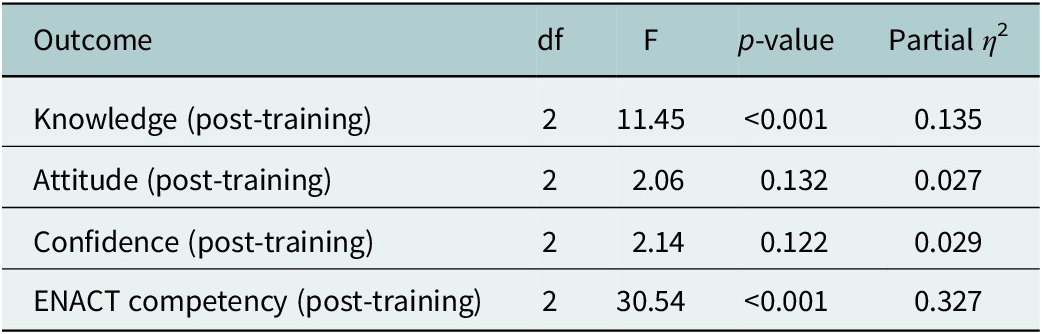
Baseline differences across provinces were observed for knowledge, skills, attitudes and confidence scores. Accordingly, analyses of covariance were used to compare post-training outcomes across provinces, adjusting for baseline scores (Table 3), while the post-hoc analyses are presented in Supplementary Material B.
Between-province comparisons of post-training outcomes adjusted for baseline scores (ANCOVA)

Table 3. Long description
The table consists of five columns: Outcome, d f, F, p-value, and Partial eta super 2. There are four rows of data:
* Knowledge (post-training): d f is 2, F is 11.45, p-value is less than 0.001, and Partial eta super 2 is 0.135.
* Attitude (post-training): d f is 2, F is 2.06, p-value is 0.132, and Partial eta super 2 is 0.027.
* Confidence (post-training): d f is 2, F is 2.14, p-value is 0.122, and Partial eta super 2 is 0.029.
* E N A C T competency (post-training): d f is 2, F is 30.54, p-value is less than 0.001, and Partial eta super 2 is 0.327.
Bonferroni-adjusted post-hoc comparisons showed that adjusted post-training ENACT scores were significantly higher in GB than in KP and Balochistan. There was no significant difference between KP and Balochistan.
After adjusting baseline scores, post-training improvement in knowledge and skills was significantly different across provinces. However, no statistically significant differences were observed for post-training attitudes or confidence scores across provinces. Also, gender was not significantly associated with post-training knowledge, attitude or confidence outcomes after adjusting for baseline scores and province.
Pairwise comparisons of adjusted means showed significant differences in post-training ENACT scores, which were highest in GB (adjusted mean 3.02), compared with KP (2.51) and Balochistan (2.52). For knowledge, adjusted post-training scores were higher in KP (21.61) than in both Balochistan (19.47) and GB (19.22). These adjusted differences indicate greater post-training gains in skills among participants from GB and greater gains in knowledge among participants from KP, after accounting for baseline variation.
Feedback
The quantitative feedback across all mhGAP training workshops showed that the participants rated high levels of satisfaction (either excellent or good) for the overall experience, training content, role of the facilitators, teaching methodology, opportunity to participate and learn from peers. Ten to fifteen percent of participants shared reservations about the logistics and training duration, rating these as fair or needing improvement.
The qualitative feedback was also encouraging as the participants consistently emphasized that the mhGAP training strengthened their clinical capacity and confidence to identify and manage mental health conditions in primary-care practice. They valued the structured, interactive and supportive learning environment, which helped foster collaboration across different levels of care. Suggestions for continuous supervision and refresher training emphasized the need for sustained efforts through ongoing institutional support to integrate mental healthcare within primary care.
Table 4 shows the thematic analysis of the participants’ feedback, illustrating perceived improvements in clinical competence and perspectives, and bridging the gap between theoretical understanding and applied confidence in routine service delivery after the training.
Thematic analysis of the participants’ feedback

Table 4. Long description
The table consists of four primary themes, each with specific subthemes.
1. Clinical competence: Focuses on enhancing knowledge and skills for primary care.
- 1.1 To assess: Participants learned to take focused histories and recognize conditions rather than dismissing or instantly referring patients.
- 1.2 To manage: Bridged theory and practice through role-play and case discussions.
- 1.3 To refer: Clarified when to treat in primary care versus when specialist care is necessary.
2. Training program: Feedback on workshop logistics and design.
- 2.1 Role of trainers: Trainers were described as approachable and able to simplify complex concepts.
- 2.2 Teaching methodology: Interactive role-plays and group activities were highly valued for clinical application.
- 2.3 Logistic and planning: Generally well-organized, though some noted challenges with travel distances and balancing clinical duties.
3. Clinical perspective: Focuses on patient-centered approaches and reducing stigma.
- 3.1 Collaborative paradigm: Fostered teamwork between primary care providers and specialists.
- 3.2 Attitude and confidence: Shifted from avoidance of mental health cases to empathetic, nonjudgmental care.
- 3.3 Shift toward evidence-based practice: Emphasized patient dignity, rights, and ethical care over labeling.
4. Recommendations for integrating mental health in primary healthcare: Suggestions for sustainability.
- 4.1 Recognition of mental health care needs: Stressed the need for holistic patient management and multidisciplinary participation.
- 4.2 Preservice training and supervision: Advocated for including m h G A P in medical curricula and providing ongoing refresher sessions.
Discussion
Our mixed-methods evaluation study enriches the literature by offering insights into implementing mhGAP-HIG in three distinct humanitarian contexts across Pakistan. It offers a holistic evaluation of competencies and operational insights into implementing a large-scale competency-oriented mhGAP-HIG program in resource-constrained public sector settings, facing humanitarian challenges.
Use of contextualized tools and multidimensional evaluation not only enhances methodological rigor but also offers in-depth reflections by the participants to explain improvements in their competencies. Embedding assessments within a scalable MHPSS digital model enhances its feasibility and scalability, while reducing administrative burden. Aligned with WHO guidelines, we did not rely on self-reported measures only, but also focused on observable competencies for a person-centered approach (Michael et al., Reference Michael, Chowdhary, Rawstorne and Dua2020). We have also offered insights for quality improvement for future capacity-building initiatives to bridge the identified knowledge-to-practice gaps (Humayun et al., Reference Humayun, Muneeb, Najmussaqib, Haq and Asif2025).
The convergence between quantitative improvements and qualitative reflections indicates that PCPs not only assimilated knowledge but also developed perceived competence to apply skills in a person-centered manner. Consistent with recent scoping evidence from fragile and conflict-affected settings, qualitative feedback proved critical for identifying gaps in functional skills, risk assessment and psychosocial engagement that are not captured by knowledge tests alone (Queiroz et al., Reference Queiroz, Rubini, Valente, Hubloue and Corte2025).
As proposed (Böhm et al., Reference Böhm, Palma, Ousley and Keane2022), we moved beyond a didactic, manual-focused pedagogy to a competency-focused experiential learning through role plays, simulations, structured feedback and supervised case discussions. Evidence from Nigeria, Malawi and Turkey also showed that didactic teaching alone is insufficient to change clinical practice (Karaoğlan Kahiloğulları et al., Reference Karaoğlan Kahiloğulları, Alataş, Ertuğrul and Malaj2020; Kokota et al., Reference Kokota, Lund, Ahrens, Breuer and Gilfillan2020; Adewuya et al., Reference Adewuya, Ola, Coker, Atilola, Olibamoyo, Oladipo and Ajomale2025).
Hitherto, the mhGAP trainings have been evaluated within a single domain, most often knowledge, or by combining two domains (Karaoğlan Kahiloğulları et al., Reference Karaoğlan Kahiloğulları, Alataş, Ertuğrul and Malaj2020; Kokota et al., Reference Kokota, Lund, Ahrens, Breuer and Gilfillan2020; Asher et al., Reference Asher, Birhane, Teferra, Milkias, Worku, Habtamu, Kohrt and Hanlon2021; Aldana López et al., Reference Aldana López, Serrano Sánchez, Páez Venegas, Chávez Sánchez, Flores Bizarro, Blanco Sierra, Jarero González and Carmona Huerta2024). It has also been suggested that improvement in knowledge might not be the best predictor for change in practices, as a positive association has been shown between improvement in attitudes and confidence and desirable practice patterns of patient engagement (Spagnolo and Lal, Reference Spagnolo and Lal2021; Adewuya et al., Reference Adewuya, Ola, Coker, Atilola, Olibamoyo, Oladipo and Ajomale2025; Queiroz et al., Reference Queiroz, Rubini, Valente, Hubloue and Corte2025).
Our findings demonstrated improvement in all domains; for instance, we observed an improvement in empathy and person-centered perspective in PCPs, a reduction in negative attitudes and an increase in confidence to manage mental health problems within PHC, rather than referring them to the specialists. Based on our experience, we strongly agree that knowledge acquisition alone is insufficient for safe and effective task-sharing, and that the PCPs’ overall competence and confidence must also be addressed so that they do not act primarily as gatekeepers for referral but rather function as first-line providers of mental health care. Others have also found that trainees improved on knowledge tests, yet struggled with psychoeducation, mental status examination and risk assessment (Tarannum et al., Reference Tarannum, Elshazly, Harlass and Ventevogel2019), or were not confident to deliver psychosocial interventions despite knowledge gains (Petagna et al., Reference Petagna, Marley, Guerra, Calia and Reid2023).
We agree with Kokota et al. (Reference Kokota, Lund, Ahrens, Breuer and Gilfillan2020) that despite a change in knowledge and confidence among primary care workers, a change in their attitude is much more difficult. As observed in Malawi (Ahrens et al., Reference Ahrens, Kokota, Mafuta, Konyani, Chasweka, Mwale, Stewart, Osborn, Chikasema, Mcheka, Blackwood and Gilfillan2020), despite improvement in knowledge and confidence, there was no significant difference in terms of attitude in Balochistan and GB. This might be attributed to long-standing beliefs and prevailing stigma in primary care toward mental health (Husain et al., Reference Husain, Zehra, Umer, Kiran, Husain, Soomro, Dunne, Sultan, Chaudhry, Naeem, Chaudhry and Husain2020). Also, 5-day training may not be enough to change attitude, and continuous supervision is needed so that physicians may not forget the training content or revert to their default attitude (Hana et al., Reference Hana, Heim, Cuijpers, Sijbrandij, Chammay and Kohrt2024). Our study also observed province-wise change in competence of physicians, which might be attributable to variable preservice education, mandating structured training programs at undergraduate and post-graduate levels (Siddiqui, Reference Siddiqui2018).
There is emerging evidence to use ENACT or ENACT-derived tools to assess communication and therapeutic skills as a component of mhGAP training (Kohrt et al., Reference Kohrt, Asher, Bhardwaj, Fazel, Jordans, Mutamba, Nadkarni, Pedersen, Singla and Patel2018, Reference Kohrt, Pedersen, Schafer, Carswell, Rupp, Jordans, West, Akellot, Collins, Contreras, Galea, Gebrekristos, Mathai, Metz, Morina, Mwenge, Steen, Willhoite, van Ommeren, Underhill, Akhtar, Bryant, Concepcion, el Marsi, Elnasseh, Hemmo, Kasujja, Manolova, Maslovskiy, Mbwayo, Moran, Munthali-Mulemba, Mutamba, Mutavi, Raji, Rangel, Sangraula, Sepulveda, Tol, van t’Hof and Yurtaev2025; World Health Organization, 2025b). The challenges of implementing ENACT in resource-limited settings have also been reported (Kohrt et al., Reference Kohrt, Jordans, Rai, Shrestha, Luitel, Ramaiya, Singla and Patel2015; Mwenge et al., Reference Mwenge, Figge, Metz, Kane, Kohrt, Pedersen, Sikazwe, Van Wyk, Mulemba and Murray2022; Spedding et al., Reference Spedding, Kohrt, Myers, Stein, Petersen, Lund and Sorsdahl2022). We addressed these challenges by adapting it into a structured and brief measure encompassing eight core competencies to overcome its stated challenges in terms of resources, feasibility, cultural sensitivity and administration (Humayun et al., Reference Humayun, Nisa, ul Haq, Najmussaqib and Muneeb2026).
We understand that small changes in competencies may not be best assessed immediately after training (Jordans et al., Reference Jordans, Steen, Koppenol-Gonzalez, El Masri, Coetzee, Chamate, Ghatasheh, Pedersen, Itani, El Chammay, Schafer and Kohrt2022). We agree with Asher et al. (Reference Asher, Birhane, Teferra, Milkias, Worku, Habtamu, Kohrt and Hanlon2021) that repeated ENACT assessments can be used to identify gaps in training programs, and that it remains to be seen whether the gains in these competencies would be sustained over time and may best be assessed post-refresher training or during supervision.
Despite structured debriefing on the objectives of the assessments, it was observed by trainers that some PCPs were concerned that their evaluations might have professional implications. This underscores the importance of creating psychologically safe training spaces where participation is understood as formative and developmental, rather than purely assessment-driven. Similar dynamics have been reported by Tarannum et al. (Reference Tarannum, Elshazly, Harlass and Ventevogel2019) in humanitarian settings, where capacity-building efforts may appear to challenge professional autonomy or established hierarchies, particularly in contexts influenced by organizational, gender or seniority differences.
The need to carefully recruit PCPs eligible for mhGAP programs has been previously highlighted (Humayun and Najmussaqib, Reference Humayun and Najmussaqib2025). Despite providing a predefined criterion, many participants were nominated by the district administration based on convenience. As a result, marked differences in the interest, engagement and commitment toward delivering mental healthcare were observed. Similar observations were reported in the Rohingya, Sub-Saharan African and Nigeria’s mhGAP programs, reinforcing the need for criteria-based recruitment (Tarannum et al., Reference Tarannum, Elshazly, Harlass and Ventevogel2019; Jervase et al., Reference Jervase, Adams, Myaba and Vallières2022; Adewuya et al., Reference Adewuya, Ola, Coker, Atilola, Olibamoyo, Oladipo and Ajomale2025). Based on our experience, career incentives should also be provided by the relevant health departments to encourage interested PCPs to provide mental healthcare.
We agree with Keynejad et al. (Reference Keynejad, Spagnolo and Thornicroft2021) that the selection, motivation and training of trainers is critical for engaging the PCPs and creating a conducive learning environment, and believe that effective simulation-based pedagogy requires facilitators who can model empathic communication, guide structured feedback, manage group dynamics and apply competency scoring reliably.
Consistent with findings from the mhGAP implementation in other humanitarian settings (Tarannum et al., Reference Tarannum, Elshazly, Harlass and Ventevogel2019; Böhm et al., Reference Böhm, Palma, Ousley and Keane2022), we also found that systemic constraints such as work pressures, high patient volumes, travel inconveniences and overlapping administrative responsibilities influenced participation and engagement. Yet the overall consistency of improvements across provinces in our study demonstrates that meaningful gains are achievable despite logistical constraints.
Limitations
The findings of the present study must be interpreted in light of several limitations. First, without a control group, the observed changes cannot be linked to the training alone. Future studies may assess the effectiveness of training programs through controlled or quasi-experimental designs. Second, we plan to incorporate longitudinal monitoring into our programs, but this study does not examine the sustained gains in knowledge, skills, attitude, and confidence. Third, the selection bias cannot be ruled out since participants were nominated by district health authorities. It is possible that more motivated or readily accessible PCPs were nominated, potentially limiting representation across rural–urban settings and gender distribution. Future mhGAP implementation initiatives should adopt more systematic and transparent recruitment strategies to avoid selection bias. Fourth, we used self-report measures for assessing knowledge, confidence and attitude outcomes, which may be influenced by social desirability bias. Finally, the study did not include patient-level or service delivery outcomes, which limits understanding of the training’s downstream impact on clinical practice and patient care. Future research may include objective measures and patient outcomes or service provision indicators.
Future implications
Current evidence strongly supports scaling up of mhGAP-HIG implementation to strengthen primary healthcare services across regions facing humanitarian contexts. Training programs must prioritize competency-based learning outcomes and attitudinal transformation, with emphasis on communication and therapeutic skills, and efforts to reduce stigma. Global evidence increasingly supports shifting mhGAP implementation benchmarks from training completion toward demonstration of minimum competency thresholds, supported by ongoing supervision and refresher cycles (Queiroz et al., Reference Queiroz, Rubini, Valente, Hubloue and Corte2025).
Structured supervision, even if remote, and refresher cycles of training should be institutionalized as a routine element of service delivery (Gureje et al., Reference Gureje, Abdulmalik, Kola, Musa, Yasamy and Adebayo2015). This will also help develop effective working connections between the specialists and primary healthcare providers. These findings also emphasize the need to strengthen services at the primary care level and address systemic challenges related to work environments, managerial support, medication supply and referral mechanisms.
Preservice integration of mhGAP competencies into medical, nursing and psychology curricula is critical for effective integration of mental healthcare as a core function of primary healthcare (World Health Organization, 2025a). Lastly, it is also essential to redefine the role of specialists and institutionalize their training as trainers and supervisors of PCPs for implementing mhGAP guidelines.
Conclusion
This evaluation provides strong evidence that contextualized, competency-focused mhGAP-HIG training can significantly strengthen PCPs’ ability to identify and manage mental health conditions in Pakistan. By addressing critical gaps identified in global mhGAP literature, particularly in knowledge, attitudes, skills and confidence, this model offers a scalable and context-sensitive framework suitable for national scale-up in low-resource humanitarian settings, aiming to integrate mental health into primary care in other LMICs as well.
List of abbreviations
- ENACT
-
Enhancing Assessment of Common Therapeutic Factors
- GB
-
Gilgit Baltistan
- KP
-
Khyber Pakhtunkhwa
- LMCs
-
low- and middle-income countries
- mhGAP-HIG
-
mhGAP-Humanitarian Intervention Guidelines
- MHPSS
-
mental health and psychosocial support
- MICA
-
Mental Illness Clinicians’ Attitudes Scale
- PCPs
-
primary care physicians
Open peer review
To view the open peer review materials for this article, please visit http://doi.org/10.1017/gmh.2026.10281.
Supplementary material
The supplementary material for this article can be found at http://doi.org/10.1017/gmh.2026.10281.
Data availability statement
The data that support the findings of this study are available from the Health Section at the Ministry of Planning, Development & Special Initiatives, Government of Pakistan. Confidentiality restrictions apply to the availability of the data used under the license for the current study, and so are not publicly available. However, the data can be made available from the authors upon reasonable request after formal approval from the Ministry of Planning, Development & Special Initiatives, Pakistan.
Acknowledgments
The authors would like to thank Mr. Mujeeb ur Rehman, Secretary of Health, Balochistan; Mr. Asif ullah Khan, Secretary of Health, Gilgit-Baltistan; and Dr. Shahid Yunis, Director General Health Services, Khyber Pakhtunkhwa, for extending their support.
The pilot project in Kyber Paktunkhwa was supported by the German Federal Ministry of Economic Cooperation and Development (BMZ) through its implementing agency Deutsche Gesellschaft für Internationale Zusammenarbeit (GIZ) GmbH and their grant partner, International Medical Corps (IMC), Pakistan. The authors would also like to acknowledge International Organization for Migration, Pakistan and United Nations Population Fund (UNFPA), Pakistan for their support in implementing mhGAP-HIG in Balochistan and Baltistan respectively.
At the time of publishing this article, Arooj Najamussaqib worked as a Senior Assistant Professor at Bahria University, Islamabad.
Author contribution
Conceptualization: A.H.; data collection: I.H., A.N., N.M.; formal analysis: A.s.N.; Methodology: A.H., A.s.N., A.N.; Project administration: A.H.; project implementation: I.H., A.N., N.M., H.A., T.H.S., S.Z., K.H.M., H.K.; Supervision: A.H.; Visualization: A.H.; Writing – review and editing: A.H.; Writing – original draft: A.s.N., I.H., N.M.
Funding statement
The reporting and publication of this research are not funded by any organization.
Competing interests
The authors have declared no competing interests.
Ethics and approvals
This study was conducted as part of the Mental Health and Psychosocial Support Project, approved by the Ministry of Planning, Development & Special Initiatives in compliance with ethical standards and consent protocols under letter no. 6(262) HPC/2020 and the Health Department, KP, under letter no. 2243-49/PH. Ethical approval was also sought from the institutional review board of Bolan University under Approval No. 1078/IRB/BUMHS/25. Our study adheres to the Declaration of Helsinki, and the reported data comply with the declaration.
Patient and public involvement
Patients or the public were not involved in the design, conduct, reporting or dissemination plans of our research.




 Open access

