Introduction
When considering the loss of Endurance and the subsequent dispersal of staff and crew, very little information emerged from the Weddell Sea party which had four scientists: James (later Sir) M. Wordie geologist, Robert S. Clark biologist, Leonard D.A. Hussey meteorologist and Reginald W. James physicist (Stonehouse Reference Stonehouse2014: 192–198). Similarly, only very brief mention of the extensive scientific observations by the Ross Sea party has been published in two comparatively recent books (McElrea and Harrowfield Reference McElrea and Harrowfield2004; Tyler-Lewis Reference Tyler-Lewis2006) with the most recent book on the expedition also centred on the sledging (McOrist in press), along with comments in various book chapters. A scholarly overview of Antarctic science (Fogg Reference Fogg1992: 127) and other works have focused on or concluded with science during Captain Robert Falcon Scott's 1910–1913 expedition.
There are however, archives from the Ross Sea party (and relating to Aurora) that detail the science undertaken. Included are the diary and scientific data by Andrew Keith Jack, physicist, by Alexander Stevens Chief Scientist and geologist; correspondence and oral histories from interviews done with the last remaining survivor of the Ross Sea party, Richard Walter Richards, physicist, and a report by John Lachlan Cope, biologist and surgeon. Mention of science is also in diaries compiled by Mackintosh, officers and other personnel on Aurora.
Unfortunately Stevens’ diary, scientific records, specimens and photographs, including possessions of the Revd. Arnold Patrick Spencer-Smith, were lost in Medina torpedoed off Start Point Devon 28 April 1917. The diary of John Lachlan Cope biologist and surgeon, known to have existed (Stevens Reference Stevens1920), has not been seen since.
In spite of incredible privations a detailed record in meteorology was obtained at Cape Evans over two years, along with other significant observations, often through the use of improvised instruments and other equipment.
Antarctic science 1841–1914
In January–February 1841, James Clark Ross’ British naval (HMS Erebus and HMS Terror) expedition (1839– 1843) which entered the Ross Sea, chartered 900km of new coastline, conducted meteorological and magnetic observations and from a glaciological perspective, discovered the vast ice shelf named for Ross, and shown to be floating at its seaward edge. From 1898 until 1914 seven expeditions from England (5), Norway and Japan, undertook exploration and science in the Ross Sea region. A further eight expeditions from Belgium, Scotland, Germany (2), France (2), Sweden and Australia, operated in the Weddell Sea, on the Antarctic Peninsula and in east Antarctica.
Each expedition had a detailed science focus which included meteorological and magnetic observations, also extensive research in other fields. Important discoveries were made and extensive reports were published along with appendices in books compiled by the expedition leaders (Headland Reference Headland2009; Fogg 2003).
Ross Sea party of the Imperial Trans-Antarctic Expedition 1914–1917
Shackleton stated that the Ross Sea party ‘will probably await the arrival of the Trans-continental party at the top of the Beardmore Glacier, near Mount Buckley. . .Both ships will be equipped for dredging, sounding and every variety of hydrographic work. . .[and] the several shore parties will thus carry out geographic and scientific work on a scale over an area never before attempted by any one Polar expedition. . .branches of science will be most carefully attended to, and the net result scientifically ought to be a large increase to human knowledge. . .’(Shackleton Reference Shackleton1913: 6; RGS 1914: 6).
Following a luncheon with the Rt. Hon. Winston Churchill First Lord of the Admiralty, Shackleton seeking support from the Royal Navy, referred to Churchill's comment on Antarctic exploration as being undertaken ‘for the sake of science and country. . .and really Regent Street holds out more dangers on a busy day, than the five million square miles that constitute the Antarctic Continent’ (Shackleton Reference Shackleton1914).
The costs of the expedition were estimated to be £60,000 and impressive letters in support, were received from Lord Curzon President of the RGS; Sir Archibald Geike geologist and past President of the Royal Society (RS); Professor Arthur Thomson, zoologist at Aberdeen University, along with leaders of past polar expeditions. Media rallied to the cause.
Shackleton received a grant of £14000 from Sir James Caird enabling him to buy Endurance, a Government grant of £10,000, from the RGS £1000 and a number of lesser private donations along with support in-kind. He still needed an estimated further £10,000 and although Shackleton considered total expenditure was likely to be £60,000, this escalated to £100,000 (McElrea and Harrowfield Reference McElrea and Harrowfield2004: 19; Tyler-Lewis Reference Tyler-Lewis2006: 23). A mere initial £2000 was made available to Mackintosh for the Ross Sea party, with a possible further £1000 available. Mackintosh was instructed before leaving London, ‘to fit out the expedition with the greatest economy’ (Stevens Reference Stevens1917: 2). Sir Clements Markham critical of the expedition from the outset, made himself clear when he stated ‘there must be no mistake or miscalculations, or there will be a catastrophe’ (Markham Reference Markham1914: 6).
Although Shackleton was ‘personally generally uninterested in science [he used it]. . .simply as a veneer to help gain funding for his true geographic goals’ (Riffenburgh Reference Riffenbugh2010:136, Reference Riffenburgh2004:134). Furthermore to what extent Shackleton considered science of importance to the expedition is not established. As he stated ‘the scientific world is very hard to get money out of at all. If I were to go for a purely scientific purpose I should expect them to give me the money’ (RGS 1914: 10).
Preparations and staff appointments - London
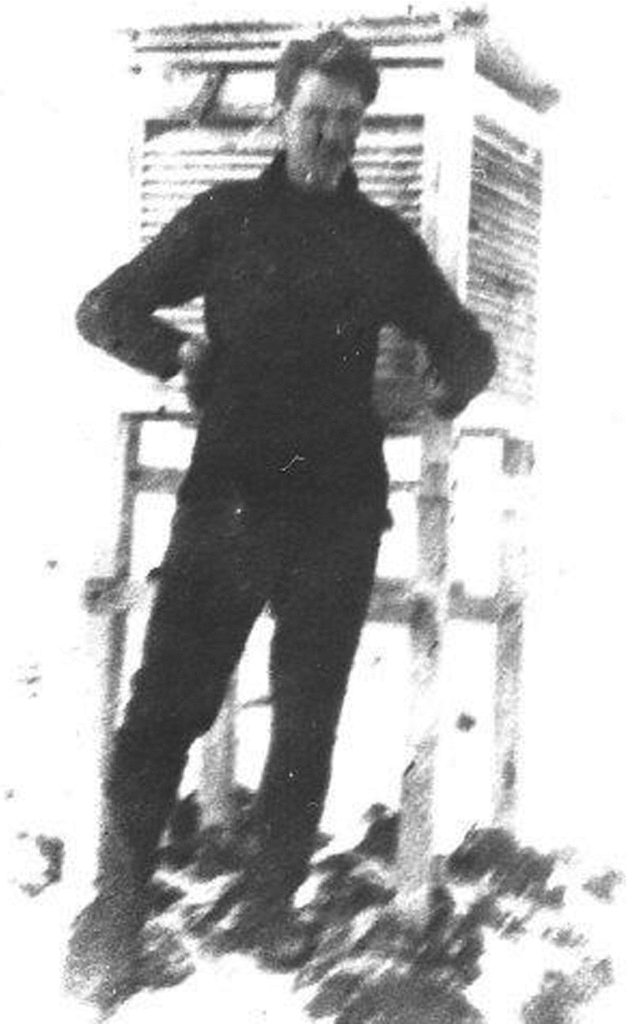
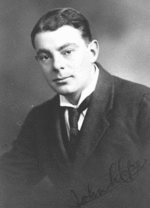
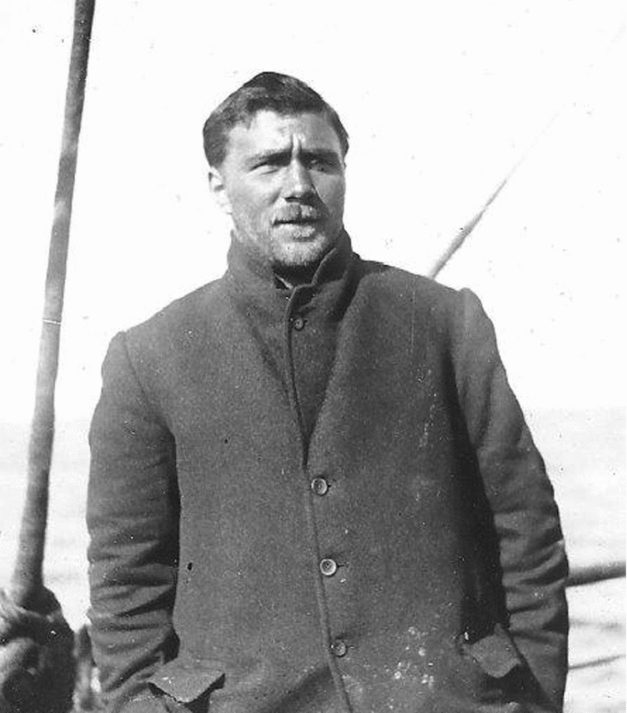
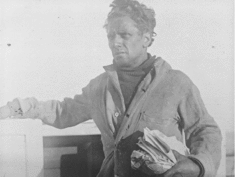
The first scientific appointments for the Ross Sea party made by Shackleton in 1914, were Stevens (Fig. 1) as geologist and Cope (Fig. 2) as biologist at a salary of £52 per annum (Stevens Reference Stevens1917: 4). Neither had any previous polar experience and both appointments were ‘. . .ill-defined scientific positions’ (McElrea and Harrowfield Reference McElrea and Harrowfield2004: 26).
Alexander Stevens, Chief Scientist, beside meteorological screen circa mid-January 1915. Courtesy R.W.Richards. Author's collection.

John Lachlan Cope Reference Cope1917. Courtesy R.W. Richards. Author's collection.

Alexander Stevens (28), a tall, slender man, with sandy hair, an unusually retentive memory and an excellent observer (H.A.Huggins, personal communication, 3 May 1988), graduated MA followed by a BSc with distinction in Geology, from Glasgow University. At the time of appointment, Stevens was an Assistant in the Department of Geography.
It is likely Stevens had received tuition in geology from the glacial geologist and geographer, Professor John Walter Gregory (1864–1932) who was known to Shackleton, both being associated with Scott's National Antarctic (Discovery) Expedition 1901–1904. Stevens was most probably encouraged by Gregory to apply for the position of geologist with the Ross Sea party. At the time his only known paper relating to geology concerned an important discovery about the age of rocks around the town of Stornoway in the Outer Hebrides (Stevens Reference Stevens1914a). It was perhaps on the strength of this, that he was appointed by Shackleton (C.A.Halstead, personal communication, 8 January 1988) who had visited Glasgow in August that year (Tyler-Lewis Reference Tyler-Lewis2006: 40).
Stevens was doubtless familiar with published results and accounts of Borchgrevink's Southern Cross expedition (1898–1900), Scott's Discovery expedition, Shackleton's Nimrod expedition (1907–1909) and the Appendices in Volume 2 of Scott's last expedition published in 1913 (Scott Reference Scott1913). The first geological report from the last was published by The Trustees of the British Museum by Seward (Reference Seward1914). This covered Antarctic fossil plants, while a paper by T. Griffith Taylor appeared the same year (Taylor Reference Taylor1914).
By the time the Ross Sea party departed from England, there were various reasons for a lack of published works, ‘despite the successful results produced by the scientific programme of the British Antarctic (Terra Nova) Expedition 1910–1913, not all the studies made significant contributions. . .’ Reasons included data returned in a form unsuitable for analysis and also un-completed, delay in publication, lack of finance, lack of production, condition of some biological specimens, commencement of WW1 and the over-riding loss of the polar party in 1912 (Fogg Reference Fogg1992: 126).
It is possible that Stevens had prior contact with some scientists from the earlier Shackleton and Scott expeditions in particular as he hoped to undertake field work concerned with physiography west of McMurdo Sound, along with a study of movement on the Great Barrier (Ross Ice Shelf) previously recorded on the Discovery and Nimrod expeditions, along with observations during the Terra Nova expedition (Debenham Reference Debenham1948: 196–212). Perhaps if chosen as a member of the southern depot-laying party, Stevens hoped to do field work in the vicinity of the Beardmore Glacier where the Beacon Formation had included the discovery of fossil fish remains (David and Priestley Reference David and Priestley1914).
John Lachlan Cope (21) attended Christ's College, Cambridge in 1911–1914 where he allegedly graduated BA in Natural Science and Medicine, although no record of the qualification appears in the University Calendar (Jones Reference Jones1981). On the recommendation of Dr (later Sir) Arthur Everett Shipley Fellow of the Royal Society (1861–1927), Master of Christ's College, Cambridge (1910–1927), and a former medical student and zoologist specialising in parasitic worms, Cope a former biology student of Shipley (Tyler-Lewis Reference Tyler-Lewis2006: 31) was appointed biologist.
Richard Walter Richards, one of two physicists appointed in Australia recalled ‘according to Cope, Shackleton got in touch with Shipley and asked him to get a man’ (Richards Reference Richards1981b). If so, Cope from discussions with Shipley, was likely to be familiar with the first recording of freshwater fauna in Antarctica, including rotifers and tardigrades, by James Murray at Cape Royds in 1908 (Murray Reference Murray1910). As Riffenburgh points out, Murray was already ‘an expert in the relatively new field of microscopic fauna’ (Riffenburgh Reference Riffenbugh2010: 34).
Shipley, who previously had contact with Dr Edward Wilson (Riffenburgh Reference Riffenbugh2010: 97), perhaps also made Cope aware of the extensive marine collections by D.G. Lillie on the Terra Nova. These were deposited in the Natural History Museum and Cope may have hoped to extend his studies to marine biology, along with the unresolved (Sydney Morning Herald, 14 December 1914) embryology of emperor penguins, previously investigated by Dr E.A. Wilson at Cape Crozier, during four visits in 1902–1903 and in the winter of 1911. Wilson had originally hoped to return to Cape Crozier in the spring (Wilson Reference Wilson1912: 580–582). Cope, as with Shackleton, would have been familiar from previous accounts, of difficulties with field work in Antarctica, particularly at Cape Crozier during winter.
As records have not been seen, it is not known whether Stevens and Cope signed their Agreement for Employment in London.
Equipping the expedition
With limited funds available, Mackintosh procured instruments and other equipment and in doing so, presumably consulted Shackleton, Stevens and others. His order book for 6 June 1914, lists Cary Porter as suppliers for surveying and meteorological instruments. Included were four three inch aneroids, binoculars, two plane tables, four theodolites, various thermometers including ‘pocket size’, 20 sling thermometers, hypsometric apparatus, two registering barographs and thermographs, one Robinson's anemometer and two wind (Stevenson) screens.
In addition there were almanacs and tables costing £14.15.0 from the Army and Navy Stores and J. Seager & Sons, along with a set of blank (perhaps Antarctic) charts from the RGS. One eight-day and two one-day chronometers costing £26.10.0 and £15.15.0 were ordered from Heath & Co. It is not certain all of this equipment was supplied as further instruments were requested in Sydney (Mackintosh Reference Mackintosh1914a). For the Aurora party there were standard and wet and dry bulb thermometers; and a wind (Stevenson) screen. Shackleton requested a loan of chronometers, surveying instruments and sounding equipment from The Hydrographic Department of The Admiralty, to be returned after the expedition.
In September 1914, Stevens ordered for biological work, three eight inch sieves with 10 (.0787 inch), 100 (.0059 inch) and 150 (.0041 inch) mesh; a bottle of Canada Balsam, slides, cover slips and a slide box for microscopy along with other items including one foot (30.5cm) of .015 inch platinum wire, from Baird and Tatlock, costing £7.2.0. (Stevens Reference Stevens1914b).
Shackleton said farewell to eleven advance members of the Ross Sea party, who departed from Tilbury on Ionic 18 September 1914 bound for Hobart. During the voyage Stevens and Cope gave lectures to the passengers with Stevens including ‘Polar problems: glacial’ and Cope speaking about ‘Religion and science’. With reference to Cope's lecture, Aurora's First Officer Joseph Stenhouse wrote ‘Cope has extraordinary views on the first subject and also a habit of wandering about the room while talking his thoughts. As to where he would wander and to what he would say next, kept everyone interested’ (Stenhouse Reference Stenhouse1914).
Ionic arrived in Hobart on 30 October. After off-loading 43 cases of stores and the 26 dogs, along with motor engineer Aubrey Howard Ninnis, a distant relative of Lieutenant Belgrave Ninnis who had died on Sir Douglas Mawson's Australasian Antarctic Expedition 1911–1914, and storeman Henry Ernest Wild, a brother of Frank Wild on Endurance, Ionic departed for New Zealand. The remainder of the party left Hobart on Moeraki 3 November for Sydney arriving two days later. Here they met Mackintosh who had initially arrived in Sydney on Osterley on 8 October and had then proceeded to Hobart arriving there on 29 October. He then joined Aurora which had been laid up for nine months and two weeks later, travelled on her to Sydney. Here the ship entered Cockatoo Island dry dock for a refit until 14 November, with the £500 cost being met by the Commonwealth Government, although eventual cost was estimated at £4000 (Stevens Reference Stevens1917:14).
Final arrangements and science appointments - Sydney
Mackintosh, with help from Professor Edgeworth David, who had served on Shackleton's Nimrod expedition, negotiated Government funding for the refit. David, concerned at the financial state and probably other aspects of the expedition, went to considerable effort to assist Mackintosh and his staff.
Mackintosh duly took Stevens and Cope aside telling the former, that he must act as chief of the scientific staff and take over the instruments that had arrived in charge of Stenhouse (Stevens Reference Stevens1917: 1). He also arranged for Stevens to meet Professor William E. Cooke, Professor of Astronomy Melbourne University along with colleagues at the Sydney Observatory, and for Cope to contact biologists at the university. Mackintosh however, on being told from London that no further funds were available, then had to negotiate a £3000 mortgage for Aurora, with the Australian Government induced to guarantee a loan of £1000 for insurance (Stevens Reference Stevens1917: 3).
When interviewed in Sydney, Stevens, in support of Shackleton's objectives, stated with respect to geology ‘more detailed work would be done than had hitherto been the case in a selected area, and they would endeavour to make a feature of geological mapping. There was a big series of rocks that had been identified by fossils, and their relationship to one another had yet to be determined’.
He added that the embryology was ‘in dispute as to the evolution of penguins’, the physicist would be mainly concerned with meteorological observations, ‘sent by wireless to the Commonwealth meteorologist [and] physiological observations would be made by the surgeon, of members of the party and of the dogs, in order to work out the effects of the climate and of work’ (Sydney Morning Herald, 14 December 1914).
Dr H.A. Andrews of Melbourne Hospital, who wrote on 29 November requesting details of the position of surgeon then declined. With no doctor available and many required for war service, Cope, on the basis of his background, was then appointed Surgeon. According to Stevens however, Cope ‘had represented [to Mackintosh] in London he had been appointed Surgeon [by Shackleton?], a matter which apparently surprised Mackintosh’ (Stevens Reference Stevens1917: 6). Cope was told his salary would be increased to £150 per annum but he allegedly turned down the advance (Stevens Reference Stevens1917: 6).
Cope (21) taken on as a biologist having then signed on as Surgeon 15 December, falsified his age as 25 and also wrongly stated his qualifications as MA, MB (Sydney Morning Herald, 10 November 1914, 14 December 1914). Stevens who signed on the same day was listed Assistant Purser (Agreement 1914).
Mackintosh engaged a further two scientists as physicists at £52 p.a. each.
Richard Walter Richards (22) a tutor at the Junior Technical School Ballarat, had completed two years study at Melbourne University in Natural Philosophy (Physics), and Pure and Mixed Mathematics under Professor Thomas R. Lyle (Richards Reference Richards1914a). After seeing an advertisement in a newspaper for a physicist on the expedition, he was motivated to apply although in later life could not recall the reason (Lathlean Reference Lathlean1966). Richards, whose speciality was physics, hoped to undertake magnetic observations, a field of science in which questions were still unanswered (Riffenburgh Reference Riffenbugh2010: 37). He was under the impression the necessary equipment was available (Stevens Reference Stevens1917: 6).
On 21 November Richards sent details of qualifications, then on 30 November procrastinated advising that he may not obtain leave from his employer, this again expressed in a telegram to Mackintosh that day, although stating that he was ‘anxious not to lose the chance’. In reply Mackintosh on 1 December, stated to Richards he would prefer an interview and requested testimonials (Mackintosh Reference Mackintosh1914b). That day Richards again wrote advising he had found it ‘extremely difficult to obtain relief from duty at this time of year, and with short notice. Examinations press and the staff is undermanned’ (Richards Reference Richards1914b). He stated his health was good and sent a further telegram to this effect on 2 December confirming his qualifications and other details. He then went to Sydney for an interview and was appointed. Equipped with Elementary meteorology by W.M. Davis (Reference Davis1894) and Physical and chemical constants by G.W.C. Kaye and T.H. Laby (1911) he signed his contract and boarded the ship (Richards Reference Richards1914c).
Andrew Keith Jack (29) as with Richards had also studied Natural Philosophy and Pure Mathematics under Lyle at Melbourne University. He had specialised in chemistry under Professor (later Sir) David Orme Masson FRS, along with studies in botany and zoology, earning him a BSc (1912) and MSc (1914) from the University of Melbourne (Jack Reference Jack1914a).
A science master at Dookie Agricultural College (The Age (Melbourne) 28 September 1916) Jack was ‘a meticulous person (Rolfe Reference Rolfe1981), a competent glass blower also a friend of Irvine Owen Gaze (24) the third Australian appointed. Gaze a cousin of expedition photographer and Padre Spencer-Smith, had the job of ‘lamp and oil man’ and on account of his business experience was also instructed to assist with stores and meteorological observations. Gaze, described by Richards as ‘a nice dignified sort of bloke’ (Harrowfield Reference Harrowfield1981a), persuaded Jack to apply which he did on 26 November and following Richards’ appointment, he left Melbourne on 5 December. Jack had excellent references and although a rupture necessitated wearing a ‘truss’ (as did Richards) he advised Mackintosh that ‘he would go in any capacity. . .’ (Jack Reference Jack1914b). He was then interviewed by Stevens in Sydney.
Mackintosh was at first reluctant to engage Jack as well. With Richards already appointed, Mackintosh on discussing with Stevens the proposed appointment of Jack, who would by a year be the oldest member of the party, was informed by Stevens that
there was no provision for physical work, and that it was doubtful wisdom to engage even one man specially as physicist. . .I recommended [to Mackintosh that] Jack be not appointed, and as he had a rupture this was decided upon, and he was informed the vacancy had been filled (Stevens Reference Stevens1917: 5).
Mackintosh, seeking Stevens’ opinion on Jack, was advised that he considered ‘there was no provision of apparatus or material for physical work, and that due to the nature of the programme of the Expedition [this] made it likely that all scientific work would be required to be relegated to spare time. . .’ Jack however was also engaged, ‘but in what capacity seems to be a matter of obscurity’ (Stevens Reference Stevens1917: 6).
Stevens, clearly unhappy with two Australian physicists, later claimed ‘I put Richards in charge of meteorology while Jack was away on The Barrier and he set up and organised the [meteorological] station. Jack is [however] a more push full individual and rather winkled Richards out of this’ (Stevens Reference Stevens1961).
It now appeared that Mackintosh had exceeded his authority for the number of staff taken on. Meanwhile Stevens and Cope were instructed to see to scientific arrangements and with a sponsored wireless set obtained from Sir Douglas Mawson's Australasian Antarctic Expedition 1911–1914, plans were made to send daily weather reports to Australia from McMurdo Sound.
With Mackintosh obtaining on 5 and 6 November a further £1700 along with £1000 borrowed in Sydney, the total being £2700, money was still considerably less than required. Sponsorship sought for essential items resulted in frames for dredges made at Cockatoo Dockyard; a ‘motor [for a small boat] having been someway obtained’; preserving spirit from Colonial Sugar Co.; solar radiation thermometer from Easdale Opticians Sydney; photographic chemicals from Burroughs Welcome and a small wooden science hut, clad with concrete slabs supplied by Fibro-Concrete Co. (Stevens Reference Stevens1917: 17).
On 16 November Stevens and Cope dined with John Hunter, biologist on Mawson's expedition. After a further meeting on 4 December, Hunter gave Stevens a list of equipment which appeared excessive and was reduced. Stevens wrote
I am afraid that Cope was much displeased with this arrangement. He said he knew what he meant to do and that the list contained his minimum requirements. Spencer-Smith considered further equipment was required for photography. . .During this period I was under increasing pressure from Cope, who was very anxious to have the matter settled. Finally, it was decided that no money could be applied to scientific equipment (Stevens Reference Stevens1917: 12, 13).
Additional loaned meteorological equipment ordered on 19–24 November from the Commonwealth Meteorological Bureau Melbourne, in exchange for delivering stores and 25 sheep to Macquarie Island (Stevens Reference Stevens1917: 13, 17), was consigned to Hobart or collected by Stevens. Included were two thermographs, two hair hydrographs, one anemograph for wind velocity and direction with indoor recorder, wind gauge, thermometers, snow gauge and a large thermometer screen (Commonwealth Meteorological Bureau 1914).
Mackintosh considered the medical equipment ‘was already ample’ (Stevens Reference Stevens1917: 13) and other items such as a typewriter and two watches were lent.
Stevens and Cope, approached Mackintosh on 7 December over concern about the lack of funding and equipment. Stevens advised Mackintosh that he personally required nothing and that Cope ‘had made no provision for biological work and required further medical equipment’ (Stevens Reference Stevens1917: 12).
The same day Mackintosh advised Stevens, that no further funds were available and authorised Dr [sic] Cope, Spencer-Smith and Stevens to raise a loan (Mackintosh Reference Mackintosh1914c). Spencer-Smith stated that he had funds to enable him to complete the scientific gear advanced to him and this Mackintosh approved. The three men then agreed to guarantee a loan and minimum prices with best discounts were obtained along with books (Stevens Reference Stevens1917: 13).
Stevens then replied to Mackintosh outlining requirements. His list included photographic supplies from Harringtons; glassware from Elliott Bros and Lasseter; tow nets from H. Simon Ltd; stationery from W.E. Smith Ltd and literature from Angus & Robertson, amounting to £119.5.7 with a discount of 15%, ‘the lowest discount prices I can obtain. Some apparatus, and all the spirits required for preserving I have had presented or loaned’ (Stevens Reference Stevens1914c). Glassware and other items sold by Elliott Brothers wholesale druggists and manufacturing chemists, amounted to a greatly reduced £18.1.4d (Spencer-Smith Reference Spencer-Smith1914).
In the meantime Stevens who was with others staying at the Wentworth Hotel, had met Professor David. Stevens, still hoping to carry out geology, discussed potential field work in the Mackay Glacier region and other areas, along with further measurements for rates of glacier movement (Stevens Reference Stevens1914d). A copy of the geological report from the Nimrod expedition (David and Priestley Reference David and Priestley1914) was obtained for the expedition.
Aurora still with a Kelvin sounding machine; azimuth mirror and three cases of charts the property of The Admiralty; a reel of sounding cable, a Lucus sounding machine and other equipment belonging to the Australian Association for the Advancement of Science, along with a small engine and dynamometer used for deep-sea dredging belonging to oceanographer Bruce and some of Mawson's sledging rations remained on board (Mawson Reference Mawson1915). The expedition departed a month late for Hobart on 15 December.
Antarctic meteorological research had until now been concerned with atmospheric circulation and Shackleton placed greater emphasis on glaciology and especially geology. Meteorology [he considered] ‘a simple matter’ (RGS 1914).
On 19 December 1914 Stevens, at Mackintosh's request, posted detailed instructions for meteorological observations.
. . .The direction of the wind will be estimated from observation of the drift of the clouds, and will always be magnetic for observations made at sea. The velocity of the wind will be noted according to Beaufort's Scale, and in making the estimation, the aid of the officer on watch will be useful. The proportion of the sky covered with cloud will be noted; 0 will indicate that the sky is completely free from cloud, 10 that it is completely overcast; 5 that there are equal proportions of cloud and blue sky, and so on. The nature of the cloud will be described according to the International Code from the figures hung in the Chart Room.
Precautions: In reading the wet bulb thermometer the observer will see that the bulb is wet when he begins his observations at the thermometer screen. If it should be dry, he will moisten it well from the water bottle in the screen, and only read when the mercury has taken up a steady position, the bulb remaining moist (Stevens Reference Stevens1914e).
Aurora arrived in Hobart next day and after taking on the dogs and stores, left on 25 December.
Mackintosh had already asked Stevens to commence meteorological readings with the major part of the work to be done by the officers and Stevens maintaining a record. It appears the work started well although Gaze soon gave up participating in the observations.
Observations were made by the officer on watch every two hours and included direction (true) and force of wind, amount and nature of cloud, state of weather, and condition and colour of sea. The member of the scientific staff on duty was also required to read and enter data from the barometer and thermometers (wet and dry bulb and maximum and minimum) in the Stevenson screen. Readings would be taken at 4, 6, 8, 10 p.m. and midnight with Richards checking the midnight reading and recording those at 2 and 4 a.m. Gaze would check the 4 a.m. reading and record those at 6 and 8 a.m. (he only did one reading). Jack would check the 8 a.m. reading then record observations at 9 and 10 a.m., mid-day and 2 p.m. Work had to be done regularly and punctually and in addition to noting the temperature of the sea water, a sample should be taken from 6–12 inches (15–30cm) below the surface (Stevens Reference Stevens1914f).
Southward
Aurora departed Hobart on 25 December and by now Mackintosh had it seems decided to restrict Cope's activities to those of surgeon only. In addition to being responsible for the meteorological observations, Stevens became involved in biology and a tow net used since departure captured the lava of a small crustacean (Mackintosh Reference Mackintosh1915a).
The voyage south from Macquarie Island was generally uneventful. On 8 January, Stenhouse, Spencer-Smith and Cope met to discuss a winter journey from the winter quarters to Cape Crozier to collect emperor penguin eggs. On reaching Cape Crozier next day it was hoped to land the hut and stores to be used during a winter journey (Stenhouse Reference Stenhouse1915a, Reference Stenhouseb). A boat was then launched with hut components, picks, shovels and the carpenter's (Clarence Mauger) tool chest.
According to Stenhouse on arrival there was ‘no place to land C. Crozier hut and stores so must build a hut in the winter here which will mean so much extra sledging from Winter Quarters’ (Stenhouse Reference Stenhouse1915c). While in mist, Aurora unable to quickly go astern, collided with The Barrier, broke the bowsprit and the landing was aborted. The expedition then continued towards inner McMurdo Sound.
On the 12 January, Aurora moved toward open water ‘in order to allow the biologists to do some dredging’ (Stenhouse Reference Stenhouse1915d). Stevens, seemingly keen and enthusiastic, had limited success, although he did collect an organism he could study with the microscope (Stenhouse Reference Stenhouse1915d). Stenhouse, wishing to help as much as possible with science added, ‘. . .it is a pity that we have not time to deviate to sounding and dredging. . .our main object is to work into the Sound and get the depot laying parties away’ (Stenhouse Reference Stenhouse1915d).
Problems had emerged within the scientific staff and Cope, doubtless disappointed at being unable to land at Cape Crozier, was not pulling his weight. The next day, Mackintosh recorded ‘I had to give Cope a lecture – thinks he is here for a picnic, so had to assure him this was not the case’ (Mackintosh Reference Mackintosh1915b) with Stevens later stating the whole of the Cape Crozier incident gave rise to lively discussion at various times (Stevens Reference Stevens1917: 19).
Cape Evans – 1915
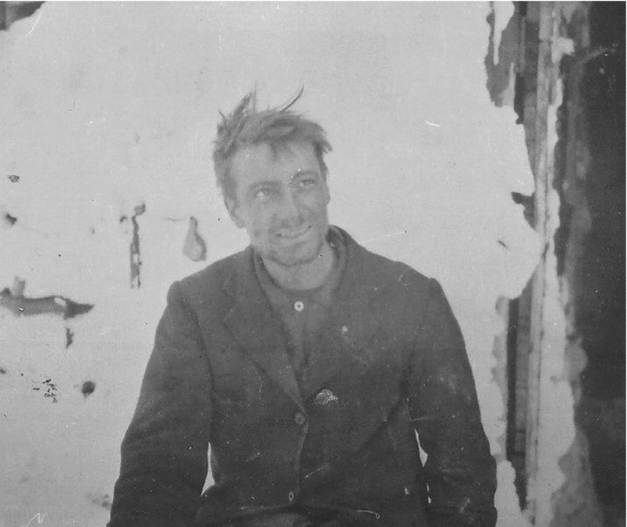
Aurora arrived off Cape Evans on 16 January and at 9 a.m. Mackintosh accompanied by Discovery and Nimrod veteran Ernest Joyce, Spencer-Smith and Stevens (Fig. 3), skied over the sea ice to Scott's Terra Nova expedition hut where they found
Stevens outside Scott's Hut, Cape Evans. Canterbury Museum: Gaze collection.

. . .the very decided state of neatness and every sign to show that work had been carried on here of no mean order. Little compact heaps of store cases surrounded the hut itself-sledges, snow houses, huts, electric wire like cast off spiders web, seemed to litter the place. The meteorological screen on the Wind Vane Hill when opened showed the minimum temperature to be recorded since the party left, to be –18.2°F [–27.9°C]; the maximum 39.5°F [4.2°C]. The other thermometer was smashed. . .’ (Mackintosh Reference Mackintosh1915c).
After removal of window shutters, within the hut were seen cast-off clothing, sleeping bags, tents and items of equipment including a Fleuss Geryk vacuum pump, Hearson's Patent Incubator for the cultivation of micro-organisms, a blow torch, copper wire, scientific glassware and hand tools. Two sets of test tubes possibly Daniell cells, an early non-chargeable battery invented by British chemist and meteorologist John Frederick Daniell in 1836, were in the laboratory. The Daniell cell with copper and zinc electrodes, along with copper sulphate and zinc solutions, had the potential of 1.1 volts (Robin Duff, personal communication, 3 July 2014). Mackintosh removed a sounding tube containing records of Scott's expedition although the whereabouts of this is presently unknown.
Outside below Wind Vane Hill, was a meteorological screen on stand, a small hut for magnetic observations and attached to the winter quarters were a wind vane, support for wires from the electrical cup counter anemometer previously on Wind Vane Hill, along with two iron tubes (one for a wind vane) mounted on the east wall, from which two metal hoses were linked to a box with inlet nozzle. A further hose entered the laboratory and was formerly connected to a recording instrument. These were components from the specially built Dines pressure tube anemometer.
In 1912, the Scott expedition meteorologist Dr (later Sir) George Simpson, had returned to England and following completion of recordings by the second wintering party on 31 August 1912, instruments were removed by physicist Charles (later Sir) Wright on departure of the expedition 19 January 1913. Next year the Scott expedition Dines anemometer was placed on Shackleton's ship Endurance (Munro Reference Munro Ltd1964: 12).
Mackintosh had hoped to lay depots as far as Mt Hope (83o31’S, 171o16’E) that season, however being a month late leaving Australia prevented this. The alternative, was to carryout sledging as far as 80o south that summer and involve each of the scientists, with Mackintosh, and Jack, also tasked with meteorological work. Stevens had Richards in his party and now decided to ‘stimulate his [Richards’] interest. I thought it would be well to leave the thermometers to him’ (Stevens Reference Stevens1917: 23).
During a brief cruise on 18 January some dredging was done, however the dredge was found too light and only a few specimens were obtained. Three days later however an emperor penguin was taken and skinned by Cope, for retention as a specimen. In February 1914, Shackleton had made Joyce responsible for obtaining a ‘good Zoological collection’ (Joyce Reference Joyce1929: 27, 28) and Mackintosh hoped zoological specimens (penguins and seals) could be collected while the ship was in McMurdo Sound (Mackintosh Reference Mackintosh1915j).
The depot laying parties started out on 24 January and on 11 March Stevens, Richards, Spencer-Smith, Gaze, Hooke and Ninnis having completed their sledging, were collected from Hut Point. Aurora was now relocated to Cape Evans where the ship prepared to winter over.
On 23 January and ‘according to instructions received’, Stenhouse now landed Stevens, Spencer-Smith, Richards and Gaze at Cape Evans, to commence scientific work (Mackintosh Reference Mackintosh1915j) and to lay in a stock of seals for food and fuel (Thomson Reference Thomson1915a; Stevens Reference Stevens1915). Spencer-Smith was instructed to devote his time to photography (Stevens Reference Stevens1915).
Only some of the equipment was sent ashore although Stevens recorded ‘Stenhouse stated that he had been ordered to land no stores at Cape Evans, and later Mackintosh confirmed this. . .’ (Stevens Reference Stevens1917: 26). Although there had been some friction on board Aurora, Mackintosh and Stenhouse were in ‘full consultation’ (Stevens Reference Stevens1928) and with departure of Mackintosh on the depot laying, Stenhouse became captain and Leslie Thomson the second officer was elevated to first officer, roles the two men would eventually retain.
Meteorology, a resistance thermometer and routine duties
With the meteorological equipment set up by Richards, Gaze and Spencer-Smith, Richards began meteorological observations each four hours and the laboratory was tidied. On Wind Vane Hill, the self-recording anemograph transmitted mean velocity and direction every quarter of an hour via five fine wires left by Scott's expedition, to the hut in which the recording drum was placed. A Robinson anemometer was erected. The Stevenson screen with recording thermograph, barograph and maximum and minimum thermometers was between Wind Vane Hill and the hut (Richards c.1961: 2–3).
Only part of the scientific equipment and few personal effects were off-loaded. As Stevens wrote
We proposed to improvise an electric micro-thermometer. With a commercial instrument, it is possible to measure temperature to 1/10,000 of a degree, and we hope for a limiting error of 1/1,000 [of a] degree with an improvised instrument. Sea temperature measured with this degree of refinement, would be of great interest in an ice-bound region (Stevens Reference Stevens1917: 28).
The resistance in any electrical circuit is the opposition created to the flow of the current. In 1871 George Carey Foster adapted the Wheatstone bridge to measure small differences of resistance. Already familiar with the Cary Foster bridge circuit, Richards began experiments with copper electrical thermometers
for earth, ice and sea temperatures; tide observing; ice sublimation and other things. . .But there was not sufficient time to complete these undertakings firstly owing to the time used in improvising, and later for the struggle for existence that we ultimately had to face (Richards c.Reference Richards1961: 3).
Because the electrical resistance of wire changes with temperature, for this work thin copper wire within a cotton sheath was wound around two legs of a laboratory bench and there used as a resistance temperature detector. By using thin wire, this had a larger resistance and the change in resistance that causes changes in voltage, could then be measured thereby detecting temperature changes. The temperature would have been measured by the difference to another metal variable; perhaps the platinum wire (Ian Duff, personal communications, 7, 8 June 2014).
As part of this work Richards commented:
we [also] had to construct a reflecting galvanometer surrounded by a coil of fine wire – Stevens did that. He had a fine wafer of glass that he cut into a circular disc to make the reflecting part of it and little bits of watch spring on the back to make the magnet. We had some silk that we would suspend it from (Harrowfield Reference Harrowfield1981b; Richards Reference Richards1960a, Reference Richardsb).
Leslie Thomson spent an afternoon ‘making a few splices in copper wire for the engineer for some electric instrument or other’ (Thomson Reference Thomson1915b). A few days later he ‘had a look through the hut at the instrument for measuring the force of the wind and some other gear’ (Thomson Reference Thompson1915c).
A routine instigated by Stevens stated
on alternate nights Richards and I took watch between 11 p.m. and 3 a.m. (local time), taking meteorological readings at these hours. Gaze remained up till 11 each night to call the men to watch. Spencer-Smith at his own request kept the morning watch from 3 till 7 a.m. and prepared breakfast at 7. After breakfast the radiator at the north [east] end of the hut was lit, and the galley stove [was] allowed to go out. Smith as a rule retired to the darkroom, and Richards and I to the laboratory. Lunch was about 1 p.m. It was a scratch meal and was prepared by the first man who was idle or hungry. Dinner was at 7 p.m. (Stevens Reference Stevens1917: 28).
Break-out
On 6 May Aurora which had previously broken away from her moorings on 10 and 12 March, was reported by Richards on 7 May when doing the meteorological observations, as having again broken out. On this occasion, when the ship did not return, an immediate inventory was made of stores. Two days later the lowest temperature –22.5°F (–30.3°C) was registered. As Stevens later commented, ‘of course nothing could be done’ (Stevens Reference Stevens1917: 26).
Following completion of the autumn depot laying, Mackintosh, Joyce, Wild, Hayward, Cope and Jack, who had been at Discovery Hut since 14 March, arrived at Cape Evans on 2 June after a 12 hour 15 minute walk in a stiff north-east wind. Here they found Gaze, Spencer-Smith, Stevens and Richards well, but were most disturbed to find the ship gone.
Mackintosh then instructed Stevens to ‘act as his second, as Stenhouse had done on the ship and also asked Stevens to continue his supervision of the stores’. Stevens pointed out that men on the ship were ‘grumbling’. Mackintosh told Stevens ‘. . .it was a pity I wasn't a sailor and that I did not understand’ (Stevens Reference Stevens1917: 29). At this time Cope was laid up with ulcerated legs.
Next morning after breakfast, Richards showed Jack the various instruments with Jack writing
I was very pleased with the way they had been arranged and the records that had been kept. With exception of the barometer, barograph and one or two thermometers, I was quite unaware of the fact that other instruments were aboard the ship. Stevens appears to have interested himself but little in scientific work (Jack Reference Jack1915a).
While the others were away, Stevens had devoted much of his time to cooking. However, on 4 June he showed Mackintosh round the instrument screens. Mackintosh, concerned about the disappearance of the ship, wrote next day ‘I only pray and trust wherever she may be, she is safe and all on board likewise - Poor fellows - I am sure they will have a thrilling story to tell us when we see them. Meanwhile we are making all preparations for a prolonged stay’ (Mackintosh Reference Mackintosh1915d). Mackintosh would not see his ship again.
With return of the depot laying party, a new winter routine was established. Mackintosh noted
Stevens, Richards and Smith have breakfast at 7 a.m. At 9 a.m., the others are called and the breakfast is served, the table is afterwards cleared, the floor swept [and] the routine work for the day commences. About 11 a.m. lunch is served. We just have what we call a ‘counter lunch’ – that is, to be cold food and cocoa. 2pm to 5 pm the work again starts. After 5, people can do what they wish. Dinner is at 7. . .’ (Mackintosh Reference Mackintosh1915d).
After the sledging, Richards continued weekly charts and averages for the register of meteorological observations. Commenting on the scientific programme Stevens wrote
Cope had trouble getting started. There was some objection to his working in the laboratory, but he managed to get a bench rigged and started to study the fauna of the fresh-water ponds about [the hut]; but his preparations were disturbed and his apparatus broken, so he gave up in disgust. Unfortunately I had arranged with Mackintosh that Richards and Jack should now be free for scientific work, and that with myself, they should take all the readings of the meteorological instruments (Stevens Reference Stevens1917: 30).
C.T.R. Wilson cloud chamber
Jack planned to construct a ‘cloud chamber’ however equipment was limited to a few items left by Scott's expedition. With help from Richards, Jack began on 4 June to
take up the problem of estimating dust particles in air as my winters work. Today started grinding a mirror for the micrometer. Stevens announced to Richards that the scientific staff was to devote their time solely to scientific work and not to be hampered with the routine work about the hut. Eminently satisfactory. Hope it continues (Jack Reference Jack1915b).
Richards recalled ‘the only things we had to work with left by Scott[‘s expedition] were a Geryck vacuum pump and a blow lamp which we used a great deal. I seem to remember that we used petrol in it, but that seems to me to be incredible’ (Richards Reference Richards1982a). There were other items abandoned by Scott's expedition also put to use.
The ‘cloud chamber’ was first investigated by a Scottish engineer John Aitken in 1880. Aitken was interested in the formation of clouds and his experiments showed that expansions could produce clouds in air which contained nuclei, such as particles of dust.
Also known as the ‘Wilson chamber’ it was named after Charles Thomson Rees Wilson (1869–1959), a Scottish physicist at Cambridge who in 1894, focused on the development of expansion chambers (Wilson Reference Wilson1899). In 1912 he found that ions could act as centres for water droplet formation in such chambers. In his original cloud chamber, the air inside was sealed with water vapour and a diaphragm was used to expand the air inside the chamber. Termed adiabatic expansion, in which there is no gain or loss of energy, this cooled the air and water vapour then condensed on the resulting ions. Particles were then visible in the vapour cloud (Wilson Reference Wilson1899).
For Antarctic science, especially during World War 1, this was ground-breaking work. Jack persisted each day with grinding and polishing of a ‘silver mirror’ but found ‘the process is a slow one and rendered more difficult by a lack of proper materials. The silver too, has a grain which may prove troublesome’ (Jack Reference Jack1915c). He then decided to try copper plate which he found unsuitable and reverting back to silver before changing to a ‘small square plate of glass. . .’(Jack Reference Jack1915d). This was then ruled with lines to form a grid and was placed in a flask. Richards later recalled:
you would create a partial vacuum in the flask and introduce air by means of an air pump, give a whorl of the [vacuum pump] wheel and that would reduce the pressure in the glass flask, create a lowering of temperature and immediately you would get a deposition of smoke particles on moisture that would appear as little globules of light on a silvered graticule. . .if you diluted the air to make it cleaner and cleaner so that you had comparatively few particles, then when you exhausted these few particles would fall in the form of droplets of water and they’d be sufficiently far apart to count them (Harrowfield Reference Harrowfield1981a).
Frustrations and discontent
On 5 June, Mackintosh recorded, ‘Stevens is now the senior officer ashore [and] Richards has taken on the keeping of the meteorological log – he is a young Australian and [a] hard conscientious worker and I look forward to good results from his endeavours. . .Jack is his assistant’. Mackintosh also considered Richards ‘a stable companion [who] keeps us amused. . .’ (Mackintosh Reference Mackintosh1915e). Jack was satisfied that together with Richards and Stevens, the three men could now take the watches in turns in ‘order that scientific observations may be made by the scientific staff only. The fact that our observations will be made by none but ourselves, will enhance their value considerably’ (Jack Reference Jack1915e).
On 18 June Stevens, far from happy, ‘opened out on Mackintosh at dinner re treatment of scientific staff with respect to sledging’ (Jack Reference Jack1915f) and the next day Jack ‘talked over one or two matters with Stevens – not altogether satisfactory’ (Jack Reference Jack1915g). According to Mackintosh, Stevens considered that ‘[explorers] are all frauds and scientists are taken [on] under false pretentions; not doing all they are expected to do: but doing work of a more manual character. Perhaps he's right -but no one, or one on such an expedition, do, strictly what they have been taken on for’ (Mackintosh Reference Mackintosh1915f).
That night Jack had a further discussion with Stevens and wrote ‘I cannot fathom him; appears to be playing a double game – a deep customer truly’ (Jack Reference Jack1915g). At the time Jack slept in Norwegian Trygve Gran's bunk of 1911–1913, with Cope below in the bunk once occupied by Thomas Griffith Taylor in 1911. Stevens slept in a bunk used by Dr Edward Atkinson in 1911–1913, on the opposite side of the hut (Quartermain Reference Quartermain1963: 45), an area known during Scott's expedition as ‘The Tenements’.
At this time Jack observed Stevens had yet to start what he considered to be any scientific work ‘but spends most of the time in the galley with Cope and Smith’ (Jack Reference Jack1915h). Cope had similarly done very little biology and Mackintosh did not wish to become involved in issues between the scientists.
Midwinter Day was celebrated on 21 June. On 26 June, Mackintosh called a meeting of all hands and discussed plans for sledging and invited suggestions. ‘Several objected on the grounds that the whole complement was unnecessary’ with the result that they should delay the decision ‘until we had given the parties some [further] practical work’ (Mackintosh Reference Mackintosh1915g).
The issue simmered for several days and came to a head on 2 July when Mackintosh recorded ‘Stevens and I had a long discussion as to S[tevens] saying he has been hoodwinked, for he came to do science but has no opportunity – I say no initiative, to take advantage of circumstances for there is plenty of opportunity now, as no one is tied down all day – Cope has started his first time today, to do some biology. . .’(Mackintosh Reference Mackintosh1915h). Specimens from ponds and soil were examined with his microscope (R.W. Richards, Reference Richards1981a).
With plans for a winter journey to Cape Crozier now abandoned, by early July, Cope, with apparent renewed enthusiasm to do biology and assisted by Stevens, had undertaken further sampling in a lake [Skua Lake?] where they collected microscopic rotifers and ‘water bears’ or tardigrades. Mackintosh, pleased to see the men working together, found ‘looking at these through the microscope is most fascinating as we see them going through all kinds of antics [with] the rotifers getting their food from both ends of their bodies; which apparently form feeders’ (Mackintosh Reference Mackintosh1915i).
Stevens, who was suffering from ‘lumbago’ (rheumatism) in the lower back (Cope Reference Cope1917: 1), continued however to be disenchanted, and on 28 July, Mackintosh became aware of ‘some misunderstanding’ between Stevens and Richards. Next day, a further discussion between Mackintosh and Stevens resulted in ‘many matters being brought up – I am afraid [wrote Mackintosh] the best is not made of opportunities and much is put down as [an] excuse not to do certain duties and our conditions which have been forced upon us is no excuse at all’ (Mackintosh Reference Mackintosh1915k).
Time spent in the winter confines of the cold, smoky Cape Evans hut, had inevitably led to frustration and a clash of personalities. On 3 May, Jack who at the time was in the dirty confines of the equally miserable Discovery Hut at Hut Point and frustrated at not being able to do scientific work, wrote ‘we all want to get away from the reeking blubber fumes and smoky fire and lamps’ (Jack Reference Jack1915h). Richards later recalled ‘everything in the hut was well and truly covered with an oily black deposit which even got into books. . .’ (Richards Reference Richards1982c). Cope later in his medical report noted ‘the blubber fumes were obnoxious and nauseating, causing the eyes to ache and pains in the head. . .’ (Cope Reference Cope1917: 2).
Some of the party was also suffering from sleep deprivation. As Mackintosh observed ‘complaints are made that they cannot sleep. I don't wonder – when on occasions they sleep the clock round. Not enough work to do. At least plenty to do – but slack. For peace sake I am not saying anything’ (Mackintosh Reference Mackintosh1915l).
By the end of July 1915, Jack and Richards who also spent time in the laboratory with Richards’ experimental thermometer, had turned their attention to depth sea temperature recording although found that owing to refreezing, they had trouble extricating the thermometers. They later took advantage of tide cracks and seal breathing holes in the sea-ice and this enabled them to obtain sea bottom temperature readings.
The two men also began ablation measurements from evaporation on frozen melt-water ponds behind the hut, recording on their first reading a surface lowering of 2mm with Mackintosh considering ‘part must be due to the friction of drift over the surface’ (Mackintosh Reference Mackintosh1915m). In early August, cubes of fresh-water ice were also placed by Jack in the sea to examine rate of melt or increase of ice.
With return of the sun on 26 August, the men were able to move further afield. Spencer-Smith was delighted with ‘a beautiful day: the northern slopes of Erebus wonderfully flecked by the sun. Gorgeous blood red clouds to East and the W[estern] mountains wonderfully lit up. [Mt] Discovery rather misty’ (Spencer-Smith Reference Spencer-Smith1915).
Specimens of penguins were collected by Hayward and Joyce; Mackintosh collected lichens, Cope who had dissected a seal, continued a little lake and pond biology, and Stevens took photographs of ice cliffs. Jack meanwhile experienced problems with his ‘dust counter’ with the counter flask found one morning to be frozen and the following day had ‘. . .difficulty owing to the high temperature of the hut compared to the low temperature of the outside air’ (Jack Reference Jack1915i). Eventually Jack discontinued the project.
Stevens, still unhappy, had a further problem on 28 August, when he asked Jack and Richards for the results of scientific work and was refused. This was reported to Mackintosh, as directed who told Stevens ‘the matter had been adjusted. . .[although] later the adjustment was denied’ (Stevens Reference Stevens1917: 31). As Tyler-Lewis wrote, ‘Stevens could be combative with Mackintosh one day, defending the rights of the junior scientists, then currying favour the next. . .Mackintosh had drifted apart from most of his men and gravitated towards Stevens, querulous and unpopular but highest in rank below him’(Tyler-Lewis Reference Tyler-Lewis2006: 139, 141).
Main sledging
With commencement of sledging to complete the depot-laying, Mackintosh sensibly requested on 27 August that Cope carry out a medical examination, of those likely to be involved in the sledging. One person was to remain at Cape Evans to carry on scientific work. Cope in his report stated that Richards and Joyce did not have a medical examination although Stevens stated only Richards declined (Stevens Reference Stevens1917: 33). Although Richards was meant to remain at Cape Evans, Stevens was found the least fit. Cope wrote ‘He was not strong and his urine showed traces of sugar. . .[although] this was not important from a medical point of view. . .I considered Stevens the least physically fit of the ten of us’ (Cope Reference Cope1917: 3). This marked the end for Stevens’ opportunity to do any geology near the Beardmore Glacier.
Richards and Jack verified Cope's findings, although Richards later recalled ‘Stevens produced a certificate from Cope’ while Jack considered
‘from the test Cope made. . .it was the wrong sort of sugar he had’ (Harrowfield Reference Harrowfield1981a; Richards Reference Richards1982b), that Cope ‘did not have the means of testing for that complaint and that Stevens had pulled a fast one on Cope. . .I dare say he was right on this as Stevens never showed the slightest trace of diabetes in the further 18 months or so we were there’ (Richards: Reference Richards1984).
In 1910, Edward (later Sir) Sharpey-Schafer discovered and named a single chemical produced by the pancreas ‘insulin’. Although Cope was likely to be aware of the breakthrough, he considered ‘sugar in the urine was not important from a medical point of view’ (Cope Reference Cope1917: 3).
On 6 September apart from Richards, they began to transport stores to Discovery Hut. Gaze, who sustained frost bite to his feet, was carried back to Cape Evans on a sledge on 9 September and six days later the motor-sledge was dragged back to Cape Evans where Richards and Gaze attempted repairs (Harrowfield Reference Harrowfield2013b) however, Mackintosh decided not to use the machine.
On 1 October, all except Gaze who remained at Cape Evans while his feet healed set out to complete the depot laying. While at Hut Point, Jack made a stand on which to place thermometers, when camped on The Barrier. Gaze remained at Cape Evans until 26 October, although Jack noted he had been to Hut Point on 17 October. Gaze wrote ‘Spent a rotten, lonely and very miserable time - I had the Records to look after, also two loads of stores to get over to Hut Point (in the month) + blubber to obtain. . .I managed to get through with the job. . .’ (Gaze Reference Gaze1915b). Unfortunately some data including temperatures were not recorded by Gaze.
Stevens, Cope and Hayward returned to Cape Evans from The Barrier on 30 October, and on 2 November, Cope returned to Hut Point with Hayward followed by Gaze (now mobile), Richards and Jack. Stevens now taking over from Gaze, remained at Cape Evans although he made a brief visit to Hut Point on 11 or 13 December, this being his final trip. Transport of supplies south continued and Cope, Jack and Gaze returned to Cape Evans on 15 January 1916. Mackintosh, Hayward and Spencer-Smith would not return to Cape Evans again.
Cape Evans 1916
Now in the second year of the expedition and with Richards sledging on The Barrier, Jack on return to Cape Evans found Stevens in bed with toothache and a few days later Cope was also in bed. In spite of suffering from insomnia, Jack, who continued the meteorological observations along with maintaining the meteorological register, managed to coerce Stevens, to assist with erection of bamboo poles to carry the wires from the anemograph on Wind Vane Hill to the hut. Stevens, also installed a light in the Stevenson screen near the hut.
Problems and projects
There was continual trouble with the anemograph circuit and on 11 March, Jack wrote, ‘Stevens and I continued on the anemograph. In afternoon spent the time soldering the wires to the leads at the top of the hill, a bitter wind of 25–30 mph (40–48km/hr) blowing at the time – indeed we had to rig up a canvas screen before we could work’ (Jack Reference Jack1916a). The hut was also very cold and in the morning before the stove was lit, was 5–10o below freezing point (Jack Reference Jack1916b).
The 20 March was the very latest date with which Shackleton stated the men were to wait for his party in McMurdo Sound, if he had not put in an appearance before this time. Shackleton however had also stated the Ross Sea Party may remain in Antarctica for two years (RGS 1914: 9). Jack wrote ‘but one thing is certain – something very serious must have happened to the Aurora’ (Jack Reference Jack1916c).
On 14 April, a four day blizzard began with the wind blowing at 50–60 mph (80–96km/hr). Jack wrote ‘It shrieks and howls around the hut with hurricane force at times causing the whole structure to shake and rumble’ (Jack Reference Jack1916d).
Jack also embarked on a further ablation study and then discovered from Cope that Stevens had decided to undertake the same work and told Stevens ‘that his action re ablation experiments seemed very much of piracy. . .he intends to make some measurements by the weighing method’ (Jack Reference Jack1916e).
Stevens, who although having given up hope of doing any geology and also perhaps having lost interest in his role of Chief Scientist, appeared to have a more enthusiastic attitude. He modified a petrol drum as a snow gauge, the original unable to be located, worked on the meteorological register, compiled wind charts and in April installed his ablation stakes from which he obtained measurements. He then began construction of a ‘nethoscope’, a device for measuring the altitude, direction and velocity of clouds, invented by Mikhail Pomortsev in 1894.
Cope had since March, spent considerable time in bed complaining of a ‘bad attack’ of gastric pains and suspected appendicitis on 5 May. According to Stevens (Reference Stevens1917: 33) Cope was ‘very difficult’.
The anemograph meanwhile gave continual trouble with blizzards not helping by breaking wires. On 25 April Jack (Reference Jack1916f) wrote ‘This blizzard [which had been blowing since 13 April] caused us a lot of worry, blowing away the [anemometer] cups and breaking four wires’. He then overhauled the instrument and the other anemometer also failed.
Ice studies
A sample of ‘ground [anchor] ice’ was collected with a duplicate sample bottled and sealed for later analysis and eight samples of ‘ice flowers’ were collected ‘in order to test [the] cryohydrate theory of formation by Mawson’ (Jack Reference Jack1916g). Mawson had observed in 1908 during the Nimrod expedition that they formed on the surface of new sea ice during calm conditions, from drops of brine exuded by the hardening of sea-ice below and as they grow in size, the original brine is continually diluted (Mawson Reference Mawson1910).
In addition to further solution experiments, Jack embarked on a new project. This focused on ice crystals (previously studied by physicist Charles (later Sir) Wright in April 1911) which Jack photographed ‘by magnesium light in the passage by the hut. . .the crystals appear to grow from a nucleus or centre, each needle as a rule branching into two and reaching anything up to 1.5 inches (3.9cm) in length. Those with the southerly aspect were well developed [and] the surface of the ice at this time was very wet and salt[y]. . .’ (Jack Reference Jack1916i). A table was then made for using the camera to vertically photograph the crystals in-situ.
Continuing problems from blubber fumes, along with limited light from the old Scott expedition acetylene plant, hampered work such as repairing the thermograph, or writing up the meteorological register. Stevens and Jack did most of this work, although Jack was critical of Steven's November–December 1915 data compiled when at Cape Evans on his own, finding illegible writing along with ‘a number of observations omitted and the shocking state of the notes themselves. . .’ (Jack Reference Jack1916h).
During May – July, Stevens continued to spend some days in his bunk suffering from toothache and in June, rheumatism, while Cope was ‘only up for dinner practically each day.’ Some of the men were still plagued with insomnia which Jack found ‘truly exhausting to say nothing of the loss of time it entails’ (Jack Reference Jack1916j). On Midwinter Day 21 June, Stevens produced a sumptuous dinner; however, by July, there was concern for Mackintosh's party. Cope, ‘who is too ill’ (Jack Reference Jack1916k) with constipation (Cope Reference Cope1917: 12), remained in bed and Jack with Gaze, spent considerable time sealing. For warmth meals were eaten by the galley stove.
On 15 July, after wind the previous day, Joyce, Richards and Wild arrived at Cape Evans. Mackintosh and Hayward had left Discovery Hut on 8 May and the following day, the meteorological record at Cape Evans stated ‘ice along the shore south of Glacier Tongue has gone out’. Before Mackintosh and Hayward left the hut, they were strongly advised by Ernest Joyce not to go, as the sea ice was thin and a blizzard was imminent. Mackintosh promised if the weather deteriorated they would return to the hut. As predicted, the weather changed and later, Joyce, Ernest Wild and Richards discovered the ice had gone out and there was open water. With the return of Joyce, Wild and Richards to Cape Evans, Jack wrote ‘. . .it was a most agreeable surprise to us to see the three survivors but the news of the disaster to the others came as a great shock’ (Jack Reference Jack1916l).
Meanwhile concern continued for Aurora and its crew, and Joyce, who had on 8 January 1916 been appointed by Mackintosh as leader of the sledging parties (Fisher Reference Fisher and Fisher1957: 407), had now appeared to have become the leader overall (Fisher Reference Fisher and Fisher1957: 410), although Stevens in the absence of Mackintosh, was presumably still ‘the senior officer ashore’ (Mackintosh Reference Mackintosh1915e). Joyce, after hearing reports on the scientific work which would continue through winter and following Mackintosh's instructions, stated he planned to collect as many zoological specimens as possible. This work would later see him spending considerable time at Cape Royds.
On the 19 July, Jack went through the meteorological records with Richards and discussed the work generally. Richards’ sledging temperatures were entered in the register and they regretted not having a Dines anemometer to record gusts.
With a brief hint of the sun's return on 31 July, the men felt better ‘after the continual darkness being, somewhat depressing’ (Jack Reference Jack1916m). As the sun slowly rose higher, along with the appearance of ‘the most beautiful opalescent [nacreous] clouds . . .varying from the most vivid green to the deepest shade of purple and passing with the most delicate gradations into pink, pale blue, orange and burnished gold’ (Jack Reference Jack1916n). This meant more work could be done outside and searches were made by Joyce and Wild for any trace of Mackintosh and Hayward in the vicinity of Erebus Glacier Tongue, Turk's Head and Razorback, Tent and Inaccessible Islands.
Ablation and solution studies
In 1911, Wright had observed the formation of sea ice and ablation, although with glaciology a relatively new science and new to chief scientist Dr Wilson, ‘many of his research concepts were ill-defined at the outset and only took form as he studied the environment and formulated new questions’(Bull and Wright Reference Bull and Wright1993: 129).
Jack, doubtless familiar with Wright's research, decided to continue his ablation measurements. He now made from wood ‘moulds for ice blocks used to determine solution of ice’ (Jack Reference Jack1916o) a project revisited from the previous year. As an extension of his scientific activity, further ‘solution blocks’ were immersed by Jack in the sea using a winch and then weighed from an improvised tripod.
Stevens, who was helping compile met data, recorded that the ablation study was ‘continued assiduously during the winter’ (Stevens Reference Stevens1917: 30). In September, Jack and Richards fixed up a pointer for determining wind direction.
At this time work continued, including repairing the difficult anemograph after wires were broken in blizzards and cups began slipping on the spindle. Then on 10, 11 and 22 September Richards suffered cardiac disorders. Cope reported that Richards had in February 1916, experienced ‘jumps’ over his heart [and] after 17 February, he did not experience these again till September (Cope Reference Cope1917: 5) when Cope using a stethoscope, detected an irregular pulse. Richards then moved to Scott's former bed this previously used by Mackintosh (Quartermain Reference Quartermain1963: 45) and was cared for by Cope who administered a ‘cardiac tonic’ (Cope Reference Cope1917: 12). This was probably Digitalise (Gaze Reference Gaze1916: 161).
Cope moved into a bed beside Richards as he recuperated in Scott's cubicle. Hour after hour, Cope monitored Richards’ blood pressure and attended to his needs, something for which Richards was forever grateful. On 8 October, Richards got up but had a relapse and returned to bed until 11 October. He gradually made a full recovery, although participated in light duties only, including reading ablation at the lake and assisting with the meteorological register.
Stevens constructed a recording wind vane which was more sensitive to light breezes and made a pressure plate anemometer.
Ablation measurements of ice on Skua Lake behind the hut were made by Jack from 23 July–16 November 1915, with data recorded using a micrometer and measured every fortnight. Further measurements were made in 1916 using wooden stakes driven into the ice. Stevens carried out measurements by weighing his samples although his data have not survived. Jack and Stevens also used improvised evaporimeters for daily observations. Although he may not have used the term, transfer from ice to evaporation was studied by Jack using a block of ice suspended from the tripod.
The evaporimeter built by Jack was designed ‘to take the place of ablation measurement when the lake thaws out’ (Jack Reference Jack1916q) as the stakes installed were no longer vertical, and included a micrometer for measuring the evaporation. The evaporimeter cylinder was then placed in the lake which by 3 December had nearly thawed and the first measurements were made two days later.
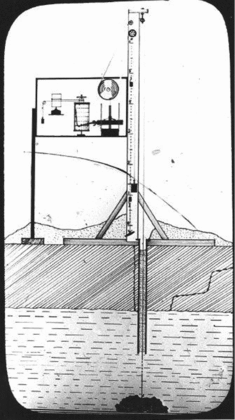
Jack's work routine which began after breakfast, included the evaporimeter, tide gauge (Fig. 4), solution blocks and the tide chart changed at noon followed by the meteorological register. Blocks of ice from the Barne Glacier replaced unsuccessful freezing of water in moulds, with seven new ice blocks installed on 16 and 20 December.
Diagram of tide gauge used at Cape Evans in 1916. Victoria State Library: Jack collection.

A further evaporimeter made by Stevens was positioned in the lake on 17 December, with Jack observing the ‘rate of evaporation was surprisingly rapid’ (Jack Reference Jack1916r). On 22 December, he also noted ‘the ice blocks appear to indicate a higher rate of solution than sea ice under natural conditions’ (Jack Reference Jack1916t).
Jack had placed three solution blocks in the sea off Cape Evans. With knowledge of current circulation in McMurdo Sound and an interest in sea ice, the rate of solution of cubes of ice with sides 15–20 cm long, taken from the Barne Glacier, were immersed in October, followed by a further seven blocks in December.
Samples of sea ice formations and of ‘anchor ice’ intended for analysis, although carefully documented, appear to have had no further work done on them. ‘Anchor ice’ forms on the sea bottom and is common down to depths of 15m and rarely to 30m (Dayton, Robilliard and DeVries Reference Dayton, Robilliard and DeVries1969). When the sea water temperature slightly lower than the surface, it is advected from under the floating ice surface.
Tide studies
With tides having been recorded by the Discovery, Nimrod and Terra Nova expeditions, Jack, who began research on tides in May, improvised a tide gauge. This was installed through a hole in the 5ft 10 inches (1.8m) thick sea ice and had previously noted on 20 October, that the ‘water rose to a height of 8.5 inches (21cm) from the upper surface of the ice’ (Jack Reference Jack1916p). The tide gauge continued to work well and by mid-November, he was taking hourly readings.
Jack then commenced construction of an improved model with readings taken 12–30 November 1916. Now using two improvised tide gauges on the sea ice, Jack took daily and almost hourly readings with graphs compiled indicating spring and neap tides. Using thermometers and Richards experimental ‘electric thermometer’, sea water temperatures were recorded.
In late September, Joyce, Wild and Gaze had relocated to Cape Royds to collect emperor and Adeliè penguin skins along with Adeliè penguin eggs. They were later joined by Jack followed by Stevens, with each spending about two weeks at the Nimrod expedition hut. Stevens hoped to collect penguin embryos for a friend in Scotland. Using arsenical soap, Joyce eventually preserved skins of over 70 penguins, 26 flying birds and 18 seals (Joyce Reference Joyce1929:200).
Back at Cape Evans, Richards, Jack and Stevens, also obtained emperor and Adeliè penguin skins and preserved the skins with arsenical soap. Stevens also saved specimens of seal skulls and a penguin skeleton. An emperor penguin skin, presumably stuffed by Jack, remains in the hut to this day along with a box of Adeliè penguin eggs, of which 3150 in total were brought from Cape Royds on 14 December (Jack Reference Jack1916s).
A keen lookout was now being kept for a ship. Cope at this time tended to remain in his bunk and Stevens, to get away from the smoky hut interior pitched a tent later also used by Jack and Joyce, by the met screen. After producing ‘a first rate Christmas dinner, Stevens captured a number of Hydromedusae (a translucent organism in the phylum Cnidaria which includes jellyfish) in an open pool . . . in certain lights the most beautiful waves of colour pass along the animals from end to end. . .’ (Jack Reference Jack1916u). Further catches included fish, starfish and (nemertean?) worms.
The men were now filling in time for what they hoped would soon see the arrival of a relief ship and on 17 December, a trip was made to The Barrier to collect the Mt Hope geological specimens and other equipment. Originally Richards hoped that Joyce and Wild could accompany him to explore the ranges around Shackleton Inlet ‘but my illness put paid to that as I was the motivation for the journey’ (Richards Reference Richards1982a).
The bag of geological specimens presumably from Mt. Hope, were most likely obtained by Richards (for Stevens) who went part of the way from the landward border of The Barrier to The Gap, while Joyce, Wild and Hayward placed the crucial depot for Shackleton on 26 January 1916 (Joyce Reference Joyce1915–16; McElrea and Harrowfield Reference McElrea and Harrowfield2004: 167). Deep snow prevented a proposed visit to Cape Crozier although what was planned is uncertain and a cross was placed on Spencer-Smith's grave.
When hoping to sight a relief ship, a further geological collection was made from Inaccessible Island. Jack and Richards continued recording, with Jack placing a further six solution blocks in the sea on Christmas Day. Stevens again became engaged in biological work and using a theodolite estimated time for Jack's tide records. Cope had long ceased to contribute to science, and in preparation for a departure, the hut was tidied and swept.
Relief expedition 1917
On 10 January 1917, Aurora having already visited Shackleton's hut at Cape Royds, was sighted by Richards. Jack completed final observations and wrote ‘it did not take long to get apparatus and gear dismantled and packed, so that by 9.30 p.m. all hands were aboard ship’ (Jack Reference Jack1917). To their amazement, on board were Captain John King Davis, Shackleton, Ninnis, ship's Bosun James Paton and William (‘Ginger’) Kavanagh a seaman.
After the emotional meeting, Dr Frederick Middleton examined the seven men with smoke-bleared eyes and pronounced them generally in good health and fit although as Captain John King Davis observed ‘naturally the party we relieved are labouring under considerable excitement and it is a little difficult to obtain a coherent statement. . .’ (Davis Reference Davis1917). Cope was soon his old self, and along with Stevens, Richards and Jack, they too were relieved to be back on Aurora (Figs. 5, 6) Stevens also wrote a report for Shackleton while in ‘heavy weather with the typewriter lashed to the ward-room table and for immediate purposes only’. A copy was kept on Shackleton's authority (Stevens Reference Stevens1931).
R.W. (Dick) Richards on Aurora after relief 10 January 1917. Author's collection.

A.K. (Keith) Jack with two years of mail, on Aurora after relief 10 January 1917. Canterbury Museum: Middleton collection.

On 11 January, a search for any trace of Mackintosh and Hayward was made in the vicinity of Butter Point. Following a return to Cape Royds specimens and equipment were uplifted and a message was left. Returning to the ice edge at Cape Evans, on 13 January Ninnis, Stevens, Gaze and Wild went ashore and the same day Shackleton, Joyce, Wild and Jack, also visited the hut. From here a further search was made of the Erebus Glacier Tongue, however owing to bad weather, they remained at Cape Evans on 14 and 15 January.
On 16 January Jack and Wild erected a cross on Wind Vane Hill, to the memory of Mackintosh, Hayward and also Spencer-Smith who had died on The Barrier. A message left by Shackleton in an attached cylinder is now in the National Maritime Museum London. The expedition closed Cape Evans hut and departed for Wellington arriving to a civic welcome on 9 February.
Health of shore party
From surviving records of the Ross Sea Party, several members appeared to have been affected by sleeplessness during the winter months. Priestley (Reference Priestley1922: 18) reported similar symptoms during his Terra Nova expedition of 1912 had after his experiences that year, and attributed them to the intense cold of winter and to spring sledging.
There is no doubt that in the case of Cope and perhaps also Stevens, insomnia from lack of sleep had perhaps led to depression. Being unable to embark on useful projects may have contributed to this and led to an overall lack of interest. There was no evidence in Jack's temperament of depression. Both Stevens and Cope from an early stage had however become disinterested in research, with Cope as expedition surgeon having also to reply on his rudimentary knowledge of medicine acquired at Cambridge.
While it is well-established that depression can lead to insomnia, it is also well known that having chronic insomnia can result in a person becoming depressed along with deterioration in the quality of life, resulting in increased irritability and the decreased ability to accomplish daily tasks (Morawetz Reference Morawetz2003; J. Ash, personal communication, 6 May 2014).
Cope who like others, in the party had minor ailments, appeared in 1916 to suffer pain, a symptom also linked to insomnia and depression (Wilson and others Reference Wilson, Eriksson, Joyce, Mikhail and Emery2002). He suspected he had appendicitis and remained in bed for weeks. At times he was hallucinating, this being a feature of mental trouble not uncommon on many polar expeditions (McElrea and Harrowfield Reference McElrea and Harrowfield2004: 231), and at one stage in the winter of 1916, members of the party feared for their safety and dismantled a harpoon gun (Richards Reference Richards1960a).
In contrast, Jack, who suffered from insomnia along with neuralgia particularly in July 1916, still managed to continue work and produce interesting and useful results.
Sleep deprivation or ‘big-eye is nothing new for people in Antarctica and from his research, Taylor has established that of nearly 60% of people wintering-over at New Zealand's Scott Base, stated that their sleep was affected at some stage during the year and more nominated winter as the time of sleep disturbance rather than any other season (Taylor Reference Taylor1987: 69).
Stevens, Jack, Richards and Cope also Joyce, Wild and Gaze, suffered from smoke inhalation, during most of the time at Cape Evans in 1916 especially, this primarily through use of seal blubber although some coal and oil cake was also used for fuel. Coupled with dim acetylene lighting, this affected sight as shown by a marked deterioration in Jack's hand writing. Their breathing also suffered and headaches were frequent. At Discovery Hut, blubber was similarly used and timber from the hut false ceiling, while at Cape Royds blubber and timber were used in the coal range.
Drift of Aurora
During the 282 day drift of Aurora, Stenhouse recorded in the ship's log and his personal diary wildlife, sea ice, aurora and other atmospheric phenomena. Meteors were seen along with a comet on 10–12 June 1915. An important meteorological record, the direction and force of currents, along with ship position and speed of drift was recorded. Motor engineer Ninnis who observed Stenhouse ‘is particularly keen on ice movement and aurora and has a collection of facts that will prove of greatest value on both these subjects. . .’, was also a prolific recorder of bird and mammal life which he sketched during the drift (Ninnis: 1915–1916; Shaughnessy: Reference Shaughnessy1990: 277–287).
In the ship's log a record was entered every four hours of wind direction and force, barometric pressure (chart room) along with temperatures recorded with thermometers on the deck and bridge. The minimum temperature was recorded at noon with –33°F (–36.1°C) on 8–9 July and occasionally temperatures were noted on a thermometer exposed to sun and shade. The weather at the time of observation was also noted. A blizzard on 3 August blew down and damaged the Stevenson screen, breaking the minimum thermometer. Sea temperatures were recorded periodically (Stenhouse Reference Stenhouse1915–1916; Wordie Reference Wordie1921: 223).
When leads occurred in the sea ice, specimens of seals and penguins were collected and the skins salted. The contents of penguin stomachs including stones were examined, recorded and retained.
Over four days 17–20 November 1915, when just north of the Antarctic Circle and about 8o longitude west of the Balleny Islands, a fish trap was lowered through a hole in the ice by Ninnis and seaman Sydney Atkin, to 440 fathoms (805m). Small starfish caught were preserved. A sounding using a telephone wire to 200 fathoms (366m) indicated a ‘bluish-grey mud and sand bottom’ (Thomson Reference Thomson1915d). In a further sounding next day, a sample of mud was saved and some ‘showed distinct colours of gold [likely to be pyrite iron] in small particles. Too little to be exciting, but raising speculation as to the main supply and its whereabouts’ (Ninnis Reference Ninnis1915: 9). Thomson recorded ‘the sand when washed was found to be ordinary sea sand, similar to that which is found around Kiama or Shell Harbour [New South Wales]. . .and some black substance we have kept in bottles’ (Thomson Reference Thomson1915e).
In spite of suffering from insomnia and strain for weeks in June-July 1915, this out of concern for the ships and their own safety, Stenhouse, Thomson, Ninnis and Paton in his beautifully written diary (Paton Reference Paton1914–1917), compiled a unique record of observations.
Post expedition
On return to civilisation of the 56 who served with Shackleton's Imperial Trans-Antarctic Expedition, three had died in Antarctica, three in action and five were wounded during the final months of WW1.
In 1917–1919, Stevens joined the Artists Rifles-Ordnance in Surrey. He also spent time recuperating in France and in 1919 became an assistant in Geology at Glasgow University. In the early 1920s he visited Svalbard in search of a coalfield. He later became a lecturer and was appointed to the Chair in Geography at Glasgow University, with his main interest in physical geography including synoptic meteorology. Other publications in cultural geography indicate Stevens was a well-rounded and competent geographer. He died in 1965.
Cope, the youngest member, led his British Imperial Antarctic Expedition 1920–1922 (Harrowfield Reference Harrowfield2013a) and in 1930 resumed study in medicine qualifying in 1933 (Jones: Reference Jones1982). He seldom discussed his Antarctic experiences and died in 1947.
Jack, the oldest member of the Ross Sea Party by a few months over Stevens, volunteered for service with the Australian Infantry Force; however he was instead seconded as a chemist to the Munitions Factory at Maribyrnong Melbourne. He donated archives and artefacts to the State Library of Victoria and further archives to the Scott Polar Research Institute. He died in 1966.
After years recuperating, Richards returned to teaching. In 1961, Richards Inlet at the mouth of the Lennox-King Glacier was named. He maintained occasional contact with Jack and Gaze and died in 1985.
Gaze, following the expedition, joined the Royal Flying Corps and was shot down twice behind enemy lines. After the war he ran a family boot making business and was an instructor during the Second World War. He died in 1978.
Each man received HM King George V Silver Polar Medal with clasps Antarctic 1914–1916 and Antarctic 1917. Richards along with Joyce, Hayward and Wild also received, in 1923, the Albert Medal 2nd Class in bronze. This decoration was superseded by the George Cross in 1972, with Richards the sole recipient since he was the only one alive. Richards became the last surviving member of the Ross Sea party, and the most frequent correspondent. Out of gratitude for the welcome given by New Zealanders on their return in 1917, he presented his archives and medals to Canterbury Museum.
Stevens, who remained disillusioned, rarely discussed his time in Antarctica. In a letter to H.R. Mill he wrote ‘I do not know just how familiar you are with the circumstances of the whole thing. In my opinion they are disgraceful, and the less said about them the better. On reaching home I was disgusted with the whole affair’ (Stevens Reference Stevens1928).
Results of observations at Cape Evans
Of the four members comprising the scientific team, the two Australians Jack and Richards with assistance from Gaze and to a lesser extent Stevens and Cope, must be acknowledged for their efforts while at Cape Evans in particular. Their work covered the fields of meteorology, glaciology, oceanography, aurora, with further observations and collections of mammals (seals), birds (skuas, other birds and penguins) marine invertebrates, geological and botanical specimens.
Meteorology
The meteorological record begun by Stevens on Aurora was maintained by Richards, Jack and Stevens, including two winters at Cape Evans with some data recorded at Hut Point in September 1915. The register for Cape Evans from 25 March 1915 to 8 January 1917 which has few gaps, consisted of six four-hourly observations each day. Stevens alone made four-hourly observations day and night over ten weeks (Loewe Reference Loewe1963: 2).
Given the circumstances the party found themselves in, along with Stevens apparent health problems in November 1915 when alone, the standard of his work had diminished, with Jack a perfectionist, disapproving of the quality of Stevens work (Jack Reference Jack1916g). This was in marked contrast to the tidy record kept by Stevens on Aurora for 24 December 1914–4 January 1915 (Stevens Reference Stevens1914–1915). Others on board were less particular, and in Stevens absence less care was taken.
Richards, following his return to Cape Evans in mid July 1916 after sledging, was because of illness, unable to work for three weeks in September–October.
Variables recorded were minimum and maximum temperatures, relative humidity, wind force and direction, barometric pressure, extensive observations of cloud movement, of aurora and of the weather at the time. Data were also noted by Jack and Richards during sledging and while at Discovery Hut 5 October–15 December 1915, a total of 40 observations were made with temperatures 1°C higher than at Cape Evans.
In his important study of Jack's excellent meteorological register, Loewe (Reference Loewe1963: ii) found ‘that the meteorological conditions differed little from those found during other years in McMurdo Sound. . .the mean annual temperatures were slightly higher than the average temperature over 12 years. . .’ The temperatures from May to September were almost uniform except in mid- summer, when they rose with cloudiness and wind speed. In autumn, temperatures on the Ross Ice shelf dropped very rapidly compared with those at the coast, and the mean daily temperature range was more closely connected with the mean daily minimum than for the mean maximum temperatures.
In 1915–1917, the highest mean daily maximum was –18.9°C (May) and the mean daily minimum –27.1oc (August). The minimum on 15 July 1915 was –38.6°C and on 31 August and 5 September 1916 –37.2°C. Terrestrial minimum temperatures were recorded with a terrestrial thermometer twice daily at 7 a.m. and 7 p.m. during 334 days of observations with the lowest recorded –45.3°C. When considering inter-diurnal temperature variations, on average, the increases in temperature from day to day were found to be slightly larger than the decreases (Loewe Reference Loewe1963: 3–7).
At Cape Evans, comparisons of temperatures at the two screens showed little difference between both and using a mercury thermometer, soil temperatures recorded at 4 cm indicated the ground became considerably warmer in mid-summer than the air. The influence of clouds and wind was also observed with both raising temperature considerably in midwinter.
Barometric pressure was recorded with a mercury barometer and a barograph and related to sea ice and tides with a gravity correction applied. The pressure variation from day to day was twice as large in winter as in summer.
Anemometer records for wind speed in m/sec and direction, with six-hourly observations per day, were recorded from 5 April 1915 to 7 January 1917. Throughout the year, weaker winds were in mid-summer and stronger winds in winter with most gales from the southeast and exceeding 30 m/sec (108 km/hr; 67 mph). Stronger winds tended to be in the afternoon and lower wind speeds in the morning. There was also considerable variation in monthly and annual wind speeds. Wind speeds agreed well with those measured in 1912 and most of the winds had a marked diurnal variation.
Direction for upper level airflow was obtained by observing the plume emitted from Mt Erebus (3794m) and compared with Simpson's observations in 1911 (Loewe Reference Loewe1963: 18). A detailed study was also made of clouds to establish the diurnal variation of cloudiness in October to February.
Relative humidity, recorded with a hair hygrometer, showed that during winter months (May–October), the mean humidity of the lowest layers corresponded almost exactly to the equilibrium pressure in contact with the surface of the ice at the mean monthly temperatures. The highest relative humidity occurred during night and the lowest during the midday hours. In May to July, when the sun was absent, relative humidity was at its maximum at 11 p.m. and coincided with a temperature maximum at that hour. There were however, occasions when relative humidities were below 45% and occasionally at 25%. Besides the hydrograph records, readings for dry and wet bulb temperatures compared favourably with those from the hair hygrometer (Loewe Reference Loewe1963: 19).
Other research
To study evaporation in 1915–1916, Jack took fortnightly readings during winter of the ice level with reference to three stakes frozen into the lake surface. Observations from 24 July to 25 September 1915 and from 19 April to 16 November 1916 were made when there was no possibility of a thaw and when the daily maximum was warmer than –10°C, at which time temperature traces of melting can be noticed. The similarity between the fortnightly amounts of evaporation and mean temperature was very good. The mean water vapour pressure close to equilibrium with the ice and evaporation from a lake surface was about 0.1 mm/day. The evaporation loss of ice blocks of different sizes put on snow from 30 December 1916 to 1 January 1917 indicated a loss of .05 mm/hr.
Tides were generally diurnal and the spring tide range was about 125 cm. Of the tides in the days near the neap tide, high tide occurred soon after midnight and low tide around midday. Spring tides lasted one or two days and at new moon were bigger than those at full moon. Variations of the mean daily sea level were closely related to those of air pressure (Loewe Reference Loewe1963: 24–25).
In the 1880s, experimental work relating to the dissolving of freshwater ice in sea-water of a polar environment, had already been done in Greenland by noted geologists R.R.I. Hammer and K.J.V. Steenstrup, when ice blocks were suspended to 10 m in sea-water having 3.4% salinity and a temperature in March of –1.6°C to –1.3°C. After a few hours marked ablation was observed and the blocks had disappeared in two or three days (Loewe Reference Loewe1961: 1052).
Whether Jack was familiar with this work is uncertain; however his solution studies in 1915 on winter sea-ice when sea water was below 0°C, had already produced interesting results. Blocks of fresh-water ice immersed from 9 to 26 August 1915 at the height of winter, had shown a marked increase in weight and cubes immersed on 3 October 1916 gained weight until 18 October. However, on 16 November, only a slight increase in weight was recorded, although this was greater than when immersed with growth of ice stronger at greater depths. By 8 December, the ice had dissolved. Temperature readings in August from surface to the sea floor were practically those of the freezing point of water.
A further seven blocks of ice from the Barne Glacier, each about 2.5 kg and retained in netting, were placed 11–14 and 16–19 December 1916 between the surface and 9 m depth, with the surface temperature of the water recorded at –1.7°C about 0.15°C above freezing point. By using a range of block weights, Jack observed that a 9kg surface block in a net to prevent slipping, was after 53 hours, reduced to 2 kg. A block at 9 m depth had reduced from 6 kg and almost dissolved and a 5 kg block on the bottom at 47 m immersed on 25 December had lasted 24 hours (Loewe Reference Loewe1961: 1052).
In his review of Jack's field data, Loewe (Reference Loewe1961: 1052) considered:
evidently at the bottom of an extended level ice sheet, particularly far from the border with a very sluggish water circulation, the rate of melting will be considerably less for small blocks of ice with relatively big surfaces exposed to a lively motion of water. But the observations suggest that with water temperatures below 0°C appreciable melting can occur even if the water temperature is less than one degree above freezing point.
Efforts to make an improvised dust counter were unsuccessful. Limited observations and collections were however made in biology and together with the geological samples collected from Mt. Hope, were lost with Stevens’ scientific and personal records in Medina. Cope discontinued observations in micro-biology and did not undertake a planned programme of physiology. He did however carry out a post-mortem on a dog, dissect a seal and compile an important report on the overall health of the party, medical problems encountered and his conclusions concerning scurvy.
Although Shackleton failed in his primary objective to complete the first crossing of the Antarctic continent, he had good reason to be pleased with science carried out on Endurance although unfortunately, less recognition was given to that by the four scientists of his Ross Sea Party. However considering the unfortunate circumstances for both parties, if compared to science undertaken by previous expeditions, the results were the best that could be expected. In the end Shackleton's hope of extending considerably scientific knowledge of Antarctica was not achieved.
Cape Evans today
Today there is still evidence of the Ross Sea party occupancy of Scott's Hut at Cape Evans. Walls stained with soot from burning blubber, seal blubber cached in the annex, items of household equipment and in the laboratory, wire wrapped by Richards around legs of a bench for the experimental Cary Foster bridge to measure resistance, glassware, a Stevenson screen, the vacuum pump used by Jack in his attempts to make a cloud chamber and other artefacts. In the environs about the hut, are fine copper wires that once carried data from the anemograph on Wind Vane Hill and the Stevenson screen that housed thermometers and a thermo hydrograph, are now cared for by the Antarctic Heritage Trust.
Conclusions
The four scientists engaged by Shackleton and Mackintosh had no previous polar experience and the rigours of sledging was new to them. When accepting their appointments, while aware that finance was tight and also aware that the primary task was to undertake sledging, they were however under a misapprehension that there was perhaps more scope for scientific work.
Stevens, appointed geologist and Head of Scientific Staff found to his humiliation, that he was involved in other duties. He also appears to have been discontented from the time of arrival in Sydney and summing up his role wrote ‘. . .I held myself in a position of difficulty. I went out as a geologist, with I think, a keen interest and a desire to make good. All the way out I found my attempts to study Antarctic geology, more thoroughly, thwarted in absurd ways. . .for one reason or another any biology done on the Aurora was done by me, as well as meteorology’ (Stevens Reference Stevens1928).
Stevens had difficulty in relating to the Australian members of his scientific team although he accepted that from the time of joining the expedition. On his association with Richards, he commented ‘He and I never “hit it off” very well, mainly because of circumstances neither of us could control; but he was a very level-headed fellow’ (Stevens Reference Stevens1928). Richards considered Stevens ‘an excellent scientist who was frustrated by circumstances down there. . .he felt there was little scope at Cape Evans for his work, although I do not know that I agree with him. He felt or I think he did, that there was absolutely no future for his science in a sledging trip. . .he was a cut above the others intellectually. . .’(Richards Reference Richards1982b).
Jack, who like Stevens was similarly well qualified, also did not get on well with Stevens. While frustrated at the manner in which Stevens had recorded his observations, Stevens had then proceeded to undertake other work, similar to that done by Jack. Nevertheless by working together, Stevens, Jack and Richards, obtained a meteorological record of considerable importance and useful analysis remains to be done for data obtained during the drift of Aurora.
Cope, although contributing little to biology, fulfilled his obligations as surgeon. In doing so he successfully treated a range of ailments and perhaps also saved Richards’ life. His detailed report was an important record of his service with the expedition. Dr Frederick Middleton who examined Richards on Aurora, found his heart ‘was normal and his general condition was very good’ (Middleton Reference Middleton1917).
Although historian H.R Mill examined Cope's diary (Stevens Reference Stevens1928), its location is presently unknown; if indeed the diary still exists, and apart for his report, he appears to have left no other archive connected with his service on the expedition. Stevens, unfortunately, when in communication with Mill, chose to ignore even Cope's treatment of his own medical problems and summed up Cope as being ‘quite unreliable. . .his [last] venture in the South Shetlands is sufficient commentary’ (Stevens Reference Stevens1928; Harrowfield Reference Harrowfield2013a).
From the outset and even after leaving Hobart, Stevens, Cope, Richards and Jack, by virtue of their differing personalities, nationalities and ages, were overall not temperamentally suited. Consequently, they never become a strong cohesive unit and this was probably not helped by their separation during sledging. Stevens and Cope were also unfit, had never worked in a demanding polar environment and were unsuited to heavy sledging.
While Stevens was not suitable as leader, as with Mackintosh, one must sympathise for the positions they found themselves in. Ultimately it was Richards and Jack with their meteorology and innovative projects, even if some of the latter were unsuccessful, along with Jack's meticulous recording and help from Stevens that enabled the Ross Sea party to compile a significant scientific record (Jack Reference Jack1915–1917).
Shackleton who from his previous expedition clearly understood the value of scientific observations, unfortunately had out of loyalty to his friend from the Nimrod, placed Mackintosh in a difficult situation. Mackintosh had no understanding of the needs of the scientists and in retrospect, all the scientific party would have been best appointed in England. This would have enabled an opportunity to meet and discuss potential research that with exception of meteorology was never clearly defined.
Some of the Ross Sea party science was largely ad-hoc with experimental work, a feature of evolving science during previous expeditions (Riffenburgh Reference Riffenbugh2010: 20). There was probably also little to be gained from collecting further emperor penguin eggs from Cape Crozier and one must ask why a bag of geological specimens was collected from Mt. Hope and carried north as Dr Edward Wilson had from Mt Buckley and other localities in 1912.
Although a geologist, biologist and physicist was a satisfactory selection, Mackintosh made a mistake by allowing a second physicist to be appointed and perhaps a marine biologist or glaciologist would have been a better choice. He also had little understanding of the scientists needs and in making Stevens senior officer ashore, was also an error of judgement. As Gaze wrote ‘Stevens. . .would argue his way through a brick wall – [and was] very clever at it’ (Gaze Reference Gaze1915a). All credit however must go to Stevens for implementing the meteorological programme and at Cape Evans, to Jack and Richards for their meticulous work. Had Richards the instruments for observing magnetism, he may have enhanced earlier records for that locality.
In Richards’ opinion Mackintosh ‘was not a good choice of a leader’ (Richards c.Reference Richards1961: 9) and the marooning of the party could have been prevented with Aurora returning to Hobart or wintering at a different location. By not doing so, this was perhaps a contributing factor to the general well-being of the party, leading to irritability, physical and mental health problems that in the case of Cope, became acute (Richards: Reference Richards1960a).
Considering around half the time in Antarctica was available for the four men to do any science while at Cape Evans, the above is still a fine record of careful observations. Without Jack and Richards in particular, there may have been little achieved.
It is clear that while previous expeditions to the Ross Sea region ‘helped to shape the twentieth-century view of Antarctica’ (Larsen Reference Larsen2011: 294), work by the Ross Sea party did not greatly advance knowledge of science including the physical geography, beyond that of Scott's last expedition. Unlike the expeditions of Scott 1910–1913 and and Mawson 1911–1914, the Ross Sea scientists were not fully cooperative with one another and to an extent, each undertook their own work in comparative isolation. Yet the men produced good results in science under extraordinary circumstances and conditions. Unfortunately many of the collections (including Stevens’) were lost and following the relief expedition, mounted and un-mounted penguins were either sold (Evening Post (Wellington) 5 March 1917) or presented to museums, friends and supporters. In terms of the overall expedition objectives, Shackleton's Ross Sea party, was the only component that fulfilled Shackleton's objectives as outlined in his prospectus. To what extent his supporters appreciated this is not known.
Acknowledgements
Scott Polar Research Institute Cambridge University (Heather Lane, Naomi Boneham, Bryan Lintott, Bob Headland, Dr John Ash, Dr Beau Riffenburgh, Dr Bernard Stonehouse); the late R.W. Richards GC, Royal Geographical Society (former Archivist Mrs Christine Kelly); University of Otago (Dr Pat Langhorne); Industrial Research Ltd (Dr Tim Haskell); Byrd Polar Research Centre, The Ohio State University (Dr Peter J. Anderson, the late Dr Fritz Loewe, Lynn Lay); Canterbury Museum Christchurch (Anthony Wright, Roger Fyfe, Sarah Murray); Colin Monteath; Dr Trevor Chinn (Alpine and Polar Research); Hocken Library (P.R. Miller); University of Canterbury (Emeritus Professor Jane Soons, Emeritus Professor Bob Kirk, Associate Professor Ian Owens, Anna Petrie – Department of Geography; Caroline Anderson - Central Library); Victoria University of Wellington (Emeritus Professor Tony Taylor – Department of Psychology); Dr James S. Burgess Canberra, Malcolm Thomson, Patricia Mantell, Robin and Ian Duff, Wilson McOrist, Antarctic Heritage Trust (Nigel Watson, Lizzie Meek, Paula Granger), Zena Keen and the late David Yelverton.