The issues in the Ehrenhaft–Einstein epistolary
Science has now practically forgotten the polemic figure of Felix Albert Ehrenhaft (1879–1952), an Austrian physicist who in the 1900s and 1910s assumed the existence of electric charges smaller than the electron, based on his experimental work. Three decades later, Ehrenhaft came up with what appeared to be another heresy, insisting that he had observed isolated magnetic poles. He maintained a correspondence with Albert Einstein on these subjects for about thirty years, trying to convince Einstein of the validity of his arguments, while Einstein attacked Ehrenhaft's conclusions, but followed his experimental work. The personal Ehrenhaft–Einstein correspondence examined here is remarkable and mostly unpublished.Footnote 1 Although the collection has been available for consultation for decades now, it has seemingly not caught the attention of historians, although these letters, telegrams and handwritten notes are a valuable source, bringing out some instigating scientific, epistemological and historical questions.
The foremost scientific investigation in physics addressed by Ehrenhaft in these letters is whether Maxwell's second law holds, or if, on the contrary, there exist entirely separate magnetic north and south poles – also termed magnetic monopoles. And supposing we have an affirmative answer, in what sense can a flow of magnetic monopoles from north to south, or vice versa, be designated a ‘magnetic current’? Ehrenhaft was considered by many scientists a gifted and careful experimenter, and although his results were challenged in the physics community, he remained convinced that careful repetition had yielded ground enough to support his interpretation. Instead of rejecting his data, he would rather neglect the current theoretical foundations, an epistemological path that accompanied him throughout his life. Was this a legitimate stand, or was it a cul-de-sac?
Historically examined, this episode was known to various physicists during the period of the Second World War, which entices a further question in the domain of the history of science, and one that has not been particularly well answered: how important is it in the long term to scrutinize the losing-party arguments of scientific controversies, no matter how invalid they appear to be in the short term?Footnote 2
In biographic terms, the conflict of Ehrenhaft with Einstein is also especially interesting, as they both shared a German cultural background and a Jewish origin. Ehrenhaft remained emotionally attached to Einstein almost until the end of his life, but failed to perceive that his feelings were not reciprocated.Footnote 3
The life and times of Felix Ehrenhaft
It is rather disappointing to look for information on the life of Felix Ehrenhaft, and until now the only extant source is a biography written by Joseph Braunbeck.Footnote 4
Ehrenhaft was born in Vienna on 24 April 1879, the son of an affluent medical doctor. After completing the military service, and graduating as an artillery officer, he finished his studies at the University of Vienna in 1903, earning both a doctor's degree in physics and the title of mechanical engineer. Next he pursued a research programme on colloids, which enabled him to be promoted to Privatdozent in 1905, and afterwards engaged in other research about Brownian motion, publishing in 1907 his discovery that this erratic movement exists also in gases.Footnote 5 His finding was immediately considered another decisive step towards unveiling the inner structure of the atom.Footnote 6
In 1908 he married his former university colleague Olga Steindler, who became the mother of their two children, and at this time he engaged in the measurement of the elementary electricity quantum, as the electron charge was then called. J.J. Thomson had argued that cathode rays were a stream of electrical particles and had proposed that what came to be called ‘electrons’ moved in a hypothetical positively charged fluid.Footnote 7 These ideas were further elaborated and reformulated in the following decade by Thomson himself, aided by his important research team at Cambridge, and other European scientists.Footnote 8
The new experiments conducted by Ehrenhaft with the electron charge brought him fame, especially in Europe, but later he suffered a rapid collapse in prestige, as he repeatedly reported measured values that contradicted exactly the assumed charge quantization. As will be discussed later, this led to a controversy with Robert Millikan on the subject.
During the First World War Ehrenhaft was mobilized, and fought at the front but later served as ballistics professor in the officer artillery school. Immediately following the war's end, he devoted himself to new research, whereby he claimed in 1918 to have discovered photophoresis, a phenomenon by which light could move particles in suspension.Footnote 9 This was considered by many physicists just a radiometric effect – as in the well-known Crookes radiometer, a pinwheel with four blades painted alternately black and white, which when illuminated produces a thrust, due to different luminous absorption of the blades, and subsequent air heating that will make the wheel spin around its axis. Ehrenhaft dismissed the radiometric explanation after a series of new experiments, preferring to explain his observations as the direct effect of light on matter. For particles of size comparable to the wavelength of light, he maintained they might move towards the light source, an effect which he called ‘negative photophoresis’. This affair increased the reproof he had been suffering from other physicists as a consequence of the previous electron charge controversy.
In 1920 Franz Exner retired as director of the physics institute at the University of Vienna. Ehrenhaft thought he was a natural candidate for the office, yet he was not elected, because the institute's senior fellows considered him a dissident with respect to mainstream physics. Besides, Exner had played a role in Vienna which went beyond physics, in the tradition of Helmholtz and Boltzmann, for he was an intellectual with broad interests, including philosophy and the evolution of culture, an advocate for the interdisciplinary benefits which the exact sciences could reap from the social sciences, while Ehrenhaft did not exhibit such a cultural profile.Footnote 10
Einstein was consulted in this matter by the University of Vienna and his advice was against the indication of Ehrenhaft.Footnote 11 In what appears to have been a political decision, Ehrenhaft subsequently received from the university a new independent physics institute to chair, where his influence was expected to be comparatively minor.
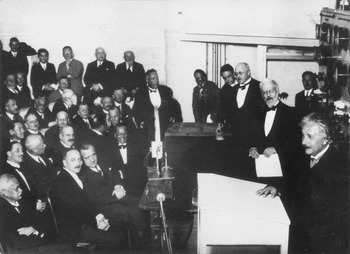
Despite their strong scientific differences, whenever Einstein came to Vienna for conferences or congresses between the years 1921 and 1931 (Figure 1), he stayed as a guest at Ehrenhaft's house. Ehrenhaft socially entertained Einstein, took him around the city and even once arranged for Einstein to play his violin in a string quartet at a domestic reception. The personal relationship between the two was seemingly cordial at this time, and Einstein invited back the Ehrenhafts, hosting them at Caputh, near Potsdam, in the summer of 1932. Ehrenhaft's first wife died later that year, and he was married again in 1935, to Bettina Stein.
This was a period of great unrest in Vienna. Anti-Semitic newspaper articles demanded the barring of Jewish intellectuals from public activities, including the academic world. The murder of philosopher Moritz Schlick in 1936 at the University of Vienna was hailed by the Austrian fascist wing as a ‘good’ solution to the Jewish question – even though Schlick himself had no Jewish ancestry. In this same year the German physicist Philipp Lenard (1905 Nobel Prize), supported by Johannes Stark (1919 Nobel Prize), published the book Deutsche Physik, containing a manifesto against ‘Jewish physics’. The book pleaded for practical physics and attacked what it called theoretical, ‘modern’ speculations, such as relativity and quantum theory. Nazi ideology denied the universality of science, proposing instead a ‘German’ science – Deutsche Physik, Deutsche Mathematik – a trend which was supported by only a few authoritative scientists.Footnote 12
A lecture by Einstein in Vienna (undated) – Ehrenhaft is standing third from the right. (Courtesy of University of Vienna, Österreichische Zentralbibliothek für Physik.)

Ehrenhaft continued working normally after Hitler seized power in Germany in 1933, and in spite of the mounting Austrian Nazi pressure against Jews and converted Jews, he maintained positions in state commissions, such as membership in the national patent evaluation office and in the technical standards committee. However, after the 1938 Anschluss, he was arrested by the police and beaten up, had his money confiscated and was expelled from the University of Vienna, together with many other scientists labelled either Jewish or politically dangerous to the regime. Even so, Ehrenhaft still hoped he could be left undisturbed by the Nazi government, but then slowly changed his mind. He finally applied for a visa, and in April 1939 left for England to further migrate to the USA in June, leaving his second wife in Vienna, where she died of a devastating cancer a few months later.
Initially Ehrenhaft lived in the USA with his first wife's brother, and later with his own son, a surgeon in the Mid-west, and it is unclear how he supported himself during this time. In Vienna he had been funded by the Rockefeller Foundation, and there was an account there in his name but he was unable to use those funds. He then made several contacts with scientists in the USA, including Einstein, trying to find an academic position, but to no avail. Eventually he managed to publish some of his recent work – especially the experiments where he claimed to have separated magnetic monopoles.Footnote 13
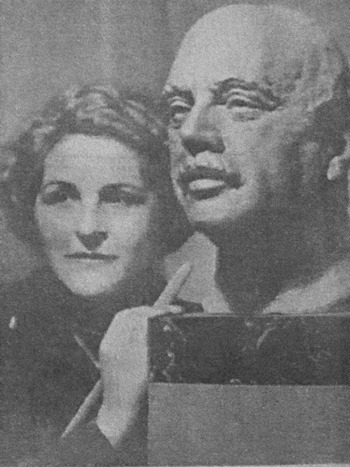
He moved to New York City in 1940, where he met sculptress Lilly Rona (Figure 2), a Jewish Austrian who had emigrated earlier, and whom he would marry in March 1942.Footnote 14 Born Alice Lili Taussky in 1893 in Temesvar (now in Romania), she moved to Vienna to study physics and languages, before joining the studio of Austrian sculptor Gustinus Ambrosius. She bought equipment for Ehrenhaft and assembled a small laboratory that allowed him to continue with his experiments on water magnetolysis (separation of the component gases through a strong homogeneous magnetic field, supposedly analogous to electrolysis) and magnetic currents. Lilly Rona also followed the scientific conversation between Ehrenhaft and Einstein, and she ended up accusing Einstein of playing a two-faced game. As a result, their relationship became ever more shattered and embittered.
Lilly Rona with 1940 bronze portrait of Ehrenhaft (Radiocraft, November 1944).

The Dibner Collection correspondence between Ehrenhaft and Einstein
The earliest letter in the Dibner archives is a typed transcript by Ehrenhaft of Einstein's handwritten letter of August 1917, commenting on two of Ehrenhaft's articles, and explicitly mentioning negative photophoresis. Ehrenhaft had probably earlier used a metaphor comparing theories with the fable of the greater strength of dry twigs when bundled together, to which Einstein replied something reminiscent of what came to be known as the Duhem–Quine thesis in the philosophy of science: ‘but taking one individual piece apart to show it can be broken induces error. The value of a hypothesis lies in its multiple applications. One can never demonstrate a hypothesis that belongs to a theoretical complex’.Footnote 15 The next item is a more extensive manuscript letter from Einstein, written on 23 March 1932, while returning from Pasadena to Europe on board the ship San Francisco, where he acknowledged and thanked Ehrenhaft for sending him an (undisclosed) amount of money. Einstein discussed some of Ehrenhaft's experimental curves, apparently linked to the subelectron question, and said he was especially interested in a ‘most important question’, i.e. whether uncharged particles would experience any forces in the electrical field and also whether the charge differences corresponded to the elementary electric quantum.
Most contemporary physicists regarded Ehrenhaft's results of the subelectron controversy with suspicion, and at the same time were puzzled by his experiments.Footnote 16 Could Einstein and others have been mistaken about his claims? Some of his published work on subelectrons was revisited in 1972, on occasion of a meeting about the history of twentieth-century physics at Lake Como.Footnote 17 One of the related communications there was by Gerald Holton, and another by Paul Dirac, thus giving an opportunity to know how Ehrenhaft's early work was judged in the 1970s.
Holton gives a vivid tale of the polemic Ehrenhaft got into with Robert Millikan about the value of the electric charge e. Ehrenhaft had been the first to publish this value in 1909, using Brownian movement in colloidal preparations, and his figure at that time was close enough to what is accepted today. Millikan used a different (‘oil-drop’) method and his first values were not so close, but he improved in the next years. The problem started when Ehrenhaft announced through the prestigious Physikalische Zeitschrift that he had also measured values smaller than e, which he called ‘subelectrons’, generally 2e/3, but also e/3 and e/2. Millikan said that this was a result of inadequate methods or erroneous observations, and Ehrenhaft in turn criticized Millikan's data. A new series of experiments by Millikan was viewed as a final blow to the hypothesized subelectron, the academic world at large became convinced, and Millikan received in 1923 the Nobel Prize for the charge measurement. Ehrenhaft's values and his interpretation were then generally discredited, even though he and his collaborators still carried on new experiments which kept reporting fraction charges of electricity.
Holton went back to Millikan's original notebooks to analyse his measurements, and concluded that the same values could indeed be taken as evidence for charges smaller than e, as pointed out by Ehrenhaft.Footnote 18 Holton also suggested that there was more at stake than rivalry between two methodologies of experimental work, pointing to Ehrenhaft's dedication to the teachings of Ernst Mach (1838–1916), usually referred to as ‘positivism’. Taken as a belief that facts speak for themselves, the same things must be observed by any able experimenter – however, the positivist's faith in facts becomes an issue because data can be as much laden with ideas and subjectivities as are theories. Mach is also remembered for his stubborn denial of atoms, using the argument that an atom is not a phenomenon to be directly sensed.Footnote 19
Ehrenhaft was imbued with the ideas that once animated that scientist–philosopher (who also greatly influenced Einstein), as seen on the occasion of the 1926 inauguration of a monument to Mach at the Vienna University. Einstein sent his salutation, which was followed by addresses of Moritz Schlick, Hans Thirring and Ehrenhaft – and with the exception of Ehrenhaft, they all distanced themselves from Mach on the subject of atomic evidence, while Ehrenhaft reaffirmed that
Mach had the courage to fight against … the strong mainstream of atomistic vision … which in the smallest apparently has no further divisible components of matter, and recently also of electricity, believing he had the magic key, with which in the end all knowledge gates of natural science can be opened.Footnote 20
The same defence of Mach by Ehrenhaft can apply in principle to Ehrenhaft and the electron, in a way other than the trivial empiricist interpretation it first seems to be. There was a deeper phenomenological question – to decide whether atoms were the smallest entity that can exist. In other words, how could one be sure atoms were indivisible? Is any so-called smallest entity truly ultimately quantized or can a further subdivision be expected beyond that stage? Ehrenhaft sided with those who thought that the ideal atom had not been found, and if, on the other hand, the electron could be broken down into further components, was there ground for believing that an ultimate electric ‘unit’ existed? Ehrenhaft was attacked by scientists who were pro-Millikan and consequently he was supported by anti-atomists and empiricists around Mach.
The issue opposing atomism and anti-atomism with this latter implication has reappeared, as for example in the 1960s in the context of quark theory. More recently there have been proposals even going down to subquarks, all of which could render Ehrenhaft's subelectrons more real than they had appeared at the beginning of the twentieth century.Footnote 21 Yet according to Holton it would be highly improbable that Ehrenhaft could have measured what are now hypothesized as quarks solely with the experimental arrangement he had.Footnote 22
In the other 1972 conference, Dirac reminded his Lake Como audience that the most prominent proposed quarks were subelectrons with ⅔ of the electron charge, and he re-examined the paper published by Ehrenhaft in Philosophy of Science (1941) with experimental data on subelectrons. He accused Ehrenhaft of not being a good physicist because he should have identified such strange results as systematic errors, but Dirac conceded that the data showed exactly 2e/3 charges, and wondered about the reason for that.
Returning to the Einstein–Ehrenhaft correspondence, there follows a major gap, resumed with a letter from 19 May 1939 addressed to the latter, now living in London, his first step towards American exile. Einstein started expressing his joy because Ehrenhaft had ‘now escaped from that Hell. One generally says that the Austrian Nazis are even more infamous than the German ones (if that were possible …)’.Footnote 23 Einstein then threw cold water on Ehrenhaft's intention to publish a book in the United States, arguing that there were considerably fewer readers of scientific books there than in the German-speaking countries. The Princeton Institute, he continued, could not give Ehrenhaft a grant or be of any help to him – and ended by stating that there were no theoretical reasons for all electric charges to be multiples of an elementary charge, though there were plenty of empirical motives that fit into that hypothesis.
On 10 July 1939, Ehrenhaft was already living in Iowa City, at his brother-in-law Steindler's, and Einstein wrote to disagree that the velocity of a minute sphere suspended in gas would be little affected by Brownian motion.Footnote 24 This subject is taken up again in a series of four letters, and in the first one (30 August 1939) Einstein wrote that, given the content of Ehrenhaft's work, he would like to prevent him from publishing, for this would ‘unleash ferocious criticism, which would worsen your practical situation’.Footnote 25
Ehrenhaft replied (September 2) that his situation was already so difficult that it could not possibly become worse, and defended his experimental work, insisting that it was necessary to work with such small particles because smaller charges would manifest themselves more easily. Einstein immediately (September 3) countered the technical objections of Ehrenhaft with some of his own epistemological conceptions: ‘The experimental physicist's goal is not only to achieve reproducible results of experiments. The determining factors should also be as simple as possible, so that one can thereof deduct elementary laws that may be applicable in other situations.’Footnote 26 At the end of this letter there is a harsh comment against Ehrenhaft, with the excuse that he was being very brutish only to make himself well understood; further, ‘Your opinion, that new field laws should be used to clarify the phenomena researched in your work, without indications on how to proceed, sounds simply ridiculous; compare: someone proposes to research the stock market oscillations based on Maxwell's equations.’Footnote 27 It is ironic that not Maxwell's equations, but Brownian movement itself had already been used by that time to analyse stock market oscillations.Footnote 28
Anyway, what Ehrenhaft had in mind now was the existence of monopoles, which did demand new field laws.Footnote 29 To propose the existence of magnetic monopoles a person might have invoked an aesthetic dissatisfaction with the non-symmetry of Maxwell's equations regarding the electric and magnetic fields, but this was not the case for Ehrenhaft. He had not started from revisionist assumptions regarding the laws of physics, but worked the other way round, in the sense that his experimental results prompted him to revise the theory. In his words, ‘When I came to the conclusion that there are single magnetic poles (magnetic charges), it was therefore not necessary to ask if they agreed with existing theories, but rather whether there are any experimental facts that contradict it.’Footnote 30
Ehrenhaft apparently replied to all objections, as Einstein said in the next letter (6 September), that even so he could not believe at all that the charge depended on the size of the particle, and if it did so, there must exist an unknown source of errors – he concluded in a friendlier mood saying that this letter exchange brought him ‘true joy, because through it I can better apprehend the problem’.
On 9 January 1940, Einstein wrote and begged Ehrenhaft (now living in New York) not to visit him with his ‘artist friend’ (probably Lilly Rona) for he would be too busy, and said that he had not yet talked with others about Ehrenhaft's expectations concerning work in Harvard.
The correspondence rhythm of February and March 1940 is a frenetic one. Ehrenhaft's letter from 14 February 1940 was appended with a copy of his communication on photophoresis to the forthcoming meeting of the American Physical Society (later printed in the Journal of the Franklin Institute). Ehrenhaft's carbon copy of this letter had a postscript: his discovery that there were charges smaller than the electron in 1910 had led him afterwards to know that light, given certain conditions, could exert upon matter not only compression forces, but also traction ones. He had discovered magnetophoresis as a symmetrical process to electrophoresis, following the footsteps of Oersted and Faraday. In his words, ‘light dissociates not only electric poles, but also magnetic ones’, a knowledge he had ‘acquired without any resource to the atomistic hypothesis’,Footnote 31 here doubtless meaning the assumption of an elementary electricity quantum.
The next day, Ehrenhaft wrote again, telling Einstein that after discovering light's action to create magnetic monopoles, he would also be able to speak of magnetic currents, and hinted that in outer space there is a flow of magnetic current from the Sun to the Earth. On 16 February Einstein replied that Ehrenhaft's opinions were probably wrong, and he also commented on Ehrenhaft's paper, soon to be presented at the American Physical Society, making some suggestions but reassuring him that its content was very good and efficient. On the following day Ehrenhaft wrote in disagreement with most of Einstein's corrections, emphasizing that in his experiment the magnetic monopoles moved along the lines of force of the homogeneous magnetic field, and not perpendicularly to them, as was also observed in the case of the Sun's corona radiation.
A short digression is worthwhile here. Dirac's 1972 paper also mentioned that in the 1930s Ehrenhaft had insisted on having discovered single magnetic poles and sought support for his discovery. Dirac refused, because Ehrenhaft's monopoles were much weaker than those predicted by his own theory.Footnote 32 According to Dirac, Ehrenhaft often approached him in the corridors to pour out his woes about the matter, since he
was not allowed by the secretaries to speak at these [American Physical Society] meetings. His reputation had sunk so low, everybody believed him to be just a crank … I formed the opinion that he was in any case sincere and honest, but he must have given the wrong interpretation to his experiments.Footnote 33
We here find a clue to the general disapproval of Ehrenhaft in mainstream physics: he was treated by many scientists as an eccentric, and, to say the least, someone to be ignored publicly to avoid embarrassment. Dirac's judgement is retrospective and his notion of Ehrenhaft's exclusion from the meetings is not exact, since Ehrenhaft did deliver his intended lecture at the American Physical Society in 1940. In Ehrenhaft's own view such presentation met with success in terms of the public interest it aroused.
Einstein (on 20 February 1940) renewed his objections, and asked Ehrenhaft why the magnetic charge should leave the particle after the radiation was interrupted, and why the magnetic monopole only appeared in small particles, which all seemed ‘to be forced and anti-natural hypotheses, inasmuch as there is no broader experimental basis for them. This does not change anything, that the phenomenon itself is highly interesting’.Footnote 34
Ehrenhaft (21 February) insisted that he was not interpreting wrongly, what he had observed was a real current, evidenced by the displacement of magnetic monopoles, and he had followed Faraday's advice: ‘nothing is so good as an experiment, which removes the errors and leads to unconditional progress’.Footnote 35
A singular personality trait of Ehrenhaft, as he would also demonstrate in his contacts with Einstein in America, was his naivety – for example, in spite of his Jewish origins he had publicly agreed in principle with right-wing radicals such as Lenard and Stark, albeit only in terms of physics. Anyhow, his endorsement of epistemological premises of ‘German physics’, as the above apology of practice against theory suggests, continued even after the war was over, and Ehrenhaft always chose to ignore its political content, and satisfy himself with what he thought was a vindication of his own scientific convictions.Footnote 36
Ehrenhaft (on 27 February 1940) continued to counter the arguments of Einstein's previous letter and objected that Lorentz's force was not the explanation for the shape of the Sun's corona – Einstein had insisted on 16 February that Ehrenhaft must mention Lorentz's force, so that people would not think he was ignorant. Lorentz's force, according to Ehrenhaft, was not a sufficient explanation because with the Sun's magnetic field strength H decreasing rapidly with distance, the spiral where the particle moved should become ever smaller, whereas the solar photographs did not show that.
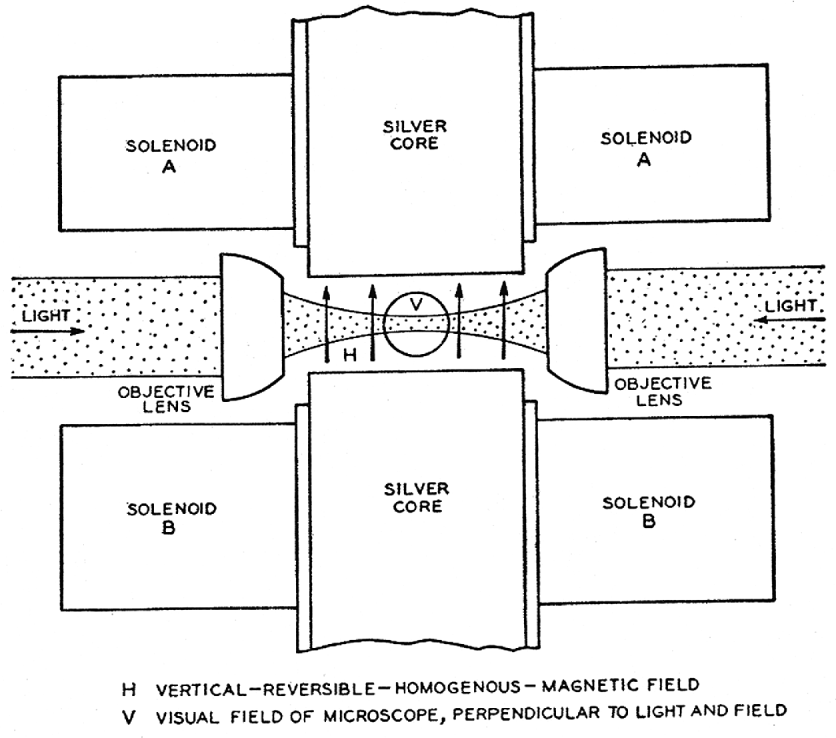
As most of the letters written by Ehrenhaft to Einstein here examined are devoted to his alleged experimental production of isolated magnetic poles, this deserves a closer examination. The laboratory arrangement is described in many of his articles and also repeated in class notes taken during the year 1947 (Figure 3).Footnote 37
Condenser and coils in Ehrenhaft's apparatus (Journal of the Franklin Institute (September 1940) 230(3), p. 388).
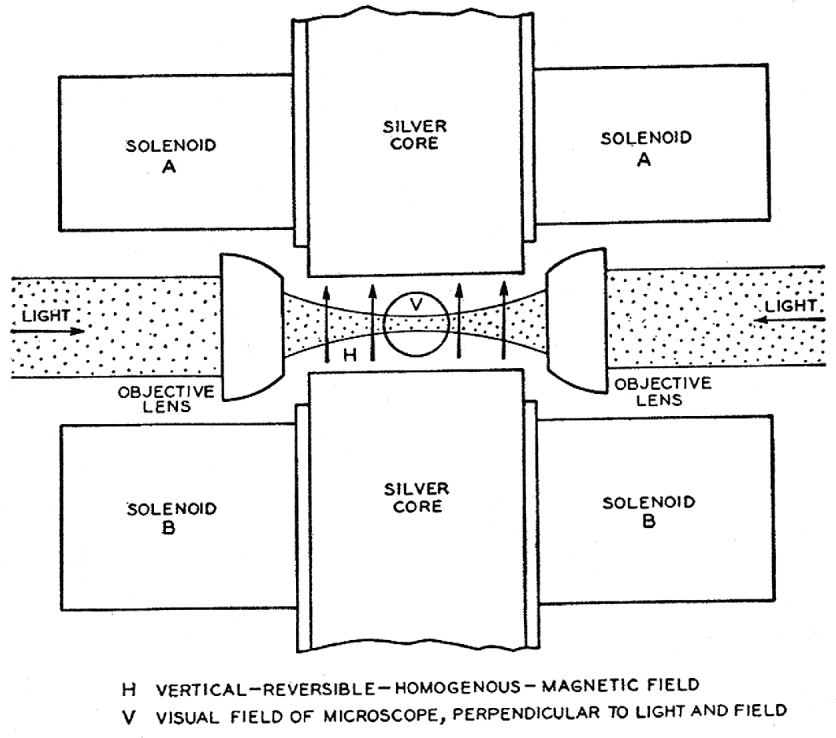
He started with a glass cell of square cross section placed between the two poles of a permanent magnet (or also an electromagnet). The cell gathered probes suspended in a gas, and was provided with two thin grounded silver bands, which functioned as a Faraday cage to avoid electrostatic influence. The magnet poles had diameters varying between two and sixteen millimetres, and were conductively interconnected and grounded. To the right side of the poles was a plate condenser, to be directly viewed through a microscope.Footnote 38
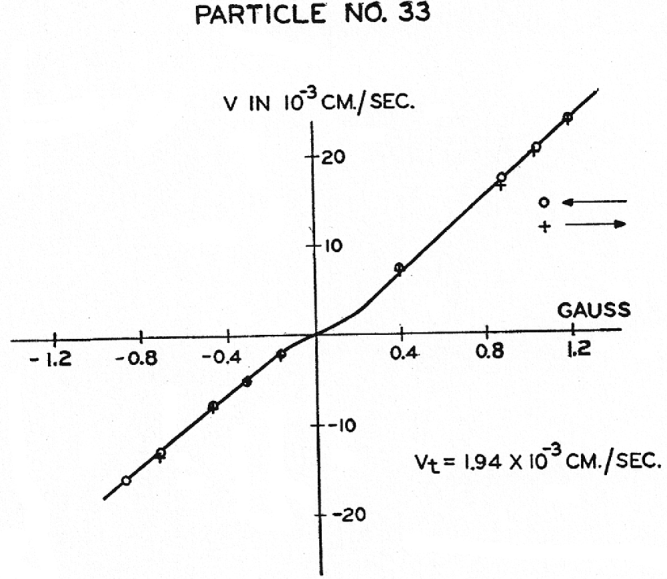
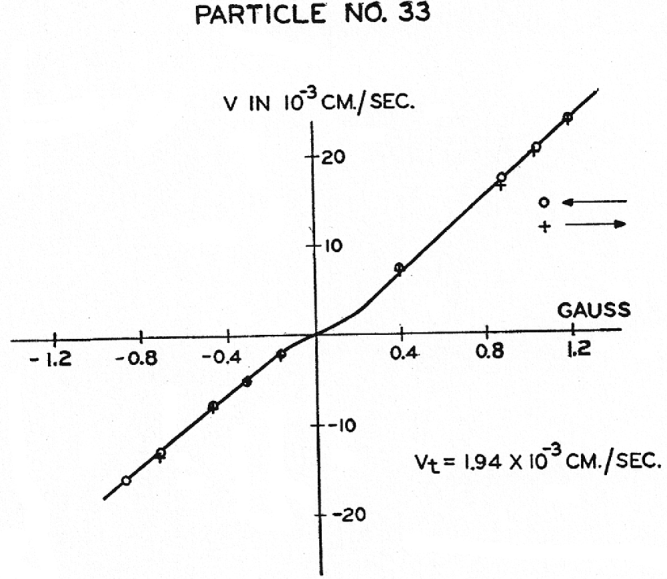
The experiment started with a vertical, homogeneous, magnetic field, that could be switched on and off, entirely free of remanence (remaining magnetism after removal of an exciting magnetic field). Several tiny bits of matter, neither spherical nor diamagnetic, were suspended, and these particles were brought together by the action of the magnetic field in the absence of light, along the direction of the magnetic force, letting them fall under the influence of the Earth's gravity. By compensating the gravity force the particles floated. An intense light then hit them, from either side or both sides, and it was observed that the particles moved away, some towards the north end, and others towards the south side of the magnetic field, while there was light. The resulting force was proportional to the field strength (Figure 4 – Ehrenhaft stated his precision to be 3 per cent). Switching off the magnetic field, this movement was immediately interrupted, thereby causing the particles to fall.
Magnetophoretic force – V t velocity of fall (Journal of the Franklin Institute (September 1940) 230(3), p. 390).
Once again resuming the letter exchange, Ehrenhaft communicated (10 March 1940) the recent death of his second wife, and asked if he could visit Einstein in Princeton to discuss the magnetic current experiment. On 27 March 1940, Ehrenhaft thanked Einstein for sending a check for 250 dollars. The series of references concerning money (always involving that same amount) had to do with Einstein's friend Janos Plesch, whom Ehrenhaft had first met in Berlin in the early 1930s when he visited Einstein.Footnote 39 Plesch was a famous medical doctor, married to an experimental physicist, and responsible for gathering the Einstein Fund in Berlin, which was a permanently renewed total of 10,000 marks, a considerable amount at the time, laid at Einstein's disposal. Plesch became a lifelong friend of Ehrenhaft's and helped him on several occasions during the exile, including lodging Ehrenhaft when he escaped to London, where Plesch was living. It is possible that money out of that fund was still available through Plesch after Einstein went to the USA, and maybe Einstein occasionally used this money to help Ehrenhaft.
In the same letter Ehrenhaft answered a question asked by Einstein's secretary (Helen Dukas) about the Rockefeller grant money: he avoided giving it right away to the Nazi authorities, but even so it had been held back in Vienna. He also mentioned that the Rockefeller Foundation was no longer supportive of research in physics, preferring biology instead. He had reviewed the literature on the Brownian movement since 1905 and found that the experiments did not confirm Einstein's theory.Footnote 40 Ehrenhaft had also talked with Bell Laboratory (apparently a suggestion given by Einstein) about conducting there his experiment on magnet discharge by light, but they gave no answer, so he added, ‘it is always difficult to conduct pure scientific experiments in a technical laboratory devoted solely to profit’.Footnote 41 Ehrenhaft also questioned the numerical determination of the Loschmidt number, a German term used to designate the Avogadro constant, insisting that the correct value could only be obtained if the Brownian movement experiment proposed by Einstein were conducted in a dark room.Footnote 42
On 28 March, Einstein reported that Ehrenhaft's manuscript (which Einstein had forwarded to Sir William Bragg over two months before) had been refused in London. Also, it would be useless for Einstein to write to the Rockefeller Foundation to intercede in favour of Ehrenhaft. In his reply (3 April 1940), Ehrenhaft said he could well understand the Royal Society's viewpoint, since it was ‘the last work of a Jew in German land’,Footnote 43 hastily written, incomplete and without the experimental construction instructions. He could, however, not understand James Frank's refusal in the name of Physical Review to publish another work of his, and gave Einstein a long list of articles whose study reinforced his conviction that photophoresis could not be a consequence of radiometric effects. To this Ehrenhaft appended a list of seven detailed technical questions concerning the measurements and experimental evidence of photophoresis. The Dibner Library keeps Einstein's refutations thereof and also Ehrenhaft's final rejoinders to the seven questions.
When he wrote to Einstein on 7 April 1940, Ehrenhaft was about to send a note to Physical Review (apparently not accepted) about Einstein's theory – possibly again a reference to Brownian movement. The next day Ehrenhaft told Einstein he had just come back from another talk with Marvin Kelly, head of the Research Laboratory of Bell Co. and an ex-student of Robert Millikan's. Ehrenhaft had proposed working at Bell on the magnetophoresis experiments, but Kelly told him that meanwhile Millikan had written a letter mentioning some negative comments from Einstein to Millikan about the same subject.
On 10 April 1940, Ehrenhaft unusually wrote in English, and complained to Einstein that in a second letter to Kelly, Millikan stated that Ehrenhaft's article (the one sent to William Bragg at the Royal Society) was ‘so inferior and below the average American level’ that it could not be published – and how would Millikan know of that?Footnote 44 Only by being part of the editorial board, or if Einstein had written to Millikan about this subject, said Ehrenhaft. He agreed that no one was obliged to give him a job in a country where he did not seem to be welcome, but it was unacceptable to prevent him from having his article published. He felt hurt especially because of the coming international physics congress to be held in New York, following the last one in Paris before the war (1937), where Ehrenhaft had the honour of being chosen by four thousand scientists to deliver the prestigious thanking speech. Ehrenhaft was willing to go to London to defend himself against those accusations. Einstein (15 April) replied that he had asked for but not yet received Kelly's letter cited by Ehrenhaft, and thought it useless to have a conversation with Ehrenhaft, especially because he was overloaded with work and did not have time.
The intense letter exchange momentarily halted. Did Ehrenhaft suspect that the embargo in fact stemmed not only from Millikan, but also from Einstein?
The Dibner Library keeps also a letter to Einstein dated 31 May 1940, written ‘under real tragical circumstances’ by Richard Kobler, an Austrian engineer and ex-student of Ehrenhaft's now living in New York.Footnote 45 Kobler said that ‘the “Ehrenhaft affair” threatens to take such catastrophic proportions’ that he decided to address Einstein himself. Kobler and other friends had persuaded Ehrenhaft not to travel to London at all, an uncertain destination at this time, even though in England there was assurance of material support for Ehrenhaft and his experiments, exactly what was lacking in the USA. Kobler wanted to talk these matters over with Einstein in Princeton. It is not known whether Einstein answered Kobler and if such a meeting ever occurred.
Einstein wrote again to Ehrenhaft on 26 July 1940, saying he knew nothing concerning any ill feelings between them and evoked again the amount of $250 that Ehrenhaft was unable to use, and added,
I must admit that for theoretical reasons I am firmly convinced that there cannot be any isolated magnetic pole. The reason is that the quadrupole potential appears to have an immediate physical signification, and this because Stokes’ theorem excludes isolated magnetic poles. Even so you may convey your ideas to me and I will tell you what I think of them.Footnote 46
Perhaps Einstein had in mind that the usual quadrupole derivation matched most of the experimental evidence, lending support to the assumptions behind Stokes's theorem (the surface integral of the curl of a vector function equals the line integral of that function around a closed curve bounding the surface). Ehrenhaft's position implied that Stokes's theorem was in this case equivalent to the denial of monopoles, and he chose not to use it.
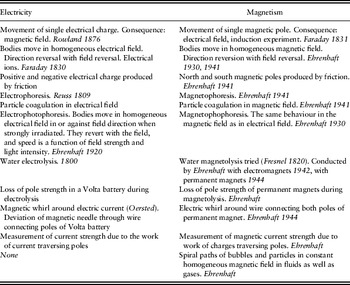
From Ehrenhaft's letters and articles consulted, it can be said that nowhere did he clearly indicate how isolated magnetic poles or magnetic currents were to be produced from his experimental setups. He certainly thought that a causal relationship in this sense would result from further research in the foundations of physics – and he was not worried with such explanation, as for him the experimental evidence was sufficient. His research programme can be summed up in a lifetime dedication to the proof of a complete and equivalent parallel between the electric and magnetic fields. This is illustrated in Ehrenhaft's own perspective by Table 1, devised after his return to Vienna, comparing what he considered his achievements in exploring the full implications of this parallelism with other hallmarks previously established by others.Footnote 47
Electric×magnetic current

A triangular correspondence
At this moment there appears in the correspondence the intrusive register of a third person: Lilly Rona. Her contribution is at first through poems, a form of expression she shared with Einstein – these poems are here fully presented to give the flavour of the dispute. It was Einstein who started it, writing to Ehrenhaft the following short verse on 16 August 1940:
Ten days later Lilly Rona replied to Einstein in the same vein:Footnote 49
On 17 September, Lilly wrote another poem to Einstein, implying that Ehrenhaft had studied Morichini's 1812 essay about the dissociation of magnetic poles by light:Footnote 50
Ehrenhaft resumed the prose correspondence on 26 September, saying he was far from forcing conviction upon Einstein, he only wanted to keep him informed, and by the way he had another article ready, this time about Einstein's own research area, namely light. Ehrenhaft was ‘convinced that our scientific opposition will in no way damage our old friendship relations’.Footnote 51 On 15 October, Einstein replied that he was sorry, for he could not invite Ehrenhaft for a conversation since he could no longer hope to achieve agreement. This very day Ehrenhaft wrote back an interesting answer, not entirely free from positivist tones:
Scientific matters are not matters for agreement, as usually happens in politics or in men's lives, but scientific knowledge is either right or wrong. The judge of new or rediscovered knowledge remains solely the well-arranged experiment with the consequent conclusions and added-on knowledge.Footnote 52
Einstein, however, remained firm in his decision, and communicated to Ehrenhaft on 17 October 1940 that ‘a new discussion would be useless, because hopeless. Moreover, if the experiment alone decides or has already decided, then my participation is totally superfluous’.Footnote 53
Ehrenhaft (24 October) answered that Einstein's behaviour was not appropriate to their almost thirty-year friendship. If Einstein could not receive him any more, Ehrenhaft for his part could not accept any longer the amount at his disposal with the warranty given by their mutual friend, Plesch, and with that letter Ehrenhaft returned Einstein a cheque (of undisclosed amount).
All of this prompted Einstein to write Ehrenhaft the following poem (26 October):Footnote 54
Lilly did not let the chance pass by, and immediately answered this challenge (27 October):Footnote 55
Afterwards (9 April 1941), Ehrenhaft explained to Einstein that according to his calculations the Earth's magnetic field ought to be nearly one million times stronger to be capable of moving monopole magnets. In his magnetic condenser, with a more sensitive arrangement and minute particles, he had nonetheless succeeded in isolating magnetic poles and proved that light magnetizes, which would explain numerous anomalies observed in Brownian movement in liquids and gases, as well as other phenomena. He repeated that Morichini had been the first to magnetize through light, besides having discovered the photoelectric effect, and said that also Humphry Davy had observed magnetization by light.
On 22 April, Lilly wrote Einstein another poem; on her carbon copy she added a note, stating that this was after she had received report from different sources that Einstein cut off Ehrenhaft's possibilities of getting a working space in the USA by defaming her husband. She appealed strongly in this poem to puns on their names, as Einstein can stand in German for ‘a stone’, and Ehrenhaft for ‘honored one’:
Einstein decided to write back to Lilly in a well-humoured mood on 5 May 1941:
The final move of this poetic quarrel was made on 12 May when Lilly wrote,
On 17 May, Einstein wrote that he saw no reason for complaint, as he could not go against his own convictions. Ehrenhaft answered (29 May) that he, on the contrary, did have reasons to complain,Footnote 59 since Einstein had spoken with colleagues against Ehrenhaft's experiments, and though he had volunteered several times to demonstrate them in Princeton, Einstein had never agreed, without substantiating his refusal. Besides, he had heard that Einstein had commented to a common acquaintance (the philosopher of science Spencer Heath) that magnetism propagates at the speed of light, which was an idea similar to Ehrenhaft's. Moreover, he continued, Einstein should know that his opinions greatly influenced public opinion, and the monopole question remained a fundamental one for physics. Lilly Rona decided then to write not a poem but a direct letter to Einstein, and in English, on 2 February 1942. She said this was the day when Ehrenhaft had discovered how to measure the magnetic current, having observed it with and without light. She bluntly asked how Einstein was going to repair ‘the great injustice done to Felix Ehrenhaft’ through his
attitude towards him and the unfounded and defaming reports about his discoveries [which Einstein had] spread out not only among his colleagues but also in financial circles among bankers who had wanted to help him to proceed with his research work.Footnote 60
To one of these bankers, Lilly continued, Einstein had even said ‘hands off … Ehrenhaft is a fantast’, and she had no doubt that Einstein had been the source of all distrust and animosity against Felix Ehrenhaft, and this was unfair to someone of whom ‘Planck said to have given the finest methods of measurement to modern physics’. Lilly accused Einstein of not having kept their disagreement private, spreading rumours against her husband instead. Einstein's own ideas about the infinity of the world, Lilly went on, were followed with interest by many people, and they could as well ‘be called fantastic with much more reason than the experimental work of Ehrenhaft, who was about to develop a new source of energy and give it to the world’.Footnote 61 The last phrase probably refers to magnetolysis. Lilly ended her heavy indictment by stating she was ‘going to make every possible endeavor to reestablish the honor and the scientific reputation’ of her very dear friend. On 18 March 1942, Lilly complained again to Einstein, attaching a copy of the previous unanswered letter, and hinting that the publication of Ehrenhaft's paper about the magnetic current, which was about to appear in the March issue of the Franklin Journal, might give Einstein an opportunity to correct his regrettable statement, for which it might ‘be hard to bear the responsibility’.Footnote 62
This second letter was presumably never answered either, and it can only be conjectured that, contrary to Lilly's poems which Einstein cared to answer, the letters could not be taken light-heartedly. This remains the last item in the correspondence file, even though Lilly Rona reproduced another poem written to Einstein in a manuscript of her own article kept in the Dibner Library, Der Magnet als negativer Katalysator des Wassers:Footnote 63
An inconclusive aftermath
After the war was over, the University of Vienna asked Einstein (of all people) to give his opinion whether Ehrenhaft should be invited to come back home. Einstein's answer sounds like a final judgement: Ehrenhaft's subelectrons were a misinterpreted experiment; photophoresis was an interesting result, but could be explained as a consequence of radiometric forces; and magnetic charges and currents were arbitrary interpretations. However, Einstein acknowledged, Ehrenhaft had been the first scientist to measure single elementary electric charges, and he was an able experimental physicist, in spite of drawing so many wrong conclusions, a feature which did not earn the respect of his colleagues. As Ehrenhaft was already at the age of retirement, Einstein recommended that the university award him the emeritus title and provide him with the task of lecturing on the history of physics, a subject about which he knew a lot, adding a final remark, ‘This would be noble and at the same time not dangerous, and he could go to his end without bitter[ness].’Footnote 65
The USA was at that time interested in repatriating some Austrian scientists, in order to irradiate a good image of the American way of life, and to strengthen personal ties within the academic circles of both countries. Ehrenhaft did go back, while Lilly Rona on the contrary resisted and wished to remain in the USA; in the end it was not possible to reconcile their differences and the couple decided to divorce. A note written by Lilly on 10 February 1944 already anticipated conjugal problems – she admired her husband scientifically, but sadly complained about the burden of being married to such a stubborn man, who only cared about himself, and did not give sufficient credit to his collaborators.Footnote 66 In March 1947, Ehrenhaft was again in Vienna, where he was reinstated as university professor, finally resuming his researches on magnetism and light, teaching classes and pronouncing at conferences.
One of the post-war physics students in Vienna who at first had a very sceptical attitude towards Ehrenhaft was Paul Feyerabend, as he recalled in his autobiography.Footnote 67 Accordingly, Vienna's university in 1947 had three reputed physicists: Ehrenhaft, Karl Przibram and Hans Thirring. Ehrenhaft's fame was dubious, so the students decided to unmask him; however, the professor conducted his experiments in class in such a simple and convincing manner that Feyerabend was won over and changed his opinion.
According to Feyerabend, there was ‘an iron curtain’ that protected established physics from Ehrenhaft, exactly like the one that had shielded Galileo's opponents.Footnote 68 This may well have been a first incentive for Feyerabend to question ‘normal science’, stressing that scientists did not always win just because of the merit or the ‘truth’ of their ideas – for him, the history of science showed that victory may lie with whoever is cleverer at producing the right propaganda. The next semester Feyerabend decided to stenograph Ehrenhaft's lectures about magnetolysis and magnetic poles, and sold copies thereof to his fellow students.Footnote 69
In 1949 Lilly Rona went to Vienna, trying to publish scientific articles based on the work she and Ehrenhaft had conducted in New York. Ehrenhaft seemingly avoided her publicly, as if embarrassed by her attempts to enter the scientific milieu, though they still exchanged letters.Footnote 70 Perhaps Ehrenhaft was too proud to now acknowledge her past participation in his work in New York.
From 1950 onwards Ehrenhaft was sick, and finally died in Vienna on 4 March 1952. Around this time Lilly Rona filed for some patents in the USA and Europe concerning magnetolysis (these are also found in the Dibner Collection). She died on 2 April 1958, in New York.
How successful a scientist was Ehrenhaft? Judging from the number of his publications, he should be relatively well known by his peers – his contributions appeared for decades in several publications in German, English and French, including some prestigious ones such as Nature, Science, Physical Review, Comptes rendus, Annalen der Physik, Physikalische Zeitschrift and Zeitschrif für Physik.Footnote 71 Sometimes a publication would include a cautionary note, as for example in the article ‘Physical and astronomical information concerning particles of the order of magnitude of the wave-length of light’, where the editor added the following remark, at the same time an avowal that other scientists did take notice of Ehrenhaft's work: ‘While it is recognized that Professor Ehrenhaft's conclusions as to the significance of his experiments are highly controversial, the experimental results themselves are such as to have recently excited the interest of several prominent authorities.’Footnote 72 A fair reassessment of the conflict between Einstein and Ehrenhaft against the scientific tradition is very difficult. On one side is the ever more celebrated ‘father of relativity’, on the other a neglected physicist. There has been ongoing research on the subject of magnetic monopoles since Ehrenhaft's efforts, but it is almost entirely theoretical and the bibliography does not usually mention Ehrenhaft's publications in this field, something that could be ascribed to different concepts of what a ‘magnetic monopole’ is, implying different values of mass and strength. Modern experiments, some of which were initially considered as evidence of the practical existence of monopoles, were subsequently reviewed and deemed inconclusive.Footnote 73
From the references encountered in the literature, and in various letters written by such American physicists as W.F.G. Swann, John Zeleny, G.N. Stewart, Edwin Kemble and others, it seems that Ehrenhaft, though controversial, was really considered an able experimentalist with important, albeit problematic, research.Footnote 74 To check for eventual systematic experimental errors, the best way would be to re-examine Ehrenhaft's original arrangements and methods, which have not been subject to new and more accurate investigation. Subelectrons, as well as magnetic monopoles, may indeed be hard to find in his conditions, but this possibility cannot be simply ruled out beforehand. Unfortunately, it is difficult to reconstruct his setups and interpretations based on the available documents, and after his death Ehrenhaft's experimental work has not been continued.Footnote 75
One may feel that the opposition between Ehrenhaft and Einstein had to do with the debate of practice versus theory. Already during the Weimar period, there was a latent conflict in the German-speaking countries between theorists and experimentalists.Footnote 76 Some of the experimental physicists decried relativity and quantum theory, as the afore-mentioned Stark and Lenard, and when these pushed for an ‘Aryan’ science through the book Deutsche Physik the artificiality of the argument became patent, as there were ‘pure’ Germans like Heisenberg who sided against this movement, as well as a Jewish physicist (Ehrenhaft) who supported it.
Therefore, even though Einstein and Ehrenhaft indulged in this kind of mutual judgement of theorist and experimentalist, it has to be treated with care. Both scientists had once been practical examiners at patent offices, and notwithstanding what Einstein publicly avowed, he was well acquainted with the importance of experimental corroboration of theoretical results.
Jeroen van Dongen has written two articles which shed more light on the relationship Einstein established with the experimental field, exposing his association after 1926 with the German physicist Emil Rupp to investigate the wave–particle duality using canal radiation.Footnote 77 Einstein wanted to test whether light was instantly emitted when an atom was excited, or took a finite time span, and he rejoiced that Rupp would conduct such an experiment, even though working in Heidelberg exactly under the anti-relativist and anti-Semite Lenard. The evidence slowly built up to show that Rupp never observed what he claimed, and just reported what he believed to be Einstein's correct prediction.
There was at this time another division in the German physics community, between northern physicists who accepted the new theories, and southern conservatives who did not. Two of Rupp's supporters, Einstein and Max von Laue, were prominent theoretical physicists in Berlin, while Lenard and Wilhelm Wien held important chairs in the south, and viewed themselves as exponents of a more experimentally oriented tradition (as did Ehrenhaft).
Van Dongen concludes that, rather than attributing Einstein's and von Laue's reactions only to sociopolitical factors, there is a much more likely cause for their continued trust in Rupp's work: the theorists’ prejudices when confronted with experiment. This theoretical prejudice has a counterpoint in the experimentalist who stops searching for systematic error in his arrangement as soon as he gets the expected results. Moreover, Einstein gradually shifted the importance he attached to experience, and started believing that new insights for the creative theorist were to come just from mathematics. This might also apply to his conduct towards Ehrenhaft, even though in Rupp's case the accusations were of fraudulent works, while Ehrenhaft was until the end charged with ‘systematic errors’.
On the other hand, even though Ehrenhaft strongly emphasized the intuitive approach and used in his favour the experimental examples of Franklin, Oersted and Faraday, he knew he could not simply dismiss theory.Footnote 78 It is more likely that both scientists diverged in their theoretical foundations, and as a consequence they viewed the same experimental results differently.
Ehrenhaft's personal interpretation of these differences lies in his unpublished recollections on Einstein.Footnote 79 In a section titled ‘On his [Einstein's] attitude towards research’, he writes,
In my opinion there are two totally different ways of conducting research in physics. I would like to designate these two types as Faraday’s method of work, and the second one as Hamilton’s … My conversations with Einstein have convinced me that he has always preferred Hamilton's. It is known that Hamilton predicted external and internal conical refraction purely based on the differential equations for crystal optics … one must say, then, that Einstein predicted the gravity of light entirely in the form of Hamilton.
Ehrenhaft's attitude towards theory is the reason why, on 15 February 1940, he wrote to Einstein that his experimental findings regarding the existence of magnetic currents naturally demanded a modification of Maxwell's equations. Indirectly referring to Einstein's position, Ehrenhaft complained on 10 March 1940, ‘I discovered, however, that the look of many people through the glasses of theory clouds the knowledge of experimental facts.’Footnote 80
In his already mentioned recollections Ehrenhaft judged that although Einstein was an excellent physicist,
he had in his chest two souls, as well as in the case of Maxwell. But one should say that, the older Maxwell grew, the more he distanced himself from atomic theory. This cannot be so clearly recognized in Einstein.Footnote 81
In the 1930s Ehrenhaft was willing to disregard Maxwell's formulation of the classical electromagnetic theory, as he found it impossible to reconcile it with his experiments. The epistemological attitude taken by scientists in face of the paradigmatic body of knowledge, when confronted with sets of conflicting experimental data, renews the question: if data do not fit the accepted theories, at what point should one distrust the results or, on the contrary, challenge the theories? The standard answer has been experimental repetition – by the same scientist or ultimately by entirely different observers.Footnote 82 However, Ehrenhaft repeated his experiments, and seemed willing to demonstrate them to others.
Helge Kragh has written an interesting essay analysing the concept of monopoles from both the historical and theoretical viewpoints, including a section devoted to Ehrenhaft's monopole.Footnote 83 He starts by supposing the existence of magnetic monopoles with the necessary consequent changes in Maxwell's equations. The quantization of the electric charge could be explained assuming the existence of monopoles – though it should be pointed out that this would not necessarily imply that the minimum charge must have the known value of e.
At least for part of the physics community, the existence of magnetic monopoles is nowadays considered plausible, and most ‘grand unified theories’ presume that, according to the ‘big bang’ hypothesis, in the initial stages of the universe a huge number of monopoles were produced. The so-called ‘monopole problem’ is exactly what happened afterwards and why monopoles seem so elusive to detect. These considerations led to the ‘inflationary universe’ model to explain the dilution of the monopoles.Footnote 84 Initially, such theories predicted lighter monopoles, but later the values were changed to extraordinarily heavy ones to prevent the enormous attraction they could exert, and which would crunch the universe. All taken into consideration, Ehrenhaft's claims about detection of lighter monopoles around 1940 would not seem so absurd for a theoretical physicist in the late 1970s, or even today, and of course it can always be questioned whether such monopoles would be detectable by his apparatus (as Holton argued for subelectrons).
Overall, Ehrenhaft maintained a rebel attitude towards the current theories. He appeared to be a very persistent person, perhaps sometimes in a very unpleasant manner, and his personality became abhorrent to other physicists, even to those who had themselves once dared to defy conventional explanations of physical science (as Einstein or Dirac had).
Ehrenhaft had a peculiar affection for investigating the history of physics, which he showed on many occasions, including his lengthy 1932 commemorative address on Faraday's discovery of induction.Footnote 85 Einstein was also considerably interested in the history of physics, but not in Ehrenhaft's opinion:
I mention yet another observation. In a longer conversation in Caput, while we sailed I said that there existed too much writing and measuring, and stated that to be knowledgeable in physics since the year 1870 it sufficed to read no more than 25 works. Einstein thought there would be many more. We counted together and arrived at only 17 to 18, naturally excluding measurement tables among others. He agreed. In general, I observed that he is little acquainted with the history of physics, and I was amused to observe that he didn't read much either.Footnote 86
When commenting on his own methods, Ehrenhaft repeatedly mentioned his preferred examples of Faraday and Oersted, and he often referred to himself as a continuator of their tradition, as in this letter to Einstein (14 February 1940): ‘In direct continuation of Oersted's and Faradays's path I arrived at the other knowledge relative to the conflict among matter, light, electricity and magnetism.’Footnote 87
This appeal to the epistemological procedures of Oersted and Faraday may not be casual. Perhaps Ehrenhaft viewed himself as a continuator of the German Naturphilosophie tradition, which certainly bore fruitful scientific results, including Oersted's discovery of the first magnetoelectric effect.Footnote 88 Even his wording is modelled after Oersted's famous communication (on the ‘electric conflict’) about the movement of a compass needle parallel to a current-carrying conductor. Among Naturphilosophie’s features there are some that reappear in Ehrenhaft's interpretation of elementary charges and magnetic monopoles, such as that matter fills space continuously by means of its primitive forces of attraction and repulsion, that matter is divisible to infinity, and that there are no discrete fluids.Footnote 89
Ehrenhaft, obsessed with an unreturned but trusted friendship, probably posed a riddle to Einstein: should the Austrian be ignored in the field of physics? Einstein was at least relatively interested in the subelectron and later in the isolated magnetic pole experiments, but certainly not interested in the person of Ehrenhaft. On the other hand, one can say that there was a limited material support from the part of Einstein, and yet there was very little empathy. He had not endorsed Ehrenhaft's appointment to a professorship in Vienna in the 1920s, and he was not willing to help him get a position in America in the 1940s; accordingly, he did not approve of his colleague's reinstatement at the post-war Vienna Physics Institute.
Ehrenhaft, on the other hand, behaved as a very naive and politically alienated person, and tended to neglect the real outside world and to minimize the attacks he received. His work with the electron charge might have brought him resting fame, but he chose instead to emphasize small perturbations that others like Millikan neglected as non-significant errors.Footnote 90 Ehrenhaft continued believing in the results of his experiments as indicative of some hitherto hidden aspects of nature, with the result that he paid the high price of ostracism.
Judging from the examined correspondence, Ehrenhaft acted as if he expected Einstein to repay the kind treatment he had received in Vienna, while Einstein probably felt Ehrenhaft a nuisance disturbing him from his personal affairs, and his politeness started to fade out when Ehrenhaft challenged not only one but many of Einstein's major achievements: electromagnetic theory, as Ehrenhaft's attrition with Maxwell's equations might hit Einstein's special relativity grounds; the nature of light, which could impart the Nobel Prize-winning photoelectric effect explanation; and, last but not least, Einstein's theory of Brownian movement, a field where Ehrenhaft had great practical experience.
It seems worthwhile to remark that when Ehrenhaft wrote to Philipp Frank (9 February 1940) to provide some anecdotes regarding Einstein, he took the chance to urge Frank, then also in the USA, to go and see the American scientist Dayton Miller, who had been redoing Michelson-Morley's famous light-speed experiment with much more accuracy. Miller did expect to find variations in light speed according to differences in the ether velocity relative to the Earth, and one may well suspect that Ehrenhaft really had in mind challenging this basis of Einstein's relativity.Footnote 91
Complicating an already strained relationship, Ehrenhaft indirectly brought to the arena a third person, a woman of strong personality, who had no credentials in the scientific world, but assisted him in his American experiments, to the point where she invaded the debate in a flamboyant manner. Maybe the sum of all these factors was too heavy a burden, at a moment of Einstein's life when, though a glorious political figure and the best-known scientist in the world, he was nonetheless relegated to an academic standstill in virtue of his dissent with the dominant quantum theoretical interpretation.Footnote 92 All of that might have led to no more than silence, or maybe also to some devastating words to friends and acquaintances about Einstein's fellow physicist, as the Ehrenhaft couple believed.
It is fitting to conclude this article with an autograph note by Einstein kept at the Dibner Collection, a somewhat embittered thought of a politically disillusioned man. It sounds as a reminder that history should not be forgotten (and, may we add, neither should history of science): ‘Children do not make use of their parents’ life experiences, nations do not turn back to History. The bad experiences must always be renewed once more.’Footnote 93