Introduction
Conduct disorder (CD) and conduct problems (CP) refer to a persistent pattern of antisocial behaviour in young people, and represent a significant public health cost (Romeo et al. Reference Romeo, Knapp and Scott2006). Children with CP are a heterogeneous group. Levels of callous–unemotional (CU) traits, that is a lack of guilt and empathy, have been shown to differentiate individuals with CP in terms of aetiology, behaviour and neurocognitive processing (Frick & Viding, Reference Frick and Viding2009).
Research suggests that affective processing styles differ between children with CP and low levels of CU traits (CP/LCU) and those with high levels of CU traits (CP/HCU). Behavioural data indicate that children with CP/HCU show a hypo-reactive response profile to affective cues (Loney et al. Reference Loney, Frick, Clements, Ellis and Kerlin2003; Sharp et al. Reference Sharp, van Goozen and Goodyer2006), coupled with difficulties in processing and recognizing others’ fearful and sad facial and vocal expressions (Blair et al. Reference Blair, Colledge, Murray and Mitchell2001, Reference Blair, Budhani, College and Scott2005). By contrast, CP/LCU children may show an exaggerated or hyper-reactive response profile to emotional stimuli, and a hostile attribution bias where neutral stimuli are construed as threatening (Frick et al. Reference Frick, Cornell, Bodin, Dane, Barry and Loney2003a ; Dadds et al. Reference Dadds, Perry, Hawes, Merz, Riddell, Haines, Solak and Abeygunawardane2006). This emotional reactivity is often coupled with poor emotion regulation skills (Frick & Morris, Reference Frick and Morris2004), resulting in aggression that is usually reactive in nature (Frick et al. Reference Frick, Kimonis, Dandreaux and Farrell2003b ). By contrast, aggressive behaviour in CP/HCU children may be either reactive or proactive, that is, used in pursuit of a goal (Frick & Viding, Reference Frick and Viding2009).
Neuroimaging data have also shown neurocognitive differences in affective processing between CP/CU subtypes. Studies contrasting CP/HCU against typically developing (TD) controls have found evidence for reduced amygdala response to others’ fearful facial expressions (Marsh et al. Reference Marsh, Finger, Mitchell, Reid, Sims, Kosson, Towbin, Leibenluft, Pine and Blair2008; Jones et al. Reference Jones, Laurens, Herba, Barker and Viding2009), mirroring behavioural evidence of emotional hypo-reactivity in this group. Similarly, a recent study from our group directly contrasting CP/HCU and CP/LCU found a significantly greater amygdala response to fearful faces presented below the level of conscious awareness in children with CP/LCU compared with CP/HCU (Viding et al. Reference Viding, Sebastian, Dadds, Lockwood, Cecil, De Brito and McCrory2012).
However, findings from studies investigating CP independent of CU traits present a mixed picture, with some reporting reduced amygdala responses to negative facial expressions (Passamonti et al. Reference Passamonti, Fairchild, Goodyer, Hurford, Hagan, Rowe and Calder2010) and negatively valenced pictures (Sterzer et al. Reference Sterzer, Stadler, Krebs, Kleinschmidt and Poustka2005) relative to TD controls, and others report increased amygdala response using similar stimuli (Herpertz et al. Reference Herpertz, Huebner, Marx, Vloet, Fink, Stoecker, Shah, Konrad and Herpertz-Dahlmann2008). One potential explanation was suggested by a recent study (Sebastian et al. Reference Sebastian, McCrory, Cecil, Lockwood, De Brito, Fontaine and Viding2012), which found that amygdala response to negatively valenced cartoon stimuli in CP children was positively associated with CP symptoms after controlling for CU traits, and negatively associated with CU traits after controlling for CP symptoms. Patterns of opposing influences on amygdala reactivity may thus exist within the same CP sample.
Behavioural and neuroimaging data have converged on fear processing as an important source of difference between CP/LCU, CP/HCU and TD controls (Marsh et al. Reference Marsh, Finger, Schechter, Jurkowitz, Reid and Blair2011). However, the cognitive mechanisms underpinning these differences remain a subject of debate. Facial fear is unique in that it is identified chiefly by eye region information (Adolphs et al. Reference Adolphs, Gosselin, Buchanan, Tranel, Schyns and Damasio2005). One study found that a deficit in recognizing fearful expressions in adolescent males with high levels of CU traits could be temporarily ameliorated by instructing participants to attend to the eye region of the face (Dadds et al. Reference Dadds, Perry, Hawes, Merz, Riddell, Haines, Solak and Abeygunawardane2006). A follow-up study using eye tracking (Dadds et al. Reference Dadds, El Masry, Wimalaweera and Guastella2008) found that (non-CP) adolescents with high CU scores made fewer and shorter fixations to the eye region of fearful faces under free viewing conditions than those with low CU scores. It is therefore possible that reduced amygdala response to fear in CP/HCU children (Marsh et al. Reference Marsh, Finger, Mitchell, Reid, Sims, Kosson, Towbin, Leibenluft, Pine and Blair2008; Jones et al. Reference Jones, Laurens, Herba, Barker and Viding2009) is secondary to reduced attention to the eyes (Moul et al. Reference Moul, Killcross and Dadds2012). One aim of the current study was to investigate whether directing attention to the eye region of a fearful face would normalize amygdala response in CP/HCU relative to TD controls.
A second important aim was to investigate the effects of directing attention to the eye region in children with CP/LCU. Although there is evidence to suggest increased emotional reactivity to emotional stimuli in this group (e.g. Frick et al. Reference Frick, Cornell, Bodin, Dane, Barry and Loney2003a , Reference Frick, Kimonis, Dandreaux and Farrell b ), few neuroimaging studies have explored the mechanisms underlying this reactivity, or how this reactivity may be modulated. For example, directing attention to the eyes might have no effect on amygdala response. Equally, however, attending to eyes may serve to augment amygdala response relative to the degree of activation observed when attending to the whole face. In the current study we investigated whether instruction to focus on the eye region during fear processing interfered with performance of a concurrent task, predicting that this effect would be greater in the CP/LCU group relative to TD controls.
We devised a task in which participants judged whether a blue dot was present or absent from target faces that were either fearful or calm. In half of the blocks of each valence (fear versus calm), the dot was presented anywhere within the face (i.e. the whole face, including the eyes, needed to be scanned); in the other half the dot was presented in the eye region only. Participants were directed to attend to either the whole face or the eye region accordingly. Our rationale for using the dot task was twofold: first, accurate performance ensured that participants were focusing on the instructed region of the face; second, it introduced an implicit emotion regulation component, in which successful task performance depends on automatically regulating responses to distracting affective information (fearful faces) (Ochsner & Gross, Reference Ochsner and Gross2005). This allowed us to test two hypotheses. First, we hypothesized that CP/HCU would activate the amygdala to a greater extent to fearful faces when instructed to focus on the eye region compared with the whole face. Second, given evidence of emotion regulation deficits in CP/LCU, we predicted that this group would show a greater amygdala response (relative to TD controls) to fearful faces when instructed to focus on the eye region compared with other conditions; and that this would be accompanied by a selective reduction in task performance, representing a reduced ability to implicitly regulate emotion in pursuit of a goal.
Method
Participants
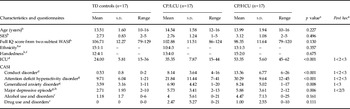
Participants largely overlapped with a sample reported previously (Sebastian et al. Reference Sebastian, McCrory, Cecil, Lockwood, De Brito, Fontaine and Viding2012; Viding et al. Reference Viding, Sebastian, Dadds, Lockwood, Cecil, De Brito and McCrory2012). Full details of sample recruitment are reported in these studies and in the online Supplementary Material. Participant characteristics are displayed in Table 1. The study was approved by the University College London Research Ethics Committee (Project ID: 0622/001).
Demographic data, presented by group

SES, Socio-economic status; WASI, Wechsler Abbreviated Scale of Intelligence; ICU, Inventory of Callous–Unemotional Traits; CASI, Child and Adolescent Symptom Inventory; TD, typically developing; CP/LCU, conduct problems and low levels of callous–unemotional traits; CP/HCU, conduct problems and high levels of callous–unemotional traits; s.d., standard deviation.
* p < 0.05, Bonferroni corrected.
a All p values obtained using t tests except for Ethnicity and Handedness (Fisher's exact tests used).
b Measures taken at screening phase, parent report.
c Child at scanning session.
d Measures taken at screening phase, parent and teacher report.
e White:Black:Mixed.
f Right:Left:Ambidextrous.
g Measures taken at scanning session, parent report.
h Missing data from one participant with conduct problems.
Fifty-five males aged 10–16 years were scanned: 38 with a research classification of current CP based on combined parent and teacher report on the Child and Adolescent Symptom Inventory-4R (CASI-4R; Gadow & Sprafkin, Reference Gadow and Sprafkin2009) Conduct Disorder subscale (CASI-CD); and 17 age-, IQ-, handedness- and socio-economic status (SES)-matched TD controls. Data from CP children were excluded because of: excessive motion and poor task accuracy (one CP); motion plus suspected autism spectrum and tic disorder (one CP); scanner refusal (one CP); and technical problems (one CP). The 34 remaining participants with CP were assigned to low versus high CU trait groups (CP/LCU v. CP/HCU, n = 17 per group) on the basis of a median split on combined parent- and teacher-reported scores on the Inventory of Callous-Unemotional Traits (ICU; Essau et al. 2006). Median ICU score within the CP group was 44.5; all TD controls scored below this CP group median.
For all groups, exclusion criteria included a previous diagnosis of any neurological or psychotic disorder, or a current prescription for psychiatric medication. [We later found that three participants (two CP/LCU, one CP/HCU) had been medicated for attention deficit hyperactivity disorder (ADHD) symptoms during scanning. However, analyses conducted with and without these participants were very similar, and so their data were retained in reported analyses.] To recruit a representative sample of children with CP, common co-morbidities [ADHD, generalized anxiety disorder (GAD), major depressive disorder (MDE) and substance/alcohol abuse] were not used as exclusion criteria but current parent-reported symptom counts were obtained using the CASI-4R.
Experimental task
Stimuli comprised fearful and calm faces of four individuals taken from the NimStim (two male, two female; mouths closed). Face stimuli were presented as ovals measuring 7.5 cm by 5 cm, in greyscale and with hair cropped. Stimuli were presented on a white background. Four block types were presented using a 2 × 2 factorial design with the factors Emotion (fear, calm) and Region (eye region, whole face). Sixteen blocks were presented in four sets of four blocks containing one of each condition: fear/eyes, calm/eyes, fear/face, calm/face. Block order was randomized within each set of four blocks.
Participants indicated with a keypress response on every trial whether there was a blue dot present on the face or not. In the ‘eyes’ blocks, half the stimuli had a dot present within the eye region of the face (but not covering the eye) whereas for the other half there was no dot present. In ‘face’ blocks, the blue dot was located in the wider face area. The location of the dot varied and was counterbalanced across Emotion conditions. Each block lasted 30 s, comprising 2.5 s instructions, 20 s face stimuli, and 7.5 s fixation cross between blocks. The instruction screen reminded participants of the correct keypress responses. It also told participants whether to look at the eyes or the face for the coming block. Participants knew to expect that during ‘eyes’ blocks the blue dot would only be presented near the eye region but during ‘face’ blocks it would only be presented in the wider face. The stimuli comprised eight trials of 2500 ms each: 1750 ms face presentation and 750 ms inter-stimulus interval (ISI) fixation cross. The eight trials consisted of the two male and two female faces presented both with and without a dot present. On ‘dot present’ trials, the dot appeared concurrently with the face. Trial order within each block was pseudo-randomized to prevent all stimuli of one type (i.e. dot, no-dot, male or female) being presented together. Participants practised the task outside the scanner, with calm faces of differing identities to those shown in the full experiment.
Psychometric and questionnaire measures
Participants completed the Wechsler Abbreviated Scale of Intelligence (WASI; Weschler, Reference Weschler1999) two-subtest version for group matching purposes, in addition to Alcohol/Drug Use Disorder Identification Tests (AUDIT and DUDIT; Babor et al. Reference Babor, Higgins-Biddle, Saunders and Monteiro2001; Berman et al. Reference Berman, Bergman, Palmstierna and Schlyter2005). A parent or guardian also completed the CASI-4R scales for ADHD, GAD and MDE to ascertain symptom counts for common co-morbidities with conduct problems (Table 1).
Functional magnetic resonance imaging (fMRI) data acquisition
A Siemens Avanto 1.5-T MRI scanner with a 32-channel head coil was used to acquire a 5.5-min three-dimensional (3D) T1-weighted structural scan, and 209 multi-slice T2*-weighted echo planar volumes with blood oxygen level-dependent (BOLD) contrast (one run of 10 min). The echo planar imaging (EPI) sequence was designed to optimize signal detection and reduce drop-out in the orbitofrontal cortex (OFC) and amygdala (Weiskopf et al. Reference Weiskopf, Hutton, Josephs and Deichmann2006), and used the following acquisition parameters: 35 2-mm slices acquired in an ascending trajectory with a 1-mm gap, echo time (TE) = 50 ms, repetition time (TR) = 2975 ms, slice tilt = –30° (T > C), flip angle = 90°, field of view (FOV) = 192 mm, matrix size = 64 × 64. Fieldmaps were also acquired for use in the unwarping stage of data pre-processing.
fMRI data analysis
Imaging data were analysed using SPM8 (www.fil.ion.ucl.ac.uk/spm). Pre-processing followed a standard sequence: the first five volumes were discarded; data were realigned; unwarped using a fieldmap; normalized by segmentation of the T1 scan with a voxel size of 2 × 2 × 2 mm; and smoothed with an 8-mm Gaussian filter. A block analysis compared neural activity in a 2 × 2 factorial design with regressors representing fear/eyes, calm/eyes, fear/face and calm/face conditions, with each block of 20 s duration. Two additional regressors of no interest were included: modelling fixation (duration 7.5 s) and instructions (duration 2.5 s). These six regressors were modelled as boxcar functions convolved with a canonical haemodynamic response function. The six realignment parameters were modelled as effects of no interest. For 13 participants (three TD controls, six CP/LCU, four CP/HCU), extra regressors were included to model a small number of corrupted images resulting from excessive motion. These images (no more than 10% of each participant's data) were removed and the adjacent images interpolated to prevent distortion of the between-subjects mask. Data were high-pass filtered at 128 s to remove low-frequency drifts.
At the first level, the main effects of each factor (Emotion and Region) were calculated, along with the interaction term (Emotion × Region). Contrast images were entered into separate second-level analyses, where Group (TD control, CP/LCU, CP/HCU) served as a between-subjects variable in one-way ANOVAs. For whole-brain analyses, an initial threshold of p < 0.005, k ⩾ 10 (uncorrected) was used (Lieberman & Cunningham, Reference Lieberman and Cunningham2009), with results reported as significant if they reached p < 0.05, family-wise error (FWE) corrected at the cluster level. As the amygdala was the a priori region of interest (ROI), we also conducted ROI analyses in this region bilaterally using two 3-mm-radius spheres centred on anatomically defined central amygdala coordinates used in a previous study contrasting fearful and calm faces (Phillips et al. Reference Phillips, Medford, Young, Williams, Williams, Bullmore, Gray and Brammer2001) [± 20 −8 −16, after conversion from coordinates reported in Talairach space (± 20 −8 −13)]. Results are reported if they survive small volume correction (SVC) across the bilateral mask at p < 0.05, FWE corrected.
Results
Behavioural data
Mean reaction times (RTs) and percentage errors were calculated for each participant for each of the four conditions: fear/eyes, calm/eyes, fear/face, calm/face. Missed trial rates were low (mean across all groups and conditions = 0.98%, s.d. = 1.94) and were excluded from subsequent analyses.
RTs
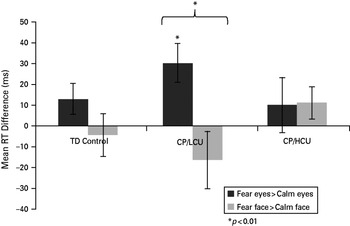
For RT data, a mixed-model ANOVA was conducted with within-subjects factors of Emotion (fear, calm) and Region (eyes, face) and with a between-subjects factor of Group (TD control, CP/LCU, CP/HCU). There were no main effects of Region (p = 0.46) or Group (p = 0.82) but there was a marginal main effect of Emotion (F 1,48 = 3.25, p = 0.078), with marginally slower RTs across fear stimuli as a whole. There was also a significant Emotion × Region interaction (F 1,48 = 5.41, p = 0.024) and a trend-level three-way interaction between Emotion, Region and Group (F 2,48 = 2.30, p = 0.11). As we had an a priori hypothesis of group differences, we deconstructed the three-way interaction into separate Emotion × Region analyses in each group. These data showed that the Emotion × Region interaction in the full sample was driven by the CP/LCU group only (F 1,16 = 8.80, p = 0.009). In the TD controls, F 1,16 = 1.59, p = 0.23, and in CP/HCU, F 1,16 = 0.001, p = 0.97. Post-hoc t tests in CP/LCU showed that the interaction in this group was driven by significantly slower responses to fear/eyes than calm/eyes (mean RT for fear/eyes = 728 ms and for calm/eyes = 697 ms, t 16 = 3.22, p = 0.005). Mean RTs to fear/face versus calm/face stimuli did not differ in the CP/LCU group (p = 0.25) (Fig. 1).
Mean reaction time (RT) differences plotted by Group and Condition. The significant Emotion × Region interaction is driven by the group with conduct problems (CP) and low levels of callous–unemotional (CU) traits (CP/LCU), who showed significantly slower RTs to fear/eyes than calm/eyes (the dark grey bar for CP/LCU). This group also showed significantly slower RTs for the interaction term (fear/eyes > calm/eyes) > (fear/face > calm/face) (the difference between the dark and light grey bars), that is, the fear/eyes condition had a disproportionate slowing effect on RTs in CP/LCU but not in the other two groups.

Errors
The total percentage error rate across groups and conditions was 3.17% (s.d. = 3.65). A mixed-model ANOVA was conducted as for the RT data. No main effects were significant (for Emotion, p = 0.80; for Region, p = 0.78; for Group, p = 0.12). No interactions reached significance, although there was a marginal Region × Group interaction (p = 0.11) and a marginal three-way interaction between Emotion, Region and Group (p = 0.095). On the basis of an a priori hypothesis for a three-way interaction, we explored further. Although the CP/LCU group made significantly more errors than TD controls for the calm/eyes condition (p = 0.031), no other effects were significant, and error data are not discussed further.
fMRI data
Main effects
For completeness, main effects across all groups are reported in the online Supplementary Material using whole-brain analyses with a threshold of p < 0.005 uncorrected, k ⩾ 10. The primary contrast of interest was the Emotion × Region contrast (fear/eyes > calm/eyes) > (fear/face > calm/face). This mirrors the behavioural data interaction analysis above, and indicates increased response to fearful eyes relative to the other conditions. We also report overall responses to fear > calm (and the reverse).
ROI analyses
We explored fMRI data in relation to the two specific hypotheses regarding amygdala response, using ROI analyses with bilateral amygdala spheres as described in the Method.
The first hypothesis was that directing attention to the eyes would lead to increased amygdala response to fear in CP/HCU. Looking within CP/HCU only, there was no Emotion × Region interaction effect for (fear/eyes > calm/eyes) > (fear/face > calm/face) in the amygdala, and also no significant difference when looking at responses to the simple effect fear/eyes > fear/face in CP/HCU (at either p < 0.05 FWE-SVC, or at p < 0.005, uncorrected, k ⩾ 10). We then looked at comparisons between CP/HCU and TD controls on these two contrasts. Neither contrast showed an effect in the amygdala when data were collapsed across groups. There were also no group differences for the Emotion × Region interaction contrast (fear/eyes > calm/eyes) > (fear/face > calm/face). However, for the fear/eyes > fear/face contrast, CP/HCU showed a significantly greater response to fear/eyes relative to fear/face than did TD controls in the right amygdala [peak = (20 −10 −14), k = 5, t = 3.04, z = 2.89, FWE-SVC p = 0.018]. This was driven by the TD controls, who showed a significantly greater response to fear/face than to fear/eyes (t 16 = –3.56, p = 0.003, based on mean contrast estimates across the cluster). Responses in CP/HCU did not differentiate between conditions (t 16 = 0.83, p = 0.42).
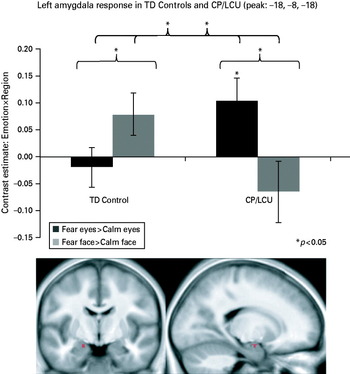
The second hypothesis was that CP/LCU would show a greater amygdala response to fear/eyes relative to other conditions than would TD controls. For the Emotion × Region interaction contrast (fear/eyes > calm/eyes) > (fear/face > calm/face), there was a significant effect in the left amygdala in the direction CP/LCU > TD controls, suggesting an increased response to fearful eyes in CP/LCU [peak = (−18 −8 −18), k = 6, t = 3.16, z = 2.99, FWE-SVC p = 0.013]. Mean contrast estimates across the cluster (Fig. 2) show that the interaction was driven by a significantly greater amygdala response to fear/eyes > calm/eyes than to fear/face > calm/face in CP/LCU (t 16 = 2.19, p = 0.043), and a significant difference in the opposite direction in TD controls (t 16 = –2.22, p = 0.041). Comparing TD control and CP/LCU groups directly, there was a significantly greater response to fear/eyes > calm/eyes in CP/LCU than in TD controls (t 32 = 2.21, p = 0.034), and to fear/face > calm/face in TD controls than in CP/LCU (t 32 = 2.09, p = 0.045). The only significant simple effect was a greater response to fear/eyes relative to calm/eyes in CP/LCU (t 16 = 2.51, p = 0.023).
Emotion × Region × Group interaction in the left amygdala [peak = (–18 –8 –18)], driven by a significantly greater response for (fear/eyes > calm/eyes) > (fear/face > calm/face) in the group with conduct problems (CP) and low levels of callous–unemotional (CU) traits (CP/LCU) relative to the typically developing (TD) controls. Top: Bars indicate mean contrast estimates across the cluster (k = 6) surviving family-wise error (FWE) correction within a 3-mm-radius bilateral sphere centred on central amygdala coordinates [± 20 –8 –16]. Bottom: Overlay shows the significant cluster overlaid on a mean T1 scan from all participants.

Although we had no specific hypotheses regarding amygdala response comparing CP/HCU and CP/LCU, for completeness we report that there were no significant differences between these groups for the Emotion × Region interaction contrast within our ROI, even at uncorrected levels.
Whole-brain analyses
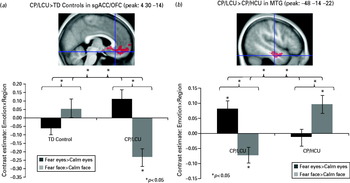
We report results from exploratory whole-brain analyses for the contrast (fear/eyes > calm/eyes) > (fear/face > calm/face), which survived cluster-level FWE correction at the whole-brain level after initial thresholding at p < 0.005, k > 10. Note that the results are not further corrected for multiple comparisons across groups. There were no differences between CP/HCU and TD controls. For the contrast CP/LCU > TD controls, a response was seen in the subgenual anterior cingulate cortex extending into the OFC (sgACC/OFC), indicating a greater response to (fear/eyes > calm/eyes) > (fear/face > calm/face) in CP/LCU [peak = (4 30 –14), t = 4.18, z = 3.84, FWE corrected p < 0.001, k = 1542; Fig. 3 a]. No significant differences were seen for the reverse contrast TD controls > CP/LCU. The contrast CP/LCU > CP/HCU yielded one cluster surviving cluster-level FWE correction in the left middle temporal gyrus (MTG) [peak = (−48 −14 −22), t = 4.69, z = 4.23, p = 0.019, k = 570; Fig. 3 b]. No significant differences were seen for the reverse contrast CP/HCU > CP/LCU. Post-hoc analyses on significant effects showed that all interactions were driven by cross-over effects (see Fig. 3 and the online Supplementary Material).
Regions showing an Emotion × Region × Group interaction at a whole-brain cluster-corrected threshold of p < 0.05, FWE. Overlays are displayed at the initial threshold of p < 0.005, k ⩾ 10. (a) A significantly greater response in the group with conduct problems and low levels of callous–unemotional (CU) traits (CP/LCU) than in the typically developing (TD) controls in the subgenual anterior cingulate cortex (sgACC), extending into the orbitofrontal cortex (OFC). (b) A significantly greater response in CP/LCU than in the group with CP and high levels of CU traits (CP/HCU) in the middle temporal gyrus (MTG).

Relationships between behavioural and fMRI data
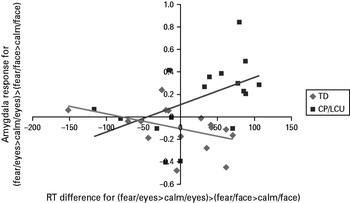
In support of hypothesis 2, both RT and fMRI data showed a disproportionate response to fear/eyes in CP/LCU relative to other experimental conditions and TD controls. We explored potential relationships between RTs and the amygdala effect hypothesized a priori by creating a single metric for each variable reflecting difference values for (fear/eyes > calm/eyes) > (fear/face > calm/face). A positive value on this metric indicates slower RTs/greater amygdala response to fear/eyes relative to other conditions. Amygdala response was defined as for Fig. 2, that is mean contrast estimates across the cluster surviving SVC for (fear/eyes > calm/eyes) > (fear/face > calm/face) in the direction CP/LCU > TD controls.
Bivariate correlations between RT and amygdala response showed a significant positive correlation in CP/LCU (r = 0.50, p = 0.043) but no significant relationship in TD controls (r = −0.42, p = 0.093). The correlation in CP/LCU could not be explained by co-morbid anxiety, depression or ADHD symptoms; including these as covariates: r = 0.58, p = 0.030. To test for a significant difference between the slopes for TD and CP/LCU groups, a custom univariate ANOVA was conducted with amygdala response as the dependent variable, mean-centred RT as a covariate and Group as a fixed factor (including CP/LCU and TD controls). After accounting for main effects, there was a significant interaction between RT and Group (F 1,30 = 7.59, p = 0.01), showing a significant group difference in slopes indexing the relationship between RT and amygdala response (Fig. 4).
Relationship between reaction time (RT) and amygdala response for the contrast (fear/eyes > calm/eyes) > (fear/face > calm/face), in the group with conduct problems (CP) and low levels of callous–unemotional (CU) traits (CP/LCU) and the typically developing (TD) controls. Slopes differed significantly between groups, with a significantly positive relationship between RT and amygdala response in CP/LCU and no relationship in the TD controls.

Discussion
The current study investigated behavioural and neural consequences of directing attention to the eye region of fearful versus calm faces in children with CP and differing levels of CU traits. Contrary to our first hypothesis, amygdala response to fearful faces in children with CP and high CU traits (CP/HCU) did not increase when participants looked for a dot near the eye region of fearful faces compared with searching across the whole face. However, in line with our second hypothesis, children with CP and low CU traits (CP/LCU) showed increased left amygdala response to the fear/eyes condition relative to both other conditions and TD controls. This was accompanied by increased RTs, with the RT increase specific to fearful eyes correlating with amygdala response in CP/LCU but not in TD controls. CP/LCU also showed increased neural responses to fearful eyes in the sgACC/OFC (relative to TD controls) and left MTG (relative to CP/HCU).
It is important to consider why directing attention to the eye region during fear processing did not result in increased amygdala response in CP/HCU. One interpretation is that amygdala response in this group is largely immutable to the effects of manipulating attentional focus. Under this interpretation, improved fear recognition when focusing on the eye region (Dadds et al. Reference Dadds, Perry, Hawes, Merz, Riddell, Haines, Solak and Abeygunawardane2006) would not be mediated by increased amygdala response. An alternative explanation relates to the nature of task demands. It has been suggested that fear-processing deficits in CP/HCU are associated with a reduced ability to reflexively shift attention to the salient eye region, a process potentially mediated by the basolateral amygdala (Gamer & Buchel, Reference Gamer and Buchel2009; Moul et al. Reference Moul, Killcross and Dadds2012). In the fear/eyes condition, attention was already focused on the eye region, meaning that no amygdala-mediated reflexive shift was needed; by contrast, the fear/face condition may paradoxically elicit greater amygdala response because of the need for a reflexive gaze shift. This idea is supported by the pattern of results seen in TD controls in analyses for hypothesis 1. This group showed increased right amygdala response to fear/face relative to fear/eyes whereas CP/HCU showed no difference between conditions. Although speculative, the pattern of results in TD controls may reflect a typical orienting response that involves the amygdala, and the lack of difference between conditions in CP/HCU could reflect atypical processing.
It is also important to consider that the instruction to look for a dot may have introduced unforeseen processing biases that limited modulation of amygdala responses to fear. A recent study investigating CP/HCU responses to fearful eye gaze during a spatial attention task (White et al. Reference White, Williams, Brislin, Sinclair, Blair, Fowler, Pine, Pope and Blair2012) found reduced activation in a dorsoparietal-orienting network compared with controls, but no effect in the amygdala. It was suggested that CP/HCU amygdala hypo-activity may be specifically elicited when task demands are low. Similarly, it may be that the present task was not optimized for detecting conditions under which a fear-processing deficit in the amygdala might be elicited or ameliorated in CP/HCU.
Previous studies have shown a hyper-reactive affective profile in CP/LCU (Frick et al. Reference Frick, Cornell, Bodin, Dane, Barry and Loney2003a ; Dadds et al. Reference Dadds, Perry, Hawes, Merz, Riddell, Haines, Solak and Abeygunawardane2006). The current data suggest that emotional reactivity may be augmented when attention is directed to the eye region, which is high in affective salience (Adolphs et al. Reference Adolphs, Gosselin, Buchanan, Tranel, Schyns and Damasio2005). RT data further show a specific slowing during the fear/eyes condition. The positive relationship between RTs and amygdala reactivity in CP/LCU suggests that increased reactivity as indexed by amygdala response is associated with a reduction in task performance. It is unlikely that these results are driven by anxiety because TD and CP/LCU groups did not differ on this measure. It is also unlikely that the results can be explained by other symptoms on which the groups differed (i.e. ADHD and MDE) because the CP/HCU group also showed elevated symptoms but did not show the same pattern of results. Instead, increased amygdala reactivity and slower RTs suggest that children with CP/LCU have difficulty implicitly or automatically regulating emotional responses in pursuit of a goal (Ochsner & Gross, Reference Ochsner and Gross2005). This complements well-documented reports of difficulties with explicit emotion regulation in everyday life (Frick & Morris, Reference Frick and Morris2004). Indeed, difficulties with automatic emotion regulation may contribute to the development of expressed behaviours such as reactive aggression (Eisenberg et al. Reference Eisenberg, Spinrad and Eggum2010).
These data are in line with a recent study exploring interactions between attention and affective processing in adults with externalizing behaviours (Baskin-Sommers et al. Reference Baskin-Sommers, Curtin, Larson, Stout, Kiehl and Newman2012). Using an instructed fear paradigm, this study found that externalizing behaviours were not associated with a global hyper-reactivity effect. Instead, increased emotional reactivity and amygdala response, relative to low-externalizing participants, was seen specifically when attention was focused on threat-related information. Together, these data suggest the importance of understanding the specific conditions under which emotional hyper-reactivity is seen in externalizing conditions such as CP/LCU. This is necessary to elucidate neurocognitive mechanisms underpinning such behaviours, and may provide insights that will improve current approaches to intervention.
Although not predicted a priori, increased neural responses to fear/eyes were seen in CP/LCU in sgACC/OFC (relative to TD controls) and in the left MTG (relative to CP/HCU). The sgACC and medial OFC form part of an extended network involved in the experience and regulation of emotional states (Drevets et al. Reference Drevets, Savitz and Trimble2008). More specifically, the OFC and amygdala are involved in directing attention to affective stimuli (Zikopoulos & Barbas, Reference Zikopoulos and Barbas2012) and in the integration of emotion and cognitive control (Pessoa, Reference Pessoa2008). Our data suggest aberrant cognitive control of emotion in CP/LCU, which may include sgACC/OFC dysfunction. Future studies should investigate further the role of these regions in reactive aggressive CP. The difference between CP/LCU and CP/HCU in the MTG is difficult to interpret because this region is not typically activated during facial emotion processing, and indeed was not activated under any condition in the TD controls.
Limitations of the present study include the use of a community sample of males; extension to clinically diagnosed and female participants would be of interest. Additionally, CU trait groupings relied on a median split, meaning assignment depended on sample characteristics rather than independently agreed cut-offs. Finally, relative to CP/LCU, the CP/HCU group showed elevated CD symptoms in addition to CU traits. This is not surprising because CU traits index a particularly severe subgroup of children with CP (Frick & Viding, Reference Frick and Viding2009). Moreover, severity of CP symptoms is unlikely to explain the observed pattern of results, with the greatest RT and neural responses to fearful eyes seen in CP/LCU, not CP/HCU.
In summary, this study compared CP/LCU, CP/HCU and TD control children on a facial emotion-processing task including an implicit emotion regulation component. Children with CP/LCU, associated with reactive aggression, showed increased amygdala reactivity compared with TD controls, specifically in response to fearful eyes. This was correlated with longer RTs in the fear/eyes condition relative to control conditions. These data are in line with cognitive and behavioural profiles showing increased emotional reactivity in CP/LCU, and extend our knowledge to suggest specific conditions under which hyper-reactivity may be elicited in neural circuitry engaged in emotion–cognition interactions.
Supplementary material
For supplementary material accompanying this paper visit http://dx.doi.org/10.1017/S0033291713000482.
Acknowledgements
This work was supported by the Economic and Social Research Council (ESRC; award no. RES-062-23-2202 to E.V. and E.M.), the British Academy (award no. 53229 to E.V. and E.M.) and the Birkbeck UCL Centre for NeuroImaging (BUCNI). S.A.D.B. was supported by a research fellowship from the Swiss National Science Foundation (FNS PA00P1_139586). We thank P. Kelly and E. O'Nions for help with data collection and checking.
Declaration of Interest
None.