Introduction
Eosinophilic oesophagitis is a chronic, immune/antigen-mediated clinicopathological condition, only recently considered an important cause of upper gastrointestinal morbidity in adults and children.Reference Furuta, Liacouras, Collins, Gupta, Justinich and Putnam1–Reference Dellon, Gonsalves, Hirano, Furuta, Liacouras and Katzka3 Before the 1990s, the abnormal presence of oesophageal intraepithelial eosinophils was simply attributed to reflux.Reference Winter, Madara, Stafford, Grand, Quinlan and Goldman4 The first case series in adults appeared in 1993,Reference Attwood, Smyrk, Demeester and Jones5 and in children in 1995.Reference Kelly, Lazenby, Rowe, Yardley, Perman and Sampson6 Increasing incidence and prevalence was reported in USReference Prasad, Alexander, Schleck, Zinsmeister, Smyrk and Elias7 and EuropeanReference Hruz, Straumann, Bussman, Heer, Simon and Zwahlen8 population-based studies, and in AsianReference Ngiu and Low9 and AustralasianReference Cherian, Smith and Forbes10 cohort analyses. Whilst initially attributed to rising endoscopy rates,Reference DeBrosse, Collins, Buckmeier, Allen, King and Assa'ad11 a 20-year, prospective, Swiss population-based study confirmed a true increase.Reference Hruz, Straumann, Bussman, Heer, Simon and Zwahlen8 Reported prevalence varies widely,Reference Sealock, Rendon and El-Serag12 estimated in adults at 56.7 cases per 100 000 population.Reference Dellon, Jensen, Martin, Shaheen and Kappelman13 In children, a meta-analysis reported an incidence of 0.7–10 cases per 100 000 population, and prevalence of 0.2–43 cases per 100 000 population.Reference Soon, Butzner, Kaplan and Debruyn14
In 2007, a multidisciplinary task force of 31 physicians defined diagnostic criteria and recommendations for the evaluation and treatment of suspected eosinophilic oesophagitis. Their systematic literature review and expert opinion achieved a consensus.Reference Furuta, Liacouras, Collins, Gupta, Justinich and Putnam1 They recognised that eosinophilic oesophagitis manifests mainly in the child with vomiting, a failure to gain weight or a feeding disorder, but in older patients it manifests with abdominal pain, dysphagia and food impaction. It is strongly associated with atopy, with an estimated coincidence of 50–80 per cent, suggesting eosinophilic oesophagitis is a manifestation of an allergic response.Reference Simon, Marti, Heer, Simon, Braathen and Straumann15, Reference Assa'ad16 An updated consensus statement in 2011 added recommendations for diagnostics, genetics, allergy testing and therapeutics.Reference Liacouras, Furuta, Hirano, Atkins, Attwood and Bonis2 The 2013 American College of Gastroenterology clinical guidelines provide an additional evidence-based approach to diagnostics.Reference Dellon, Gonsalves, Hirano, Furuta, Liacouras and Katzka3
Despite mucosal inflammation limited to the oesophagus, eosinophilic oesophagitis appears to be an immune-mediated aerodigestive tract disorder that is also associated with ENT symptoms. An otolaryngologists' review indicated that 10–15 per cent of paediatric patients present to ENT prior to gastroenterology referral, and the disease remains under-recognised by our specialty.Reference Karkos, Srivastava, Kaptanis and Vaughan17 Furthermore, eosinophilic oesophagitis histological changes compare to those seen in the airway mucosa in chronic rhinosinusitis and asthma.Reference Dauer, Ponikau, Smyrk, Murray and Thompson18 The spectrum of paediatric eosinophilic oesophagitis includes upper airway disease, and eosinophilic oesophagitis should be considered in patients with atopy and unexplained upper airway findings that are refractory to reflux treatment.Reference Dauer, Ponikau, Smyrk, Murray and Thompson18 A cohort study reported otolaryngological surgery in nearly one-third of children with eosinophilic oesophagitis, often prior to this diagnosis.Reference Kelly, Linn, Keppel, Noel and Chun19 There is an increased prevalence of grommet insertion, and, in one series, five patients with eosinophilic oesophagitis required airway reconstruction for inflammatory stenosis.Reference Kelly, Linn, Keppel, Noel and Chun19 However, most otolaryngologists are less aware of eosinophilic oesophagitis than of gastroesophageal reflux disease.Reference Smith, Chewaproug, Spergel and Zur20 Care is multidisciplinary, involving gastroenterologists, otolaryngologists, allergists, pathologists and dieticians. We present an evidence-based systematic literature review, particularly relevant to the otolaryngologist.
Search strategy
We searched Medline, Embase and Cochrane Library databases, from their creation to 30th June 2015, using the following search term combinations: (1) ‘eosinophilic esophagitis’, (2) ‘eosinophilic oesophagitis’, (3) 1 or 2 (i.e. ‘eosinophilic esophagitis’ or ‘eosinophilic oesophagitis’), and ‘otolaryngology’, (4) 1 or 2, and ‘review’, (5) 1 or 2, and ‘systematic review’, (6) 1 or 2, and ‘meta-analysis’, and (7) 1 or 2, and ‘controlled trial’.
We sought high-quality, ideally prospective, clinical studies, reviews or laboratory work relevant to the diagnosis, pathophysiology and management of eosinophilic oesophagitis, especially those pertaining to ENT. Abstracts, identified from a review of article titles, were evaluated for inclusion by two authors (MB and LF) working independently, with consensus if opinions differed. Two authors (ND and LF) reviewed and revised the systematic process. Papers were chosen if the abstracts suggested systematic reviews or meta-analyses, prospective controlled studies, original basic science findings from laboratory studies, or publication in the otolaryngology literature. Abstracts were excluded if they suggested isolated case reports or presented no novelty; in the interests of brevity, these are not tabled. Non-English language papers were excluded, unless they significantly contributed to the evidence base.
Results
A search for (1) ‘eosinophilic esophagitis’ and (2) ‘eosinophilic oesophagitis’ identified 1357 and 1402 titles respectively. The search term combination (3), that is, 1 or 2 (i.e. ‘eosinophilic esophagitis’ or ‘eosinophilic oesophagitis’), and ‘otolaryngology’, identified 24 titles; (4) 1 or 2, and ‘review’ identified 368 titles; (5) 1 or 2, and ‘review, systematic’ identified 26 titles; (6) 1 or 2, and ‘meta-analysis’ identified 7 titles, and (7) 1 or 2, and ‘controlled trial’ identified 21 titles.
We selected 1 Cochrane review,Reference Elliott, Thomas and Markowitz21 6 meta-analyses,Reference Soon, Butzner, Kaplan and Debruyn14, Reference Kim, Vance, Shaheen and Dellon22–Reference Kavitt, Penson and Vaezi26 11 systematic reviews,Reference Furuta, Liacouras, Collins, Gupta, Justinich and Putnam1–Reference Dellon, Gonsalves, Hirano, Furuta, Liacouras and Katzka3, Reference Sealock, Rendon and El-Serag12, Reference Dauer, Ponikau, Smyrk, Murray and Thompson18, Reference Lin, Sabharwal and Ghaffari27–Reference Bergquist and Bove32 12 non-systematic reviews,Reference Assa'ad16, Reference Karkos, Srivastava, Kaptanis and Vaughan17, Reference Liacouras and Markowitz33–Reference Attwood and Sabri42 11 randomised trials,Reference Helou, Simonson and Arora43–Reference Straumann, Conus, Kita, Kephart, Bussmann and Beglinger53 15 other controlled trials,Reference Kottyan, Davis, Sherrill, Liu, Rochman and Kaufman54–Reference Schoepfer, Panczak, Zwahlen, Kuehni, Coslovsky and Maurer68 58 case series and cohort studies,Reference Winter, Madara, Stafford, Grand, Quinlan and Goldman4–Reference Hruz, Straumann, Bussman, Heer, Simon and Zwahlen8, Reference Cherian, Smith and Forbes10, Reference DeBrosse, Collins, Buckmeier, Allen, King and Assa'ad11, Reference Dellon, Jensen, Martin, Shaheen and Kappelman13, Reference Simon, Marti, Heer, Simon, Braathen and Straumann15, Reference Kelly, Linn, Keppel, Noel and Chun19, Reference Smith, Chewaproug, Spergel and Zur20, Reference Liacouras, Spergel, Ruchelli, Verma, Mascarenhas and Semeao69–Reference Butsch Kovacic, Biagini Myers, Lindsey, Patterson, Sauter and Ericksen115 1 qualitative study,Reference Hommel, DeBrosse, Greenberg, Greenler, Abonia and Rothenberg116 1 case report,Reference Hartnick, Liu, Cotton and Rudolph117 1 published guideline,Reference Sharaf, Shergill, Odze, Krinsky, Fukami and Jain118 and 5 published abstracts.Reference Ngiu and Low9, Reference Sperry, Shaheen and Dellon119–Reference Khanna, Kujath, Katzka, Arora, Grothe and Romero122 Eighteen of these articles were selected from the otolaryngology literature.Reference Karkos, Srivastava, Kaptanis and Vaughan17–Reference Smith, Chewaproug, Spergel and Zur20, Reference Bergquist and Bove32, Reference Amin, Postma, Setzen and Koufman40, Reference Brigger, Misdraji, Hardy and Hartnick60, Reference Bergquist, Larsson, Johansson and Bove95, Reference Dauer, Freese, El-Youssef and Thompson103–Reference Yawn, Acra, Goudy, Flores and Wootten110, Reference Hudson, Sampson, Muntz, Jackson and Smith112, Reference Hartnick, Liu, Cotton and Rudolph117
Clinical picture
Features in children
Children typically present with one or more symptoms such as: vomiting; regurgitation; nausea; refractory gastroesophageal reflux disease; epigastric, abdominal or chest pain; water brash; globus; decreased appetite; or growth failure.Reference Furuta, Liacouras, Collins, Gupta, Justinich and Putnam1, Reference Liacouras, Spergel, Ruchelli, Verma, Mascarenhas and Semeao69 Haematemesis is rare. Infants and toddlers tend to present with difficulty feeding, manifesting as gagging, choking, food refusal and vomiting. Dysphagia and food impaction are uncommon until adolescence.Reference Furuta, Liacouras, Collins, Gupta, Justinich and Putnam1, Reference Noel, Putnam and Rothenberg70, Reference Liacouras and Markowitz33 Pooled prevalence was 3.7 per cent in children undergoing oesophagoscopy for any indication.Reference Soon, Butzner, Kaplan and Debruyn14 In a 14-year study, 68 per cent of 620 patients presented at younger than 6 years, commonly with reflux symptoms, feeding issues or failure to thrive. Systemic symptoms such as fever or weight loss suggest another diagnosis.Reference Spergel, Brown-Whitehorn, Beausoleil, Franciosi, Shuker and Verma71
An allergic component to oesophageal eosinophilia was recognised in 11 cases associated with refractory gastroesophageal reflux disease and stricture.Reference Lee72 Genomic analysis has established several genetic origins to the allergic response,Reference Kottyan, Davis, Sherrill, Liu, Rochman and Kaufman54, Reference Rothenberg, Spergel, Sherrill, Annaiah, Martin and Cianferoni73 though twin and family studies suggest environmental factors predominate.Reference Alexander, Martin, Collins, Kottyan, Sucharew and He55 Children with eosinophilic oesophagitis show increased prevalence of atopy (asthma, eczema or rhinitis), environmental allergies and immunoglobulin E (IgE)-mediated food allergy (urticaria and anaphylaxis) (Table I).Reference Simon, Marti, Heer, Simon, Braathen and Straumann15, Reference Noel, Putnam and Rothenberg70, Reference Assa'ad, Putnam, Collins, Akers, Jameson and Kirby74, Reference Dauer, Freese, El-Youssef and Thompson103, Reference Otteson, Mantle, Casselbrant and Goyal108 It is estimated that 30–50 per cent have asthma and 50–75 per cent have allergic rhinitis, compared to 10 and 30 per cent, respectively, in the general paediatric population.Reference Assa'ad16 Over 50 per cent have a family history of allergy.Reference Simon, Marti, Heer, Simon, Braathen and Straumann15 Nevertheless, the literature remains unclear on testing to guide food elimination diets.Reference Lin, Sabharwal and Ghaffari27 Moreover, eosinophilic oesophagitis is strongly associated with inherited connective tissue disease, with a cohort study comprising 42 cases reporting an 8-fold risk of eosinophilic oesophagitis.Reference Abonia, Wen, Stucke, Grotjan, Griffith and Kemme75 Crohn's disease can show a similar eosinophil-predominant oesophageal inflammation.Reference Liacouras, Furuta, Hirano, Atkins, Attwood and Bonis2, Reference Abonia, Wen, Stucke, Grotjan, Griffith and Kemme75 Treatment of such presumed primary aetiology requires monitoring of oesophageal inflammation. If eosinophilia persists after primary disease control, eosinophilic oesophagitis may co-exist. Eosinophilic oesophagitis inevitably occurs by chance in children with other syndromes.Reference Liacouras, Furuta, Hirano, Atkins, Attwood and Bonis2
Reported rates of atopy*

Data represent percentages.
* In children with eosinophilic oesophagitis.
Features in adults
In contrast to children, the commonest adult presentation of eosinophilic oesophagitis is solid food dysphagia, reported in 60–100 per cent of cases.Reference Noel, Putnam and Rothenberg70, Reference Spergel, Brown-Whitehorn, Beausoleil, Franciosi, Shuker and Verma71, Reference Straumann, Spichtin, Grize, Bucher, Beglinger and Simon76 Eosinophilic oesophagitis can account for over 50 per cent of adult emergency food impaction cases, and over a quarter of adults with eosinophilic oesophagitis report this history. Eosinophilic oesophagitis is the strongest predictor of multiple food bolus impactions (odds ratio = 3.5; 95 per cent confidence interval (CI) = 1.8–7.0)Reference Sperry, Crockett, Miller, Shaheen and Dellon77 and non-obstructive dysphagia.Reference Ricker, McNear, Cassidy, Plott, Arnold and Kendall78
Many adult sufferers adapt their eating behaviour and deny dysphagia, but will recount being the last diner to finish, lubricating or chewing food into a mush, drinking copious amounts of water after each bite, swallowing repeatedly to push food down, avoiding foods that tend to stick, and crushing or avoiding pills.Reference Straumann, Spichtin, Grize, Bucher, Beglinger and Simon76 Heartburn is experienced by 30–60 per cent and non-cardiac chest pain by 8–44 per cent of patients with eosinophilic oesophagitis.Reference Noel, Putnam and Rothenberg70, Reference Straumann, Spichtin, Grize, Bucher, Beglinger and Simon76 Abdominal pain, nausea, vomiting, diarrhoea and weight loss are atypical in adult eosinophilic oesophagitis, and suggest a more diffuse eosinophilic gastrointestinal disorder. Atopic diseases, such as food allergies, asthma, allergic rhinosinusitis and atopic dermatitis, frequently co-exist.Reference Simon, Marti, Heer, Simon, Braathen and Straumann15 As in children, atopy is reported in 20–80 per cent of adults with eosinophilic oesophagitis, with even higher rates of allergen sensitisation,Reference Straumann, Spichtin, Grize, Bucher, Beglinger and Simon76 as supported by genomic analysis.Reference Blanchard, Wang, Stringer, Mishra, Fulkerson and Abonia56
Diagnosis
Eosinophilic oesophagitis is suggested by a history of allergy, typical symptoms and endoscopic features, but confirmation relies on histopathology. The updated 2011 consensus report,Reference Liacouras, Furuta, Hirano, Atkins, Attwood and Bonis2 and separate American College of Gastroenterology clinical guidelines,Reference Dellon, Gonsalves, Hirano, Furuta, Liacouras and Katzka3 provide evolving evidence-based recommendations on diagnostic criteria. A systematic literature review found a significant increase in studies using 15 or more eosinophils per high-power field as the histological diagnostic cut-off,Reference Sperry, Shaheen and Dellon119 as recommended by the consensus.Reference Liacouras, Furuta, Hirano, Atkins, Attwood and Bonis2 However, variability in biopsy protocols and eosinophil count methodology suggests that early work, published prior to the first 2007 consensus document, be interpreted with caution.Reference Sperry, Shaheen and Dellon119
Endoscopic features
Oesophageal structural changes associated with eosinophilic oesophagitis include fixed oesophageal rings (corrugations or trachealisation) (Figure 1),Reference Gonsalves, Policarpio-Nicolas, Zhang, Rao and Hirano123 which is the prototypical finding. These rings can be transient, termed ‘felinisation’.Reference Kim, Vance, Shaheen and Dellon22, Reference Prasad, Talley, Romero, Arora, Kryzer and Smyrk79, Reference Veerappan, Perry, Duncan, Baker, Maydonovitch and Lake80 Strictures often develop as a result of chronic inflammation and fibrosis.Reference Dellon, Kim, Sperry, Rybnicek, Woosley and Shaheen81, Reference Schoepfer, Safroneeva, Bussmann, Kuchen, Portmann and Simon82 In the ‘small-calibre’ oesophagus, the lumen appears diffusely narrowed; this is difficult to appreciate endoscopically, but can be demonstrated using contrast swallow.Reference Lee, Huprich, Kujath, Ravi, Enders and Smyrk83 Linear furrows, white plaques or exudates are frequent (Figure 2).Reference Attwood, Lewis, Bronder, Morris, Armstrong and Whittam96 A subtler finding is a decrease in the normal vascular pattern and oedema due to mucosal congestion. ‘Crêpe paper mucosa’ describes the tendency of the oesophageal mucosa to split with passage of the endoscope. None of these features are universal, and Sgouros et al.Reference Sgouros, Bergele and Mantides28 report normal endoscopy in 8.8 per cent of eosinophilic oesophagitis.
Food impaction in the mid oesophagus with concentric mucosal rings and evidence of subtle linear furrowing. Reproduced with permission.Reference Gonsalves, Policarpio-Nicolas, Zhang, Rao and Hirano123
Furrows and rings in combination, creating a cobblestone appearance. Reproduced with permission.Reference Attwood, Lewis, Bronder, Morris, Armstrong and Whittam96
Endoscopic findings differ between children and adults.Reference Hirano, Moy, Heckman, Thomas, Gonsalves and Achem57, Reference Veerappan, Perry, Duncan, Baker, Maydonovitch and Lake80 Children are more likely to show either a normal-appearing oesophagus or plaques and oedema, whereas adults show rings and strictures (Figures 3 and 4).Reference Attwood, Lewis, Bronder, Morris, Armstrong and Whittam96, Reference Attwood and Lamb124 The earlier features of eosinophilic oesophagitis result from acute inflammation (furrows, plaques and oedema), whilst the later features represent fibrosis (rings, strictures and narrowing), which occurs with longer-standing inflammation.Reference Dellon, Kim, Sperry, Rybnicek, Woosley and Shaheen81, Reference Schoepfer, Safroneeva, Bussmann, Kuchen, Portmann and Simon82
Concentric oesophageal rings without associated mucosal change – referred to as ‘trachealisation’. Reproduced with permission.Reference Attwood, Lewis, Bronder, Morris, Armstrong and Whittam96
Trachealisation with associated hyperplasia of the mucosa. Reproduced with permission.Reference Attwood and Lamb124
No endoscopic finding diagnoses oesophageal eosinophilia or eosinophilic oesophagitis with a high degree of sensitivity or specificity.Reference Veerappan, Perry, Duncan, Baker, Maydonovitch and Lake80 Narrow-band imaging offers no further benefit.Reference Tanaka, Rubio, Dlugosz, Truskaite, Befrits and Lindberg58 Endoscopy alone therefore cannot confirm or refute a diagnosis. This was reported in a meta-analysis of 4678 patients with eosinophilic oesophagitis and 2742 controls,Reference Kim, Vance, Shaheen and Dellon22 and in a subsequent prospective, single-centre analysis of 2545 cases.Reference Hori, Watari, Fukui, Tanaka, Tomita and Sakurai84 Kim et al.Reference Kim, Vance, Shaheen and Dellon22 concluded that, although findings associated with eosinophilic oesophagitis are not universal, 83 per cent of cases had at least one abnormality. A proposed novel classification system for standardising such endoscopic findings and severity has been validated.Reference Van Rhijn, Warners, Curvers, Van Lent, Bekkali and Takkenberg59 Termed the eosinophilic oesophagitis endoscopic reference score, its acronym (‘EREFS’) reflects the components: Exudates, Rings, Edema, Furrows and Strictures.Reference Hirano, Moy, Heckman, Thomas, Gonsalves and Achem57
Histological features
The histological features of eosinophilic oesophagitis are similar in children and adults. The oesophageal epithelium shows prominent infiltration of eosinophils, cells which are absent in healthy mucosa.Reference Collins35 Eosinophilic infiltration is, however, recognised in gastroesophageal reflux disease, eosinophilic gastroenteritis with oesophageal involvement, collagen vascular disease, achalasia, and parasitic infections.Reference Dellon36, Reference Rodrigo, Abboud, Oh, DeMeester, Hagen and Lipham85 At least 15 eosinophils per high-power field, following an initial proton pump inhibitor (PPI) trial, suggests a diagnosis of eosinophilic oesophagitis.Reference Furuta, Liacouras, Collins, Gupta, Justinich and Putnam1–Reference Dellon, Gonsalves, Hirano, Furuta, Liacouras and Katzka3 No other associated histopathological findings are pathognomonic for eosinophilic oesophagitis. The disease remains defined by both clinical and pathological features.Reference Brigger, Misdraji, Hardy and Hartnick60, Reference Prasad, Talley, Romero, Arora, Kryzer and Smyrk79
In a cohort of 222 adults with dysphagia and normal endoscopy findings, 9.8 per cent had histological features of eosinophilic oesophagitis.Reference Prasad, Talley, Romero, Arora, Kryzer and Smyrk79 Only 38 per cent of patients with suggestive endoscopic changes had the typical biopsy findings of eosinophilic oesophagitis. Routine biopsies in that study identified eosinophilic oesophagitis in 10 per cent of cases presenting with unexplained solid food dysphagia.
Biopsy recommendations
Endoscopic biopsy samples the oesophageal epithelium and rarely obtains tissue deeper than the lamina propria. The histological diagnosis of eosinophilic oesophagitis therefore relies on surface mucosal findings. Dellon et al.Reference Dellon, Speck, Woodward, Woosley and Shaheen120 identified a high variation in eosinophil counts throughout the oesophagus in eosinophilic oesophagitis, with only one-third of high-power fields meeting the 2011 consensus recommendations.Reference Liacouras, Furuta, Hirano, Atkins, Attwood and Bonis2 A localised and less symptomatic eosinophilic oesophagitis variant arises in the distal oesophagus.Reference Abe, Iijima, Ohara, Koike, Kikuchi and Kato86 Nielsen et al.Reference Nielsen, Lager, Lewin, Rendon and Roberts87 reviewed 102 cases of eosinophilic oesophagitis biopsied from the mid and distal oesophagus to determine best practice in sampling. They recommended at least four and no more than six biopsies (after which sensitivity reaches 100 per cent) from the mid or proximal oesophagus, to ensure distinction from distal oesophageal biopsies that possibly represent gastroesophageal reflux disease. The American Society for Gastrointestinal Endoscopy acknowledges that the patchy microscopic and macroscopic distribution characteristic of eosinophilic oesophagitis compromises biopsy standardisation.Reference Sharaf, Shergill, Odze, Krinsky, Fukami and Jain118 Pharyngeal biopsies proved unnecessary in a small series of 10 eosinophilic oesophagitis cases, as none showed eosinophilia.Reference Bove, Tegtmeyer, Persson and Bergquist88
Both the 2013 American College of Gastroenterology clinical guidelines,Reference Dellon, Gonsalves, Hirano, Furuta, Liacouras and Katzka3 and 2011 consensus statement,Reference Liacouras, Furuta, Hirano, Atkins, Attwood and Bonis2 recommend two to four separate biopsies from both the proximal and distal oesophagus, with additional biopsies from the antrum and/or duodenum only in patients with atypical gastric or small intestinal symptoms or endoscopic abnormalities.
Differential diagnoses
Despite established diagnostic criteria for eosinophilic oesophagitis, there are confounding differential diagnoses. Gastroesophageal reflux disease and PPI-responsive eosinophilic oesophagitis also cause oesophageal eosinophilia.Reference Rodrigo, Abboud, Oh, DeMeester, Hagen and Lipham85, Reference Ravi, Katzka, Smyrk, Prasad, Romero and Francis89 Gastroesophageal reflux disease and eosinophilic oesophagitis show symptom overlap. Moreover, eosinophilic oesophagitis could cause gastroesophageal reflux disease (because of impaired oesophageal clearance of physiological refluxate), and gastroesophageal reflux disease could cause acid-mediated eosinophilic oesophagitis (if reflux leads to a leaky epithelial barrier, through which antigens induce an allergic response).Reference Ravi, Katzka, Smyrk, Prasad, Romero and Francis89 Eosinophilic oesophagitis and gastroesophageal reflux disease may demonstrate histological differences in eosinophil infiltration and secondary changes to the squamous epithelium.Reference Mueller, Neureiter, Aigner and Stolte90
Proton pump inhibitor responsive eosinophilic oesophagitis is now recognised as a distinct disease entity, though ill-understood.Reference Liacouras, Furuta, Hirano, Atkins, Attwood and Bonis2, Reference Molina-Infante, Katzka and Gisbert29, Reference Dranove, Horn, Davis, Kernek and Gupta91 A proportion of patients with confirmed eosinophilic oesophagitis experience complete clinical and histological resolution following PPI therapy. The clinical, endoscopic and histological features of eosinophilic oesophagitis and PPI-responsive eosinophilic oesophagitis overlap, and the conditions cannot be distinguished by pH monitoring.Reference Dellon, Speck, Woodward, Gebhart, Madanick and Levinson61 Furthermore, they are associated with the production of similar cytokines and tissue biomarkers. The immunohistochemical evidence of inflammation is similar in patients with eosinophilic oesophagitis and PPI-responsive eosinophilic oesophagitis,Reference Dellon, Speck, Woodward, Covey, Rusin and Gebhart62 being driven by allergy rather than reflux injury.Reference Lewis, Lamb, Kanakala, Pritchard, Armstrong and Attwood63 In retrospective studies, 23–75 per cent of patients with eosinophilic oesophagitis demonstrated a histological response to PPI therapy,Reference Molina-Infante, Katzka and Gisbert29 which correlated with cytokine down-regulation in PPI-responsive eosinophilic oesophagitis.Reference Molina-Infante, Hernandez-Alonso, Vinagre-Rodriguez, Mateos-Rodriguez, Duenas-Sadornil and Perez-Gallardo64 Proton pump inhibitor responsive eosinophilic oesophagitis is currently recognised as a variant of eosinophilic oesophagitis, distinct from gastroesophageal reflux disease, though this area of research is developing rapidly.Reference Spechler, Genta and Souza37, Reference Kia and Hirano38
The current American College of Gastroenterology guidelines make specific recommendations on distinguishing eosinophilic oesophagitis from gastroesophageal reflux disease or PPI-responsive eosinophilic oesophagitis.Reference Dellon, Gonsalves, Hirano, Furuta, Liacouras and Katzka3 The limited evidence suggests patients with suspected eosinophilic oesophagitis should receive a two-month course of PPI, followed by endoscopy and biopsies. A response to PPIs may still warrant further evaluation, such as pH monitoring.
Treatment
The literature summarises three treatment approaches to eosinophilic oesophagitis: drugs, dietary therapy (primarily targeting the inflammatory response), and dilatation (for fibrosis and stricture).
Drugs
Corticosteroids
Although oral corticosteroids improved symptoms and resolved eosinophilia,Reference Liacouras, Wenner, Brown and Ruchelli65 they have now been abandoned because of concerns of long-term systemic administration.Reference Liacouras, Furuta, Hirano, Atkins, Attwood and Bonis2 Arora et al.Reference Arora, Perrault and Smyrk92 presented the first series describing the role of topical steroids for dysphagia in adult eosinophilic oesophagitis. Topical steroids do reduce eosinophil counts; however, evidence for symptom response is inconsistent.Reference Chuang, Chinnaratha, Hancock, Woodman, Wong and Cock30 Only one published randomised, controlled trial (RCT) included a recommended pre-treatment PPI trial. Dosage reduction can lead to rapid relapse.Reference Helou, Simonson and Arora43
A case series showed that fluticasone or beclomethasone, swallowed rather than inhaled using a multi-dose inhaler, proved highly effective.Reference Faubion, Perrault, Burgart, Zein, Clawson and Freese93 Randomised, controlled trials have studied fluticasone and budesonide, administered either as viscous slurry or as a swallowed nebulised vapour. There have been three RCTs of fluticasone versus placebo (one in children,Reference Konikoff, Noel, Blanchard, Kirby, Jameson and Buckmeier44 one in adults,Reference Alexander, Jung, Arora, Enders, Katzka and Kephardt45 and one enrolling children and young adultsReference Butz, Wen, Gleich, Furuta, Spergel and King46), and one RCT of fluticasone versus prednisone in children.Reference Schaefer, Fitzgerald, Molleston, Croffie, Pfefferkorn and Corkins47 In each of these placebo-controlled trials, patients in the topical steroid group had statistically significant reductions in oesophageal eosinophil counts.
Two RCTs reported on budesonide versus placebo in children,Reference Dohil, Newbury, Fox, Bastian and Aceves48, Reference Gupta, Vitanza and Collins49 and one investigated swallowed nebulised budesonide versus placebo in adults.Reference Straumann, Conus, Degen, Felder, Kummer and Engel50 These showed significant efficacy for budesonide in decreasing or normalising eosinophil counts.
Long-term data have shown budesonide to be more effective than placebo.Reference Straumann, Conus, Degen, Frei, Bussmann and Beglinger51 A five-year follow-up cohort analysis reported that increased swallowed topical steroid also lowered the risk of bolus impaction;Reference Kuchen, Straumann, Safroneeva, Romero, Bussmann and Vavricka94 however, quality-of-life (QoL) analyses remain limited to pilot data.Reference Bergquist, Larsson, Johansson and Bove95 A 2010 Cochrane review of non-surgical interventionsReference Elliott, Thomas and Markowitz21 reported on three RCTs, two of which investigated topical corticosteroids, and found limited evidence to compare the benefits and harms of current medical treatments.
No study has shown significant adrenal axis suppression.Reference Liacouras, Furuta, Hirano, Atkins, Attwood and Bonis2 Gastrointestinal inflammation of eosinophilic oesophagitis may increase budesonide absorptionReference Dohil, Newbury, Fox, Bastian and Aceves48, Reference Gupta, Vitanza and Collins49 and impair systemic elimination.Reference Lopez-Lazaro, Marx, Bussmann and Straumann66 Oesophageal candidiasis was identified in follow-up endoscopies of 15–20 per cent of patients treated with topical steroids.Reference Konikoff, Noel, Blanchard, Kirby, Jameson and Buckmeier44–Reference Butz, Wen, Gleich, Furuta, Spergel and King46, Reference Faubion, Perrault, Burgart, Zein, Clawson and Freese93 Herpes esophagitis has been reported in a single case.Reference Faubion, Perrault, Burgart, Zein, Clawson and Freese93
Leukotriene D4 antagonist, mast cell stabiliser and other biological drugs
Montelukast, a selective inhibitor of the leukotriene D4 receptor, is used to treat adult asthma. In a study of eight adults with eosinophilic oesophagitis treated with montelukast, six patients reported complete subjective improvement and five remained asymptomatic, but eosinophil infiltration was incompletely reversed.Reference Attwood, Lewis, Bronder, Morris, Armstrong and Whittam96 Cromolyn sodium, a mast cell stabiliser, was ineffective in treating eosinophilic oesophagitis.Reference Liacouras, Furuta, Hirano, Atkins, Attwood and Bonis2 Mepolizumab, an interleukin (IL)-5 monoclonal antibody, apparently improved histological findings, but long-term data are lacking,Reference Assa'ad, Gupta, Collins, Thomson, Heath and Smith52 and the effects on clinical symptoms and endoscopic appearances vary.Reference Straumann, Conus, Kita, Kephart, Bussmann and Beglinger53, Reference Garrett, Jameson, Thomson, Collins, Wagoner and Freese67 Anti-IL-13 monoclonal antibodies, anti-eotaxin-3, anti-IgE antibodies and anti-inflammatory drugs hold early promise in research.
Dietary therapy
The identification and elimination of potential food antigens, which cause an antibody response and eosinophilic infiltration, is the mainstay of treatment for eosinophilic oesophagitis.Reference Liacouras, Furuta, Hirano, Atkins, Attwood and Bonis2 Corticosteroid benefit is temporary, but many patients experience long-term remission with food elimination (without medication).
A meta-analysis of 33 studies concluded that elemental diets (amino acid based formulas) and the six-food elimination diet (eliminating milk, egg, soy, wheat, nuts and seafood) were the most effective, achieving histological improvement in 90.8 and 72.1 per cent of cases respectively.Reference Arias, Gonzalez-Cervera, Tenias and Lucendo23 Early data from a four-food elimination diet (eliminating milk, wheat, egg and soy) have shown comparable efficacy to the six-food elimination diet; histology, symptoms and endoscopic features significantly improved in children and adults, but QoL scores were unchanged.Reference Gonsalves, Doerfler, Schwartz, Yang, Zalewski and Amsden121 A meta-analysis of food elimination directed by skin allergy test results showed limited efficacy, with 45.5 per cent improvement (95 per cent CI = 35.4–55.7 per cent).Reference Arias, Gonzalez-Cervera, Tenias and Lucendo23 In this approach, if no allergens were identified, the commonest were empirically eliminated.
Dietary therapy improves oesophageal fibrosis and remodelling.Reference Liacouras, Furuta, Hirano, Atkins, Attwood and Bonis2 An association between the onset of eosinophilic oesophagitis during oral immunotherapy for IgE-mediated food allergy has been reported in 2.7 per cent of cases, which reversed after discontinuation of the challenge.Reference Lucendo, Arias and Tenias24 Successful dietary therapy requires a multidisciplinary approach to avoid dietary deficiencies.Reference Doerfler, Bryce, Hirano and Gonsalves39
Dilatation
Early case reports and small series of oesophageal dilatation performed in patients with eosinophilic oesophagitis described a higher risk of perforation, deep mucosal tears and hospitalisation for post-operative chest pain.Reference Kaplan, Mutlu, Jakate, Bruninga, Losurdo and Losurdo97, Reference Cohen, Kaufman, Palazzo, Nevin, Dimarino and Cohen98 The 2007 First International Gastrointestinal Eosinophil Research Symposium Subcommittee guidelines mentioned above cautiously recommended that dilatation be considered only after failed drug or dietary therapy.Reference Furuta, Liacouras, Collins, Gupta, Justinich and Putnam1 However, a subsequent meta-analysis of 9 studies and 992 procedures calculated the risk of perforation from dilatation in eosinophilic oesophagitis to be 0.3 per cent, which is similar to the rate for any oesophagoscopy procedure.Reference Moawad, Cheatham and Dezee25 Overall, short-term clinical improvement was seen in 75 per cent of cases (95 per cent CI = 57–93 per cent). An earlier review described longer-term benefits in 92 per cent of cases; these benefits were sustained for one to two years, and clinical improvement occurred independently of eosinophil counts.Reference Bohm and Richter31 Swallowed fluticasone via an inhaler (followed by oesophagoscopy with dilation if necessary) remains the more cost-effective initial strategy when compared with first-line oesophagoscopy and dilatation.Reference Kavitt, Penson and Vaezi26
Symptomatic and histological responses are often dissociated.Reference Schoepfer, Gonsalves, Bussmann, Conus, Simon and Straumann99 Dilatation can rapidly correct dysphagia, but, without dietary or pharmacological therapy, oesophageal eosinophilia persists. In contrast, a patient with a stricture, treated with steroids or diet, may achieve histological normalisation, but experience persisting dysphagia. The goal of the dilation is a mucosal tear, a break in the oesophageal mucosa at the level of the stricture. This is not considered a complication, as highlighted by Croese et al.,Reference Croese, Fairley, Masson, Chong, Whitaker and Kanowski100 who reported a mucosal tear in 13 of 17 cases. A single-centre retrospective analysis found no variation in outcomes between dilatation techniques.Reference Ally, Dias, Veerappan, Maydonovitch, Wong and Moawad101
Otolaryngology perspectives
Pharyngolaryngeal symptoms often accompany eosinophilic oesophagitis. Despite the likelihood that otolaryngologists will encounter eosinophilic oesophagitis patients, and the close association with aerodigestive symptoms, atopy and overlap with gastroesophageal reflux disease, it remains under-reported in our literature.Reference Bergquist and Bove32 Whilst gastroenterology, paediatrics and pathology journals have seen over 1400 publications, those in otolaryngology-specific journals number only 24. Otolaryngology interest stems from 2002, and a single case reporting a potential association between eosinophilic oesophagitis and a failed airway reconstruction for subglottic stenosis.Reference Hartnick, Liu, Cotton and Rudolph117 Several case series and cohort studies followed, but no randomised, controlled trials or meta-analyses have been performed, limiting our contribution to level III evidence.
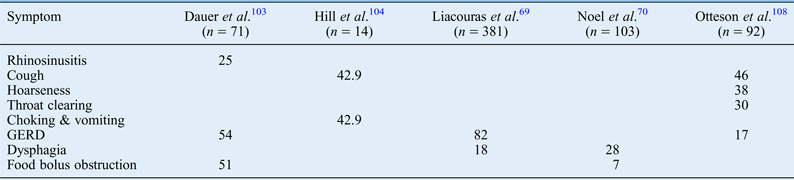
Several studies have recognised an association between eosinophilic oesophagitis and ENT symptoms (Table II). Clinical features (Table III) vary and overlap with airway and reflux symptomatology.Reference Orenstein, Shalaby, Di Lorenzo, Putnam, Sigurdsson and Mousa102 Rhinosinusitis was reported in 25 per cent of patients, food bolus impaction in 51 per cent and gastroesophageal reflux disease in 54 per cent, of whom four subjects had undergone fundoplication.Reference Dauer, Freese, El-Youssef and Thompson103 A range of refractory upper airway and gastrointestinal symptoms is typical.Reference Hill, Ramakrishna, Fracchia, Sternberg, Ojha and Infusino104 Flexible endoscope examinations conducted during airway evaluation for croup identified eosinophilic oesophagitis in 7.2 per cent of patients,Reference Duval, Tarasidis, Grimmer, Muntz, Park and Smith105 and eosinophilic oesophagitis was present in 10 per cent of patients in a select cohort.Reference Cooper, Kuruvilla, Persad and El-Hakim106 A case–control study identified eosinophilic oesophagitis in 36 per cent of 101 children with cow's milk protein intolerance,Reference Paddack, Gibbons, Smith, Patil and Richter107 with 60 per cent showing improvement in ENT symptoms following dietary elimination. Otolaryngology interventions were more common in the cow's milk protein intolerance cohort than in controls (odds ratio = 33.78; 95 per cent CI = 7.55, 151.03).
Reported rates of ENT manifestations*
Data represent percentages. *In children with eosinophilic oesophagitis. GERD = gastroesophageal reflux disease
Typical features of eosinophilic oesophagitis
Otolaryngologists will encounter both paediatric and adult eosinophilic oesophagitis patients. In a retrospective analysis, up to 20 per cent of paediatric eosinophilic oesophagitis cases had undergone ENT evaluation for a range of diagnoses.Reference Smith, Chewaproug, Spergel and Zur20 In 144 patients seen by otolaryngologists, only 32 per cent of those ultimately diagnosed with eosinophilic oesophagitis were referred onwards as suspicious at early consultation, leaving 68 per cent that our specialty initially failed to recognise.Reference Smith, Chewaproug, Spergel and Zur20 A 5-year review of 362 patients with confirmed eosinophilic oesophagitis diagnosis revealed that 33 per cent had undergone at least one, and 16.6 per cent had undergone multiple, ENT procedures.Reference Kelly, Linn, Keppel, Noel and Chun19 Contrary to other reports, a diagnosis of eosinophilic oesophagitis was achieved in 75.6 per cent of cases by onward referral by ENT after their first procedure (12.6 per cent had biopsies confirming eosinophilic oesophagitis as part of their ENT assessment). Patients presented to ENT, on average, four years prior to gastroenterological diagnosis of eosinophilic oesophagitis.
Eosinophilic oesophagitis must be considered in children undergoing diagnostic aerodigestive endoscopy. A tertiary multidisciplinary centre reported a prevalence of 3.7 per cent in 372 children undergoing endoscopy for refractory aerodigestive symptoms.Reference Hill, Ramakrishna, Fracchia, Sternberg, Ojha and Infusino104 This is comparable to the prevalence of 3.8 per cent reported in the largest study, which comprised 2429 patients who were managed through a paediatric otolaryngology-led service;Reference Otteson, Mantle, Casselbrant and Goyal108 the mean age of 4.4 years is younger than that in the literature, suggesting increased awareness in a multidisciplinary service. Published multidisciplinary approaches to croup and chronic cough,Reference Greifer, Santiago, Tsirilakis, Cheng and Smith109 and aerodigestive dysfunction,Reference Yawn, Acra, Goudy, Flores and Wootten110 used in children, highlight an increasing recognition.
However, the literature highlights the ongoing failure of otolaryngology to consider the diagnosis.Reference Sperry, Crockett, Miller, Shaheen and Dellon77, Reference Williams, Jameson, Bishop, Sawaya and Nowicki111 Williams et al.Reference Williams, Jameson, Bishop, Sawaya and Nowicki111 found eosinophilic oesophagitis more prevalent in food bolus obstruction cases, yet ENT departments never performed mucosal biopsies (despite eosinophilic oesophagitis being involved in 25 per cent of 572 cases of paediatric food bolus obstruction retrieval). One ENT series identified 18 cases of eosinophilic oesophagitis in 27 patients biopsied, from a series of 271 paediatric food bolus obstruction cases.Reference Hudson, Sampson, Muntz, Jackson and Smith112
Increased adoption of transnasal oesophagoscopy by otolaryngologists may increase exposure to eosinophilic oesophagitis and allow biopsy.Reference Karkos, Srivastava, Kaptanis and Vaughan17, Reference Amin, Postma, Setzen and Koufman40, Reference Bennett, Sharma, Price and Montgomery113 The specialty of ENT should maintain awareness and ensure that patients with clinical features of eosinophilic oesophagitis are referred to gastroenterology, recognising the importance of histology.
Otolaryngology series report significant delays to diagnosis. A mean diagnostic delay of 6 years in a series of 200 patients led to increased rates of fibrosis and stricture formation. Even delays of up to 2 years produced fibrosis and stricture formation rates of 46.5 and 17.2 per cent, respectively; delays of over 20 years produced rates of 87.5 and 70.8 per cent.Reference Schoepfer, Safroneeva, Bussmann, Kuchen, Portmann and Simon82
Natural history and prognosis
Eosinophilic oesophagitis is a chronic disease, which commonly relapses following the cessation of beneficial treatment.Reference Straumann, Spichtin, Grize, Bucher, Beglinger and Simon76 There is no evidence that the disease process limits life expectancy, but it can impair QoL.Reference Gonsalves, Doerfler, Schwartz, Yang, Zalewski and Amsden121, Reference Khanna, Kujath, Katzka, Arora, Grothe and Romero122 The Pediatric Eosinophilic Esophagitis Symptom Score (‘PEESS’, version 2.0) explored the QoL impact in children, reporting patient and parent-proxy reported outcomes.Reference Hommel, DeBrosse, Greenberg, Greenler, Abonia and Rothenberg116 This validated tool has yet to demonstrate improved treatment outcomes. Quality of life and symptom questionnaires are applied in clinical practice in adults, and clinicians broadly judge severity based on endoscopic features and symptoms.Reference Schoepfer, Panczak, Zwahlen, Kuehni, Coslovsky and Maurer68
Eosinophilic oesophagitis has not been associated with an increased risk of malignancy. It is suggested to be the commonest cause of spontaneous oesophageal perforation, through a process distinct from that of Boerhaave syndrome.Reference Attwood and Furuta41 In an 11.5-year follow-up study, the inflammatory process remained confined to the oesophagus, without transition to eosinophilic gastroenteritis or other disease.Reference Straumann, Spichtin, Grize, Bucher, Beglinger and Simon76 The evidence base for the diagnosis and management of eosinophilic oesophagitis is limited, and provides opportunities for further research.Reference Lucendo, Arias, Molina-Infante, Rodriguez-Sanchez, Rodrigo and Nantes114
Future work
Extensive research has aimed to establish genetic banking and define the phenotypes of eosinophilic oesophagitis.Reference Butsch Kovacic, Biagini Myers, Lindsey, Patterson, Sauter and Ericksen115 The interplay between eosinophilic oesophagitis, PPI-responsive eosinophilic oesophagitis and gastroesophageal reflux disease, and the role of PPI treatment in these phenotypes remain contentious.
Future otolaryngology research could focus on comparisons of topical steroids and oesophageal dilatation, techniques for dilatation, the role of maintenance versus on-demand topical steroid therapies, biological agents, and biomarkers of disease progression.Reference Attwood and Furuta41, Reference Attwood and Sabri42 Significantly, a collaborative venture, funded by United European Gastroenterology, hopes to establish a European-wide clinical network, registry and learning platform for eosinophilic oesophagitis. Involving both physicians and otolaryngologists, it is termed ‘Harmonizing diagnosis and therapy of Eosinophilic Oesophagitis (EoE) across Europe (HaEoE-EU)’.125
Conclusion
Eosinophilic oesophagitis is a chronic, immune/antigen-mediated oesophageal disease that has recently become an increasingly recognised cause of upper gastrointestinal morbidity in adults and children. Characterised by eosinophilic infiltration, its typical clinical presentation includes dysphagia and food impaction due to fibrostenosis, associated with inflammatory changes and the alteration of biomechanical properties. It can only be recognised if the diagnosis is considered, and this necessary awareness may be lacking in our specialty, to which such patients frequently present. Despite characteristic endoscopic features, biopsy is mandatory. A PPI trial rules out the one-third of patients with PPI-responsive eosinophilic oesophagitis. Treatment comprises diet therapy, topical corticosteroids and/or endoscopic dilation. Further basic and clinical research data are needed to understand the pathophysiology and clinical course (including biomarkers), to update the diagnostic algorithm and develop novel treatments. The care of patients with eosinophilic oesophagitis and the study of the disease are multidisciplinary, involving gastroenterologists, otolaryngologists, allergists and dieticians. The role of the otolaryngologist may be to consider the diagnosis primarily, to obtain biopsy confirmation, and to treat complications such as bolus obstruction or stenosis.
Acknowledgement
We thank Professor Stephen Attwood (Department of Health Services Research, Durham University, UK), for his expert advice in the preparation of this manuscript, for reviewing the final draft and for providing the illustrations.