The power that people have to gather is itself an important political prerogative, quite distinct from the right to say whatever they have to say once people have gathered. The gathering signifies in excess of what is said.
— Judith Butler, Notes toward a Performative Theory of Assembly Footnote 1Long forgotten, Elizabeth Polack (fl. 1835–43) is the earliest known Jewish woman playwright in England.Footnote 2 This essay argues that her first play, Esther, the Royal Jewess, or the Death of Haman! (1835), performed at a public playhouse in the Jewish working-class neighborhood of London's East End, radically realigns diverse genres and populations in advocating both Jewish emancipation and a voice for women. By way of a very brief introduction, I first point out the applicability here of Judith Butler's Notes toward a Performative Theory of Assembly. Butler explores how group protest, such as Tahir Square or Occupy Wall Street, serves as a kind of communal bodily signification. Of course, her point is not to address how people come together in a public theater, where the cast arrives daily for salaried jobs and the audience plunks down cold cash for a fun night out. Yet something else meaningful can occur in assembly within the theater. Theatrical performances can take on the discursive power of political assembly that Butler defines, signifying “in excess of what is said,” bringing actors and audience together with potentially political valence.Footnote 3 Butler helps us understand the stakes of theatrical performance and public assembly and why it is important to examine Esther, the Royal Jewess beyond recovering a neglected author, though that too is part of my object.
Nineteenth-century English law understood the political power of theater and theatrical assembly. Drama was censored and theaters highly regulated. Rules tightly constrained the performance of religious plays and prohibited anything that would seem to incite violence or civic unrest. The Licensing Act of 1737 drove authors such as Henry Fielding to abandon writing plays and switch to novels because of the burden of censorship faced by playwrights that novelists did not incur. Thus, no matter what its themes, any nineteenth-century British play inhabits politically charged terrain. Furthermore, Polack's subject matter was inherently risky in dramatizing a familiar biblical story: Queen Esther of Persia (secretly Jewish) saves her people from the villain Haman (who plans to kill all the Jews) by imperiling her life in an appeal to the King Ahasuerus. In 1830, just five years earlier, a play on a related topic, Thomas Wade's The Jew of Arragon; or, The Hebrew Queen, was denied a license for performance at Drury Lane largely because of religiously tinged dialogue.Footnote 4 Although Polack's play adapts a religious text outright, its production was legal. Because it is a melodrama (a musical form rather than a purely spoken drama) that was performed at the Pavilion (a nonlicensed theater) rather than a drama or comedy at Covent Garden or Drury Lane (royally patented theaters), it did not need to be submitted to censors before production, required at that time only of plays mounted at licensed theaters. In the theatrical environment of 1835 London, genre and venue dictated what was lawful to perform.Footnote 5
Uniting topics surrounding law, gender, genre, religion, and Jewish emancipation in Britain, Esther, the Royal Jewess is a touchstone for key intersectional questions, both theatrical and historical. Generally read by critics as an “oriental” or “exotic” melodrama, Polack's play, I argue, is also a kind of Purimspiel, or Purim play, a traditional Jewish entertainment that raucously and humorously dramatizes Esther's story through music. By blending two seemingly unrelated genres—melodrama and Purimspiel—that fulfill wildly different social functions for apparently distinct audiences assembling at the Pavilion, Polack negotiates some of the most imperative issues confronting British Jews and non-Jews in 1835. The generic blend Polack uses unites these forms to address multiple communities. Polack provides a vehicle to help mixed audiences consider the question of Jewish belonging to the British nation.
Polack's play crucially brings together diverse groups both in its storyline about Jewish people in ancient Persia (an analogy to contemporary England) and in its historically specific audience drawn from the demographically multifarious Whitechapel. Directly addressing the community in and formed by the Pavilion playhouse, Polack creates, on one hand, a picture of an already welcoming and inclusive nation in the person of King Ahasuerus, while urging, on the other, more tolerance and liberality from all parties. What makes all this cultural work possible is her generic blend of melodrama and Purimspiel. As a hybrid form, in which each genre reshapes the other, Esther, the Royal Jewess addresses the Pavilion's mixed Jewish and non-Jewish spectatorship. Because neither population's reaction to the movement for Jewish enfranchisement and other civil liberties was monolithic, the play attends to the various responses within both groups to agitation for Jewish emancipation. Esther, the Royal Jewess performs this critique smack in the middle of a decade that brought both exciting reforms and repeated disappointments to the Jewish population in England and to the overlapping community of the working class.
In addition to advocating Jewish civil liberty and promoting religious freedom everywhere, Polack's play models women's political agency. Because melodrama was far more amenable than traditional Purimspiel to depicting active heroines, recasting the Purim play as a melodrama allowed Polack to modify and amp up Esther's role. At the close of the final act, literally taking a position center stage as a feminist and a liberal, Esther proclaims the universal importance of religious tolerance to the historically specific audience present at the Pavilion theater as well as to the published play's readership, admonishing them to accept one another's religious difference. The actress playing Esther directly talks to members of the audience to urge the powerful to protect the vulnerable in a varied population while asserting universal religious rights. In this action, she steps out of the traditional feminine role expected of a woman in 1835 and out of the silent role permitted women on theological issues in nineteenth-century Jewish orthodoxy.
At a historical moment replete with change, following unprecedented expansion of the franchise in 1828 and 1829 and the 1832 Reform Act and anticipating Victoria's imminent ascension to the throne (the first queen regnant since Anne Stuart), Polack's crossbred play offers multiple polemics advocating mutual respect, ethnic acceptance, a role for Jews in government, a voice for women, and—most explicitly, through plot, dialogue, characterization, staging, even music—universal religious liberty. To make my case that Polack's generic merging of melodrama and Purimspiel speaks to and brings together several interconnected populations, I will provide somewhat lengthy but necessary historical, religious, and cultural contexts for both theatrical forms as well as for the legal and social status of Jews, women, Jewish women, and the British working class in the 1830s. Only after teasing out these dynamic intersections can I offer a reading of text, music, and performance that confirms the ideological work Polack performs through her amalgamation of unlikely genres.
1. Oriental Melodrama in Whitechapel
Melodrama was born in France and popularized with the French Revolution.Footnote 6 It was, as David Mayer has pointed out, “responsive to immediate social circumstances and concerns,” providing social critique and often written for working-class audiences, at once reifying and interrogating class identity and hierarchy.Footnote 7 In part because it could be performed legally at nonpatent theaters such as the Pavilion, melodrama was the most widespread theatrical form in Britain for most of the nineteenth century.Footnote 8 Its key characteristics include alternating dramatic and comic scenes; employing stock characters such as heroes, villains, and damsels in distress; incorporating sensational effects; and using songs and musical underscoring to heighten emotion as well as to remain within the legal restrictions against performing strictly spoken drama outside royally patented theaters.
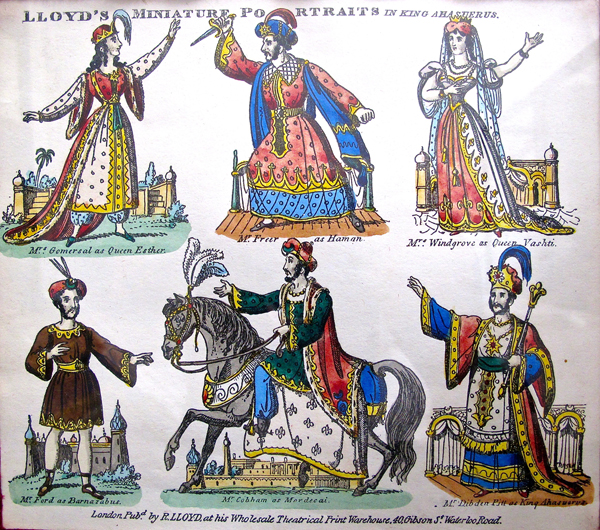
The subgenre of oriental melodrama, employing lush spectacle and foreign settings, was particularly fashionable in the earliest decades of the nineteenth century.Footnote 9 Marjean D. Purinton positions Esther, the Royal Jewess “among the Romantic-period dramas that depict British constructions of Arabia and reveal the evolving Arab-British relations.”Footnote 10 She rightly connects its vision of splendor with contemporary plays depicting Arabian nights.Footnote 11 Exotic images are everywhere: the king refers to banished queen Vashti (Esther's predecessor) as a “fountain in the burning desert,” “graceful as the stately palm.”Footnote 12 He must forget her, saying “even as the wind sweepeth the sand of the desert, so do I sweep her image from my soul!” (7). So generic were expectations of the play's scenery that Lloyd's souvenir theater sheet for Esther illustrates a “geographically indistinct” stylized hodgepodge, with “palm trees, Moorish arches, castles with bulbous, onion-shaped towers” that evoke a “portmanteau dramatic orientalism,” as Jane Moody describes the souvenir sheet for a completely different play contemporary to Esther (fig. 1).Footnote 13 These sheets would not be understood as an accurate reporting of the actual set but rather as a generic backdrop for the celebrity actors in costume. However, reading Esther and its ephemera solely as commenting on British constructions of Arabia or Persia misses other crucial elements in its cultural work. Esther uses its orientalism not only to construct Arab-British relations but also to address concerns of the diasporic Jewish community as “Oriental” or Other within England and to shape an alternative vision, both for themselves and their neighbors, of how they fit into British society.
Lloyd's miniature portraits in King Ahasuerus. The souvenir sheet gives the title as Ahasuerus, but the cast is the correct one for Polack's Esther. Courtesy of Pollock's Toy Museum, London.

Part of the effect of oriental melodrama was, as Edward Said describes more generally, to cultivate British national “identity by setting itself off against the Orient.”Footnote 14 For British Jews, the situation was complex; Michael Ragussis points out that they found in the theater “a site of contestation between and among different ethnic and national groups” struggling to understand their place in the British nation.Footnote 15 English Jews were long used to seeing themselves depicted, like Rebecca in stage adaptations of Ivanhoe (1820), in “oriental” garb, very similar to the dresses of Esther and Vashti in the Pavilion production of Polack's play (fig. 2). The superstar Edmund Kean had already popularized playing Jewish characters as “Oriental.”Footnote 16 At the performances of Esther, the Royal Jewess at the Pavilion, many in the audience would have been Jewish. The theater was located in Whitechapel, a bustling neighborhood consisting of a mixture of tradespeople, shopkeepers, dockworkers, and skilled laborers and including a large Jewish population. They knew themselves to be of “Oriental type” in an English setting; for example, contemporary reviews quipped about the theater's shabby location in the “oriental part of the metropolis,” a joke conflating the East End with the Levantine, continental, and eastern European origin of London Jews.Footnote 17 Beyond its religious connections (more on that in a moment), Jewish members of the audience would identify with the story of Esther and Mordecai as oppressed minority Jews foiling the monstrous Haman and living happily ever after under the patronage of the tolerant Persian king.Footnote 18
Costume for Miss Inverarity in her first performance as Rebecca in The Maid of Judah, June 16, 1831, at the Theatre Royal, Covent Garden. Courtesy of the Museum of Music History, London.

But the audiences were not exclusively Jewish. Just because many in the Jewish community were enthusiastic theatergoers does not mean, as Jim Davis and Victor Emeljanow explain, “that every play with a Jewish subject was aimed exclusively at this community, any more than plays on Irish topics were aimed at Irish East Enders.”Footnote 19 In fact, Esther’s only contemporary review was by a paper hostile to Jews, Figaro in London, indicating that even Figaro’s readership would be interested in what was performed there. Despite what clearly must have been the play's success, with multiple publications and revivals, Figaro in London responded with contempt, declaring, “We disgraced ourselves by a visit to the Pavilion the other day to see Esther. Such trash as Ahasuerus, and such actors and actresses, are below notice.”Footnote 20 These dismissive remarks probably reveal more about Figaro’s habitual anti-Semitism than about the play. A couple weeks later, Figaro asserted that “the whole race of Jews are our detestation and abomination.”Footnote 21 The month after that, the editors professed that they had “sworn, like Hannibal to the Romans, an eternal hatred to the beastly Israelitish nuisance, and will hunt them to the death.”Footnote 22 Inhabitants of Jewish neighborhoods like Whitechapel and audiences at their theaters (particularly the Pavilion, the Garrick, the Standard, the City of London, and the Effingham) are often depicted in Victorian reviews in Figaro and other papers as unscrubbed, odiferous, and loud.Footnote 23 But no matter what the Figaro says, the catchment of the Pavilion included non-Jews not only because it was a mixed neighborhood but also because shows at the Pavilion were not restricted to local clientele, whatever their religion or ethnicity. Its “playbills advertise transportation options, such as stages and omnibuses, suggesting that management expected to attract audiences outside its own workingclass neighborhood.”Footnote 24 It is within this diverse audience environment that Esther's generic classification as an oriental melodrama remains fundamental for understanding its ideological utility as a Purimspiel.
2. Jewish Emancipation and National Allegory
The period immediately after the enfranchisement of Dissenters in 1828 and Catholics in 1829 was a roller coaster for English Jews. The second half of the 1830s brought a series of hard-fought but triumphant firsts: first Jewish barrister, first Jewish London sheriff, first opportunity for Jews to vote for members of Parliament, first right for Jews to attend the University of London.Footnote 25 Although Polack's play merely follows the biblical story in raising Mordecai to his well-earned place as trusted adviser to the king, in the mid-1830s this plot of overcoming bigotry to win high office must have had particular resonance. Polack's King Ahasuerus is at once the powerful Persian ruler of the Bible story and the English king, William, wisely permitting Jews greater rights and freedoms. Mordecai is both the sage uncle of Esther and the representative of Jewish aspirations for a full place in British civil society, with rights, responsibilities, and the potential to serve in public office. Esther, who passes for Persian and enters the royal family incognito, is both a heroine saving her people from destruction and a woman who at first hides her identity but then comes out of the assimilationist closet as a Jew—as Eve Kosofsky Sedgwick points out in her study of Esther in the work of Jean Racine and Marcel Proust.Footnote 26
Racine's play Esther (1689) is just the first of several important precursors of Esther, the Royal Jewess, all produced in London multiple times and likely within Polack's ken. Even better known to Polack would probably be Thomas Brereton's English translation of Racine, Esther, or Faith Triumphant (1715), and George Frideric Handel's adaptation of Brereton into the full oratorio Esther (1732), which was his first in English. Concerts of Handel's oratorios appeared well into the early nineteenth century during Lenten season.Footnote 27 But these high art forms of patent house drama or opera do not speak directly either to the current circumstances (the 1830s push for and against Jewish emancipation) or to the communities (working-class Jewish and non-Jewish) that Polack addresses through working-class melodrama/folk entertainment. In contrast, Polack's hybrid form openly comments on and, in a sense, even exemplifies Jewish integration in the turbulent social, political, and civic context of the 1830s.
The progress in removing civil disability throughout this period moved unsteadily, controversially, and with recurrent frustrations. The House of Commons perpetually passed laws permitting Jews to enter Parliament, but the House of Lords rejected them in 1830, 1833, 1834, 1836, 1841, and six more times before success in 1858.Footnote 28 Even among Jews, emancipation was controversial, as some traditionalists feared that “participation in public life would weaken Jewish faith and practice.”Footnote 29 Polack's play depicting Haman's hatred of the Jews, Mordecai's elevation to power, and Esther's marriage outside the faith intervenes in these contemporary debates, both inside and outside the Jewish community, by openly addressing the issues. Just depicting positive Jewish characters was at this time something of a statement.
In the 1830s, representations of Jews in drama were mostly negative. Barabas from Christopher Marlowe's The Jew of Malta (first performed in 1592) and Shylock from William Shakespeare's The Merchant of Venice (first performed in 1605) and their imitations predominated as Jewish stereotypes. The character Fagin, appearing in the fourth installment of Charles Dickens's Oliver Twist in Bentley's Miscellany in May 1837 and immediately dramatized, exacerbated the situation; as Michael Scrivener explains, “Just as the movement for Jewish emancipation was stirring to life in the 1830s, Dickens's Fagin, unforgettably drawn as despicably satanic in George Cruikshank's illustrations, kept alive the medieval libel of Jewish ritual abuse and murder of Christian boys,” perhaps delaying “Jewish Emancipation for a generation.”Footnote 30 Yet there were some notable positive exceptions. Michael Ragussis points to novels such as Sir Walter Scott's Ivanhoe (1820) and Maria Edgeworth's Harrington (1817), to plays such as Thomas Dibdin's The Jew and the Doctor (1798) and Richard Cumberland's Sheva, the Benevolent (1794), and to the opera La Juive (Paris, 1835), by Eugene Scribe and Fromental Halévy, which was adapted to the British stage in 1835 by James Robinson Planché as The Jewess; or, The Council of Constance.Footnote 31 But as Ragussis explains, “in the opening decades of the nineteenth century” these positive representations that promoted religious toleration were routinely counteracted by the older anti-Semitic ones, so that “benevolent Jews played in the same season, and even on alternate nights, with revivals and double bills that featured conventional stage Jews … demonstrating the kind of cultural schizophrenia” that he suggests “was the hallmark of Enlightenment and post-Enlightenment British culture.”Footnote 32 Moreover, it is worth noting that several of the affirmative Jewish characters turn out not to be Jews after all, in La Juive and Harrington, for example, diluting their beneficial impact.Footnote 33 In addition, Cumberland created as many—and Edgeworth many more—negative portrayals of Jewish characters as positive ones. Even Wade's The Jew of Arragon; or, The Hebrew Queen, explicitly dedicated to “the Jews of England” and urging their release from “those unworthy bonds with which you still remain encumbered,”Footnote 34 compromises the titular Jewish protagonists. A beautiful Jewish woman, raised to royal station (like Esther) by the love of the king, becomes involved, along with her father (through heroic but ultimately wrongheaded motives), in a plot to trick the king into better treatment for the Jews, for which the tragedy ultimately punishes them both by suicide.
The schizophrenia that Ragussis identifies often exists within the same play or novel. Even Scott's saintly Rebecca in Ivanhoe had the unpleasantly stereotyped Isaac for a father. Furthermore, favorable representations of Jews in novels tended to be part of conversion narratives. Nadia Valman details the substantial popularity of (fictional) autobiographies about Jewish women becoming Christian in the 1830s.Footnote 35 Formulaic tales, they stress the Jewess's own “tolerance and compassion” as contrasted with the “tyranny of the Jewish family”—particularly Jewish fathers—that she must rebel against in clinging to her newfound faith.Footnote 36 The already intense efforts to convert Jews by such organizations as the London Society for Promoting Christianity (founded in 1809) increased in the 1830s and ’40s; “in the 1830s, a slew of Anglican Evangelical conversionist periodicals began publication.”Footnote 37 And the campaign often succeeded. Only as a convert would Benjamin Disraeli be able to enter the House of Commons in 1837. Many Jews converted to Christianity, often for practical reasons when confronted with otherwise insurmountable barriers to success in education, business, politics, love, and life. Some maintained robust ties with the Jewish community. Needless to say, the practice of converting for convenience sparked debate among Jews who might well view converts as deserters.
Polack chooses a different model in the story of Esther, who succeeds simultaneously within Jewish and non-Jewish patriarchies, saving her people without having to give up love, family, her own beliefs, or her non-Jewish husband. Esther emphatically does not convert to the ancient Persian religion, nor does her adherence to Judaism pose any problems for Ahasuerus, once he learns her true identity. Likewise, the play offers no hint that she wants him to convert. Unlike so many contemporary conversion novels, Esther's father-figure, Mordecai, supports and loves her throughout the play. Far from being cruel or mercenary, Mordecai is pure nobility. Esther's open-minded Jewish piety is rewarded with prestige and a happy union that symbolizes (through intermarriage) Jewish integration into the British body politic without conversion. As Fredric Jameson asks us to expect of “Third-world texts,” Polack's play uses “the story of the private individual destiny” as “national allegory.”Footnote 38 If Esther and Mordecai can overcome senseless hatred, prove their patriotism through service to crown and country, and enter the social and civic fabric of society at the highest imaginable level despite proclaiming and adhering to their true identity, so can the Jews of England.
The maelstrom of conflicting concerns for Jews in the 1830s resulted in all sorts of publications grappling with these issues. The first novel by a professing English Jew, Maria Polack—perhaps a relative of Elizabeth—appeared in 1830. And the first plays by self-identifying male English Jews (Charles Zachary Barnett and Morris Barnet)Footnote 39 were performed and published in 1830.Footnote 40 Voice of Jacob and The Jewish Chronicle, the first and second Jewish newspapers in England, were both established in 1841 partly in response to conversion magazines throughout the 1830s.Footnote 41 Jews in Britain, including Jewish women writers at this historical moment, “wrote to defend and debate the two salient movements gripping the community—the movement to emancipate themselves from the legal and political disabilities from which they still suffered as British subjects, and the movement to reform their religious institutions and practices” in a response to modernization and Enlightenment philosophies.Footnote 42 Polack's Purim play dramatizes not just two but three vigorously debated impulses, directly expressing the British Jews’ aspiration for political rights, portraying tolerance within the Jewish community for assimilation and even religious reform (which was a current and controversial movement), and depicting women speaking out in multiple patriarchal societies.
3. Gender and the Nineteenth-Century Jewish Woman Playwright
Even the title Esther, the Royal Jewess, or the Death of Haman! signifies a number of points relevant to my argument that the play's hybrid genre enables its cultural work. First, its exclamatory subtitle conveys the sensational plot and helps identify it as a melodrama. Second, its main title is not just Esther, which would have tied it more closely to Racine, Brereton, and Handel, but Esther, the Royal Jewess, emphasizing its appeal to Jewish audiences by insisting on Esther not as a self-sacrificing archetypal Christ-figure but as an emphatically Jewish heroine, bravely defending her own people by defeating their archenemy. Even the word “royal” matters here, indicating that the possibility for Jews to enter the body politic knows no limits. But perhaps most meaningful is the gendered term “Jewess,” which reminds audiences that it is a woman who foils the villain and speaks for religious tolerance. Gender is, furthermore, the most obvious factor intersecting with Polack's own Jewishness that affects her as the first Anglo-Jewish woman playwright, raising the question of how she came to write for the theater.
Many serious obstacles confronted British women writing for the public stage in the 1830s. Kerry Powell explains that most male playwrights came from “some other male-dominated area of employment”;Footnote 43 Jane Moody describes women's exclusion from the Dramatic Authors Society.Footnote 44 Kate Newey argues that most nineteenth-century women dramatists who successfully entered the profession were already in communities with alternative access to performance, such as members of the Boaden, Kemble, and Planché families.Footnote 45 Almost nothing is known for sure about Polack's biography, but what information we have neatly fits into Newey's outline. In Sketches of Anglo-Jewish History (1875), James Picciotto states that Polack's grandfather befriended and supported a poor Jewish orphan who was later to become the renowned opera singer John Braham (ca. 1774–1856).Footnote 46 In addition, the Polack family already included writers and artists. Maria Polack, whom I just mentioned as the first Anglo-Jewish novelist or at least the first who self-identified as Jewish,Footnote 47 may be her aunt.Footnote 48 Joel Samuel Polack (1807–1882), author of two highly regarded books on New Zealand published in 1838 and 1840, was likely Elizabeth's brother.Footnote 49 If so, then Elizabeth was the daughter of artist Solomon Polack (1754–1839), who exhibited at the Royal Academy.Footnote 50 But this tells us almost nothing about Elizabeth herself. With such skimpy and uncorroborated details to go on, it is hard to know exactly how Polack overcame the difficulties of becoming a performed and published woman dramatist in the 1830s. Certainly, the Polacks sound like an artistic and intellectual family that might have supported her writing, including a female novelist as a possible relative and the famous Braham as a family friend. But even with such connections, writing for the stage, as Newey and others have pointed out, posed special complications for women dramatists, since the theater was a particularly public venue, unlike the novel, which could be written and read entirely within private spaces, thus seen as more appropriate to women.
I see two additional possible factors undergirding the ultimate production of Polack's play: class and ethnicity. Rather than penning legitimate dramas and comedies for the patent houses as her contemporary dramatist Caroline Boaden did, Polack wrote melodramas for working-class theaters such as the Pavilion. Despite the lack of prestige, writing for these theaters rather than West End companies may have been an advantage for a woman playwright. Heidi Holder argues that the East End was more welcoming to women dramatists, where “the ideology of ‘separate spheres’ … was virtually absent … and women's public role was more flexible.”Footnote 51 But beyond the perhaps more easygoing attitudes of the East End, there is a second specific avenue that is important to consider, and that is the tradition of the Purimspiel itself, which, I argue, would be both an impediment and a path forward for the first Anglo-Jewish woman playwright: an impediment because of gendered Jewish traditions surrounding the Purimspiel and a path forward because of the Purimspiel's track record of providing a route to secular success for Jewish theater professionals.
4. The Whole Megillah
To understand how the Purimspiel operated as a conduit into theatrical careers for Jewish men and how both a mixed Jewish and non-Jewish audience attending a Purimspiel-inflected melodrama in a commercial theater might interpret the play, one must first become somewhat acquainted with the Jewish holiday of Purim. It celebrates the exciting narrative told in the Scroll or Book of Esther, known as the Megillah, from the Hebrew Bible. Probably originally written around the fourth century BCE, it is set about one hundred years earlier, during the reign of the Persian emperor Xerxes I. The entire scroll (the whole Megillah) is read aloud at Purim services, generally taking between twenty-five and forty-five minutes, depending on how much noise the congregation makes, since part of the fun involves interrupting the performance with noisemakers, stamping, clapping, thumping their seats, or shouting to drown out the name of Haman every one of the fifty-four times it occurs. It is a participatory event somewhat like the convention among some melodrama audiences of hissing the villain.Footnote 52 So boisterous was this Purim tradition in nineteenth-century London that one of the reforms to insert suitably British decorum into the service instituted in 1824 by the New Synagogue in Leadenhall Street and in 1827 by the Hambro Synagogue in Magpie Alley was the banning of children's “Haman clappers” or noisemakers,Footnote 53 a ban that, according to one 1842 account, may have been only partially successful.Footnote 54 The Book of Esther itself reads like fiction; and, indeed, virtually none of the story is corroborated by external evidence.Footnote 55 Nevertheless, it is historical in the sense that Jews lived in ancient Persia, beginning at least with the Babylonian Exile in 586 BCE. When Cyrus the Great of Persia defeated the Babylonians, a large number of Jews returned to what had been the kingdoms of Israel and Judea, starting in 538 BCE; but Jewish populations also remained scattered throughout Persian lands. Thus the Book of Esther has been serving as a touchstone for the anxieties of Jews in diaspora more generally for a long time, including those in early nineteenth-century England, who were negotiating their dual identities as Jews and British subjects. Because not everyone knows the Purim tale, I offer a very brief summary here.
The story begins with the King of Persia, Ahasuerus,Footnote 56 at a feast with his chief advisers. He sends for his queen, Vashti, but she refuses to come. Angered by her insubordination and instigated to action by his men, Ahasuerus sets her aside and declares that he will choose a new queen from among the many beautiful virgins in the land. Esther, a young Jewish woman, follows her uncle Mordecai's advice in not revealing her Jewish identity when she is selected and made queen.Footnote 57 Mordecai overhears a plot to kill King Ahasuerus and reports it, saving the king's life. But he also refuses to bow to the king's chief adviser, Haman, because Judaism forbids it as a kind of idolatry. Furthermore, Mordecai's reward for saving the king's life is to be honored by riding the king's horse, being led through the streets by Haman, who now feels doubly insulted and humiliated. Haman vows to kill not only Mordecai but also all the Jews, convincing the king to set a date for the mass execution. Chosen by lots or chance, the doomsday is fixed nearly a year later, allowing significant events in the plot to occur in the meanwhile. Mordecai exhorts Esther to save her people by speaking to her husband. She reminds him of a law that, on pain of death, no one may approach the king uninvited, and she has not been asked into his presence for months. Nevertheless, recalled to her duty by Mordecai, Esther risks summary execution by going to the throne room unasked. Ahasuerus, struck by her beauty all over again, extends his royal scepter, signifying his permission for her to enter. When the king asks her to state what she wants, she merely invites him to dinner, along with Haman. At a second banquet, she finally reveals Haman's perfidy. Overcome with horror and anger, Ahasuerus leaves the chamber. Haman immediately sues Esther for his own life, falling on her couch, where she reclines, to plead his case. Ahasuerus returns and finds Haman in this compromising and perhaps menacing pose. Accusing Haman of trying to force himself on Esther, the king has him dragged off to be impaled on the very stake the villain had built for Mordecai. The king calls off the scheduled massacre of the Jews and makes Mordecai his new chief adviser.
The story of Esther is ready-made for melodrama because it has a beloved heroine endangered by a powerful and dastardly villain who threatens both “her virtue and her life,” as Dickens defines the genre in Oliver Twist.Footnote 58 For that reason alone, it makes sense that Jewish authors (and others) have dramatized it often. But there is more to it. Although Jews have been writing plays since ancient times,Footnote 59 antitheatrical prejudice—based on religious deterrence—tended to dampen dramatic output by Jews even more thoroughly than by Christians, at least until the Enlightenment. The Talmud directly discourages wasting time on the foolishness of theaters and circuses.Footnote 60 But even before the Enlightenment, the great exception was Purim. Plays about the Esther story or other Jewish themes were traditionally mounted for the holiday, when theatricals and parading in costume was (and remains) customary. Purim was (and continues to be) a festive and uninhibited time of drinking, costuming, and misrule akin to Mardi Gras. Like Mardi Gras, although embedded within the Jewish religious calendar, the practice of producing Purim entertainment is cultural rather than liturgical. The tradition of Purim plays ushered many male Jewish performers and playwrights into the profession before Polack. A quick glance at the origin and history of Purimspiel will illuminate Polack's innovation in blending Purimspiel with melodrama and will illustrate how the hybrid form might facilitate her success.
5. Purim Plays and the London Theater
A Yiddish word, Purimspiel literally translates to English as “Purim play.” Medieval Purimspiels consisted of masked and costumed strolling musicians and players entering homes, like the tradition of mummers at Christmas or Easter,Footnote 61 to entertain people with music and parodies of the Purim story or other satirical efforts. They would refuse to leave until they received payment in coin or refreshment.Footnote 62 These improvised revels evolved into more formal musical plays, sometimes performed in professional venues instead of in homes or in synagogue courtyards. An early example is The Deeds of Esther and Ahashverosh, which “is said to have been staged with music in a regular theatre in Prague … in 1720” by students.Footnote 63 By the later eighteenth and early nineteenth centuries, Purimspiels on the Continent transformed into fully realized plays with scripts, increasingly produced in theaters as well as in homes, even starring known comedians in traditional parts; they constitute the origin of Yiddish theater as a vibrant artistic entity.Footnote 64 A similar path into the acting profession for Jews seems to have operated in London. Jacob de Castro, the celebrated Jewish comic and the most famous of “Astley's Jews,” attributes his entrée into the theater (as opposed to becoming a rabbi) to Purimspiels at the Great Synagogue in Duke's Place. In his autobiography, he relates that at the age of fifteen, he and his friends “got up plays and farces in commemoration of the puerim, that is the festival of the hanging of ‘Haman’—a custom strictly observed by the Jews. … [F]rom the encouragement which they met with on these representations … his thoughts became entirely bent on the pursuits of the stage as a profession.”Footnote 65
De Castro and his school chums were not the only people getting up Purim plays in Whitechapel in the late eighteenth and early nineteenth centuries. According to an 1839 source, The History and Antiquities of London, Westminster, Southwark, and Other Parts Adjacent:
In the month of March or April, according as Easter falls, there is a fair held in Duke's-place, called the Jewsfair, which is probably of great antiquity. It is a kind of carnival, and is denominated the Feast of Purim. Though the Jews have held rejoicings at this period in Duke's-place ever since their establishment there, yet they were not publicly sanctioned till the latter part of the last century, when the city allowed the parish of St. James the privilege of letting out the ground for three days, to the itinerant show-men.Footnote 66
London's Jewish community avidly participated in Purimspiels and masquerades, which provided theatrical training, exposure, opportunity, and validation to aspiring Jewish show people. Given Polack's family's connection to Braham (who went from singing in the Great Synagogue to an illustrious stage career), it seems less and less surprising that Polack's first published play should be a Purim play.
And it was, truly, a Purim play. Esther, the Royal Jewess, or the Death of Haman! opened on Saturday, March 7, 1835. This was precisely one week before the Purim celebration, which fell on Saturday, March 14, in 1835.Footnote 67 Jews typically went to the theater on Saturday night, after the close of the Jewish Sabbath, but on the eve of Purim they would likely go to the synagogue for the public reading of the Purim scroll itself, which—as I described—is its own festive, animated occasion. Thus, producing the play on Saturday night, March 14 (conflicting with the Purim Eve celebration), would exclude many of the target audience, but performing it on Saturday one week before Purim is an excellent marketing strategy. In fact, Polack's play was competing at the same time with a similar play at “another East End theatre favoured by Jews, the Garrick,” also based on the same story, apparently entitled Ahasuerus; David Conway speculates that “Ahasuerus was … presumably on the same subject and intended as a spoiler.”Footnote 68 That is possible, but also there may simply have been enough demand for two simultaneous Purim plays, just as today we see multiple versions of the Nutcracker and A Christmas Carol performed in the same city every December. In fact, I argue that Purim plays were a hitherto unnoticed but significant part of the London East End theater scene during the Purim season throughout the 1830s and ’40s, catering to the Jewish and non-Jewish theatergoing market. A City of London Theatre playbill for March 5, 1849, advertises Maurice Phillips's The Downfall of Haman, or the Triumph of the Jewish Queen. Monday, March 5, 1849, was again just before Purim, which began the evening of Wednesday, March 7, in 1849 (fig. 3). The Downfall of Haman playbill specifically advertises the show as telling the story that the Festival of Purim observes, targeting Jewish patrons. The play was, moreover, a revival; the playbill states that the show was originally performed in 1834 at the Garrick, the same theater performing Ahasuerus in 1835, the play that Figaro derided, like Esther, as trash.Footnote 69 Clearly there was a lively market for Purim plays that Polack was able to tap into.
Playbill for the City of London Theatre for the week of Monday, March 5, 1849. Victoria & Albert Museum, 2009, East London Theatre Archive.

One reason for savvy commercial theaters to market to Jews for Purim is that the holiday generally falls during Lent, when theater attendance among the Christian majority could be expected to drop off a little. While Queen Victoria would change the rule shortly after assuming the throne in 1837,Footnote 70 in 1835 theaters were not permitted to perform spoken plays on Wednesdays and Fridays during Lent, which is why Handel's oratorios—including Esther—were performed on those days through the 1790s and beyond. Although the law forbidding nonmusical theatrical performance on these days during Lent was “flouted with impunity by minor theatres” such as the Pavilion, as Richard Foulkes explains,Footnote 71 this cultural tradition suggests that non-Jews as well as Jews would be attracted to Polack's musical play, which was kosher for all, so to speak. In 1835 Lent (Ash Wednesday) began on March 4, a few days before the March 7 debut of Polack's Esther, the Royal Jewess. The Pavilion would thus at that time have a financial incentive to entice even more Jews than might normally come to the theater to make up for the possibility that non-Jewish attendance would likely be somewhat lighter.
Polack ensures that the Jews in her audience at the Pavilion would have experienced Esther, the Royal Jewess explicitly as a Purimspiel, not just a dramatization of the Esther story. Esther's final speech, which closes the play, wishes that Jews “in every clime celebrate this time in happy Purim!” (20). To complete the effect, a final backdrop descends, displaying the word “PURIM” as a kind of greeting card to all present who understood the word.Footnote 72 But with non-Jews also present at this theater (documented by the attendance of the Figaro in London reviewer), Polack disarmingly presents information about Jewish cultural practices and a set of ideological positions about Jewish emancipation, religious tolerance, acceptance of assimilation, and expanded roles for women. It is the hybrid form of musical entertainments during Lent and Purim that constitutes the mixed audience which becomes, in Judith Butler's terms, a performative assembly. Jews and non-Jews attending a Purimspiel-cum-melodrama together at the moment when the demographics are likely shifting to a larger proportion of Jews would have the potential to create a kind of politically aware community promoting inclusiveness. Regardless of anyone's actions or opinions afterward, within the theater's walls and for the running time of the show, Polack's play helps establish a diverse constituency with the potential to advocate for political reform. But while the play premiered during Lent and just before Purim, it was revived for three performances in April and May 1835, long after Purim, Lent, Passover, and Easter, during a week unrelated to either the Christian or the Jewish religious calendar. A melodrama as well as a Purimspiel, Esther, the Royal Jewess did not require the larger Jewish audience that might be typically expected of the Lenten season to succeed, despite explicitly wishing the audience a happy Purim.Footnote 73
In giving Esther the last words of the melodrama-Purimspiel, Polack blends the genres into a fusion that not only advances Jewish emancipation but also addresses gender directly, bringing us back to the question of why the first Anglo-Jewish woman playwright might have become a professional dramatist through combining melodrama with Purimspiel. As John Franceschina points out, a drama's final speech, the one that restores order, is more typically reserved for the hero than for the heroine.Footnote 74 But Polack gives it to Esther rather than to Mordecai, emphasizing her active role.Footnote 75 It is even more surprising in a Purimspiel, showing how far the genre had come by 1835, at least in Polack's hands.
Purimspiel began in the Middle Ages as ragged, outlandishly dressed male revelers parading and performing bawdy musical versions of the tale of Queen Esther, with a set group of stock characters, including fools and clowns. Again, like Mardi Gras, the Purim holiday permitted and even encouraged not only playacting but also cross-dressing, otherwise frowned upon in the Jewish community.Footnote 76 Men wearing women's clothes was normally understood to be prohibited by Judaism.Footnote 77 The character of Queen Esther, always played by a man in earlier Purimspiels, rarely speaks in these topsy-turvy, ribald, satirical versions of the story. Ahuva Belkin persuasively critiques early Purimspiels as misogynist, participating in the cultural control of gender difference.Footnote 78 Thus, although Purimspieling helped de Castro and other “itinerant show-men” into the world of the theater, would such a male-centered genre (despite the seemingly female-centered plot) enable a Jewish woman playwright to succeed? In addition, for a nineteenth-century Jewish woman writer like Polack to tackle a religious topic such as the Book of Esther, which is the purview of male religious scholars and rabbis, is a radical act in 1835. This is especially true of the theater, a public forum. Polack's play appears almost a decade before important educational religious texts by Jewish women such as Grace Aguilar's Women of Israel (1844), which also discusses Esther, but within a solely printed and private rather than a public theatrical medium. A devotional writer, Aguilar wrote about Judaism despite being, as Nadia Valman says, “religiously undereducated and more familiar with Christian values than Jewish texts,” a function of how Jewish women were typically excluded from formal religious instruction and the practice of theological scholarship.Footnote 79 No matter how far from the synagogue a melodrama performed in the commercial theater might seem, the fact that the play often quotes the religious source word for word and explicitly wishes the audience a “happy Purim” indicates that it daringly brushes up against the male privilege of nineteenth-century Jewish religious commentary. So how could Polack have tackled the form of Purimspiel?
Of course Esther, the Royal Jewess is not just a Purimspiel. While the Purim play allowed British Jewish actors like de Castro to cut their dramatic teeth, the genre that provided an opening for Polack to write a play depicting Esther's heroism is melodrama, predominant at the Pavilion. Melodramas featuring feisty female leads prevailing over dreadful odds were particularly prevalent at working-class theaters, so popular with working women; examples include George Dibdin Pitt's wildly successful 1841 play at the Victoria Theatre, Susan Hopley, or The Vicissitudes of a Servant Girl, to which serving girls flocked in record numbers,Footnote 80 and Jessy Ashton, Adventures of a Barmaid, first performed at the Effingham in April 1862.Footnote 81 Polack's representation of a forceful Esther, very different from her silent predecessors in Purimspiels, resists the constraining and frankly patriarchal force of the traditional folk masquerades. Polack's melodrama also counters some prior dramatizations of the story of Queen Esther that—oddly, from a Jewish perspective—portray the events as a tragedy, such as Racine's version, Esther, subtitled “tragédie.” Esther, the Royal Jewess, or the Death of Haman! is not a tragedy, despite the word “death” in the title,Footnote 82 but a melodrama, replete with humor and music, written in prose, aimed at the working class. Not only is Haman a villain whose demise is overwhelmingly deserved, but also the heroine (Esther), hero (Mordecai), romantic love interest (Ahasuerus), and comic relief (Levi the Peddler) end the play alive and happy.
Polack's fusion of genres operates both to bring the first Jewish woman dramatist in Britain into the playwriting profession and to give women a voice within the traditional tale. It also brings together a variegated audience for an evening's entertainment that speaks to the politics of class, gender, and Jewish enfranchisement. The cultural work of Esther, the Royal Jewess operates not only through the dialogue, plot elements, historical relevancy, and generic concerns we have discussed so far, but also through music—a necessary, even constitutive, component of both melodrama and Purimspiel. Music cements the links between the two genres.
6. Music in Melodrama
Just as Purimspiels began with roving musicians, melodrama—or melody drama—also started as a musical entertainment;Footnote 83 indeed, it was music that made melodrama a genre that could be legally performed outside of the royal patent theaters because it was not purely spoken drama. Part of being a melodrama is the use of melos, or snippets of melody that indicate particular emotions or themes. Esther, the Royal Jewess has many cues for music, including an explicit cue for trumpets as “a grand melos” (6). Although David Conway states that “it is not known who provided the music for Esther,”Footnote 84 I have found evidence that very clearly points to the Jewish composer Edward Woolf (1803–1882), the violinist, novelist, humorist, graphic artist, composer, and father of the more famous American playwright and composer Benjamin Woolf as well as of several other sons illustrious in nineteenth-century American art and academia.Footnote 85 As the Pavilion's resident orchestral leader for approximately fourteen years,Footnote 86 he would have created most of the music for performances at the theater during his tenure. He is explicitly credited on many Pavilion playbills as the composer of their melodramas until 1837, when he and his wife left for the United States, where he performed and conducted in Mobile, New Orleans, St. Louis, and Philadelphia, before ultimately settling in New York in 1841. There he conducted and composed for a variety of fashionable theaters, generally a step up from the Pavilion, including Burton's, the Bowery, and the Winter Garden as well as for synagogues.Footnote 87 Several of his original compositions and piano arrangements of operatic pieces were published as piano sheet music.Footnote 88 But so far as I know, none of the music for Esther survives.Footnote 89
Beyond his having been the resident composer at the Pavilion when Esther was performed, a playbill proves him to have collaborated with Polack on a sixth, until now unknown, play by Polack (fig. 4).Footnote 90 The playbill for the week beginning June 29, 1835, at the Pavilion theater advertises a play entitled The Echo, or The Whisper of Westminster Bridge by Miss Polack, with music by Mr. Woolf, as opening on that Tuesday, June 29.Footnote 91 Given that Woolf was the house bandleader and composer for the Pavilion and given the near proximity in time to another play written by Polack and composed by Woolf, the likelihood of their having collaborated on Esther is very high. The Echo playbill lists the cast of Pavilion regulars, including several who had performed in Esther back in March (according to the Duncombe's edition's dramatis personae) and again in Esther’s revival for three performances during the last week of April 1835, as indicated on that week's playbill (fig. 5).Footnote 92 The creative teams appear to be nearly identical. That Woolf, composer of synagogue music, is the composer of this mongrel Purimspiel-melodrama matters for understanding the use of music in a live performance to create a theatrical experience that connects Jewish to non-Jewish audience members in a pleasurable way.
Pavilion Theatre playbill for the week of Monday, June 29, 1835. Victoria & Albert Museum, 2009, East London Theatre Archive.

Pavilion Theatre playbill for the week of Monday, April 27, 1835, listing the cast of Esther, the Royal Jewess. Victoria & Albert Museum, 2009, East London Theatre Archive.

Music and dance—so hard to visualize from a play text—are a major part of Esther’s entertainment; the stage directions for lavish dance sequences give a hint of how much music and movement were carrying ideological import involved in creating what was simultaneously an oriental melodrama and a Purimspiel. The curtain rises on a chorus, singing “Hail, mighty King” to a tune probably repeated twice more in the play. There are trumpets, cymbals, and a “Grand Ballet, in which the Performers at intervals salaam to the King, and present the Guests with Wine. Grand Flourish” (5). Like the costumes and set, the movement here signified by “salaam” establishes Esther’s “oriental” milieu.Footnote 93 What must be a reprise of the same tune comes at the beginning of act 2, scene 5, in which Esther is crowned, with the chorus singing lines that parallel the play's opening chorus in rhythm, rhyme, and theme, now with the refrain “Hail, Esther, hail!” (21, 22). The likely reiteration of the music earlier employed in Ahasuerus's procession emphasizes the majestic heights Esther, too, has reached. After Esther receives the crown and scepter, another grand ballet ensues: “The Seasons enter separately, and place their Offerings at the foot of the Throne. Last of all, Mordecai, disguised as Winter, with an Urn of Fire.” These diegetic uses of dance permit the sophisticated furthering of plot, since Mordecai plays his role in this performance-within-a-play to gain undercover access to Esther in order to warn her of a second scheme against the king before the festivities resume, and the curtain falls on “a Grand and Joyous Tableau” to close the second act (23). As Carolyn Williams explains of melodrama more generally, we see here that “the chief formal features of melodrama—the music and the tableau—are not ‘merely’ formal, but are fully integrated with the social thematics of the genre.”Footnote 94 Whereas movements such as the “salaam” and words praising majesty indicated in the script emphasize the pleasure in exoticism and pomp that the dual audience would enjoy, the joyous tableau that closes act 2 celebrates the Jewish Esther's marriage, her virtuous rise to the level of royalty, and the thwarting of danger to the crown and state solely through the actions of the two Jewish protagonists.
Act 3 also employs music and tableaux to advance the story in a dream sequence that presages the twentieth-century Broadway musical's dream ballet, shifting into a psychological landscape that warns both characters and audience against religious/ethnic persecution. The scene opens with Ahasuerus sleeping. Father Time enters, explaining that he is ruled by no one, not even the king. He is free to show to the sleeping monarch “the hidden sorrows of thy people,” meaning the Jews, as the curtain behind Ahasuerus parts to reveal a series of two tableaux accompanied by music: first is “prostrate Jews, over which are Persians—some holding the Jews by the Throat, strangling them, &c., in all the attitudes of slaughter.” The next shows “Esther in mourning, her Hair disheveled—the Sceptre and Crown at her Feet—her Hands extended towards the King. Mordecai also in supplication. A group of Jewish Priests, &c., in attitudes of solicitation.” As Father Time slips away, the king awakens, rushes toward the now-vanished vision with his arms extended (like Esther's), duly warned. Because of this dream (which emphasizes that the Jews are worthy of the king's attention, as much his own people as the Persians), Ahasuerus calls his ministers to read aloud the palace annals that will remind him to reward Mordecai's much earlier foiling of the assassin's plot.
There are at least eighteen other explicit music cues, covering the gamut of musical expression typical in melodrama. Several are extensive processions; one is a comic dance; one is “plaintive music” that underscores Mordecai's blessing of Esther. The plaintive air suggests Woolf may have appropriated a traditional melody for the Hebrew prayer used by Jewish parents to bless their children on the Sabbath and by worshipers in the synagogue reciting the “priestly blessing” of the congregation; like most Judaic music, it would be chanted in minor (plaintive) key.Footnote 95 Whether Woolf borrowed the customary tune or composed something evoking it, insinuating Jewish music into melodrama would increase its resonance with the Jewish members of the audience through shared experience while demystifying the exoticness of Jewish practice for non-Jewish auditors, increasing their familiarity with Jewish culture. Yet it would not be the first time synagogue music appeared on a commercial London stage for mixed audiences, even “in the context of Gentile stage entertainment” (Conway 86). Conway identifies the first such occasion as Thomas Dibdin's comic opera Family Quarrels (1802) performed at Covent Garden, to which the tenor Braham added the melody of the Kaddish (an important Jewish prayer recited repeatedly in religious services that is also used to remember the dead) to enhance his comedic performance of a character disguised as a Jew. The incident resulted in a disturbance among Jewish audience members in the gallery (the less expensive seats) sometimes characterized as a riot (96, 99). Even though the offending song was performed by an acclaimed Jewish singer, Conway argues that the more religious lower-class Jewish customers were outraged by the show's using the echo of a somber Hebrew prayer melody to poke fun at a character pretending to be a Jew—and his being played by Braham did not ameliorate the offense.
Flash-forward thirty-three years, and everything is different. The social milieu has changed: elapsed time, the contrasting venues of the prestigious national English opera house in the West End and the lowly Pavilion in Whitechapel, the mounting agitation for Jewish rights. Likewise, the valences of each prayer are distinct as is the utility of the melodies in their dramatic contexts, one for satire and the other for verisimilitude. These changes make all the difference in understanding the cultural significance in how each play may have deployed Jewish music and what the music signified to its audiences. By 1835, in the throes of agitation for the removal of Jewish civil disabilities, Woolf's likely weaving a Jewish prayer melody for an uncle appropriately and poignantly blessing his niece into Polack's melodrama performed in a local theater in a Jewish neighborhood about Jewish characters acting nobly did not, apparently, start a riot. Indeed, repeat performances and multiple publications indicate that the heterogeneous audiences were moved by it.
The same air we have heard twice before, at the play's opening and at Esther's crowning, is probably used a third time in the final scene, when, after Esther's closing speech and before the transparency with the word “PURIM!” on it descends, “The Band strikes up the Chorus—Mordecai enters on horseback [echoing the earlier scene of Haman's humiliation], accompanied by numerous Characters”; together with the painted word Purim, they all group together and “the whole form a Grand Tableau” (30). This extensive and sophisticated use of music, dance, and tableaux that emphasize this amusement as a Purim play does more than deepen meaning, add interest, manipulate emotion, and entertain. The grand tableau brings everyone except the villains together for a harmonious visual effect: Ahasuerus, Esther, Mordecai, Persians, Jews, and even the horse congregate on stage in symbolic amity. Throughout the play, music and tableaux—these necessary elements in melodrama—play a vital role in its cultural commentary, in urging that Jews be given the full rights of citizens and that women be given a voice.
7. The People's Purimspiel
The hybrid musical form of Purimspiel-melodrama that Polack molds out of the Bible story spoke directly to her Jewish constituents’ specific concerns. Mordecai could be speaking in a nineteenth-century European setting rather than ancient Persia when he explains stereotypically “Jewish” trades: “Are we not shut out from all exercise of our talents in the state? Are not even your common artisanships debarred us? And when deprived of this, our honest endeavors are called groveling, and a thirst for gold?” (15). His appeal not only defends the traditional mercantile trades to which Jews often were limited through their exclusion from owning landed property or entering guilds but also argues for admittance to the very professions that would exercise their talents in the state (sheriff, barrister, member of Parliament) that we have seen British Jews were struggling to enter in 1835. In addition to the righteous, refined Esther and Mordecai, a lower-class Jewish character redolent in some ways of the traditional “stage Jew” appears, but with positive adjustments to avoid the deleterious effects of Barabas, Shylock, or Fagin. Unlike the Received Pronunciation that Esther and Mordecai use, Levi the peddler speaks with a strong Yiddish accent, indicated with phonetic spellings, such as “vader” for “father,” “mitout” for “without,” “vill” for “will.” Levi even lisps slightly, to the extent that he uses the “sh” sound for “s” as in “hishtory” instead of “history” (8), a concession to the strange stage convention of lisping “stage Jews,” such as Fagin was usually given in performance, for example.Footnote 96 But unlike Fagin, Levi is a cheerful supplier of pleasing baubles, bringing fun wherever he goes, not a corrupting villain who preys on children or a crooked middleman who receives stolen goods. Nor is he servile, sacrificing his lawful profit to the uneven benefit of the dominant community, as some benevolent Jewish characters are depicted, such as Riah, whom Dickens would later create in Our Mutual Friend (1864–65) in reparation for Fagin. With Levi, Polack provides enough of the prevailing type to satisfy tastes for the familiar among the non-Jewish audience members (and perhaps the Jewish ones as well) while educating them beyond the injurious cliché.
Besides adding Levi the Peddler, Polack's play emends the Purim story by eliminating several characters. Most important is the dropped female role of Zeresh, Haman's bloodthirsty wife, the Lady Macbeth of the Purim tale. Racine includes her in Esther, as does Brereton in Esther, or Faith Triumphant. Zeresh could have been expanded into a juicy role. Instead, Polack enhances Vashti's part considerably. The Book of Esther gives Vashti no voice at all; it does nothing to present what life might be like from her point of view, leaving readers to assume, perhaps, that she deserves punishment for her defiance of her husband and king. Likewise, in Racine and Brereton, Vashti is merely mentioned by Esther, who refers to her haughtiness (Racine) and mocking the king's command (Brereton) as reason for the king's displeasure. In Handel's oratorio, performed well into the nineteenth century, she is never even mentioned. None say what becomes of her after dethronement.
In contrast to these well-known precursors, Polack allots the soon-to-be eliminated queen a whole scene and an extended monologue. Vashti is discovered lying on her couch, surrounded by attendants who sing a chorus about how she is blessed with every charm and with exotic fragrance to “transport the royal bed,” hinting at the Purimspiel genre's bawdy beginnings (11). What follows is a painful encounter with Haman, who relates to her the bad news of her downfall and—consummate villain that he is—tries to take advantage of her new vulnerability. She then gets a richly melodramatic mad scene as she confronts her sudden and completely unwarranted tumble from power. Imagining that her husband is present, she calls out piteously to her slaves,
Will none save the wretched Vashti? Ha! See, see! He raises his sabre! Strike, great Ahasuerus, and let me die! Here, at thy feet, thy queen implores thee—strike! He laughs as if in mockery at my prayer—now he ascends the throne! Shall I not take my place there?—do you refuse your queen? Do not raise the sceptre in anger—[Screams and falls]—Gods! He has struck me!—my brain is on fire!—madness! Death! Banishment! ha! ha! ha! [She laughs hysterically.—Music—Haman coolly folds his Arms. Tableau]. (13)
In giving a voice—and a sympathetic one at that—to the silent Persian queen of the Book of Esther, Polack multiplies her play's political commentary on Jewish emancipation in Britain. She explores links between Jewish women's plight and possible response to both political and religious forms of subjugation, addressing the intersection of their constrained position within both the Jewish and non-Jewish communities, subject to husband's whim, lacking state protections, without legal tools to defend themselves. But in addition, Vashti's madness and what appears to be her conveniently spontaneous on-stage death means not only is Ahasuerus's queen disposed of, but also Esther is not depicted as marrying a married man. In the Book of Esther, Esther's bravery in going to the throne room rests on her having not been brought to the king's chamber for many months, suggesting that Ahasuerus has other options. In other words, in Polack's nineteenth-century British melodrama, the nice Jewish girl does not become one of a harem. Here Polack insists that while British Jews may recognize themselves as Oriental in some ways, they resist or at least redefine the label in others, as Said suggests about nineteenth-century British culture more generally.Footnote 97 In this respect, the play positions Jews (unlike the even more “Oriental” Persians within this construct) as mainstream, monogamous, bourgeois British subjects.Footnote 98
So much is Esther not a part of the harem that she does not even enter the play until act 2, when Vashti is safely out of the picture. The scene opens on the bucolic cottage where Mordecai and Esther live in pious affection, reinforcing the notion that British Jews, like British non-Jews, adhere to middle-class familial Victorian values. When Mordecai challenges the king's herald who has come to take his cherished niece off to the national beauty contest for choosing a new queen, the herald assures him that all is legit. Still, Mordecai reassures Esther that “if thou art not happy—should proud Ahasuerus not honour thee as his lawful queen—return to thy peaceful home” (16). This dialogue of pastoral domesticity and Mordecai's solicitous concern for Esther's happiness is entirely Polack's invention, not appearing in the Bible, Racine, Brereton, or Handel. The play tells us that later Esther becomes the king's “chosen partner,” emphasizing the couple's monogamy (19). Esther is no concubine. Throughout their marriage, she has full access to her husband; he repeatedly expresses affection and regard for her. No bravery is needed by a neglected bride to go unasked to the throne room, risking death. Only Vashti's speech recalls that aspect of the Purim story when in her madness she envisions Ahasuerus's scepter rising in anger.Footnote 99 Later, in a gloriously Freudian moment, Ahasuerus actually bestows his scepter on Esther exclusively, saying, “Take my golden scepter—it secures you from all danger, and assures you of my unabated love” (28).
The play is very overt in its message of tolerance. Esther reveals her true identity to her husband only when he asks her to go to the Temple of the Gods to pray for her safety. His response to her revelation is a model of liberalism: “Never should feelings of the heart be perverted by religious opinion. That power omnipotent be it what it may, never intended its laws for cruelty and oppression” (28). Only then, after he has already espoused an emphatic doctrine of acceptance and inclusiveness, does she expose Haman's plans for her own murder. Polack models a reciprocal dynamic for her audience and readership: Esther's revelation of her Jewishness is in response to an already tolerant and progressive liberalism declared by the king. In other words, a good ruler is always already a champion of religious freedom. He does not need to be converted to liberality through love. Unlike the biblical Ahasuerus (and that of both Racine and Handel), Polack's king never knows of Haman's genocidal plot to kill the Jews and so never acquiesces to it. When Ahasuerus removes the ring of office that Haman had been wearing and assigns it to the deserving Mordecai, the symbolism could not be clearer: Jews have earned the right to hold office and other civic liberties through their loyalty to king and country and through their righteousness in general, but also through Ahasuerus's recognizing Jews as being fully as much his genuine subjects as the (rest of the) Persians. His statements of broad-mindedness to Esther indicate that in Ahasuerus's Persia (and William's Britain), access to full rights should not necessarily require demonstrations of extravagant loyalty and heroism but is guaranteed by the rule of law. Never an intolerant despot but only ill advised by Haman until Esther and Mordecai arrive, the Persian monarch is a beacon of religious tolerance.
And so is Esther. Unlike Racine's Esther, who in the very first scene complains of living among pagans and loathing their heathen rites, Polack's Esther promotes religious liberty for all. I have already quoted the final lines, but those slightly earlier in Esther's closing speech are also important in their unequivocal declaration of the politics of liberalism and emancipation in a straightforward address to both the Jewish and non-Jewish audience members: “Blessed be this hour! Happy be my king! And prosperous be the Jews of every land and clime! May the sacred tree of liberty never lose a branch in contending for religious superiority; but all be free to worship as he pleases. Let that man be for ever despised who dares interfere between his fellow man and his creed” (30). Her urging universal religious tolerance would certainly seem to apply to everyone: not only asking Christians to accept Jews and vice versa but everyone to accept everyone else's form of devotion. This would include those whose creed varies from orthodoxy within their own faith communities, like the nascent reform movement within Judaism in Germany (with ripples already being felt in London) and—given the intermarriage between Ahasuerus and Esther—the rifts caused within the Jewish community by assimilation. Esther here wishes her king well, meaning Ahasuerus. But of course the actress, speaking to the historically specific audience at the Pavilion during Lent, just before Purim in 1835, speaks also for the whole pluralistic Pavilion's public, for their patriotism and their loyalty to King William. Unlike any Haman before him, Polack's archvillain plans not only to murder all the Jews but also to assassinate the king and usurp the throne. Together Mordecai and Esther thwart his heinous plans, proving the two Jews’ doubly heroic fealty. Their actions not only save the life of the king but also indicate that Jews are an essential part of the state: they secure and preserve the Persian throne/British government through their tolerance for all faiths.
8. Conclusion
Esther, the Royal Jewess, or the Death of Haman! is not only an “exotic” 1835 melodrama replete with extravagant tableaux, songs, and dances. It is also a Purimspiel, a musical play celebrating a Jewish holiday for its local, mixed audience. Its hybridity exemplifies the vibrant theatrical culture of Whitechapel, where Jewish folk customs impacted the nineteenth century's most popular genre. It demonstrates how Polack built bridges, negotiating the as-yet-unknown trajectory of history tending toward the Jews’ full participation in British civic life. She brought varied audiences together into a theatrical community that she encouraged, through humor and pathos, to think about tolerance, respect, and expanding civic rights for a reviled minority. In this play, she used the conventions of melodrama to portray a variety of Jewish characters that trounced prevailing stereotypes. At the same time, she employed the conventions of Purimspiel to mold this biblical story into an attraction for local Jewish audiences anticipating a jovial show. Moreover, by uniting oriental melodrama to Purimspiel, Polack blended both genres into a vehicle for presenting women's usually silenced Purimspiel voices (giving speech to Vashti and to Esther and dignifying the oft-parodied characters) while elevating the melodrama heroine to get the last word. Her play also ushered the first Anglo-Jewish woman dramatist into the playwriting profession by combining the genre of melodrama, which welcomed women writers, and the Jewish genre of Purimspiel, which didn't.
The manipulation of genre makes Polack's political intervention possible: it's only by combining melodrama and Purimspiel that Esther, the Royal Jewess can speak to burning issues both within and beyond the Jewish subculture, depicting Jews’ relevance to the state to both audiences as it unites them in the performance space. In addition, these completely intertwined generic innovations and political interventions are feasible only because of a hitherto overlooked but popular form of entertainment for Jewish and non-Jewish audiences alike, an aspect of Victorian theatrical activity that thrived in London's East End throughout the 1830s and ’40s. By bringing together mixed audiences to the Pavilion, Polack made use of the theater as a place of public and political engagement in a way that approaches Butler's notion of assembly. Aesthetic and commercial aims notwithstanding, when the actress playing Esther declares at the Pavilion in March 1835 that all should be free to worship as they please, that all—across their evident religious and ethnic differences within this public venue—participate joyfully in an open celebration of the Jewish holiday of Purim (even when it's not the Purim season) for all, Butler's point applies: the act of people gathering together signifies in excess of the words they speak. With this play by this playwright at this moment, the diverse Pavilion audience's assembly, even though it's for entertainment, is part of its political message. Recognizing the dual form of Esther, the Royal Jewess allows us to see that Polack's play works through the most vital social issues facing the Jewish community and their neighbors in 1835: emancipation, gender, Jewishness, Britishness, liberty, and the politics of insularity versus assimilation.