Introduction
Intranasal oxytocin (OT) has been proposed as a novel treatment to attenuate social dysfunctions and anxiety in autism spectrum disorder, social anxiety, and schizophrenia (Kendrick, Guastella, & Becker, Reference Kendrick, Guastella, Becker, Hurlemann and Grinevich2017; Meyer-Lindenberg, Domes, Kirsch, & Heinrichs, Reference Meyer-Lindenberg, Domes, Kirsch and Heinrichs2011; Young & Barrett, Reference Young and Barrett2015), as well as an augmentative strategy to facilitate fear extinction (Eckstein et al., Reference Eckstein, Becker, Scheele, Scholz, Preckel, Schlaepfer and Hurlemann2015) and working memory performance (Zhao et al., Reference Zhao, Becker, Yao, Ma, Kou and Kendrick2018). Following an initial landmark study in humans demonstrating that OT reduces amygdala responses to threatening (fear and angry) face stimuli (Kirsch et al., Reference Kirsch, Esslinger, Chen, Mier, Lis, Siddhanti and Meyer-Lindenberg2005), subsequent preclinical research has consistently reported that its effects on amygdala function (attenuated fear reactivity and increased amygdala-prefrontal intrinsic connectivity – Domes et al. Reference Domes, Heinrichs, Gläscher, Büchel, Braus and Herpertz2007; Eckstein et al. Reference Eckstein, Markett, Kendrick, Ditzen, Liu, Hurlemann and Becker2017; Kendrick et al. Reference Kendrick, Guastella, Becker, Hurlemann and Grinevich2017; Meyer-Lindenberg et al. Reference Meyer-Lindenberg, Domes, Kirsch and Heinrichs2011; Quintana et al. Reference Quintana, Westlye, Alnaes, Rustan, Kaufmann, Smerud and Andreassen2016; Spengler et al. Reference Spengler, Schultz, Scheele, Essel, Maier, Heinrichs and Hurlemann2017; Sripada et al. Reference Sripada, Phan, Labuschagne, Welsh, Nathan and Wood2013; Wang, Yan, Li, & Ma, Reference Wang, Yan, Li and Ma2017) may represent its primary therapeutic-relevant neural mechanism of action.
The proposed neural mechanisms of OT have been established using acute single-dose administration protocols, with a dose-response study demonstrating 24 international units (IU) as optimal for reducing amygdala responses to fear stimuli using conventional intranasal spray devices (Spengler et al., Reference Spengler, Schultz, Scheele, Essel, Maier, Heinrichs and Hurlemann2017). To date, however, no human studies have demonstrated whether chronic treatment protocols can produce enhanced functional effects and initial clinical trials using chronic (twice daily) administration over periods of a week or longer have reported inconsistent, or at best modest therapeutic efficacy on social-emotional dysfunctions (Guastella et al., Reference Guastella, Gray, Rinehart, Alvares, Tonge, Hickie and Einfeld2015; Halverson, Jarskog, Pedersen, & Penn, Reference Halverson, Jarskog, Pedersen and Penn2019; Jarskog et al., Reference Jarskog, Pedersen, Johnson, Hamer, Rau, Elliott and Penn2017; Kendrick et al., Reference Kendrick, Guastella, Becker, Hurlemann and Grinevich2017; Watanabe et al., Reference Watanabe, Kuroda, Kuwabara, Aoki, Iwashiro, Tatsunobu and Kasai2015; Yamasue et al., Reference Yamasue, Okada, Munesue, Kuroda, Fujioka, Uno and Yoshimura2018).
G-protein-coupled neuropeptide receptors typically exhibit internalization following even a relatively short period of constant exposure to their target peptides and cannot subsequently respond (desensitized) until they are recycled back to the surface of the cell membrane (Lohse & Hofmann, Reference Lohse and Hofmann2015; Pierce, Premont, & Lefkowitz, Reference Pierce, Premont and Lefkowitz2002). Growing evidence from both, in vitro and animal studies suggest there may be extensive internalization and subsequent desensitization of OT receptors (OXTRs) following repeated OT administration (Smith et al., Reference Smith, Ayad, Mundell, McArdle, Kelly and López Bernal2006; Stoop, Reference Stoop2012). In terms of neural OXTRs, those in the amygdala may be particularly susceptible to desensitization (Terenzi & Ingram, Reference Terenzi and Ingram2005) and this region critically mediates many of the effects of intranasal OT on social cognition and anxiety (Kendrick et al., Reference Kendrick, Guastella, Becker, Hurlemann and Grinevich2017). Moreover, rodent models have reported that in contrast to single doses, chronic administration of OT can actually produce social impairment (Bales et al., Reference Bales, Perkeybile, Conley, Lee, Guoynes, Downing and Mendoza2013; Du et al., Reference Du, He, Cai, Hao, Dong, Yuan and Tai2017; Huang et al., Reference Huang, Michetti, Busnelli, Manago, Sannino, Scheggia and Scattoni2014) in the context of reduced receptor expression in the amygdala and nucleus accumbens (Du et al., Reference Du, He, Cai, Hao, Dong, Yuan and Tai2017). Furthermore, an initial study reported that chronic v. single administration of OT results in divergent neurochemical changes in both the rodent and human frontal cortex (Benner et al., Reference Benner, Aoki, Watanabe, Endo, Abe, Kuroda and Kasai2018), emphasizing high translational relevance of the preclinical animal models for clinical trials employing chronic treatment protocols. Thus, empirically evaluated optimal treatment protocols for chronic intranasal OT administration in humans are urgently needed to determine its therapeutic potential.
A further unresolved issue is that different OXTR genotypes have been associated with social behaviors and may influence the sensitivity of behavioral and neural responses to intranasal OT. In particular, OXTR polymorphisms rs53576 and rs2254298 have been associated with autism (Cataldo, Azhari, & Esposito, Reference Cataldo, Azhari and Esposito2018), deficits in social and emotional processing, and anxiety (Jurek & Neumann, Reference Jurek and Neumann2018; Parker et al., Reference Parker, Garner, Libove, Hyde, Hornbeak, Carson and Hardan2014; Yang et al., Reference Yang, Dong, Guo, Han, Song, Gao and Zhang2017) and individual variations in behavioral and neural responses to intranasal OT (Chen et al., Reference Chen, Kumsta, Dvorak, Domes, Yim, Ebstein and Heinrichs2015; Feng et al., Reference Feng, Lori, Waldman, Binder, Haroon and Rilling2015). Indeed, variants of rs2254298 may represent a trans-diagnostic biomarker for social dysfunctions (Brüne, Reference Brüne2012). It is, therefore, imperative to establish whether OXTR polymorphisms could influence sensitivity to the effects of intranasal OT.
While single doses of OT can produce numerous functional effects, two of the key importance are attenuated amygdala responses to face emotions, particularly fear, and increased resting-state functional connectivity between the amygdala and prefrontal cortex (Domes et al., Reference Domes, Heinrichs, Gläscher, Büchel, Braus and Herpertz2007; Eckstein et al., Reference Eckstein, Markett, Kendrick, Ditzen, Liu, Hurlemann and Becker2017; Kirsch et al., Reference Kirsch, Esslinger, Chen, Mier, Lis, Siddhanti and Meyer-Lindenberg2005; Koch, van Zuiden, Nawijn, Frijling, & Veltman, Reference Koch, van Zuiden, Nawijn, Frijling and Veltman2016; Quintana et al., Reference Quintana, Westlye, Alnaes, Rustan, Kaufmann, Smerud and Andreassen2016; Spengler et al., Reference Spengler, Schultz, Scheele, Essel, Maier, Heinrichs and Hurlemann2017; Sripada et al., Reference Sripada, Phan, Labuschagne, Welsh, Nathan and Wood2013). While most task studies have focused on the effects of OT on amygdala responses to fear faces using a variety of different task paradigms some studies have reported valence independent effects of OT (Domes et al., Reference Domes, Heinrichs, Gläscher, Büchel, Braus and Herpertz2007; Koch et al., Reference Koch, van Zuiden, Nawijn, Frijling and Veltman2016; Quintana et al., Reference Quintana, Westlye, Alnaes, Rustan, Kaufmann, Smerud and Andreassen2016). Both these tasks and resting-state neural markers have been primarily associated with attenuated anxiety in terms of reduced responses to social threat and enhanced top–down control of emotion (Zhao et al., Reference Zhao, Yao, Li, Sindermann, Zhou, Zhao and Becker2019), although the effects of OT on the amygdala may influence a range of social cognition domains (Kendrick et al., Reference Kendrick, Guastella, Becker, Hurlemann and Grinevich2017; Meyer-Lindenberg et al., Reference Meyer-Lindenberg, Domes, Kirsch and Heinrichs2011; Young & Barrett, Reference Young and Barrett2015).
To help determine optimal treatment protocols for chronic intranasal OT administration, the current pre-registered double-blind, randomized between subject placebo (PLC)-controlled pharmacological neuroimaging trial, therefore, aimed to replicate previous findings for effects of a single dose of OT (24 IU) on reduced amygdala responses to fear or other face emotions (Domes et al., Reference Domes, Heinrichs, Gläscher, Büchel, Braus and Herpertz2007; Kirsch et al., Reference Kirsch, Esslinger, Chen, Mier, Lis, Siddhanti and Meyer-Lindenberg2005; Koch et al., Reference Koch, van Zuiden, Nawijn, Frijling and Veltman2016; Quintana et al., Reference Quintana, Westlye, Alnaes, Rustan, Kaufmann, Smerud and Andreassen2016; Spengler et al., Reference Spengler, Schultz, Scheele, Essel, Maier, Heinrichs and Hurlemann2017; Wang et al., Reference Wang, Yan, Li and Ma2017) in a large sample at the whole-brain level and on increasing resting-state functional connectivity between the amygdala and prefrontal cortex (Eckstein et al., Reference Eckstein, Markett, Kendrick, Ditzen, Liu, Hurlemann and Becker2017; Sripada et al., Reference Sripada, Phan, Labuschagne, Welsh, Nathan and Wood2013). Next, the primary outcome of the trial was to establish whether different repeat dosing protocols (daily, OT5 group, or every other day, OT3 group, for 5 days) modulate amygdala-centered neural and behavioral responses and resting-state functional connectivity. As a secondary outcome, we further aimed to establish if effects of OT on primary outcome measures were influenced by the OXTR genotype, focusing on the rs53576 and rs2254298 polymorphisms most frequently associated with social function and individual variations in intranasal OT sensitivity.
Material and methods
The main study objectives were to investigate both the effects of acute (single dose) and repeated doses (daily or every other day for 5 days) of 24 IU OT v. PLC on two primary outcomes: (1) amygdala and behavioral responses to face emotions (particularly fear faces) and (2) resting-state functional connectivity between the amygdala and frontal cortex. We investigated the modulatory influences of OXTR rs53576 and rs2254298 polymorphisms on the sensitivity to intranasal OT as a secondary outcome.
Participants
A total of 150 right-handed healthy adult male subjects were enrolled according to common inclusion and exclusion criteria for human OT administration studies (see online Supplementary material SI). Given that methods for estimating power for whole-brain task-based functional magnetic resonance imaging (fMRI) analyses are limited (Poldrack et al., Reference Poldrack, Baker, Durnez, Gorgolewski, Matthews, Munafò and Yarkoni2017), the subject number was initially chosen on the basis of recent large-scale studies investigating dose effects of OT (Spengler et al., Reference Spengler, Schultz, Scheele, Essel, Maier, Heinrichs and Hurlemann2017, n = 111 males; Lieberz et al., Reference Lieberz, Scheele, Spengler, Matheisen, Schneider, Stoffel-Wagner and Hurlemann2019, 90 females). A priori power estimates for behavioral analyses were calculated using Webpower (Zhang & Yuan, Reference Zhang and Yuan2018) giving a range of 60–80% power for analysis of variance (ANOVA) main and interaction effects and post-hoc tests. For full details, see online Supplementary material SI. Calculating power for fMRI experiments is more problematic and likely to be much lower, although since the amygdala was our only pre-registered region of interest (ROI), and the majority of fMRI post-hoc analyses used a single amygdala ROI, this avoids the problem of significantly reduced power when undirected whole-brain analyses are performed (see Cremers, Wager, and Yarkoni, Reference Cremers, Wager and Yarkoni2017). The current chosen sample size is also comparable to the previous largest fMRI studies investigating task-related effects of OT (Lieberz et al., Reference Lieberz, Scheele, Spengler, Matheisen, Schneider, Stoffel-Wagner and Hurlemann2019; Spengler et al., Reference Spengler, Schultz, Scheele, Essel, Maier, Heinrichs and Hurlemann2017). Three subjects failed to meet inclusion criteria (were currently taking medications) and nine subjects were excluded due to the failure to complete the study or excessive head movement (see online Supplementary material Fig. S1). Subjects were randomly (computer-generated randomization) assigned to repeated intranasal treatment (single daily dose on five consecutive days) of (1) PLC (n = 46, M ± s.d., 22.46 ± 2.3 years), (2) OT (OT5; n = 49, M ± s.d., 21.78 ± 2.3 years), or interleaved OT and PLC (OT on days 1, 3, and 5, PLC on days 2 and 4; OT3; n = 43, M ± s.d., 21.02 ± 2.0 years) (see online Supplementary material SI). To ensure compliance, all subjects were supervised during self-administration of all nasal sprays. Groups did not differ on a number of potential confounders (see online Supplementary material SI and Table S4). The study was approved by the local ethics committee (Institutional Review Board, University of Electronic Science and Technology of China) and subjects provided written informed consent. The study was in accordance with the latest revision of the Declaration of Helsinki, pre-registered at Clinical Trials.gov (NCT03610919 – https://clinicaltrials.gov/ct2/show/NCT03610919) and in line with recommendations for trials in psychological experiments (Guidi et al., Reference Guidi, Brakemeier, Bockting, Cosci, Cuijpers, Jarrett and Rief2018) (see online Supplementary material Fig. S1 for a consort flow diagram). Subjects received 500 RMB monetary compensation for participation.
Experimental procedures
The study employed a double-blind, randomized, PLC-controlled, between-subject design. The OT and PLC sprays used in the three groups were supplied by Sichuan Meike Pharmaceutical Co. Ltd, Sichuan, China in identical dispenser bottles containing identical ingredients (glycerine and sodium chloride) other than OT. In line with recommended guidelines, experiments started 45 min after intranasal administration (Guastella et al., Reference Guastella, Hickie, McGuinness, Otis, Woods, Disinger and Banati2013). Recent studies have confirmed that intranasal OT enters the brain (Lee et al., Reference Lee, Scheidweiler, Diao, Akhlaghi, Cummins, Huestis and Averbeck2018), increases cerebrospinal fluid and blood concentrations (Striepens et al., Reference Striepens, Kendrick, Hanking, Landgraf, Wüllner, Maier and Hurlemann2013), and produces activity changes in brain regions expressing OXTRs in humans at around 45 min after administration (Paloyelis et al., Reference Paloyelis, Doyle, Zelaya, Maltezos, Williams, Fotopoulou and Howard2016; Quintana et al., Reference Quintana, Rokicki, van der Meer, Alnæs, Kaufmann, Córdova-Palomera and Westlye2019). In post-treatment interviews on days 1 and 5, subjects could not identify better than chance whether they had received OT or PLC (χ2 < 0.1, p > 0.2, online Supplementary material Table S4). For OXTR, genotyping subjects provided buccal swaps on the first day for analysis of OXTR rs2254298 and rs53576 single-nucleotide polymorphisms (SNPs) (see online Supplementary material SI and Montag et al., Reference Montag, Sindermann, Melchers, Jung, Luo, Becker and Kendrick2017).
For the implicit face-emotion processing task, 208 grayscale facial stimuli displaying happy, neutral, angry, or fearful facial expressions (n = 26 per category, 50% female) were used (two different stimulus sets – see online Supplementary material SI for details).
Primary outcomes and analysis plan
Face emotion-related amygdala responses were assessed using the event-related implicit face processing fMRI paradigm on treatment days 1 and 5. Intrinsic amygdala connectivity was assessed by means of resting-state fMRI assessments before the task-paradigm. Valence, arousal, and intensity ratings (scale: 1–9) for the facial stimuli were collected immediately after magnetic resonance imaging (MRI) acquisition as additional behavioral outcomes (for further details see online Supplementary material SI). In line with the main aim of the study changes in the amygdala face emotion reactivity and amygdala intrinsic connectivity between the first and fifth day served as primary outcome measures. Changes in valence, arousal, and intensity ratings for the different face emotions represented an associated behavioral outcome measure.
Imaging acquisition and analysis
Blood oxygenation level-dependent contrast functional images were acquired using standard sequences on a 3T GE MR750 system. High-resolution T1-weighted structural MRI data were acquired on both first and fifth day to improve normalization. MRI data were preprocessed using validated procedures in SPM12 (Friston et al., Reference Friston, Holmes, Worsley, Poline, Frith and Frackowiak1994) (Statistical Parametric Mapping; http://www.fil.ion.ucl.ac.uk/spm) and Data Processing Assistant or Resting-State fMRI (Yan & Zang, Reference Yan and Zang2010) (DPARSFA; http://rfmri.org/DPARSF) (for details see online Supplementary material SI). First-level general linear models for the task-related fMRI data included separate regressors for the four emotional conditions, gender identity rating period, six movement parameters, and appropriate contrasts were subjected to a second-level random-effects analysis.
Primary outcomes: the effects of OT on amygdala and behavioral face emotion reactivity and intrinsic connectivity
Differences in amygdala and behavioral responses to face emotions were examined using mixed ANOVAs with treatment group (PLC, OT3, and OT5) as between-subject and time point (first and fifth day) and face emotion (angry, fear, happy, and neutral) as within-subject factors. Dependent variables were extracted from target region amygdala responses using the template of left and right amygdala masks from the Brainnetome Atlas (Fan et al., Reference Fan, Li, Zhuo, Zhang, Wang, Chen and Fox2016) to faces (parameter estimates extracted using Marsbar, http://marsbar.sourceforge.net) and valence, intensity, and arousal ratings. Post-hoc comparisons explored significant interactions for amygdala and behavioral ratings. Associations between amygdala responses and behavioral ratings were assessed using Pearson correlation.
Differences in resting-state amygdala functional connectivity were determined using a voxel-wise seed-to-whole-brain ANOVA as implemented in the SPM flexible factorial design with treatment (PLC, OT3, and OT5) as between-subject and time point (first and fifth day) as within-subject factors and amygdala connectivity maps as the dependent variable (see data analysis flow chart in online Supplementary material SI)
Secondary outcome measures: influence of OXTR genotype
For rs2254298, subjects were divided into A carriers (AA and AG) and A non-carriers (GG) and rs53576 into G carriers (GG and GA) and G non-carriers (AA). To explore the effects of genotype as a secondary outcome measure, the OXTR group was included as an additional between-subject factor in the corresponding ANOVAs and amygdala reactivity to face emotions, amygdala-prefrontal cortex intrinsic functional connectivity, and behavior rating response served as dependent variables.
Control for treatment effects on brain structure
To control the potential confounding effects of single- and repeated OT administration on brain structure, a voxel-based morphometry analysis was conducted on the T1-weighted images acquired on both testing days using SPM12 standard procedures (Ashburner, Reference Zhao, Yao, Li, Sindermann, Zhou, Zhao and Becker2007; Ashburner & Friston, Reference Zhao, Yao, Li, Sindermann, Zhou, Zhao and Becker2005) (see online Supplementary material SI).
Thresholding and statistical implementation
In line with our regional hypothesis, the analysis of the implicit emotional face task focused on the amygdala. To account for the complex design of the trial, we employed two analytic approaches: (1) a ROI analysis on the extracted beta estimates from atlas-based masks for the left and right amygdala (Brainnetome Atlas, Fan et al., Reference Fan, Li, Zhuo, Zhang, Wang, Chen and Fox2016), respectively. To this end, the extracted estimates were subjected to three-way ANOVAs (treatment × time point × face emotion) examining effects on the left and right amygdala separately. The p value for the analysis was adopted to p < 0.025 (Bonferroni corrected multiple comparison 0.05/2). (2) To facilitate a more specific localization of the effects and to determine a more specific seed mask for the seed-to-whole brain resting-state functional connectivity analysis, a voxel-wise small volume corrected analysis for the entire bilateral amygdala was additionally employed. To this end, a peak-level family-wise error (FWE) small volume correction was applied to a single mask encompassing the bilateral amygdala as provided in the Brainnetome Atlas (Fan et al., Reference Fan, Li, Zhuo, Zhang, Wang, Chen and Fox2016) (total volume of the mask, 4572.27 mm3) (FWE, p < 0.05). For the seed-to-whole brain resting-state data analysis, a whole-brain cluster-based FWE-correction with an initial cluster forming threshold of p < 0.001 and FWE (p < 0.05) was employed. Behavioral and neural (extracted parameter estimates) indices were further analyzed using SPSS 22.0 with appropriate ANOVA models and Bonferroni corrected post-hoc tests. p < 0.05 two-tailed was considered significant. Partial eta squared (η 2p) and Cohen's d were computed for behavioral results as measures of effect size and SPSS outlier analysis was used to confirm the absence of statistical outliers. Full details of the post-hoc and correlation analyses are provided in online Supplementary material SI Tables S7 – S11.
Results
Primary outcome measure: ROI analysis of acute and repeated doses on OT-evoked changes in amygdala responses to face emotions
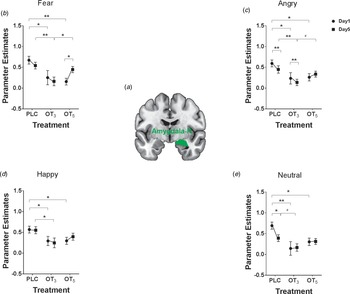
Examination of the extracted parameter estimates from the amygdala (a priori ROI approach in accordance with trial pre-registration) revealed a significant three-way ANOVA for the right amygdala (F (6405) = 2.563; p < 0.019), but not the left amygdala (F (6405) = 1.860; p = 0.087). Post-hoc analyses on the extracted beta values from the right amygdala mask on the first day revealed that both OT groups compared to PLC exhibited a suppression of right amygdala reactivity (fear: p < 0.015, angry: p < 0.016; happy: p < 0.041: neutral: p < 0.017). Analysis on the fifth day revealed that the OT3 group exhibited suppression of right amygdala reactivity to fear and angry faces relative to both the PLC (fear: p = 0.003, angry: p = 0.008) and OT5 groups (fear: p = 0.021; angry: p = 0.082) but the OT5 group did not (ps > 0.315, relative to PLC group). The OT3 group also exhibited reduced right amygdala reactivity to happy faces on the fifth day compared with the PLC group (p = 0.028) but there was no significant difference between OT3 and OT5 groups (p = 0.272). There were no significant effects of OT on the fifth day for neutral faces (ps > 0.203, although OT3 v. PLC was marginal, p = 0.052). While amygdala reactivity to fear faces did not differ in the PLC group between days 1 and 5 (p = 0.356), its reduction in the OT3 group on day 5 was equivalent to day 1 (p = 0.538), whereas in the OT5 group, the reduction on day 5 was significantly less than on day 1 (p = 0.035). Amygdala reactivity to angry faces decreased significantly more in the OT3 group on day 5 relative to day 1 (p = 0.006), although it also did so in the PLC group for both angry (p = 0.007) and neutral (p = 0.028) (Fig. 1b–e).
The effect of intranasal OT treatment on neural responses to faces. (a) The mask of right amygdala from the Brainnetome Atlas (Fan et al., Reference Fan, Li, Zhuo, Zhang, Wang, Chen and Fox2016). (b)–(e) Post hoc analysis on extracted parameter estimates from the right amygdala mask for all face emotion categories on the first and fifth day. #p < 0.1, *p < 0.05, **p < 0.01, two-tailed. Bars depict standard errors.

Primary outcome measure: behavioral rating analysis of acute and repeated doses to face emotions
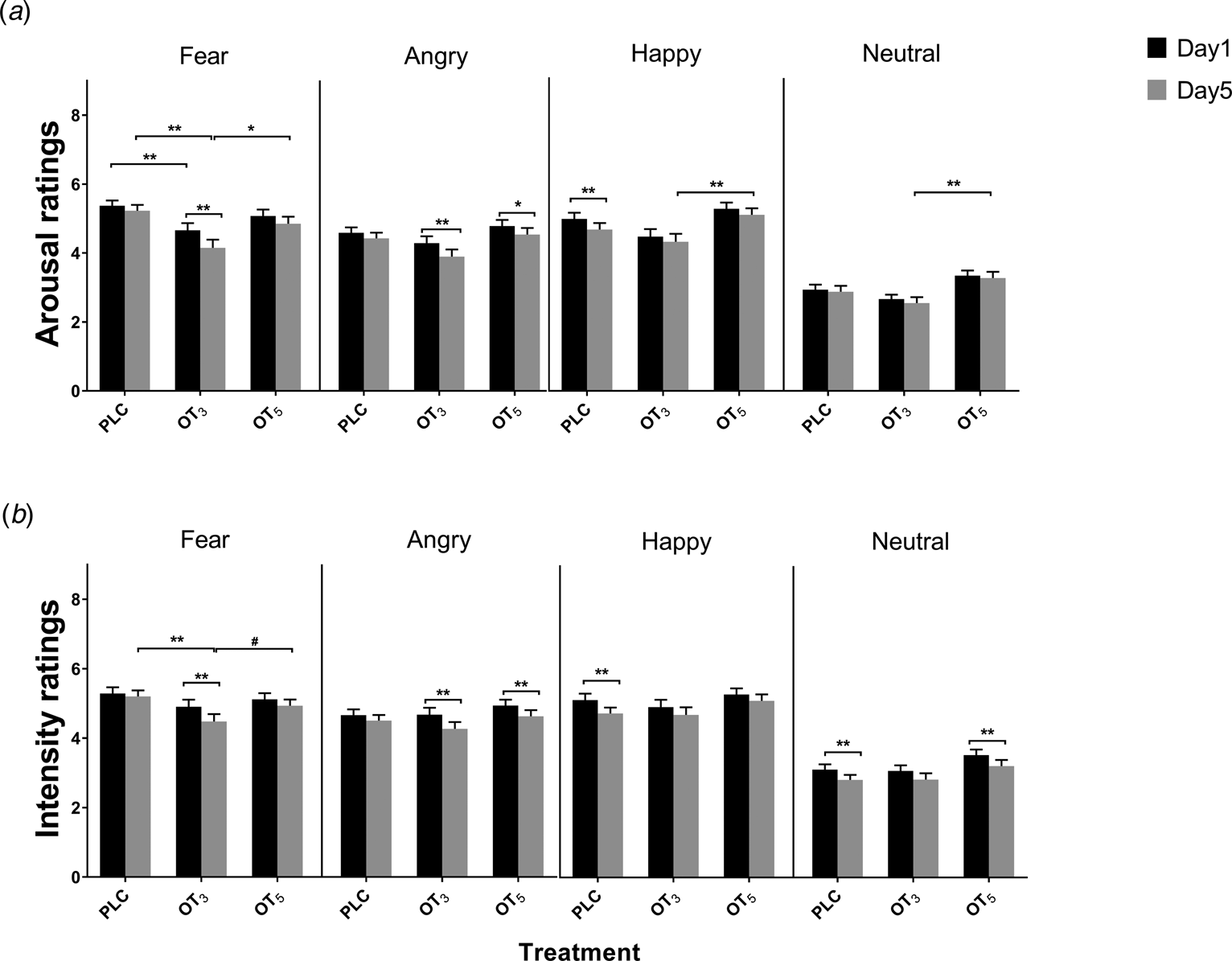
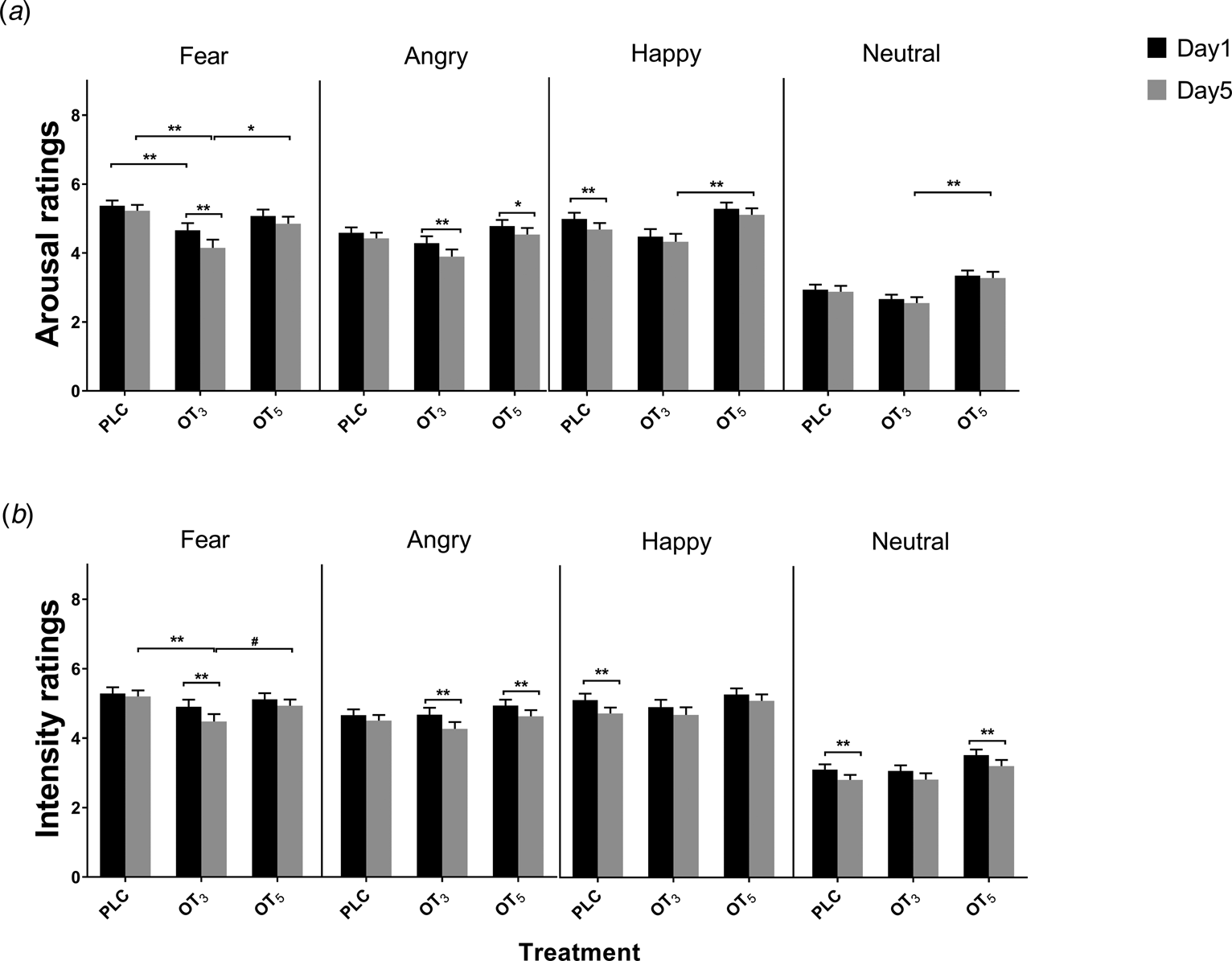
Mixed ANOVAs on the behavioral data revealed a significant main effect of the treatment group on arousal ratings (arousal: F 2, 135 = 5.06, p = 0.008, η 2p = 0.07) due to the ratings generally being lower in the OT3 group. There was also a marginal significant treatment group × time point × face emotion interaction effect for arousal (F 6405 = 1.83, p = 0.093, η 2p = 0.03) and a significant one for intensity (F 6405 = 3.327, p = 0.004, η 2p = 0.05). Post-hoc analysis showed that intensity ratings were significantly reduced for fear faces in the OT3 group on the fifth day (fear: p = 0.004 v. PLC, d = 0.62, 95% CI, −1.299 to −0.247, p = 0.088 v. OT5, d = 0.33, 95% CI, −0.968 to 0.068). Exploratory post-hoc analysis of arousal ratings revealed a similar reduction to fear faces on day 5 (p = 0.001 v. PLC, d = 0.77, 95% CI, −1.544 to −0.420, p = 0.033 v. OT5, d = 0.42, 95% CI, −1.158 to −0.051). Arousal ratings to fear faces were also decreased in the OT3 group on the first day compared to the PLC group but not the OT5 group (arousal: p = 0.015 v. PLC, d = 0.60, 95% CI, 0.129–1.175, p = 0.355 v. OT5, 95% CI, −0.268 to 0.744). Arousal and intensity ratings to angry faces were reduced on day 5 compared with day 1 in the OT3 (arousal: p = 0.001, d = 0.30, 95% CI, 0.164–0.619, intensity: p = 0.001, d = 0.32, 95% CI, 0.173–0.641) and OT5 groups (arousal: p = 0.023, d = 0.19, 95% CI, 0.032–0.461, intensity: p = 0.006, d = 0.26, 95% CI, 0.088–0.526). There were no significant differences for angry, neutral, and happy faces between OT and PLC groups on the first day (ps > 0.194, although OT5 v. PLC was marginal, p = 0.051 for neutral faces) and fifth day (ps > 0.671, although OT3 v. PLC p = 0.053 was marginal for angry faces). There was, however, a significant group difference between OT3 and OT5 on the first and fifth day for happy and neutral faces (ps < 0.007) (Fig. 2). While there was a significant three-way interaction for valence ratings (F 6, 405 = 2.63, p = 0.016, η 2p = 0.04), post-hoc analysis revealed no significant differences between OT and PLC groups on the first (ps > 0.200) or fifth day (ps > 0.173).
The effects of OT on arousal and intensity ratings for face emotions. (a) OT decreased arousal and intensity ratings of fear faces on both the first and the fifth day of treatment in the group receiving OT on alternate days (OT3) compared with PLC and ratings were significantly reduced on day 5 relative to day 1. The group receiving OT every day (OT5) did not show significant effects on either day 1 or 5. No effects of OT on ratings for (b) anger, (c) happy, and (d) happy face emotions. #p < 0.1, *p < 0.05, **p < 0.01 two-tailed. Bars depict standard errors.
The whole-brain voxel-based morphometry analysis revealed no significant effects of acute or repeated doses of OT on gray matter volumes.
Associations between amygdala responses and behavioral ratings to emotional faces
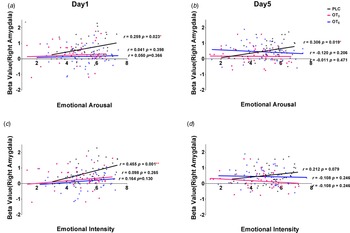
Associations between right amygdala activation (extracted parameter estimates from the right amygdala mask as provided by the Brainnetome Atlas) and emotional arousal and intensity scores to fear faces were observed in the PLC group on the first day (arousal: r = 0.295, p = 0.023; intensity: r = 0.455, p = 0.001) demonstrating that greater amygdala activation in response to fear faces was associated with increased anxiety. This association was absent in both OT groups on the first day (arousal: OT3, r = 0.041, p = 0.398; OT5, r = 0.050, p = 0.366; intensity: OT3, r = 0.098, p = 0.265; OT5, r = 0.164, p = 0.130). A similar trend occurred on the fifth day (arousal: PLC, r = 0.306, p = 0.019; OT3, r = −0.011, p = 0.471; OT5 group, r = −0.120, p = 0.206; intensity: PLC, r = 0.212, p = 0.079; OT3, r = −0.108, p = 0.246; OT5 group, r = −0.043, p = 0.385) (Fig. 3). There was a similar relationship with responses to angry faces for intensity but not arousal ratings in the PLC group on the first day (arousal: r = 0.107, p = 0.240; intensity: r = 0.297, p = 0.023). No associations were found for responses to neutral or happy faces.
Associations between intensity and arousal ratings of fear faces and amygdala activation in the PLC and two OT treatment groups (OT3 and OT) on days 1 and 5. The magnitude of the right amygdala (from the Brainnetome Atlas) responses was positively correlated with arousal and intensity ratings in the PLC group on day 1 but not in the OT groups. There was a similar trend on day 5. *p < 0.05. **p < 0.01 (Pearson correlation).

Primary outcome measure: effects of acute and repeated OT doses on resting-state functional connectivity
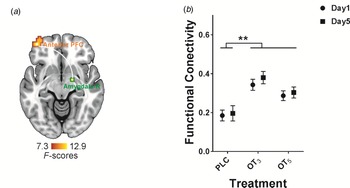
To facilitate a more precise localization of the coordinates of the amygdala for the resting state analysis, a voxel-wise mixed ANOVA with treatment group (PLC, OT3, and OT5) as between-subject, time point (first and fifth day) and face emotion (happy, neutral, angry, and fear) as a within-subject factor was computed on the task-based data. This analysis revealed a significant three-way interaction effect in the right amygdala after small volume correction for the bilateral mask encompassing the entire amygdala (k = 7, p FWE = 0.021, F 6405 = 4.47, peak MNI co-ordinate: x = 18, y = −7, z = −16) (Fig. 4a) confirming the findings from the ROI analysis, which revealed a significant interaction effect for the right amygdala only. An amygdala seed-to-whole brain fMRI resting-state analysis employing this region as seed (six radius spheres centered at x = 18, y = −7, z = −16) by mixed-effect ANOVA revealed a main effect of treatment (OT3, OT5, and PLC) on amygdala functional coupling with the anterior prefrontal cortex (peak MNI coordinate x = −3, y = 53, z = −19, F 2, 135 = 16.55, p FWE = 0.001, k = 88) (see Fig. 4a) but no treatment group × time point interaction. Right amygdala intrinsic connectivity with the prefrontal cortex was stronger in both the OT3 (k = 74, p FWE = 0.014, x = −3, y = 53, z = −19) and OT5 groups (k = 127, p FWE = 0.001, x = −3, y = 53, z = −19) relative to PLC. The OT3 and OT5 groups did not differ significantly on the first (p = 0.147) or fifth (p = 0.107) day (see Fig. 4b). Correlation analysis revealed no significant association between resting state and amygdala task-related changes (r = −0.08, p = 0.59 in the PLC group) or behavioral ratings of emotional faces (−0.085 < r < 0.055, p > 0.57).
The effects of OT on resting-state functional connectivity (a) schematic visualization of the identified functional pathway between the right amygdala and anterior prefrontal cortex (replicating Eckstein et al., Reference Eckstein, Markett, Kendrick, Ditzen, Liu, Hurlemann and Becker2017). (b) Seed to the whole-brain analysis of functional connectivity (FC, seed region right amygdala, 6 mm sphere, x = 18, y = −7, z = −16) revealed significantly increased functional connectivity between the right amygdala and anterior prefrontal cortex (p FWE = 0.039, x = −36, y = 59, z = −7) in both OT treatment groups (OT3 and OT5) on both, days 1 and 5 relative to PLC. Line graphs depict the extracted parameter estimates from right amygdala connectivity with anterior prefrontal cortex (M ± s.e.). *p < 0.05, **p < 0.01 two-tailed. Bars indicate standard errors.

Secondary outcome measure: associations between OT effects and OXTR genotype
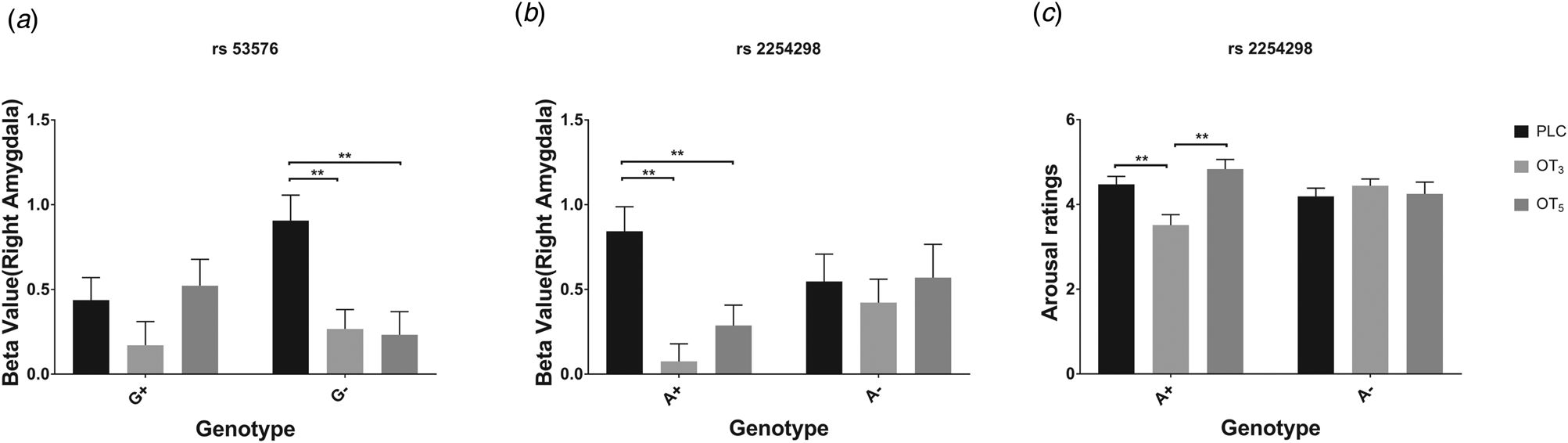
The number of G-carriers and G-non-carriers of rs53576 and A-carriers and A-non-carriers of rs2254298 did not differ between the three groups and both SNPs satisfied Hardy–Weinberg equilibrium (see online Supplementary material Tables S2 and S3). A four-way mixed ANOVA with treatment group and genotype as between- and time point and face emotion as within-subject factors revealed significant treatment × genotype interactions for both rs2254298 and rs53576 (rs 2254298: F 2, 105 = 3.17, p = 0.046; rs53576: F 2, 105 = 3.23, p = 0.044) for amygdala responses to emotional faces, although they would not survive a Bonferroni correction for four genotypes (i.e. p < 0.0125). Post-hoc analysis showed that reduced amygdala reactivity to emotional faces in both OT groups occurred in A-carriers of rs2254298 (ps < 0.009) but not A-non-carriers (ps > 0.587) and G-non-carriers of rs 53576 (ps < 0.002) but not G-carriers (ps > 0.196) (see Fig. 5a, b). For behavioral ratings, there were significant treatment group × genotype interactions for both arousal and intensity ratings for rs2254298 (arousal: F 2,105 = 6.60, p = 0.002, η 2p = 0.11; intensity: F 2, 105 = 3.85, p = 0.024, η 2p = 0.07). Post-hoc analysis showed that decreased ratings for faces in the OT3 group only occurred in A-carriers (arousal: v. PLC: p = 0.002, d = 4.68, 95% CI, 0.363–1.524 and OT5: p < 0.001, d = 6.56, 95% CI, 0.743–1.904; intensity: PLC: p = 0.021, d = 3.40, 95% CI, 0.109–1.301; OT5: p = 0.003, d = 4.40, 95% CI, 0.314–1.507). No significant main or interaction effects involving treatment and genotype were found for resting-state functional connectivity between amygdala and prefrontal cortex (rs 2254298 all p > 0.123; rs53576 all p > 0.566).
Influence of OT receptor genotype on the effects of intranasal OT on right amygdala and behavioral responses to face emotions (n = 111 subjects). (a) For rs53576, only G-non carriers (i.e. AA) showed reduced amygdala responses to faces (PLC, n G+ = 15, n G− = 21; OT3, n G+ = 17, n G− = 24; OT5, n G+ = 20, n G− = 14); (b) for rs2254298, only A-carriers (i.e. AA and AG) in the groups with intranasal OT treatment showed reduced amygdala responses to faces (PLC, n A+ = 20, n A− = 16; OT3, n A+ = 23, n A− = 18; OT5, n A+ = 20, n A− = 14); (c) for rs2254298, only A-carriers (i.e. AA and AG) in the groups with intranasal OT treatment showed reduced emotional arousal ratings **p < 0.01, two-tailed t test (Bonferroni corrected significance threshold of p = 0.0125). Bars indicate standard errors.

Discussion
Overall, our findings validate OT reductions in amygdala responses to face emotions and associated emotional intensity and arousal ratings for fear faces, together with increased resting-state functional connectivity between the amygdala and prefrontal cortex as robust markers for its putative therapeutic mechanisms of action. While these task-dependent and resting-state effects of OT show a different sensitivity to repeated intranasal doses and OXTR genotype our findings indicate that to achieve maximal effects of chronic treatment on neural and behavioral responses to face emotion stimuli and resting-state changes the optimal protocol may be to administer 24 IU doses every other day rather than daily.
Our findings are highly consistent with preclinical animal models demonstrating OXTR desensitization following repeated doses of OT in some brain regions (Terenzi & Ingram, Reference Terenzi and Ingram2005; Smith et al., Reference Smith, Ayad, Mundell, McArdle, Kelly and López Bernal2006; Stoop, Reference Stoop2012) and that chronic administration can reduce brain OXTR expression (Du et al., Reference Du, He, Cai, Hao, Dong, Yuan and Tai2017) and alter patterns of neurochemical release (Benner et al., Reference Benner, Aoki, Watanabe, Endo, Abe, Kuroda and Kasai2018). Importantly, chronic doses of OT in rodents fail to produce anxiolytic effects normally seen with single doses (Du et al., Reference Du, He, Cai, Hao, Dong, Yuan and Tai2017), which mirrors our present observations. The apparent long-lasting desensitization effects of daily OT administration on amygdala responses to threatening and happy faces may be contributed to by dose magnitude and so possibly lower daily doses might be less problematic. We also observed some evidence for reduced amygdala and behavioral responses to repeated emotional face presentations in the PLC group in line with previous observations (Fischer et al., Reference Fischer, Wright, Whalen, McInerney, Shine and Rauch2003; Wright et al., Reference Wright, Fischer, Whalen, McInerney, Shin and Rauch2001), even though different sets of face stimuli were used at the two time-points. This may have served to reduce the time-dependent effects of OT to some extent.
The amygdala is one of the main neural substrates mediating OT's functional effects and its attenuation of reactivity to threatening stimuli is considered as a putative primary therapeutic mechanism of action (see Jurek & Neumann, Reference Jurek and Neumann2018; Kendrick et al. Reference Kendrick, Guastella, Becker, Hurlemann and Grinevich2017; Neumann & Slattery, Reference Neumann and Slattery2016). However, in the current study, we demonstrated similar effects of OT in reducing the right amygdala responses to all emotional faces, although desensitization effects were only significant for threatening (fear and anger) and happy faces. While some previous studies have found effects of OT only for fear faces (Spengler et al., Reference Spengler, Schultz, Scheele, Essel, Maier, Heinrichs and Hurlemann2017) or for fear and angry ones (Kirsch et al., Reference Kirsch, Esslinger, Chen, Mier, Lis, Siddhanti and Meyer-Lindenberg2005), our current findings are in agreement with a number of others reporting that it can reduce amygdala responses to both positive and negative (Domes et al., Reference Domes, Heinrichs, Gläscher, Büchel, Braus and Herpertz2007) or all face emotions (Koch et al., Reference Koch, van Zuiden, Nawijn, Frijling and Veltman2016; Quintana et al., Reference Quintana, Westlye, Alnaes, Rustan, Kaufmann, Smerud and Andreassen2016). A possible explanation for these differences could be that studies, including our own, using presentation strategies where subjects are not directly required to identify or discriminate between face emotions (Domes et al., Reference Domes, Heinrichs, Gläscher, Büchel, Braus and Herpertz2007; Koch et al., Reference Koch, van Zuiden, Nawijn, Frijling and Veltman2016; Quintana et al., Reference Quintana, Westlye, Alnaes, Rustan, Kaufmann, Smerud and Andreassen2016) have tended to report valence-independent results. Importantly, however, only the magnitude of amygdala responses to fear faces was positively associated with arousal and intensity ratings in the PLC group, and OT exerted an anxiolytic action by both reducing these ratings and abolishing their correlation with amygdala activation. Dysregulations in amygdala and behavioral responses to threatening stimuli have been observed across major psychiatric disorders, particularly those characterized by marked social impairments and anxiety (Hennessey, Andari, & Rainnie, Reference Hennessey, Andari and Rainnie2018; Neumann & Slattery, Reference Neumann and Slattery2016). There was some evidence that behavioral anxiolytic effects of OT were greater after repeated compared to single doses in the group receiving OT every other day for angry faces but not in terms of amygdala responses. Possibly the short 5-day period for OT treatment was not sufficient to demonstrate robust enhancement effects of repeated doses and time-dependent enhancement effects of longer duration treatment need to be investigated in studies on clinical populations.
A major finding from our secondary outcome measure is that OT's attenuations of neural and behavioral responses to face emotions are highly dependent on the OXTR genotype. Only G non-carriers of rs53576 and A-carriers of rs2254298 showed significant reductions in amygdala responses to face emotions under OT although only A-carriers of rs2254298 showed evidence for significant reductions in arousal and intensity ratings. A-carriers of both SNPs have frequently been associated with social dysfunction in autism and social anxiety disorders (Cataldo et al., Reference Cataldo, Azhari and Esposito2018; Jurek & Neumann, Reference Jurek and Neumann2018). A recent haplotype-based analysis of OXTR SNPs including rs53576 and rs2254298 also indicated an association with sensitivity to OT effects on face recognition (Chen et al., Reference Chen, Kumsta, Dvorak, Domes, Yim, Ebstein and Heinrichs2015).
Interestingly, task-related and intrinsic network changes produced by OT showed a strikingly different sensitivity to repeated doses and OXTR genotype and there were no associations between resting-state connectivity and either amygdala or behavioral responses to face emotions. However, for the resting-state effects of OT, there was no advantage of giving OT daily as opposed to every other day. Intrinsic networks may, therefore, be less sensitive to the effects of repeated OT administration or OXTR genotype than those engaged by external social-emotional stimuli, although arguably the effects of OT on neural processing during the actual processing of social cues should be of greatest therapeutic relevance.
There are several limitations to the current study. Firstly, we only included male subjects to increase relevance to potential therapeutic use in autism and to avoid menstrual cycle effects. There is, however, increasing evidence for sex-dependent effects of OT, notably for amygdala responses (Gao et al., Reference Gao, Becker, Luo, Geng, Zhao, Yin and Kendrick2016; Jurek & Neumann, Reference Jurek and Neumann2018; Lieberz et al., Reference Lieberz, Scheele, Spengler, Matheisen, Schneider, Stoffel-Wagner and Hurlemann2019; Luo et al., Reference Luo, Becker, Geng, Zhao, Gao, Zhao and Hu2017) and also for rs53576 (Feng et al., Reference Feng, Lori, Waldman, Binder, Haroon and Rilling2015). Thus, females may show different responses to repeated doses of OT and associations with a receptor genotype. Secondly, for the genotype analysis, subject numbers are relatively low for establishing robust associations. While treatment × genotype interactions only passed Bonferroni correction for arousal ratings, post-hoc tests for both behavioral and amygdala effects were highly significant. . The AA allele of rs53576 also occurs more frequently in Asian and Caucasian populations (Butovskaya et al., Reference Butovskaya, Lazebny, Sukhodolskaya, Vasiliev, Dronova, Fedenok and Butovskaya2016). Finally, we only examined the effects of one dose and time course for the effects of OT and there may be dose-dependent and temporal variations. The 24 IU dose and 45 min post-treatment time course used are the same as in many previous studies demonstrating both task and resting-state effects of OT (Kendrick et al., Reference Kendrick, Guastella, Becker, Hurlemann and Grinevich2017) and maximal effects on reduced amygdala responses to fear faces occur with a 24 IU dose from 45–75 min (Spengler et al., Reference Spengler, Schultz, Scheele, Essel, Maier, Heinrichs and Hurlemann2017). However, higher doses may produce different effects (Spengler et al., Reference Spengler, Schultz, Scheele, Essel, Maier, Heinrichs and Hurlemann2017) and a recent regional cerebral blood flow study has reported reduced resting amygdala activity at shorter time points following 40 IU intranasal OT (Martins et al., Reference Martins, Mazibuko, Zelaya, Vasilakopoulou, Loveridge, Oates and Paloyelis2020).
In conclusion, the current study provides the first evidence for an important influence of OT dose frequency and receptor genotype on its modulation of neural and behavioral responses to emotional faces in healthy human subjects. Dose frequency, therefore, requires further empirical evaluation in patient populations given that it can critically determine treatment efficacy in clinical trials employing chronic administration.
Supplementary material
The supplementary material for this article can be found at https://doi.org/10.1017/S0033291720003803
Acknowledgements
We thank the reviewers and editor for their comments and suggestions for improving the manuscript. This project was supported by the National Natural Science Foundation of China (NSFC) grant numbers 31530032 (KMK) and 91632117 (BB).
Author contributions
JK and KMK designed the experiment. JK, YZ, and CS carried out the experiment. JK, KMK, CM, FZ, and BB analyzed the experiment, and JK, KMK, CM, and BB wrote the paper. All authors contributed to the conception of the study and approved the paper.
Competing interests
The authors declare that they have no competing interests.