Introduction
A news story broadcast on July 4, 2015 reported on a phenomenon that has become all too familiar in Turkey—but this time the news had acquired a new dimension. A minibus carrying seasonal migrant workers had an accident in Tokat province; one worker died and 20 others were injured. Riding in overloaded minibuses or even trucks while trying to find work in various parts of Anatolia, seasonal migrant workers in agriculture have accidents that often result in casualties. Such car accidents are emblematic of the precarious working conditions in agricultural labor markets. Nevertheless, this particular accident pointed at a new phase in agricultural work in Turkey: all of the workers in that minibus were Syrian migrants, a new reserve for cheap labor in Turkey.
Turkey is a major destination for Syrian refugees. The United Nations High Commissioner for Refugees (UNHCR) has published on its website that, as of May 2016, there were 2.7 million registered Syrian refugees in Turkey. This article is an attempt to shed light on just one particular consequence of this refugee flow; namely, the condition of migrants within a particular labor market, seasonal migrant work in agriculture. The labor dimension is significant given the extent of informality and volatility in the Turkish labor market. Arguing that precarity is a relational concept and that integration into the labor market does not necessarily end one’s precarity—it might actually worsen it—this article seeks an answer to the following questions: what does precarity mean in the lower segments of the labor market in an economy that is characterized by high levels of employment informality (around 86 percent in agriculture and 32 percent in non-agricultural jobsFootnote 1 ) and how does precarity relate to (migrant) workers’ lives? How does this large influx of people affect the structure of the agricultural labor market in Turkey, which is already defined by extensive informality and insecurity? In this context, I have developed two related arguments. One is that labor precarity—the condition of lacking predictability, job security, and material welfare—is relational in the sense that it does not just affect groups such as migrants, refugees, or subordinated ethnic groups (although they may indeed be vulnerable), but also creates a centripetal force that pushes the labor market in a more insecure and informal direction through the resonation of precarity and livelihood pressures. Second, relational precarity functions through “adverse incorporation” in the lower segments of the labor market.Footnote 2 Adverse incorporation allows us to capture dynamic and inter-related processes in the lower segments of labor market, where the workers are not excluded from the labor market but rather incorporated into it through adverse terms that stem from already existing vulnerabilities. These conditions pose difficulties that prevent people from entering the formal labor market, and therefore they also limit access to welfare schemes and result in poverty and deprivation of any means that might allow upward mobility. For migrants, adverse terms also include legal status in the host country, language and cultural barriers, and serious livelihood pressures. All of the adverse terms experienced by both local workers and migrants in the lower segments of the labor market result in a situation of hyper-precarity. Hyper-precarity indicates a labor market position characterized by workers’ diminished capacities of negotiation and an urge to tackle short-term livelihood pressures at the expense of long-term accumulation and social reproduction strategies, and it is experienced by local workers and immigrants alike.Footnote 3
This article is based on analysis of the transformation of the labor market in seasonal migrant labor in agriculture with the arrival of refugees from Syria. There is an overlap between the areas that attract seasonal migrant labor and the major points of entry of Syrian refugees. As of 2014, around 500,000 Syrian refugees were living in Şanlıurfa, 330,000 in İstanbul, 253,000 in Gaziantep, and 204,000 in Hatay.Footnote 4 Though significant numbers have relocated outside the region, it is no surprise that most of the refugees have chosen border cities to settle in, since former kinship ties, relatively smaller language barriers, and chain migration all contribute to the directions of migration. The southern and southeastern provinces where Syrian refugees first enter Turkey are also regions where the demand for temporary labor in agriculture is relatively high. Hence, temporary work in agriculture is one of the main income-generating activities available for the refugees. Şanlıurfa, where almost half of a million refugees live, is the major province from which seasonal agricultural laborers originate (accounting for up to 60 percent); thus, encounters between Syrian refugees and Turkish seasonal migrant workers do not only take place in the provinces where they both travel to work, but also in the provinces where they live. Both types of provinces are included in the research here.
Hometowns of migrant households Source: Ministry of Labor and Social Security Statistics, 2010

Methodology
The data for this article comes from intensive field research in the rural areas of ten provinces across Anatolia—namely, Adana, Şanlıurfa, Samsun, Afyon, İzmir, Konya, Aksaray, Kayseri, Düzce, and Ordu—that took place between February and November 2014. The provinces were chosen from among those where the demand for migrant labor is high according to statistics and previous research on the phenomenon.Footnote 5 Malatya and Giresun could not be included in the fieldwork because of a frost during the spring of 2014 which severely reduced the yield. However, this misfortune did enable the research team to observe how migrant households survived when faced with a major contraction in labor demand.
A two-fold strategy was pursued during the field research. The first part was a household survey designed to collect information on both an individual and a household levels in order to assess household structures, income, poverty, working conditions, and access to welfare services, which allowed us to map out characteristics of precarity. At the individual level, questions were asked regarding gender, age, civil status, literacy, education level, school attendance by children, and occupational status. At the household level, the questions related to place of origin, migration history and motives, property ownership, social security and social aid, housing, indebtedness, and sources of income. As a sampling method, probability proportional to size (PPS) was used, whereby the number of surveys was decided according to the size of workers’ camps. Surveys were conducted face to face and lasted at least half an hour, in order to avoid validity biases.
The second part of the research was qualitative and consisted of semi-structured, face-to-face, in-depth interviews and focus group interviews with migrant workers. Gender-balanced random sampling was used. Questions were asked relating to migration experience; labor relations between workers, intermediaries, and farm owners; reasons for migration; and socioeconomic status. Moreover, although this article is not directly related to the experience of Syrian refugees, indepth interviews with 15 Syrian migrant workers were also incorporated into the field research.
A total of 168 household surveys and 85 in-depth interviews were conducted with seasonal migrant workers in agriculture. The survey data consists of information on 1,353 people—660 male and 693 female—who are either seasonal migrant workers or who are affected directly by the activity.
Precarity, migrant labor and adverse incorporation
Though precariousness is always multi-dimensional, it has some basic features. The precariat is defined as a class of laborers who have lost the characteristics of the proletariat because of neoliberalism and post-Fordism, maintaining their subsistence through insecure, temporary, and mostly informal activities.Footnote 6 Precariousness may include employment precarity, poverty, short-term employment, difficulties in entering the labor market, gender-related inequalities, and so on. It conveys a difficulty to obtain an income stable enough to subsist without complementary social transfers.Footnote 7 At the lower end of the labor market, there is an increasing reliance on migrant labor where the work is not only temporary and insecure, but also low paid and exploitative. Standing describes how undocumented migrants provide cheap labor and how this contributes to productivity, as well as how international migrants occupy an increasingly important role in the heartlands of global capitalism.Footnote 8
As several studies have demonstrated,Footnote 9 migrants go through various immigration and sociolegal statuses while trying to cope with serious livelihood pressures. Therefore, so as to secure work, they are at risk of entering the labor market at its lowest end, where marginalization and exclusion are already widespread. These constraints on migrants contribute to hyper-precarity, which refers to a situation in which workers are captured between multifaceted insecurities and uncertainties related to both work relations and their broader socioeconomic positioning in society. Moreover, for migrants, these insecurities are also related to their exclusion, in law and in practice, from a wide array of social, economic, and civil rights in the host state, which can result in extremely exploitative conditions.Footnote 10 In such a situation, the question becomes, how are we to analyze precarity in the lower strata where migrants, especially undocumented migrants, are present?
The impact of immigration on the labor market has predominantly been analyzed within the framework of labor market segmentation theories. Segmentation theories address the dual market structure (i.e., divided along formal-informal lines) in developing countries, and seek to explain labor market discrimination, especially towards disadvantaged groups such as immigrants, ethnic minorities, and women.Footnote 11 Segmentation theory thus posits that women,Footnote 12 minorities,Footnote 13 and working class peopleFootnote 14 are trapped in lower labor market segments, and that these gender, ethnicity, and class effects often overlap and create social exclusion. Even so, segmentation theory provides only a partial picture of the labor relations and class positions in informal labor markets, as it focuses on the experiences and exclusion of immigrants and other disadvantaged groups, but not the transformation of the lower segments of the labor market as a whole. The concept of social exclusion has also been criticized for stifling “attention to exploitation in explaining impoverishment,” as stated by Philips.Footnote 15
Alternatively, the concept of “adverse incorporation” refers to a situation in which workers’ prospects for better income and longer-term security are significantly impeded, thus perpetuating their chronic poverty and vulnerability. Adverse incorporation points not only to the condition of socioeconomic exclusion as the major source of poverty and marginalization, but also to the terms under which different social groups are integrated into economic activity in relation to each other.Footnote 16 Poor people are not excluded from, but rather integrated into markets in a way that perpetuates their chronic poverty, largely because particular forms of employment offer few or no prospects for social reproduction and accumulation. As Philips says:
[P]overty and vulnerability consequently become chronic, and the possibilities for exploitation are enhanced, as a huge “reserve army” of vulnerable workers is created, overwhelmingly informal in nature, often highly mobile and substantially unprotected. The dynamics of adverse incorporation are thus circular: poverty generates vulnerabilities among workers, which facilitate their exploitation; their exploitation in turn serves as the key mechanism of impoverishment.Footnote 17
As compared to segmentation theory or the social exclusion paradigm, there is merit in using the concept of adverse incorporation in the analysis of the inter-group relations in seasonal migrant work in agriculture because all the workers in this segment of the labor market are already defined as marginalized and excluded. Analyzing this phenomenon through the aforementioned conceptual lens provides a good framework for understanding both the social and economic processes in action and the impact of the influx of refugees. The following section will describe the main features of seasonal migrant work in Turkey, including the extent of informality and chronic poverty in the labor market in which Syrian refugees find themselves the moment they arrive in Turkey.
Precarity in seasonal agricultural work in Turkey
Seasonal agricultural labor is a cheap way of satisfying the demand for labor in agricultural production around the world, and Turkey is no exception to this. There are certain common characteristics among worker households that generate vulnerabilities in the labor market. Household structures and lack of access to basic welfare services point to precariousness.Footnote 18 There is also a spatial dimension to this precarity in terms of the origins of migrant workers: according to survey results, 81.1 percent of migrant families come from southeastern Turkey—predominantly from Şanlıurfa, Mardin, and Diyarbakır—as Map 1 confirms. 100 of the 168 surveyed households (60 percent) are from Şanlıurfa.
The percentage of the households who own land is just 7 percent, and their holdings are smaller than 10 acres per household. Most households who migrated to the provincial center stated that they were either sharecroppers or subsistence farmers. This region has a history of large land ownership, which is one of the most important reasons behind seasonal migration. Landlessness is arguably a structural factor leading to poverty and migration in Şanlıurfa and its surroundings. Data on the size and numbers of farms in Şanlıurfa shows that almost half of the total land is comprised of farms between 500 and 5,000+ acres (see Table 1).Footnote 19
Table 1: Size of Land Holdings, Turkey and Şanlıurfa

Source: TURKSTAT
Agricultural work is difficult, tiring, and generates low income. Households have a propensity to exploit family labor because the more household members work on the farms the more income is generated. Meanwhile, those who do not work in the field do housework (tents in the current case) and take care of the younger children. As a consequence, the children’s schooling is interrupted: 12 percent of the children in the surveyed households left school in the age cluster of 5–12, with the rate rising to 36 percent in the age cluster of 12–15; only 27 percent in the age cluster of 16–18 continue their education. Children become active participants of seasonal migration, working in the fields, looking after their siblings, and not going to school.
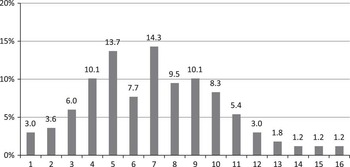
Figure 1 shows that households are large, with an average household size of 8 people, as compared to the nationwide average of 3.7. Almost a quarter of the households have more than 10 people. It is important to note that 69.6 percent of the households are nuclear families; therefore, it is clear that the number of the children per household is higher.
Distribution of household size

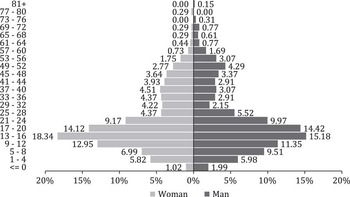
Figure 2 below shows the age distribution in seasonal migrant households. The share of the population below the age of 33 is significantly high, and so we might suggest that the relevant activities are carried out by a very young portion of the society.
Age distribution of migrant household members

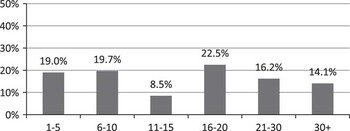
Responses to the question on the length of time for which families have been earning a living on seasonal agricultural work give us an understanding of the structure of seasonal labor migration (Figure 3). More than 60 percent of the respondents have been subsisting on seasonal agricultural work for more than 10 years, whereas more than 30.3 percent have been doing so for more than 20 years.
Length of subsistence on migrant work (years)

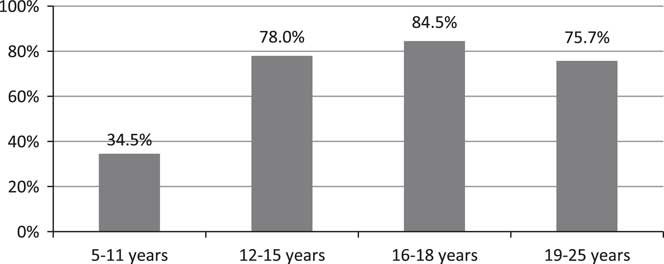
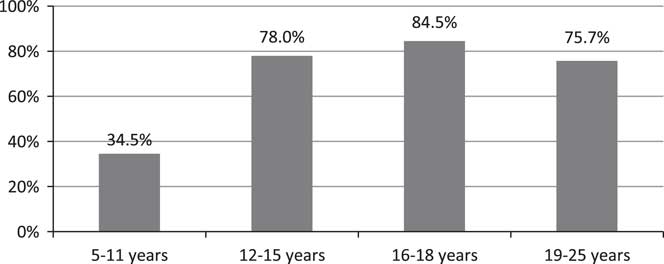
The younger population distribution, combined with longer periods of subsistence on agricultural work, suggests that it is difficult for the children of migrant families to escape this cycle of poverty, vulnerability, and precariousness, and thus that the process is likely to reproduce itself. In this way, poverty becomes chronic. Figure 4 below shows the age distribution of children working in the field: 34.5 percent of the children between the ages of 5 and 11 work in the field, while more than three-fourths of the children above the age of 12 work in the fields.
Age distribution of working children
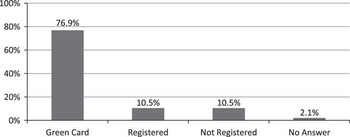
Social security data is also telling concerning the precariousness of this segment of the labor market (See Figure 5). As shown in Figure 5, only 5.6 percent of the workers have social security, while 76.9 percent benefit from the green card, which provides free healthcare to people living below the poverty line based on a means test. Even though those with a green card are covered by basic health services, it is important to note that this type of coverage does not include retirement pensions; in other words, it does not provide social security. 10 percent of the people do not have any kind of social security coverage.
Access to social security

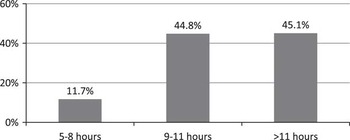
Figure 6 is beneficial to understanding the degree of exploitation in terms of working hours: about 90 percent of the workers work for more than nine hours per day. However, the daily wages per day per worker were around 40 liras (12.5 Euros, according to the exchange rate in March 2016).
Working hours per day

We observed two forms of payment during the field research: the first and most widespread is the daily payment of a wage, called yevmiye in Turkish, while the second is a lump sum payment calculated according to the size of the land a family works on. Figure 7 shows the average amount of money the workers earn. The daily wages are between 35 and 45 liras, while the lump sum payments are more varied. It is difficult to assess the income earned through lump sum payments because these depend on the household labor capacity and the number of people working in the field. However, it is important to note that families have a tendency to overexploit the household aggregate labor capacity in order to work more land and thus earn more money. In places where lump sum payment is widespread, such as the sugar beet fields of central Anatolia, the extent of child labor is more severe because of this tendency.
Daily wages and lump sum payments (TL)

Chronic indebtedness, which is one of the defining features of precariousness, is widespread among seasonal agricultural workers. 65 percent of the households stated that they have debts. Among those, 18.9 percent are indebted to banks and 4.2 percent to state institutions, while more than 50 percent are indebted to usurers or acquaintances, usually at very high interest rates. Informality brings about more informality, even in indebtedness. The remarks below—made by a female interviewee (33) from Şanlıurfa who was working in Adana’s watermelon fields—present a clear example of how easy it is for a seasonal migrant family to get into debt.
“We do not have a house; we stay with our relatives [whenever we go to the village]. We used to have a house but we sold it in order to pay our debts.”
Question: Why did you need to borrow money?
“Just debt; there was a blood feud, then we sold the house. My husband’s brother died; he was shot but he did not die instantly. He was in the hospital for nine days. My husband stayed with him, too. The hospital has cost a lot, my husband got into debt. We sold our field and everything. The debt was around 100,000 liras.”
The unexpected event, a blood feud involving the family, disrupted the livelihood of this household, who had once farmed their own land. Having to take care of an injured relative with no social security, they borrowed money, for which they had to sell their farmland and house, thereby being forced to start working as seasonal migrant workers throughout Anatolia, together with their five children. Though it had been ten years since the incident, the family was still paying off the debt that had initially stemmed from just nine days of intensive care at the hospital.
In sum, seasonal agricultural work is a segment of the labor market defined by high levels of vulnerabilities at both the social and the economic level. The exploitation is intense and the insecurities multifaceted. Escaping from this cycle of poverty and vulnerability is rendered difficult by a myriad of structural factors, ranging from the extent of informality to patterns of land ownership. Moreover, the influx of Syrian refugees and their joining the labor market in seasonal agricultural work has clearly complicated this already precarious picture.
Seasonal agricultural work and the adverse incorporation of Syrian refugees
Refugees from Syria have inevitably joined this reserve labor force of precarious workers because their vulnerabilities are multifaceted and compounded by their ambiguous legal status. As of March 2016, around 270,000 Syrians were residing in camps according to figures from the Disaster and Emergency Management Authority (Afet ve Acil Durum Yönetimi, AFAD), which suggests that the vast majority live in towns and cities. The urban refugees face difficulties in finding housing, paying rents, finding employment, and accessing healthcare and the education system.Footnote 20 AFAD data suggests that at least one-third of the refugees living in cities are not registered,Footnote 21 which indicates that they lack any legal status and therefore have no access to the public services provided to registered refugees. As a result, these Syrians are especially vulnerable to informality inasmuch as their legal invisibility puts them even deeper into precarity and informality. Since seasonal agricultural work is already primarily informal, it represents one of the few income-generating options for Syrian refugees. What is more, the provinces close to the Syrian border—such as Adana, Mersin, Şanlıurfa, and Hatay—are the very same places with larger land ownership and more commercialized farming, which makes the demand for such labor still more widespread.
Our in-depth interviews with Syrian workers demonstrated that there is almost a generic pattern to their experiences in the agricultural labor market. The story of one Syrian family interviewed in a one-room house in Viranşehir, a district of Şanlıurfa, reflects the situation and conditions shared by most Syrian migrant workers. A labor intermediary (dayıbaşı) from Şanlıurfa had a deal with 60 Syrian refugees from Viranşehir and took them to Antalya to pick citrus fruits. The initial deal was that the daily wage would be 50 liras per worker and all costs would be paid by the intermediary—which, once they arrived in Antalya, turned out to be a false promise. The intermediary first deducted the accommodation costs, and the daily wage was reduced to 36 liras. Then, he began to charge the workers for food and transportation expenses. They stayed in Antalya for two months and worked for one month, from four in the morning until seven in the evening, and were able to earn just enough money to get them back to Şanlıurfa. The intermediary received the money from the landowner but did not pay the workers their promised earnings. Demands on the workers’ side went unanswered, or else were countered by the intermediary’s threat of deportation through official complaint. Although Syrians cannot be legally deported owing to the temporary protection status granted by Turkey, deportation was still used as a threat nevertheless.
The Syrian refugees stated that they found temporary agricultural work upon crossing the border. The adverse incorporation of Syrians into the labor market resulted in undesirable conditions both for the Syrian refugees and for Turkish-citizen seasonal migrant workers. In short, the entry of the Syrian refugees into the seasonal agricultural labor market did not diminish the native workers’ precariousness: in this labor market, both the Syrians and the Turkish citizens continued to suffer from intense poverty and exploitation.
If we follow the migration route of the workers, we can assess how the labor market was transformed and see the adverse terms that such refugees have encountered. Overall, the daily wages and amount of work per worker represent the two major adverse conditions that directly affect the workers. The sudden increase in the labor supply has led to stagnation of the level of daily wages and a reduction in the average amount of work per household, thus leading to a reduction in earnings per household as well. The amount of seasonal labor necessary for a landowner is more or less constant. The oversupply of labor thus acts as a double-edged sword. As the field research in Afyonkarahisar province shows, the amount of the days spent by a family in one location for agricultural work decreased drastically over the last few years because of the increase in the labor supply.
Cherry cultivation is the major production activity in the Sultandağı district of Afyonkarahisar. Cherries have a labor-intensive harvest, and so Sultandağı attracts seasonal labor migration during the cherry-picking season. The size of the cherry harvest is more or less constant if there is no sharp fall due to climatic conditions, which would result in a worse situation for farmers and workers both. Hence, the total number of worker days required is approximately constant for the province. Moreover, once the cherries ripen, farmers want to harvest and sell them as quickly as possible because they face market insecurities. The increase in the labor supply decreases the number of days worked per person and per household, since the farmers want the harvesting to be finished as soon as possible, which in turn means a decrease in the income earned by the workers. As one seasonal migrant worker from Diyarbakır (male, 18) summarized: “This year [in Sultandağı] there are a lot of workers. This work used to take 40–45 days here; this year it ended in 20 days.” The situation in Adana was similar. Most of the respondents stated that the numbers of workers had increased such that they could not find as much work as they had in previous years.
The following statement from an interview with a young man from Şanlıurfa working in the watermelon fields clearly demonstrates this phenomenon: “Normally, you need to earn 40 daily wages [yevmiye] per month for two people. We have been here for three months; we earned 100 yevmiye. We should have earned at least 180. This is very little; there is no work.”
It would be reductionist to attribute the increase in the labor supply solely to the influx of Syrian refugees. Nevertheless, the refugee influx does resonate with other factors that contribute to volatility of this labor market, resulting in the deterioration of working conditions. Our field research demonstrated that there are certain migration paths for the rural workers. For example, those hailing from Şanlıurfa migrate for longer periods, from December/January to September/October; some families do not even return to their homes for several years. The household survey results and in-depth interviews point at a pattern in the migration routes of migrant workers from Şanlıurfa: the routes start in the vegetable and fruit fields of Çukurova, continue on to the sugar beet fields of central Anatolia, and then on to the apricots of Malatya before finally ending with the hazelnuts of the coastal Black Sea region. The workers then return to Şanlıurfa to work in the cotton fields or to Çukurova to work in the citrus orchards.
The livelihood pressures experienced by the refugees, as well as their legal precarity, effectively force them to accept the adverse terms of the labor market. They work for less money and under worse conditions. The labor inflation and the vulnerability of the refugee households has deteriorated working conditions and decreased the aggregate income per household. The disruption started in Adana and then spread to the other provinces of Turkey, creating a domino effect.
Disruption of the worker-work balance
The increase in the number of seasonal migrant workers in Adana stems partly from Syrian migration. This increase has resulted in stagnation, if not reduction, in the level of daily wages. The respondents in Adana stated that their daily wages have not increased over the last two years. The daily wage set in the Yüreğir plain in Adana province was 35 liras, 10 percent of which was paid to the intermediary. Along with the decrease in the number of the days worked, the daily wages remained the same, pointing to a reduction in the purchasing power of migrant workers due to inflation.
The situation deteriorated further due to a frost in the spring of 2014, which drastically decreased the yield of apricots in Malatya and hazelnuts in the eastern Black Sea region, two major crops that require labor for harvesting. This interrupted the seasonal migration of many workers. In response, some of the workers with the means for more mobility attempted to migrate to other regions, resulting in an increase in the labor supply in those places, as evident in the case of Afyonkarahisar mentioned above.
However, as already mentioned, the increase in the labor supply does not stem solely from the influx of Syrian refugees. A worker in Konya (male, 40, Şanlıurfa) stated the following:
Here, Georgian, Afghan workers also do work for lower prices. [The presence of] Syrian workers decreased wages. For example, in Antalya, the daily wage for orange picking decreased from 55 to 40 liras. Syrians arrived and it fell to 40 liras. They have labor intermediaries. The middlemen do not pay 40 liras directly to the Syrians, but they pay 15–20 liras. I do not know how he [the middleman] got the people out of the camps in Adana,
Reyhanlı, Ceylanpınar, Birecik. He makes them work in Polatlı [in Ankara].
This narrative points to another phenomenon that has emerged after the Syrian immigrants joined the market; namely, the involvement of labor intermediaries, a situation that simultaneously contributes to the decrease in daily wages and intensifies the exploitation of the Syrian migrant workers. The intermediaries have bargaining power. In principle, they get a commission of 10 percent on the amount earned by the worker. As such, normally they have an inherent interest in higher wages in that this would increase their commission. However, market conditions may allow a trade-off between the price and the number of workers working with a particular intermediary. For example, in the Çarşamba plain in Samsun, one intermediary proposed 40 liras per day while the going daily wage in the area was 45 liras, which he did because he had better connections with the farmers and the district governor and as a result could have more workers than many other intermediaries. That particular intermediary had more than 150 workers in the region, and so he had the power to lower the daily wage. Even though lowering the wage also decreased his commission, he still managed to earn more because farmers preferred workers from his circle, who would work for lower wages. In this way, he could find work for more workers and attain an advantageous position in the market. A similar pattern is observable in case of the Syrian workers as well. With daily wages stagnant or decreasing with the additional labor supply largely due to the influx of refugees, vulnerability levels rise even higher. Labor intermediaries also prefer Syrians because of the latter’s livelihood pressures, as they accept working for lower wages, which allows the intermediaries to earn much more than the usual 10 percent. This contributes to the strengthening of informal labor relations and the transformation of the labor market in a hyperprecarious direction.
Unregistered Syrians experience serious livelihood pressures: they are in desperate need of work, and seasonal agricultural work places them right at the center of labor exploitation. Further exploitation is caused by their particular vulnerabilities stemming from the war, as well as due to the fact that they do not speak Turkish or even recognize the numbers that are affecting their lives. The intermediaries or farm owners can also make the Syrians work for longer hours and for less money. A worker (male, 55, Şanlıurfa) in Sultandağı stated as follows: “Some labor intermediaries get the money as a lump sum. They agree with the landowner for 100 liras for an acre, but they make daily wage payments to the Syrians of 25 liras per day. Syrians do not know money. That’s how they’re deceived.” Similarly, another worker (male, 50, Şanlıurfa) told us during the fieldwork in Yozgat: “Labor intermediaries are selling the Syrians. If the daily wage is 50 liras, they pay them 20. They make Syrians work just for food. In Adana, one person was giving food to [Turkish citizen] workers but they didn’t give it to a kid from Syria.”
This exploitation deepening though informality, which increases the vulnerabilities of every worker in seasonal agricultural work, becomes even more explicit in the citrus fields of Adana, where the number of Syrian refugees is considerably higher. The struggle in Kobane (a Kurdish-populated Syrian town bordering Şanlıurfa) between the Kurdish People’s Protection Units (Yekîneyên Parastina Gel, YPG) and Women’s Protection Units (Yekîneyên Parastina Jin, YPJ) and the Islamic State of Iraq and the Levant (ISIL) resulted in further displacement of locals and, by the time of the 2014 citrus harvest, these refugees joined the labor force of temporary workers in Adana. During the field research, we observed that Syrian workers in the Doğankent region of Adana, most of whom were Kurds from Kobane, outnumbered the native workers. Their most probable income source is temporary work in agriculture and, if they cannot find work, they stay in their tents. The vulnerability of the refugees was so high that the basic food items are citrus and peanuts collected from the surrounding fields. Meanwhile, daily wages declined from 45 liras to 30–35 liras, largely due to the intermediaries’ decision to increase the per-worker commission that they received. The intermediaries prefer Syrians because it is easier to make more money employing them instead of local workers. This situation inevitably creates resentment among the native seasonal migrant workers. The role of the labor intermediaries in the informal labor market points at the dependent nature of the labor in precarious work. With no tempering mechanisms or constraints on the intermediaries’ drive for profit in an entirely informal market, refugees and locals compete for a diminishing demand for work.
Faced with serious livelihood pressures and insecurities both in law and in practice, Syrian refugees are compelled to work under exploitative conditions. For the most part, they have no choice but to accept what the labor intermediaries and/or farm owners dictate. All these factors contribute to a state of hyper-precarity for the refugees. However, as explained in the previous section, native workers also experience serious livelihood pressures, and their chances of finding other sources of income is also limited. The oversupply of labor results in a decrease in the amount of money earned per household, while the prevalent informality strengthens the position and profit drive of the labor intermediaries. All these adverse conditions and vulnerabilities result in a situation of joint, collective hyper-precarity for all workers in the agricultural labor market.
Life beyond the field and tent
Syrian refugees’ encounters with native migrant workers in the agricultural labor market do not occur only in the field, but also in the migrant workers’ hometowns. As stated above, the data indicate that the majority of the seasonal agricultural migration originates in Şanlıurfa and that around 60 percent of households live in the provincial center, not in the villages. The survey results show that most of the households migrated from the villages of Şanlıurfa due to economic reasons and landlessness. After migrating to the city, the ex-peasants became new members of the informal urban labor force and joined the informal rural labor force. The degree of seasonal migration originating in Şanlıurfa inevitably gives us an idea of the availability of employment opportunities, which are extremely limited, especially for “unqualified” workers.
Şanlıurfa lies on the border with Syria and is a major destination for Syrians. Apart from geographical proximity, family and kinship ties also contribute to its being the primary destination. Data from AFAD and the Ministry of the Interior suggest that there are around 500,000 Syrian refugees in Şanlıurfa. The refugees, especially those from northern Syria, have relatives in and around the city. Moreover, the majority of the population residing in the city is Arab or Kurdish in ethnicity, and so there is a smaller language barrier for the Syrians. As a result, Şanlıurfa and its surroundings emerge as another space of encounter for Syrian migrant worker households and the urban poor. Apart from the labor market, Syrians also influence housing and food prices. It was repeatedly stated by the interviewees that the prices of vegetables and fruit have significantly increased. The rents have increased as well, as one female respondent mentioned: “The rent used to be 3,000–4,000 liras per year. The Syrians arrived, and rents went up to 5,000–5,500 liras.”
Regarding formal employment opportunities, one man (39, Şanlıurfa) working in the cotton fields of Şanlıurfa stated the following: “They want you to work for 400–500 liras now, even if you were working for the minimum wage before the Syrians came. There is no insurance. They make deals with big factories. If anyone manages to stay employed more than 3–4 months, then [the employer] will have him or her insured.” This implies a further deterioration of the conditions in the labor market through the addition of vulnerable, precarious workers. The account of one family from Şanlıurfa is particularly telling as regards the fragility of the labor conditions in precarious work. This family’s 19-year-old daughter used to work as a sales assistant in a shop; she earned the minimum wage and had social security. However, the increase of the hyper-precarious labor supply in the city undermined the already fragile formal employment opportunities in the lower segments of the formal labor market, and as a result she lost her job. She stated that the employers now prefer to employ Syrians because they work for considerably lower wages and without social security. The loss of a stable salary increased the indebtedness of the family as obtaining loans from informal sources became the only way to survive. These two reasons combined were enough to make the household join the labor reserve of the seasonal rural workers. This is important insofar as it demonstrates that the increase of the labor supply and the deterioration of labor security contribute to the high vulnerability levels of the lower classes, immigrants and non-immigrants alike.
Conclusion
The influx of refugees from Syria and the entrance of many of them into seasonal agricultural work has had a considerable effect on Turkey’s agricultural labor markets. Seasonal agricultural work was already based on precarious labor, but the entry of refugees has created new forms of precarity and economic vulnerability. The adverse terms through which Syrians have been incorporated into the agricultural labor market have deteriorated the working conditions and bargaining power of all the workers in this specific segment of the labor market, one where exploitation was already deep and multifaceted. Daily wages have decreased, as has the aggregate amount of money earned per household. Livelihood pressures have been exacerbated through the increase of living costs in border cities, which are among the primary destinations for migrants, as well as in the seasonal migrant workers’ hometowns.
The economic vulnerability of both the migrant workers and the Syrian refugees also suggests that integration into the labor market rarely ends the cycle of precarity and poverty. In fact, the process of adverse incorporation into the lower segments of the labor market creates an army of working poor unable to survive on their wages and also unable to negotiate with their labor intermediaries, due both to their urgent need for work and to livelihood pressures. These vulnerabilities, which stem from their socio-legal status and livelihood pressures, push them to the bottom of the labor market.
In short, there is a circular dynamic in the functioning of adverse incorporation in the lower segments of the labor market. Poverty and livelihood pressures generate vulnerabilities among the seasonal migrant workers in the agricultural field, which in turn facilitates their exploitation and results in further impoverishment. Emphasizing that precarity is a relational concept, I suggest that that it does not only affect certain groups, like refugees or subordinated ethnic groups (although they are indeed the most vulnerable), but also creates a centripetal force that pushes the labor market in a more insecure and informal direction. This generates an economic situation that can be called “hyper-precarity,” characterized by workers’ diminished capacities of negotiation and an urgent need to tackle short-term livelihood pressures at the expense of long-term saving and social reproduction strategies.